1. Introduction
In 2000–2003, India conducted no fewer than eight antidumping (AD) investigations on imported animal feed. There was nothing surprising about the fact that domestic producers clamored for relief from imports. What was surprising was that this relief ultimately took the form of an AD duty. Indeed, the Indian government could have simply increased its applied tariff on animal feed by 112 percentage points and still been fully compliant with its tariff obligations under the World Trade Organization (WTO). Rather than use this binding overhang – i.e., the gap between its applied tariff and bound rate – the government issued an AD duty, the result of a process that not only requires proof that imports hurt domestic producers, but also leaves an affirmative decision to judicial review.
In 1996–1999, Turkey witnessed a flood of imports of fresh or chilled beef. The government came quickly to the aid of domestic producers, an outcome that could easily have been predicted. Less predictable, however, was the means by which the government chose to supply this protectionism. Dramatically, Turkey more than doubled its applied tariff from 95% to 200%, leaving it just shy of the country's bound rate of 225%. What made this use of binding overhang so intriguing is that Turkey has an insatiable appetite for trade remedies, ranking among the top ten users of AD duties, and second only to India in safeguards. And yet, in fresh or chilled beef the government chose to significantly increase its applied tariff at the risk of casting doubt on the country's commitment to free trade more generally.
Why did India and Turkey respond to these import surges with different protectionist means? This puzzle merits close consideration, since, like India and Turkey, an important group of emerging economies has the option of using either trade remedies – which, in addition to AD duties and safeguards, include countervailing duties – or binding overhang. The simultaneous availability of these two ‘flexibility’ mechanisms is an accident of history; it was neither anticipated by the designers of the WTO, nor planned for by the emerging economies themselves. Yet, owing to their unprecedented situation, the choice of protectionist policy by these governments offers a rare window into the politics of flexibility mechanisms in trade institutions, as well as other institutions in which flexibility and rigidity are balanced.
At the inception of the WTO, a number of developing countries were required to convert their nontariff barriers into ad valorem tariffs – a process called ‘tariffication’ – in exchange for an ‘insurance policy’ in the form of high bound rates. Often, these countries had never had applied tariffs that came anywhere close to these bound rates, but that was precisely the point: this binding overhang was an insurance policy meant to compensate emerging economies that lacked the legal and bureaucratic capacity to use trade remedies. Indeed, the justification was that, since these countries ‘lack[ed] the institutional capacity to use trade remedies (i.e. safeguards, antidumping, etc.) they need[ed] to preserve high bound duties as a substitute instrument’.Footnote 1 Rather than being a product of domestic political demand, the margin of these countries' binding overhang was vetted by the WTO membership to afford them some flexibility.
And yet, the fastest growing subset of these countries, often described as emerging economies, soon went on to acquire the domestic legal and bureaucratic capacity to use trade remedies. No fewer than 22 countries fit this unique group: unlike nearly all rich countries, they have binding overhang on hand, and unlike almost every poor one, they possess the bureaucratic apparatus to implement AD, countervailing duty (CVD), and safeguards. A few, such as India and Turkey, are among the world's most prolific users of trade remedies, but they also regularly raise their applied tariffs underneath their bound rates. The question we ask is, how do these governments choose between answering demands for protectionism with trade remedies versus binding overhang?
We argue that smaller import surges inspire the use of trade remedies, whereas larger ones lead governments to exploit binding overhang. The reason is politics: to win electoral support, a government may find it expedient to supply protection to a domestic constituent, but how this is interpreted by foreign trade partners will depend on the economic context in which trade remedies or binding overhang are used. Trade remedies involve a process in which governments are required to show that imports are causing, or threaten to cause, injury, a conclusion that can be legally challenged. This makes trade remedies predictable, and we contend that governments have incentive to invest in predictability when import surges are smaller. The reason is that, with a lesser threat from imports, governments have more discretion to act (or not), and thus greater incentive to convince foreign trade partners that this bout of protectionism is just a temporary departure from free trade. This is exactly as the ‘escape clause’ literature would have it.
In contrast, the use of binding overhang is unfettered by any process and cannot be legally challenged. This ease of use, however, carries a cost: raising an applied tariff beneath a bound rate can undermine the predictability of a country's import regime. We contend that this cost is likely to be prohibitive in the face of smaller import surges, just as the escape clause literature says, but not in reaction to large import surges, which are more likely to be understood as meriting a strong protectionist response. Here, an investment in predictability through trade remedies promises smaller returns, since foreign trade partners are unlikely to be concerned about a government's use of binding overhang under these circumstances. This is the twist in our story: governments will use trade remedies where import surges are big enough that injury can be proven, but low enough that governments have incentive to prove it.
Ours is thus a paper about the form that protectionism takes; we are interested in the use of two different flexibility measures which we argue are (and empirically show to be) substitutes, not complements. We test our argument on industry-level data for a sample of 22 WTO members that, since 1995, have had both the capacity to implement trade remedies, and enjoyed a margin of binding overhang to exploit. The results strongly support our argument.
The paper has important implications for the design of trade institutions. The conventional wisdom is that, to attract and retain members, flexibility mechanisms like escape clauses are a must. The intuition is that, under agreed-upon conditions, antidumping duties and the like offer temporary relief from the political pressure that comes with adherence to free trade. In this spirit, Bagwell and Staiger argue that governments are more likely to bind their tariffs, and also implement lower applied rates, if trade agreements allow for flexibility measures (Bagwell and Staiger, Reference Bagwell and Staiger2005; see also Limão and Tovar, Reference Limão and Tovar2009). Kucik and Reinhardt (Reference Kucik and Reinhardt2008) find strong empirical support for this view. This view taps Bhagwati's ‘law of constant protection’ (Bhagwati, Reference Bhagwati1989), in that members will give up some longer-term protectionism in exchange for other, more temporary means of stemming imports. Rosendorff and Milner (Reference Rosendorff and Milner2001) and Rosendorff (Reference Rosendorff2005) insist that trade remedies are well suited to this role because they are predictable, and thus not likely to be confused with broader deviations from free trade. We concur with this logic, but argue that it has less reach than the literature suggests.
Where import surges are larger, our subset of emerging economies shows a preference for using binding overhang rather than trade remedies, indicating that they do not always find investing in predictability to be cost effective. The implication is that, to attract and retain members, trade deals may gain from providing a fuller menu of flexibility measures in striking a balance between political expediency and adherence to the rule of law. Our paper proceeds in four further sections. Section 2 presents our argument. Section 3 describes our data and methodology. Section 4 reports our results. Section 5 concludes.
2. Argument
2.1 Unprecedented flexibility
The General Agreement on Tariffs and Trade (GATT) had always had a simple logic to it: bind and reduce Members' nondiscriminatory tariffs, convert their nontariff barriers to tariffs, and bind and reduce these too (Mavroidis, Reference Mavroidis2005). For those emerging economies joining the multilateral system during the GATT's Uruguay Round, tariffication, not least in agriculture, was viewed as the key to future trade liberalization.Footnote 2 As compensation for this tariffication, however, these new Members got high binding points as an insurance policy, since they lacked the capacity to use trade remedies (Pelc, Reference Pelc2011). There was no ambiguity about the insurance function of this binding overhang; ceilings were set at levels far in excess of anything the country had ever charged, prompting concerns for what has been called ‘dirty tariffication’ (Ingco, Reference Ingco1996).
WTO members soon had a change of heart. Calls for a reduction of binding overhang grew louder. The fear was that this insurance policy came at the expense of a predictable trade environment for exporters, since the cost of selling abroad was hard to pin down. Accordingly, countries such as China, Mongolia, and Taiwan that acceded to the multilateral trading system after 1995 were made to bind tariffs at their applied levels, leaving them with little or no binding overhang. In fact, when acceding countries have proposed to bind their tariffs at levels far in excess of their applied rates, members of the accession working party have refused to even consider the entrant's offer (Michalopoulos, Reference Michalopoulos1999: 11).
The group of WTO Members that joined during Uruguay, and were given a margin of binding overhang, is thus unique. Our interest is in a subset of this group: the 22 emerging economiesFootnote 3 that went on to invest in building the capacity to use trade remedies. This subset includes Argentina, Brazil, Venezuela, and Chile in Latin America, and India, Indonesia, and Malaysia in South East Asia, all of whom enjoy significant margins of binding overhang, as well as the capacity to conduct AD, CVD, and safeguard investigations. They likely claim many of the same domestic political economy factors at work in their trade policies. But just as important is the fact that they were able to supplement the insurance policy that the WTO granted them – that is, their binding overhang – with the capacity to use trade remedies. These 22 emerging economies thus present us with a unique window on how governments choose among flexibility measures in WTO trade.
2.2 Theory
We argue that when countries have the choice between trade remedies and binding overhang, they use the former where import surges are smaller, and the latter where import surges are larger. This is because of the expected costs and benefits of delivering either type of protectionism. Trade remedies are vetted according to a process that makes their application predictable; the criteria that result in an AD duty, for example, are set out in a transparent methodology, administered in a way that is consistent with international standards of review, and subject to legal challenge if there is a question about compliance. We expect governments to make this investment in predictability where import surges are smaller, since under these conditions, the benefits of reassuring trade partners are likely to outweigh the costs of vetting a case.
In contrast, the use of binding overhang is unfettered by any process or methodology. So long as an applied tariff is not raised above the government's bound rate, there is no possibility of a legal infraction about which foreign trade partners might seek judicial review. But it is precisely because binding overhang is so easy to exploit that it runs the risk of casting doubt on a country's import regime more generally. Indeed, this is the central fear of the escape clause literature. When will governments have incentive to run this risk? We predict that governments will use binding overhang where import surges are larger because, under these conditions, governments have little choice but to supply protectionism, and thus there are fewer returns to investing in predictability.
In other words, when confronted by a big exogenous shock, a government's use of binding overhang is unlikely to inspire foreign trade partners to revise their estimates of the country's commitment to free trade. Put simply, the context in which protection is offered matters.Footnote 4 Where Turkey faces a 1000% surge of imports of fresh or chilled beef, as it did in 1996–1999, vetting causation of injury and inviting legal scrutiny seems superfluous, given that its trade partners are likely to conclude only that desperate times call for desperate measures.
In the remainder of this section, we elaborate the logic of our argument. Because we fully subscribe to the literature's account of how trade remedies are an investment in predictability, our attention is mainly directed at explaining how governments use binding overhang, and what the WTO, government officials, and industry representatives say about its use. Later sections offer empirical tests of the component parts of the argument. In particular, we assess the extent to which trade remedies and binding overhang offer similar relief from imports, serve as substitutes rather than complements, and how using binding overhang when facing smaller import surges reduces trade in related products, as per our argument about predictability. These tests are undertaken to ensure that the empirical evaluation of our argument is as direct as possible. These tests are also among the first to show the workings of binding overhang in practice.
2.3 Trade remedies
Our point of departure is the literature on escape clauses and the design of trade institutions. The intuition behind trade remedies is that, as Rosendorff and Milner (2001) aptly describe it, governments find it easier to commit to free trade obligations if instruments like AD duties enable them to temporarily defect when faced with unexpected political pressure. The rules governing the use of these escape clauses are key in this regard; by turning to a measure that is contingent upon establishing injury, for example, there is likely to be less concern on the part of foreign trade partners that this protectionism is part of a broader trend. Indeed, Bagwell and Staiger (Reference Bagwell and Staiger2005) argue that, where governments are uncertain about the future, and hold private information about their domestic political economy, flexibility is essential in responding to exogenous shocks, which might otherwise lead to noncompliance by self-interested members. Like Rosendorff, Bagwell and Staiger see the answer in the form of an escape clause that, by design, can credibly signal that a defection from free trade is temporary. As is well rehearsed in the literature, trade remedies fit this bill, a conclusion borne out empirically by Kucik and Reinhardt (Reference Kucik and Reinhardt2008).
The key to trade remedies is the expectation that they will be implemented in line with codified rules. AD and countervailing duties, for example, hinge on two questions: (1) are foreign firms selling below a fair-market value or being subsidized to sell in the home market, respectively? And if so, (2) is this causing material injury to domestic producers? An affirmative answer to the latter question results in a temporary duty meant to offset the margin of dumping or subsidy, respectively.Footnote 5 Safeguards are a little different, in that they are not based on a balancing rationale against a given trading partner, but instead are contingent on the ‘serious injury or threat thereof’ caused by increased imported quantities of a product.Footnote 6 What matters for our argument, and for the escape clause literature more generally, is that demonstrable injury is a necessary condition for all trade remedies.
There is more. These domestic inquiries are also to be conducted in keeping with international obligations. The WTO's Anti-Dumping Agreement (ADA) requires, for example, that in addition to conducting formal investigations governments adhere to certain conventions on how they derive reference prices, calculate the level of injury, and prove causation. There are further procedural requirements covering how investigations are to be conducted, and how duty orders are to be imposed and subsequently reviewed. In fact, the ADA calls upon members to notify the WTO at each step of an AD investigation and order. Similar provisions obtain for countervailing duties and safeguards.
Finally, compliance with these procedures is subject to legal review. For example, foreign trade partners can challenge US trade remedies at the Court of International Trade in New York or at the WTO. Through 2007, WTO judicial bodies issued 12,751 pages of rulings on AD duties alone. Of the 427 disputes filed in Geneva since 1995, fully 89 were brought against AD duties, roughly 40 targeted countervails, and another 38 challenged safeguards. China's WTO litigation attests to the salience of being able to challenge trade remedies: of its nine complaints, eight pertain to AD duties, countervails, and safeguards. Keep in mind, of course, that this litigation is consequential not just for the case in question, but for the government's use of trade remedies in the future. This is because disputes often target aspects of domestic statutes and procedures, not just specific instances of their use, and the quasi-precedent set – what legal scholars call de facto stare decisis (Bhala, Reference Bhala1999) – can fundamentally alter how, or if, these methodologies are employed later. For example, the practice of ‘zeroing’ out negative dumping margins in AD determinations has been halted by WTO rulings, with Canada formally abandoning the practice in the wake of successive US losses.
None of this is to say that there is an exact science to trade remedies. Clearly, authorities exercise discretion; their decisions are influenced by political context, as a large body of work admirably describes (Finger et al., Reference Finger, Hall and Nelson1982; Rehbein and Lenway, Reference Rehbein and Lenway1994; Rosendorff, Reference Rosendorff1996; Gilligan, Reference Gilligan1997; Rosendorff and Milner, Reference Rosendorff and Milner2001; Drope and Hansen, Reference Drope and Hansen2004). Yet, what the escape clause literature likes about trade remedies is that they represent an investment in predictability because they can only be triggered after exhausting an investigation that must, itself, adhere to international disciplines. For any cross-national differences in trade remedies practices, these instruments leave a paper trail that must adhere to minimum standards of review, setting the stage for judicial review if deviations are suspected. In this sense, trade remedies afford a government the opportunity to supply protectionism without casting doubt on the country's import regime more generally, but at the cost of complying with a process that may leave it vulnerable to legal challenge. Add to this that losing a trade remedies case can reverberate through quasi-precedent well into the future, and it becomes clear why governments might sometimes look for an easier way to supply protectionism to domestic producers. This is where binding overhang comes in.
2.4 Binding overhang
Binding overhang is the gap between a country's applied tariff and its bound rate. Quite simply, this differential is an insurance policy; a government confronted by a surge of imports can simply raise its applied tariff up to its bound rate and still comply with its multilateral obligations. There is no need to establish injury, or the threat thereof, in using binding overhang, and so long as an applied tariff does not go above the country's bound rate, there is nothing for trade partners to legally challenge. Put simply, binding overhang is easy to use. In this sense, it is politically interesting because it is everything the escape clause literature deplores.
As an example of how binding overhang works, Armenia and Pakistan both levy an applied tariff on tomatoes of 10%, but while Armenia's bound rate is 15%, Pakistan's is 100%. So while Armenia is a mere five percentage points shy of the maximum duty it can charge, Pakistan could implement a tenfold increase of its applied tariff and still be compliant with its multilateral obligations. This differential – what the WTO refers to as ‘water’ – is talked about in much the same way as trade remedies: i.e., as a safety valve on free trade.Footnote 7 Some WTO Members, like Nigeria, have as much as 89 percentage points of binding overhang. And they use it. In 2000, for example, Brazil more than doubled its applied tariff on peaches, from 23% right to its bound rate of 55%, where it stayed for the next four years. Turkey, which has half the amount of binding overhang that India enjoys, uses it at a rate that is 15 times greater, resorting to tariff hikes 245 times in the WTO period. By comparison, Venezuela has exploited its binding overhang 83 times, the Philippines 62 times, Indonesia 47 times, Taiwan 35 times, and Jamaica 10 times.
The magnitude of protection afforded by binding overhang is comparable to that had through trade remedies. For example, the average AD duty applied across AD-using countries ranges from 12% to 90% (CVDs and safeguards tend to result in somewhat lower duties), figures consistent with the average (18% across the membership) and the peaks (like Nigeria's 89%) for binding overhang.Footnote 8 Rates of usage of the two protectionist means are also comparable. According to the WTO, between 2005 and 2006 the entire WTO membership exercised just over 150 trade remedies, while relying on increases of applied tariffs greater or equal to 15% 560 times.Footnote 9 In our data, if we follow the WTO's own usage and define use of overhang as a tariff hike of 15% or more, then the rate at which countries use both instruments is almost identical, with about 1,300 recourses to each instrument across the sample period. To put all of this in perspective, it is estimated that if all WTO members raised their applied tariffs up to their bound rates on all products, global trade would drop by 7.7% (Bouët and Laborde, Reference Bouet and Laborde2009).
While the aim and usage of trade remedies and binding overhang are comparable, the similarities end there. Unlike invoking a trade remedy, Pakistan, to go back to our example of tomatoes, can use its binding overhang without having to prove that its actions are in response to dumping, subsidies, or unforeseen spikes in imports that are causing, or threaten to cause, injury to its domestic producers. On the contrary, Pakistan need merely notify its trade partners of its increased applied tariff. Herein lies the rub: unlike a trade remedy, there is nothing predictable about using binding overhang because there is no process, and no way of credibly identifying it as a temporary modification of a country's multilateral commitments.
The WTO, government officials, and industry representatives are quick to raise this concern about binding overhang. Like the literature on escape clauses, the language is all about predictability. Starting with the WTO, the Secretariat has minced few words on the subject, noting with respect to Brazil, for example, that ‘there is still a gap between Brazil's applied rates, averaging 11.5%, and bound rates, averaging 30.2%’ and that ‘[t]his imparts unpredictability to Brazil's tariff regime’.Footnote 10 Likewise, on more than one occasion, the institution has reprimanded Malaysia for what it describes as ‘considerable unpredictability for traders in the sense that there is significant scope for the authorities to raise tariffs’.Footnote 11 More generally, the WTO explains with respect to the Doha negotiations that ‘[r]educing binding overhangs which are currently prevalent in tariff structures of many Members would render the trading environment more stable and potentially also improve the investment environment’.Footnote 12
Government officials have been just as vocal as the WTO Secretariat. The US's 2012 National Trade Estimates Report observes, for example, that, ‘[g]iven the large disparities between bound and applied rates, U.S. exporters face significant uncertainty in the Brazilian market because the government routinely changes tariffs to protect fledgling domestic industries’.Footnote 13 Brazil is hardly alone in this regard; the same document explains that ‘[w]hile the reduced applied rate provides increased export potential, U.S. stakeholders report that frequent Philippine government changes in the applied rate for these products makes it difficult for them to take advantage of the lower applied tariffs’.Footnote 14 Likewise, Turkey, a frequent user of binding overhang itself, boldly reprimanded India for how the ‘difference between the applied and bound tariffs provides New Delhi with a wide scope to change its tariff rate in response to market conditions … increas[ing] the unpredictability of the trade regime as voiced quite often by exporters’.Footnote 15
More generally, the WTO points to the problem of binding overhang as one of the main reasons governments pursue preferential trade agreements, since those tariff rates are usually cut from applied, versus bound, rates, resulting in more meaningful market access.
Export-oriented industries echo this sentiment. For example, a representative of Daimler Chrysler testified before the House Ways and Means Committee that ‘many countries have not bound their tariffs at the current levels applied’, and that ‘[t]his provides the opportunity for increasing tariffs from current levels, thus impairing trade predictability and reliability’.Footnote 16 In this same session, the Distilled Spirits Council of the US also drew attention to this concern, insisting that future trade negotiations should pertain to applied, rather than bound, rates.Footnote 17 Firms go so far as to associate binding overhang with a lack of transparency. Two US firms, Torrington and Timkin, separately testified to Congress that ‘in some instances tariffs are applied at levels below bound rates, including through tariff regimes that appear to be complex, nontransparent and discriminatory’.Footnote 18 An American soda ash producer testified that it was ‘concerned over the possibility that Indonesia will increase its current 5 percent tariff to the WTO bound rate of 40 percent’.Footnote 19 Similarly, a large coalition of US processed food manufacturers claimed that ‘when countries have very high bound tariff rates, but apply actual tariff rates below the bindings … [they] often adjust these applied rates to protect domestic production from market price signals’.Footnote 20 And finally, as a representative from Libbey Inc., an American glass manufacturer, observed, ‘bound rates that [are] substantially higher than existing applied rates … can create market uncertainties, particularly in countries where there has been frequent resort to tariff modifications’.Footnote 21
One of the contributions of this paper is that we can speak directly to the cost of this lack of predictability, and how it relates to countries' behavior under different circumstances. It is worth keeping in mind that as per some members' statements above, merely having access to this insurance policy is costly, never mind actually using it. According to a recent estimate, a one-point increase in the amount of binding overhang a country has reduces imports by nearly as much as a half percentage-point tariff (Pelc, Reference Pelc2013). Hence, an increase of one standard deviation from the mean level of binding overhang, and the unpredictability this generates, leads to an average 17.6% drop in imports for that product, all else equal. More telling still, a difference of 85 percentage points, corresponding to the aforementioned difference in the amount of binding overhang enjoyed between Pakistan and Armenia in tomatoes, would lead to a 68.2% decrease in imports.
Naturally, the unpredictability flowing from having access to binding overhang is driven by trade partners' fears that this flexibility will be exercised. And when countries substantiate these fears by relying on binding overhang in the absence of a large, observable import surge, their trade partners accordingly update their expectations about the odds of similar behavior in the future. We go on to measure these costs in terms of lost trade in the analysis.
So why pursue an insurance policy that one might argue is too costly to use? The reason is that, when confronted by a larger import surge, binding overhang is not too costly to use, since, under these conditions, import relief through tariff hikes is not likely to be seen by trade partners as discretionary. Far from it, a substantial exogenous shock is expected to elicit a quick response. This undermines the case for investing in predictability, since the government's motivation is unambiguous, and its actions are therefore unlikely to lead others to update their beliefs about its commitment to free trade.
In this respect, our argument is analogous to recent studies of sovereign debt that show how investors differ in their reaction to default, according to the circumstances leading up to it. In this way, Tomz demonstrates that sovereign defaults due to extenuating circumstances over which governments have little control do not result in increased risk premia, whereas defaults in the absence of such extenuating circumstances, when defaults are viewed as discretionary, do lead to increased premia (Tomz, Reference Tomz2007). In both settings, investors and exporters modify their expectations over future behavior based not only on past behavior, but also on the circumstances leading up to it. In our case, large observable import surges lower the costs of using binding overhang; conversely, smaller import surges raise these costs, since foreign trade partners have reason to believe that governments had discretion over whether to provide import relief or not, and willfully elected to do so.
We thus hypothesize that governments will act on demands for protection with trade remedies when facing smaller import surges, and use binding overhang when confronted by larger ones. The logic is that governments will use trade remedies where import surges are big enough that injury can be proven, but low enough that governments have incentive to prove it.
3. Data and methods
Our sample is made up of the group of 22 WTO member countries that has ready access to both trade remedies and binding overhang. This group is comprised of emerging economies that, as we note above, benefited from a unique moment in GATT's history in which binding overhang was negotiated with the membership as an insurance policy. It is also a group that, unlike other developing countries, went on to invest in the capacity to use trade remedies. These countries are thus as different from the US and Canada, which use trade remedies but have no binding overhang, as they are from countries like Bangladesh, which exhibits over 110% binding overhang but does not have the capacity to use trade remedies.
There turns out to be no grey area in the sample selection, since the difference, in terms of binding overhang, between traditional trade remedy users and more recent users, is stark. The country with the lowest average binding overhang in our sample is Jordan, at 5%, and the highest, Trinidad and Tobago, at 48%. The average level of binding overhang across all countries in our sample is just over 20%. Similarly, the ability to use trade remedies is also straightforward to operationalize: it includes 37 countries, if we consider the EU as a single country. We denote it as the existence of a working domestic antidumping regime, using data we borrow from Kucik and Reinhardt (Reference Kucik and Reinhardt2008),Footnote 22 since antidumping is both the most widespread, and most complex, of the three trade remedies. As Kucik and Reinhardt note, ‘at any given time, not all countries share a willingness or ability to bear these [bureaucratic domestic] costs’, since an AD regime requires training seminars for industry groups, collection of timely information on trade flows and prices, and a body of permanent staffers dedicated to monitoring the compliance of AD policies with WTO rules (ibid.: 484).
Our sample includes all countries that meet this double criterion: a working AD regime, and at least 5% of binding overhang, on average, across all traded products. As a result, these 22 countries find themselves routinely choosing between trade remedies and binding overhang when offering import relief. This analysis aims at testing our expectations about the drivers of this choice. For the countries in our sample, we collect all available product-level data about trade remedy initiation, tariff rates, imports, and exports for the entire WTO period under consideration, from 1996 to 2010.
Most of our analysis is concerned with the decision to provide import relief. As such, our dependent variable is a measure of trade protection supplied either in the form of a trade remedy or binding overhang, for a given product, in a given year. Then, in our last test, we assess how the government's choice of protectionist measure impacts trade flows. All data on tariff levels, and tariff changes, come from the World Integrated Trade Service (WITS), hosted by the World Bank. Through WITS, we access data from the WTO; Comtrade, the UN trade agency; and the TRAINS database from the United Nations Conference on Trade and Development (UNCTAD). The data on trade remedies, in turn, come from Bown's recently updated Global Antidumping Database, which covers all remedy-using countries from at least 1995 onward (Bown, Reference Bown2010). Bown's data include product-level information, which we normalize to the six-digit level. In other words, all products at a greater level of disaggregation than six digits are cut-off at the sixth digit, while all two- and four-digit products are expanded into all the six-digit product codes that fall under them.
Importantly, our analysis is monadic. This is not a concern in the case of safeguards, which are not targeted at specific trade partners, and which raise barriers on all imports of a given product, but it does prevent us from differentiating between the targets of AD and countervailing duties, which do discriminate between countries. Since ours is a supply-side argument, however, our claims should hold whether or not import relief is directed against a specific trade partner, or the membership as a whole.
To set the stage for empirically evaluating our hypothesis, we first take up a prior question: is it possible that the government's choice to use trade remedies or binding overhang is in some way predetermined? In other words: are there attributes of these forms of protectionism, such as the ability to target some trade remedies against a subset of trade partners, which would hardwire the decision in favor of one instrument or the other? To get at this, we evaluate whether trade remedies and binding overhang are truly similar in the way they confer relief from imports.
3.1 Are binding overhang and trade remedies used for similar policy purposes?
We begin by examining the premise that trade remedies and binding overhang are used for similar policy purposes, an assumption that underlies this paper. Though this is the conventional wisdom, stated explicitly in the WTO's World Trade Report,Footnote 23 it has rarely been directly tested. To do so, we ask, in the event that one of these measures becomes unavailable for exogenous reasons: does reliance on the other measure increase? To get at this question, we exploit variation in the timing of implementation of commitments across tariff lines, within countries.
Our main independent variable is a dummy indicating whether the tariff line for a product is bound or not. A great majority of all traded goods are currently bound under the WTO (98% for developed countries, and 76% for developing countries), meaning that countries commit to a maximum tariff level on each good. Yet, the point in time at which these bindings are implemented varies considerably within each country. Most product bindings were phased in during the first five years of the WTO, but other products were bound much later. For example, in India's tariff schedule, the binding for photocopiers took effect in 2005, a decade after many of its other tariff lines, such as the one on live sheep (bound at the time of India's entry into the organization in 1995). This variation aids causal inference by offering us an opportunity to check whether a tariff, once bound, affects the demand for trade remedies for the product in question.
We submit that the distribution of the binding point bears no relation to the ability to call for import relief. We know of no theoretical explanation accounting for whether a product is bound earlier or later. Moreover, how swiftly a tariff line is bound in our data holds no significant relationship with either the level of imports, the applied tariff, or the bound rate for that product, either before or after the binding point. As such, variation in the point in time at which a product is bound provides us with what approaches a natural experiment, and thus an opportunity to assess whether these protectionist measures serve similar ends (Dunning, Reference Dunning2008). If they do, we would expect a tariff line's binding point to be associated with a significantly increased likelihood of observing trade remedies being supplied for that product, all things equal.
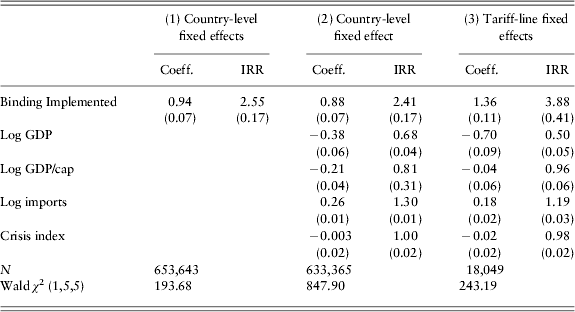
Our dependent variable is a count of trade remedy actions for a given country-product-year.Footnote 24 In our sample, this count ranges from 0 to 15, though naturally most country-product-years show no remedies. Our main variable of interest is a dummy variable indicating whether a tariff line is bound in the year under observation. The results are presented in Table 1, which shows estimates from a bivariate negative binomial panel regression model.
The effect of the binding point on trade remedy petitions

Notes: Robust Standard Errors in parentheses. Estimates are from panel negative binomial model with country-level fixed effects in (1) and (2) and tariff-line fixed effects in (3). Table shows coefficients and corresponding incident-rate ratios for interpretation.
In estimations (1) and (2), we add country-level fixed effects to control for any country-specific variation. Estimation (1) is a highly parsimonious model that includes only the indicator variable for whether a tariff line is bound or not. Estimation (2) adds a number of additional variables that may factor into a country's likelihood of turning to trade remedies. We control for a country's logged GDP and GDP per capita for a given year, which we gather from the World Bank's World Development Indicators. We also control for the logged imports in the relevant tariff line, expecting that higher volumes of imports are more likely to be associated with greater demands for import relief. And, finally, we control for an index of hard economic times, taken from the recent Reinhart and Rogoff data, which ranges from 0 to 6, according to whether a country is experiencing a crisis in six different economic areas.Footnote 25 In our sample, the highest values on this index, suggesting the most widespread crises, correspond to Indonesia in 1998, during the Asian Financial Crisis, and Argentina in 2002, at the height of its own crisis. The broad expectation is that remedy usage should be higher in times of crisis.
In both the bivariate and multivariate estimations, the findings support the expectation that the constraints on tariffs that come from the implementation of bound rates – no matter how high – lead industries to increase their demand for trade remedies. Note that coefficients from count models, such as the negative binomial estimation, cannot be read straight from the table: to aid interpretation, we include the incidence rate ratios (IRRs) for each variable. These stand for the effect of the variable on the rate of occurrence of remedy actions in a year. An IRR of more than 1 means that the variable has a positive effect on the odds of occurrence, while an IRR of less than 1 conveys a negative effect on the rate of occurrence. Looking at estimations (2) and (3) in Table 1, we see that the binding point exerts a strong positive effect on the odds of remedies: countries are about 2.5 times more likely to turn to remedies as soon as a tariff line is bound.
In estimation (3), we account for the possible concern that these findings conceal variation across industries: perhaps some industries are more likely to have tariffs bound sooner, for instance. While, as we mention above, the binding point does not seem to correlate with any characteristic of a tariff line, we can increase confidence in these results by adding tariff country-product fixed effects to our estimation. What this means is that the estimation is now looking at within-tariff-line variation. This has the added benefit, since some variation is required within the country-product, of doing away with all those industries that never saw any trade remedy action. As a result, we are left with a much smaller sample. As might be expected when looking at such a sample of remedy users, the effect of binding is ever stronger now: a given tariff line becomes, on average, almost four times more likely of turning to remedies when the tariff is bound.
We also test for this substitution effect in a different way: by running both models separately for those country-product-years that are bound, and those country-product-years that are not. We then generate predictions in each case, and t-test for the difference between these predictions for each product. In both cases, the difference is significant at 0.001, with highly similar substantive effects. In other words, industries seeking import relief change their strategies once a product is bound by a tariff. Past this binding point, they rely more heavily on trade remedies, since the easiest option – that is, petitioning for a tariff hike – becomes constrained by the bound rate. Finally, when we redefine our dependent variable from a count to an indicator of any trade remedy activity, the results remain unchanged: as soon as a tariff line is bound, the corresponding industry becomes more likely to seek import relief through trade remedies.
3.2 The choice between trade remedies and binding overhang
Having established that trade remedies and binding overhang are used for similar purposes, and with similar frequency, we turn to our main question: how do governments choose between the two in supplying trade protection?
Our sample of 22 WTO members is unchanged. The explanatory variable of interest is the magnitude of the import surge for a given product, in a given country, for a given year. Import surges constitute a good proxy for exigency. The greater the surge, the greater the stress on an import-competing industry. As we note above, the rules for the use of trade remedies reflect this: a frequent requirement for the invocation of remedies is an observable, unforeseen surge of imports. This further sharpens our theoretical expectation, since we claim that the higher the import surge, and thus the greater the legal merit of trade remedies, the less governments will turn to them in favor of the other flexibility mechanism.
Our analysis poses a number of methodological challenges which no single estimation is able to address simultaneously. As a result, we use a combination of approaches. We seek to measure the drivers of a choice through time and across countries between two policy measures, both coded as binary variables, the use of which we suspect to be related, given that they have demonstrably similar policy objectives, as we show above.
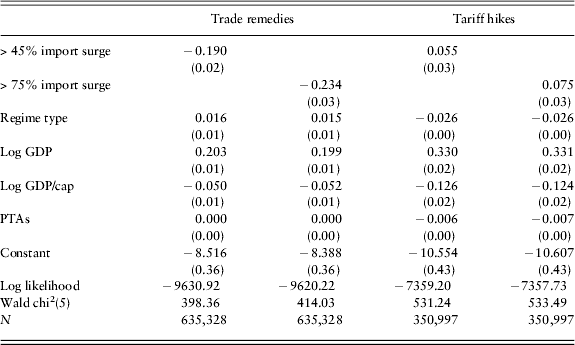
We begin by running a panel probit estimation with random effects, first on use of remedies, and then on binding overhang. Our main variable of interest on the right-hand-side is an indicator for the presence of a large import surge, the definition of which varies across estimations. We expect that countries will prefer to exploit binding overhang when confronted with a larger import surge, since the exigency associated with such an exceptional situation should have the effect of lowering the costs of using it. On the other hand, we expect countries to turn to trade remedies when faced with small import surges, just as the escape clause literature would have it. We vary the threshold that distinguishes small surges from large ones between 45% and 75%. In all estimations, we control for logged GDP, logged GDP per capita, regime type, and the number of PTAs a country is party to in any given year. The results are shown side by side in Table 2.
What explains the usage of trade remedies vs. tariff hikes?

Note: Random effect probit estimation, standard errors in parentheses.
The effect of the magnitude of imports follows our expectations: larger surges lead to less reliance on remedies, and more reliance on tariff hikes through overhang, and the effects in both directions are substantive. Moving past the 75% import surge threshold point, for instance, makes reliance on binding overhang 24.2% more likely, on average, keeping all other variables at their sample mean. Conversely, industries that experience a greater than 75% import surge become 60.4% less likely to see reliance on trade remedies.
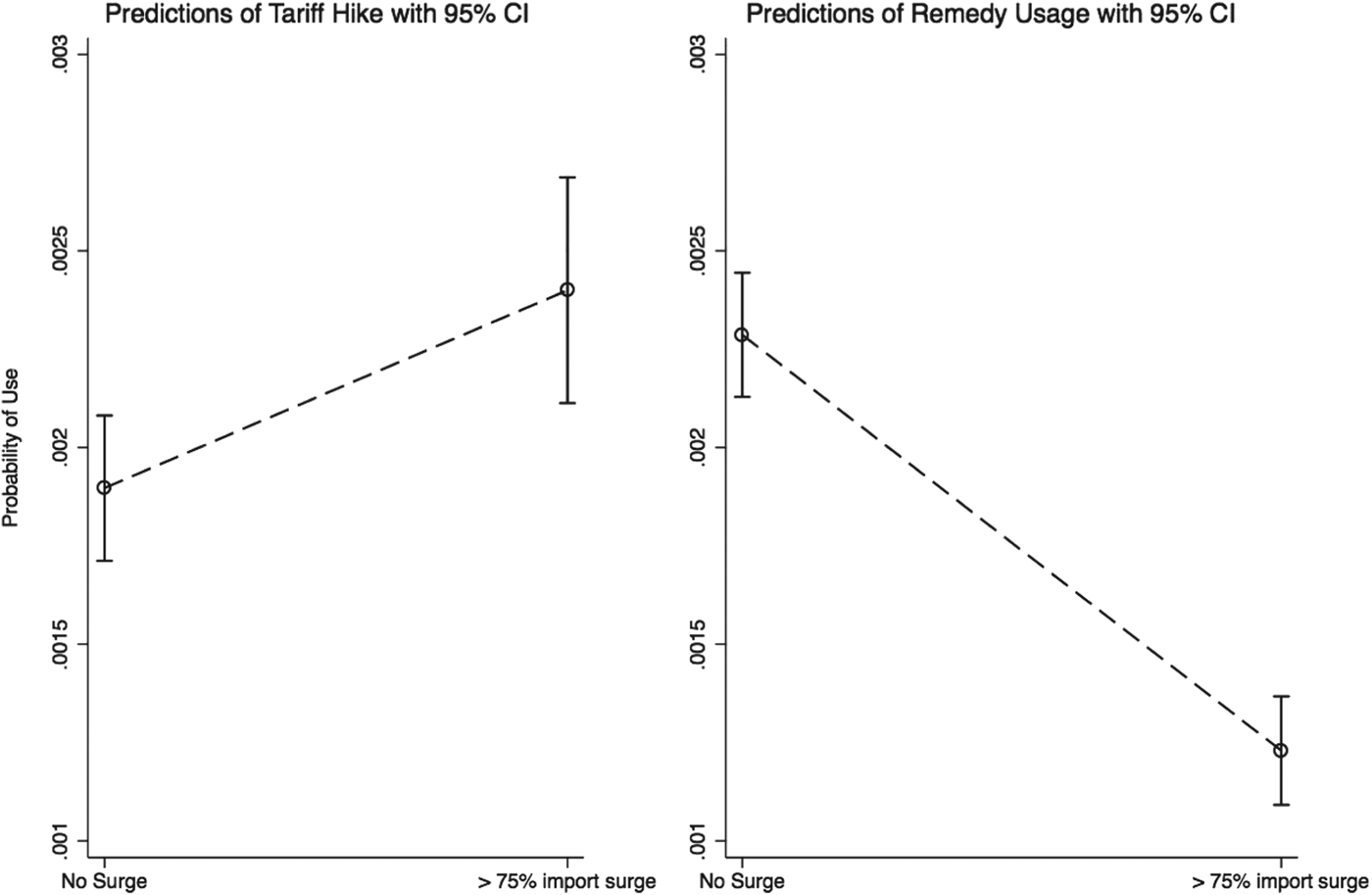
Note that, while not apparent in the results that speak only to relative likelihoods, a majority of import relief actions occur in the wake of positive surges – both in the case of trade remedies and binding overhang. The likelihood of a country turning to trade remedies behaves in exactly the opposite way to binding overhang: it is highest following small surges, and lowest for large import surges. The same pattern holds across all four specifications, regardless of whether the threshold for large import surges is set at 45% or 75%. We present this relationship graphically in Figure 1. There, we show the predicted likelihoods of seeing usage in both instruments, with and without an import surge. The vertical bands correspond to 95% confidence intervals, demonstrating that the change is statistically significant for both instruments, but in opposite directions. The starkest change in odds is with regard to remedies: even as trade remedies are designed as a response to high import surges, they cease to be used when these surges are self-evident.Footnote 26
The effect of a large tariff hike on use of trade remedies vs. tariff hikes

The difference in the samples between the two dependent variables is due to missing data on tariff rates, which is needed to calculate tariff hikes. By comparison, we have a full record of trade remedy usage. To ensure that our results are not due to differences in the sample, we rerun the remedies estimations on the sample used in tariff hike estimations. The results hold perfectly. As another robustness check, we add our domestic Crisis Index variable, the same variable used in our first test above, in Table 1. Interestingly, while it does not have a highly significant effect on the use of remedies, domestic crises are highly positively related to the use of binding overhang. Most importantly, our main findings remain: high import surges see reliance on tariff hikes, smaller import surges see reliance on trade remedies.
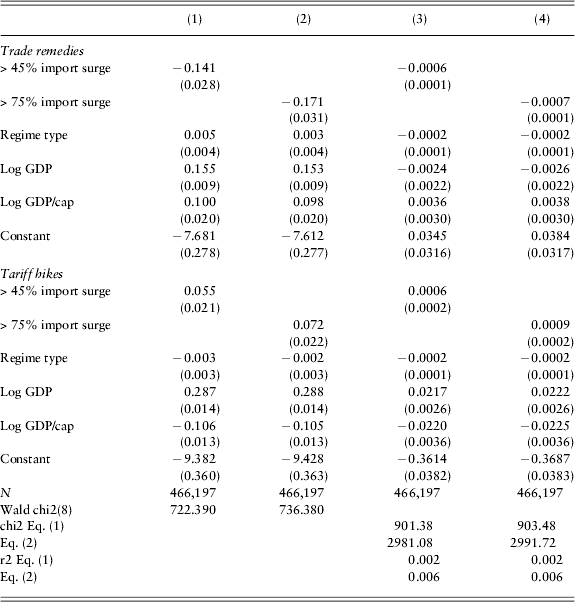
Yet the estimations in Table 2 consider these measures independently. Recall that in Table 1, we showed that trade remedies and binding overhang are used for similar policy objectives, and that if one becomes unavailable, governments immediately start relying on the other. Our panel probit estimation above does not capture this relationship. To do so, we run a seemingly unrelated bivariate probit regression, with standard errors clustered on the country-product. The advantage of maximum-likelihood two-equation probit models is that they account for the fact that the errors for the equations shown in Table 2 are likely to be correlated.
The findings are shown in Table 3. Once again, we find that smaller import surges make trade remedies more likely than larger ones, and that the exact opposite holds for tariff hikes towards the bound rate. In substantive terms, using the more conservative estimation with 45% (Column 1) as the threshold between small and large import surges, and keeping all other variables at their mean sample values, the presence of an import surge greater than 45% decreases the odds of a trade remedy being used by an average of 37.3%, and increases the odds of a tariff hike being relied on by 20%, on average.Footnote 27
The drivers of use of substitutable policy mechanisms

Notes: Columns 1, 2 show seemingly unrelated bivariate probit with robust SEs clustered on country-product in parentheses. Columns 3, 4 show seemingly unrelated regression with country fixed effects and SEs in parentheses.
The chi-squared statistic for both estimations allows us to reject the null hypothesis that both equations are independent: as follows intuition, and our prior findings that both flexibility mechanisms seek similar policy objectives, their use appears related.
Yet, the weakness of both panel probit models and seemingly unrelated bivariate probit regressions is that these models do not allow for fixed effects. To address these weaknesses, we re-estimate the first two estimations of Table 3 with a linear model, this time adding country-level fixed effects, so that we are controlling for any country-specific variation. The resulting estimates are shown in columns 3 and 4 of Table 3. Even with a linear estimation and fixed country effects, the findings support the theory, though the coefficients here are smaller, since we are looking at within-country variation: higher import surges are associated with less reliance on trade remedies, and more reliance on tariff hikes.
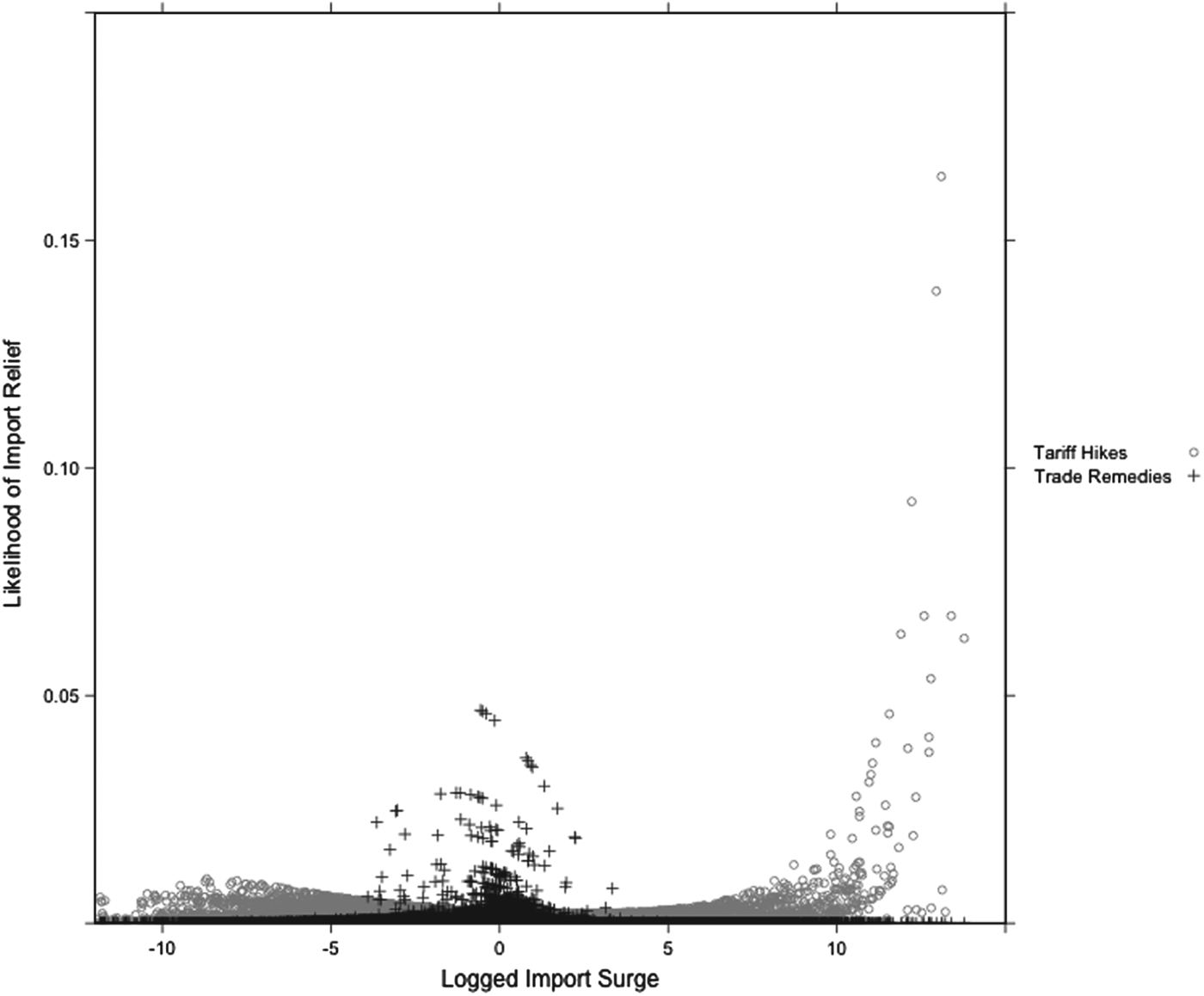
Finally, the use of cut-off points (at 45% and 75%) aids interpretation, but it does not offer a continuous view of the likelihood of turning to one mechanism or the other across the range of import surges. These are necessarily arbitrary thresholds. To offer a more general sense of the impact of import surges on the use of flexibility, we define a basis of cubic splines in the value of import change from the prior year, and regress these on the likelihood of both our policy mechanisms. The result is graphically represented in Figure 2, where the x-axis shows logged values of import surges, and the y-axis shows the likelihood of seeing reliance on one mechanism or the other. The scatter plot thus shows results for our entire sample, and largely follows from our results: the highest likelihood of trade remedies is found at low values of import surges. By comparison, the highest likelihood of seeing reliance on tariff hikes is found at higher values of import surges.
The relationship between import surges and remedies vs. tariff hikes

In sum, our results indicate that (i) trade remedies and binding overhang serve similar protectionist aims; (ii) the frequency with which governments rely on them is remarkably similar; and (iii) when both are available, they are invoked under different circumstances: trade remedies when import surges are small, and binding overhang when they are large.
3.4 The cost of misusing binding overhang
We have argued that the problem with binding overhang is that it is too easy to use. Unless it is employed in the wake of a large import surge, it is likely to lead trade partners to doubt the government's commitment to free trade more generally. This goes to the heart of our argument: where governments would seem to have wide discretion in acting on demands for protection, raising an applied tariff closer to the bound rate is likely to be costly. We turn now to empirically investigate this claim.
The typical way of looking at such costs is to examine trade flows for the product under observation. In this way, one can demonstrate that the mere existence of a gap between applied tariffs and bound rates acts as a tax on trade, since it leads to uncertainty: high-overhang products, all things equal, display a lower trade volume. But this approach is inadequate for the present case. What renders the use of binding overhang ‘justified’ or not in our model is precisely the presence of a large import surge. Since we might expect some reversion to the mean following an unexpected increase in imports, we would face the risk of endogeneity: an import surge, itself, could be leading to a subsequent drop in imports, leaving us without the means necessary to assess whether this might be due to the unwarranted use of binding overhang.
Our solution is to look at similar products, which we obtain by taking adjacent products in the harmonized system classification. Our reasoning is that if a country uses binding overhang by raising applied tariffs on saffron spice in the absence of an import surge, the resulting fears of trading partners are likely to be felt most acutely for similar products like turmeric, ginger, and curry. Traders and investors will reason that whatever pushed up the tariff on saffron spice is most likely to also affect these other similar products. These are the products that saffron is grouped together with one level up in the HS classification, at the 4-digit rather than the 6-digit HS level. We expect that the increased uncertainty trade partners would face over tariffs for these similar products would lead to a fall in trade for those products. Note that, in the absence of such uncertainty, an increased tariff on a similar product could actually have a positive impact on trade by increasing demand for these products, as those sharing a 4-digit HS code are often quasi-substitutes.
Our estimation takes place across three periods. First, we either observe a surge of imports or not. Second, tariffs are either raised or not on a given product. And, third, this tariff hike either affects imports of similar products or not. We then use what amounts to a difference-in-difference model to ask whether the use of binding overhang, in the absence of an import surge, leads to a greater fall in imports for similar products than when it follows a large import surge. Our dependent variable is thus the average change in imports for related products over t–(t–1).
For ease of presentation, we run the same estimation, looking at the impact of using overhang, on two different subsets of the data. One is made up of cases where imports surged for the product under consideration by more than 75% (corresponding to a larger import surge), while the other is made up of cases where there was no import surge over the same period.
To ensure that we are isolating the effect of a given product's tariff hike on similar products, we control for changes in applied tariffs for those similar products. We are also wary that import surges may not be independent across similar products. If they are correlated, then we may see a reversion after to the mean for the similar products, following import surges. A first sign that this is unlikely to be an issue is that the bivariate correlation between changes in imports of the product of interest and similar products is only 0.06. So, in general, changes in trade flows do not seem to be highly related between similar products. We nonetheless control for the possibility of such correlation by including a control variable that corresponds to the average change in imports between (t–2) and (t–1) for the products on the left-hand side. This amounts to a lagged dependent variable. We also include country fixed effects, and cluster robust standard errors on the 4-digit product. The estimation looks as follows:
 $$\eqalign{ \Delta \,Similar\,{\rm} Products\,{\rm} Imports_{i,j,(t - (t - 1))} =\, &\beta _0 + \beta _1 \Delta \,Tariff_{i,j,((t - 2) - (t - 3)} \cr &+ \beta _2 \Delta \,Similar{\rm} \,Products \ Tariff_{i,j,((t - 2) - (t - 3)} \cr &+ \Delta \,Similar\,{\rm} Products\,{\rm} Imports_{i,j,((t - 1) - (t - 2)} \cr &+ \mu _{i,j,t}} $$
for country i and product j, at year t.
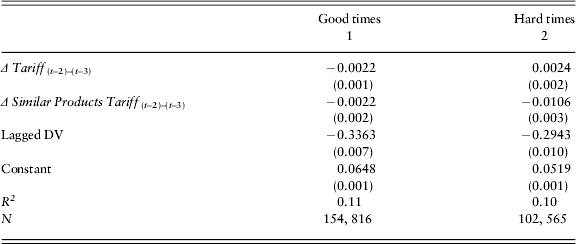
The results are found in Table 4. The first column shows the estimation for the subset of the use of binding overhang in the absence of an import surge, while the second shows the same estimation results in the presence of a large import surge.
Cost on trade of using binding overhang in hard times vs. normal times

Notes: Fixed effects panel estimation with robust standard errors in parentheses clustered on product. Hard times denote a surge of imports(t–2)–(t–3) >75%. Good times denote the absence of an import surge.
The findings are striking, and offer strong support for our argument about the forces that are driving the choice among flexibility mechanisms. When the use of binding overhang is not justified by a large import surge, it leads to a sharp, statistically significant reduction in trade flows of similar goods. Given the log linear functional form of the estimation, we can interpret the coefficients as point elasticities: in this case, a 15% increase in a given tariff, if unjustified by hard times, increases the drop in imports of its neighboring products by 3.3%. Yet as the second column makes clear, when a tariff hike is justified by a large import surge, use of this flexibility mechanism does not negatively impact the trade flows of similar products in the least. This endorses our argument that binding overhang is a viable alternative to trade remedies when import surges are large, undermining the incentive to invest in predictability.
As follows intuition, tariff hikes of similar products lead to decreases of imports of those same products. Comparisons between the effects of the product under examination and its adjacent products are problematic, since the sample is defined by the presence or absence of import surges in the product under examination. Yet what is important for our purpose is that, controlling for tariff changes in adjacent products, the use of binding overhang when it is not justified by a large import surge results in a significant drop in similar products’ imports, even when controlling for tariff changes in those neighboring products. In sum, Table 4 offers a glimpse of the differential reaction of trade partners to the use of the same mechanism, depending on context.
4. Conclusion
The escape clause literature has long sung the praises of trade remedies without giving much attention to binding overhang, an alternative means of supplying protectionism which is used just as frequently by emerging economies. There is no doubt that antidumping, countervail, and safeguard actions give governments the flexibility to deliver protectionism while reassuring trade partners that their defection from free trade is temporary. We concur with this logic, but insist that it holds across a more narrow range of circumstances than is widely suggested. Investing in the predictability of trade remedies makes sense when confronted by smaller import surges, since trade partners will be looking to interpret this discretionary act of protectionism. By contrast, such an investment is doubtful to be cost-effective where import surges are larger, since under these conditions, governments have little choice but to act, and the ease of using binding overhang is likely to be understood against the backdrop of these exigent circumstances. Our results strongly bear out this proposition, suggesting that, in designing trade institutions, the challenge of attracting and retaining members is likely to include providing a fuller menu of flexibility options than is typically on offer in the escape clause literature.
Our conclusions are reassuring in two ways. First, while binding overhang is easy to use, it is used less often than some might fear. The emerging economies in our sample value the predictability of trade remedies when import surges are smaller, and turn only to binding overhang when facing observably dire economic circumstances. And with good reason: they pay dearly, in terms of trade in related products, when hiking tariffs in the face of smaller import surges.
Second, while showing that the escape clause literature has less reach than is often argued, we shed new light on its basic intuition: the injury test, which is the investment in predictability, is taken seriously. This result should embolden those who see trade remedies, as escape clauses, being central to the design of trade institutions.
Taken together, these points serve to make our case: governments will use trade remedies where import surges are big enough that injury can be proven, but low enough that governments have incentive to prove it.