


I
Keynes's investment activity in various markets has recently attracted the attention of scholars, including both historians of economic thought and financial historians. A growing literature has appeared in the last few years, mainly based on archival material, reconstructing and analysing his investments in currencies (Accominotti and Chambers Reference Accominotti and Chambers2016), commodities (Fantacci, Marcuzzo and Sanfilippo Reference Fantacci, Marcuzzo and Sanfilippo2010; Cristiano and Naldi Reference Cristiano and Naldi2014; Marcuzzo and Sanfilippo Reference Marcuzzo and Sanfilippo2016; Foresti and Sanfilippo Reference Foresti and Sanfilippo2017; Marcuzzo and Rosselli Reference Marcuzzo, Rosselli, Kregel, Corsi and D'Ippoliti2018; Marcuzzo and Sanfilippo Reference Marcuzzo and Sanfilippo2019) and stocks (Holder and Kent Reference Holder and Kent2011; Chambers and Dimson Reference Chambers and Dimson2013; Woods Reference Woods2013; Chambers, Dimson and Foo Reference Chambers, Dimson, Foo, Brown and Hoxby2015a, Reference Chambers, Dimson and Foo2015b; Marcuzzo and Sanfilippo Reference Marcuzzo and Sanfilippo2020), as well as his behaviour as an investor in general (Millmow Reference Millmow2012; Wasik Reference Wasik2013; Cristiano and Marcuzzo Reference Cristiano and Marcuzzo2018; Cristiano Reference Cristiano, Rosselli, Naldi and Sanfilippo2019; Sicsù Reference Sicsù2020).
In some cases, scholars have focused mainly on reconstructing Keynes's trading activity in specific markets as an end in itself, contributing to filling out the picture of this extraordinary economist. The surprisingly wide range of his investment activity that emerges from these analyses, representing only partial accounts of his entire portfolio and its evolution over time, as well as the continuity of his involvement and interest in the actual markets, is further confirmation of the exceptional capacity Keynes had to combine theoretical and professional achievements and helps us towards a better assessment of the fundamental role this aspect played in his life.
In other cases, researchers have sought to detect the possible reciprocal influences between his investment practice and some fundamental theoretical aspects of his system of thought, such as the theory of commodity futures markets, the theory of financial markets, and the theory of choice in a context of radical uncertainty. In yet other cases, their analyses were mainly driven by the curiosity to assess his performance and strategies as a trader, and discover whether one of the greatest economists of all time was good or bad as an investor, or what type of investor he was. All these studies shared the ambition of contributing to a better understanding of the economist who is widely acknowledged as one of the best interpreters of the actual working of a monetary economy in general, and financial markets in particular.
One of the subfields of Keynes's extensive investment practice which has so far come in for rather less investigation lies in his investment activity on the US stock market. Keynes invested in US securities on his own behalf and also for King's College, Cambridge, from the beginning of the 1930s up to the end of his life, but until very recent times the only data and general source of information we had on Keynes's American investments were those contained in tables provided by Moggridge in his Introduction to vol. xii of the Collected Writings (Moggridge Reference Moggridge, Johnson and Moggridge1983, pp. 12–14, tables 4–6).Footnote 1 This sort of neglect by the specialised literature appeared all the more surprising considering at least three circumstances: (1) the years in which Keynes invested most in the US stock market (that is from 1933 to 1939, when the US holdings covered on average 30 per cent of his own entire securities portfolio) coincide with the aftermath of the Great Depression and Roosevelt's administration; (2) in chapter 12 of The General Theory, the celebrated chapter containing the metaphor of the ‘beauty contest’ and the concept of ‘animal spirits’, there are also many direct references to Wall Street and the specific characteristics of the US stock market; (3) and, finally, chapter 12, as emerges from analysis of the proofs of The General Theory and reconstruction provided, for example, by Moggridge (Reference Moggridge1973) and Hirai (Reference Hirai2008), was probably written in 1934, when his holdings of US securities (both in his personal and the King's portfolios) began to reach significant dimensions in value (about $500,000 in all, equally distributed between the two portfolios).
Recently efforts have been made to investigate more closely this fundamental aspect of the full picture of Keynes as investor in financial markets. Chambers and Kabiri (Reference Chambers and Kabiri2016) provide a highly detailed and insightful analysis of the strategies, performance and behaviour Keynes pursued when he invested on Wall Street on behalf of King's College, while Cristiano, Marcuzzo and Sanfilippo (Reference Cristiano, Marcuzzo and Sanfilippo2018) provide a reconstruction of Keynes's personal investments in the same market, in relation to his views on the US economy in general, and Roosevelt's policy and the opportunities offered by Wall Street, in particular. These two works, both dealing with Keynes's trading on the US stock market, rely on two different databases: the King's College Papers for Chambers and Kabiri's analysis and the Keynes PapersFootnote 2 for Cristiano, Marcuzzo and Sanfilippo's investigation. The data, in the case of Keynes's personal investments, are not regularly recorded and sometimes very difficult to decipher, severely limiting the possibility to apply standard portfolio analysis (for more details see the Appendix). Nevertheless, both these studies, while using different methodologies, contribute to the reconstruction of Keynes's investment activity in a complex and peculiar international stock market, as indeed Wall Street was during the 1930s and the 1940s, but only if considered together do they enable a full appreciation of Keynes as a trader in this market. In the specialised literature on Keynes's investment behaviour in the stock markets, in fact, more often than not Keynes as the individual investor and Keynes as the manager of institutions’ portfolios are treated as perfectly coincident in terms of investment philosophy and strategies. More specifically, all the results reached in the reconstruction of his choices as an institutional investor are considered as representative of his behaviour in general (see, e.g., Chambers and Dimson Reference Chambers and Dimson2013; Chambers, Dimson and Foo Reference Chambers, Dimson, Foo, Brown and Hoxby2015a, Reference Chambers, Dimson and Foo2015b; Chambers and Kabiri Reference Chambers and Kabiri2016) and the investigations into Keynes's personal portfolio are viewed as more or less redundant. On the other hand, this study starts from the conviction that Keynes's conduct in the two capacities calls for distinct analysis and needs to be compared, since there are some significant differences, not so much in the general principles of investment he followed in his activity in financial markets, but in the specific trading decisions he took and in the different characteristics of the two portfolios – elements that have so far been somewhat overlooked. These differences, if duly appreciated, can add to our previous knowledge of Keynes as an investor on Wall Street or, at any rate, fill out the picture. This is exactly what this article aims to show.Footnote 3 Furthermore, in the investigation pursued here we work on the basis of the consideration that investing on his own account in a highly speculative stock market like Wall Street was at the time was not exactly the same as investing in the same market on behalf of a time-honoured institution like King's College. We may, therefore, reasonably assume that Keynes made some distinction when taking decisions for himself or as manager of his College portfolio.
In the present article, therefore, we compare in detail Keynes's investment choices and strategies in the US stock market when he traded for himself and for King's (Section II). There are similarities, as might be expected, but also significant differences, well worth investigating. As far as the differences are concerned, a particularly striking case is to be seen in his investment choices when, after a period of bull market in 1936, he had to face the spring 1937 burst of the speculative bubble and subsequent recession. Detailed analysis of his behaviour reveals that this event took him by surprise but his reaction differed with regard to his personal investments and the King's investments (Section III). The prevalence of a ‘buy and hold’ strategy, which, according to Chambers and Kabiri (Reference Chambers and Kabiri2016), characterised his behaviour in general when investing for King's, was not always the typical choice when the investments were undertaken on his own account. Finally, a possible interpretation of this difference is suggested (Section IV), together with some considerations on Keynes's investment philosophy and behaviour when investing for himself and on behalf of his College, which should help to enhance our knowledge of Keynes as a trader on Wall Street.
II
Comparing in detail Keynes's investment choices and strategies in the US stock market when he traded for himself and for King's we find many similarities but also some significant differences.
The similarities more closely regard his general investment philosophy and approach and the timeframe of both investment activities, which covers the period from the beginning of 1930s to the end of World War II.
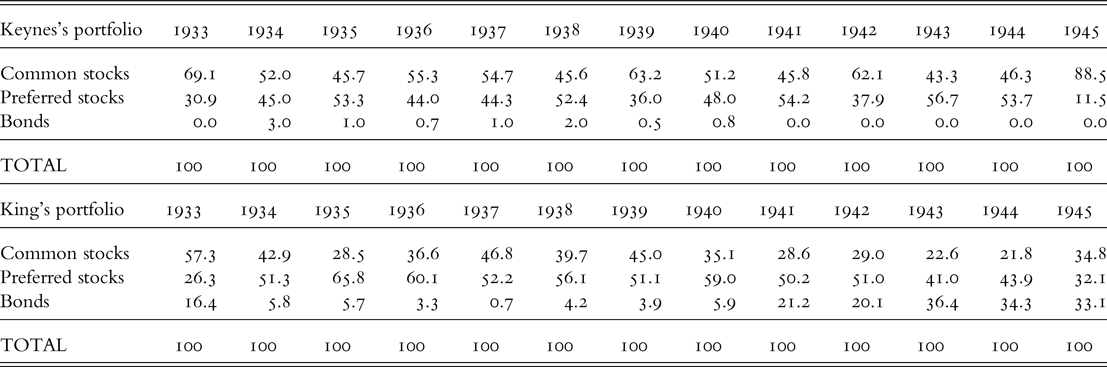
As for the types of securities, in both cases we observe, to begin with, a definite preference shown by Keynes for equities (common and preferred stocks) over bonds. According to the figures provided by Chambers and Kabiri (Reference Chambers and Kabiri2016, p. 308, table 1), the latter represented, especially for the period 1934–9, a very small quota of the King's US portfolio (less than 4 per cent on average) in terms of value and an even smaller quota of his own US portfolio for the same period (see Table 5 below). Things partially changed, at least for the King's US portfolio, during the war, when the quota of bonds rose to about 25 per cent on average for the period 1940–5, while his own portfolio was totally devoid of dollar bonds from 1941 to 1945.
Secondly, both analyses confirm that Keynes started his regular investment activity on the US stock market for King's and on his own account in the same period, after the Great Crash, when the stock market was at a low point, showing a contrarian approach. The only difference is that while for his personal investments regular trading in dollar securities began between the end of 1931 and the beginning of 1932 (see Cristiano, Marcuzzo and Sanfilippo Reference Cristiano, Marcuzzo and Sanfilippo2018, p. 22), for King's Keynes started his forays in the US stock market a bit earlier, just a few months before and after the Wall Street collapse, and more precisely in April 1929 and September 1930 (Chambers and Kabiri Reference Chambers and Kabiri2016, p. 303).Footnote 4
A point worth making here is that in March 1930 he had publiclyFootnote 5 rebutted the pessimistic view of his business partner Oswald Falk on the future of the British industrial sector and also his suggestion in favour of redirecting investments from British to US sharesFootnote 6 (see Cristiano, Marcuzzo and Sanfilippo Reference Cristiano, Marcuzzo and Sanfilippo2018, p. 14). Falk saw the Wall Street market in the aftermath of the crisis as offering a good opportunity for British investors to buy cheap and gain from future appreciation. Keynes took a gloomy view of the US economy at the time – an impression which was subsequently reinforced during his trip to the United States in May and June 1931, when he was able to perceive the extent of the economic crisis more directly. These opinions could partially explain why his personal portfolio shows no trace of any dealing in US securities in this period, at least up to 9 November 1931 (KP SE/11/5/26). On the other hand, on the evidence of the data provided by Chambers and Kabiri (Reference Chambers and Kabiri2016, p. 303, table 1), between 1930 and 1931 the King's US holdings grew from a market value of $9,900 to $17,600, in a context in which the US stock price indexes were still falling, which suggests that when investing on behalf of King's, even though on quite a small scale, Keynes was more inclined to try Wall Street, taking advantage of low prices.
As for the subsequent evolution of the two portfolios over time, both studies confirm that 1934 (one year after Roosevelt came to power) represented the watershed in Keynes's US holdings, since in both cases they reached a significant dimension, more than $200,000. They then peaked in 1936 and remained quite substantial up to the mid 1940s (with some appreciable differences between the two portfolios in 1937, as we shall see).
Both studies testify to Keynes's extreme care in collecting all the relevant information on the companies and shares he invested in, anticipating what came to be known as the ‘fundamental security analysis’ (Chambers and Kabiri Reference Chambers and Kabiri2016, p. 306; Cristiano, Marcuzzo and Sanfilippo Reference Cristiano, Marcuzzo and Sanfilippo2018, p. 18). In fact, in his selection of stocks he followed, for both King's and himself, a value approach,Footnote 7 aiming at choosing, in particular, market-undervalued shares.
Finally, both studies confirm the importance of the ‘core holdings approach’ as a general investment philosophy followed by Keynes also in the case of his US dealings, that is the strategy of selecting few assets mainly for ‘keeping’.
In an oft-quoted passage in a letter to Francis Scott on 15 August 1934, Keynes presented his golden rule for investment: ‘As time goes on, I get more and more convinced that the right method in investment is to put fairly large sums into enterprises which one thinks one knows something about and in the management of which one thoroughly believes’ (CWK xii, p. 57).
Here Keynes is referring to companies and selection of them in an investor's portfolio. Keynes makes the motivations that should guide the choice quite clear and, interestingly enough, the two reasons he gives are both grounded on factors of a mainly subjective nature. One relates to the quantity and quality of information that the investor believes he possesses on these companies (‘the degree of confidence’ attached to his knowledge); the other to the trust that the investor has in the management of the different companies.
Keynes used to define this small set of companies (and securities) he was keen on as his ‘pets’ (CWK xii, p. 78). A few years later, he made clearer how many companies he knew ‘something about’ and how many there were in whose management he ‘thoroughly believed’:
I myself follow very closely, or think I have some knowledge, of upwards of perhaps 200 investments … Now out of the 200 which one tries to follow more or less, there are probably less than 50 in all classes about which, at any given time, one feels really enthusiastic. (Memorandum for the Provincial Insurance Company, 7 March 1938, in CWK xii, p. 99)Footnote 8
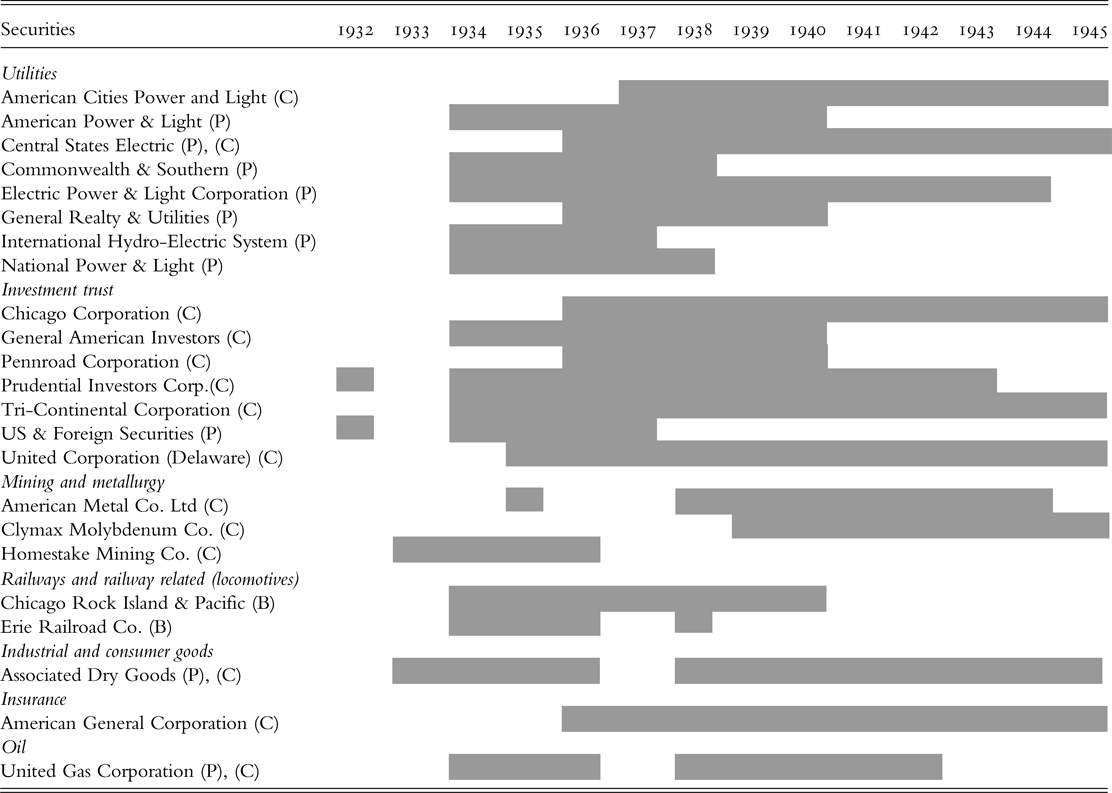
In their analysis of Keynes's core holdings in his personal US portfolio, Cristiano, Marcuzzo and Sanfilippo (Reference Cristiano, Marcuzzo and Sanfilippo2018) concentrated mainly on the selection of companies and the reasons behind Keynes's choice. They thus identified Keynes's American ‘pets’ as a subset of 23 companies whose shares he held for at least four years over the period 1932–45 (see Cristiano, Marcuzzo and Sanfilippo Reference Cristiano, Marcuzzo and Sanfilippo2018, p. 34, table 4), and which represented only a quarter of the total number of companies traded by him in the period considered. On average, however, these holdings accounted for about three-quarters of the value of his personal portfolio over this period. The authors also offered some tentative explanations of Keynes's strategy for selecting companies, which had to do with their solidity or performance, his confidence in their management, the quantity of information he possessed (directly, or through his personal connections) and, finally, his grounded opinions on the future development of a particular sector. Chambers and Kabiri (Reference Chambers and Kabiri2016, pp. 320–1, table 2), on the other hand, focused more specifically on the stock-picking strategy adopted by Keynes in his management of the King's portfolio. They identified the King's core US holdings according to the following, more quantitative criterion as ‘any security held for a period of at least 5 years with a weighting greater than 1 per cent of the total value of his US stocks’. They thus arrived at the number of 20 core stocks which accounted ‘for an average of two-thirds of his US portfolio across the whole period from 1931 to 1946’ (Chambers and Kabiri Reference Chambers and Kabiri2016, p. 319). Now, for more direct comparability of the two subsets (the core holdings of US securities in the King's portfolio and the core holdings of Keynes's personal US investment) we list in Table 1 the US securities (26 in all) that Keynes kept longest. The criterion we have adopted here for Keynes's portfolio is slightly less stringent than that followed by Chambers and Kabiri (Reference Chambers and Kabiri2016) for King's, since we have listed in Table 1 all the securities held for at least four (rather than five) consecutive years, regardless of their weight in Keynes's own US portfolio.
List of US ‘pet’ securities held in Keynes's own portfolio, 1932–45, as of 31 December each year

Legend: P = preferred stock; C = common stock; B = bond
Source: Author's elaboration from Keynes's own end-of-year evaluations (KP, SE/11/5-7).
From Table 1 it emerges that, as far as his personal portfolio was concerned, Keynes had a net preference, among the different sectors, for securities of companies belonging to investment trusts (mainly common shares, 6 out of 7 securities in this sector) and public utilities (mainly preferred shares, 7 out of 8 securities in this sector).
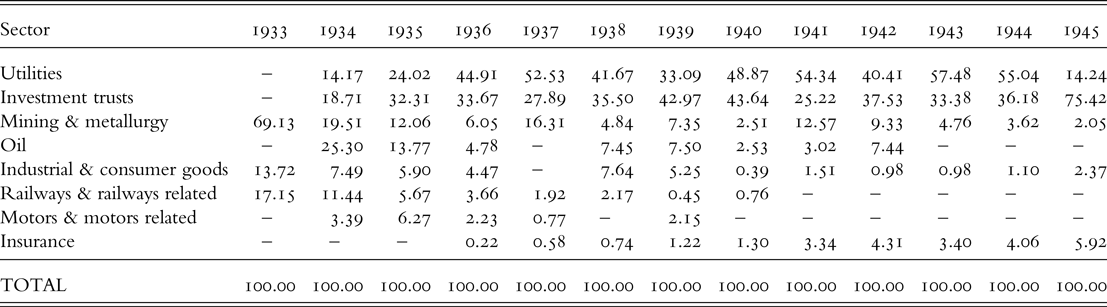
The weight of his holdings in these two sectors taken together represented about 75 per cent of his US portfolio in the mid 1930s and an even larger share during the 1940s, as shown in Table 2.
Composition of Keynes's own US securities portfolio (market value, USD) by sector (as percentage of the total for each year), 1933–45

Source: Author's calculations from Keynes's end-of-year evaluations (KP, SE/11/5-7).
The preference for these two sectors is also confirmed by the analysis by Chambers and Kabiri (Reference Chambers and Kabiri2016, pp. 303 and 320, table 2), as far as the King's portfolio was concerned, although to a lesser extent than in the case of his personal portfolio: in fact, the shares of these two sectors taken together represented about 50 per cent of the King's US securities portfolio during the 1930s and only about 40 per cent during the 1940s. On the other hand, industrials had a far greater share in the King's portfolio than in Keynes's own.Footnote 9
As for the specific items selected, we have 12 securities appearing as core holdings in the King's portfolio that also appear as core holdings in Keynes's personal portfolio. These securities are: General American Investors, Prudential Investors, Tri-Continental, Climax Molybdenum, Homestake, United Corp. (all common); and US and Foreign Securities, Associated Dry Goods, American Cities Power and Light, Commonwealth and Southern, Electric Power and Light, United Gas Corp. (almost all preferred).
This substantial overlapping in the selection of company assets is not surprising, and simply testifies that when Keynes believed in a particular investment, he decided to buy (and hold) it whether acting as a personal investor or as manager of the King's portfolio.
While Keynes's activity on the US stock market on his own account and on behalf of King's shows - as we have seen – substantial similarities as far as the selection of stocks is concerned, in the choice of the sectors of investment, and indeed in his investment philosophy in general – grounded on the choice of securities of few companies he was keen on (‘pets’), which he bought fundamentally for ‘keeping’ – some significant differences in Keynes's management of the two portfolios are to be found, and in particular in the following aspects: (1) the relative dimension of the two portfolio holdings and its evolution over time; (2) the degree of diversification in terms of number of securities held; (3) the allocation between common and preferred stocks; and finally (4) his different behaviour in the face of the specific event of spring 1937, namely collapse of the US stock market.
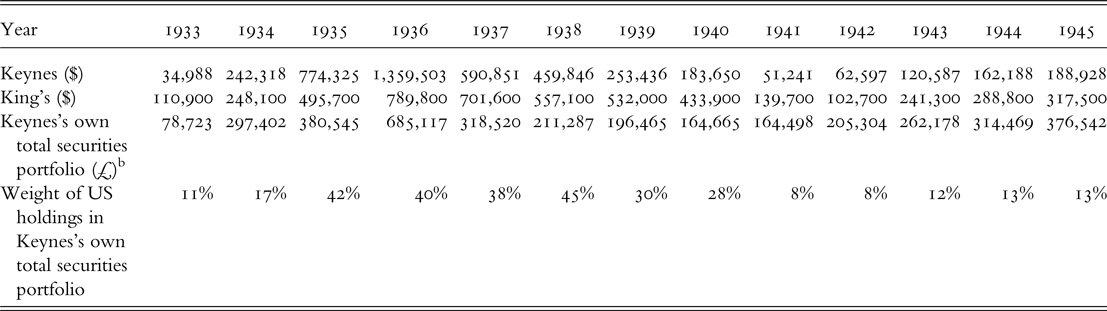
As far as the relative size of holdings is concerned, comparison of the two portfolios (not taking into account the time-lag of a few months in the date of valuation, the end of August of each year for the King's portfolio, and the end of December for his personal portfolio) reveals that while in 1933 the King's US portfolio was appreciably higher (about three times greater) than his own, in 1934 the holdings – which increased substantially in both cases – reached more or less the same dimensions (as shown in Table 3).
Keynes's own and King's College US securities holdings (market value), 1933–45a

aAs of 31 December of each year for Keynes's own, and 31 August for King's.
bThis includes both sterling and dollar denominated securities. To compute the value of the total portfolio in securities by year the value of the dollar securities has been converted in British pounds by using the annual US dollar/British sterling exchange rates (Source: Board of Governors of the Federal Reserve System 1943, Banking and Monetary Statistics, 1914–1941, p. 681) and added to the value of sterling securities.
Source: Author's calculations from Keynes's end-of-year evaluations (KP, SE/11/5-7) for Keynes's portfolio and from Chambers and Kabiri Reference Chambers and Kabiri2016: p. 308, table 1, for the King's portfolio.
In fact, from 1933 to 1934 both portfolios increased in value, but while that of King's more than doubled, Keynes's own portfolio grew almost seven times greater.
The relative scale of the two portfolios between 1933 and 1934 could be further confirmation of Keynes's strong (personal) inclination throughout 1934 – when Roosevelt started to implement his policy of public spending – to invest in the US, and could provide evidence of the increasing ‘degree of confidence’ in his conviction.Footnote 10 As shown in Table 3 (last row), the weight of his US holdings grew from 11 per cent to 17 per cent of his total personal portfolio in securities from the end of 1933 to the end of 1934, reaching 42 per cent by the end of 1935. The data also reveal that the US holdings represented on average about 30 per cent of his own securities portfolio during the 1930s and a lesser quota (about 13 per cent on average) during the 1940s.Footnote 11
Unfortunately, as far as King's is concerned, Chambers and Kabiri (Reference Chambers and Kabiri2016) do not provide detailed data on the value of the total securities portfolio, nor indeed on the exact share of US securities by year, but they do offer the information that ‘the allocation to US stocks within the Discretionary Fund averaged 33 per cent through the 1930s, reaching a maximum of 50 per cent in 1939’ (p. 305).Footnote 12
The increasing involvement in the US stock market starting around 1934 may also attest that Keynes wanted to exploit as much as possible the opportunities offered by the dollar devaluation that occurred in that year. It may also be worth recalling that, as far as his personal investment is concerned, it was precisely from 1933 to 1934 that the scale of his loans greatly increased, rising from a value of £78,000 to about £165,000 (Moggridge Reference Moggridge, Johnson and Moggridge1983, CWK xii, p. 11, table 3), showing that at the time Keynes was particularly keen on stepping up his activity on Wall Street, without necessarily contracting his domestic investment.Footnote 13
Table 3 also shows that in the following two years, 1935 and 1936, this inclination, as far as his personal investments are concerned, persisted and the scale of his own US securities portfolio became much larger than that of King's.Footnote 14 The situation changed in 1937, when Keynes's own portfolio became smaller than that of King's, and remained so also in the following years.
Looking more closely into the trend of the exchange rate over the period considered, the pound sterling went through depreciation and instability immediately after the abandonment of the gold standard in September 1931 and up to the end of 1932, when parity stood at $3.5. Then, after the US suspension of gold convertibility in 1933 and consequent dollar devaluation in 1934, the dollar/sterling exchange rate reached the peak of $5=£1, and remained substantially stable around this parity until 1937 (Board of Governors of the Federal Reserve System 1943, p. 681). Afterwards, the dollar went through a slight appreciation up to March 1940, when the British government took the decision to peg the value of the pound to the dollar, at $4.03, where it stayed up to 1950.
As for the level of diversification in terms of number of securities held,Footnote 15 again on comparing the two portfolios we observe that the King's portfolio was more diversified than his personal portfolio. In 1938–9, according to the data provided by Chambers and Kabiri (Reference Chambers and Kabiri2016, p. 308, table 1), the number of US securities held in the King's portfolio reached the highest figures for the whole period considered – in both years over 40 securities – while in the case of Keynes's own portfolio the number fell below 30 (see Table 4).
Number of securities held in Keynes's and King's College US securities portfolios, 1933–45

Source: Author's calculations from Keynes's end-of-year evaluations (KP, SE/11/5-7) for Keynes's portfolio; from Chambers and Kabiri Reference Chambers and Kabiri2016: p. 308, table 1, for the King's portfolio.
From Table 4 it emerges that, except for the years 1934–7 in which the number of securities held was almost the same in the two portfolios (even though, as we have seen, the value of Keynes's holdings was much greater than King's, especially in the years 1935 and 1936), the King's portfolio was invested in a greater number of securities (from two to three times) than Keynes's for most of the years. The higher concentration on very few selected assets of Keynes's own US securities portfolio can be further appreciated in terms of value by considering that on average about 55 per cent of his holdings were concentrated in fewer than five assets during the 1930s (while the proportion drops to 46 per cent for the King's portfolio), and about 75 per cent on average in fewer than four assets during the 1940s (while the proportion drops to 40 per cent for the King's portfolio).Footnote 16
A tentative explanation for this difference may have to do with the existence of some kind of constraints in the case of King's that were not at work in the case of his own investments, and that led Keynes to be more wary as far as the degree of concentration was concerned. The constraints we refer to here are not of an external kind – Keynes ‘enjoyed full investment discretion’ in the management of the King's Discretionary PortfolioFootnote 17 (Chambers, Dimson and Foo Reference Chambers, Dimson, Foo, Brown and Hoxby2015a, pp. 130, 134) – but internal, reflecting a sort of feeling of self-restraint, due to his own sense of responsibility when dealing with the King's funds.
Moreover, while in both cases his serious involvement in Wall Street dates back to the beginning of the 1930s, with his holdings increasing in 1934, 1935 and 1936, and declining in the 1940s, in 1937 and the following two years 1938–9 we observe another striking difference in the two portfolios. His personal portfolio was dramatically reduced in 1937 and continued so in 1938–9, while the King's portfolio showed only a slight reduction. This confirms Chambers and Kabiri's findings (Reference Chambers and Kabiri2016) that, as far as the King's portfolio is concerned, Keynes fundamentally held on to his assets during the 1937 collapse (see also Section III below).
Some possible interpretations of this difference come to mind.
First of all, we might consider the greater weight of common stocksFootnote 18 in Keynes's portfolio than in King's (see Table 5). As can be seen, for all the years from 1933 to 1945 the weight of common stocks in his personal portfolio was greater than in the King's portfolio; moreover, if we compare the relative shares of common and preferred stocks in Keynes's own and the King's portfolios, we observe that the distribution is, in most of the cases, undoubtedly in favour of common stocks for Keynes's holdings while the opposite is true for the King's holdings (more precisely, over the period 1933–45 on average 55 per cent was the weight of common stocks against 43 per cent of preferred in Keynes's portfolio, while 49 per cent was the share of preferred against 36 per cent of common in the case of King's).
Distribution of Keynes's own and King's College US securities portfolios (market value, USD) by instrument (as percentage of the total for each year), 1933–45

Source: Author's calculations from Keynes's end-of-year evaluations (KP, SE/11/5-7) for Keynes's portfolio; from Chambers and Kabiri Reference Chambers and Kabiri2016, p. 308, table 1, for the King's portfolio.
This feature, combined with the larger scale of his exposure in 1936 and the wide recourse to loans as for his personal US portfolio, probably made the need to limit his personal losses in a falling market stronger and more urgent, when, in spring 1937, the bubble burst and fears were that a new Great Crash seemed to be forthcoming (on this aspect, see also Section III below). The Wall Street drop in prices of April 1937 was followed by a real contraction (a 10 per cent fall of real GDP accompanied by a 20 per cent rate of unemployment), which lasted from May 1937 to June 1938. According to the literature (see, e.g., Romer Reference Romer2009; Bordo and Haubrich Reference Bordo and Haubrich2012), the tightening policy adopted by the Fed as from summer 1936, when it began to raise reserve requirements, together with a premature halt in the expansionary fiscal policy, contributed to the subsequent recession (see also Friedman and Schwartz Reference Friedman and Schwartz1963).
Keynes showed a comprehensibly different attitude when investing on his own behalf as opposed to investing on behalf of King's. Clearly, in the management of the King's portfolio (as well as the portfolios of other institutions) Keynes was more inclined to resort to instruments like preferred shares,Footnote 19 which were more similar to bonds, than in his own investments. At the same time, Keynes's interest in common stocks as a form of long-term investment as from 1925 – convincingly argued by Chambers and Kabiri (Reference Chambers and Kabiri2016, p. 302) – seems better evidenced by the distribution by instrument of his own US securities portfolio than by that of King's. A more general consideration that may explain all this is that probably any type of innovative investment strategy in the stock market could be more easily and extensively adopted in the case of his own portfolio than when managing the King's funds.
III
As for Keynes's behaviour during the 1937 crisis, here we find the most striking difference between his management of his own portfolio and that of King's – an aspect which does not emerge in the findings of Chambers and Kabiri (Reference Chambers and Kabiri2016).
The collapse in stock prices in the second half of 1937,Footnote 20 which Keynes had not been expecting (see also Chambers and Kabiri Reference Chambers and Kabiri2016, p. 306), prompted different responses: liquidating in the case of his own portfolio, also because of his greater exposure in common stocks, and a ‘keeping’ strategy in the case of the King's portfolio, allocated to a greater extent in preferred shares. This might not be the only explanation. We might also take into account the fact that Keynes resorted massively to loans for his own investment activity in 1936, which may have forced him to sell to meet margin calls, a circumstance that did not apply in the case of the King's investments.Footnote 21 As for Keynes's loans, unfortunately, we have no detailed and disaggregate data per type of investment, but only the aggregate value in sterling provided by Moggridge (Reference Moggridge, Johnson and Moggridge1983, p. 11, table 3) from which we learn that his loans in 1936 amounted to about £300,000 for all his investments. If we assume that the quota of loans devoted to US securities investments is in line with the share of US securities holdings out of his entire 1936 portfolio, which is about 35 per cent (53 per cent being the UK securities and 12 per cent commodities, mainly tin and wheat),Footnote 22 we can infer that loans amounted to £105,000, that is $525,000, at the then exchange rate, for a total value of about $1,400,000 of his 1936 US securities portfolio, and this also could also explain his greater recourse to sales during the 1937 Wall Street collapse.
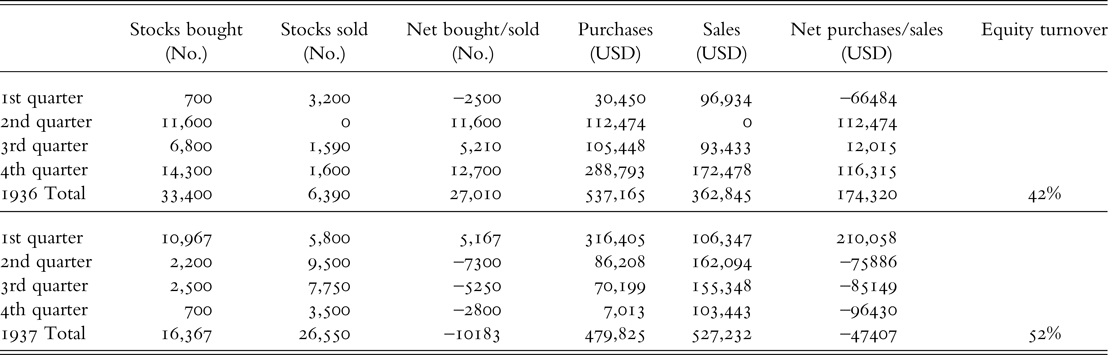
According to the data shown in Table 6, the liquidation started in the second quarter of 1937 and continued to a greater extent in the second half of the year.Footnote 23 It regarded mostly common shares, in all sectors of investments: first of all railways (he sold 800 shares of two different companies, Erie and Great Northern Railway); then industrials (3,500 common shares only of Carriers and General Corporation), oil companies (1,800 common shares of three different companies) and investment trusts (he sold, mostly in August, 4,000 shares of Atlas Corporation, 2,500 of Blue Ridge, 1,600 shares of Chicago Corporation, 600 of Tri-continental and 500 of General American Investors), ending with mining companies (in November he sold 1,400 common stocks of Homestake) and again investment trusts (2,100 more stocks). The equity turnoverFootnote 24 (last column, Table 6) shows that he was a very active trader in this particular year, and not a substantial keeper of securities against the market drop, as in the case of the King's portfolio. Chambers and Kabiri (Reference Chambers and Kabiri2016), while providing a graph showing net purchases and sales for the period 1929–46 (p. 307) compared to the movements of the US stock market, unfortunately do not provide the exact figures for the equity turnover of the King's US portfolio for 1936 and 1937 that we could have directly compared with those we have computed for his personal portfolio. Nevertheless, referring to the 1937 Wall Street crisis, they clarify that ‘despite some turnover of the portfolio, in the main, he [Keynes] stuck to his stock positions’ (p. 306).Footnote 25
Purchases and sales by quarter in Keynes's own US securities portfolio and equity turnover in 1936 and 1937

Source: Author's calculations from Buckmaster and Moore's (Keynes's broker) statements of account (KP, SE/9/43-75) for sales and purchases in number and value, and from Keynes's end-of-year evaluations (KP, SE/11/5-7) for Keynes's US portfolio equity turnover.
Interestingly enough, Keynes did not change the allocation between common and preferred shares in his own portfolio, which remained stable around 55 per cent of common against 44 of preferred in both years, while he shifted temporarily towards preferred shares in the following year (see Table 5).
The considerations guiding Keynes in the management of the King's Discretionary Fund were different from those he followed in his role as a personal investor. As for the ‘keeping’ strategy, seen by Chambers and Kabiri as typifying Keynes's choice, it is confirmed on the whole by analysis of the US core holdings in his personal portfolio but belied at least in the significant case of the 1937 US stock market collapse. The different behaviour adopted by Keynes seems to depend mainly on the following factors: the greater weight of the common stocks, the higher degree of concentration and the high leverage shown in his own portfolio; and the extent of his personal disappointment with Roosevelt's policy at the end of 1937, which had a stronger impact on the decisions he took as far as his personal portfolio is concerned.Footnote 26 To these considerations another, very tentative, one could be added. In 1934 Keynes had greatly increased both his personal and King's exposure on the US stock market, but in 1936 his personal US portfolio was double that of King's, and the spring 1937 crash took him very much by surprise. In the light of the dimension and the distribution by instrument of his own portfolio it seems plausible that he may have overreacted, which led him (albeit with a delay of a few months and having missed the right momentFootnote 27) to liquidate in the second half of 1937, in particular selling common stocks.Footnote 28 A few months later he regained some confidence, as he wrote to G. H. Recknell on 30 April 1938:
In the case of the United States, the immediate prospect is more obscure. But there is surely a case for patience and fortitude. Both the forces of natural recovery and those of official assistance may take a bit of time to work. But, after reading innumerable reports and statistical analyses of the American position, I can see no reason for expecting a very serious further recession and every reason for believing that things will be a great deal better than they are by the end of the year. (CWK xii, p. 40)
As for the King's portfolio, on the other hand, smaller in scale, invested more in preferred shares and less concentrated, the decrease in holdings from 1936 to 1937 amounted only to a value of $100,000 (about 12 per cent of 1936 portfolio), which implies that Keynes substantially held on to securities on King's behalf, as confirmed by Chambers and Kabiri's analysis (Reference Chambers and Kabiri2016, p. 306). Having retained securities when the bubble burst, in the following two years he continued largely to pursue the same choice as far as the King's portfolio was concerned, while in the case of his own portfolio he continued to disinvest. During the 1940s, the circumstances of the war in progress and the Treasury restrictions on American dealings affected Keynes as personal and institutional investor in much the same way, and the pattern of the two portfolios became more aligned, even though the stronger preference for common stocks and the dislike of bonds still continued to distinguish his own from the King's US securities portfolio.
IV
Chambers and Kabiri (Reference Chambers and Kabiri2016), who undertook highly detailed analysis of the King's College US portfolio managed by Keynes, provided some general conclusions on Keynes as a trader on Wall Street which confirm the view shared in the literature (see, e.g., Wasik Reference Wasik2013; Woods Reference Woods2013; Chambers, Dimson and Foo Reference Chambers, Dimson and Foo2015b) that, during the 1930s, Keynes had decidedly turned to a buy-and-hold strategy based on the selection of a limited set of securities. However, in their study they do not investigate Keynes's personal dealings in the US stock market, assuming that analysis of Keynes's own investment in the US stock market could not add anything new or different to their analysis of the King's investments. However, no analogy between Keynes's personal and institutional dealings should be accepted as altogether obvious, without comparative analysis of both portfolios. This finding constitutes the contribution offered by this article, which may, in our opinion, help to qualify the findings and conclusions reached by Chambers and Kabiri (Reference Chambers and Kabiri2016) and better appreciate Keynes's different behaviour as a personal investor and as manager of an institution's portfolio when he traded on Wall Street.
In the case of choice between common and preferred stocks, for example, we reached a more qualified conclusion. One of the findings of Chambers and Kabiri's investigation based on analysis of the King's holdings is that Keynes allocated his investments equally between preferred and common stocks (Chambers and Kabiri Reference Chambers and Kabiri2016, p. 309),Footnote 29 and this is further confirmation of Keynes's innovative style as an institutional investor (see also Chambers and Dimson Reference Chambers and Dimson2013; Chambers, Dimson and Foo Reference Chambers, Dimson, Foo, Brown and Hoxby2015a, Reference Chambers, Dimson and Foo2015b) since investment in equities, and especially in common (ordinary) shares, was at the time an unusual approach to the management of institutions’ portfolios. But what the analysis undertaken in this article helps us to appreciate (showing Keynes's definite preference for common stocks in his personal US securities portfolio) is that his innovative investment philosophy as an institutional investor somehow reflected ideas that could be tested more freely, and to a much larger extent, while investing on his own private account.
As for the diversification measured in terms of number of securities held, Keynes's behaviour appears more prudent when investing on behalf of King's since the portfolio appears less concentrated than in his own case. Furthermore, with regard to the increase of US holdings in 1934, which characterised both portfolios, we have seen that the relative extent of this increase is very different, being much greater in the case of his own portfolio. A possible interpretation seems to be that his personal conviction as an economist of the rightness of Roosevelt's policy was given greater play in influencing Keynes the personal investor than in his institutional role, and also that he allowed himself more freedom in pursuing his investment policy and exploiting Wall Street opportunities when acting as an individual trader.
In conclusion, as far as his general strategy and investment behaviour are concerned, what comparison makes clearer is that, although he followed in both cases what we have called elsewhere (Cristiano, Marcuzzo and Sanfilippo Reference Cristiano, Marcuzzo and Sanfilippo2018) his ‘pet philosophy’ – that is, the choice to invest huge sums of money in few assets, selected mainly on the basis of the amount of reliable information he possessed on them, for keeping them – Keynes undoubtedly preferred common stock, did not care about asset diversification, and liquidated during the 1937 crisis, when he invested on the US stock market on his own account. To some extent these findings differ from the evidence provided in the literature (Chambers and Kabiri Reference Chambers and Kabiri2016) on Keynes's behaviour when dealing on Wall Street as manager of the King's College portfolio.
Appendix on archival sources
The relevant information on Keynes's US personal investments, not always complete or easy to decipher, is scattered throughout many files in Keynes's Papers. It includes statements of account sent by the brokers to Keynes, notes and computations handwritten by Keynes on dealings and profits on each company over time, and correspondence with brokers (mainly file KP SE/2/6-7), exchanges (published and unpublished) with other investors and businessmen, containing views or considerations on specific companies and/or the US markets, and, finally, Keynes's manuscript ledgers (file KP SE/11/5-7), which represent the main source for Keynes's holdings. They contain Keynes's own ‘Valuations’ of his securities portfolio (including both British and US) at the end of each year, at market value, for the period 1922–45.
The other fundamental source for dealings in dollar securities for the period March 1932 to July 1939 is file SE/9, which contains the statements of Keynes's dollar account with Buckmaster & Moore (Keynes's main broker). They register the list of US stocks (and companies) in which Keynes invested in chronological order, with indication of the type of asset (if common or preferred), the dates of buying and selling operations, although not recorded pair-wise, the quantities traded, and, as far as dividends are concerned, a complete account of the sums received at different dates. Unfortunately, details of the stock prices at which Keynes made his dealings are not registered, but only the total debit (including taxes) and credit positions for each buying and selling operation, with no exact indication of the matching between stocks bought and sold.
As for Chambers and Kabiri's analysis (Reference Chambers and Kabiri2016) of Keynes's US investments on behalf of King's, we were unable to find detailed indication of the data sources in their paper, while they provide full archival details for the list of people Keynes met during his trips to the USA. More detailed information on archival data sources relating to Keynes's investments in equities on behalf of King's can be found in Chambers, Dimson and Foo (Reference Chambers, Dimson, Foo, Brown and Hoxby2015a, p. 130 and Reference Chambers, Dimson and Foo2015b, pp. 846–7).