The people of the Niger Delta, as well as those from the ÌlàjẹFootnote 1 regions of south-western Nigeria, emerged from agrarian populations that once occupied the entire Delta region. Until recently, these groups engaged in fish farming, land cultivation and other agricultural activities. However, with the advent of oil exploration in 1956, farming activities gave way to oil pipelines, flow stations and platforms, and thriving agrarian populations fell into decline. Control of agrarian land and aquatic water by government fiat – first under the British colonial administration and later under the post-colonial state – resulted in a change from community ownership to state ownership of resources. This change further resulted in the widespread marginalization of minorities, violent disputes over the control of natural resources, and conflicting rights claims to indigeneity, descent and belonging.
It is within this context that the people of the Niger Delta now refer to themselves, and are referred to by non-governmental organizations (NGOs), government entities and multinational corporations, as ‘oil-producing communities’. In this article, I explore how and why the Ìlàjẹ people of the Niger Delta define themselves as oil communities, using techniques of narrative, myth, ritual and song in ways that inject them into the larger imaginaries that frame the Niger Delta politics of oil. I examine how narratives of belonging and ownership of natural resources are reshaping the politics of claim making in many communities of the Niger Delta, and also how the politics of claim making is reshaping narratives of belonging. I argue that the claim to ownership of land and oil resources is not only rooted in the rich history of the Ìlàjẹ but also stems from the events of November 1995 when many communities in the Niger Delta, reacting to the execution of Ken Saro Wiwa by the Nigerian state, began to form associations and other protest groups to make claim to ownership of oil resources. For the Ìlàjẹ, I suggest, this process of claim making produced the Parabe protest of 1998 against Chevron Nigeria Limited. The Parabe protest organized by Ìlàjẹ youth in consultation with their elders was violently crushed by the Nigerian state, allegedly at the urging of Chevron. The protest lasted three days and attracted the attention of both local and international media in ways that also spurred the participation of environmental and human rights groups. The protest led to a legal challenge against Chevron in a San Francisco court on the propriety of the use of violence against local oil communities. Thus, I examine how the Parabe protest was in a way embedded in the Ìlàjẹ narrative of belonging as well as the general rhetoric of resource ownership prevalent in the entire Niger Delta.
The core problem is that the oil economy is structured in such a way that communities located in resource exploitation areas do not derive any of the benefits. Communities are denied access to their land and experience high unemployment, and revenues from oil are beyond the reach of most community members (Barber Reference Barber1982; Renne Reference Renne1995; Apter Reference Apter2005; Smith Reference Smith2007; Okonta Reference Okonta2008; Mitchell Reference Mitchell2009; Adunbi Reference Adunbi2011; Medani Reference Medani2011). This discrepancy between regional belonging and national resource control, and the related contestations, took me to the Ìlàjẹ area of Western Niger Delta, first in 2005 and later in 2007 for fieldwork that lasted more than two years.Footnote 2 I became interested in understanding how the physical presence of the oil installations – drilling platforms, flow stations, pipelines – represents a promise of widespread wealth, while at the same time the realities of resource control exclude local people from the benefits of oil-related modernity. These exclusions, beginning during the colonial era and continuing in the post-colonial state, range from land reform, usage laws and zoning restrictions to militarized formations in the region by the Nigerian army and multinational corporation security forces intended to protect oil operations. As a result of such exclusions, many communities, including the Ìlàjẹ, have been involved in political organizing against multinational corporate control of land and oil in the Niger Delta.
This article examines the genealogies of the Ìlàjẹ and how their narrative of belonging reinforces claims to ownership of land and natural resources such as oil. The article shows how such narratives are embedded in practices that are transforming communities rich in natural resources into enclaves of protest in an attempt to regain what many communities claim belongs to them. The article maps how the oil installations have come to represent an ancestral promise of wealth to many members of Ìlàjẹ communities. This claim making, I suggest, is embedded in a myth of origin that continuously reinforces a distinct Ìlàjẹ identity, projecting an imagined community connected to the Yorùbá of south-west Nigeria as well as the oil-rich Niger Delta region. While many scholars focus on the myth of origin of the Yorùbá, in most cases centring their interest on rituals and a political imagination that intersect with linguistic evidence in determining group identity (see, for example, Peel Reference Peel1983; Apter Reference Apter1992), these scholars have not explored the centrality of these myths to oil resources. Thus, I investigate how the Ìlàjẹ narrative of belonging creates its own specificity of ‘ownership’ of natural resources through ritual performances connected to migration and dispersal of subject populations. These ritual performances, I argue, reinforce claims to ownership of land and natural resources such as oil in ways that project the oil installations as the fulfilment of ancestral promises of wealth. I show how the Ìlàjẹ embed their claims to land ownership and natural resources in practices allegedly derived from divine knowledge that continuously reinforce processes of remembering and imagination. I suggest that these Ìlàjẹ narratives and claims shape an identity that positions Ìlàjẹ communities as a distinct Yorùbá community inserted through divine power in the oil-rich Niger Delta. In what follows, based on interviews and participant observation among community environmental activists, elders, chiefs, youth and women of Ìlàjẹ,Footnote 3 I also show that this process of claim making has transformed Ìlàjẹ communities into new spaces of protest in ways that challenge the activities of the Nigerian state and multinational oil corporations in the region.
MYTH, MIGRATION AND GENEALOGIES OF BELONGING
The Ìlàjẹ are classified as Yorùbá, but, in recent times, they have begun to distinguish themselves by claiming to belong to what I call the economic Niger Delta.Footnote 4 In this section, I give a brief background to Ìlàjẹ social organization that situates the broader analysis. The Ìlàjẹ can be subdivided into four main entities: Ugbo,Footnote 5 Mahin, Aheri and Etikan. All are interconnected and possess a shared history. The main Ìlàjẹ occupations are fishing, canoe making, mat making, farming and trading. The Ìlàjẹ occupy more than two thirds of the coastal belt in Ondo State in the south-west and Niger Delta regions of Nigeria, with a southern border at the Atlantic Ocean.
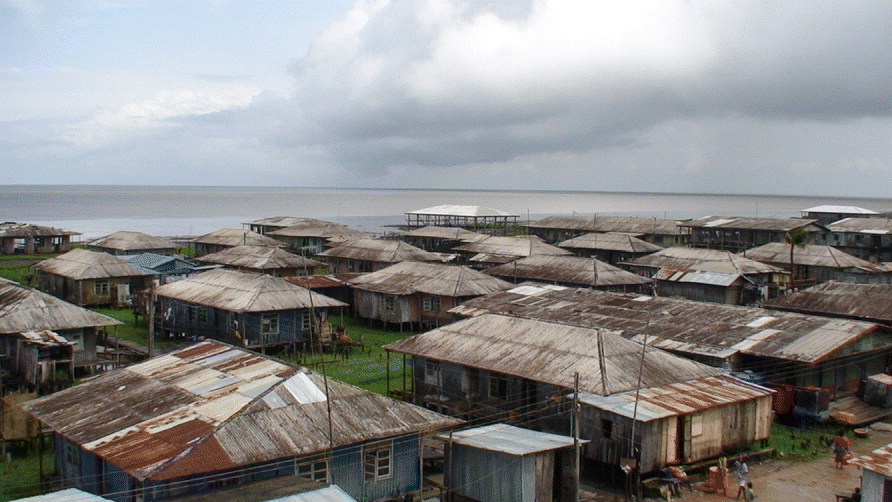
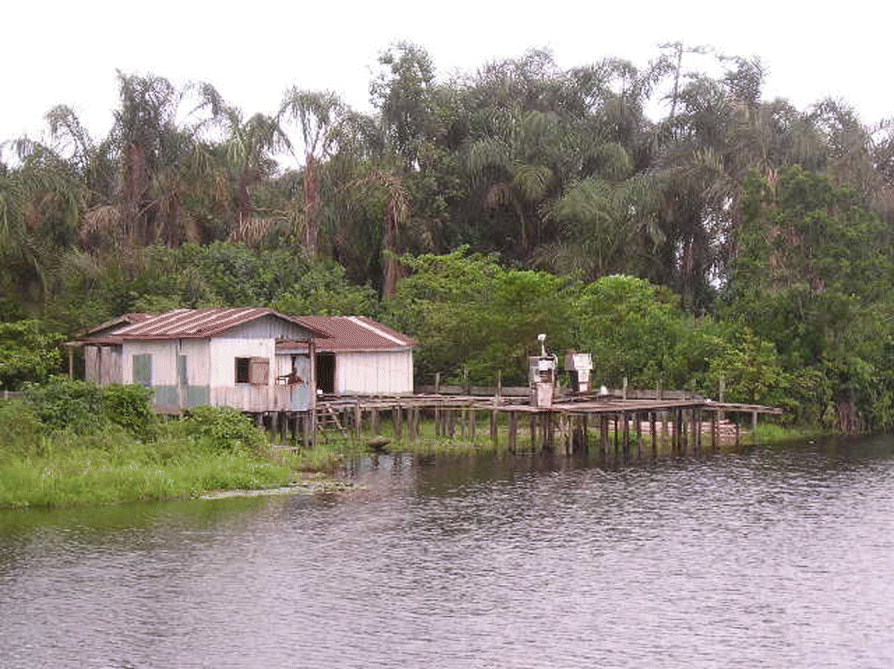
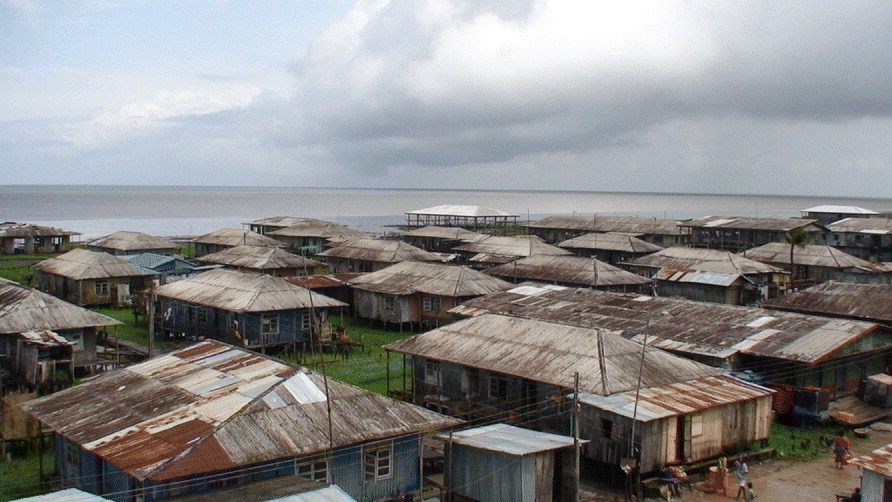
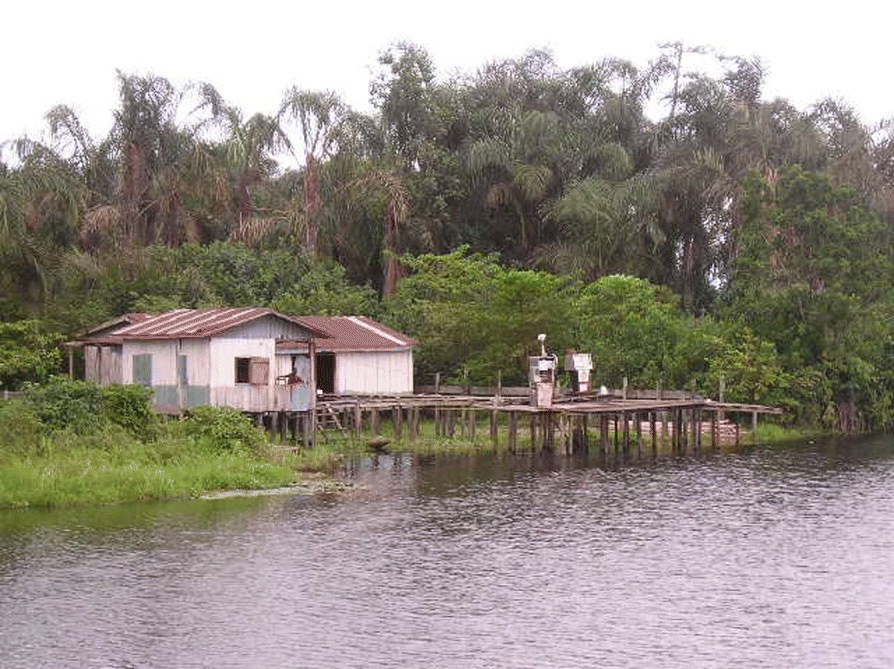
While the Ìlàjẹ have a shared history, I focus on the Ugbo Kingdom because it is the only oil-bearing community in the area. The Ugbo Kingdom is composed of 140 communities spread across several towns and villages (see Figures 1 and 2). There are sixteen quarters in Ugbo township, each representing a family, which is why they are referred to as Èjìnédógún (‘Sixteen’) in the local dialect. Senior chiefs (Dosun) constitute the Olugbo-in-Council, the highest decision-making body of the kingdom, which is presided over by the king. These Ugbo communities view the Atlantic Ocean as significant both for its role as a source of income and also as an omen of one of the most important rituals of the Ìlàjẹ. The Atlantic Ocean and other adjoining rivers host many oil platforms, wells, and stations located offshore.
An aerial view of one of the sixteen quarters (Èjìnédógún) of Ugbo township
Canoe petrol station
Thus, I build upon the important scholarly work on ritual and political imagination among the Yorùbá (Bascom Reference Bascom1969; Atanda Reference Atanda1980; Olupọna Reference Olupọna1991; Apter Reference Apter1992; Clarke Reference Clarke2004) by relating it to a novel area of inquiry: how ritual performances and myths of dispersal and belonging are being mobilized to project a distinct identity connected to natural resources, particularly oil. My point of departure is to examine ways in which these rituals and myths of origin are being mobilized by different actors within the Ìlàjẹ community to make political claims to ownership of oil resources. Where and how do migration and dispersal interconnect and interrelate with notions of an ancestral promise of wealth? How and why did those notions become an important rhetoric in mobilizing against multinational corporation control of oil resources? Investigating Ìlàjẹ cosmology and migration history helps to shape understanding of how the discovery of oil in Ìlàjẹ in particular and the Niger Delta in general continues to structure notions of belonging, protest, governance and ‘ownership’ of land and natural resources in Nigeria.
IMAGINING THE ‘WEALTHLAND’: MYTH, MEMORY, AND DIVINE POWER
The Ugbo people consider themselves to be the ‘original’ inhabitants of Ilé-If (better known as If today) who were driven out as a result of an interplay of power, political manipulation and family disputes. The Ugbo interpret their loss of Ilé-If as divinely ordered because their ancestors had promised an abundance of wealth. It is the realization of this divine promise by their ancestors that made the Ugbo embark on a journey in search of a particular ‘sign’ that promises and manifests wealth. As many community members told me, this particular ‘sign’ revealed itself when they migrated to what is today known as the Ugbo Kingdom. The Atlantic Ocean, huge oil reserves and other natural resources in this region today represent the manifestation of this sign. This section maps the Ugbo narrative of a divinely ordained journey from Ilé-If to the present location of the Ìlàjẹ people. I examine how this ‘sign’ of wealth manifested itself, who led the Ugbo to their present location, and how this myth translates into a form of memory and divine knowledge for the Ugbo people.
Ìgbọ́kọ̀dá is the gateway to Ìlàjẹ communities and, until recently, the end of the access road to the entire area. Consequently, Ìgbọ́kọ̀dá is the headquarters of the local government as well as the transit point for those travelling on the Atlantic Ocean to other communities in the area. It is also considered a transit point between the ‘semi-urban’ areas and the rest of the community. At the end of the access road that enters the city is the bank of the river where inhabitants and visitors usually board a canoe to the hinterland. A few metres before the bank of the river is an imposing one-storey building. This building is known as the transit house of the king of Ugbo Kingdom. During the period of my field work, ỌbaFootnote 6 Adebayọ Akingbade Mafimiṣebi IV, the Olugbo of Ugbo Kingdom, occupied the throne.Footnote 7 During my third visit to the area in 2007, the Supreme Court had removed Ọba Mafimiṣebi because Prince Akinrutan had challenged his ascension to the throne, claiming it was the turn of his family to produce the king. The building serves a dual purpose: a space where the king welcomes visitors who may not want to travel over the river and a place where the king connects with members of his subject population who either occupy positions of power within the local administration or generally reside in the area.
The boat ride to Ugbo, where the palace of Olugbo is situated, takes about fifty minutes from Ìgbọ́kọ̀dá. The palace, painted in white, is the only ‘modern’ building in the kingdom. Social amenities such as electricity, roads,Footnote 8 pipe-borne water and hospitals are completely absent in the area. The palace, however, has its own electricity generator. The palace waiting room also serves as the community's television-viewing centre. The palace even receives CNN signals from its huge satellite dish mounted on the roof of the building. The site of the palace is called Ode-Ugbo, which means ‘central Ugbo’ in the Ìlàjẹ dialect of Yorùbá.
Popular folksongs and divination poetry are two key ways in which Ugbo legitimize their claim of ownership to the area's land, ocean and natural resources. Popular folksongs serve as a daily legitimization of ownership claims. One such example is the saying tibé káruf, ul ti Oronmaken (sometimes also used as a song), which literally means ‘From here [from Ugbo Kingdom] to Ilé-If [the cradle of Yorùbá civilization], all land belongs to Oronmaken [the founder of Ugbo Kingdom].’ As Ọba Mafimiṣebi explained, ‘The Odùduwà group migrated from the east and met the Ugbo at Ilé-If. It took Odùduwà and his group of migrants almost fifteen years to learn our language and adapt to our culture.’
Local songs such as the one above reinforce how Ugbo narratives privilege the abundance of oil and other natural resources in the area. This song precedes all traditional prayers, festivals and meetings, and is akin to starting a Christian prayer with the words ‘In the name of the Father…’. During my stay in Ìlàjẹ, I often heard elders and chiefs sing the song at the beginning of an important meeting or when receiving visitors. While this song refers to land, many Ìlàjẹ will point to the fact that here land is a symbol that represents all natural resources.
The story of Àjàlọ́run,Footnote
9
the founder of Ilé-If, is representative of the types of narrative used by the Ìlàjẹ to justify their claims of ownership to natural resource wealth. The Ugbo, as many informants told me – including Prince Adeyẹmi, who prides himself on being the ‘official’ historian of the UgboFootnote
10
– believe that Àjàlọ́run descended from heaven and settled at Ilé-If with many people.Footnote
11
Àjàlọ́run begat Oronmaken, the first Olugbo of Ugbo. When Àjàlọ́run was old, he became blind, and an Ifá priest informed him that unless the Ugbo discovered a sea, his sight would not be restored. Àjàlọ́run then gathered his children and asked who could find the sea. Oronmaken offered to help find the sea and cure his father's blindness. Before Oronmaken started his journey, he consulted an Ifá priest known as Ekango (Awo Oronmakenja, meaning ‘the priest of Oronmaken’). The priest told Oronmaken to perform certain rituals for a successful journey, including use of ewua (‘rat’) to appease Ọlọ́nà (‘owner of the road’) for easy access, òrònmadìyẹ (‘day-old chick’) to appease his orí (‘head’), and a dog carrying àpáàdì (‘hot broken pot’) with fire to appease Ògún (god of iron).
After performing these rituals, Oronmaken travelled towards the coastal area of today's western Niger Delta with an entourage of many followers and relatives. Based on Ifá divination, I was told, he first met ewua in the afternoon, who showed him a portion of the road before disappearing. Disappointed that ewua could not lead him to his final destination, Oronmaken placed a curse on ewua that he would never again be seen in the afternoon.Footnote 12
Oronmaken also encountered òròmadìyẹ crying for attention. He quickly asked òròmadìyẹ for directions in return for his help, but, after showing Oronmaken the way, the day-old chick disappeared. Oronmaken, I was told, said something confidential to òròmadìyẹ, and only the priests and members of the Olugbo-in-Council know that ‘special’ message, which the king refused to disclose. This special message now constitutes part of the funeral ritual for a departed king, who cannot be buried without this rite.
The dog showed Oronmaken a road that led to what is today Ode-Aye. It was at this point that Oronmaken first saw the Atlantic Ocean. Its waves were so powerful that Oronmaken thought people were flatulating inside the sea and exclaimed ayé rèé, which means ‘what a wicked world’. At that spot, Oronmaken began to recite incantations before touching the sea, but the sea goddesses stopped him from doing so.
Through the power of Aramufen, Ọba Mafimiṣebi asserts, Oronmaken succeeded in capturing three sea goddesses: Kalagbinle olómi, Agbo, and Igodo. The goddesses surrendered the power of the sea to Oronmaken. Oronmaken went back to Ilé-If with the three goddesses. On the way, he was said to have had sexual intercourse with Igodo. When Oronmaken arrived in If, he used the seawater to cure Àjàlọ́run's blindness. Later, he presented all three goddesses to Àjàlọ́run, in accordance with a tradition requiring sons to render account of their stewardship after returning from a journey, and Àjàlọ́run took Igodo as a wife.
Àjàlọ́run later discovered that Igodo was already pregnant, though Oronmaken did not disclose his sexual exploit with her. When Àjàlọ́run died Oronmaken was installed as OlufeFootnote
13
(king of Ilé-If). However, his subjects disliked him because he was a warrior and preferred his brother Aláyémọr because of his record of goodwill in the community.Footnote
14
To end the political impasse generated by the two brothers’ struggle for control of Ilé-If, Araba, Oronmaken's friend, later tricked him out of the palace to pave the way for the ascension of Aláyémọr to the throne. Frustrated by his sudden removal from power, Oronmaken left If with many of his supporters, wives and children. Many of these people established kingdoms and towns on their way to Ugbo.
Important to the ways in which Ugbo narrate their story is how they give primacy to Àjàlọ́run's descent from heaven. In many accounts given by other communities, particularly the Mahin, Etikan and Aheri, there is also the myth of someone descending from heaven. What this demonstrates is an attempt by each group to pride itself as the first to occupy a particular space: the Ugbo are not exceptional in this. What makes the Ugbo narrative interesting, as we shall see, is how it is embedded in a claim of ownership. This claim is often reconstructed to mobilize a subject population for protests against multinational oil corporations and the Nigerian state.
Therefore, this narrative of Àjàlọ́run's journey includes many identifying landmarks which Ugbo use to cement their claim to natural resource ownership. These landmarks include rivers, the Atlantic Ocean, and towns or villages established during migration from If. Many sites of offshore and onshore oil platforms, wells and flow stations in the area such as Awoye and Abiteye are today proudly shown as evidence of the divine manifestations of resource ownership.
The king and members of his council also give prominence to Ifá divination, which predates any written record. Ifá, a system of divination traditional to the Yorùbá people of south-west Nigeria, is central to the ways in which Ìlàjẹ narratives of belonging shape claims of resource ownership. Ifá represents one Ugbo ritual that predates the arrival of the Odùduwà group at Ilé-If and supports Ugbo claims to ownership of land and natural resources, but also to Ilé-If itself. The recourse to the Ifá corpusFootnote
15
by Ugbo further signifies the importance of divination regarding the abundance of natural resources in the area. One such example is when the oracle told Oronmaken that a specific sign would indicate the place where he should establish the kingdom and such a place would be flowing with natural resources. Ugbo believe many generations will not have to work because there will be an abundance of wealth.
Many Ugbo that I interviewed believe the abundance of oil resources in their present area is a manifestation of this promise of wealth through divine power. They view this resource wealth as a form of compensation to Oronmaken and the Ugbo, who lost Ilé-If to the interplay of power and politics. Consequently, for Ugbo it is not a coincidence that their land is the only area rich in oil and other mineral resources in the Yorùbá-speaking area of south-west Nigeria; rather, this is the result of an ancestral promise of wealth. To the Ugbo, the Atlantic Ocean symbolizes the promised ‘sign’, and the Atlantic Ocean's location represents the actual area rich in natural resource wealth that the oracle directed Oronmaken to after he lost the battle to succeed his father as ruler of Ilé-If. The Atlantic Ocean, referred to as òkun both in Yorùbá language and Ìlàjẹ local dialect, hosts several oil platforms and flow stations offshore from the Ugbo kingdom.
Central to this notion of divine power is the importance of Ọbàtálá and Malokun to the understanding of ownership of wealth and resources in the entire area. As told by many of my informants, Ọbàtálá does not refer to a specific person; it means ‘the King that is great’ and is one of the ways to describe the status of Olugbo. Ọbàtálá also means ‘the King that is in a white robe’, which is why Olugbo always appears in white, whether in his official robes or in casual dress, as a demonstration of his purity and lordship over the entire area. Another song illustrates the king's white robes: ‘èé olugbo, èé olugbo, aṣọ funfun tolugbo miwo, ọba Ìlàjẹ’, meaning ‘here comes Olugbo, king of Ìlàjẹ who wears white robes’. Olugbo is addressed as Ọbàtálá ọ̀sìrìmàgbò, Olúwaayé, alábàálàṣẹ tako tako lóde Ìrànjé,Footnote 16 meaning ‘Ọbàtálá, man of impeccable strength, lord of the earth, master of all human beings, who has divine authority and is king of Ìlàjẹ’. The king also uses the Ifá corpus to demonstrate claims of ownership and belonging when he says:
If you go to Ifá divinations, Ọbàtálá was referred to as Òrìṣàńlá, which is Òrìṣà tó níl
, i.e., the divine that owns the land. Ifá èjìogbè is the most senior of all odù Ifá, and it says that kùtù kùtù
Ọba Ugbo, Ọ̀sán gangan ọba Mahin, Ọbàtálá ọ̀ṣrmàgbò, ẹni tí a bí lóde Ugbo tó lọ rèé jọba lóde Ìrànje. If oyè lagbò, ibi ti ojú ti mọ́ni wá (In the beginning was king of Ugbo; later in life there was king of Mahin;Footnote
17
Ọbàtálá ọ̀sị̀rìmàgbò, a person born in Ugbo who became king in Ìlàjẹ; If of the Ugbo, where the world actually started from). This is referring to the fact that the Ugbo own If. If you want to know that we own If, check how Olugbo established a tradition at If known as edi (wrestling), which is today celebrated annually as a wrestling match between Ọbawiri (one of the Ugbo left behind at If) and the Ọni of If.Footnote
18
This interpretation of the Ifá corpus, regarded as a form of divine knowledge, strengthens Ugbo's claims of ownership and belonging to a land rich in natural resources. This claim to priority was not uncontested: another Ìlàjẹ group, the Mahin, also have narratives of origin asserting the prominence of the Mahin as the first to occupy the space known as Ìlàjẹ today.Footnote 19 Indeed, it is clear that all the neighbouring communities (Mahin, Etikan and Aheri) have different and sometimes related stories of origin – connected to the sea and at the same time positioning them as the first to occupy the geographical area of Ìlàjẹ. It is the way in which the Ugbo make oil resources central to their myth of origin that makes them stand out among these groups.
What is common in all the narratives is the centrality of migration to the way in which a claim of belonging is made by the different Ìlàjẹ groups. What is absent in the Mahin narrative is that they are yet to begin to make claims to ownership of oil resources, understandably so because oil has yet to be found in their territory. If the conflict in the Delta remains a reference point, it might not be long before the Mahin, the Etikan and the Aheri begin to make similar claims, based on their being ‘impacted communities’ in the oil era.Footnote 20
More importantly, the Ugbo's use of the Ifá corpus, a highly revered institution among the Yorùbá, to reinforce their claim to ownership of land and other resources illustrates not only their connection to the larger Yorùbá community but also the unusual place they occupy as the only Yorùbá-speaking community with abundant oil resources. Understanding the nature of this claim making and how it is connected to the Atlantic Ocean – the source of offshore oil in the Ugbo area – is critical to understanding the nature of belonging and the centrality of ocean mythology.
FESTIVAL OF OIL: MALÒKUN AND THE CONSTRUCTION OF RESOURCE OWNERSHIP
Malòkun – her name means owner of the Atlantic Ocean – is central in illustrating how and why the ocean is important to Ugbo claims to ownership of oil resources. The Ugbo consolidate their narrative of belonging and claim making through an annual festival commemorating ancestral promises of wealth. As mentioned earlier, the oracles told Oronmaken to look out for a particular sign and that the location of this sign would be flowing with natural resources translatable to wealth. As many Ugbo that I encountered during my stay in the area told me, Oronmaken found this sign close to the Atlantic Ocean when he suddenly sighted a beautiful woman who turned out to be a water goddess named Malòkun. Oronmaken married Malòkun, who was said to have unimaginable prowess in generating instant wealth for the king and his subjects. The kingdom was said to have prospered beyond imagination in the entire region during the king's marriage to Malòkun.
Malòkun became the envy of other wives because of the special place accorded to her by the king. When these wives made life unbearable for her in the palace, she was said to have disappeared into the ocean and later turned into a deity with signs indicating that she should be worshipped to avert war, hunger and an end to their prosperity. Malòkun is now worshipped annually, and Ugbo also attribute the abundance of offshore oil deposits in the area to her. A folksong corroborates this connection:
Àrà mo fẹ́ olórííre ọkọ mògé ọkọ mògé ọkọ mògé
(awe-inspiring, prosperous one, darling of the world)[repeated thrice]
Malòkun ùgbà wò fi ghún mi jẹ, mo rí bùtú bùtú
(Malòkun, when you gave me plenty to eat I looked healthy and well-fed)
ùgbà wé fi ghún mi jẹ, mo rí ghára ghàra
(when you declined to feed me, I looked gaunt and unfed)
Àrà mo fẹ́ olórííre ọkọ mògé, ọba omi ju ọba òkè lọ
(awe-inspiring, prosperous one, darling of the world, the king of the ocean is greater than the king of the upland).
This song has also been associated with Olugbo, who is constantly referred to as more powerful than the earthly king because he owns and rules over the Atlantic Ocean and the resources that lie beneath it. While many Yorùbá communities have a goddess or deity who signifies abundance of wealth to community members, Ugbo are the only Yorùbá community who connect oil resource abundance to such a deity, and have oil resources in their domain.
While the story of Malòkun is unique in its centrality to oil abundance, many community members who claim to be Christians also integrate their ‘new’ religion into the narrative of ancestral promises of wealth and prosperity. While this integration underscores the growing influence of Christianity in the community, it also indicates the hybridization of Christianity and ancestral modes of worship within the community. Moreover, to corroborate this story and map how it plays out in daily community life, I asked community members about the connection between Christianity, Malòkun, and oil wealth.Footnote 21 For example, when I asked Dele, a middle-aged man who claimed to be a devout Christian, to explain why I should believe the Ugbo claim to ownership of the oil resources in the area, he justified his belief in the following way:
When it comes to wealth, even in the Bible, it was only fishermen that Jesus said I will make fishers of men because in those days, fishermen were richer than farmers. And before oil money from fish was the highest in the world. Today, our community is the only one that produces oil in the entire south-west of Nigeria and this is because the ancestors promised us wealth. Oil, fish, and all aquatic resources are the fulfilled promises of our ancestors. Before oil exploration started, people came from all over the world to buy fish from us. Many of our people became very rich and the whole community witnessed an era of prosperity. With oil exploration, people from all over the world now depend on us to sustain their life desires such as flying an airplane and driving cars. This is exactly the promise of Jesus as well as a fulfilment of our ancestors’ desire that we, fishermen and women, shall continue to prosper till eternity. (Dele, devout Christian)Footnote 22
This representative statement invokes the spirit of Malòkun and an ancestral promise of wealth while also reiterating the important place Christian beliefs occupy in the community. It also shows the incorporation of both ancestral worship and Christianity into Ugbo narratives of belonging and claim making, and demonstrates the everyday ways in which Ugbo make such claims.
Eléporọ̀bì (The Oil Millionaire), a movie produced in 2005 by African Phillips Productions, reinforces this form of narrative that privileges community ownership of natural resources. Eléporọ̀bì illustrates ancestral ownership of land while also demonstrating how the state, in collaboration with multinational corporations, alienated community members from access to land and natural resources. Community youth realized that they were being exploited, and mobilized against the corporations. In reaction, the state brought in the army to quell the protests. The movie later shows negotiations between one family of ‘land owners’ and oil executives. After the negotiation, oil executives paid millions in compensation to this family with a promise to pay rents for oil exploration every year. This agreement between multinational oil corporations and the family that negotiated the deal transforms this family from being poor farmers to instant millionaires because of the high percentage of funding that then flows from the corporations to them. The main conclusion of the movie is that ancestral land and oil resources are one pathway for some community members to become oil millionaires. This story also illustrates the inequity that can arise when oil corporations negotiate with individual families or members of the community rather than with the community as a whole.
While Eléporọ̀bì encapsulates the various levels of contestation over oil resources in the Niger Delta, it also reinforces a particular narrative that reverberates within the Ugbo Kingdom every day. This narrative is embedded in ritual practices that make the invocation of a particular ‘sign’ emblematic of claims to ownership of natural resources and belonging to a particular space where such resources are in abundance. The importance of these narratives signifies a shift to a regime of ownership of land, ocean and natural resources in ways that make Ugbo a distinct entity within a larger Yorùbá political and ritual community. I argue that this claim making is embedded in an imagined homeland and derived from mythic origins that trace its genealogies to an ancestral promise of prosperity. It is this ancestral promise of prosperity that drives the desire to organize protests against multinational oil corporations and the Nigerian state in an attempt to reclaim what many community members consider to be their heritage. Closely connected to this perception of prosperity is the belief of many community members that they are being cheated by the oil corporations, hence the desire to reactivate the narrative of resource ownership as promised by the ancestors towards mobilizing against the oil corporations and the state. I draw upon Benedict Anderson's idea of ‘imagined communities’ (Anderson Reference Anderson1991) to suggest that the Ugbo collectively imagine a community based on memory and divine power, which situates them within different sites connected to land and resource ownership. It is this imagined community based on a particular narrative of belonging that drives the aspiration to mobilize community members for action aimed at reclaiming what is considered to be lost to multinational corporations.
These sites, derived largely from a rich, ritual production, enable a particular narrative that privileges an imagined homeland rich in natural resources. This imaginary homeland also possesses certain characteristics central to the production of ritual forms. These ritual forms project Ugbo as traditional, divine, and ‘chosen’ by the Creator as earthly inheritors of wealth through the invocation of ancestral heritage. These narratives reproduce Ugbo as both traditional and modern subjects through the hybridization of Christian beliefs and ritual practices in ways that legitimize ownership of land and natural resources. Rituals and performances of the notion of belonging by Ugbo include such acts as singing songs, telling shared stories, and producing a particular culture and a common convention that connects and centralizes oil and other natural resources as important to the lived experiences of community members. These forms of performance commonly draw on memory and produce homogeneity. Anderson (Reference Anderson1991) puts it succinctly when he points out that ‘no matter how banal the words and mediocre the tunes, there is in this singing an experience of simultaneity’ (1991: 145), a comment that aptly describes Ìlàjẹ performances, rituals and songs. While Christian and ancestral beliefs are at odds with each other, they both become useful tools for simultaneously legitimizing Ugbo's claim to ownership of oil, land and other natural resources.
The language of oil becomes a medium of expressing community feelings in ways that produce and continue to reproduce representations of ancestral past coated in a future that might result in reclaiming resource enclaves through persistent protest action to regain lost territories. Occasions such as the performance of Malòkun rituals legitimize claims of ownership and also echo similar ritual performances by the state, such as national holidays and cultural festivals (Apter Reference Apter2005), celebrating independence from colonial rule or the emergence of democracy in a post-military or post-apartheid state. For the Ìlàjẹ, the production of rituals of belonging and ownership through folksongs demonstrates how they imagine themselves but also how they create connections to land, water and oil resources.
In the next section, I demonstrate that the production and reproduction of this narrative of belonging, embedded in memory and divine power, enables a particular mode of claim making that is rooted in protests against multinational oil corporations and the Nigerian state. Thus, using the example of the three-day occupation of the Parabe oil platform in May 1998, I examine how the construction of a particular narrative of ownership of land and natural resources interacts with chieftainship and youth organizing in the production of particular forms of knowledge that helped galvanize community members to taking action. This form of action is geared towards an attempt at reclaiming what many community members claim they inherited from their ancestors. While many reports of the Parabe protest highlight the important role played by the youth, I argue that the protest represents ways in which oil-rich communities embed historical narratives in their process of claim making.
SWEET CRUDE, POISONED LAND AND THE PARABE PROTEST
It was a gorgeous day in the summer of 2005; the scene was an elementary school playground in the Ìgbọ́kọ̀dá area of Ìlàjẹ. At about 2 p.m. a good turnout of residents started gathering on the playground to listen to the latest information about the lawsuit filed on behalf of their community against ChevronTexaco at a court in San Francisco, in the United States.Footnote 23 The court case Bowoto v. Chevron was brought under the Alien Tort Claims Act of 1789, which allows foreigners to seek damages in US courts for alleged human rights violations abroad. In a similar case over 30,000 Ecuadorians had filed a lawsuit against Texaco at a New York court in 1993, seeking reparations from Texaco for contaminating the Ecuadorian Amazon through its petroleum operations (Sawyer Reference Sawyer2002). In the same vein, the Bowoto/Concerned Ìlàjẹ Citizens suit sought to hold Chevron accountable for the human rights abuses and environmental and economic damage against members of the Ìlàjẹ community that arose from Chevron's complicity with the Nigerian military and their ‘kill and go’Footnote 24 mobile police. When the Ìlàjẹ protested these environmental and human rights abuses caused by Chevron's oil-producing activities in their community, the protest attracted local and international attention.
The Bowoto v. Chevron lawsuit was based on a 1998 incident in which Nigerian soldiers shot non-violent protesters at Chevron's Parabe offshore platform. The soldiers were paid by Chevron, ferried to the platform in Chevron-leased helicopters, and supervised by Chevron personnel. Two protesters were killed in the brutal attack and others were injured and subsequently tortured.Footnote 25 The claims against Chevron included wrongful death of two protesters, assaults on protesters, and battery and negligence under California and Nigeria law.Footnote 26
Representatives of organizations, such as 8 United Oil Producing Communities,Footnote 27 Ìlàjẹ Ultimate Oil Producing Communities, Ìlàjẹ Major Oil Producing Communities, Ìlàjẹ Core Oil Producing Communities, Ìlàjẹ Actual Oil Producing Communities, and Ìlàjẹ 9 Concessional Oil Producing Communities were present at the 2005 meeting to discuss the court case. One of the representatives, Larry Bowoto, the lead plaintiff in the case filed against Chevron under the auspices of Concerned Ìlàjẹ Citizens, had called the meeting. Bowoto announced that three of the counsels from the group of attorneys representing Bowoto and others would be visiting to interview members of the Concerned Ìlàjẹ Citizens for the case. Attorneys from Traber and Voorhees, EarthRights International, the Center for Constitutional Rights and the Electronic Frontier Foundation, amongst others, represented Bowoto and the Concerned Ìlàjẹ Citizens. The meeting was full of optimism even though the case was yet to be heard in court. This form of optimism centred on the belief that Ìlàjẹ affected by the activities of Chevron could finally secure justice in the United States.
Two days after the meeting, three of the attorneys arrived to interview their clients. During the time the attorneys were in Ìgbọ́kọ̀dá, the venue of the interviews became a beehive of activity. During the first few days of the interviews, I served as a translator for many of the Ìlàjẹ who were interviewed. Serving as a translator opened the door for me to further understand the intricacies of the protest organized against Chevron in May of 1998. How did Parabe happen? Who organized the protest? What is the relationship between the protest and Ìlàjẹ claims to ownership of oil and land? The next section addresses these questions.
DEATH, PROTEST AND THE CONSTRUCTION OF DEFIANCE
One significant event shaped the ways in which Ìlàjẹ began to think about making claims to their land and oil. In the early 1990s, Ken Saro Wiwa led the Movement for the Survival of Ogoni People (MOSOP) to make demands for the thousands of Ogoni in the Niger Delta (Apter Reference Apter2005; Smith Reference Smith2007; Okonta Reference Okonta2008). Saro Wiwa's organized protest against Shell and the Nigerian state in Ogoniland led to his execution alongside eight other Ogoni environmental activists in November 1995 after their trial before a military tribunal. After the Ken Saro Wiwa incident and the attendant international recognition that the Ogoni acquired, other oil-producing communities came together to form associations to demand benefits from oil corporations and ask for greater participation in corporate operations in their area. For the Ìlàjẹ, the claim to ownership of oil and land is not only rooted in their rich history, as highlighted earlier, but also gains a contemporary thrust from the events of 1995 when many communities, reacting to the execution of Saro Wiwa, began to form associations laying claim to ownership of land and oil resources in the Niger Delta. The Ìlàjẹ formed their organizations as part of this movement and today there are nine such associations representing oil-producing communities in the Ìlàjẹ area. The Concerned Ìlàjẹ Citizens and AISECUM (an acronym representing the first letter of the names of all the associations in the area) became the umbrella body for all the groups. While the central objectives of all these groups focus on recognition as the owners of oil resources, they also demand employment opportunities from Chevron and other multinational corporations, community development projects, and compensation for environmental degradation.
Protests against Big Oil are not new, as demonstrated in the protests against Texaco in Ecuador and protests in many Niger Delta communities (Sawyer Reference Sawyer2002; Okonta Reference Okonta2008; Watts Reference Watts, Watts and Peluso2003). What makes the Parabe protest against Chevron different is the multidimensional nature of its planning and the collaboration between chiefs and youths. The planning of the Parabe protest was not only embedded in rights, particularly human and environmental rights, but also inscribed with claims of ownership of resources based on ancestral promises of wealth. While most previous protests in the Delta did not include the participation of chiefs and elders (Watts Reference Watts, Watts and Peluso2003), community elders and chiefs supported the youth participants in the Parabe protest. Some of the youth have a background in environmental rights trainingFootnote 28 and connections to elders and chiefs' councils in Ìlàjẹ communities. While the youths occupied Parabe, the chiefs/elders and youths of the communities made decisions about when and how to organize the protests jointly. This collaboration challenges the prevailing view that chiefs and elders and youths are often in opposition when it comes to dealing with oil corporations because of the divide-and-rule tactics of the corporations (Watts Reference Watts, Watts and Peluso2003; Smith Reference Smith2007). The Ìlàjẹ's ability to embed their narrative of belonging and ownership of land and oil resources when making claims against corporations and the Nigerian state echo similar claim-making processes among oil-rich Niger Delta communities (Adunbi Reference Adunbi2011).
Such processes of claim making further reinforce the belief of many Ìlàjẹ, particularly those organizing against multinational oil corporations and the Nigerian state, that utilizing the myth of ownership of oil can help galvanize the youth while at the same time cementing the important role of chiefs and elders, who are knowledgeable about both history and the place of the divine in society. Thus, the Parabe protest confirms for the Ìlàjẹ youth a particular place in the history of their community as told by the elders and chiefs and acted by the youths against corporations and the state. The novel ways in which the youth have incorporated human and environmental rights rhetoric into the rhetoric of resources as community property, taking on the corporations who act in tandem with the state, represents one of the unique features of the Parabe protest.
As I was told by many of my informants, prior to the occupation of the Parabe oil platform in May 1998, several meetings were held within the communities. Discussion at those meetings focused on how oil production in the area has done more harm than good to the ecosystem and to human and material resources, and how the federal government of Nigeria and the oil corporations are the only ones who benefit from oil production. Many made the point that oil corporations, particularly Chevron, do not recognize the interest of the communities where they operate as part of their responsibility as producers; this, they argued, is because the corporations view themselves as responsible to the federal government that gives them their operating licences. As one informant told me,
Today the communities are devastated because they can no longer engage in fish and cash crop farming. Secondly, fish farming has become expensive because fishermen now travel several miles to catch any significant quantity of fish. They have also had to rely on engine boats to do this, unlike in the past when they could cast their nets and get fish in abundance at their backyard. Those into cash cropping are no longer able to do this because of sea incursion into their land as a result of indiscriminate dredging.Footnote 29
At meetings, the youth, who are knowledgeable in human and environmental rights rhetoric, emphasize how oil production has degraded their environment, denied them their livelihood, and subjected them to double marginalization because they are not able to farm or fish and they are also unable to get jobs from corporations who use their land. Consequently, they consider the Nigerian state insensitive. The elders and chiefs emphasize the fact that oil production is gradually eroding the tradition and customs of the people. The chiefs and elders dwell on how sacred forests and shrines such as Ojuolotupa in the Ikorugho community have been desecrated by oil production. Many elders will talk about how their ancestral promise of wealth has been mismanaged by the corporations in ways that have degraded their environment and undermined their ways of life and traditions.
Adding insult to the perceived injury to customs and traditions, Chevron and other oil corporations do not appear to consider community members good enough for employment. Narrating his experience, Ojo, one of the participants at the meeting, stated that on completion of his university education he had taken more than four aptitude tests organized by ChevronTexaco but was never successful. Questioning the criteria used by the multinational corporations in conducting the test, he stated that it was hard to believe that most Ìlàjẹ candidates consistently underperformed, and suggested that the corporations were biased against giving jobs to the Ìlàjẹ. Reeling out statistics, he opined that between 1962 and 2001, only 6 Ìlàjẹ, 19 Ijaw, and 35 Itsekiri have been employed by ChevronTexaco.Footnote 30 Between 2001 and 2002, two tests were conducted by Chevron to correct this inequity, but Ìlàjẹ still did not pass the employment test.
For example, in a letter written to the then military administrator of Ondo State on 5 May 1998, Concerned Ìlàjẹ Citizens claimed that since 1994 about 2,500 Nigerians had been employed by Chevron, of whom only two were ÌlàjẹFootnote 31 – despite the fact that close to 20 per cent of Chevron's oil production in Nigeria come from the Ìlàjẹ area. Many Ìlàjẹ accordingly wonder why they should not derive more benefit from a resource that they not only own but was put there by their ancestors for their benefit. Thus, both elders/chiefs and youth draw attention to the ironic correlation between ownership of natural resources and denial of employment opportunities. As many told me, their inability to control what they own is directly responsible for the plight of their sons and daughters who are denied employment by Chevron and other corporations in the area. Consequently, they believe they need to protest to reclaim what they consider to be their heritage.
Membership in the community, anchored in the belief that oil and land belong to communities rather than the Nigerian state, helped to shape the nature and form of the Parabe protest. After the series of meetings, decisions were taken to organize a protest. The protest was not only aimed at drawing attention to the plight of the Ìlàjẹ. It also became a way of reiterating the Ìlàjẹ belief that oil and land are resources promised by their ancestors. As Chief Melshedek E. Meduoye, the Baale of Beku, told me in an interview,
I was one of the community leaders that took the decision to organize a protest against Chevron. Each community nominated five youths to protest at Parabe against the lack of jobs, oil spillage, and lack of attention to the communities. At the end of the protest, Nigerian soldiers drafted to quell the protest killed two people and several others were injured. Prior to the protest we had written several letters to Chevron highlighting all of these issues but they refused to listen to us. Therefore, we decided to organize as a community to take a step towards reclaiming our heritage, our land and what our ancestors bequeath to us as a people.Footnote 32
Corroborating this assertion is the affidavit submitted in court documents by one of the central figures of the protest, Ola-Judah Ajidibo. According to Ajidibo,
Before the men left for the Parabe Platform, they were given instructions by the elders and by me at the direction of the elders. The elders and I told them that no one was to carry any firearms or other weapons onto the platform, that no one was to drink alcohol or use other drugs, and that the protest was to be orderly and entirely peaceful. Bola Oyinbo was appointed to lead those men who travelled out to the platform in boats on May 25, 1998. With the approval of the chiefs and leaders, I told Bola that he was to speak with the naval security on the Parabe Platform at his arrival, explain the reason for the protest, and provide the naval officers with copies of our recent letters to Chevron. Again with the approval of the chiefs and elders, I told Bola that he was then to request a meeting with whomever was in charge for Chevron on the platform and that he was to ask that individual to contact [CNL managing director] George Kirkland in order to set up a meeting between Mr Kirkland and the elders and chiefs onshore. (Case 3:99-cv-02506-SI Document 1640, filed 08/14/2007, p. 9)
The protest therefore became a way of illustrating Ìlàjẹ claims to ownership of oil to the Nigerian state and also to the rest of the world. When the protest occurred, many global news outlets reported its impact on world oil production. One of the internal emails from Chevron's (then) Public Affairs Manager for Africa, Europe and the Middle East, Joseph Lorenz, indicated to the Public Affairs Officer, Ṣọla Ọmọle, that if the media were to report on the Parabe incident, Chevron would then announce to the world that the Parabe facilities handle about 70,000 barrels per day, and that Chevron would be optimistic of a peaceful resolution.Footnote 33 Fearing that a reduction of close to that quantity of daily production could result in a loss of revenue if the protests continued, Chevron – so many community members alleged – informed the Nigerian state, who in turn invited soldiers to quell the protest.
The protest lasted for three days, during which period over 100 youths occupied the Parabe oil platform. During the three daysFootnote
34
many protesters, I was told, engaged in dancing and occasionally singing popular local songs, including the one discussed above: ‘tibé káruf, ul ti Oronmaken’ (here understood to mean ‘from the location of the platform all the way to Ilé-If, all land belongs to Oronmaken’). These performances by protesters reify the central belief of the Ìlàjẹ that oil is a manifestation of an ancestral promise. Protest becomes a way of legitimizing that claim while embellishing the protest with human and environmental rights rhetoric embedded in denial of access to the benefits of oil exploration in Ìlàjẹ communities. Therefore, framing the protest as a way of reclaiming what ancestors promised community members, and not only as an attempt at securing more benefits for their communities from Chevron, reinforces the Ìlàjẹ as a community that is distinct because of its rich oil resources.
CONCLUSION
The greater part of the literature on the Yorùbá people of south-west Nigeria has focused on myth of origin, ritual production and performances. This scholarship addresses myths of origin by concentrating on the connection between ritual production and political imagination that derives largely from power. These studies have not explored the centrality of oil and other natural resources in the production of an Ìlàjẹ/Ugbo identity. This unanswered question is at the heart of my analysis of how Ìlàjẹ, a Yorùbá community, produce particular narratives, performances and songs in ways that place oil, land and other natural resources at the centre of what I call an Ìlàjẹ wealthland. Today, these narratives are embedded in protest forms challenging multinational oil corporations and the Nigerian state. Recourse to the narratives of myth of origin through claims to ownership of oil resources enables Ìlàjẹ youths to connect a modern rhetoric of rights with historical narratives of belonging.
Similarly, these forms of ritual production project Ìlàjẹ into the centre of resource contestation through the generation of a distinct identity that simultaneously positions Ìlàjẹ as Yorùbá while at the same time injecting Ìlàjẹ into the larger Niger Delta politics of oil imaginaries. Central to this ritual production, as I have argued, is how Ìlàjẹ continually use the narratives to critique their inability to derive benefits from abundant oil resources that they claim to own. The Ìlàjẹ are not able to derive benefits, they say, because multinational corporations in alliance with the state have consistently, for many years, denied them this opportunity. Therefore, inscribed in Ìlàjẹ's notion of belonging is the perception that narratives of origin can be better utilized if reconstructed to mobilize action against corporations. Out of this came the Parabe protest that redefined the politics of claim making among the Ìlàjẹ.
Claims of natural resource ownership have also deepened the ways in which some Ìlàjẹ communities reshape notions of community and belonging. Out of this comes a form of belonging to a unique Ìlàjẹ community where elders, chiefs and youth interact and interrelate on the basis of a common bond: an ancestral promise of wealth. Community members, by incorporating rhetoric of human and environmental rights and democratic values into traditional nodes of organizing, are therefore devising new methods of organizing and making claims not only from oil corporations but also on the Nigerian state. The Parabe protest exemplifies the interaction between nodes of traditional organizing and the rhetoric of environmental and human rights, as well as reinforcing claims to ownership of land and oil resources. Understanding these particular narratives, I argue, has important consequences for the ways we rethink the interconnectedness of natural resource wealth to the broader political imaginaries of belonging, governance, resource ownership, ritual production and performances.
ACKNOWLEDGEMENTS
I am grateful to Derek Peterson, Feyi Adunbi, Elisha Renne, Kelly Askew, Kamari Clarke, Oluṣeyẹ Adeṣọla, J. D. Y. Peel, Adam Ashforth, Andrew Apter, J. Lorand Matory, Adélékè Adéẹ̀kọ́, Henry Drewal, Mike McGovern, Jide Ọlọlajulọ, Lawson Akintokun and Ọba Afọlabi Odidiọmọ (Olu of Ìgbọ́kọ̀dá) for their suggestions. I am particularly grateful to the organizers and participants at the Mellon-Sawyer Ethnicity in Africa conference on The Making of the Yorùbá at the University of Michigan. I am also grateful to the audience at the annual meetings of the American Anthropological Association and the African Studies Association, where various versions of this article were presented. The fieldwork on which the article is based was conducted between June 2005 and April 2008. The research was made possible through the generosity of the McMillan Center at Yale, Yale Law School, Yale African Studies Program, and Yale Department of Anthropology.