Introduction
Stroke is a leading cause of disability in adults globally (Ward & Cohen, Reference Ward and Cohen2004). Limitations experienced by stroke survivors in carrying out basic and instrumental activities of daily living, and restrictions to their participation in social roles, attest to the disabling impact of stroke (Patel et al., Reference Patel, Tilling, Lawrence, Rudd, Wolfe and McKevitt2006). Fundamental to these negative sequelae are motor impairments, which are the most common primary impairments immediately after a stroke event. Indeed, deficit of motor performance is one of the most disturbing signs of stroke (Rathore, Hinn, Cooper, Tyroler, & Rosamond, Reference Rathore, Hinn, Cooper, Tyroler and Rosamond2002).
Due to its sudden onset and often long-term effect, impairment of motor performance after stroke is a central subject in stroke studies and rehabilitation. Additionally, impaired motor performance is regarded as the sequela closest to the pathophysiology of stroke (Fedy et al., Reference Fedy, Carlier, Roby-Brami, Bussel, Cazalis, Pierot and Maier2002; Shelton & Redding, Reference Shelton and Redding2001) and its assessment over time is regarded as suitable for tracking actual neurological recovery without the influence of compensatory strategies (Desrosiers et al., Reference Desrosiers, Malouin, Bourbonnais, Richards, Rochette and Bravo2003; Duncan et al., Reference Duncan, Goldstein, Horner, Landsman, Samsa and Matchar1994).
Several studies have profiled motor performance after stroke, but very few have studied longitudinal patterns beyond 6 months after onset of the disease (Ferrucci et al., Reference Ferrucci, Bandinelli, Guralnik, Lamponi, Bertini, Falchini and Baroni1999; Horgan, O'Regan, Cunningham, & Finn, Reference Horgan, O'Regan, Cunningham and Finn2009). The inadequate characterisation of motor performance beyond 6 months after stroke could be due to the assumptions that recovery stabilises at this time with little or no recovery thereafter (Bonita & Beaglehole, Reference Bonita and Beaglehole1988; De Wit et al., Reference De Wit, Putman, Schuback, Komarek, Angst, Baert and De Weerdt2007; Duncan et al., Reference Duncan, Goldstein, Horner, Landsman, Samsa and Matchar1994; Kwakkel, Kollen, & Twisk, Reference Kwakkel, Kollen and Twisk2006; Wade, Langton-hewer, Wood, Skilbeck, & Ismail, Reference Wade, Langton-hewer, Wood, Skilbeck and Ismail1983). Consequently, rehabilitation beyond 6 months after stroke is often considered unnecessary and futile by many rehabilitation experts (Aziz & Raymond, Reference Aziz and Raymond2008).
One of the few studies that have reported improvement in motor performance beyond 6 months involved an Irish sample of individuals with mild stroke (Horgan et al., Reference Horgan, O'Regan, Cunningham and Finn2009). However, excluding individuals with moderate or severe stroke, as was done in the study, reduces the generalizability of findings and limits applicability to different scenarios. For instance, people of African ancestry have been reported to suffer severe stroke, receive less than optimal stroke care and experience poorer outcomes compared to other racial groups (Horner, Matchar, Divine, & Feussner, Reference Horner, Matchar, Divine and Feussner1991; Horner, Swanson, Bosworth, & Matchar, Reference Horner, Swanson, Bosworth and Matchar2003). In Nigeria, the most populous country in Africa, standard stroke care is yet to incorporate stroke teams and units. The majority of stroke patients receive medical, nursing and physiotherapy care on general medical wards. Due to the lack of inpatient rehabilitation wards, physiotherapy, which is the main rehabilitation service in the country, is usually provided on an outpatient basis following discharge from acute care settings. In spite of these peculiarities, there is a dearth of information on long-term motor performance in stroke survivors in Africa, with no available data from Nigeria. The only existing longitudinal data in the country was restricted to 6 months after stroke (Hamzat & Peters, Reference Hamzat and Peters2009).
Information on long-term patterns of motor performance after stroke, however, has profound prognostic significance and is valuable for educating stroke survivors, their families and for planning treatment. This present study therefore examined the trajectory of motor performance over 12 months after first-incidence stroke in a Nigerian sample, with consideration for severity of impairment and difference between affected upper and lower extremities. The study tested the following hypotheses:
1. There is no improvement in motor performance beyond 6 months after stroke.
2. Upper-extremity motor performance is worse than that of the lower extremity across the first 12 months post stroke.
Methods
Design
A 12-month longitudinal study of an inception cohort of individuals with first-incidence stroke was carried out between 2010 and 2012.
Participants
Within a period of 1 year, 83 first-incidence stroke survivors were recruited consecutively during the first month of stroke onset. Stroke survivors who were conscious at the time of recruitment with no pre-existing motor disability, and who exhibited willingness to participate in the study by provision of informed consent, were considered eligible to participate in the study. All participants received routine physiotherapy during hospital admission in addition to medical and nursing care.
Participants were recruited from the medical wards of a university teaching hospital in north-eastern Nigeria, while follow-up assessments were conducted in the abode of the stroke survivors. Institutionalisation is rare in Nigeria and all the stroke survivors in this study returned to their homes or homes of their relatives after discharge from acute-care inpatient admission.
Measures
Motor performance was assessed using the Simplified Fugl-Meyer Assessment (S-FM), a 12-item observer-administered measure comprising two subscales for the upper and lower extremity with six items in each subscale (Hsieh et al., Reference Hsieh, Hsueh, Chou, Sheu, Hsieh and Kwakkel2007). The S-FM is a short-form of the 50-item motor subscale of the original Fugl-Meyer Assessment (FMA) (Fugl-Meyer, Jaasko, Leyman, Olsson, & Steglind, Reference Fugl-Meyer, Jaasko, Leyman, Olsson and Steglind1975), and has high concurrent validity (r = .93) with the subscale. Like the FMA, each item on the S-FM is scored on a scale of 0–2, with 0 representing complete paralysis while a score of 2 indicates full movement performance. Total scores are obtained by simple summation and, for ease of comparison with the original FMA, scores obtained in this study were converted to a scale of 100 with the following categories of impairments: 0–33 (severe), 34–79 (moderate) and >79 (mild) which were extrapolated from a previous study (Duncan et al., Reference Duncan, Goldstein, Horner, Landsman, Samsa and Matchar1994). Similarly, the S-FM upper- and lower-extremity subscale scores were converted to a scale of 100 to allow for comparison of motor performance between the upper extremity and lower extremity. Due to its brevity and ease of administration, even in stroke patients with low levels of tolerance, the S-FM is ideal for repeated assessments of motor performance (Hsieh et al., Reference Hsieh, Hsueh, Chou, Sheu, Hsieh and Kwakkel2007), as in this study.
Stroke severity was assessed at baseline using the Stroke Levity Scale (SLS). The SLS comprises four items that evaluate upper-extremity motor performance; lower-extremity motor performance; presence or absence of aphasia; and mobility. The total obtainable score on the SLS is 15, with severe stroke represented by a score of 0–5; scores ranging from 6 to 10 depict moderate severity, while 11–15 is mild severity. With the National Institute of Health Stroke Scale (NIHSS) as the criterion measure, the SLS has a high criterion validity of r = −.79. The SLS also has good internal consistency represented by Cronbach's alpha of .75 (Owolabi & Platz, Reference Owolabi and Platz2008).
Procedure
Stroke survivors were recruited into the study and assessed by trained research assistants. The research assistants were uninvolved in, and blinded to, the care received by the stroke survivors. Baseline data such as age, gender, stroke severity, subtype and side of hemiplegia were obtained from the stroke survivors, their relatives and from the hospital case-notes (for stroke subtype and date of stroke onset) at recruitment. Baseline motor performance was assessed with the S-FM via face-to face observation. Home address and telephone numbers of the stroke survivors and/or their relatives were also obtained for purposes of follow-up. Following discharge from the hospital, follow-up assessments of motor performance were carried out on a monthly basis for 12 consecutive months at the stroke survivors’ abode.
Data Analysis
Statistical analyses were conducted with SPSS version 15 (SPSS Inc., Chicago, Illinois, USA). Descriptive statistics of percentages, mean and standard deviation were utilised to summarise the demographic and clinical characteristics of the stroke survivors. To test the first hypothesis, Friedman's ANOVA was used to assess the changes in the motor performance over 12 months while Wilicoxon signed-rank test with Holm's sequential Bonferroni adjustment (Holm, Reference Holm1979) for level of significance was carried out for pairwise comparisons of motor performance across consecutive months.
Based on scores on the S-FM, three strata of motor performance impairment were obtained, namely severe (0–33), moderate (34–79) and mild (>79). Percentage distribution for each severity stratum was calculated for the baseline assessment and at 1, 3, 6 and 12 months post stroke, and proportions of stroke survivors in each stratum at the five time points were compared.
To test the second hypothesis that upper-extremity motor performance is worse than that of the lower extremity across the first 12 months post stroke, paired t-tests were used to compare mean upper- and lower-extremity motor performance scores each month across the first 12 months. Level of significance was set at p = .05.
Results
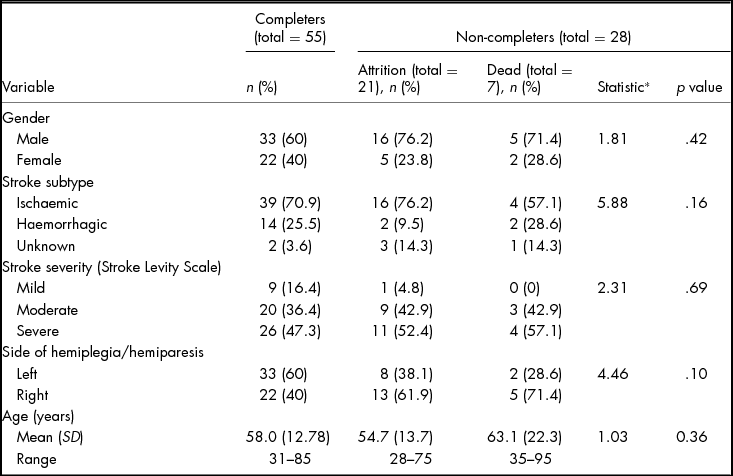
Eighty-three stroke survivors were recruited into this study. Of those recruited, 55 completed the study while 28 dropped out as a result of death (7), voluntary withdrawal from the study (2) and loss to follow-up post hospital discharge (19). There were, however, no significant differences in demographic and clinical characteristics between those who dropped out and those who completed the study (Table 1).
Demographic and Clinical Characteristics of Study Participants (N = 83)

*One-way ANOVA for age and Fisher's exact test for gender, stroke subtype, severity and side of hemiplegia/hemiparesis.
Thirty-three (60%) male and 22 (40%) female stroke survivors completed the study. Mean age of participants was 58 ± 12.8 years (range 31–85 years). The majority had an ischaemic stroke subtype (70.9%) and presented with left hemiplegia or hemiparesis (60%). Based on the Stroke Levity Scale, stroke was severe in 47.3% of the stroke survivors while 36.4% and 16.4% presented with moderate and mild stroke, respectively, at baseline (Table 1).
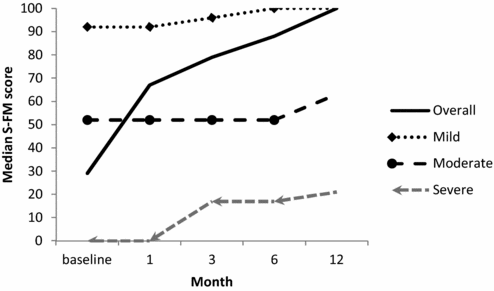
Median scores on the Simplified Fugl-Meyer scale (S-FM) for motor performance increased significantly (p < .001) across the 12 months (Figure 1). Comparisons of S-FM median scores between consecutive time points using Wilcoxon signed-rank test with Holm's Sequential Bonferroni adjustment showed statistically significant positive change (i.e., improvement): p < .001 (baseline and 1 month); p < .001 (1 and 3 months); p < .001 (3 and 6 months); p = .003 (6 and 12 months).
Pattern of motor performance (S-FM) for the entire cohort (overall) and stroke survivors in the three severity strata (mild, moderate and severe) across 12 months.
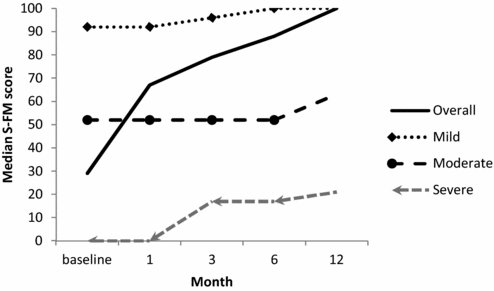
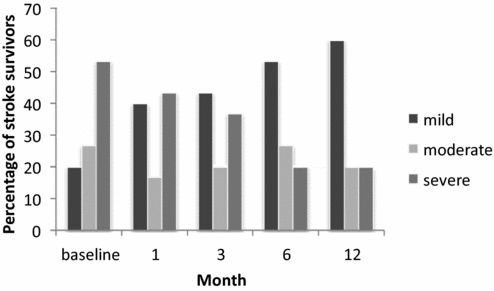
Figure 2 displays the severity strata of motor performance impairment at baseline, 1, 3, 6 and 12 months. At baseline, the majority (53.3%) of the stroke survivors had severe motor impairment, while 20% were in this category at 6 and 12 months. This occurred as more than half of the survivors, with initial severe motor impairments improved to moderate and mild severity categories by 12 months.
Severity of motor performance impairment over 12 months. The graph shows the distribution of motor impairment severity across 12 months after stroke. Stroke survivors were stratified into three severity groups based on their scores on the S-FM. All groups experienced improvement in motor performance across 12 months except the severe impairment group, which remained unchanged between 6 and 12 months.
Comparison of Upper- and Lower-extremity Motor Performance across 12 Months
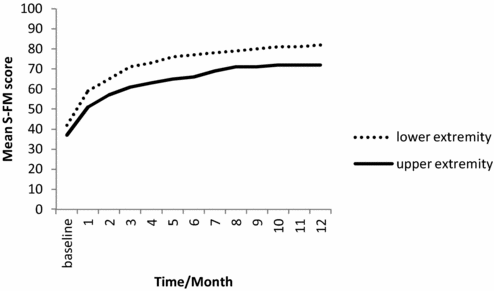
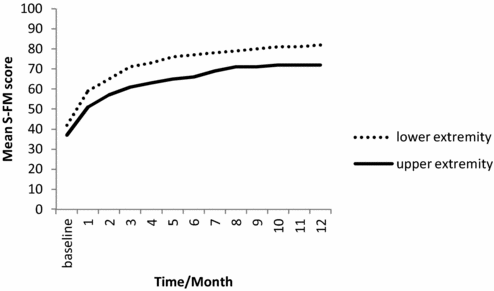
As analysed with paired t-tests, mean motor performance score for the affected upper and lower extremity did not differ significantly at baseline (p = .I7). Mean motor performance score for the affected lower extremity was, however, significantly higher than that of the upper extremity from 1 to 12 months, with p < .01 at 3, 4, 5, 6 and 12 months and p < .05 for the remaining months (Figure 3).
Pattern of upper and lower extremity motor performance (S-FM) over 12 months. Significantly higher motor performance scores in the lower extremity from 1 to 12 months.
Discussion
Impairment of motor performance, often presenting as hemiplegia or hemiparesis, is a major and very important feature of stroke. The predominance of reports on the conclusion of motor recovery in the first 3–6 months of stroke (De Wit et al., Reference De Wit, Putman, Schuback, Komarek, Angst, Baert and De Weerdt2007; Duncan et al., Reference Duncan, Goldstein, Horner, Landsman, Samsa and Matchar1994; Kwakkel & Kollen, Reference Kwakkel and Kollen2013; Kwakkel et al., Reference Kwakkel, Kollen and Twisk2006; Wade et al., Reference Wade, Langton-hewer, Wood, Skilbeck and Ismail1983) has, however, resulted in a shortage of studies on long-term trends. One major shortcoming of these reports is that they all emanated from longitudinal studies that were restricted to 3–6 months after stroke. This present study examined motor performance in Nigerian stroke survivors over the first 12 months. We observed significant improvement across the study period, similar to findings of the few studies that have examined motor performance at chronic stages of stroke (Ferrucci et al., Reference Ferrucci, Bandinelli, Guralnik, Lamponi, Bertini, Falchini and Baroni1999; Horgan et al., Reference Horgan, O'Regan, Cunningham and Finn2009). Neuroplasticity has been identified as being central to the long-term recovery of motor performance after stroke, with the brain possessing the ability to recover long after an acute injury, even up to an average of about 5 years after stroke (Lo et al., Reference Lo, Guarino, Richards, Haselkorn, Wittenberg, Fererman and Peduzzi2010). Hence, extended periods of rehabilitation, using techniques that enhance neuroplasticity, will be required for optimal outcomes in the long term (Krakauer, Reference Krakauer2005).
Severity Strata of Motor Performance Impairment over 12 Months
About half of the stroke survivors had severe initial motor impairment according to the S-FM, while only a fifth presented with mild impairment. Based on the Stroke Levity Scale, approximately half the sample also had severe stroke at onset. The high incidence of severe stroke among people of African ancestry has been reported previously (Horner et al., Reference Horner, Matchar, Divine and Feussner1991). However, at 12 months, 60% of the stroke survivors presented with mild motor impairment, representing a tripling of the baseline proportion and significant recovery over time. On the contrary, in a study of an unselected population of Caucasians with stroke, there were equal numbers of participants with mild, moderate and severe motor impairment at onset, while about 80% had mild or no motor deficit by 6 months (Bonita & Beaglehole, Reference Bonita and Beaglehole1988).
It is worthy of note that equal proportions of the stroke survivors in this present study had severely impaired motor performance at both 6 and 12 months. While the proportion of patients with mild stroke increased across the 12 months, the proportion of those with severe stroke declined up until the sixth month, after which it stabilised. Although the low likelihood of appreciable improvement in motor status after 6 months of stroke has been widely reported (De Wit et al., Reference De Wit, Putman, Schuback, Komarek, Angst, Baert and De Weerdt2007; Duncan et al., Reference Duncan, Goldstein, Horner, Landsman, Samsa and Matchar1994; Kwakkel & Kollen, Reference Kwakkel and Kollen2013; Kwakkel et al., Reference Kwakkel, Kollen and Twisk2006; Wade et al., Reference Wade, Langton-hewer, Wood, Skilbeck and Ismail1983) and could be assumed as being responsible for this finding, the overall significant improvement, and in those with moderate initial impairment over the same period, weakens that assumption. It is therefore apparent that the fixed status at 6 and 12 months was restricted to those with severe impairment. Described as ‘outliers’, Prabhakaran et al. (Reference Prabhakaran, Zarahn, Riley, Speizer, Chong, Lazae and Krakauer2008) discovered a small group of stroke survivors with severe initial motor impairment who showed poor recovery, distinct from others. One study, however, reported that intensive rehabilitation can result in continued long-term recovery even in severely impaired stroke survivors (Ferrucci et al., Reference Ferrucci, Bandinelli, Guralnik, Lamponi, Bertini, Falchini and Baroni1999). The potential for recovery in those with severe motor deficits was also somewhat portrayed in this present study (Figure 1). Concerted rehabilitation efforts might therefore be required to address cases of severe motor impairment at onset, since such impairment is more likely to persist over time. Such efforts will be in addition to continuous research for novel and evidence-based therapies for chronic severe motor impairments after stroke.
Difference in Motor Performance between the Affected Upper and Lower Extremity
Reports vary regarding differentials in motor performance in the affected upper extremity and lower extremity after stroke. While a lack of significant difference in upper- and lower-extremity motor recovery has been reported (Duncan et al., Reference Duncan, Goldstein, Horner, Landsman, Samsa and Matchar1994; Higgins, Mayo, Desrosiers, Salbach, & Ahmed, Reference Higgins, Mayo, Desrosiers, Salbach and Ahmed2003), there are some reports of better outcomes in the lower extremity than in the upper extremity (Feys et al., Reference Feys, De Weerdt, Selz, Cox Steck, Spichiger, Vereek and Hoydonck1998; Kwakkel, Kollen, & Wagenaar, Reference Kwakkel, Kollen and Wagenaar1999). In this present study, motor performance was significantly worse in the affected upper extremity from 1 to 12 months post stroke. The fact that the middle cerebral artery is affected in the majority of stroke patients, with attendant more profound effect on the upper extremity than the lower extremity (Shelton & Redding, Reference Shelton and Redding2001) may be responsible for our findings, although we did not observe a significant difference between upper- and lower-extremity motor performance at onset. Information on location of stroke was, however, not obtained. It is also important to note that although upper-extremity motor performance was poorer, improvements were still observed across 12 months, as displayed in Figure 3. These findings imply the need for more attention to the treatment of the upper extremity after stroke. For instance, utilising therapies that have been trialled for their efficacy, such as repetitive-task training (Winstein et al., Reference Winstein, Rose, Tan, Lewthwaite, Chui and Azen2004), electrical stimulation (Sonde, Fernaeus, Nilsson, & Viitanen, Reference Sonde, Fernaeus, Nilsson and Viitanen1998), robot-assisted therapy (Lo et al., Reference Lo, Guarino, Richards, Haselkorn, Wittenberg, Fererman and Peduzzi2010; Lum, Burgar, Shor, Majmundar, & van der Loos, Reference Lum, Burgar, Shor, Majmundar and van der Loos2002), Bobath therapy (Platz et al., Reference Platz, Eickhof, van Kaick, Engel, Pinkowski, Kalok and Pause2005) and constraint-induced movement therapy (Sawaki et al., Reference Sawaki, Butler, Leng, Wassenaar, Mohammad, Blanton and Wittenberg2008), may assist in the effective management of post-stroke upper-extremity motor impairments. Additionally, development of, and adherence to, evidence-based stroke rehabilitation guidelines are necessary.
Study Limitations
This study has several limitations. The fact that all the stroke survivors were recruited from in-patient admission might limit the external validity of findings for stroke survivors who do not report to hospitals. The rate of drop-out in this study also constitutes a limitation, although the demographic and clinical characteristics of those who completed the study and those who dropped out did not differ significantly. As was acknowledged in a previous longitudinal study (Hamzat & Peters, Reference Hamzat and Peters2009), challenges of locating patients after hospital discharge, due to poor housing plan and numbering, telecommunication difficulties and frequent relocation (often for non-medical and alternative care), adversely affect the performance of longitudinal studies in Nigeria. Similarly, the small sample size for this study could also limit generalizability of findings. The reliability of the method of stratification of severity of motor impairment was not confirmed, and could also constitute a substantial limitation of this study, although similar methods of stratification have been utilised in previous studies (Duncan et al., Reference Duncan, Goldstein, Horner, Landsman, Samsa and Matchar1994; Duncan, Goldstein, Matchar, Divine, & Feussner, Reference Duncan, Goldstein, Matchar, Divine and Feussner1992).
Conclusions
Motor performance improved significantly in the first 12 months after stroke in the cohort of Nigerian stroke survivors studied. This finding may serve as evidence for the appropriateness of continued rehabilitation efforts in order to maximise the potential for motor recovery at the chronic stage of stroke. The comparatively poor upper-extremity motor performance observed suggests the need for rehabilitation experts in Nigeria to adopt current, effective and proven strategies for upper-extremity rehabilitation after stroke.
Acknowledgement
This research received no specific grant from any funding agency, commercial or not-for-profit sectors.
Conflict of Interest
None.