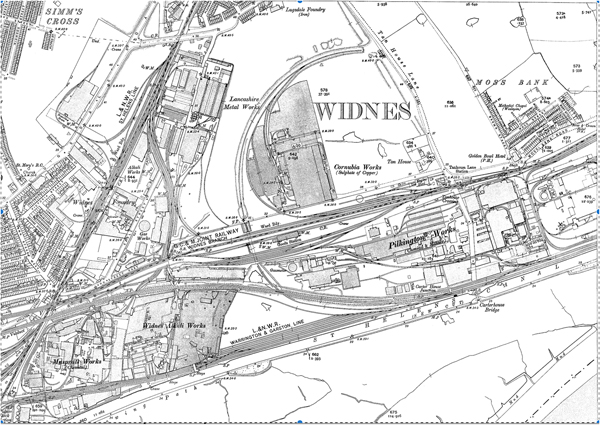
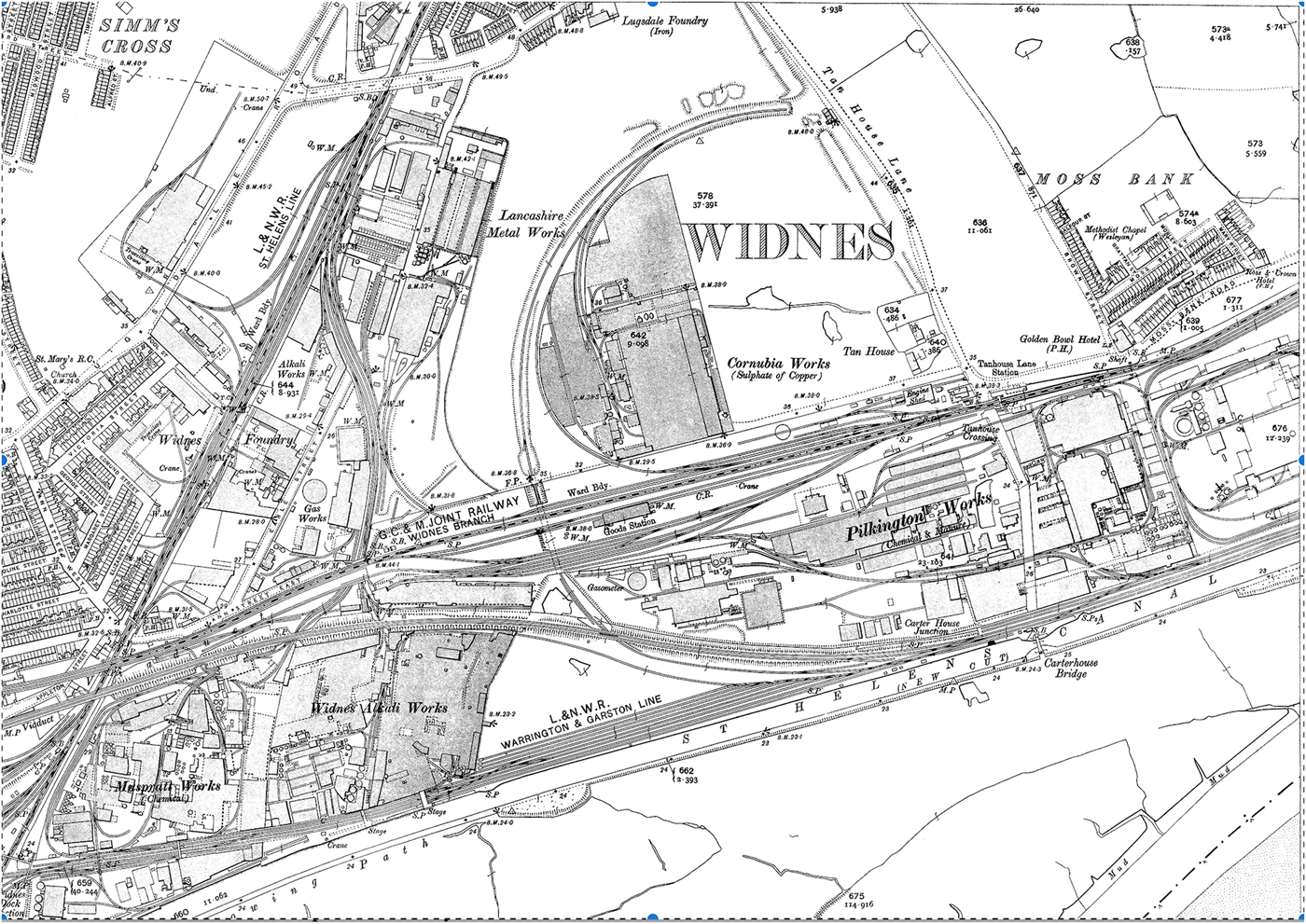
At the Catalyst Science Discovery Centre in Widnes, located on the site of a nineteenth-century alkali chemical factory in northwest England, near Liverpool, the history of the British chemical industry is narrated in stories that while mostly being about national progress through chemical discovery and invention, are also stories about local people and places. (Fig. 1) Between 1848 and 1880, this area witnessed the rapid growth of Britain's new chemical industry. (Fig. 2) Prior to the 1840s, the small community of Widnes had been a sleepy rural hamlet.Footnote 1 The first large-scale alkali works in Widnes were established by John Hutchinson, adjacent to Widnes Dock and the terminus of the St. Helens Canal, in 1847.Footnote 2
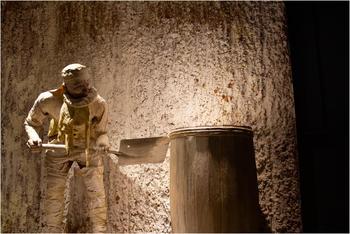
Bleach packer tableau with mannequin at Catalyst Science Discovery Centre, Widnes, England. Source: Paul Meara.

Widnes Ordnance Survey map showing the location of local alkali works, c. 1905. Printed in Widnes 1905: Lancashire Sheet 115.09 (Old Ordnance Survey Maps of Lancashire). London: Alan Godfrey, 1907.
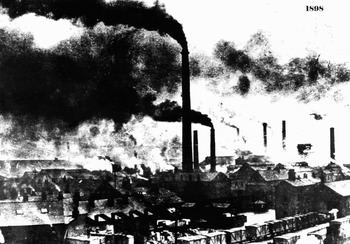
This region had a number of advantages for the chemical trade: easy access to the essential raw materials, including salt, coal, and limestone, as well as specially built railway lines and docks. It also was near the local glassmaking industry (the main prospective customer base for the sodium carbonate alkali).Footnote 3 For a few decades in the nineteenth century, alkali production was a rapidly growing business, attracting large numbers of male workers to the regionFootnote 4 (from 1851 to 1871, the population of Widnes grew from 3,211 to 14,300).Footnote 5 However, chemical factories were one of the dirtiest, smelliest, and most dangerous places to work in England. The regulation of industrial pollution in the United Kingdom before the 1950s was generally weak, leading to indiscriminate discharges of pollution and dumping of waste (some of which may still be present in the local environment; for example, as contaminated land).Footnote 6 Testimony from townspeople, medical officers, inspectors, workers, and visitors attests to the sensory impact of the chemical industry in the region.Footnote 7 (Fig. 3)
“Smoke Over Widnes,” gelatin photograph, ca. 1898 (photographer unknown). Source: Robert Martindale.

Locating the chemical industry in rural areas like Widnes reduced its exposure to costly nuisance lawsuits from city dwellers (though not from local farmers and landowners). In contrast to the Victorian textile industry, which was mostly located in large cities, the alkali industry of Widnes and St. Helen's existed largely away from the eyes of people who consumed its end products. A dangerous occupation during decades when, as Carolyn Malone has shown, the focus of most labor reformers concerned with the hazardous trades was on work by women and children; the Victorian production of alkali—with its labor force dominated by young to middle-aged working-class men and Irish immigrants and near invisibility relative to other manufacturing trades—attracted less attention.Footnote 8 Only gradually did the labor of the chemical worker—in factories for heavy industry that were mostly removed from established city centers—become a subject of concern. Despite the importance of the chemical industry in nineteenth-century Britain, more attention has been paid to the textile industry and industries associated with the production, for example, of white lead (perhaps because those factories were situated within large metropolitan areas in London and the north). By contrast, Britain's chemical factories were built on lands in the northwest of Britain that previously had been agricultural, beyond the immediate sight (and smell) of reformers.
One of the most striking museum exhibits at the Catalyst Science Discovery Centre is a full-size model of a chemical worker, depicted as if caught in motion shoveling a white bleaching powder into a barrel, clad in clothing that is entirely white, with a protective rag across his face.Footnote 9 (Fig. 1) In public narratives about the history of the chemical industry in Victorian Britain, the individual chemical worker is often not seen or remembered. Examining how the alkali worker became visible within the discourses of late Victorian industrial reform can reveal important and otherwise hidden aspects of conditions of work in the British chemical trades. This paper focuses on the Victorian chemical industry in addressing several questions that lie at the heart of this special issue of ILWCH: What is the relationship between waste work and labor? What unseen stories are revealed when this connection is explored? Using newly recovered archival and primary sources, this paper offers a brief account of the history of waste work, its removal, and its depiction in visual sources in the late nineteenth century.
This paper considers how Robert Harborough Sherard's essays, serialized in Pearson's Magazine in 1896 and published the following year as a book, The White Slaves of England, being true pictures of certain social conditions in the Kingdom of England in the year 1897, presented the story of the alkali industry as a series of “life-stories.” More than any other single work, that 1897 essay finally brought the alkali workers and waste work in Britain into national, and even international, view in the late 1890s. Beyond documenting the devastating conditions of the nineteenth century chemical industry, the paper addresses how bodies and environments were differentially valued and made to matter, debates triggered by 1) entangled processes of human and landscape wasting and 2) visual techniques that rendered these industrial byproducts visible. The case of the alkali workers and waste thus indicates how a focus on waste products and wasted bodies became a way of combining environmental and labor concerns, and how appeals to embodied wasting processes both magnified and undercut prevalent constructions of working class masculinity, as well as suggesting the important role that Victorian popular visual culture played in making the problems of the alkali worker concrete for middle-class readers.Footnote 10 The conclusion is that late Victorians used visual technologies, such as mass illustrated magazines, to imagine nineteenth-century chemical waste work being done in largely rural areas at a moment when the image of industrial labor was (and remains) dominated by images of textile manufacture in London and large northern cities.
A Dirty Industry
Before Widnes and St. Helen's, the first chemical works had been established in Liverpool, by James Muspratt (1793–1886), who was the first in the United Kingdom to make alkali by the Leblanc process on a large scale. Muspratt found himself in court on a number of occasions to face charges of causing a nuisance, though he usually got off without punishment.Footnote 11 In one case in 1838, he escaped with a fine of one shilling having “proved” that muriatic acid gas possessed beneficial properties. The judge and jury had a hard time evaluating the conflicting scientific evidence presented by the defense and plaintiff.
From about 1820 until the 1880s the Mersey Basin was a center for the alkali industry, with production centered at various times in Liverpool, St. Helens, Newton le Willows, Runcorn, and Widnes, located along the Mersey River.Footnote 12 The Mersey River earned the reputation of being the most polluted estuary in Europe.Footnote 13 One horrified onlooker, the London-based journalist Sherard, described Widnes in 1896 as: “Squalid cottages, large areas of muddy waste, with a pigsty here and there, and perhaps a gipsy's van in a desert of puddles and mud; black alleys, intricate gangways over an intricate network of railways, high chimneys on every side, and below these such grotesque shapes of towers and bubbling cauldrons and tanks and wheels, as seem the very nightmare of industrialism.” Sherard noted that its structures were not built to last: Sheds were “knocked together anyhow, with great holes in the roof and door-less entrances on every side.” “There are open sewers, too, through which the green liquid refuse of factories is carried off, canals on which squat barges lie at anchor, and when the tide is out there may be seen by the great railway bridge which spans the Mersey a huge expanse of muddy sand.”Footnote 14
By 1872 there were thirty-five industrial plants in Widnes of which twenty-four were described as chemical works.Footnote 15 John Hutchinson's alkali works of 1847 were soon joined by that of William Gossage (1850), the Muspratt family (1852), and Henry Deacon (1853). Gossage diversified into soap production in 1853, being one of the first to exploit the detergent qualities of sodium silicate. Gossage's popular mottled soap (marketed as “Magical” and pitched to lower as well as higher social orders) was created by adding traces of iron sulphides to the production process. While he made his name and fortune in soap, Gossage's chief interest was chemical invention. Gossage towers, for the condensation of acid fumes evolved from the saltcake phase of the Leblanc process, were erected at practically every alkali factory in the world. Gossage attempted the solution of two major problems of the nineteenth century soda industry: the recovery of the sulfur from the alkali waste and the development of a practical ammonia-soda process to displace the Leblanc system.Footnote 16
Victorian chemistry was a filthy industry, but its products—soap, glass, dyed fabrics, and fertilizer for lawns—were the very elements of the Victorian middle-class' identity of “civilization.”Footnote 17 An article published on “The Chemical Industry” in the London Times (April 13, 1898) openly stated that the alkali trade was driven by “somewhat more than proportional development of the desire for reading, washing, and windows.” Alkali soda was “the chief magic agent by the operation of which things common and even despised in themselves—rags, wood pulp, animal fats, and sand—have been converted in vast quantities into substances affording the vehicles of mental instruction and information, the means of bodily cleanliness, and perhaps the most essential physical requisite of domestic comfort.” It continues: “The scale of the world's chemical, and very specially of its alkali, manufacture affords, and that not only on the material side, a fair measure of the diffusion of the elements of civilization.”Footnote 18
Other products of alkali manufacture were glass and textile dyes. Ammonia from alkali was widely used as a household cleaner. Magnesium hydroxide was used in the production of antacid and other medicines and calcium hydroxide (or lime) to raise the pH value of acidic soil for healthy growth of plants. Alkali was even used in food and beverages, for example, to darken cocoa—a process known as “dutching.”Footnote 19 From glass to gardens, from soap to cocoa, from urban life to agricultural industry, alkali was an omnipresent material in nineteenth-century Britain. Yet despite its seeming ubiquity, alkali metals and their synthetic production and transmutations are seldom thought of as a material, visual, or social presence in Victorian Britain.
Chemistry posed a special problem for those who sought to reduce the amount of wasteful output, however. Alkali, or sodium carbonate, was first manufactured on a large industrial scale through the adoption of the Leblanc process, whereby salt was reacted with sulfuric acid to produce sodium sulphate, which was then heated with coal and limestone, or chalk, to form a crude soda known as black ash. Yet, as the country's leading authority at the time on waste re-use, P.I. Simmonds, explained: “It is a well-known fact that more than nine-tenths of the sulphur used in the manufacture of soda is retained in the material called ‘alkali-waste,’ which is thrown away by the manufacturer. Thus is presented a problem, the thorough solving of which would effect a large reduction in the cost of soda.”Footnote 20 The waste from alkali factories in Widnes accumulated “at the rate of five or six hundred tons per week. From 15 to 20 per cent of sulphur lies buried in it—a total loss to industry, and a positive detriment to the surrounding air, which it infects with the noisome odour of sulphuretted hydrogen.”Footnote 21 By 1873, the total salt cake from which waste was obtained in Great Britain amounted to 385,000 tons a year; and about 90 percent of the sulphur, or 66,600 tons, remained in the waste.Footnote 22 Yet little or no effort was made to recycle waste, which was simply dumped on the surrounding land if they were solids, fed into rivers or streams if they were liquids, or released into the atmosphere if they were gases—such as hydrogen chloride.Footnote 23 Complaints from people who lived in the surrounding neighborhood—farmers and landowners, in particular—drew public attention to the problems of chemical industry pollution and waste disposal, but in the face of “nuisance” law suits (claiming damages for adverse effects of industrial outputs on physical surroundings, health, vegetation, and farm values), industry, local, and central government struggled to provide a legislative framework to mitigate the problem.Footnote 24
Adverse Health Effects of the Victorian Chemical Trades
An unusually wide range of chemical manufacturing processes took place in this sector, each with its distinctive residues and emissions to the environment.Footnote 25 Under the British Alkali Act of 1863, an alkali inspector and four sub-inspectors were appointed to curb discharge into the air of muriatic acid gas (gaseous hydrochloric acid) from Leblanc alkali works. Under the 1874 Alkali Act, the inspector became the chief inspector, and the first person to hold the post was Dr. Robert Angus Smith, said to have coined the term “acid rain.”Footnote 26 Yet the state of atmospheric pollution did not greatly improve in Widnes despite the passing of these Acts, and waste continued to accumulate. The Vicar of Widnes in the 1870s gave evidence before the Royal Commission on “Noxious Vapours” on October 12, 1876, testifying that the poor air quality in Widnes caused him to lose his voice during sermons. As one visitor described it, “spring never comes hither.” “The foul gases which, belched forth night and day from the many factories, rot the clothes, the teeth, and in the end, the bodies of the workers, have killed every tree and every blade of grass for miles.” “There was no green anymore, a malodorous wind from the south, nuisance, sulphuretted hydrogen and other gases. Trees cannot live here, but men must and do.”Footnote 27 It was widely reported by 1891 that about five hundred acres of land in the Widnes and Ditton Marsh region had been buried under an average depth of twelve feet of sulphurous waste: a by-product of alkali production (locally referred to as “galligu,” which was produced during the third stage, when sodium carbonate was extracted from water).Footnote 28 This foul-smelling and viscous substance, also referred to as “alkali waste,” “tank waste,” and “vat waste,” was deposited in enormous quantities in the alkali factories and surroundings. [Today, the list of potentially polluting emissions, wastes, and residues that have been identified as associated with historical manufacturing in the region includes an unusually large number of compounds: acids, alum, arsenic, barium, copper, hydrogen cyanide, muriatic acid (hydrochloric acid), alkalis, asbestos, chlorinated organic wastes, galligu (sulphurous waste), lead, mercurcy, and nitric acid, to name just a few.]
The discharge of effluents from the chemical manufacturing processes into wastewater and onto local land resulted in the area gaining a reputation as one of the most polluted areas in Europe. Research on the Mersey River has confirmed that it has suffered a legacy of abuse and neglect since the beginning of the Industrial Revolution. Because the region has such a long and distinctive history of industrial activity, including the manufacture of alkalis, acids, chlorines, organic and inorganic chemicals, and other potentially harmful substances, the effects of discharges to air, land, and water—including the effects of contaminants remaining in the soil as a result of past industrial practices—remain as significant issues for the borough councils, voluntary groups, and local residents even today.Footnote 29
The Scottish scientist A.P. Laurie, who in 1902 published one of the first scientific studies of the manufacture of chemical substances (arsenic, lead, copper, mercury, chlorine, antimony, etc.) in relation to health, explained why chemical factories were suspected as having an impact on health symptoms and occupational mortality of alkali workers and others did not lead to significant remedies. His essay, “The Chemical Trades,” published in Sir Thomas Oliver's Dangerous Trades in 1902, a collection of essays by leading researchers on the subject of “occupation diseases,” noted that studies of aniline and other chemicals showed that substances were “dangerous to health” and urged that “special measures” were required to protect the workers.Footnote 30 He cited especially the accidents involved when making caustic soda, the “impurities” of the air, and the effects of chlorine gas when breathed. As for some of the chemicals used in the alkali industries—such as cyanide, compounds of antimony and arsenic, and barium—they were known as having “poisonous qualities,” which “have been shown very clearly upon the workmen,” e.g., in the form of dizziness, pain, paralysis, and fuzzy vision.
Yet even he was cautious about recommending fundamental changes, saying that more scientific research was needed to establish the links to adverse health effects. While he agreed that the “general conditions of the chemical worker” were “terrible,” for example, he also said the science did not necessarily prove a causal link between exposure to chemical compounds and adverse health effects, and noted that “how far they affect his health is a more difficult matter.” In contrast to some industries, where it was “very easy to trace back the cause of illness” to the source, with heavy industrial chemical manufacturing work, “when we are dealing with a general undermining of health, it is much more difficult to give definite figures or definite facts as to the effects of an industry.” Furthermore, many chemical compounds that formed the basis of the alkali industry were themselves “so new to science that their possible poisonous qualities are not yet known,” he stated. The chemicals existed in mixtures (of galligu, arsenic, hydrated lime, lead, asbestos, and hydrocarbons): many of which, though “manufactured in very large quantities … have not, as far as I am aware, ever been studied in relation to health.”Footnote 31 He strongly agreed that more work was needed to find out what the health effects of this branch of chemical manufacturing were. Yet like many medical commentators on the issue at the time, he urged the need for “special precautions” in the workplace, saying that if “every precaution” were taken for efficient ventilation and removal of dust, there was “no reason why many of these substances should not be manufactured, although poisonous in their nature, without injury to the workmen.”Footnote 32 (He also downplayed the deleterious health effects on people living in the neighborhood of factories, who often were mostly workers, saying that though they frequently breathed gases, such as sulphuretted hydrogen, and while “they seem at first to suffer in health, loss of appetite, and so on, they seem soon to adjust themselves to it, and not to suffer any permanent inconvenience.” At the same time, he insisted, it was “very difficult” without “a large number of cases very carefully watched for many years, to tell how far the presence of this gas is deleterious to health in its ultimate effects.”Footnote 33)
These remarks expressed a wider view shared by many in the newly professionalizing public health community at the time that long-term cohort studies of specific populations were required to prove a causal link or bodily harm due to exposure to specific chemicals. Today, too, a similar reason is raised when questions, or specific information, are requested about the impact of specific traces of chemical pollutants on health. In a region where large toxic waste dumps are discovered under development and regeneration sites, where residents in the area often have expressed concern about the impact of environmental pollution on health; and where standardized mortality ratios (SMRS) are especially high for cancers, coronary heart disease, circulatory disease, stroke, and infant mortality, a reason that is often given for the lack of documentation of health effects in the region is “the lack of reliable and objective environmental data for periods before 1980.” As a 2003 report on the factors affecting health in Halton put it, “In the not too distant past, there was relatively little awareness of the risks associated with the release of chemicals to the environment, data was not routinely collected and data that had been gathered was often discarded because its future value was not fully appreciated.”Footnote 34 As the essay below suggests, however, contemporary workers, doctors, and commentators did believe, on the contrary, that the known toxins (arsenic, acid, asbestos, cyanide, mercury, barium, at least) in the production of alkali was wasting the workers' bodies; for a variety of reasons, partly, but not exclusively, to do with the ending of the LeBlanc process by 1900, the health legacies of these chemicals were not seemingly well-researched until the later decades of the twentieth century, for reasons that remain to be explored.
The Chemical Workers of Widnes
The complaints of landowners who brought nuisance suits against the chemical industries were relatively well publicized at the time. But until the 1890s, less attention centered on the workers who actually worked with the waste: producing it, moving it, burying it. Meanwhile, Victorian critics of the pollution in the region focused their comments most often on the presence of muriatic acid (hydrochloric acid) released from chimneys (not on sulphurous waste that contaminated land and water).
Who were the chemical workers of Widnes? More research is needed but some information is available. From 1851 to 1871, the population of Widnes grew from 3,211 to 14,300, as labor migrated into the town.Footnote 35 The majority of laborers apparently came from Ireland and lived in a squalid area of town called “Pigtown” (and later Newtown). The classification of chemical laborer was the largest group in the town after 1861. Other categories of workers included semi-skilled railway and dock laborers, carters and watermen.Footnote 36 While some of the chemical workers made their home in Widnes, many moved from place to place.Footnote 37
Two changes occurred in the 1860s that profoundly affected the workers in Widnes. First, the establishment of the Companies Act in 1862 allowed companies to be run by managers rather than by the owners and their families. This had the effect, Williams shows, of separating the entrepreneur from his workforce and substituting a manager, “often foreign to the neighborhood and unsympathetic to the problems of the workforce.”Footnote 38 A second major change was the establishment of a Local Board of Health in 1865, whose members included six chemical manufacturers, two watchmakers, and one farmer.Footnote 39 The board negotiated internally over the condition of sewers, cesspools, slaughterhouses, and the supply of gas, hospital care, and (in an era fearful of cholera) the public water supply, but with no public funds or statutory powers. In July 1866, it decided to appoint a medical officer of health, and after a series of negotiations over years, a property was purchased and the Widnes Accident Hospital opened its doors in 1878.
The rapid industrial development brought with it a new and shifting hierarchy of labor. The alkali industry was particularly hostile to unions. A widely shared report among workers in the 1890s was that the average wages paid to alkali workers declined by fifty percent since the various masters syndicated their interests, even while the final products increased in price.Footnote 40 The elite workers in the Leblanc alkali process were those most physically capable of enduring the work.
The “packers” regarded themselves as the best workers but the process was so dangerous that few could stand it for any length of time. Other workers marked out for their dangerous trades were salt-cake men, lime men, vat men and burners. Their pre-eminence in the industry would mark to ascendancy of the semi-skilled worker, from among occupations which had never demanded apprenticeships. This new trend indicates the beginning of a threefold division in the chemical industry, a division between “process,” “yard” and “maintenance” workers.Footnote 41
Their work was continuous: Night shifts were routine and paid at the same rates as day shifts.Footnote 42
By 1871, moreover, semi-skilled and skilled workers were emerging in Widnes as important social groups. Unions, clubs, societies, and institutions became platforms on which emerging social groups were able to participate. After 1871, a flourishing science and art evening institute provided courses in town. As the management force grew after 1871, large numbers of them took their families to Farnworth, somewhat removed from the factory pollution; as one historian has noted, this was “a classical case of urban development where the poorest areas of a town were those from which the overseers and managers had moved.”Footnote 43
Dangerous Work
Many of the men met early deaths in the chemical factories. A medical inspector pointed out that around 1900 the chemical trades headed “all other industries in the number of deaths put down to accident.”Footnote 44 In fact, the inspector continued, “we may say that chemical manufacture is to be ranked among one of the most unhealthy of our industries,” and “Furthermore, it is one of our industries in which it is not easy to improve the health of the worker.”Footnote 45
Yet a certain fatalism about industrial diseases prevailed at the time. The few medical inspectors who actually visited the chemical factories noted that the variabilities of the work (including the state of the furnace, the condition of the weather, the moisture in the air, the speed at which the workmen worked, whether the material had time to cool, etc.) made it hard to pinpoint precisely what the effects of the work were.Footnote 46 As a result, one said, “Where we have, for example, lead poisoning produced by an industry, it is very easy to trace back the cause of illness, but when we are dealing with a general undermining of health, it is much more difficult to give definite figures or definite facts as to the effects of an industry.”Footnote 47
Most alkali factories before the 1892 Act had no accident funds.Footnote 48 There was difficulty even defining what was meant by “industrial disease.”Footnote 49 One of the leading authorities on industrial diseases at the time, Sir Thomas Oliver, professor of physiology at the University of Durham and medical expert on the White Lead, Dangerous Trades, Potteries and Lucifer Match Committees of the Home Office, defined “industrial disease” around 1902 as “the direct effects of a particular trade in which a person is engaged.” In some cases, these were indirectly induced (usually referred to in the medical literature as a “gradual deterioration of health”). In order to make an employer liable there would need to be a stated length of time the individual had worked in a factory, but “in some of the dangerous trades the workpeople change frequently from factory to factory.”Footnote 50
By the 1860s, the long and fierce battles waged over hours and wages in the textile works began to extend to other trades, although the alkali trade saw few effects.Footnote 51 In 1883, for example, rules that were developed for mines began to be applied to white lead works, one of the first efforts to directly regulate a dangerous manufacturing industry.Footnote 52 According to Dr. O'Keefe, doctor to the Mersey Chemical Works Club, the illnesses seen with the greatest frequency were: bronchitis, bronchial asthma, bronchia catarrh, and lung diseases fostered by the great heat of the furnaces simultaneously with the icy cold of the poorly covered, ill-closed works.Footnote 53 Another local doctor (Bellew) told the investigative journalist Sherard that “if the published statistics show but a small death-rate in the chemical trade, it is because the chemical yard only kills a man three parts out of four, leaving the workhouse to do the rest.”Footnote 54 On average, men lived to about forty-five to fifty-five years of age. Bellew testified that “The tubes become blocked up and asthmatical; the gases destroy all elasticity of the tubes. The lime-men get soft stone. All get more or less anaemic. Asthma, kidney disease, chronic cystitis are the perquisites of many.” Drink contributed to their poor health. “They drink because they cannot eat.”Footnote 55 The acid ate away at the emulsion on their teeth and destroyed their teeth, leaving them with toothless, blackened gums.
The workers themselves sought to draw attention to the factory conditions. In 1891, a supporter of alkali workers (who later served briefly as its first and short-lived union president) P.J. King sent the First Yearly Report of the Chemical and Copper Workers’ Union to Parliament.Footnote 56 In the report, the workers and their (short-lived) union representatives referred to themselves as “chemical slaves” —a term that later became attached to them through the publication of an investigative magazine essay a few years later.
Local reform efforts were evident in scattered activities, such as regulations aimed at ameliorating the atmosphere by pressuring chemical industry employers to reduce the amounts of hydrochloric acid emissions, to issue guidelines for contract out work, and to establish accident hospitals and compensation funds.Footnote 57 While there were some reform efforts at addressing problems of poverty, temperance, and so on, overall we should be cautious about imposing the same image of reform over Victorian Widnes as is often applied to larger cities like London and Manchester. Chemical companies themselves for the most part seemed to have been particularly resistant to labor reforms. Moreover, many of the workers in the trade were transitional: Many did not live in Widnes for long, and because the city was so dirty and foul-smelling, it did not attract many residents who were not already invested in some way in the industry.
In the context of a wider national focus on labor conditions in the 1890s, however, the harsh conditions in which alkali workers worked began to enter the public eye (although, it would turn out, with little practical effect). According to the 1891 report: “The masters might say that the men are remunerated for any labour they might perform, but I will reply that no money can compensate them for the loss of their health, for a wrecked and broken-down constitution.”Footnote 58 King complained that the town of St. Helens was, “as everyone knows, in the hands of a plutocracy.”Footnote 59 King noted that there were four thousand chemical workers in Widnes and eight thousand in St. Helen's. In his essay, “The Cry of the Chemical Slave,” King explained that “It will come as a revelation to many to know that every fourth man in Whiston Workhouse was formerly a chemical worker or a chemical labourer in this union, driven there by ill-health or poverty, or more frequently by both.” Of the 689 patients treated at the two local hospitals, 178 came from St. Helens’ chemical works, 86 from the glass works, and 75 from the collieries.Footnote 60 The report furnished extensive testimony from workers, who were individually identified and named. And some of them were given voice: “No Hope,” was the title given to Andrew Keating's testimony as related to King. Keating was “a salt-cake man,” employed at Muspratt's chemical works in Widnes. He had been at the workhouse for several months suffering from bronchitis. He had worked for twenty-one or twenty-two years among the noxious gases of the chemical works. Thomas Allwell was a Northern Irish man whose “looks belied his name.” He had worked in chemical works for thirteen years, “10 years among the salt cake.” Allwell explained to King that “The bodily labour was bad enough, but them gases was the worst … it will break any man down.”Footnote 61 According to him, a skilled chemical worker was “done” at forty-five years old, and most worked eighty-four hours per week. Patrick Donalson (whose “wasted form” could be seen by the firelight, according to King) was brought to the workhouse “by the bad gases … and nothing else.”Footnote 62 Thomas Ryan had lost an eye through a splash of black ash liquor and was unable to work afterwards. All who gave testimony to King agreed that the novice observer would have no trouble picking out the chemical man. “His wheezy breathing proclaimed the fact.”Footnote 63
In “Fairly Choked with Gas,” King furnished testimony from a man who worked among the black ash who described how the acid dropped down, burning holes in his shirt. “That's the way our money goes. People think we get big money, but believe me, when the wear and tear is taken out of it, the commonest labourer is perhaps better off without working half so hard.”Footnote 64 Asked how the gas affected him, he replied that he was “fairly choked with the smells in the morning.” He put a rag in his mouth in a mostly futile effort to keep out the fumes. He had only been at the job for eighteen months; after a few years, men's “teeth become black, and melt away to the gums.” The narrator said he, like the others, was broad-chested, muscular, and young. “But, alas! The slavery of the chemical yards, if allowed to continue, will tell its own tale before many years.” He continued: “There are men in the workhouse hospital at Whiston [workhouse] to-day with frames which were once as powerful as those of the men referred to, but who now are utter wrecks at forty years of age.”Footnote 65
King said all the men they interviewed said that a system of state insurance, such as that in Germany, would be desirable (and that the men would be happy to contribute to it from their wages).Footnote 66 One man told King that it cost him a new pair of trousers every three weeks. “The gas that knocks us up could be stopped a good deal if they liked to do it. If it affected their horses as it does the men they would have found a remedy for it before this.”Footnote 67 Another speaker, a “boiler,” reflected: “Now that the Union has been formed I hope that the whole thing will be exposed, and that the public will take our hard lot into consideration. Why don't I work elsewhere? That is a question easier asked than answered. Perhaps we have people depending upon us, and we cannot afford. Die prematurely? Yes, perhaps so; but I supposed that is the will of God.”Footnote 68 Another argued that the laborers were not “altogether fools,” “not like the fellows of 20 or 30 years ago, who were unable to read the newspapers for themselves.”Footnote 69
The local newspaper furnishes a rare and valuable record of both the “slow” and “fast” violence of industrial work in Halton. The Widnes Weekly News (later subsumed by the Liverpool Echo) regularly covered the news of fatalities and injuries in the chemical industry. For example, a report on February 1, 1896, told of a “Terrible Fatality in Sewer: Three Men Suffocated, Two Others ‘Gassed’” at Muspratt's Works. The process of cleaning out the sewer “is both dangerous and arduous, so much so that the men at that point took turns, relieving each other every five or ten minutes.” They were provided with respirators but the reporter was not sure whether they were wearing them at the time. One worker died when overcome by a “strong current of sulphuretted hydrogen which was emitted from the sewer.”Footnote 70
On February 29, 1896, the paper reported that a worker aged thirty-seven got his clothing caught in a revolving shaft, and died on the way to the hospital. It was said at the inquest that the shafts needed to be boxed in. As in most cases that I have found so far, at least, the coroner was slow to assign blame to manufacturers, who tended to respond (as here) with some modest safety innovations. On January 16, 1897, one of the long iron chimneys of the caustic plant extension fell, demolishing part of the roof and killing one worker.Footnote 71
Some workers, it seems, were well aware of the rights-based labor discourses being picked up in the country. One man added: “I saw by the papers to-day that Lord Randolph Churchill is going in for the Eight Hours’ movement, and I hope that all other statesmen, irrespective of party, will go in for the same thing; I am sure they would if they only spent one night in a chemical yard.”Footnote 72
Alkali workers appealed to politicians and reformers to spend “one night in a chemical yard” to understand what conditions of their work were like. The fact that alkali work entered public eye in a major way in the 1890s required framing the hazardous conditions of alkali work as a problem of industrial labor more generally.
The Condition of Alkali Workers Enters National Industrial Labor Discourses
By the 1890s, there were many calls to reform the “dangerous trades.” Although state intervention in the direction of industry had been relatively weak earlier in the century, there was growing interest by the late 1870s and 1880s, as an organized labor movement developed, for the possibilities of state action, which developed into a wider campaign from 1886 to 1893 for the eight-hour day.Footnote 73
Up to the early 1890s, the worker in the alkali chemical trades was relatively invisible in the broader national discussion about British industrialization in the nineteenth century. The relative remoteness of chemical processing from major metropolitan areas, the emphasis seen among many labor reformers on reforming working conditions for women and children, a weak system of industry regulation, and a general fatalism toward occupational health risks associated with factory work, among other factors, meant that the social awareness of the harsh conditions of labor in the heavy chemical manufacturing trades were less well-known to metropolitan audiences in London and northern cities than, for example, in other industrial occupations.
One of the most important vehicles for a new public imagining of the alkali worker as a vulnerable figure was Pearson's Magazine, an illustrated monthly magazine founded in 1896. Specializing in speculative literature, political discussion often of a socialist bent, and the arts, its contributors included the leading writers of the day: Upton Sinclair, George Bernard Shaw, Maxim Gorky, Domfort Yates, E. Phillips Oppenheim, and H.G. Wells, who published his famous essay “The War of the Worlds” in Pearson's Magazine in 1898. Newspapers and magazines, in particular Pearson's but also The Star and Daily Chronicle, for example, became leading forces in aggressive investigations that sought to instigate government action.Footnote 74
Published in the inaugural year of the magazine's establishment, “The White Slaves of England” helped define the image of the journal as a reforming magazine that presented contemporary topics in a new light. Sherard (1861–1943), who was a journalist as well as a biographer and novelist, is best known today for his friendship with Oscar Wilde and his publications in Wilde's defense. Born in London, he was the son of a reverend; educated at Oxford and at Bonn University; and special correspondent in various parts of the world for English, American, and Australian newspapers.Footnote 75 In a series of articles, illustrated by the artist Harry Piffard, Sherard addressed the plight of workers in the industries of the north, focusing on the chemical industries in Widnes and St. Helen's. The essays also explored the working conditions of nail makers, slipper makers, tailors, wool combers, white lead workers, and chain makers. Sherard and the artist Harry Piffard (1867–1938) set out to pictorialize the ways that work within dangerous industries, many involving waste and its disposal, affected individual workers and their lives. Piffard accompanied Sherard to visit the factories, and in all but one case was given permission to draw naturalistic sketches. When the United Alkali Company refused permission, he said he joined Sherard in climbing over the wall. Sherard explained that Piffard “visited the factories by the front door, where I had to climb over the wall at the back.” According to Sherard, “The factories I visited were visited by me as a trespasser, and at a trespasser's risk.” “I avoided contact with the masters as far as possible, and am in no way indebted to any of them for assistance in my enterprise.”Footnote 76
Sherard described Widnes as “picturesque by the excess of its ugliness” and added that “It might have tempted [Gustave] Doré—one is sure it would have pleased [Henry] De Groux.”Footnote 77
He stated that “The foul gases, belched forth night and day from the many factories, rot the clothes, the teeth, and, in the end, the bodies of the workers.”Footnote 78 In a statement that reveals much about reformers’ self-conception, as well as about the construction of ontologies of working-class masculinities in this discourse, Sherard said he respected the alkali workers “whose work is so much finer because so much more manly, so much more courageous than this unmanly trade of writing.”Footnote 79 One worker told him: “When you are working, you have one half of your body in the North Pole and the other half in Hell.”Footnote 80 The certainties of a shortened life, possibility of a sudden and terrible death, and constant risks of painful accident “are well known to all the chemical workers in these alkali factories,” and were accepted by them with “indifference.” Another man, asked what they were manufacturing there, replied: “Skeletons.” “[A]nd I, you see, am only half-done.”Footnote 81 The men told him that if they were dug up, they would “supply the raw material for a chemical yard,” for one could get “tons of alkali out of their bones and vats of acid.”Footnote 82 As we will see, this image of the chemical workers as “skeletal” was in contrast to the brawny and robust images of workers in the visual images that accompanied Sherard's piece. In fact, contemporary descriptions of the physical appearance of chemical workers’ bodies varied wildly, from reports that the strongest men were selected for work because of the strenuous physical demands of chemical labor, to accounts that the work itself wore the men down.
Sherard's use of the term “white slaves” to describe the chemical workers merits more analysis. Calling the British industrial workers “white slaves” inaccurately stretched the meaning of slavery beyond the breaking point, yet by the evocation of relations of capital and labor, nineteenth-century readers were invited to draw analogies between the systems of industrial labor and plantation slavery. Sherard's essay, moreover, while explosive and sensational, was not the first public account of the plight of the alkali workers: That distinction, as we have seen, belongs to the alkali workers themselves.
The term had been in circulation at least as early as the early 1800s, and possibly before. (And, as noted earlier, the workers in the nascent chemical union had referred to themselves in their government appeal as “slaves” before Sherard used this term).Footnote 83 The reformers John Cobden and W.T. Stead had used the term in earlier and widely-circulated publications, to refer to industrial labor and sexual trafficking of women, respectively.Footnote 84 John C. Cobden, a politician, protested what he described as “the horrible slavery to which so many thousands of our country men and women are subjected” in The White Slaves of England; compiled from official documents; with twelve spirited illustrations, which was first published in 1853 as a manifesto against unfree labor. The Eliza Armstrong case was a major scandal in the United Kingdom involving a child supposedly bought by prostitution for the purpose of exposing the evils of “white slavery.” While it achieved its purpose of helping to enable the passage of the Criminal Law Amendment Act in 1885, it also exposed the chief perpetrator, the journalist and editor William T. Stead.
As Sherard related, the “salt-cake man” was recognizable by his toothless gums — his teeth, “if not entirely destroyed,” were all but “black stumps.”Footnote 85 This rotting took place within a year of working there. Workers joked that they had to pay people to chew food for them. Removed crusts from bread were strewn on the floor—their teeth were too soft to eat them. “Lime-men” loaded the slaked lime onto lifts, by which it was conveyed to the chamber where it was treated with chlorine. Men sometimes worked with a thick oakum gag or “muzzle” in their mouths, to protect themselves in a cloud of particles. All men, he reported, must wear wool, for the gas rotted cotton in forty-eight hours. Men were seen going home with their breeches roped around their legs, because their garments were sewn with cotton whose seams had gone out.
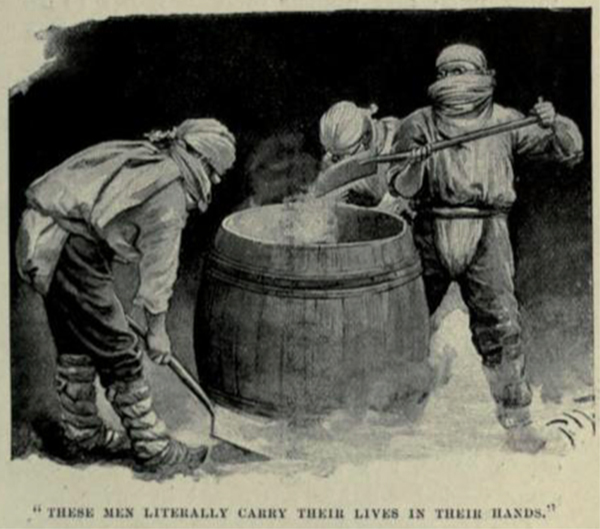
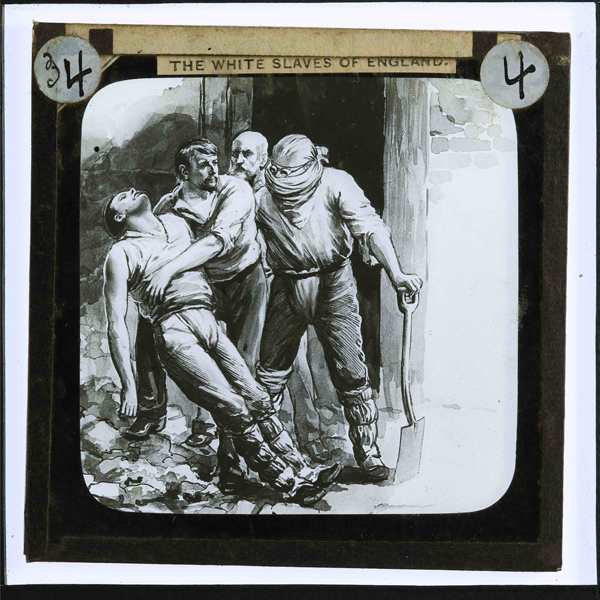
A major ever-present danger for all workers in the chemical factories was chlorine gas—pumped on to slaked lime, and then transformed into bleaching powder, which also produced a green gas, which the workers referred to by a person's name: “Roger.” Workers frequently came into contact with chlorine gas leaks (sometimes fatally).Footnote 86 “Roger” was their worst enemy. The “packers” who packed the bleaching powder after the process into barrels for export worked with goggles on their eyes and several thicknesses of flannel over their mouths, secured by stout cords. They can pack but a few minutes at a time. A “feed” of this gas kills its man in an hour.Footnote 87 A mere walk through the yard was dangerous—for the tanks leaked corrosive fluids “drop and drop.” Sherard narrated that, “One hears of a man who was slowly eaten to death in a vitriol-tan into which he had fallen, and in which he was caught fast. A priest tried to reach him to anoint him, but failed. Hundreds, powerless to help, were looking on. He joked at them between his screams, ‘Were they all out on strike to be idling there?’”Footnote 88
Robert Sherard directly linked the opaque mineral inputs of chemical production to everyday products and familiar commodities of the time, seemingly implicating consumers in the labor and environmental issues that he was making visible. The entrances to the factories were filled with “waggons and waggons” of raw material—“salt, sulphur-stone, slack, and other things which look like the refuse of the mineral world, but which here shall be transformed into yellow sulphur, bright copper, effulgent silver, and various chemicals whose chiefest use is to cleanse.”Footnote 89 His rhetoric evoked the colonial discourses discussed by McClintock—the use of these tropes to talk about both the origins of soap and their effects in the colonies, simultaneously suggesting a link between the moral purpose of missionaries and chemical workers, toiling to advance “civilization” beyond the eye of public recognition.Footnote 90 As Sherard stated: “Cleanliness out of filth, light out of darkness—If cleanliness be indeed next to godliness, then are these white slaves of Widnes pursuing a religious work.”Footnote 91 The almost magical alchemical work of chemistry was transforming minerals into products, “cleanliness out of filth,” and “slaves” out of free men.
Given what he had seen in Widnes, Sherard declared that the temperance reformers should focus their efforts on the elimination of factories altogether, recalling that one doctor had told them that “the men cannot work unless they are half-drunk.”Footnote 92 Yet there is no evidence that Sherard's appeal to other reformers led to practical improvements in the conditions of chemical work (much less the elimination of factories). Government labor and medical reports from the early 1900s confirm the finding that the vast majority of the heavy chemical industries in northern Britain (and in particular the alkali business) cooperated to resist efforts to raise pay or shorten hours, although some ameliorative safety measures were put in place (generally, however, after fatal workplace accidents). While laborers in the Widnes community—especially those seeking to establish a union of alkali workers in the early 1890s—might have welcomed the national exposure brought by Sherard's article, specific documentation of this is hard to establish. Certainly, the few members of the middle-class who lived in Widnes expressed ambivalent views: For example, a local parish priest responded to Sherard's essay, expressing his view that while the reports of the extreme hardships of the chemical laborers were largely true, Sherard sensationalized the workers’ situation and unfairly impugned the morals of a struggling community.Footnote 93 Within a decade after the piece was published, furthermore, the industrial supremacy of the British chemical and metallurgical industry declined, a development that leaders of the chemical industry generally blamed on a combination of things from high labor costs in the United Kingdom to cheapening methods of production, with old methods of manufacture being supplanted by newer ones, e.g., the application of electricity (where other countries had greater access to water-power), to the lack of scientific training among industry leaders, compared with industrial leaders on the Continent. By the early 1900s, the production of synthetic alkali was moving both to regional centers in the southern United States and central continental Europe, among others.Footnote 94
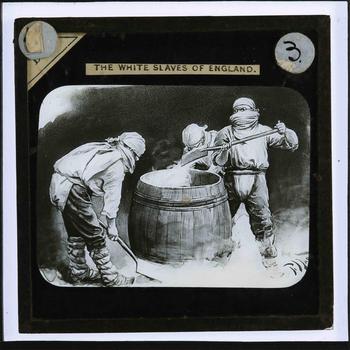
While Sherard's moral campaign on behalf of the alkali workers did not affect immediate improvements to their conditions, by bringing the subject into view as a problem of “unfree” labor of capitalism, and by incorporating images of the workers and the conditions of their work into an essay read outside the Parliamentary governmental context by a mass readership, his essay reached audiences who previously knew nothing—or very little—about the environmental and human costs of this trade. Read widely and cited by others—even incorporated into lantern slide lectures critiquing the dangers to which workers were subjected in the late-Victorian industrial trades—Sherard's piece brought the plight of chemical workers into the open, especially in Victorian middle-class reforming branches of society, which, as previously noted, were already manifesting a growing concern about the state of waste, industrial work, capitalism, and labor. More significantly, perhaps, it brought new visibility to the costs of industry in rural areas like Widnes, not just metropolitan centers. Judging by their recirculation, the illustrations (eight of alkali workers, out of forty altogether in the series) were reproduced in various forms—originally in Pearson's, then subsequently in a book, and, as recently discovered, through lantern slide lectures.Footnote 95 Consider, for example, the three illustrations by Harold Piffard above a caption inserted into the text that reads “These Men Literally Carry Their Lives In Their Hands.”Footnote 96 (Figs. 4 through 6)
Harry Piffard, “These Men Literally Carry Their Lives in Their Hands,” engraving, reproduced in Robert Sherard, The White Slaves of England (London, 1897), 71.

Harry Piffard, “These Men Literally Carry Their Lives in Their Hands,” lantern slide, c. 1900, based on the engraving, reproduced in Robert Sherard, The White Slaves of England (London, 1897), 71. Slide source: Martyn Jolly, Canberra, AU.
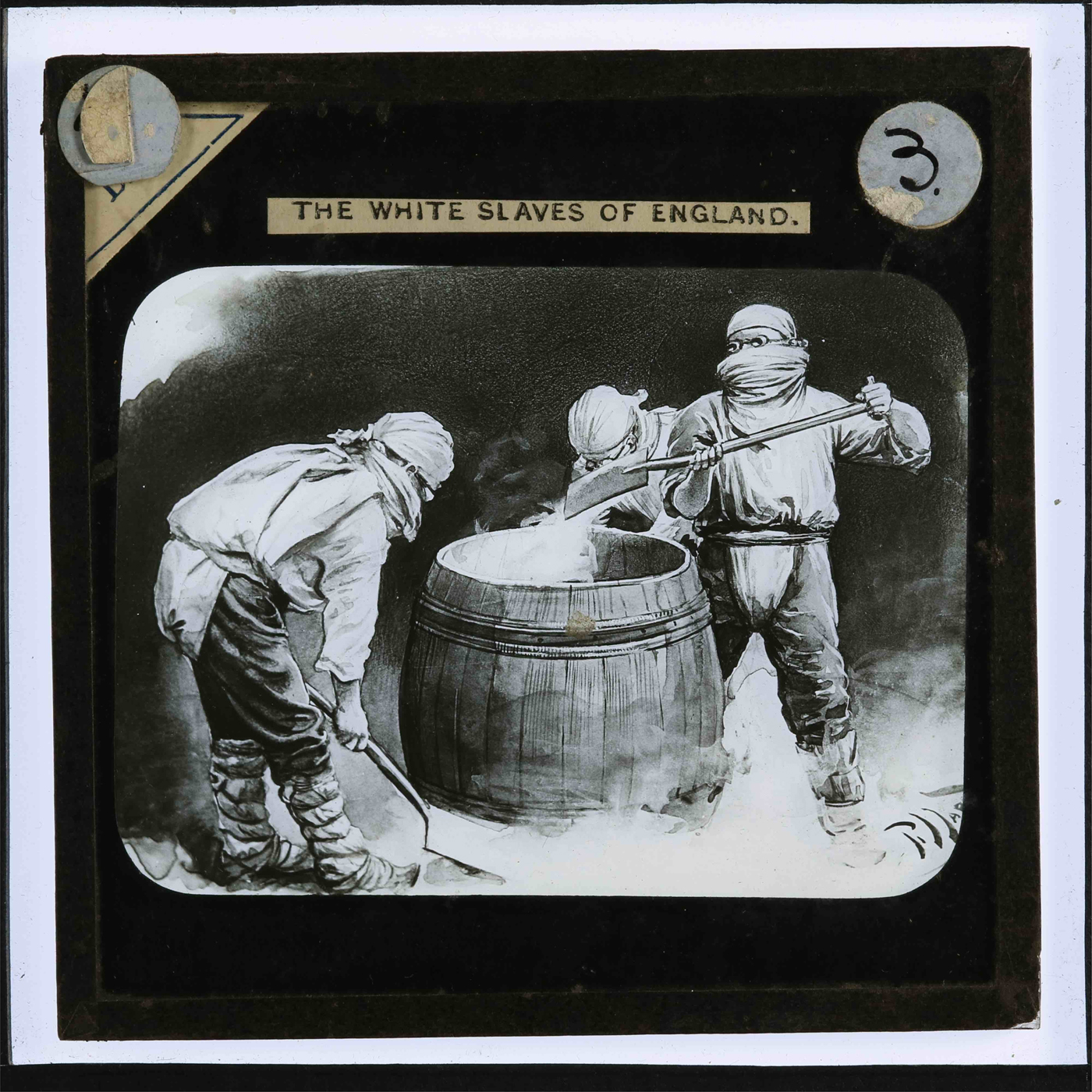
“Roger is their worst enemy.” Lantern slide, c. 1900, based on the illustration by Harry Piffard in Sherard's The White Slaves of England (London, 1897), depicting a chemical worker poisoned by chlorine gas during alkali manufacture. Slide source: Martyn Jolly, Canberra, AU.

Waste removal was already, by this time, of course, the subject of verbal and visual images. Karl Marx and especially Friedrich Engels began to render waste visible in their writings about systems. Those writing about waste and its removal in (mostly urban) conditions included Henry Mayhew in London Labour and London Poor, Charles Dickens, and many more.Footnote 97 Sherard drew analogies to these and other, earlier works that visualized the poor and the workers. As noted earlier, he mentioned Gustave Doré, a French artist who entered into a collaboration with the British journalist, Blanchard Jerrold. Over four years they depicted the squalor of mid-Victorian London, eventually producing 180 engravings (finished in 1872). Sherard also cited Henry de Groux, the contemporary Belgian Symbolist painter, sculptor, and lithographer whose 1889 painting, “Christ aux Outrages,” widely described as his masterwork, depicted Christ being attacked by a crowd.
Waste, labor, and economics was, it was recognized, also a problem of seeing (and its opposite, a refusal to see, or a challenge of seeing because of obstacles and what was rendered visible and invisible in cities). Making visible the (mostly) unseen was therefore an achievement of artists and writers, as well as scientists, photographers, reformers, and, of course, most importantly, the workers themselves.
Numerous people across different backgrounds wrote during the 1880s and 1890s about pollution and its effects—and about the conditions of industrial labor—but the links were made with varying degrees of articulation. Fogs and haze blurred the boundary between the natural and the social, and the social was subject to a process of de-naturalization. Nature was understood as offering an indistinct boundary in this period, being part of social life (which in turn broke down the boundary of nature and culture). As literary historian Emanuela Ettorre has noted recently, in discussing the writings of Victorian novelist George Gissing (1857–1903), pollution was at this time becoming “a new paradigm for urban narrativity.”Footnote 98 It was also becoming a new paradigm for rural narratives of industrial pollution.
Men pictured at alkali work are an important, and often neglected, site for Victorian figurations of the male body, industry, and pollution, as masculine working-class chemical working bodies were represented, like the natural environment, as degraded by industry. Piffard's images presented both realist and allegorical representations of the laboring body, engendering questions regarding whether the bodies in Piffard's images were generalized emblems of labor, or possessed qualities of individual human authenticity.
A comparison between Piffard's images and others produced in Victorian Britain within the context of industry serves as an analytical tool. John Stuart Mill, in his Principles of Political Economy (1848) states that “Labour is either bodily or mental; or, to express the distinction more comprehensively either muscular or nervous; and it is necessary to include in the idea, not solely the exertion itself, but all feelings of a disagreeable kind, all bodily inconvenient or mental annoyance, connected with the employment of one's thoughts, or muscles, or both, in a particular occupation.”Footnote 99
Despite the harmful environments of the alkali industry, Piffard rendered the male bodies as relatively full and heavily built, although the reality of their labor resulted in a tortured bodily condition. Underneath the cloak of the working gowns, the authentic conditions of each body, with wounds and bruises, were part and parcel of their particular form of labor performed in the industry. Historian of art Timothy Barringer suggests, in fact, that “the sphere of the visual image and more specifically representation of [the male labouring body], provided the most powerful and significant formulation of work as the nexus of ethical and aesthetic values.”Footnote 100 As he shows, the mid-Victorian period formed a pivotal moment in the histories of both labor and of art. At a time when the machine threatened the livelihood (labor equals compensation = food and shelter) of the worker, the age of mechanical reproduction simultaneously placed the privileged category of “art” under pressure with the proliferation of images in newspapers and books. Furthermore, a repertoire of new styles of masculinity was produced by the emergence of cultural dominance of new groupings, such as the industrial bourgeoisie and organized male labor. To perform a specific type of labor was to assume or to inhabit a particular style of masculinity; just as to extend compassion toward (and romanticize) working-class labor also contributed to gendered constructions of reformers’ identities.Footnote 101
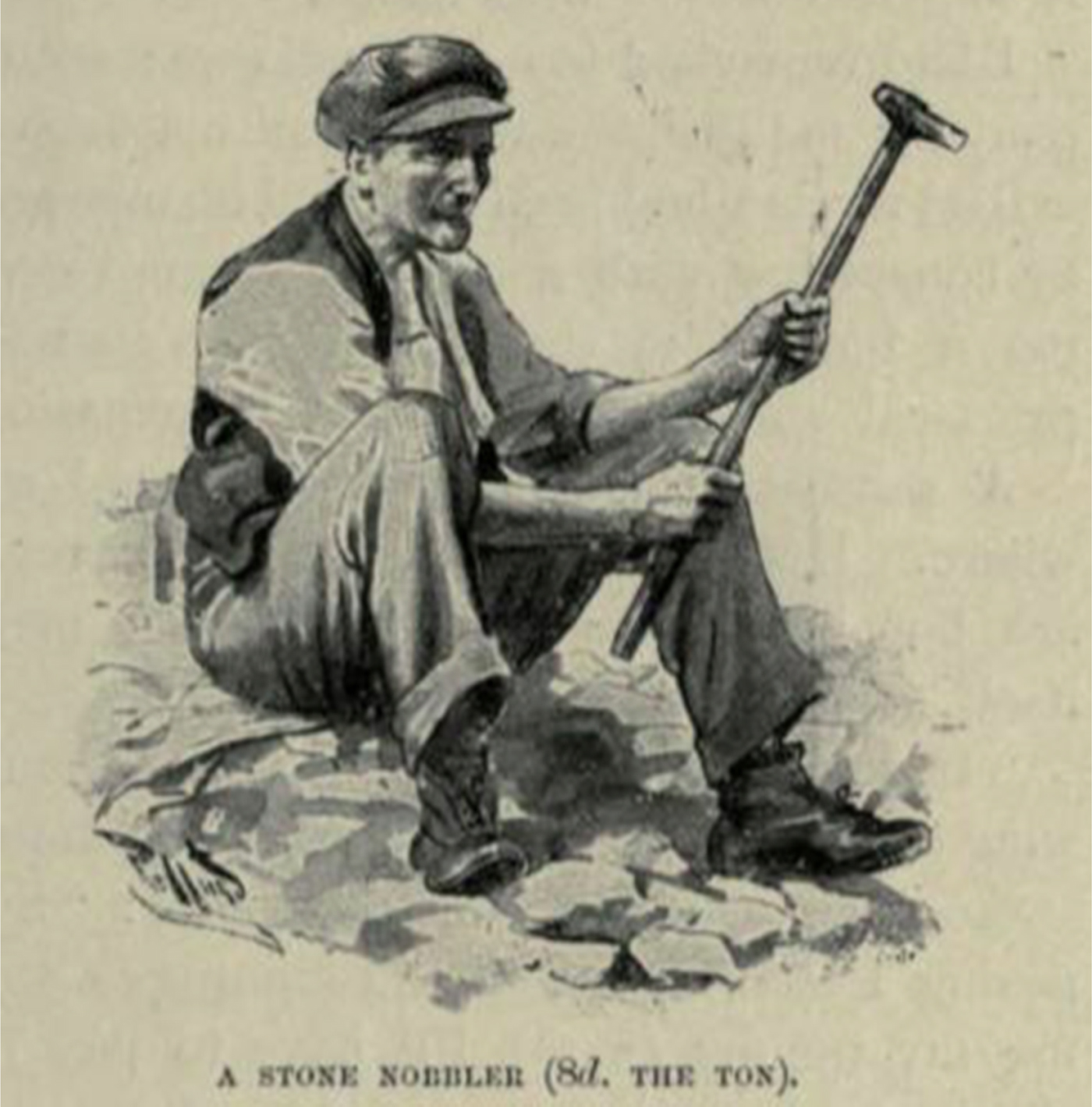
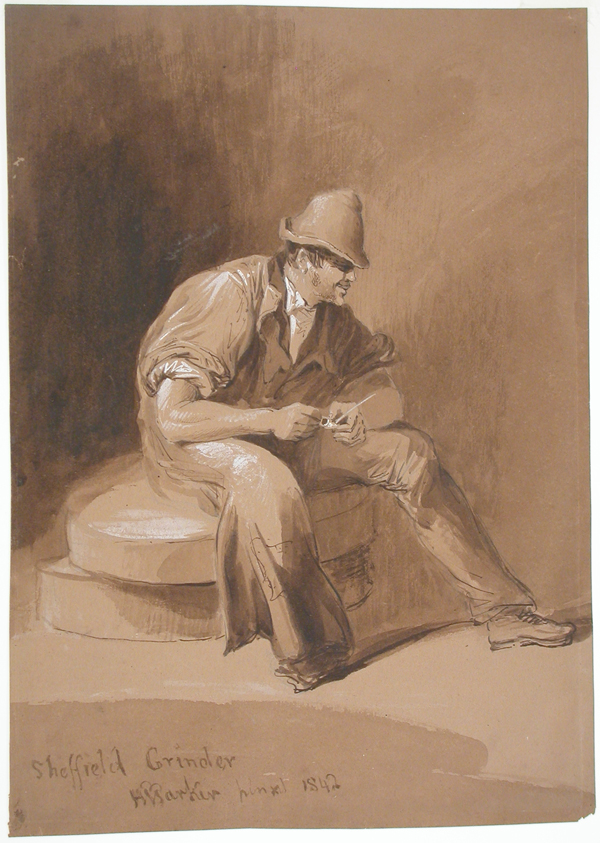
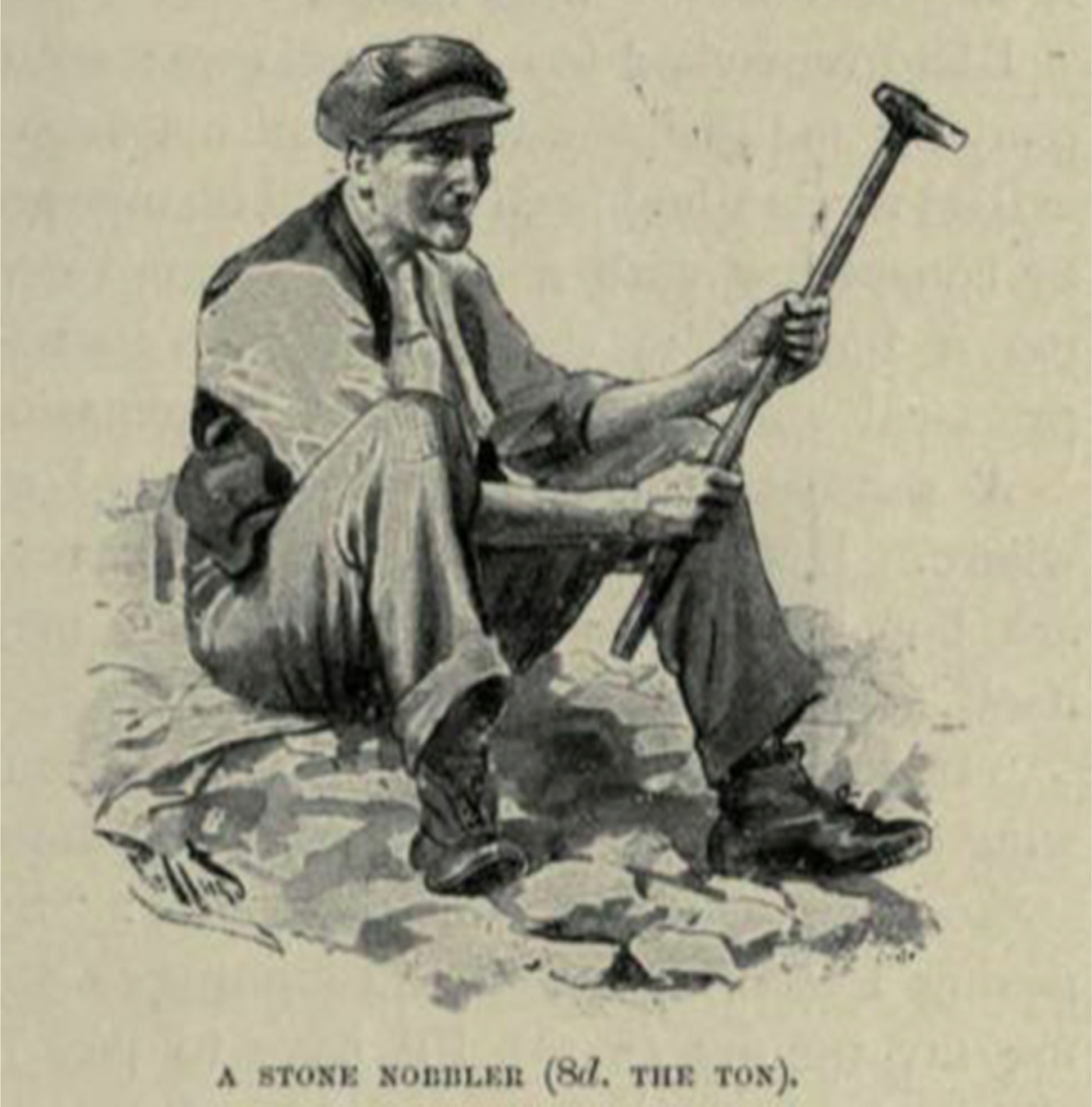
Given this moral/aesthetic regime, it could be problematic to display the embodied toll that work took on workers (a fact that might also help to account for the relative absence in this imagery of workers suffering on the job, lacking teeth, vulnerable to accidents, etc.) Presenting waste work potentially raised uncomfortable questions about the ethical regime predicated on manly industrial labor, inviting readers to reconcile textual narratives about harmful dangers with images of robust chemical bodies “drawn from life.” One way was through the depiction of the individual worker's expression. A comparison of Piffard's “A Stone Nobbler” and the English artist Henry Perlee Parker's painting “Sheffield Grinder,” ca. 1842, for example, suggests the gradual effects of industrial labor on the physique of the male body. (See Figs. 7 and 8) While Piffard's newspaper work was not generally defined as “fine” art in Victorian terms, his artwork proliferated widely and in a similar way that “fine” art (such as Parker's “Sheffield Grinder”) was becoming increasingly accessible through engraved books, lantern slide lectures, and newspaper reproductions. Both artists presented the male working body in the act of sitting. Both are hunched over their legs and looking at the rightmost corner of the pictorial field, their bodies bearing witness to the years of labor in the industry, while their tortured faces seem to veil the years of endless toil wrought on their physical and spiritual selves.
Harry Piffard, “A Stone Nobbler,” engraving, reproduced in Sherard, White Slaves of England (London, 1897), 63.
Henry Perlee Parker, Sheffield Grinder, 1842. Watercolor on paper (17.5 cm x 22 cm.) Museums Sheffield.

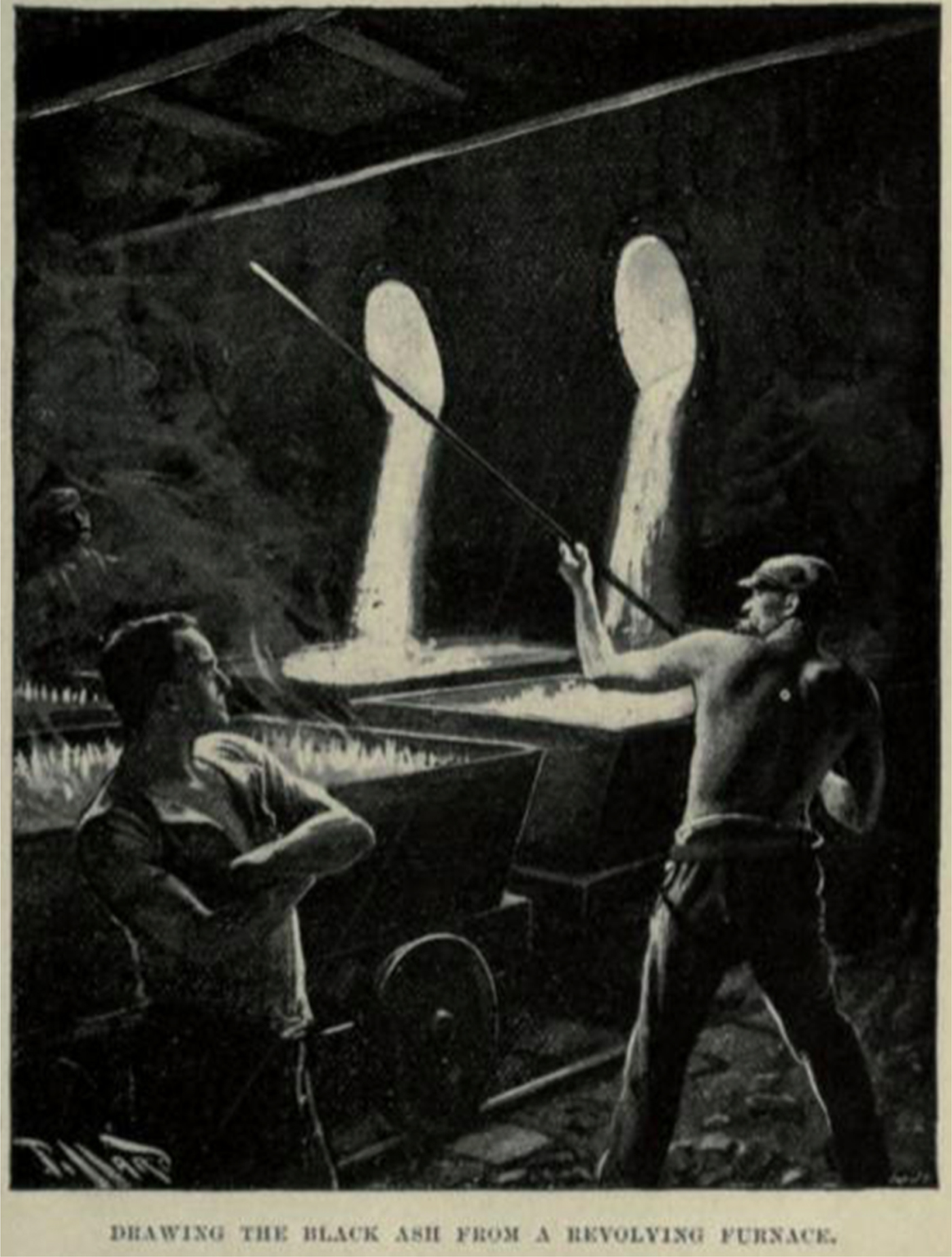
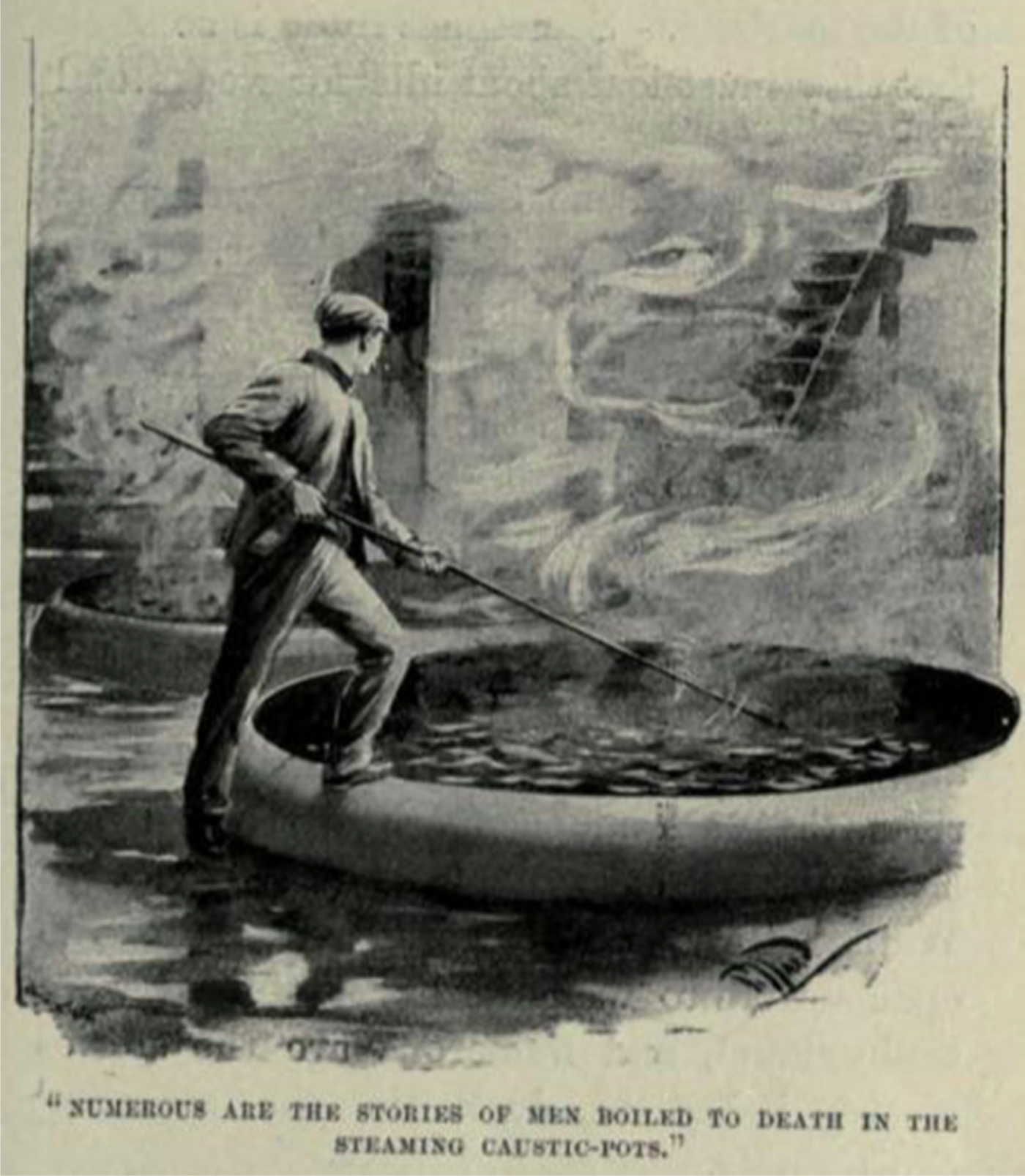
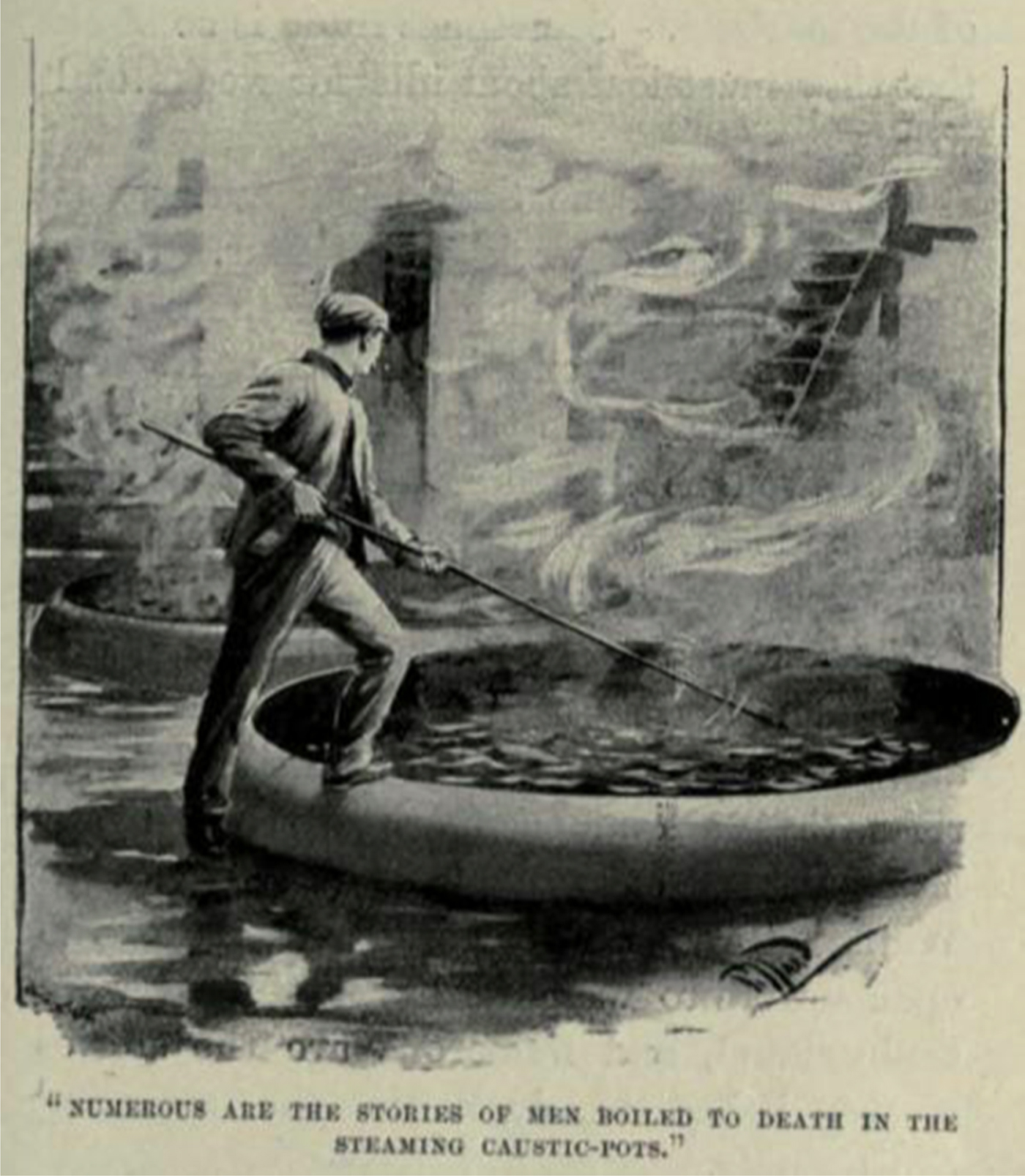
In some respects then, Piffard's images accord with Victorian moral positioning of industrial labor that would have been familiar to many readers.Footnote 102 In Figure 9, Piffard's “Drawing the Black Ash From a Revolving Furnace,” one sees the working male body as muscular and brawny, which aligns closely with Sykes’ presentation of male bodies. Yet, in Piffard's darker composition, with the only light source extending from the large black-ash pipes, the grim nature of the work is suggested to an even greater degree. The heat of the work drawing the black ash from a revolving furnace is conveyed by the depiction of a worker stripped to the waist. (Fig. 9) Furthermore, another of Piffard's engraved illustrations for Sherard's essay depicts a young man stirring the contents of a great vat filled with black-ash and water, with a caption underneath that undercuts any simply straightforward heroic stories of masculine striving over adversity: “Numerous are the stories of men boiled to death in the steaming caustic-pots.” (Fig. 10) The chemical industry was the most dangerous industry with the highest degree of workplace accidents, according to reports by the early 1900s. Through words, in combination with images, reforming journalists like Sherard and artists like Piffard sought to make this reality tangible to London-based and other readers who had scant direct experience even of what a chemical factory looked like.
Harry Piffard, “Drawing the Black Ash From a Revolving Furnace,” wood engraving, reproduced in Sherard, White Slaves of England (London, 1897), 67.

Harry Piffard, “Numerous are the Stories of Men Boiled to Death in the Steaming Caustic-Pots,” wood engraving, reproduced in Sherard, The White Slaves of England (London, 1897), 73.
The notion of the literally wasted away body as analogous to the alkali waste with which the workers were dealing emerges as particularly salient (although similar discourses about reuses for wasted workers’ bodies do not seem as evident). In a similar way that the laboring men perform the work of removing the waste from the ground of the industry—and, indeed, working in environments where waste and non-waste co-existed daily—the workers simultaneously “waste away” their own physical and mental well-being. We saw this earlier, with the reference to the alkali factories as a wasteland. Sherard described Widnes in 1896 as: “Squalid cottages, large areas of muddy waste, with a pigsty here and there, and perhaps a gipsy's van in a desert of puddles and mud; black alleys, intricate gangways over an intricate network of railways, high chimneys on every side, and below these such grotesque shapes of towers and bubbling cauldrons and tanks and wheels, as seem the very nightmare of industrialism.”Footnote 103
National discourses of the alkali worker did not then focus on the specific dangers that were starting to be associated with working in, and around, dangerous chemical compounds. Yet, as the figure of the alkali worker entered public discourses in the mid-1890s in the writings and images of middle-class reformers, it was waste—material, as well as human—that caught the eyes of reformers by the 1890s. As imagined in powerful words and images, the chemical worker's body was transformed into an appendage of the industrial apparatus whereby their mental and physical health “wasted away” with the chemical residue.
Chemical Legacies
Action on improvements to the working conditions of alkali workers faltered in the face of company resistance and the slowing demand for alkali production in Britain more generally, as production moved offshore. By the winter of 1896, chemical factories were starting to merge in order to forge a conglomerate (United Alkali Company): the British alkali industry was in serious decline by the early 1900s (although the region remains the center of Britain's chemical production today).Footnote 104
The model of the Victorian bleach packer that people see in Widnes at the Catalyst Museum provides a link between the past and the present. The model is based, of course, on the illustration by Piffard in Sherard's magazine's investigative exposé of the alkali industry on this same site. Today, the history of the chemical industry is mostly told through stories passed down by former employees, local families, and museum exhibits. Whereas there are still hulks of Victorian mills and factories, the physical traces of the chemical factories mostly didn't survive as visual evidence. The buildings themselves metabolized, the effects of the harsh muriatic acid destroying what were always ramshackle, hastily thrown together structures.
While the physical traces of the Victorian chemical industry are less visible in the landscape today than are textile mills, remnants still survive.Footnote 105 In fact, the region is still a site of clean-up and a major focus of scientific remediation efforts.Footnote 106
Research on the Mersey River has confirmed that it has suffered a legacy of abuse and neglect since the beginning of the Industrial Revolution.Footnote 107 Although as a result of remedial action over the past twenty-five years the water quality of the river and the biology of the system have improved, because the region around Widnes has such a long and distinctive history of industrial activity, including the manufacture of alkalis, acids, chlorines, organic and inorganic chemicals, and other potentially harmful substances, the effects of discharges to air, land, and water upon public health are significant issues for local residents. These results are not surprising given the historical legacy of industrial activity on land adjacent to the north and south shores of the Mersey River.
But chemical legacies are about more than toxins; they are also about historical narratives. How are places with complex and difficult histories confronted today, by local residents, museum curators, local history societies, and tourists? Though invisible to tourists, small industrial towns and cities such as Widnes provide a rich tapestry of history for locals and visitors alike. Recently, for example, historian Robert Weible, the past president of the Council on Public History and former Chief Curator of the Lowell Museum, shared his insights about American industrial heritage and the founding of Lowell Museum forty years ago, noting that in telling the story of New England textile mills and their workers for a wider public, Lowellians “decided to make their own history … by capitalizing on the power of their heritage.”Footnote 108
On June 14, 2018, global news media descended on Widnes as Queen Elizabeth and Meghan Markle, the Duchess of Sussex, visited Spike Island in Widnes on the grounds of the Catalyst Science Centre to open the new Mersey Bridge. The Catalyst Museum's Senior Curator, Paul Meara, grew up in Widnes and remembers the Queen's first visit to the town fifty years ago, in 1968. The visit was announced to coincide with “Operation Spring Clean,” a program that promoted remediation of toxic waste that chemical industries left behind and encouraged local people to pick up trash. As the town newspaper explained in its reporting of the event, Her Majesty's visit was part of her “personal look at just what had been achieved to reverse the grim aspect associated with the north west.” Mr. Meira recalled the excitement of waiting for Her Majesty to arrive on the streets of Widnes in 1968, but also added that, “To be fair, the moon landings in 1969 and the move to decimal currency in 1971 made a much more lasting impression at primary school.”
Individuals and communities make history through acts of remembering and reflecting on the legacies of physical places in all their intricacies and challenges. The Royal visit to Widnes captured public attention and world media interest but it also offered a rare opportunity to reflect momentarily on a place with a significant part in the history of the world's second industrial revolution; on the determined people who made their lives there; and on the complexity of environmental systems and stories that are embedded in the landscape that, although the signs are not always physically visible, still carries the mark of the early chemical industry.
At a time of growing interest in how to recover alkali waste and other industrial products for economic purposes today, this paper has explored how the body of the worker in alkali waste was materialized and a subject for discussion in Victorian culture. Together with other essays in this volume, it raises questions about the historical relationships between work and waste. My paper seeks to contribute to this larger discussion by bringing into the foreground one of the most toxic and yet least well known “waste economies” of Victorian Britain. As the alkali trade began to stand out among manufacturing industries in Britain and the world for the sheer extent of the waste products that its processes generated, the mostly hidden labor of the chemical worker—in factories that were mostly removed from established city centers—became a subject of concern. Examination of surviving records surrounding the alkali industries sheds light on the linkages between environmental, labor, and visual histories, illuminating the waste economies of the chemical regions of Britain as part of the wider story of the Industrial Revolution, touching on the risks as well as the ways that workers tried (mostly unsuccessfully) to change the conditions of their work, and finally, how Victorian engravings and other pictures worked to make visible what otherwise was inconspicuous to many people outside Widnes: the horror of the chemicals in the air and working environment of the factory.