Introduction
Singing is found as part of every musical culture, both worldwide (Trehub & Trainor, Reference TREHUB and TRAINOR1998) and across history (Falk, Reference FALK2004; Mithen, Reference MITHEN2005), and vocal sound has been argued to be ‘one of the defining features of humanity’ (Welch, Reference WELCH, Miell, MacDonald and Hargreaves2005, p. 239). In addition to serving important functions in early social interaction and bonding throughout life (Malloch, Reference MALLOCH1999; Powers & Trevarthen, Reference POWERS, TREVARTHEN, Malloch and Trevarthen2008), singing also brings many non-musical benefits to a wide range of people. For example, studies have highlighted the therapeutic potential of singing for patients with neurological impairments (Cohen & Masse, Reference COHEN and MASSE1993) and for the elderly (Wise et al., Reference WISE, HARTMANN and FISHER1992). Singing has also been found to increase levels of trust and cooperation (Anshel & Kipper, Reference ANSHEL and KIPPER1988), to reduce tense arousal and increase energetic arousal, positive hedonic tone and heart rate (Valentine & Evans, Reference VALENTINE and EVANS2001) and to improve psychological well-being (Clift et al., Reference CLIFT, HANCOX, MORRISON, HESS, KREUTZ and STEWART2010). Historically, vocal music has been valued through its connections to religious rituals, and singing has been a major component of music education in different educational contexts across the world for many years for a number of practical and ideological reasons (Spruce, Reference SPRUCE and Spruce2002). Good singing experiences at school are also believed to be a major component of developing a lifelong interest and involvement in music (Pitts, Reference PITTS2009).
However, in England, a range of negative attitudes and behaviours are shown towards general curriculum music from both teachers and learners (e.g. Bray, Reference BRAY2000; Harland et al., Reference HARLAND, KINDER, LORD, STOTT, SCHAGEN, HAYNES, CUSWORTH, WHITE and PAOLA2000; Lamont & Maton, Reference LAMONT and MATON2008). For example, as children move into secondary school many drop out of instrumental tuition (Sloboda, Reference SLOBODA2001); around a third of school pupils show no interest in learning to play musical instruments (Lamont et al., Reference LAMONT, HARGREAVES, MARSHALL and TARRANT2003); and very few pupils opt to study music formally when it becomes a curriculum option at age 14 (Bray, Reference BRAY2000; Bell, Reference BELL2001). This problem has persisted despite many attempts at the curriculum level to make music more inclusive, more up-to-date, and more resonant with the kinds of music that pupils like and listen to outside school, reducing the emphasis on formal tuition, classical instruments and repertoire (e.g. Green, Reference GREEN2008).
Similarly, while most children sing relatively spontaneously both in pre-school settings (Temmerman, Reference TEMMERMAN2000) and in the school playground (Marsh, Reference MARSH2008), and the inclusion of music in the various National Curricula in the UK should have provided a central role for singing and music-making across schooling, evidence suggests that singing is still a relatively low-status element of school music (Finney, Reference FINNEY2000). Children's singing skills progress relatively slowly at the start of school (Leighton & Lamont, Reference LEIGHTON and LAMONT2006) and need appropriate support, modelling, guidance and teaching in order to develop. However, many primary school class teachers lack confidence in their own singing skills (e.g. Hennessy, Reference HENNESSY2000; Seddon & Biasutti, Reference SEDDON and BIASUTTI2008; Neokleous, Reference NEOKLEOUS2009) and may not be singing very much with their classes, preferring to rely on recordings or leaving singing for the playground. In many schools singing has become a selective element of school music (for example, extracurricular choirs and performances), which can make it an unattractive activity for children lacking in confidence to volunteer and take part in auditions (Bray, Reference BRAY2009).
At the start of the 21st century, the UK Labour Government made a number of manifesto pledges to enable access to music for all (DfES, 2001), and subsequently launched a Music Manifesto, with the support of prominent musicians and policy makers, to take these pledges forwards (DfES/DCMS, 2004). While much of this emphasis initially focused on the opportunities to play a musical instrument through Wider Opportunities (see Davies & Stephens, Reference DAVIES and STEPHENS2004; Bamford & Glinkowski, Reference BAMFORD and GLINKOWSKI2010), the second report by the Music Manifesto group (DfES/DCMS, 2006) prioritised singing as a central and vital musical activity in school music education. This report was followed by the allocation of £10 million by the Government to support the development of singing in schools, particularly through a National Singing Programme ‘Sing Up’ (providing resources and training for supporting singing), thus illustrating the commitment at national level to promote high-quality singing in schools and the wider community. The report identified the importance of promoting high-quality singing, irrespective of genre or tradition; of respecting and valuing children's musical choices, interests and aspirations; and of acknowledging both the role of singing as a way into participative music-making and the extra-musical benefits that singing could bring, including enjoyment, the development of language, and the promotion of mental and physical health (DfES/DCMS, 2006).
In order to achieve this, the report recommended that singing should be put back at the heart of all primary school musical activity, with group singing opportunities offered to every primary-age child, the development of singing ‘clusters’, consultation with young people about their singing interests and preferences, and the training and development of singing leaders from diverse cultural backgrounds. Resonating with arguments from ethnomusicology and anthropology, the initial Manifesto Champion Marc Jaffray stated that singing ‘is the most elemental form of music making’ (DfES/DCMS, 2006, p. 4). One might suggest that singing also offers a relatively low cost way of engaging children in music, without the need for expensive instruments or highly specialist tuition (although the issue of teacher confidence has already been mentioned above). These initiatives, although well-intended, were based on a lack of evidence about what works in schools to promote and support singing beyond a rather vague exhortation to strive to develop ‘singing schools’, and what training needs might exist amongst school and specialist staff to support such ‘singing schools’, set against a context of known lack of confidence in singing amongst many primary school teachers. As a consequence, Trinity Guildhall and The Open University convened a consultative conference on the professional development needs of singing leaders in April 2007 which explored training needs that might arise from singing integrated into the school curriculum, singing as part of the music curriculum, and singing beyond the classroom and sometimes beyond the school (Trinity College London/The Open University, 2007).
The current project grew out of that conference to explore and identify some of the key features of good practice in school singing at the primary level, to identify limiting factors, and to consider how good practice could be translated into different educational settings. The aims of this project were thus to pinpoint a range of contexts in schools in which children sing and can be enabled to sing in order to provide a greater insight into the factors that enable and support good practice. While the landscape of music education in Britain has moved on since these initiatives with a change of government, a review of music education (Henley, Reference HENLEY2011), an ongoing review of the National Curriculum and a new national music plan (DFE 2011), at the time of writing the present government remains committed to the notion of music in the curriculum and singing at the heart of this, and ways to promote this continue to be sought.
Method
The current research comprised a series of case studies in a range of schools which had different kinds of experiences of and approaches to enhancing and developing singing. At a policy level the project explored how the strategy recommendations of the Music Manifesto at a national level were being put into practice in specific local settings. From a research perspective, the project aimed to uncover examples of good practice and explore their transferability to different settings.
Participants
The process of selecting examples of good practice started with the potential motivators for good practice in singing in Key Stage 2 which were identified through discussions at the Vocal Conference (Trinity College London/The Open University, 2007). These included: an inspirational head teacher; a specialist on the school staff; access to CPD for staff; input from visiting specialists on a short or longer-term basis; involvement with a singing network; and the opportunity for enhancing singing through the Wider Opportunities initiative.
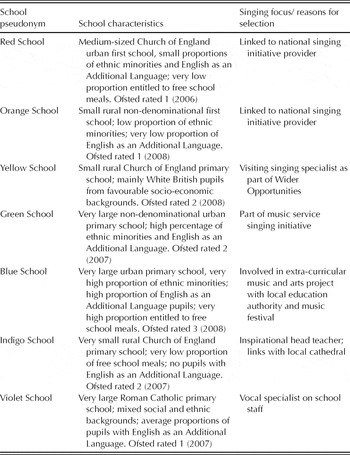
With input from vocal leaders, music service singing specialists, and other contacts in music education, a shortlist of schools with one or more of these features was drawn up, and a balance of criteria was established across the study schools (see Table 1). Head teachers were invited to participate, and every head teacher contacted gave their consent for the research to be conducted as a way of recognising the good practice they had developed. Names of schools, teachers and other individuals have been changed for reasons of confidentiality.
Participating schools (see Appendix)

Measures
Visits were made to each school by a member of the research team between October and December 2007, and where possible singing activities were observed in different settings. An observation template was drawn up covering the classroom layout, teachers, learning outcomes, observed activities, feedback, behaviour management, and any other notable features. In addition, semi-structured interviews were conducted with head teachers, class teachers, music specialists, visiting specialists, pupils and parents (in as many contexts as possible) covering the ways in which singing took place in the school, issues of access and inclusion, repertoire, teaching styles and integration with other school activities. In line with the national initiatives focusing on Key Stage 2 the research centred on the experiences of Key Stage 2 pupils (aged 7 to 11), although in some relevant cases data are presented relating to other Key Stages.
Analytic strategy
All interviews, singing activities and other observations were transcribed and analysed using thematic analysis (Richards, Reference RICHARDS2006). This aimed to uncover the motivations behind the singing initiatives in these school settings, enabling factors and challenges, and to explore the experiences of and attitudes towards singing from teachers, pupils and parents.
Results
In the first section we consider the original contexts of singing across the curriculum, in the music lesson, and beyond the classroom in relation to the case studies and analyse how far different models of good practice might be applied to different school settings.
Singing across the school curriculum
Four of the seven schools could be clearly characterised as ‘singing schools’, as singing was fully integrated into all aspects of the school day (Red, Orange, Green and Indigo Schools). It might be assumed that this approach would work best in a context where all staff were actively engaged in teaching National Curriculum music to their classes, as they would be aware of their pupils’ skills and motivations in singing and able to integrate these with other curriculum subjects. However, two of these schools (Red, Green) had a specialist teaching all National Curriculum music (including singing), while class teachers only used singing in other curriculum subjects and to accompany school routines like taking the register. As Year 4 pupils at Red School explained, ‘Sometimes when we're working in class, we listen, we listen to a few songs, practising, whilst practising, whilst we're doing our work, we listen to the songs and then we can sing along’. In the other two schools (Orange and Indigo), class teachers delivered singing in music lessons supported by the music coordinator. Music was used in a range of other curriculum subjects including French, Spanish, history, maths and science in all these schools, as well as for topic-based classroom activities (such as The Aborigines or The Tudors). At Indigo School, one year 6 pupil told us about how music fitted into their class project:
. . . in the Aborigines we had to write an Aborigine song about how it must have felt with the stolen generation, when erm, we were being taken away from our families, and we had to write a song about how we felt and then we performed them to our parents.
Commonly these topics were done in class, but occasionally the entire school might be involved in a project which included singing (e.g. a County Murals project at Indigo with other primary schools).
The four faith schools studied here (three Church of England: Red, Yellow and Indigo, and one Roman Catholic: Violet) included hymn singing in daily assembly and in class at other times of the school day, and all organised dedicated time to hymn practice, and one other school (Orange) also had a more traditional assembly with hymns and hymn practice. In the non-faith schools, special ‘singing assemblies’, held on a weekly basis, gave the children additional opportunities to sing together (organised by Key Stage at Green School).
Finally pupils were involved in a wide range of school productions, including traditional Christmas concerts and theatre productions (across all schools observed) as well as more specialised and innovative experiences such as opera projects (Indigo and Violet Schools). In addition to the opportunities offered to all pupils, every school observed had at least one choir which operated on a voluntary basis. The choir was often centrally involved in school productions and concerts, as well as in opportunities to sing outside the school (see further below).
Singing across the school curriculum, when done effectively, was observed to be a way of making singing part of the fabric of school life. This kind of singing did not require high levels of technical skill or complex learning objectives, but could make a noticeable difference to the school culture. As the class teacher at Yellow School noted, ‘it doesn't matter to them whether they're good singers or not, they'll all have a go’. This kind of cross-curricular singing can thus help to develop singing as a normal activity in school that everyone simply takes part in, and one which fosters inclusion: the same teacher also noted ‘there are one or two droners in, no-one is ever excluded’.
Singing in the ‘music lesson’
The music lesson provides the potential to enrich the basic entitlement to singing and places singing in a wider musical context. In terms of vocal skills, there was some very good work observed to be taking place in terms of use of the voice, vocal health and good vocal techniques (especially when singing specialists were involved, such as at Yellow and Violet Schools, or the input from the national singing initiative provider at Red and Orange Schools). Warm-ups featured in all the singing observed. In many schools the pupils recognised how the voice works and were aware of the parts of the body involved in singing (one Reception class even demonstrated understanding of the location and function of the diaphragm). They also showed their understanding of sophisticated vocal concepts such as aspirate singing (Yellow School) and other elements of vocal technique, as demonstrated by a group of Year 5 pupils at Green School who sang for us:
You've got to put the tongue on the teeth and the lips, and making each word as clear as can be, the tip of the tongue, the teeth and the lips, and they come together as you can see.
There was also much good teaching and learning of vocal expression and communication. For example, at Yellow School, the pupils informed us that to sing, ‘you have to use your eyebrows, [Visiting Specialist] says that's what they're there for’. Finally, in some instances pupils were involved in leading others in singing (Yellow School) or in considering how singing could be explained to other groups of pupils (Violet School).
However, there was a potential dislocation between what happened in ‘singing’ and what happened in ‘curriculum music’. When singing was delivered by a visiting specialist, efforts had to be made to link this with the curriculum music delivered by class teachers (e.g. class teachers following up on notation and terminology covered in the singing lessons at Yellow School). Some of the singing experiences observed were focused exclusively on preparing pupils for performances, although this might not be an accurate reflection of how singing would link to curriculum music more generally throughout the year. When singing was taught alongside curriculum music, in many instances it was integrated into the activities (e.g. singing within a composition activity at Indigo School). However, sometimes singing was separated structurally from the rest of the music lesson (e.g. Green School, where the first 15 minutes or so of every music lesson was dedicated to singing followed by the rest of the lesson devoted to other musical activities). In some cases singing was very effectively linked to other areas of musical understanding such as structure, terminology and notation (e.g. Green, Violet Schools), although in general most songs were taught by rote rather than reading notation (supported by displaying words on an overhead projector or whiteboard), fitting with the philosophy of sound before symbol (Odam, Reference ODAM1995) and providing an accessible foundation as preparation for developing a more technical understanding of the elements of music.
Singing in the music lesson was thus focused on acquiring singing skill, using principles of good vocal health, and as a way of developing musical understanding. It could support the teaching of National Curriculum music in a range of ways (performing, composing, evaluating, communicating). In many cases, input from specialist singers and musicians was useful in developing high-quality singing and in linking singing to music more generally.
Singing beyond the classroom
In the schools studied, there was a wide diversity of locations at which pupils sang beyond the classroom. This included singing activities and opportunities for choirs, concerts and other performances both at school but outside curriculum time and beyond the school setting. These were either inclusive (offered to all classes or all pupils) or optional (e.g. school choirs).
Learning songs for school plays and performances were one of the major highlights from the pupils’ perspective. Although children at this age tend not to verbalise a great deal about emotions and enthusiasm, evidence for this can be gleaned from the way they communicate about special performances. Across all schools pupils talk a lot about the songs they are learning, and in many interviews sing snippets for the researcher, as illustrated by this group of Year 2 pupils in Violet School:
Kyle: Singing's really fun.
Interviewer: Is it?
Sophie: Yeah, you get, it's just like talking, but you move your voice up and down.
Kyle: And there's a new song, it's [starts singing]
Interviewer: Do you do some acting when you do your singing?
Sophie: Yeah, we like, like a song, yeah, that goes, you know ‘on the bumpy journey’ one, we go [Sophie starts singing, other two join in]: ‘on a bumpy journey, and we're leaving early cause Beth-le-hem and so far away.’
Sophie: and then it's [continues singing by herself]: ‘take it nice and steady, and the bags are heavy’, that sort of stuff.
This enthusiasm is also demonstrated by the children's willingness to volunteer for singing opportunities such as solos: at Yellow School in one class we observed over 20 children putting themselves forwards to audition to sing a solo in the forthcoming Christmas concert. In most schools there were opportunities for all children to sing outside the school, but some schools with less experience of singing were concentrating these opportunities for the time being on those pupils who had opted for the choir (e.g. Blue School). The staff and parents’ choirs at Red and Orange Schools provided a structured opportunity for children to sing with adults. The music coordinator at Orange School had chosen to teach the same repertoire to all three choirs (pupils, parents and staff) to create opportunities for them to sing together, and parents and teachers spoke positively about the benefits of learning the same repertoire as the pupils.
As well as school concerts and shows, and church singing (especially for the church schools), pupils had the opportunity to sing at large concerts in major performance venues (including large arenas, concert halls and cathedrals). Singing also took place in old people's homes (Orange School) and hospices (Violet School), at railway stations raising money for charity (Orange School), in a garden centre (Yellow School) and a shopping centre (Violet School), in caves (Indigo School), on television (Yellow School) and in a village fete procession (Red School). Some children were also involved in competitive singing festivals (Violet School entered a musicals competition and a competition for Songs of Praise; Red School regularly entered a local singing festival). The opportunities to be involved in such events were valued by all those concerned. The pupils had vivid memories of the arrangements around visits outside school. For example, pupils from Yellow School told us about their forthcoming out-of-school trips:
Georgia: Yeah we go to [Yellow] Garden Centre tonight, we go on TV a week on Thursday.
Lucas: Yeah we have to get up at, erm . . .
Georgia: [interrupts, laughing] We have to be at school for ten to six.
Luke: At least you get a bacon butty though.
This detail of the unusual experiences surrounding singing excursions illustrates the lasting impact that such events can have.
Singing outside the school was seen as very valuable, and pupils, parents and staff were enthusiastic about this. Schools could make links with other schools (primary and secondary) and with the wider community (village, church, city), and use these opportunities to showcase their good singing to a wider audience.
Enabling factors for good practice in singing
In this section we consider the factors that helped get singing initiatives off the ground in our case studies. All the schools were following the Government guidance as first set out by the National Curriculum and later emphasised by the second Music Manifesto report to include singing in the school. However, some had additional motivators, including using singing as a way to develop musical achievement or teaching in the school (Blue School) or non-musical motivators including enhancing a sense of community within the school (Orange School) and developing links with the wider community (Yellow School). Three common essential factors for supporting singing initiatives have been identified, in addition to two beneficial factors, from the cases observed.
From our observations of the singing activities that took place in school, and from discussions with pupils, it is clear that in order for music making to be rewarding an inspirational and enthusiastic leader is required. Many of the external singing leaders could be seen to fulfil this role from the children's perspective, as pupils from Green School described a visiting local authority singing leader as ‘hyper’, and the visiting animateur at Yellow School was observed to have almost cult status, with pupils noting that they were ‘really lucky because we've got her’. However, for the singing school to really become established, the first essential factor was the presence of a committed and enthusiastic individual to drive the singing agenda forward within the school. In all cases observed, the singing initiatives could be traced to at least one or less rarely more than one staff member at the school, who provided an initial stimulus to engage with a particular activity.
For this to work, you've got to have a teacher in school that will push it on, and have that genuine love of wanting to keep the singing going in school. It doesn't have to be someone who's fabulous at singing, it just has to be somebody who wants it to happen. (Head, Orange School)
This stimulus might be the individual working alone to develop singing, or motivating and inspiring other staff to engage in singing, or seeking external support from schemes offered by specialist organisations. Although there were a range of existing programmes available and offered by specialist organisations, a committed individual within the school was necessary. For example, in the case of the arts festival education project which Blue School were involved with, applications were selected by the organisers on the basis of the need to have a supportive individual within the school.
In addition, the support of the head teacher was found to be vital in getting initiatives started. Every head teacher expressed their firm support for the singing initiatives, even if they had little day-to-day involvement with them, and in two cases the head was implementing the initiatives personally (Red and Indigo Schools). Moreover, gaining support from other staff beyond the inspirational individual and the head was also essential in enabling initiatives to be accepted in the first instance (e.g. to reorganise the timetable, to engage with continuing professional development for singing, or to introduce singing into other areas of the curriculum and the school day).
In addition to these essential factors, it seemed to be beneficial for there to be a level of musical skill amongst the staff. Each school studied had at least one member of staff with some musical experience, which ranged from music coordinators with confidence in teaching singing and music but without keyboard skills (e.g. Blue, Red Schools) through to very experienced staff with teaching qualifications in music (e.g. the head teacher at Yellow School had a music degree; the music coordinator at Green School was a former secondary music teacher). Having someone who could play the piano (whether within the school or a visiting specialist) was felt by many to be important, with a perception voiced by some teachers that singing with a piano ‘lifted’ the quality of the experience and could also result in better quality performances. However, some schools without access to a keyboard player did not see this as a limitation (e.g. Red School), and some schools had sought external help from specialists in terms of repertoire and teaching strategies to develop their confidence to overcome this perceived problem (e.g. music coordinator, Blue School).
External organisations were also able to help stimulate singing activities within school in a number of our case studies. This was in the form of: providing specialist input directly in to the school for the staff (staff choirs) and the pupils (Red and Orange Schools); providing CPD programmes for teachers outside school (e.g. the Royal Opera House Write an Opera project, which both Indigo & Violet Schools had participated in; CPD provided by two music services); and providing indirect support in terms of repertoire, teaching materials and access to community artists (Green and Blue Schools).
Challenges and sustainability
Many of the initiatives observed were relatively new, and as such the emphasis in much of the discourse from staff was on the processes of initiating the projects and generating enthusiasm for singing, rather than on how to sustain singing in the schools into the future. However there were some emerging themes in relation to sustainability which can be used to identify what might be necessary to maintain and develop singing initiatives into the future, both within the schools studied and across the transition into secondary school. Some obvious challenges also emerged through discussions and observations.
The first essential item is resourcing of the initiatives themselves. Continued funding of external schemes such as Wider Opportunities was felt to be vital to ensure continuity in the contexts which were heavily dependent on specialists funded through these schemes (e.g. Yellow and Violet Schools). Put simply, without continued funding the experts could no longer be involved with the school and it was feared the singing initiatives might halt entirely. This issue emerged explicitly at Indigo School in relation to their link with the local cathedral, which had been part of the reason for selecting the school for the present study but had ceased due to lack of funding (although links with cathedral schools have been formalised through Sing Up). As the head teacher explained to us,
Head: It was really, you know, it was a worthwhile experience for them.
Interviewer: And is it something that can continue or has continued?
Head: It hasn't continued, the funding has moved on. I think the problem is in so many different funding strands the government gives funding for something and then takes it away, and it, it gets assigned or reassigned to something else.
In situations where specialists (internal or external) were currently taking the lead in developing singing, the importance of developing singing skills amongst the non-specialists was strongly emphasised, through the provision of adequate and appropriate CPD opportunities, in order to sustain the momentum of singing in the school. As indicated above, each successful singing context observed here had at least one staff member with some musical expertise, and in every context singing initiatives were focusing on developing musical skill and confidence in singing amongst staff as well as pupils. The relationship between the visiting specialists or staff member(s) with appropriate expertise and the class teachers was also a problematic issue, and the need to develop expertise was emphasised, as shown in these two quotes from the same school:
There could be a tendency, I think, maybe for some of us as teachers to think, ‘well, because we've got a music specialist, you know, we kind of don't need to worry too much about the singing’, but I think it would be really good if teachers generally had the confidence, I mean, mainly it's confidence really, but also then just some understanding of how the voice works, so they can develop that with their own children themselves. (Year 4 teacher, Violet School)
Sometimes you can walk past and there's some singing going on, but they'd never tell me that! But that's their business with their class, isn't it? (Music specialist, Violet School)
The notion of buying in expertise from outside was seen as a powerful motivator for getting singing initiatives started, but one which also posed a problem for sustainability.
People that are good practitioners from [national singing initiative provider], they've got it all in their heads, you know, they come in, they do these fabulous things, and the teachers love it, but when they've gone, we don't have, the ones that aren't particularly musical, don't have that musical memory, you know, and they can't recall it well enough to teach it to the kids. (Head teacher, Orange School).
In more isolated communities, the school itself could play an influential role in supporting children's singing (e.g. Indigo School), but the opportunity to come together with other schools and sing in large massed concerts seemed to be particularly valuable. Sometimes external organisations were seen to facilitate networking on this scale, such as national singing initiative providers or music services, and sometimes schools had built the networks themselves (e.g. Green School's involvement with the schools Network Choir in their local area). A final beneficial factor in terms of guaranteeing sustainability was the establishment of links through singing with related secondary schools, which had already happened in two of the case study schools. Violet School had established a joint year 6/year 7 choir, while Blue School had developed links with their secondary school with the assistance of the local schools network, which included a secondary school and its feeder primary schools. A further school (Green) was aiming to develop links with its related secondary school in the near future. Such links were seen by those involved as highly beneficial in helping to sustain pupils’ motivations for singing as they moved to secondary school, at a point in their schooling where interests and motivations for music can be particularly fragile.
A final challenge relates to the notion of recognising and rewarding quality in singing from both individuals and groups. In the singing activities observed, the singing leaders consistently applied verbal praise and encouragement to reward good-quality singing in group settings, and in many contexts pupils volunteered and were selected for solos or duets, thereby giving indicators to the other pupils of what was valued. In some contexts, innovative reward schemes had been devised. For example, good singing in singing assemblies at Green School was rewarded by picking children out to sit on the bench, and chance cards were distributed to reward achievement in class. At Red School children were involved in assessing their peers in music. However, when visiting specialists delivered singing, this could create challenges for addressing individual progress within a group session which was always time-limited. For example, the visiting specialist at Yellow School spoke about being aware of some of the children's individual limitations in the class but not being able to address this herself within the hour-a-week singing lesson.
Discussion
The case studies reported here have enabled some essential and beneficial factors for developing singing in primary schools to be identified, and challenges to the sustainability of such endeavours to be considered. The results show that singing is a musical activity which all children can join in with, and which all staff can develop the confidence to support and lead (cf. Welch, Reference WELCH2001, Reference WELCH, Miell, MacDonald and Hargreaves2005). Singing can become an integral part of the school day or can be an activity undertaken primarily in specialist lesson time. Every type of singing can be enjoyable and rewarding for all involved. The examples of good practice observed in the case studies have shown a diversity of ways of implementing the national strategy of singing in primary schools. In every case, the enthusiasm and motivation of one key individual in the school has been vital to the success of the initiative. Support from other colleagues is also important, as is the contribution of someone (either in or outside the school) with some expertise in singing and in music. In every case singing has been seen to be enhanced by these steps, and although many projects were relatively new, schools were seen to be planning for the future to ensure they build on these.
The essential enabling factors identified above (at least one committed individual within the school, supportive staff, and access to musical expertise within and beyond the school) were found in every context observed here where singing has been successfully promoted and sustained. Other factors are also likely to contribute to the status of singing in a school, such as access to good-quality resources such as CDs, song books, online materials, and opportunities to sing with others. In particular, it is probably not a coincidence that many of the schools identified as demonstrating good practice by vocal leaders were Christian faith schools which provided ready-made opportunities to sing at different points in the school day and in different settings other than school (such as links with local churches). High levels of concentration and good class behaviour in singing were not only observed in those settings which were higher in socio-economic status, although it seems likely that introducing initiatives which can benefit from support from parents would be easier in situations where parental support for school activities is already well established. Successful singing practice in schools is not a result of any one factor but rather this combination of factors which, with planning and appropriate resourcing, can be replicated in different settings. The current results chime with preliminary evaluation of the Sing Up programme conducted over the same timespan (Welch et al., Reference WELCH, HIMONIDES, SAUNDERS, PAPAGEORGI, RINTA, PRETI, STEWART, LANI, VRAKA and HILL2008) which shows that enhancing children's singing opportunities leads to improvements in both singing behaviour and attitudes towards singing. It also relates to the finding from this evaluation that differences in children's abilities and interests in singing between schools are largely linked to school leadership decisions on the importance of singing in school.
The practical implications of the research both relate specifically to singing and also apply more generally to supporting classroom music or any other realms of curriculum and extra-curricular activity where staff and pupils lack confidence and skills (cf. Hennessy, Reference HENNESSY2000; Seddon & Biasutti, Reference SEDDON and BIASUTTI2008). The first main implication is that while buying in external specialists is one way of providing a new impetus to engage in a new activity, the longer-term success of any scheme that depends on external expertise can only be guaranteed if there is appropriate time and resource for confidence and skills to be developed amongst the class teachers as well as the pupils (cf. Davies & Stephens, Reference DAVIES and STEPHENS2004). In particular it is important that external specialists do not ‘deskill’ existing school staff, who with a minimal amount of training in principles of good vocal health are all able to teach singing and to include singing in their daily school activities. If class teachers are confident in singing themselves, they will find it easier to integrate singing into school routines, to provide effective role models for their pupils, to introduce singing into other curriculum areas, and to teach singing as part of National Curriculum music (cf. Hennessy, Reference HENNESSY2000). In addition, through learning about their own singing voices, teachers will also gain understanding of how the voice works and principles of good vocal health which need to be part of any singing initiative in schools. This needs to be added to with understanding of the specifics of children's voices (especially in relation to vocal range and suitable repertoire but also in terms of ways of promoting good vocal health for children).
Making singing happen is the first necessary step; making good singing happen can take longer. As well as motivation to sing, an understanding of teaching singing is also required for class teachers. This includes access to specialist support and training in teaching vocal technique, ways of teaching a song, making singing part of an integrated music curriciulum, knowledge of singing in a wider musical context and so on. The ability to recognise and reward quality in children's singing and understanding how to develop singing in individuals as well as groups is also important. Support for teachers in schools is also vital. Teachers need to know where to find good repertoire and how to adapt songs to their own purposes, and to be able to access high-quality CPD opportunities to develop their own skills and their teaching skills in singing. These seem to be most effective when teachers are involved first hand or teams are created to support each other in developing singing pedagogy. Music coordinators and visiting specialists can be important in facilitating this, but access to external organisations is also beneficial for boosting confidence, especially if long-term sustainable relationships can be developed.
Finally, providing a suitably broad range of opportunities for all children to sing outside school, as a school and with others, seems to be vital in encouraging singing not only while pupils are at primary school but to ensure continued motivation for singing into secondary school and beyond. Such opportunities can help to establish good singing links between secondary schools and their linked primaries so that the momentum gained through high-quality experiences in Key Stage 2 is not lost as pupils move into Key Stage 3, as often happens with extra-curricular instrumental lessons (Sloboda, Reference SLOBODA2001).
The research described here has certain minor limitations. Due to the nature of the project, the research team had contact only with the children who were involved in singing (e.g. participating in Wider Opportunities, singing in the school choir, or benefiting from a whole-school approach to singing). However it is possible that the ways in which these initiatives are implemented may leave some pupils feeling that they have been left out and not given a chance to benefit, and future research will need to consider this carefully. Furthermore, our observations were based only on single visits to the schools concerned (with advance consultation and negotiation with the schools to help select as representative an occasion as possible), and more sustained research which adopts a more ethnographic approach to understanding singing schools may shed further light on the issues raised here. Finally, the examples studied were all of schools where singing was known to be of a high quality and where motivation for singing was high. Future research should encompass situations where the conditions may be favourable but the schools, for whatever reasons, may not have fully benefited from these conditions, although it should be borne in mind that gaining access to schools to study music because it is not working presents substantial challenges to researchers.
In summary, the initiatives dedicated to supporting singing at Key Stage 2 (DfES/DCMS, 2006) have been shown to have had considerable impact in a range of different settings. Some of these have been targeted more at motivating schools to consider singing as important, while others have been focused on developing sustainable singing experiences that help give both pupils and staff more skills and confidence in singing. For any initiative to have long-term potential, it needs to be coherently embedded into the structure of the school. Visiting specialists can play an important role when their remit is carefully considered as a means of developing skills and experiences, but the support and engagement of the whole school staff is necessary to sustain such input over longer time periods. Building on the singing and musical expertise already in schools and developing less-confident class teachers’ skills in singing is essential to ensure high-quality singing experiences for pupils, which may help put singing back at the centre of the school and at the heart of the music lesson.
Acknowledgements
Thanks are due to Rebecca Hale for assistance with transcription and to all the singing leaders, staff and pupils who helped with the research.
Appendix. Case study details
Red Church of England First School
This urban first school has been involved in Creative Partnerships since 2005, and has a number of initiatives around singing including a staff choir organised by the local music service as part of a local initiative on singing. Singing and curriculum music are taught by the head teacher, supported by a music coordinator, and class teachers regularly use singing as part of other curriculum subjects. Pupils also sing in assemblies and school productions, and participate in festivals and charity events. The voluntary but popular staff choir was introduced in 2007 by the head with the primary goals of developing staff confidence and enthusiasm for singing.
Orange First School
This small rural first school has been involved with projects run by the local music service as well as Creative Partnerships for around four years (initiated by the music coordinator). In 2006–7 the music service supported singing through a project involving weekly visits to the school to support teachers and pupils, and pupils were involved in performances with other schools. As well as the pupil choir there is a staff choir and parents’ choir, with much sharing of repertoire and opportunities to perform. Singing in music and other curriculum subjects is taught by class teachers and their confidence has been dramatically improved by the compulsory staff choir
Yellow Church of England Primary School
This small rural church school has been involved in the Vocal Strategy as part of the Wider Opportunities initiative since September 2006. A visiting specialist teaches singing in years 5–6 for an hour a week, with follow-ups from class teachers. The current head teacher has a music degree and takes an active role in supporting music, singing and choirs in the school. The school has two choirs who perform within and outside the school on a regular basis, and enthusiasm for singing is very high amongst pupils. In addition, pupils show high levels of concentration, good behaviour, good vocal health and technical skill in singing. The vocal programme was rated as outstanding by Ofsted in 2007.
Green Primary School
This large urban school is part of a local education authority singing initiative, and the music service provides considerable support (materials for teaching and CPD opportunities for teachers). Music and the arts have been strong within the school for some time and it has an Artsmark gold award. The current music specialist is a former secondary music teacher and there has been a tradition of having another staff member with some musical expertise. Singing is used throughout the curriculum and helps to develop language skills and confidence in the high proportion of English as an Additional Language pupils. Singing beyond the classroom includes singing assemblies, school productions and musical events, and links with the local girls’ high school and collective singing with other schools in the local education authority. Singing is valued by pupils, teachers and parents, and although very inclusive in nature, high levels of achievement in singing from individuals are publicly rewarded. Pupils also show good levels of understanding of music literacy and technical terms in relation to singing, showing how it supports the music curriculum.
Blue Primary School
This inner city school with a high proportion of English as an Additional Language and special needs pupils had no music 2 years ago. The head teacher introduced a series of new initiatives in conjunction with a local arts festival project, and appointed a music coordinator in 2006 who has developed a successful pupil choir (the arts project is currently centred on the choir). These initiatives have generated enthusiasm from pupils, as well as improving motivation, behaviour and self-esteem.
Indigo Church of England Primary School
This small rural school has a very strong singing school culture. The head teacher, Mr Plum, is instrumental in supporting singing and music across the school, supported by a music specialist. Singing has a central role in all the school's daily routines and activities, and is used in the music curriculum (delivered by class teachers), in other curriculum areas and to support project work. Links with external organisations have helped promote particular singing-related activities (e.g. former link with local cathedral, ongoing projects with an opera house, and support from the local secondary school which is a music specialist college). The school has a reputation in the local community for encouraging high-quality singing and enthusiasm and motivation in singing is seen from pupils and staff. In a recent Ofsted inspection the school was awarded a Grade 1 for its creative curriculum.
Violet Roman Catholic Primary School
This large Roman Catholic school has, for the last 3 years, employed a full-time music specialist to teach music and support singing across the school. There are close links with musical activities at the linked Catholic high school, including a joint choir for year 6 and 7. Singing plays an important role in the faith elements of the school (hymn practice, religious services) as well as other kinds of school activities, such as a popular school choir which is involved in festivals and competitions. There are also links with external organisations (e.g. opera house creativity project for training staff). Innovative ways of rewarding quality in singing are seen, as well as high levels of motivation for singing amongst pupils.