The recent increased prevalence of diseases related to unhealthy lifestyles raises difficulties for healthcare insurance systems traditionally based on the principles of risk-management, solidarity, and selective altruism: since these diseases are, to some extent, predictable and avoidable, patients seem to bear some responsibility for their condition and may not deserve full access to social medical services. Here, we investigate with objective criteria to what extent it is warranted to hold patients responsible for their illness and to sanction them accordingly. We ground our analysis on a series of minimal conditions for ‘practical’ and for ‘moral’ responsibility attribution. By applying these criteria consistently, we highlight that individual responsibility applies to risk-taking life choices rather than stigmatized sickness. We explain that responsibility is a matter of degree, that it varies across life-history, and can be affected by factors beyond the patients’ grasp. We point out that scientific knowledge about the effect of these factors generates responsibilities for other parties such as public health agencies and private industry. The upshot of our analysis is that health policies targeting the ‘liable’ undeserving sick are mostly unwarranted, and tend to increase unequal treatment of already vulnerable groups: the unlucky sick.
Introduction
In contemporary wealthy societies, thanks to better nutrition and medical progress, diseases associated with scarcity have been progressively replaced by diseases related to unhealthy lifestyles, such as regular alcohol consumption, unhealthy nutrition, or physical inactivity.Footnote 1 In parallel, advances in medical sciences allow us to better evaluate the risks associated with unhealthy lifestyles, and this knowledge is now widely transmitted via social media.
These trends challenge the traditional foundations of social health insurance systems based on risk-management, solidarity, and selective altruism. The principle of risk-management refers to the idea that collectivity contributes to the costs of nonpredictable diseases of individuals. Solidarity refers to the common effort to preserve the health of all members of society. Selective Altruism is based on the idea that wealthy members of a society provide assistance to vulnerable groups who deserve to be helped; who provides assistance and who qualifies as deserving of that assistance varies across societies.
Diseases related to unhealthy lifestyles are in tension with the application of these three principles. Risk-management can hardly be applied to predictable and avoidable diseases, which do not count as ‘risks’ anymore. The principle of solidarity seems to be trampled by patients who, by becoming sick, impose costs on the collective health insurance system although they could have spared these costs through a healthier lifestyle. Finally, one may question whether these patients deserve to count among the vulnerable individuals receiving altruistic help. In all these cases, the heart of the matter is patients’ responsibility for an unhealthy and avoidable lifestyle. From this responsibility attribution, some conclude that these patients may not deserve full access to social medical services.Footnote 2 Punitive measures against these ‘undeserving sick’ could be enforced, such as placing them lower on the waiting list for organ transplants, denying them treatment, or increasing their insurance premium or co-pay.
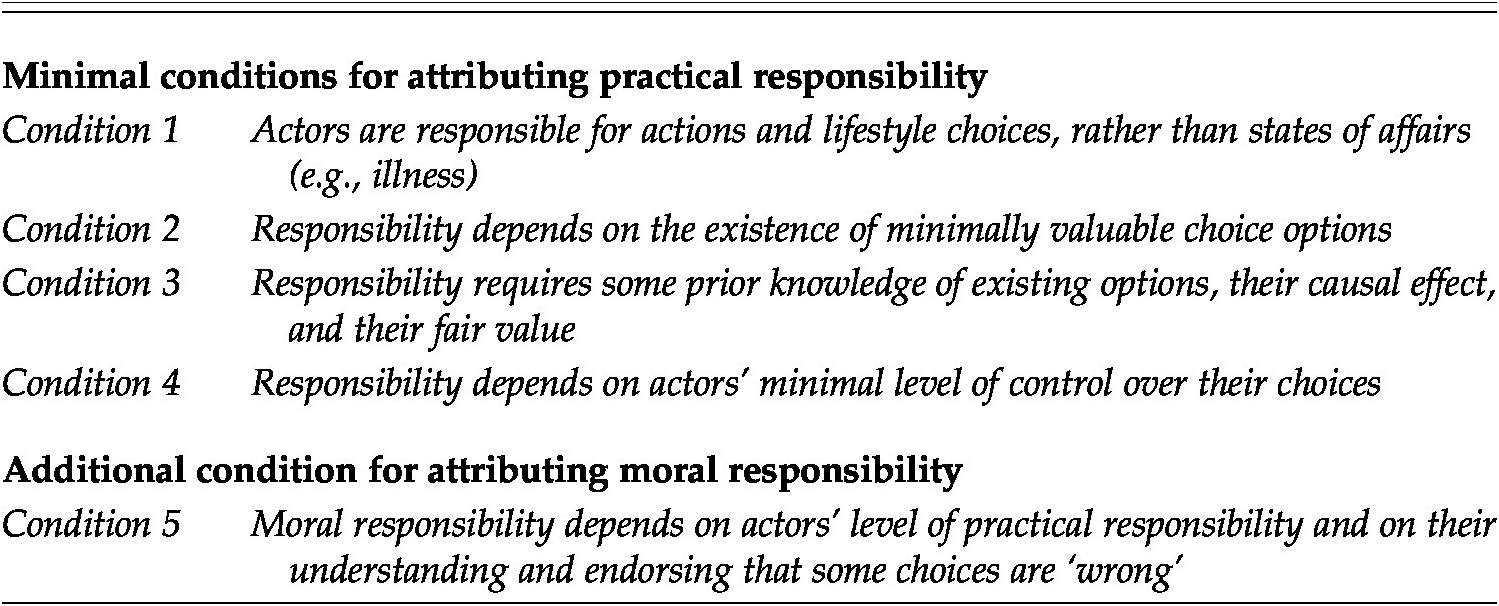
In this paper, we investigate to what extent it is warranted to hold these patients responsible for their disease and sanction them accordingly. We do not presume, as is often done, that patients have either full or no control over their unhealthy behavior.Footnote 3 As we will show, responsibility is a matter of degree and the main difficulty is to evaluate that degree. In the next section, we begin our analysis with a series of minimal and fairly uncontroversial conditions for attributing ‘practical’ and ‘moral’ responsibility. Responsibility (1) relates to actions rather than states of affairs; (2) and depends on the existence of choice options; (3) on actors’ prior knowledge of existing options, their causal effect, and their fair value; (4) on their control over their choices; and (5) on their understanding and endorsing that some choices are ‘wrong.’ In section 3, we investigate how to use these conditions to evaluate patients’ responsibility for their disease. First, we point out that patients are responsible for a health-risky lifestyle choice rather than for their actual sickness. We then show that their responsibility should be assessed in light of the explained variance of their unhealthy lifestyle, compared to causal precursors over which they have no grasp (e.g., genetic and environmental background). Further, we explain that patients’ responsibility for their life choice depends on their capacity to fulfil the above mentioned conditions 2–4, which can be constrained by various external ‘limiting factors’ such as biased available information, framing of choice options, or automatic psychological mechanisms. We point out that scientific knowledge about the effects of these limiting factors generates shared responsibilities for other parties such private industry and public health agencies. In section 4, we analyze whether it is warranted and efficient to punish patients deemed responsible. The upshot of our analysis is that patients are at risk of being disproportionately held responsible and sanctioned for their health conditions. Some “patient empowerment” health policies targeting unhealthy lifestyles can increase unequal treatment of already vulnerable groups. In the concluding section, we highlight the mistaken logic of underlying responsibility attribution to the ‘undeserving sick’ in public debates, and make practical suggestions for integrating a sustainable and coherent view of responsibility for health within healthcare systems.
Minimal Conditions for Attributing Responsibility
Sick patients who have adopted a lifestyle identified as a possible cause for their disease (e.g., smokers with lung cancer, or obese patients with diabetes) are often stigmatized.Footnote 4 There is a largely shared intuition that a causal relation between a behavior (an unhealthy lifestyle) and a consequence (an illness) is a ground for responsibility attribution. But it is unclear how this relation works and how this responsibility can serve as a justification for lesser access to treatment. In sections 2 and 3, we will discuss the possible relations between behavior and consequences. Section 4 will be devoted to the link between responsibility and lower access to treatment.
If we aim to attribute responsibility to patients, we need clear criteria for responsibility attribution. In the current literature, the notion of responsibility has been defined in many different ways. It may refer to the ‘causal role’ an actor played in bringing about the disease. It may refer to the ‘obligations imposed upon the actor,’ such as to take measures against one’s unhealthy lifestyle.Footnote 5 It may refer to some more ‘deep relationship’ between the actors and the disease, which makes them accountable for praise or blame.Footnote 6 For the purpose of our investigation, the latter notion seems to be the most appropriate, but unfortunately, the conditions of that ‘deep relationship’ are ill- or variously-defined in the literature. Here we clarify that issue by proposing a series of uncontroversial conditions that account for the most prototypical and widely shared cases of responsibility attribution (and exemption) in everyday life.
Practical Responsibility
Condition 1: Responsibility applies to actions and lifestyle choices, rather than states of affairs
Responsibility refers to actions (e.g., smoking a cigarette) or to groups of similar actions which can be described as a habit or a lifestyle (e.g., being a smoker). In contrast, responsibility does not refer to states of affairs such as becoming ill or becoming dependent on social insurance systems.Footnote 7 This distinction is important because actions or lifestyles do not perfectly correlate with health conditions. One may be a long-standing smoker and stay in good health till old age, and conversely, one may be diagnosed with lung cancer despite healthy life habits. If we attribute responsibility solely based on the health outcome, it is not possible to discriminate between these two categories of patients, or to make a distinction between the decision to take a health-related risk and the actual bad luck of seeing that risk materialized.
Condition 2: Responsibility depends on the existence of minimally valuable choice options
This condition states that one can only be held responsible for an action if there is a choice to make: we do not hold people responsible for actions made under constrained circumstances.Footnote 8 For instance, if an effective drug is unaffordable for some patients, we would not reproach them for not taking that drug. This condition also states that responsibility hinges on the possibility of producing different actions that are all ‘minimally valuable.’ This notion raises issues of interpretation. In particular cases, one may debate about whether one possible action path is sufficiently relevant and attractive to be considered a real choice option. Individuals often have the possibility of acting against a deeply rooted social rule, but the foreseen consequences may be so damaging that these options turn out to be unworkable. For instance, in social contexts where it is an offense to refuse a welcome alcoholic drink, an individual needing social acceptance may not really have the choice to refuse.Footnote 9 To some extent, the value of choice options depends on individuals’ personal needs and preferences.
Condition 3: Responsibility requires some prior knowledge of existing options, their causal effect, and their fair value
This condition means that responsibility for choosing depends on one’s capacity to grasp the most relevant features of the choice options. First, actors need to be aware of the possibilities that are available to them.Footnote 10 Patients who are unaware of the existence of an effective and affordable therapy to cure their disease cannot be held responsible for using an ineffective therapy. Second, patients made aware of existing choice options need to be capable of seeing the fair value of those options. Biased information or impaired cognitive capacities may decrease such awareness. For instance, patients experiencing a craving for a drug, or going through a manic episode, may not be able to understand that they could take a less damaging action. When the initial choice leading to addictive behavior (such as smoking) is made in childhood, cognitive capacities may be insufficiently developed to allow such awareness. More generally, the capacity of grasping existing choice options also depends on one’s capacity for imagination, which we can possess and exercise with more or less talent.Footnote 11 For instance, there may be a subtle way to avoid a welcome alcoholic drink without appearing rude. Some individuals are better than others at seeing and exploiting these opportunities. Finally, one needs to be aware of the likely consequences of our action choices. Patients cannot be blamed for choosing an unhealthy consumption habit if they did not receive warning information.
Condition 4: Responsibility depends on actors’ minimal level of control
This condition states that responsible actors have some causal power over their choices: they can somehow monitor their actions. This raises the practical question of identifying reliable cues for evaluating whether actors indeed control their actions. Some elements find consensus in the literature:Footnote 12 control can be achieved when we take the time to think over the available options, to weight them, to form preferences over actions that are coherent with our deep preferences and actual needs, and when we manage to orient our choices accordingly. In contrast, we do not control our actions if we let our impulses (i.e., automatic psychological mechanisms) make decisions alone, that is, when we do not try to reflect upon them or when the resulting decisions are not aligned with our deep preferences and actual needs. Cast in terms of the well-known dual process model of information processing,Footnote 13 it means that actors controls their actions if they are capable of thinking in a Type 2 mode and orienting the responses of their Type 1 mechanisms in line with the conclusions drawn from their Type 2 conclusions. Type 1 processes are fast, unconscious, and autonomous. They are typically induced by the activity of relatively independent and primitive systems dedicated to particular decision problems. It does not make demands on working memory and is thus relatively fluent and effortless. Type 2 thinking, however, involves slow and conscious processing that gives rise to reasoning able to manipulate abstract concepts and rules. This type of thinking needs working memory resources which make it more effortful.
At this stage, it becomes important to put more flesh on the notion of “deep preference.” In our view this notion refers to actors’ most important “theoretical preferences over long-term states.”Footnote 14 By “theoretical,” we mean preferences that are experienced when actors can think over the choice situation without being urged to choose ‘right now.’ Moreover, these preferences include desires and commitments about distant future states (e.g., losing 10 kg for next year) or about present states that should last for a long time (e.g., staying in good health).
With these clarifications in mind, it becomes clear that control does not work like an on/off button. On some occasions, one can exercise a higher or lesser degree of control over one’s actions. This gradation means that there are multiple causal sources to action decisions. Some causal sources are due to the activation of fast and automatic mechanisms (the so called Type 1 mechanisms). Whenever these mechanisms play a causal role despite actors’ best efforts, they decrease their level of control. The most obvious cases occur when automatic mechanisms’ responses clearly misalign with actors’ deep preferences. For instance, when patients try to decrease their sugar consumption but periodically fall short of motivation and compulsively empty chocolate boxes. But there are more subtle cases where actors exercise partial control. Consider the case of an actor suffering from stage fright, who only manages to feel disinhibited after having a glass of wine. On these occasions, alcohol consumption aligns with her deep preference for performing well on stage. On the long run however, this strategy may lead her down the path to addiction and it may become less clear when the glass of wine is taken as an effect of craving or as a means to performing well. In such situations, she may only partially control her consumption of alcohol.
For the purpose of this article, we do not need to unfold how to keep Type 1 mechanisms on a leash. We do not need a precise picture on “how conscious deliberations, plans, and distal intentions can have proper downstream effects on how we act in the relevant situations.”Footnote 15 We merely need to measure the end state: the extent to which patients control their lifestyle choices. In line with our analysis, the most workable criteria that could be used for this purpose are (a) the extent to which patients are capable of (and actively make use of this capacity for) sounding out their deep preferences and forming coherent evaluations of choice situations, and (b) the extent to which their actual choices match with their deep preferences. Patients failing on either of the criteria (or on both) cannot be attributed full responsibility for their lifestyle choice.
Moral Responsibility
By now, we have analyzed the notion of responsibility from a descriptive point of view. The notion of responsibility, however, is often associated with a normative and moral flavor. To account for these cases, let us add one condition.
Condition 5: Moral responsibility depends on actors’ level of practical responsibility and on their understanding and endorsing that some choices are ‘wrong’
This condition makes it explicit that for responsibility to become ‘moral,’ in addition to being practically responsible (i.e., fulfilling conditions 1–4), actors should be able to evaluate actions as morally desirable or undesirable, and to integrate these evaluations into their deep preferences. This is why, in many situations, small children can be held practically responsible, but not morally responsible for their actions. For instance, we excuse them when they brutalize their sibling or when they make crude remarks on the grounds that they fail to grasp the moral status and implications of their actions. A similar contrast between practical and moral responsibility can be made for mature adults. When the wrongness is largely culturally shaped, actors may not grasp that their behavior is ‘wrong’ at the point of action. One classical example is the status of wine drinking, which is perceived differently within different social circles. Alternatively, actors may not agree that their behavior is ‘wrong,’ which raises the difficulty of deciding who holds the correct moral evaluation. Since moral norms vary largely across history, social groups and individuals, intricate difficulties arise whenever actors do not share (for sound or unsound reasons) the moral evaluation of those who attribute moral responsibility to them.Footnote 16 Therefore, moral responsibility is a delicate notion. Since it is normative and the content of normativity does not meet clear consensus, moral responsibility cannot be considered to be an uncontroversial objective criterion. It is not grounded on stable or scientifically tractable variables, as is the case with practical responsibility.
Evaluation of Patients’ Responsibility for a Lifestyle Related Disease
The purpose of this section is to evaluate to what extent responsibility attribution for one’s disease is objectively justifiable. For this, we will systematically apply the conditions described in the previous section (summarized in Table 1).
Summary of the conditions that account for the most prototypical and widely shared cases of ‘practical’ and ‘moral’ responsibility attribution in everyday life

The first observation to make is that the normative condition 5 underlying moral responsibility arises on top of the more basic conditions 1–4 for practical responsibility. Thus, only a subclass of patients deemed to be practically responsible can be considered morally responsible. Moreover, we have seen that condition 5 raises serious problems of interpretation. Thus, for the sake of simplicity and objectivity, in what follows, we will concentrate on the more fundamental criterion of practical responsibility.
The second observation to make is that a disease is a state of affairs. Thus, patients cannot be held directly responsible for their disease. Such an attribution would violate condition 1. The connection between disease and individual responsibility is mediated by patients’ life choices, which increase the risk of becoming ill (Figure 1, dotted zones). Since, by definition, a risk does not systematically materialize into illness, it becomes crucial to assess its importance (low, medium, high). For this, we need a broad picture of all the causal sources underlying patients’ disease.
This figure gives a sense of how much responsibility one can objectively attribute to a typical patient suffering from a lifestyle related disease. The proportions of the causal effects are only illustrative; for each given disease, they would need to be evaluated according to existing scientific data. The striped zones represent the sum of the explained variance of environmental and genetic factors affecting the disease development, independently of the patient’s lifestyle choice (e.g., susceptibility genes, polluted environments). The dotted zones represent environmental and genetic factors affecting the disease development, in interaction with the patients’ lifestyle choice (e.g., increased genetic susceptibility with a particular lifestyle). Light striped and dotted zones represent the unexplained variance: it refers to factors that have not been identified by medical research although they are causally relevant for the disease development. The tiled black and white zoom illustrates the fact that individual responsibility for unhealthy lifestyle is reduced by the extent to which actors fulfil conditions 2–4 for practical responsibility.

As illustrated in Figure 1, for any given human disease, it is (theoretically) possible to represent all causal factors that have a statistical effect on the development of that disease. Each of these factors can be attributed an explained variance which ranks between 0 and 1. Such a measure represents how much the factor accounts for the expression of the disease, assuming that the sum of the explained variances of all causal factors equals 1. Note that an explained variance of 0.01 or 0.02 is often considered significant by researchers interested in population-level effects. But the same is not true for responsibility attribution.
Many external causal factors that count among possible causes for a disease are arguably unrelated to patients’ lifestyle choices (Figure 1, striped zones); they exert their effect independently of patients’ action choices. The most obvious examples are susceptibility genes or life-endangering environments such as a polluted living sites. By definition, patients have no grasp of these sorts of factors, hence, following conditions 1 and 2, they are cleared from responsibility. To illustrate, we all know examples of people suffering from lung cancer although they have conducted a healthy lifestyle (e.g., carriers of genetic predisposition to lung cancer) or because they have been forced to live in dangerous environmental conditions (e.g., children who grow up in a house of heavy smokers), or simply because of aging. Note that patients with less irreproachable lifestyles (e.g., long-term smokers or sportsmen using doping substances) are equally affected by those factors and, to the same extent, can be exposed to bad luck. This is an objective reason to reduce, accordingly, their responsibility for their disease.
Some factors that count among possible causes for a disease are arguably related to patients’ lifestyle choices. They are environmental (including physiological) and genetic factors that increase the probability of a disease developing in interaction with patients’ agency (Figure 1, dotted zone). Known examples of health-impacting lifestyles are smoking or alcohol consumption, overconsumption of fat containing food, sedentary life, use of performance-enhancing drugs, pregnancy, or risky professions. Only those factors are eligible for responsibility attribution, but as we will see below, the degree of that responsibility also depends on further considerations.
For any given disease, most factors are unknown (Figure 1, light striped and dotted zones); their causal role on the disease development has not yet been identified. According to condition 3, some knowledge about the value of options is necessary for responsibility attribution. In the absence of such knowledge, one cannot hold patients responsible for the causal effect of those factors.
Only known factors related to lifestyle choices are eligible for responsibility attribution (Figure 1, dark dotted zone). But still, patients may not be held fully responsible for their lifestyle choices. When looking more closely at the matter (Figure 1, tiled black and white zoom), it becomes clear that many ‘limiting factors’ impede the fulfillment of one or several of conditions 2–4 for practical responsibility. By limiting factors, we mean partial causal precursors of patients’ lifestyle choices on which they have no grasp. The strength of these limiting factors is inversely correlated with the degree of practical responsibility that can be attributed to the patient. Table 2 provides a nonexhaustive list of such factors and an explanation of their negative effect.
Case-by-case analysis is necessary to identify the extent to which given patients or categories of patients are able to fulfil all the practical responsibility criteria. To illustrate, here are some important elements to keep in mind.
Nonexhaustive list of causal precursors of lifestyle choices on which patients have no grasp (limiting factors), and nonexhaustive explanation of how they may negatively affect the fulfilling of three necessary conditions for practical responsibility. (Condition 1 is not represented in this because it is already fulfilled when discussing lifestyles: lifestyles express action choices rather than states of affairs.)

Practical responsibility is a matter of degree because conditions 2–4 can be more or less fulfilled. For instance, if the unhealthy character of a lifestyle (e.g., refusal of vaccination) is debated in the society, the debate becomes a limiting factor that impedes proper knowledge about the fair value of the lifestyle. Therefore, the fulfilment of condition 3 is compromised and the degree of patients’ responsibility decreases accordingly.
The degree of practical responsibility may change during patients’ life histories. Thus, since patients are more responsible when they have more control over their choices (condition 4), they are more responsible for an unhealthy lifestyle choice before the instalment of an addiction. For instance, addicted smokers find it very difficult to adjust their action choices to their deep preference for quitting that habit. To put it simply, practical responsibility often decreases with the instalment of unhealthy habits.
More generally, while assessing the extent of individual responsibility, it is important to consider all context-relevant limiting factors. For instance, even in the absence of installed addictions, before a teenager has decided to smoke her first cigarettes, she might have been biased by marketing and social pressure in favor of smoking; these external pressures are limiting factors and lead her to a biased formation about the fair value of smoking. Moreover, teenagers’ ability to resist immediate impulses is less developed than later in life. Since many smokers start this behavior during their teen years,Footnote 17 these limitations will often apply. In contrast, patients capable of understanding the long-term risks of smoking can be held more responsible for taking up that habit.
Whenever limiting factors are produced or exploited by third parties possessing agency (e.g., individuals, private companies, public administration), there is shared responsibility for the unhealthy lifestyle choice. For instance, a food company selling unhealthy products while advertising them as healthy generates wrong beliefs. These beliefs limit the fulfilment of condition 3. As a result, consumers’ practical responsibility is decreased. Our analysis thus shows that any activity of third parties that induces patients to opt for health-related lifestyles has an impact on patients’ degree of responsibility for their illness.
Actions by third parties that have an impact on health-related behaviors will sometimes also generate attributable practical responsibility for illness (or health) for these third parties. This does not happen through a transfer of practical responsibility. When applied to multiple parties, practical responsibility (as opposed to purely causal responsibility) is not zero-sum,Footnote 18 and the total cumulative responsibility attributable in a given situation will often be less or more than 100 percent. Rather, the impact of a third party’s actions on patients’ degree of responsibility and on its own degree of responsibility should be examined separately.
The level of responsibility of third parties can be evaluated according to the same conditions 1–5 detailed above. For example, when a company sells unhealthy products while advertising them as healthy, or when it takes any action that is known to have a negative effect on consumers’ health, this company also takes on practical responsibility for the patient’s illness. Condition 1 will obtain in any circumstance where a company is making a choice regarding its own actions. Conditions 2–4 will also apply: minimally valuable choice options are usually available to companies (condition 2), prior knowledge about options, their effects, and their fair value is increasingly available (condition 3), and companies do have at least a minimal level of control over their choices (condition 4).Footnote 19 As in the case of individuals, attributing moral responsibility to companies will require that condition 5 be fulfilled as well, and this will depend on their understanding and endorsing that some choices are ‘wrong.’ Although this attribution will of course be more fraught than in the case of persons, it could nevertheless apply in some cases. As in the case of individuals, however, attributing practical responsibility does not require this last condition. The same reasoning applies to other third parties, such as states that decide to forgo arranging safe environments for cyclists, for example, or that decide not to regulate advertising for substances harmful to health.
Our analysis thus shows that third parties that induce patients to opt for health-related lifestyles do not only affect patients’ responsibility; they are also among the parties responsible for patients’ health status. Even public health agencies and states that could easily take effective actions against known limiting factors have their share of responsibility. Interestingly, third parties’ positive and negative responsibilities increase continuously with the growth and transmission of scientific knowledge. For instance, it is no longer possible to ignore the fact that consumers are strongly attracted to food high in salt, sugar, and fats,Footnote 20 or that income and living environments affect eating habits.Footnote 21
To sum up, objective individual responsibility attribution for one’s disease involves a step procedure. First we need to identify known health-related lifestyle factors (Figure 1, dark dotted zone) and estimate the extent of their explained variance. This value depends on available scientific data and may change considerably from one disease to another. Responsibility attribution needs to be adjusted to that value. Second, we need to evaluate to what extent the considered patients are practically responsible for the identified unhealthy lifestyles. Third, we may want to evaluate to what extent patients are, in addition, morally responsible for their choices (i.e., fulfilling condition 5), although that part of the evaluation is grounded on more shaky criteria. And fourth, a fulfilled analysis involves evaluating relevant third parties’ responsibilities as well.
Punishing Patients on the Grounds That They Are Responsible
Attributing practical responsibility for a disease does not automatically imply that patients deserve decreased access to healthcare resources, or that any forms of punishment would be warranted as a response. Medical professionals choose a lifestyle that puts them at risk of catching infectious diseases, but few would deny them proper care on the grounds that they should be held responsible for thus becoming ill. We consider unhealthy work that benefits others such as masonry, pregnancy, or high risk sports (such as boxing or hockey playing) to be praiseworthy rather than a reason for liability or even worthy of punishment.
What type of practical responsibility for disease, if any, could justify a consideration that patients have a weaker claim to treatment? When might punitive measures be justified? Further arguments and clarifications are needed to explore this question. In what follows, we examine the characteristics of responsibility that are relevant to the question of liability and punitive measures, what implementing such measures would require, and some practical implications.
The first point to clarify is the degree of responsibility required to deserve increased liability, or punishment. That question is far from trivial, and largely unaddressed. The procedure described in section 3 may help in the task of evaluating roughly the degree of responsibility of a patient or group of patients. However, it does not help to decide the threshold above which one can confidently declare patients as ‘significantly’ or ‘sufficiently’ responsible.
Second, since patients may not be the only responsible individuals, an objective and fulfilled evaluation should take into account shared responsibilities by third parties as well. When are patients ‘sufficiently’ responsible in situations where their behavior is influenced by others? Answering this is not straightforward in the abstract, and could be even less so in specific cases where conclusive evidence may be difficult to identify. Somewhat similarly, when is a third party ‘sufficiently’ responsible to be deserving of increased liability, or punishment, for playing a role in causing a disease? Interestingly, although determining a threshold will also raise difficulties here, it seems easier and more worth the effort to evaluate the practical responsibility of private companies and other collective entities in practical cases than it would be to evaluate the practical responsibility of patients. Organized institutions are long-lived and store a fair amount of written records, thus providing more solid bases for an objective evaluation of responsibility.
Third, in order to avoid the condemnation of ‘praiseworthy risk-taking behaviors,’ we would need to determine what type of unhealthy lifestyle is blameworthy (and punishment-worthy), and why. If it is risk-taking itself that we deem to be blameworthy, then the implication is that we ought to also punish what we currently consider praiseworthy risk-taking behaviors.Footnote 22 If the blame attaches to something other than the mere fact of taking risks with our own health, however, this would weaken the case for considering patients less deserving of healthcare. In such cases, an additional justification would also be required to deem an unhealthy behavior to be blameworthy.
One option might be to focus on unhealthy lifestyles that lack the extenuating circumstance of having a social benefit. For instance, smoking or drinking are pleasurable activities that impose health costs on society, while pregnancy is advantageous to future mothers but also to society. However, this would imply that we should also include activities such as climbing or horse-riding, which increase the risk of accident; but few would deny the treatment of a fracture due to such an activities. Moreover, one might discuss what counts as social benefit. For instance, in some countries, alcohol and tobacco tax revenues may fully compensate health costs. Does that change the evaluation of individual responsibility?
An alternative option may be to target only unhealthy lifestyles that are morally or socially condemned. This option amounts to explicitly include condition 5 into the evaluation of responsibility. However, as previously mentioned, the difficulty here is that moral evaluations of lifestyles vary across history and social contexts, and few objective criteria are available for favoring one evaluation over the other. For instance, there is a social expectation of consuming alcohol in many social contexts, and high risk sports are socially valued in some circles but not in others. Thus, even if patients fulfil conditions 1 to 5, one still needs to justify why the stigmatized lifestyle is truly immoral.
Determining what category of patients is ‘sufficiently’ responsible to be deserving of increased liability, or punishment, and what behaviors are sufficiently blameworthy to justify such considerations, then, turns out to be a complex exercise. In order to avoid unfair treatment of individual patients, the targeted category of patients would need to be easily identifiable and highly homogeneous with respect to the most causally relevant criteria for responsibility attribution. The degree of responsibility would need to be assessed with sufficient precision, taking into consideration circumstances of shared responsibility. A threshold for ‘sufficient’ responsibility would have to be determined. Convincing justifications should be provided for why this particular risk-taking lifestyle is blameworthy. In the last step, the mere fact that the behavior represented a risk to health could not constitute sufficient justification without implying that we ought to also punish what are currently considered to be praiseworthy risk-taking behaviors.
Now suppose that it is possible to convincingly categorize an unhealthy behavior as morally blameworthy and to describe with some precision a class of undeserving sick patients who ‘sufficiently’ fulfil conditions 1-5. For instance, say that the targeted patients suffer from lung cancer, have been regular smokers for at least 10 years, knew all along about the unhealthy character of smoking, made the decision to smoke as lucid adults, do not carry a genetic predisposition for cancer, and have not yet shown clear signs of addiction (e.g., no previous failed attempts to quit smoking). Even in those explicit cases, further questions arise regarding what increased liability or punishment would imply in practice.
First, who would determine whether an individual patient qualifies as an ‘undeserving sick,’ and what degree of responsibility can justifiably be ascribed to her? Would that person be a reliable and adequate judge? And since we speak of sanctions and judges, how would rights to a fair trial be applied? If that task is given to healthcare professionals, the practice would run into conflict with the foundations of medical ethics and endanger the patient-physician trust relationship.Footnote 23 One of the foundations of medical ethics is that the tools of medicine should be used for, rather than against, patients. Were medical professionals tasked to determine whether their patients enter in a category of ‘undeserving sick,’ this activity would be in clear violation of this principle. Moreover, healthcare professionals and structures are ill equipped to deal with what could start to resemble legal, or even criminal investigations.Footnote 24 Hospital administrators, insurers, or other structures not staffed by health professionals may be more adequate for the task, but they are less likely to have (and interpret correctly) the most relevant information. Expeditious evaluations based on low-quality information about individual levels of responsibility would deny patients the right to be presumed innocent, and would fly against current ethical recommendations to not exploit vulnerable patients.Footnote 25 Advances in medical research would require constant updates on who could count as ‘undeserving sick.’ Since this knowledge is relevant to the assessment of responsibility and spreads only progressively within a given population, the expected state of public knowledge would need constant updates also. Overall, this process may end up becoming more burdensome than simply treating all patients without distinction.
The same questions arise when exploring the implications of increased liability or punitive measures for the responsibility of third parties. In the case of private companies or other collective entities, however, these issues are somewhat more tractable. Rather than requiring a rapid assessment as in the case of individual patients, assessments of the responsibility of third parties could take more time as they would not determine treatment or reimbursement decisions in individual cases. Longer procedures could be conducted by agencies more suited to the task, and rules of fair procedure could more easily be applied there as well.
In the case of individuals, another difficulty arises. In cases where responsibility could be clearly established, this would be responsibility for a risk-taking behavior, rather than responsibility for having become ill. If a health-related risky behavior is deemed to be blameworthy, why should only those who become ill be sanctioned, as opposed to all those who engage in this behavior? Even if we assume that the difficulties outlined above can all be overcome, this would still amount to punishing those who are not only blameworthy but unfortunate as well, and letting those who are lucky get away with it as well.
Increased liability and punishment could also both have very undesirable side-effects. Denying or constraining access to treatment would negatively impact the socio-economic status of the targeted patients. Since low socio-economic status is correlated with many stigmatized lifestyles,Footnote 26 this would increase social inequalities. This is even more problematic because the ‘undeserving sick’ already suffer from heavy burdens: they are caught in socially stigmatized life habits which are difficult to change, they have had the bad luck of catching the disease that is difficult to cope with, and on top of that, they would be held responsible and sanctioned for it through a process where fairness is difficult to ensure.
Arguably, at the population level, those negative effects may be compensated if overall increased liability and punishment efficiently deter from unhealthy lifestyles. But there is little empirical data to support or contradict that thesis,Footnote 27 and some data suggest that moralizing unhealthy behavior may be counterproductive in the targeted populations.Footnote 28 In our view, that strategy is bound to fail because the punishment targets the wrong phenomenon. Nobody needs to be convinced that it is bad to become sick, and at the individual level, it is hard to identify ‘watching TV this evening’ as a risk for being refused a therapy for a hypothetical future disease related to sedentary lifestyle. People do need to understand that some lifestyles are unhealthy, and to find the motivation to engage in less risky ones. For this purpose, however, prevention or other supportive measures will be more adequate and efficient than punishment. Blaming individuals for their share of this responsibility has been criticized as a hypocritical move designed to shirk collective responsibility for these same risk factors.Footnote 29
Decreased access to health resources, would also be problematic for other reasons. If applied to the ‘undeserving sick’ this would constitute the only use of this particular form of consequence to deter behavior. Indeed, many societies consider access to care as a right guaranteed to all. Even where this is not the case, access is provided for other blameworthy individuals including convicted criminals that have committed much more heinous crimes than repeatedly picking the wrong dessert. Moreover, decreased access to health resources can also have dire consequences, making it a clearly disproportionate consequence in the cases considered here. Overall, if all the other difficulties could be resolved, and punishment of unhealthy behaviors were to be implemented, it would be morally less problematic to make these behaviors illegal and fine those who remained guilty of them than to decrease access to health resources on those grounds.
Conclusion
Our analysis of responsibility attribution shows that patients' practical responsibility for their lifestyle can hardly be a sufficient reason for deserving punishment. In fact, punishment must be grounded on the fact that these patients exhibit a pattern of behavior that is considered immoral in a given society. But the immorality is neither objective nor self-evident when taking into account the social contingencies.
We also have pointed out that considering ‘undeserving sick’ to be more liable, or even punishing them, turns out to punish only a subcategory of individuals: those who show unhealthy habits and have been unlucky to become sick. In other words, by punishing the ‘undeserving sick’ we seem to punish a ‘wrong illness,’ since it is hardly justifiable to consider the fact of being ill to be morally blameworthy.
Here is a reconstruction of the mistaken logic underlying the undeserving sick rhetoric: people focus on the salient features of the unwanted situation—patients suffering from a socially stigmatized disease (e.g., alcoholism, compulsive eating behavior, smoking, addiction). These diseases are socially stigmatized for a number of reasons: they are difficult to cope with within families, are associated with health costs for society, and there is a feeling that this could have been avoided thanks to an alternative lifestyle. By some sort of contagion mechanism, people attribute the stigma of immorality to the patients themselves. They then post-rationalize this evaluation by wrongly attributing to the patients the responsibility for their health condition. They do so even when the behavior considered to be blameworthy is explicitly described as not the cause of the disease:Footnote 30 they simply don’t like these individuals. But since responsibility is attributed post-hoc as a means of justifying the punishment of already incriminated patients, it is done in an all-or-nothing manner which does not reflect the reality of partial and shared responsibilities.
By taking the task of reflecting seriously on objective criteria for responsibility attribution, we have shown that patients with unhealthy lifestyles are often disproportionately held responsible and sanctioned for their health conditions. In the light of our analysis, the rhetoric of patients' responsibility turns out to be an illegitimate and hypocritical opportunity to punish those who have behavioral habits that are condemned socially.
Our analysis of practical responsibility has highlighted the overlooked importance of the shared responsibility of third parties including private companies and those determining policies that impact health. By taking into account the shared responsibility of third parties instead of using a moralizing discourse directed at individual patients, and by trying to remove limiting factors, we could empower patients’ practical responsibility and help them choose more healthy lifestyles. We think that this would contribute to a sustainable and coherent integration of health responsibility into healthcare systems. We could make sure that selective altruism is not too selective, and that vulnerable groups retain access to proper healthcare.