Clostridium difficile is a spore-forming gram-positive anaerobic bacillus that is the most commonly recognized cause of infectious diarrhea.Reference Tillotson and Tillotson 1 Clostridium difficile infection (CDI) has a significant impact on a patient’s clinical course and quality of life. Nosocomial CDI often prolongs hospital stays, with a median increase in length of stay ranging between 2.8 and 16.1 days.Reference Mitchell and Gardner 2 According to Rupnik et al,Reference Rupnik, Wilcox and Gerding 3 each year approximately 500,000 cases of CDI are acquired in US hospitals and long-term care facilities, which results in 15,000 to 20,000 deaths.
During the past decade, attempts to reduce the rates of CDI have included environmental decontamination, infection control, and education among hospital staff.Reference Cohen, Gerding and Johnson 4 – Reference McMullen, Zack, Coopersmith, Kollef, Dubberke and Warren 13 Although prevention of secondary transmissions (ie, the spread of CDI from an infected patient to uninfected patients) is necessary, it alone is not sufficient to reduce its spread.
A clinical prediction rule is a tool that quantifies the effect an individual patient’s characteristics have toward the patient’s diagnosis, prognosis, or likely response to treatment. These characteristics are based on various components of the history, physical examination, and basic laboratory results. Clinical prediction rules use evidence to guide clinical management by allowing physicians to identify a patient’s individual risk of a certain disease on the basis of the patient’s personal risk factors. Applying a clinical prediction rule will allow healthcare workers to properly identify patients at high risk for CDI and intervene before these patients become ill. Our study focused on formulating a clinical prediction rule to identify those patients at risk for a primary infection, thus excluding those with a prior history of CDI. By doing so we focused on only those patients whose risk level is uncertain. Those with a previous diagnosis of CDI are clearly a high-risk population regardless of other cofounding factors.
After a thorough literature review, we identified only 5 previous studies that examined the use of clinical risk prediction models specifically created to predict the onset of a primary CDI.Reference Smith, Chan, Halm, Slattery, Lindquist and Savik 14 – Reference Tanner, Khan, Anthony and Paton 18 However, these studies have several limitations for practical use at the patient’s bedside. Two studies used length of stay of greater than 7 days as a predictor for CDI onset.Reference Smith, Chan, Halm, Slattery, Lindquist and Savik 14 , Reference Chandra, Thapa, Marur and Jani 15 However, length of stay constantly fluctuates and is unknown at the time of admission. Another study used acute physiology score as a variable,Reference Dubberke, Yan and Reske 16 which uses variables that are also not readily available. Garey et alReference Garey, Dao-Tran, Jiang, Price, Gentry and Dupont 17 evaluated only a cohort of patients on broad-spectrum antibiotics. Tanner et alReference Tanner, Khan, Anthony and Paton 18 applied the Waterlow score to patients to predict their risk of acquiring a primary nosocomial CDI. However, this score is limited by its large number of scored items. Therefore, all of these studies are limited in their practical use. Our current study focused on creating a simple-to-use, adaptable tool that fits well into clinical workflow with a focus on identifying a patient’s risk for an initial CDI, upon admission.
METHODS
A retrospective cohort study was performed. We collected all patient data from the electronic health record and administrative data systems from January 1 to December 31, 2013. All patients admitted to the hospital who were above the age of 18 were included in the study. Exclusion criteria included patients with a history of CDI, as defined by an International Statistical Classification of Disease, Ninth Revision, billing code, or those with community-acquired CDI on admission (defined as occurring before or within 3 days following admission). After applying the inclusion and exclusion criteria, we identified 61,482 subjects, who were divided into a training set and a validation set. Patient characteristics were defined using electronic and administrative data (International Statistical Classification of Disease, Ninth Revision, codes). A positive outcome was defined as the development of CDI while in the hospital, as determined by a positive CDI polymerase chain reaction assay result at least 3 days following hospital admission. Since polymerase chain reaction testing is run only on diarrheal samples, all patients who tested positive had clinical symptoms of CDI. If a patient tested positive for CDI within 3 days of admission the patient was determined to have community-acquired CDI and was excluded from the study. Random sampling was performed by research coordinators during the study to confirm CDI diagnoses.
Descriptive statistics were used to describe demographic and clinical characteristics of the sample. The χ2 test or Fisher exact test was used to examine the association between these characteristics and hospital-acquired CDI, as appropriate. Logistic regression was used to model hospital-acquired CDI as a function of potential risk factors. Best subsets selection was used as a screening method to identify the best set of predictor variables for the logistic regression model. We performed best subsets selection using SAS, version 9.4 (SAS Institute), by computing the score χ2 for each model and identified the subset with k variables, where k was the first subset for which the score χ2 changed from the previous subset by less than 5%.
The β-coefficients for variables significantly associated with in-hospital CDI were used to assign a numerical value to each risk factor and summed to create a total risk score for each patient (1 for 0 < β < 1 and 2 for 1 ≤ β < 2). The optimal risk score cutoff for predicting hospital-acquired CDI on the receiver operating characteristic curve was calculated. The optimal point was defined as the risk score closest to the upper left corner on the receiver operating characteristic curve, which represents 100% sensitivity and specificity. The area under the receiver operating characteristic curve (AUC) was also assessed. The model was validated using the validation set, and the misclassification rate, AUC, sensitivity, specificity, and positive and negative predictive values were calculated, along with corresponding 95% binomial confidence intervals. All analyses were performed in SAS, version 9.4. The procedures used were reviewed and approved by the responsible institutional review committee at the authors’ institution.
RESULTS
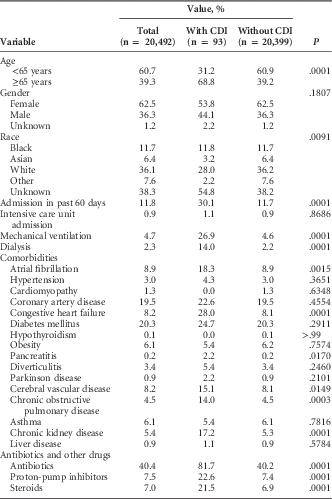
Data for 80,324 admissions were pulled from the electronic health record. After exclusion criteria were applied, 78,945 admissions remained. After accounting for repeated admissions, the total population included in this study was 61,482 unique encounters. The population was then divided into a training set (40,990) and a validation set (20,492).
Demographic Characteristics
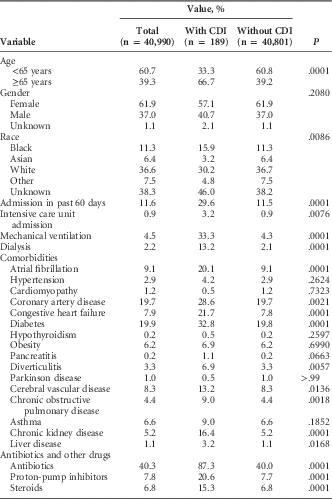
There were a total of 40,990 subjects in the training set, with a 0.46% overall incidence of CDI. Most subjects were women (60.7%) and the mean (SD) age was 56.2 (21.1) years. The most common comorbid disease was diabetes mellitus with a prevalence of 19.9%. Antibiotic usage was present among 40.3% of the population (Tables 1 and 2).
Demographic and Clinical Characteristics of Derivation Cohort in Study of Clostridium difficile Infection (CDI)

Demographic and Clinical Characteristics of Validation Cohort in Study of Clostridium difficile Infection (CDI)

C. difficile Infection Clinical Prediction Rule
The following variables were deemed nonsignificant and removed from the model using best subsets selection: race, hypertension, cerebral vascular disease, chronic obstructive pulmonary disease, intensive care unit admission, coronary artery disease, diabetes, obesity, hypothyroidism, asthma, steroid usage, proton-pump inhibitor, chronic kidney disease, Parkinson disease, atrial fibrillation, gender, cardiomyopathy, liver disease, chronic pancreatitis, and diverticulitis.
The factors included in the final tool were age, admission in the past 60 days, mechanical ventilation, dialysis, history of congestive heart failure, and use of antibiotic medications. Age, an admission in the past 60 days, and history of congestive heart failure were assigned 1 point each and antibiotic usage, dialysis, and mechanical ventilation were assigned 2 points each (Table 3).
Multivariable Model in Study of Clostridium difficile Infection

Model Calibration
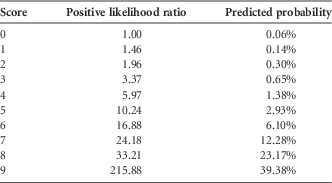
Using the scoring system, a patient’s risk of CDI increased along a continuum. For example, a patient’s risk increased from less than 1% with a risk score of 0 to 12% with a risk score of 7 and 39% with a score of 9. Similarly, the positive likelihood ratio increased from 1 with a score of 0 to 216 with a score of 9. The positive likelihood ratios and predicted probability of CDI at each score level are summarized in Table 4.
Positive Likelihood Ratios and Predicted Probabilities at Each Score Level

Model Discrimination
The values derived from Table 3 were applied to the original derivation cohort to calculate a risk score for each subject. The optimal cut-off point on the receiver operating characteristic curve to identify patients at “high risk” for CDI was determined to be a score of 3. Using this cut-off, those with a score of less than 3 were determined to be “low risk” and those with a score of 3 or greater were determined to be “high risk.” Thus, subjects with a risk score of 3 or greater were predicted to have hospital-acquired CDI. Using this cut-off, the sensitivity and specificity values were 82.0% and 75.7%, respectively. The positive and negative predictive values were 1.5% and 99.9%, respectively. The AUC was 0.85.
Applying the scoring system with a cut-off of 3 to the validation set, the sensitivity and specificity were 81.7% and 75.1%, respectively. The positive and negative predictive values were 1.5% and 99.9%, respectively. Overall, the misclassification rate was 24.9%. The AUC was calculated as 0.85.
DISCUSSION
This study addresses an important gap in current literature. With the increase in nosocomial CDI nationwide, a more standardized approach to prevention is needed. However, there is currently no commonly used risk prediction tool that can determine a patient’s risk of acquiring this deadly infection upon admission to the hospital. Previous studies that have attempted to generate clinical prediction tools for this purpose have proposed prediction rules based on data that are not readily available or based on a high number of risk factors. Therefore, they are not practical for everyday use. In order to address this problem, we worked to derive a rule that would predict a patient’s risk of acquiring a primary CDI on the basis of a limited amount of clinical risk factors that were easily accessible upon admission. We excluded those patients with a previous CDI owing to their high risk for repeated infections.
Within our patient population, we identified an easy-to-calculate tool based on 6 risk factors. These items include demographic information, history of disease, and prescription medication use, encompassing both reversible and irreversible risk factors. A patient’s risk score increased the patient’s risk of acquiring a CDI exponentially, as evidenced by the increasingly high probability of infection at each score level; a patient’s risk of CDI increased from 0.06% with a risk score of 0 to 39% with a score of 9. Moreover, when a cut-off of 3 was used, the scoring system was both sensitive (82.0%) and specific (75.7%) for identifying patients at high risk for infection. Similarly, the AUC of 0.85 in both the derivation and validation samples revealed excellent discriminatory characteristics.
These results show the tool’s ability to alert physicians to those at high risk for CDI and will allow for precautionary measures to take place in these high-risk patients. These measures can include but are not limited to decreasing the usage of proton-pump inhibitors and high-risk antibiotics in association with early detection and treatment of active infections.
Furthermore, the high negative predictive value of this tool (99.9%) will allow physicians to identify those patients with a score below 3 who may not need further CDI testing. Therefore, physicians can more accurately determine which patients are in need of CDI testing and treatment and those who may yield false positive results.
Limitations of this study include its retrospective study design and its reliance on administrative and claims data. Although there was random manual sampling of patient data, not all of the electronic data was validated manually. Furthermore, all patients in the cohort were grouped together regardless of whether they were on a medical or surgical ward. The next step for this project is a longitudinal prospective validation of the model’s predictive ability among an external population of patients. Following its validation, interventions could be designed to occur before those patients considered at high risk develop a CDI.
The results of this study speak to the importance of primary prevention in decreasing the incidence of hospital-acquired CDI. Risk factors that we noted as putting patients at high risk for infection are those commonly seen in the hospital setting and are easy to identify. Systematically recognizing the risk in a quantified manner allows for interventions that modify either the patients’ individual risk factors or their environment. Examples of possible interventions include decreasing the usages of proton pump inhibitors and high-risk antibiotic treatment in these patients. Further work is needed to validate this rule in a prospective environment.
ACKNOWLEDGMENTS
Financial support. None reported.
Potential conflicts of interest. All authors report no conflicts of interest relevant to this article.