Introduction
Host-plant use has been addressed from different perspectives including how plant chemistry (Ehrlich & Raven, Reference Ehrlich and Raven1964; Bernays & Chapman, Reference Bernays and Chapman1994; Awmack & Leather, Reference Awmack and Leather2002) and parasite or predator pressure determine host range breadth (Bernays & Chapman, Reference Bernays and Chapman1994; Stamp, Reference Stamp2001; Singer et al., Reference Singer, Rodrigues, Stireman and Carriere2004). In the case of tephritid fruit flies, understanding host use is an essential tool for host status determination when commercial strategic decisions are taken to prevent the introduction of quarantine pests to countries or regions where they do not already occur. Aluja & Mangan (Reference Aluja and Mangan2008) describe methodological processes to unequivocally assign host status and point out that the use of host resistance (Aluja et al., Reference Aluja, Pérez-Staples, Macías-Ordóñez, Piñero, McPheron and Hernández-Ortiz2003; Papachristos et al., Reference Papachristos, Papadopoulos and Nanos2008; Birke & Aluja, Reference Birke and Aluja2011), cultivar selection (Jalalulddin & Sadakathulla, Reference Jalalulddin and Sadakathulla1999; Burrack & Zalom, Reference Burrack and Zalom2008; Papachristos et al., Reference Papachristos, Papadopoulos and Nanos2008; Guillén et al., Reference Guillén, Aluja, Rull, Höhn, Schwitzer and Samietz2011; Aluja et al., Reference Aluja, Arredondo, Díaz-Fleischer, Birke, Rull, Niogret and Epsky2014a , Reference Aluja, Birke, Ceymann, Guillén, Arrigoni, Baumgartner, Pascacio and Samietz b ), ripening stage (Liquido et al., Reference Liquido, Cunningham and Couey1989; Armstrong, Reference Armstrong2001), and growing periods (Messina & Jones, Reference Messina and Jones1990; Thomas, Reference Thomas2004), are viable alternatives to classical quarantine treatments.
Host acceptance and offspring performance are influenced by both physical (color, fruit firmness, epicuticular waxes, trichomes, resin and latex channels) and chemical traits (volatiles, free sugars, primary and secondary metabolites), which differ at each host fruit development and maturity stage (Aluja & Mangan, Reference Aluja and Mangan2008) and are also modulated by factors that are inherent to the insect. These factors promote a so called ‘motivational threshold’ and are regulated by the insect's physiological stage (e.g., egg load, age) (Courtney et al., Reference Courtney, Chen and Gardner1989). Although in many cases the motivational threshold is high and non-hosts are accepted, plant chemistry of non-host species can prevent the successful development of the immature stages (Aluja et al., Reference Aluja, Birke, Ceymann, Guillén, Arrigoni, Baumgartner, Pascacio and Samietz2014b ). Predictive models which incorporate all of these aspects may help explain under which conditions certain fruits or vegetables are susceptible or remain resistant to polyphagous fruit flies, such as the Mexican fruit fly Anastrepha ludens Loew (Diptera: Tephritidae).
Comparative studies on specialist and generalist species of Bactrocera (Tephritidae) have concluded that the ability to expand their host range was influenced principally by adult female behavior (location, recognition and acceptance of a new host), and by female physiology (egg load, oviposition drive) (Fitt, Reference Fitt1986a ), rather than by the ability of larvae to metabolize a novel nutritional composition or to overcome secondary metabolites (Fitt, Reference Fitt1986b ; Aluja & Mangan, Reference Aluja and Mangan2008).
This phenomenon (acceptance of a novel host) was also observed for some species of Anastrepha. For example, ‘Manzano’ peppers were unexpectedly found to be attacked by the Mexican fruit fly, A. ludens (Thomas, Reference Thomas2004). In this case, the availability of peaches was significantly reduced by drought and A. ludens females were forced to switch to a host that had never been reported before. Although the chemistry of this pepper differs widely from that of hosts usually exploited by A. ludens, peppers were accepted; volatiles did not appear to deter females and larvae developed well in the presence of high levels of alkaloids (Thomas, Reference Thomas2004). This is evidence that the ‘innate’ larval diet breadth for polyphagous species could be wider than the range of plants that are acceptable as oviposition substrates when the main preferred hosts are absent (Fitt, Reference Fitt1986b ; Gratton & Welter, Reference Gratton and Welter1998; Aluja & Mangan, Reference Aluja and Mangan2008).
A similar case is represented by guavas which are used by several fruit fly species as a main host or as an alternative host when preferred fruit species are not available (Birke & Aluja, Reference Birke and Aluja2011). Guavas are the preferred hosts of Anastrepha striata, Anastepha fraterculus, Anastepha suspensa (Loew) and Ceratitis capitata (Wiedemann) in the USA, but an occasional host of Anastepha obliqua (Sivinski et al., Reference Sivinski, Aluja and López1997, Reference Sivinski, Aluja, Piñero and Ojeda2004; Birke & Aluja, Reference Birke and Aluja2011; Costa et al., Reference Costa, Amorim, Anjos-Duarte and Joachim-Bravo2011). Although Psidium guajava ‘criollo’ was long ago recorded as a host for A. ludens (Baker, Reference Baker, Stone, Plummer and Mcphail1944), recent evidence indicates that this tropical fruit is not naturally infested by A. ludens in Mexico (Birke & Aluja, Reference Birke and Aluja2011). It is surprising that A. ludens females fail to exploit guavas in nature, considering that their natural hosts (e.g., Citrus spp., Casimiroa edulis (La Llave & Lex.), mangos, peaches), occupy broadly overlapping ecological niches and often grow next to guava trees. The latter, contrasts with the case of A. fraterculus, another highly polyphagous fruit fly that belongs to the same species group as A. ludens (fraterculus species group (Norrbom, Reference Norrbom2003)), which is able to thrive in guavas (Sivinski et al., Reference Sivinski, Aluja and López1997, Reference Sivinski, Aluja, Piñero and Ojeda2004; Birke & Aluja, Reference Birke and Aluja2011).
The aim of this study was to experimentally determine if there are clear-cut limits to the broad host range of A. ludens using guava as a model and by comparing its development with tephritid species that naturally infest guavas such as A. striata. We also assessed the host status of guava with respect to A. ludens following the host–status–determination–guidelines proposed by Aluja & Mangan (Reference Aluja and Mangan2008).
Materials and methods
Biological material
A. striata pupae stemmed from field-infested guavas collected in Jamapa, Veracruz, Mexico (19°02′N latitude, 96°11′W longitude, at 170 m above sea level (asl)). A. ludens pupae were obtained from flies reared for three generations on grapefruit in the laboratory after collection of field-infested Citrus aurantium L. from Miradores, Veracruz, Mexico (19°29′N latitude, 96°46′W longitude, at 920 m asl). All infested fruit were placed in baskets containing moist vermiculite as a pupation substrate. At emergence, adults were held in Plexiglas cages (30 × 30 × 30 cm3) and offered ad libitum a mixture 3:1 of sugar (COSTCO®, Mexico), protein hydrolystate (Greif Bros. Corp., Delaware, OH, USA) and a water source. Environmental conditions in the laboratory were maintained at 26 ± 1°C, 65 ± 5% RH and LD 12:12 h photoperiod provided by 36 Watt Philips® daylight fluorescent bulbs.
Study sites
The experimental protocol was designed following methods outlined in Aluja & Mangan (Reference Aluja and Mangan2008). To guarantee that all environmental conditions where guava grows were represented in our study, we carried out experiments during the 2006/2007 fruiting seasons along an altitudinal gradient across three regions located at different elevations: San Julián (19°15′N latitude and 96°16′W longitude, at 26 m asl), Santa Fé (19°12′N latitude and 96°16′W longitude, at 36 m asl), Municipality of Veracruz; Rancho Viejo, Municipality of Emiliano Zapata (19°26′N latitude and 96°46′W longitude, at 912 m asl) and in a lot close to the Xico-Teocelo road junction, Municipality of Xico (19°23′N latitude, 96°57′W longitude, at 1137 m asl), Veracruz State, Mexico.
Fruit phenology and fruit characteristics
To standardize fruit phenological stages, we prepared a standard table based on fruit development, using conventional nomenclature originally proposed by Fleckinger (Reference Fleckinger1945) and marbles as size references when possible. Visual assessment of pigmentation was also considered when guavas were fully developed. Based on Fleckinger (Reference Fleckinger1945), fruit was categorized into one of seven developmental stages: flower (a flower having recently lost its petals), match (ovary enlargement), marble-fancy (15–20 mm ø), player (24–28 mm ø), mature green (full-sized fruit 100% green), turning yellow (full-sized fruit 80% green and 20% yellow) and completely mature (fig. 1).
Diagram of fruit phenological stages used for natural and artificial exposure to A. ludens at three localities (San Julián (altitude 20–26 m), Emiliano Zapata (altitude 780 m) and road junction Xico-Teocelo (altitude 1130 m)). 1 = flower, 2 = match, 3 = fancy-size marble (18 mm Ø), 4 = player-size marble (24 mm Ø), 5 = mature green (28 mm Ø), 6 = turning-yellow, 7 = fully ripe.

Guava characteristics (fruit firmness, weight and sugar content)
Ten fruit from each of five trees at each study site (three locations) and at each selected developmental stage were harvested randomly during 2006 and 2007 (750 fruit/2006, 600 fruit/2007) and transported to the laboratory where physical characteristics (weight and firmness) and sugar content were measured a few hours after fruit harvest. Fruit were selected for uniformity following the standard table described above (fig. 1).
Fruit resistance to puncture
Fruit firmness, was determined using a penetrometer with a 1 mm flat-tip, metal probe (four equatorial punctures per fruit) connected to a force gauge (Accuforce gauge III, model AF3010CE, Ametek, Mansfield and Green Division, Largo, FL, USA) on a motorized test stand (model 4665, Ametek, Mansfield and Green Division, Largo, FL, USA).
Fruit weight
Fruit was weighed using a standard electronic digital precision scale (Ohaus, TP4KD, USA).
Sugar content
Sugar content was measured by squeezing a piece of guava to obtain a drop of juice which was analyzed by means of a hand held-refractometer (ATAGO, PAL-1, Tokyo, Japan).
Comparison of natural and forced infestation rates
Experimental setup
Five trees in each of three locations (Santa Fé, Veracruz; Rancho Viejo, Emiliano Zapata and Xico-Teocelo road junction, Veracruz, Mexico) were selected to assess at which phenological/maturity stage guava fruit became susceptible to the attack of (a) naturally occurring fruit flies and (b) A. ludens and A. striata females under forced conditions. Forced infestations involved releasing gravid A. ludens and A. striata females onto (i) branches enclosed within a mesh bag (enclosed branches) or (ii) onto trees within field cages (enclosed trees) (see images in Aluja & Mangan, Reference Aluja and Mangan2008).
Natural infestation test
In each of the three regions described above, six branches per tree holding 20–30 guava flowers were covered with mesh cloth to preclude any oviposition activity by wild flies and then later uncovered at each of five development stages to be exposed to natural fruit fly populations. Developmental stages assessed for this test were as follows: (1) flower without petals, (2) match, (3) fancy marble size, (4) 80% final size and (5) mature green fruit (fig. 1). After an 8-days exposure period branches were enclosed again to preclude any additional oviposition activity by wild flies and fruit was allowed to complete development. Finally, once fruit reached full maturity, guavas were harvested and transported to the laboratory in Xalapa, Veracruz. Picked fruit was placed individually in 250 ml plastic cups with moist vermiculite. Fruit was maintained in cups until complete decomposition allowing for full larval development and exit for pupation. Pupae were recovered and maintained in vermiculite in 250 ml plastic containers until adults emerged.
Forced infestation assays
Once the developmental stage at which guavas became susceptible to fruit fly attack had been determined, forced infestation trials were performed. The methodology was the same as the one described above for natural infestation. Branches were also covered with a cloth mesh but were artificially exposed to gravid A. striata and A. ludens females at a 1:1 (female/fruit) ratio (Aluja & Mangan, Reference Aluja and Mangan2008). Stages used were: (4) 80% final size fruit, (5) mature green fruit and (6) mature yellowing fruit (fig. 1). Enclosures were examined every 48 h and dead females were replaced with flies of exactly the same age and condition. After 8 days, all females in each enclosure were recovered, transported to the laboratory, and held in 1 liter plastic cages. To ensure that exposed females were able to lay viable eggs, they were offered grapefruit as a substrate for 48 h; grapefruits were subsequently examined for evidence of larval infestation.
Guavas at the field sites remained on the tree until maturity and were then harvested and transported to the laboratory. Each fruit was also placed individually in 250 ml plastic cups, pupae were recovered, weighed and maintained in vermiculite in 250 ml plastic containers until adults emerged, whereupon date and sex ratio were determined at day one after emergence.
Comparison of A. striata and A. ludens foraging behavior and host selection under choice and no choice conditions
Choice and no choice tests were performed to determine differences in foraging behavior and host selection of gravid A. striata and A. ludens females under field-cage conditions. Tests were performed to ascertain if non-hosts for A. ludens (guava) or A. striata (grapefruit) were accepted for oviposition by both A. striata and A. ludens. Three mid-sized guava trees were selected at the high elevation site (Xico-Teocelo road junction) and each tree was enclosed using a 4 × 4 × 4 m3 mesh field cage (BioQuip Products, Compton CA). For each tree we selected 120 fully developed guavas (stage 5, fully sized) which were covered with white paper bags. At each observation day during the 14-days trial, 20 bags per tree were removed and 20 gravid females (A. striata or A. ludens at a 1:1 female: fruit ratio) were released. ‘Marsh’ grapefruits (120 fruits) were obtained from experimental trees in Alborada, Veracruz (15.3 km from the experimental area). Fruits were selected and were hung next to each guava using hemp thread. Treatment combinations for fruit fly species (A. ludens or A. striata), and host or non-host, under choice or non-choice situations, were set and rotated daily (table 1). Tests were replicated four times, each time using a new naïve cohort of flies. Observations took place from 09:00 to 15:00 h, and were performed by one observer per tree using a scan observation method (one scan per 15 min) (Aluja & Birke, Reference Aluja and Birke1993). The following parameters were recorded: visits (host or non-host), oviposition attempts (probing that was not followed by ovipositor dragging), oviposition and duration of oviposition. After the 6 h observation period bags were discarded to prevent reuse.
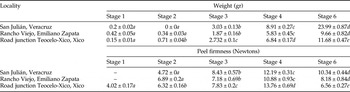
Mean weight and mean fruit firmness at five development stages (1 = flower, 2 = match, 3 = fancy-size marble (18 mm Ø_, 4 = player-size marble (24 mm Ø), 6 = mature green (28 mm Ø)) at three localities (San Julián (20 m asl), Emiliano Zapata (780 m asl) and road junction Xico-Teocelo (1130 m asl), Veracruz).

Means followed by the same letters do not differ by the Tukey test at 5% probability.
Effect of guava development stage on host-selection by A. ludens and A. striata
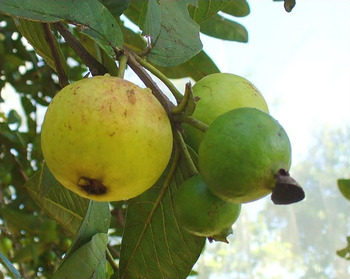
To establish whether guava developmental stage influenced foraging behavior and offspring performance, an additional trial was set up. One guava tree which harboured several guava clusters in single branches (fig. 2) was enclosed within a 4 × 4 × 4 m3 field-cage. Each guava cluster had fruit of each of four maturity stages: (a) green undeveloped fruit (stage 4), (b) mature green (stage 5), (c) turning yellow (stage 6) and (d) fully ripe fruit (stage 7) (fig. 2). A total of 80 clusters (640 guavas) were enclosed within white paper bags. All fruit bags were labeled according to fruit stage and fruits were numbered with a non-toxic permanent marker (Sharpie, NewellRubbermaid Company, Shelbyville, TN, USA).
Photograph showing guava racemes at four maturity stages. Guavas were exposed to A. striata and A. ludens in field-cage tests.

As in the first trial, observations began at 09:00 h and ended at 15:00 h. A total of 80 fruits (20 clusters) were exposed by releasing 20 A. ludens or 20 A. striata females into each cage on each day of the experiment. The species of fly released was alternated each day and a scan observation method was followed (Opp & Prokopy, Reference Opp, Prokopy, Miller and Miller1986). The same methodology was used as in the previous trial described above, and the same foraging and oviposition activities were recorded. Tests were replicated four times for each fruit fly species (8 days observation trial) and all fruit was harvested after 15 days. Fruit was transported to the laboratory and infestation level was assessed once fruit decomposed using the same procedure described previously.
Data analyses
Statistical analyses were performed using STATISTICA Version 11 (Statsoft, 1998). Prior to parametric tests, all data were checked for normality and homogeneity of variance (Shapiro–Wilk's test). If these assumptions were violated data were transformed. Data on skin firmness, fruit weight and sugar content (2006–2007 and 2007–2008) were subjected to an analysis of variance (ANOVA) with a hierarchical structure nesting fruit on tree and using a generalized linear model. Infestation levels were in all cases calculated as the number of adults obtained per fruit and were normalized by rank transformation (Conover & Iman, Reference Conover and Iman1981) and also subjected to an ANOVA with a hierarchical structure nesting fruit on tree. Mean number of oviposited fruit at different maturity stages were subjected to the same analyses. The possible association between fruit maturity/firmness and infestation level were examined using Pearson's correlation procedure. Pupal weight was compared for A. ludens and A. striata among maturity stages by means of a one-way ANOVA. Post-hoc Tukey tests were performed when necessary. Choice and no-choice activity patterns (number of fruit visits, oviposition attempts and successful oviposition events) were analyzed using Mann–Whitney or Kruskal–Wallis tests.
Results
Fruit characteristics at different fruiting stages
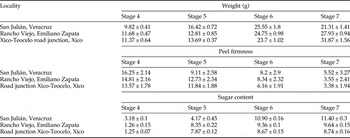
Peel firmness varied significantly among guava maturity stages and location during season 2007 but did not for location in the season 2006 (2007: F = 138.33, df = 4,573, P < 0.0001 maturity; F = 4.275, df = 2,573, P < 0.014 location) and (2006: F = 350.8, df = 2,438, P < 0.0001 maturity; F = 2.22, df = 2,438, P < 0.11 location) (tables 1 and 2, fig. 1). Fruit firmness reached its highest peak shortly before fruit started to significantly enlarge (stage 4) and decreased when fruit began to mature (tables 1 and 2). Fruit weight exhibited significant differences among fruit maturity stages and locations during 2007 but did not for location during the 2006 season (2007: F = 364.67, df = 4,583, P < 0.0001 maturity; F = 91.42, df = 2,583, P < 0.0001 location), (2006: F = 177.13, df = 3,440, P < 0.0001 maturity; F = 1.24, df = 2,440, P < 0.0001 location) (tables 1 and 2, fig. 1). With respect to sugar content, a highly significant difference among fruit maturity stages and locations was also found (2006: F = 590.39, df = 3,440, P < 0.0001 maturity; F = 10.14, df = 2, 440, P = 0.0001, location) (table 2).
Mean weight, mean peel firmness and mean sugar content (Brix) of guava fruits at four development stages (4 = player-size marble (24 mm Ø), Stage 5 = mature green, Stage 6 = turning yellow and Stage 7 = mature) at three localities (Santa Fé (20 m asl), Emiliano Zapata (780 m asl) and road junction Xico-Teocelo (1130 m asl)).

Assessment of fruit infestation under natural conditions
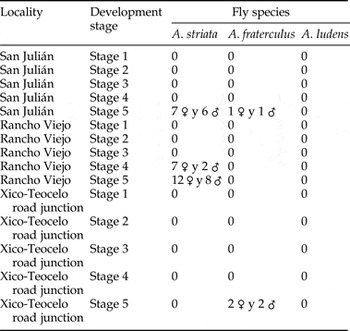
Infestation levels of 540 naturally exposed fruit revealed that guavas are only infested by A. striata (84%) and A. fraterculus (16%) in our study region. Guavas were susceptible to A. striata and A. fraterculus attack once fruit reached ca. 80% of its total size (table 3). Importantly, under natural conditions neither A. ludens larvae nor adults were recovered from naturally exposed fruit (table 3).
Adults obtained from natural infested guavas at five development stages 1 = flower, 2 = match, 3 = fancy-size marble (18 mm Ø), 4 = player-size marble (24 mm Ø), 5 = mature green (28 mm Ø), 6 = turning-yellow and 7 = fully ripe fruit at three localities (Santa Fé (20 m asl), Emiliano Zapata (780 m asl) and Xico-Teocelo road junction (1130 m asl)).

Assessment of fruit infestation rates by comparing A. ludens and A. striata under forced conditions
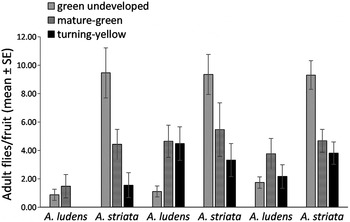
Our experiment, under forced conditions, exposing undeveloped, mature green and turning-yellow guavas, revealed highly significant differences in infestation rates between both fruit fly species and among fruit maturity and locations (nested ANOVA, F = 99.4, df = 1,690, P < 0.001 fly species; F = 18.35, df = 2,890, P < 0.0001 maturity; F = 8.16, df = 2,690, P < 0.004 location) (fig. 3). We found that guava maturity was negatively correlated with A. striata infestation (r = −0.301) and fruit firmness was positively correlated with infestation (r = 0.303). We obtained a total of 1531 A. striata pupae from undeveloped firm fruit, 684 from green mature fruit and 304 from soft turning-yellow guavas. In the case of A. ludens, we did not detect any correlation among fruit maturity stages, and infestation remained consistently low, compared with A. striata (fig. 3). Notably, in the case of the 335 guavas exposed to A. ludens females (1:1 female: fruit proportion), 44 (13% of the total) individuals died while attempting to insert their aculei (boring activity) into the fruit or while laying eggs.
Adults obtained from guavas (mean ± SE) exposed to forced infestations by A. striata and A. ludens at three maturity stages (4 = 24 mm Ø, 6 = mature green 28 mm Ø, 7 = turning-yellow) at three localities: San Julián/Santa Fé (altitude 20–26 m), Emiliano Zapata (altitude 780 m) and road junction Xico-Teocelo (altitude 1130 m).

Effect of guava on pupal weight
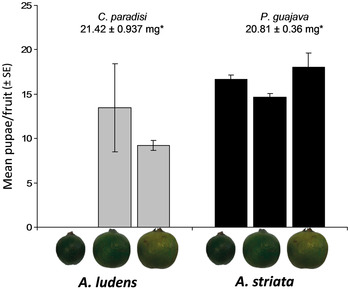
A. ludens pupae obtained from guavas (9.24 ± 0.56 mg) weighed less than a half of pupae obtained from the natural host grapefruit (21.42 ± 0.94 mg). In addition, we found that pupal weight varied significantly among maturity stages in the case of both fruit fly species (one-way ANOVA, F = 3.66, df = 2, 447, P = 0.03 A. ludens; F = 4.38, df = 2, 1003, P = 0.013 A. striata) (fig. 4).
A. ludens and A. striata pupal weight of insects that developed in guavas (mean ± SE) at three maturity stages (4 = 24 mm Ø, 6 = mature green, 28 mm Ø, 7 = turning-yellow at three localities San Julián/Santa Fé (altitude 20–26 m), Emiliano Zapata (altitude 780 m) and road junction Xico-Teocelo (altitude 1130 m).

Foraging behavior and host selection trials comparing A. striata and A. ludens using choice and no choice tests
Choice test
When given a choice (guava and grapefruit), A. ludens females visited significantly more grapefruits than guavas (Mann–Whitney, Z = −1.18, P < 0.6) and oviposited significantly more frequently in grapefruit than in guava (Mann–Whitney, Z = −2.165, P < 0.03). Overall, 64% of all grapefruit and 36% of all guavas used in the experiment were oviposited by A. ludens females. In contrast, A. striata females never oviposited or attempted to oviposit in grapefruits doing so only in guavas (fig. 5A).
(A) Visits, oviposition attempts and effective ovipositions (mean ± SE) by A. ludens and A. striata female under no choice and (B) Choice conditions.

No-choice test
When only guavas or grapefruits were offered, A. ludens and A. striata females mainly visited their preferred hosts (Kruskal–Wallis, Chi-square = 12.95, df = 3, P < 0.001) (fig. 5B). Under these no-choice conditions, A. ludens readily attempted or indeed oviposited into guavas, something not observed when females were given a choice between the natural host grapefruit and guavas. The total number of oviposition attempts per replicate varied significantly between both fruit fly species (Kruskal–Wallis, Chi-square = 8.89, df = 3, P < 0.03); A. striata attempted to oviposit significantly more frequently than A. ludens in guavas but, as was the case in the no-choice experiment, never did so in grapefruits (fig. 5B). The number of ovipositions followed by ovipositor dragging (i.e., effective oviposition) by A. ludens was significantly higher on grapefruit than on guava (Kruskal–Wallis, Chi-square = 15, df = 3, P < 0.001). Overall, 90% of grapefruits and only 10% of guavas were accepted as oviposition substrates by A. ludens females.
Effect of guava developmental stage on host-selection by A. ludens and A. striata
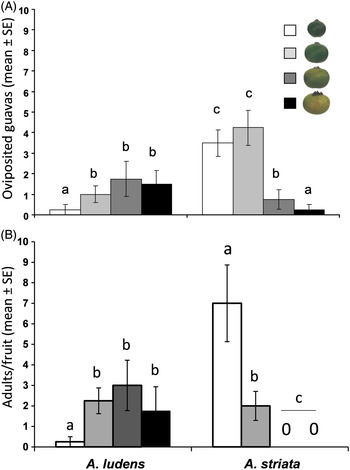
Guava developmental stage trials clearly showed that A. ludens and A. striata females oviposit into fruit at contrasting maturity stages. A. ludens preferred fully developed, yellowing or yellow mature guavas, whereas A. striata females preferred green undeveloped or fully developed green guavas as oviposition sites (nested ANOVA, F = 7.22, df = 3, 21, P < 0.001) (fig. 6A).
(A) Number of ovipositions (B) Infestation level (pupae/fruit) (mean ± SE) in each of four guava maturity stages when exposed to A. ludens and A. striata females in field-cage tests.

Infestation of guavas was significantly lower for A. ludens than for A. striata (nested ANOVA, F = 4.88, df = 3, 21, P < 0.048, fly specie) and fruit physiological stage significantly influenced adult recovery (nested ANOVA, F = 4.41, df = 3, 21, P < 0.014, fruit physiological stage) (fig. 6B).
Discussion
Although guavas have been believed to be natural hosts of A. ludens based on early observations of anecdotal nature (Baker et al., Reference Baker, Stone, Plummer and Mcphail1944), our results following the rigorous guidelines set out by Aluja & Mangan (Reference Aluja and Mangan2008) demonstrate that P. guajava cv ‘Criollo de Veracruz’ is not a natural host for A. ludens and should be treated for quarantine purposes as a conditional host. Results obtained using natural infestation trials performed along an elevation gradient, showed that only A. striata and A. fraterculus naturally attack guava, confirming earlier work by us (Birke & Aluja, Reference Birke and Aluja2011). Although in our study A. fraterculus was not abundant (only a few pupae were obtained), Sivinski et al. (Reference Sivinski, Aluja, Piñero and Ojeda2004) clearly showed that A. fraterculus can indeed infest guavas in large numbers. These authors also showed that the populations of A. fraterculus and A. striata exhibit marked annual fluctuations in the same guava trees over time. Over a 6-year period, they showed that in some years one species is almost non-existent, while in others both show up in equal numbers. These results (i.e., Sivinski et al., Reference Sivinski, Aluja, Piñero and Ojeda2004) most likely explain the phenomenon we observed, with very few A. fraterculus individuals infesting guavas the year we ran our experiments, when in fact this fruit represents a commonly infested wild host throughout the range of the species’ distribution. Extensive guava sampling elsewhere in the Mexican states of Veracruz, Chiapas, Morelos, Aguascalientes and Zacatecas have indicated that only A. striata, A. fraterculus and occasionally A. obliqua, can be recovered in nature from this host in Mexico (Aluja et al., Reference Aluja, Guillen, de la Rosa, Cabrera, Celedonio, Liedo and Hendrichs1987, Reference Aluja, López and Sivinski1998; Aluja & Birke, Reference Aluja and Birke1993; Sivinski et al., Reference Sivinski, Aluja and López1997, Reference Sivinski, Aluja, Piñero and Ojeda2004; Padilla, Reference Padilla, González, Padilla, Reyes, Perales and Esquivel2002; Birke & Aluja, Reference Birke and Aluja2011).
When analyzing at which phenological stage guavas became susceptible to naturally occurring fruit flies, we found that unripe guavas and mature green guavas were almost invariably used by A. striata and A. fraterculus. Same results were recently published for A. fraterculus in Brasil (Bisognin et al., Reference Bisognin, Nava, Diez-Rodríguez, Valgas, Garcia, Krolow and Antunes2015). Fruit firmness, sugar content was not related with infestation rates. Similarly, in some Bactrocera species susceptibility of guavas to Bactrocera infestation was not related to sugar content but was affected by fruit pH or total phenol content (Jalalulddin & Sadakathulla, Reference Jalalulddin and Sadakathulla1999). Ripening of guava is associated with a decrease in guava firmness, astringency and less phenolic compounds in the peel (Da Silva et al., Reference Da Silva, Vendramin, Denardi, Malavasi and Zucchi2000; Padilla, Reference Padilla, González, Padilla, Reyes, Perales and Esquivel2002; Bashir & Abu-Gouk, Reference Bashir and Abu-Gouk2003; Pérez et al., Reference Pérez, Mitchell and Vargas2008). High total phenolic content also has been shown to reduce larvae infestation and increase apple resistance to A. ludens attack (Aluja et al., Reference Aluja, Birke, Ceymann, Guillén, Arrigoni, Baumgartner, Pascacio and Samietz2014b ).
Specialization of both fruit fly species (A. striata and A. fraterculus) in overcoming the secondary chemistry in unripe guavas may partially explain why A. ludens is not able to reproduce successfully in unripe guavas. Additionally, as reported here, 13% of all exposed A. ludens females died when attempting to oviposit into unripe, green guavas. We believe that the abrupt death of ovipositing A. ludens females may have been caused by exposure to volatiles which are known to be emitted by guava leaves or unripe fruit and have repellent or toxic effects on other insects (e.g., psyllids) (Zaka et al., Reference Zaka, Zeng, Holford and Beattie2010) and possibly by unripe guavas when punctured by the female aculeus. Although we have to accept that the host used to originally rear A. striata and A. ludens may have in some way influenced guava preference, it does not explain the death of A. ludens females and the larval inability to develop successfully in guavas. As mean oviposition time into guavas for A. ludens is ~10 times longer than the oviposition time by A. striata or A. fraterculus, the duration of exposure to volatiles could have been extended in A. ludens. Alternatively, A. striata and A. fraterculus females may not be susceptible to the toxins as they both have a long evolutionary history of development in guavas. On the other hand, when eggs are laid in yellowing or fully ripe fruit, larvae of A. ludens have only a small time-window in which to develop as guavas senesce and decompose rapidly. This partially explains why the few A. ludens pupae recovered from guavas were very small in size. Under natural conditions, ripe guavas fall to the ground and decompose rapidly, or are eaten by birds, mammals and other insects. Under these conditions, developing larvae would not be able to complete development and pupate. So, there appears to be a number of obstacles that A. ludens would need to overcome to successfully infest and complete its life cycle in guavas. Based on our previous studies and the results reported here, it seems that guavas represent a true limit to the extreme polyphagy that A. ludens exhibits.
Forced, comparative infestation trials (enclosed branches) also revealed that A. striata preferred unripe to fully developed green guavas, which was not the case for A. ludens and seems not to be the case for A. fraterculus populations in Brasil (De Oliveira et al., Reference De Oliveira, Junior, Costa, Batista, Costa and Walder2015). A. ludens females preferred yellowing fruit (guavas) as reported previously (Berrigan et al., Reference Berrigan, Carey, Guillen and Celedonio1988; Birke et al., Reference Birke, Aluja, Greany, Bigurra, Pérez-Staples and McDonald2006) and only attempted to oviposit into green guavas when not given a choice. Moreover, A. striata never attempted to oviposit into grapefruits. As shown recently (Aluja et al., Reference Aluja, Birke, Guillén, Díaz-Fleischer, Juárez and Nestel2011), A. ludens cannot reabsorb oocytes when deprived of suitable oviposition sites and can therefore be easily forced to lay eggs in almost any fruit (Aluja & Mangan, Reference Aluja and Mangan2008). Guavas close to full maturity (yellow-turning stage) were accepted by A. ludens females for oviposition, as occurs in other fruits (e.g., mangoes and grapefruits) (Berrigan et al., Reference Berrigan, Carey, Guillen and Celedonio1988; Aluja, Reference Aluja1993; Birke et al., Reference Birke, Aluja, Greany, Bigurra, Pérez-Staples and McDonald2006) but turned out to be a poor host for larval development. We only obtained small numbers of adults from guavas when compared to those recovered from grapefruit.
Our results could have important practical implications for risk management and quarantine treatment requirements. First, we present robust data supporting the notion that guavas should not be treated as a natural host of A. ludens. Based on Aluja & Mangan (Reference Aluja and Mangan2008), and our own extensive field work (Birke & Aluja, Reference Birke and Aluja2011), we suggest that P. guajava cultivar ‘Criollo Veracruz’ should henceforth be treated as a conditional host of A. ludens. Even under artificial, forced-infestation conditions, A. ludens infestation levels were very low, a significant number of females died during the act of oviposition, and the few A. ludens adults that emerged were significantly smaller than adults stemming from the natural host grapefruit. Further studies should focus on comparing potential differences in infestation among commercially grown cultivars of guava, as our assays were only performed using wild cultivars growing in Veracruz, Mexico. This is particularly relevant given that fruit characteristics differ markedly among cultivars, and wild fruit or traditional cultivars tend to maintain natural resistance gene sets which impede insect attack (Jalalulddin & Sadakathulla, Reference Jalalulddin and Sadakathulla1999; Rodriguez-Saona et al., Reference Rodriguez-Saona, Vorsa, Singh, Johnson-Cicalese, Szendrei, Mescher and Frost2011; Aluja et al., Reference Aluja, Arredondo, Díaz-Fleischer, Birke, Rull, Niogret and Epsky2014a , Reference Aluja, Birke, Ceymann, Guillén, Arrigoni, Baumgartner, Pascacio and Samietz b ; De Oliveira et al., Reference De Oliveira, Junior, Costa, Batista, Costa and Walder2015). Additionally, we believe that late insecticide sprays in commercial guava orchards are redundant as fruit at this stage are already infested with A. striata and A. fraterculus given that, as shown here, guavas become susceptible to infestation to these two species when they are unripe.
Finally, we concur with Fitt (Reference Fitt1986a ) who concluded that limitations in polyphagous fruit fly species exploiting new hosts is a complex, multifactorial phenomenon that is mainly constrained by behavioral aspects and not by larval inability to develop in a novel substrate. This may change if the female motivational threshold is high (e.g., high egg load combined with low preferential host availability) (Courtney et al., Reference Courtney, Chen and Gardner1989). Fitt (Reference Fitt1986a , Reference Fitt b ) compared several Bactrocera species (B. tryoni, B. jarvisi, B. cucumis, B. musae and B. cacuminatus) which differ in host range and observed that larvae of most species could develop in different types of fruit under laboratory conditions, but did not use these hosts in nature. In contrast to Fitt's work (Reference Fitt1986a ), our results also suggest that limits exist to the extremely large host range of A. ludens, as immatures developed very poorly or not at all in guavas. This had not been reported previously for fruit flies as all nutritional studies using immatures (larva) have been performed in the laboratory using harvested fruit which tends to lose certain chemical characteristics after having been harvested (Fitt, Reference Fitt1986a ; Leyva et al., Reference Leyva, Browning and Gilstrap1991). We therefore believe to have identified an excellent model system to gain further insight into the reasons guavas represent such a major barrier to the reproduction of this insect.
Acknowledgments
We thank Roberto de Felipe, Nicolás Jimarez Jimarez, Carlos Ortega, Zoraya Alvarado and Martín Pale for excellent technical assistance and Trevor Williams, Alberto Anzures and Juan Rull Gabayet for comments on earlier drafts of this manuscript. We also acknowledge the Instituto Interamericano de Cooperación para la Agricultura (Agreement SAGARPA-IICA-INECOL) through the Campaña Nacional contra las Moscas de la Fruta, Consejo Nacional de Ciencia y Tecnología (CONACyT), the Asociación de Productores y Empacadores de Aguacate de Michoacán (APEAM) and the Instituto de Ecología, A.C., for financial support. This work was part of the dissertation of AB directed by MA and we therefore also thank committee members Francisco Díaz-Fleischer, Diana Pérez Staples, Elizabeth Valero and Gilberto Silva, as well the Universidad Veracruzana.