Introduction
Dioscorea alata L. (greater yam or ubi badak) is a monocotyledonous tuber crop of the Dioscoreaceae family and is reported to be an old crop species native to South-East Asia (Burkill, Reference Burkill1951; Coursey, Reference Coursey1967). Its tubers have high nutritional value and were probably the main source of sustenance for the people of South-East Asia for several decades before the introduction of rice (Burkill, Reference Burkill1966; Martin, Reference Martin1976). Today, it is recognized as an important food crop in many parts of the tropical and sub-tropical regions of the world (Purseglove, Reference Purseglove1983).
D. alata is the most polymorphic species in the genus Dioscorea (Martin and Rhodes, Reference Martin and Rhodes1973, Reference Martin and Rhodes1977; Martin and Delpin, Reference Martin and Delpin1978). Typically, D. alata can easily be distinguished from the other species in the genus Dioscorea by its quadrangular winged stems. However, much confusion exists among the cultivated varieties (cultivars) of the species (Onwueme and Ganga, Reference Onwueme and Ganga1996), perhaps due to the presence of hundreds of variants carrying numerous complex characteristics that overlap. Determining the level of variation and identifying the variants within the species is invaluable for genetic improvement and conservation of the crop (Okoli, Reference Okoli, Ng, Persino, Attere and Zedan1988).
Several morphological variability studies on D. alata have been conducted elsewhere. In New Caledonia, Lebot et al. (Reference Lebot, Trilles, Noyer and Modesto1998) undertook a variability study on the cultivars of D. alata and classified the cultivars into four major groups, while the study by Velayudhan et al. (Reference Velayudhan, Muralidharan, Amalraj, Thomas and Soudhamini1989) on the local cultivars in India found 15 groups of D. alata cultivars. Meanwhile, Sastrapradja (Reference Sastrapradja, Miege and Lyonga1982) reported the variability of D. alata collected in Java, Indonesia, suggesting that D. alata in Java was represented by six groups of cultivars.
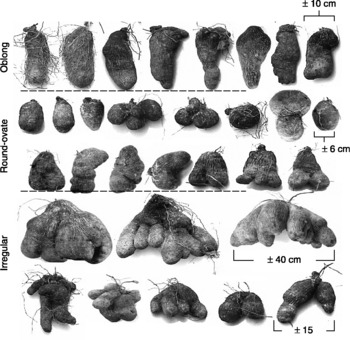
In Malaysia, D. alata is not considered a major crop, and thus there is limited information on the species, particularly with regard to the variability, evaluation and classification of the cultivars. Nevertheless, numerous local cultivars or landraces of the crop were identified by local farmers and residents (Martin and Delpin, Reference Martin and Delpin1978). According to the tuber flesh colours, the species can simply be differentiated into white and red-purple cultivar groups (Onwueme and Ganga, Reference Onwueme and Ganga1996), known vernacularly as ‘ubi nasi’ and ‘ubi kedudok’ respectively. We found that the cultivars were also distinguished by the local residents according to tuber shape, i.e. irregular, oblong and round shapes, and named locally as ‘ubi badak’ or ‘ubi dinding’, ‘ubi torok’ and ‘ubi tempayan’, respectively. Based on such observations, cultivated D. alata in Malaysia could be differentiated into six morphological groups, namely irregular-white, oblong-white, round-white, irregular-purple, oblong-purple and round-purple. Such groupings, however, are very ambiguous where each group consists of a range of variability that causes confusion when identifying the cultivars (see Fig. 1).
Photograph showing various size, shape and branching patterns of the tubers from three groups of D. alata used in this study.

In the present work, multivariates of principal components and cluster analysis based on the morphological traits were carried out to determine the level of variability, the relationship among accessions, and to identify groups of cultivars present in D. alata collected in Malaysia. The result would be very useful for conservation planning and genetic improvement of the crop.
Materials and methods
Plant material
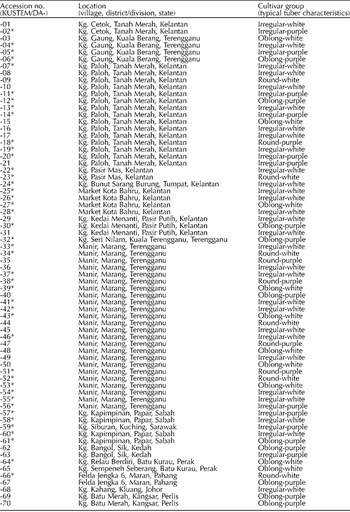
A total of 70 accessions of various cultivated groups of Dioscorea alata (see Fig. 1) were collected from numerous locations in Peninsular Malaysia, Sabah and Sarawak (Table 1). The collections were made in 2003 and 2004 during the growing season (October to December). Each collection, consisting of 3–5 tubers, was given an accession number and simply grouped into six typical cultivar groups, i.e. irregular-white, irregular-purple, oblong-white, oblong-purple, round-white and round-purple groups (Table 1). All accessions were maintained as a living collection in the experimental plot at KUSTEM, Terengganu, Malaysia.
Accession numbers, collecting sites and cultivar groups of yam (Dioscorea alata) used in the present study

Kg., Kampung or village.
Planting the materials
Material was planted in the field in March and April, after 4 months of tuber dormancy. Minisets of tubers with a size of 400–500 cm3 were cut and used as the planting materials. Prior to planting, the minisets were disinfected with a 2.0% (w/v) solution of fungicide (thiuram) for 5 min. The minisets were pre-sprouted in a nursery bed before being transferred to the field.
The minisets were transplanted into holes c. 10 cm deep on a 2 m × 1 m ridge. The spacing within and between the ridges was 0.25 m. The young plants were shaded with dry leaves for the first 20 d after transplanting. Plots were fertilized with 200 kg/ha of 12 : 12 : 15 NPK at 3 and 6 months after planting. Plants were irrigated when necessary by using a field sprinkler and tube droplet water system. Weeds were controlled manually by hand-weeding.
Morphological data recording
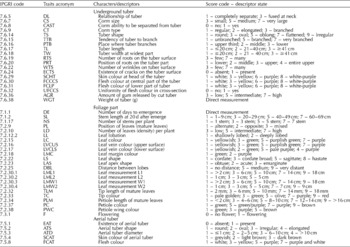
The morphological measurements were conducted on the living plants under field conditions by using 47 agro-morphological traits (Table 2). The characters used and methods of data recording were according to the International Plant Genetic Resources Institute's (IPGRI) descriptors for yam (Dioscorea spp.) with some modification (IPGRI, 1997). Only those that discriminated between our samples were used for the present analysis. The characters were measured on at least three different healthy plants and the data were then averaged for analysis. The data were recorded either directly from the measurement, using a 1–9 scale or as a binary recording (1 = present and 0 = absent). All data were standardized and subjected to multivariate principal component and cluster analysis.
List of the morphological traits that are used for recording the greater yam (Dioscorea alata) variability in the present study. The traits and measurements were based on the International Plant Genetic Resources Institute (IPGRI) descriptor (IPGRI, 1997). Most data were recorded on a 1–9 scale

Principle component analysis
Principle component analysis (PCA) was performed using SPSS software program version 12.0 (Norman, Reference Norman2004). In the PCA, the data were used to generate eigen values, percentage of the variation accumulated by PCA and load coefficient values between original characters and respective PCA. Those principal components (PC) with eigen values >1.0 were selected and those characters with load coefficient values ≥ 0.6 were considered as highly relevant characters scored for that PC and supposed to be a useful trait for distinguishing the taxa ( Jeffers, Reference Jeffers1967). The first two principal components which accounted for the higher proportion of the total variations were used to plot the two-dimensional dispersion or scatter diagram of the accessions.
Cluster analysis
For cluster analysis (CA), the same standardized data matrix was used to generate a morphological distance among accessions using Euclidean dissimilarity coefficient, and then used to generate a hierarchical dendrogram through an unweighted pair-group method average (UPGMA) (Sokal and Michener, Reference Sokal and Michener1958) using the software package NTSYSpc programme (Rohlf, Reference Rohlf2000). This analysis is used to study patterns of variance and relationship among accessions, where accessions with close genetic distances are placed in close proximity in the dendrogram.
Results
Morphological observation of tuber variability
Tubers of D. alata show a wide range of morphological variation. Visual observation, based on the tuber characteristics, enabled the separation of D. alata accessions into three main groups of cultivars, namely irregular, oblong and round or ovate groups (Fig. 1). Each group contained tubers ranging from 10 to 60 cm in length, 15–50 cm in width, and weighing between 0.1 and 5 kg/tuber. Most tubers developed branches or lobes with various shapes and sizes, although some tubers developed without having any branch or lobe and thus formed a single oblong, round or ovate tuber. The tuber flesh colour also varied, displaying white, yellowish white, purple, red-purple and mixed colours.
Principal component analysis
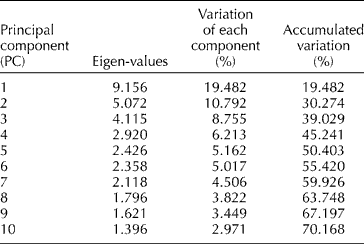
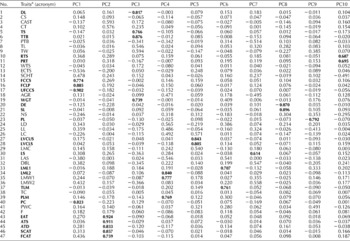
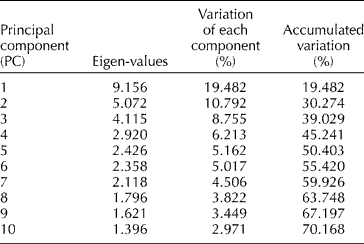
The result of the multivariate analysis based on the 47 morphological characters revealed a great diversity among the 70 accessions of D. alata cultivars used in this study. The first ten principal components (PCs) gave eigen values greater than 1.0 and together explained 70.2% of the total variance in the data set (Table 3). Scores on the first principal component (PC-1), which accounted for 19.5% of the total variation, were highly correlated (correlation coefficient >0.6) with the characters related to the tuber flesh colours (FCCS, FCLP and UFCCS) and petiole colour (PC) (Table 4). The second principal component (PC-2) explained 10.7% of the total variation and was highly associated with the aerial tuber characteristics (EAT, ATS, ATD, SCAT and FCAT).
Eigenvalue, variability percentage and accumulated variation explained by each component of the first ten principal components (PCs)
Load coefficients of each characteristic with respect to its first ten principal components (PCs). Values in bold indicate the most relevant characters (>0.6) that contributed much to the variation of the particular component

a Details of the acronyms are shown in Table 2.
The third principal component (PC-3), which explained 8.7% of the variation, was mainly loaded by the characters related to the underground tuber shapes (DL, TS, TTB) and weight (WGT). The fourth component (PC-4) explained 6.2% of the variation and was determined mainly by the leaf and petiole length measurements (LML2, LMW1 and PLM). The PC-5, PC-6, PC-7, PC-8, PC-9 and PC-10 explained an additional 5.2, 5.0, 4.5, 3.8, 3.4 and 3.0%, respectively, of the total variation. PC-5 was dominated by leaf vein colour variables (LVCUS and LVCLS), PC-6 by the leaf length variables (LML1 and TLM), PC-7 by the leaf shape variable (LS), PC-8 by number of days to shoot emergence (DE) and stem length (SL) variables, PC-9 by leaf position differences (PL) and PC-10 by root trait variables (RTS and PRT). The eleventh and subsequent PCs were considered less important as their contribution percentages to the total variation were small. Therefore they are not used in the discussion (Table 4).
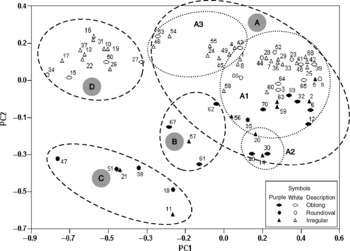
The scatter diagram of the first two PCs (Fig. 2) shows the phenotypic variation among accessions of D. alata collected in Malaysia. The accessions are widely dispersed along the both PCs axes. The dispersion slightly supported the delimitation of the accessions based on observations of the flesh colour. The accessions of purple tuber gathered on the negative side and white accessions on the positive side along the second PC axis (Fig. 2). However, there was an undefined pattern of clustering with overlap dispersion among accessions of irregular, oblong and round tuber groups. This suggests that tuber character alone may not be sufficient for delimiting taxonomic units in D. alata.
Two-dimensional plot of the first two principal components (PC-1 and PC-2). Accessions that are encircled by the dashed lines and marked as groups A, B, C and D corresponded with the grouping in the cluster analysis (Fig. 3).

The accessions of the three observed groups are scattered and intermixed among the four large groups, i.e. A, B, C and D, formed in the scatter diagram (Fig. 2). Accessions of the oblong group (nos 3, 6, 12, 32, 39, 48, 64, 65, 69 and 70), round group (nos 9, 23, 35, 44, 52 and 66) and irregular group (nos 1, 2, 4, 5, 7, 8, 25, 28, 29, 33, 36, 41, 42, 45, 56, 58, 59, 60 and 68) are mixed in sub-group A1. They are characterized by the presence of aerial tuber, fast germinating tuber with less than 1 week for shoot emergence, fast growing shoot that can reach up to 80 cm length within 20 d, large and branching tubers (up to 5 kg/tuber) and elongated leaves.
Accessions 14 and 20 of irregular-purple and accessions 30 and 40 of oblong-purple groups are mixed in sub-group A2 (Fig. 2) and distinguishable by the presence of numerous roots on the tuber surface. Meanwhile, accessions of irregular-white (24, 46, 49, 54 and 55) and oblong-white (43 and 53) formed another sub-group (A3) in the diagram and differed from the others by having a moderately lobed tuber.
Three accessions of oblong-purple (nos 61, 62 and 67) and one accession of irregular-purple (no. 57) were together in group B (Fig. 2) and they are differentiated from the others by the presence of single unbranched tubers with the smallest size (8–15 cm length and 6–8 cm width). Accessions 11 and 21 of irregular-purple and accessions 18, 38, 47 and 51 of round-purple are mixed in group C, which possess plants with moderate shoot growth that can reach 20–40 cm length within 20 d, single tuber, moderate tuber size and long sagittate leaf. The two groups B and C displayed a wide range of within-group variation in terms of tuber size, shape, branching and lobes.
The scatter diagram (Fig. 2) also displayed a close link with group D, comprising one accession (no. 34) of round-white, three accessions (nos 15, 27 and 50) of oblong-white and ten accessions (nos 10, 13, 16, 17, 19, 22, 26, 31 and 37) of irregular-white cultivars. Plants of this group are characterized by a slow growing habit, producing new shoots at 2–4 weeks after sowing and shoot elongation of 20 cm length within 20 d. This group is distinguishable by the presence of large lobes and branches on the tubers.
Cluster analysis
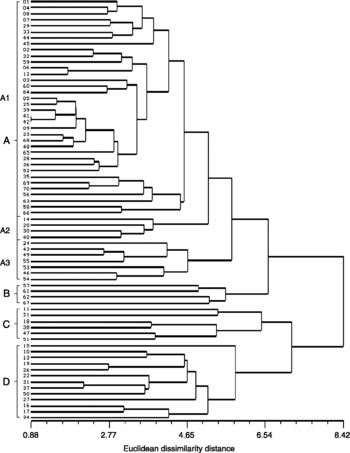
Hierarchical cluster analysis showing the dendrogram of taxa relationships is presented in Fig. 3. The analysis separated the 70 accessions as different genotypes with Euclidean dissimilarity distance ranging from 0.88 (between accessions 41 and 42) to 8.42 (between clusters A and B grouping with remaining accessions). At the dissimilarity distance = 6.54, the dendrogram identified four major clusters, A, B, C and D, containing between 4 and 47 accessions per cluster. At dissimilarity distance ≈ 4.6, cluster A is separated into three sub-clusters, A1, A2 and A3, containing 35, 4 and 7 accessions, respectively. The hierarchical cluster analysis supports the result of PCA where clustering patterns in the dendrogram (Fig. 3) confirms the grouping pattern revealed by the scatter diagram (Fig. 2).
The hierarchical dendrogram showing the relationships among seventy accessions of D. alata collected in Malaysia.

Discussion
Variability was obtained in all 47 characteristics, indicating a high degree of morphological polymorphism present in the species of D. alata in Malaysia. This shows that there are diverse variable arrangements at the individual genotype level, indicating ample possibilities for obtaining desirable trait combinations in specific materials to meet the demand requested by researchers, farmers and consumers.
The substantial morphological variation within and between cultivar groups of D. alata may associate with cross-pollination and sexual recombination, and perhaps mutation, followed by intensive selection by isolated human communities in diverse environments (Martin, Reference Martin1976). Our record indicated that the male : female sex ratio of the germplasm was 7.15 : 2.85, which is considered substantial for creating the variation within the species. It also likely that continuous vegetative propagation and selection have contributed to the wide phenotypic diversity observed in this species (Velayudhan et al., Reference Velayudhan, Muralidharan, Amalraj, Thomas and Soudhamini1989).
Despite showing a great phenotypic variation among accessions, this investigation has also found characters that are useful as markers for classifying the cultivars and for genetic improvement of the crop. Traits that best discriminate between the accessions are underground tuber size and flesh colour, aerial tuber shape and colour, leaf position, shape and size, leaf vein colour, petiole colour, shoot growth rate, and number of days for tuber miniset to germinate. This is in agreement with Sastrapradja (Reference Sastrapradja, Miege and Lyonga1982), Martin (Reference Martin1976), Onwueme (Reference Onwueme1978), and Martin and Rhodes (Reference Martin and Rhodes1973, Reference Martin and Rhodes1977), confirming that the most effectively used characters in classification of D. alata are tuber, leaf and growth characteristics.
In the present study we found that the multivariate analysis based on the 47 agro-morphological descriptors differentiated the accessions of D. alata in Malaysia into four major cultivar groups, identified as groups A, B, C and D, which possess high inter- and intra-group variability (Figs 2 and 3). This result was in line with the result obtained by Lebot et al. (Reference Lebot, Trilles, Noyer and Modesto1998) in New Caledonia, where four major groups of D. alata morphotypes were also identified.
Conclusions
This work contributes to increasing knowledge regarding D. alata genetic resources available in Malaysia. In many cases, the resources are threatened with loss by genetic erosion due to social and economic change in this country. Thus, genetic conservation and improvement based on the selected materials should be encouraged as they could lead to a reversal of genetic resource erosion in this species. Such activities would also maximize the use of genetic resources and provide the opportunity to explore the potential use of this species for other purposes.
Acknowledgements
The authors wish to thank for En Hassan for his technical assistance. This study was funded by the KUSTEM fundamental research grant, via the allocation no. 57 002.