Introduction
This special issue of Hypatia, “Indigenizing and Decolonizing Feminist Philosophy,” asks us to consider how respectful and meaningful encounters with Indigenous thought and Indigenous concerns might transform, broaden, and decolonize feminist work. In this spirit, this article examines how feminist philosophy might be unsettled (deterritorialized) through an unsettling (disturbing) encounter with AboriginalFootnote 1 artist Tracey Moffatt. I have chosen to engage an artist rather than a scholarly writer, as decolonizing philosophy requires an undisciplining of the field.
The encounter here between feminist philosophy and Moffatt's experimental art is necessarily partial; I focus on only two aspects of feminist philosophy (feminist theories of motherhood and feminist practices of mentoring) and a single short film by Moffatt (Night Cries: A Rural Tragedy). This film is part of a larger corpus of films and photographic collections created and co-created by Moffatt providing provocations on feminist issues and practices extending well beyond those considered here. I foreground Moffatt's Night Cries in these reflections on unsettling feminist philosophy for reasons that are simultaneously personal and intellectual. This film marks my earliest encounter with Moffatt's work. Year ago, while agonizing over the tensions between my brown daughter and me, her white adoptive mother, I stumbled across this film. Moffatt's work unsettled me. It still does, as I return to its lessons as a mother, a teacher, a scholar, a friend, or a mentor, again and again.
My encounter with Night Cries is not the encounter of an expert authority with an Indigenous text to be decoded. It is an encounter with a child (albeit an adult child) who screams, who cries, who mourns, who hurts. It is an encounter with a body that demands a response. It is also an encounter that makes clear that there is no “right” response for me (as a white mother or foremother) to make. I cannot “save” this child in whose grief I already stand complicit. What I can do and aim to do here is to embrace what Lori Castillo calls “radical friction” (Castillo Reference Castillo2018), a space of tension between ideas and between people and cultures—a space with the capacity to transform relationships by dislodging settled ways of thinking and being in the world.
Moffatt's film opens just such a space for feminists. By allowing us to see and feel the violent intersections of gender, race, and power in intimate life, Moffatt's Night Cries invites us to consider how colonial and neocolonial policies are carried out through domestic labor. Moffatt thus provides a window onto the struggles needed to decolonize feminist motherhood studies. From this vantage point, we may also catch a glimpse of some of the complexities involved in attempts to decolonize philosophy more generally.
Moffatt's Night Cries
Night Cries: A Rural Tragedy (Reference Moffatt1989) is one of several works that record and examine Tracey Moffatt's experiences as the Aboriginal child of a white foster mother growing up in Brisbane, Australia during the 1960s. A more complete exploration of this corpus of work would include Moffatt's photographic series “Scarred for |Life” (1994, 1999), which includes images of an adolescent daughter getting backhanded by her foster mother on Mother's Day; her series “Up in the Sky” (1998), where images of nuns holding an Aboriginal infant are interspersed with photos of mixed-race family relationships; and her 1993 feature film, Bedevil, which is haunted by ghosts often embodied in the form of a mysteriously missing child. Part autobiographical and part cultural memory, Moffatt's work is informed by media depictions of motherhood and family prevalent during her formative years. Her 2009 cinematic montage, Mother, assembles Hollywood clips of iconic mothers from Kate Hepburn and Jane Fonda's idyllic bonding in On Golden Pond to the cursing, gun-toting Sigourney Weaver in Aliens, ending with a scene of a pregnant Native American woman trudging in the snow to give birth. As one of her earliest works, Night Cries sets the stage for this larger body of work on mother–daughter relations. The eighteen-minute film, shot entirely indoors, experiments with color and sound as it provides a poignant and unsettling portrayal of a complicated mother–daughter relationship that resides at the intersections of domesticity and settler colonialism. In it, a middle-aged Aboriginal daughter who cares for her dying white mother oscillates between resentment and tenderness in a drama of irresoluble psychic tension as memories conflict with hope, death with life, and night terrors intrude on daydreams.
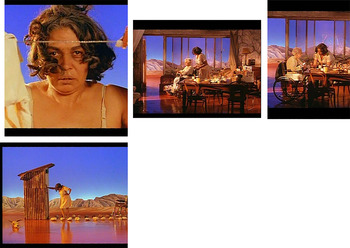
The adult daughter sighs and grimaces as she helps her dying mother eat, pushes her wheelchair to the outhouse, and washes her clothes (Figure 1); yet she also demonstrates genuine care for her mother as she washes her and eventually shrouds her. There is no dialogue between mother and daughter in the film. Their vexed relationship plays out in the coming together and moving apart of their bodies in different permutations against the backdrop of a stylized and clearly artificial rural setting and a soundtrack including sighs, moans, screams, and train whistles as well as carefully placed music evocative of a past era that continues to intrude on the present.
(color online) The artifice of colonized love. Tracey Moffatt, Night Cries, 1998, Videotape 17 minutes, 36 seconds. Courtesy of the artist and Roslyn Oxley9Gallery, Sydney.

The film engages in memory workFootnote 2 as it invites us to draw connections between domesticity and settler colonialism. Throughout the film, memories of the daughter's past intrude on her present as she recalls first in fragments, then more fully, a scene of childhood loss and abandonment (Figure 2). These flashbacks to childhood trauma are cast in subdued tones, in shades of black and white, gray and blue that mimic old home movies of a beachside vacation. This color palette contrasts starkly with the vivid colors of the present, situating the recollected past as both less artificial (a more natural color palette) and yet as also less trustworthy (more faded) than present experience. Adding a further layer to the aesthetic and epistemic complexity of these scenes is Moffatt's use of sound and genre. Mimicking the horror-film aesthetic of Night Cries Tales-from-the-Crypt-like title font, a fear-inducing shriek on the soundtrack accompanies the transformation of children's play into a scene of strangulation (Figure 3).
(color online) Screen memories. Tracey Moffatt, Night Cries, 1998, Videotape 17 minutes, 36 seconds. Courtesy of the artist and Roslyn Oxley9Gallery, Sydney.

(color online) Night Cries as horror film. Tracey Moffatt, Night Cries, 1998, Videotape 17 minutes, 36 seconds. Courtesy of the artist and Roslyn Oxley9Gallery, Sydney.

In her mother's absence, what began as children harmlessly tossing seaweed at each other becomes life-threatening to the daughter, as the debris wraps itself around the young girl's neck. The mother who leaves the children alone is faulted; yet the white mother has turned her back on her daughter only for a fleeting moment to gaze out at the ocean. This seems quite literally a screen memory, a memory that stands in for a larger trauma too dark to remember—perhaps the daughter's loss of her Aboriginal mother and Aboriginal culture. As Shirley Hill Witt explains, for Indigenous persons, the memory of genocide and tribal extinction is a “raw unhealing wound” (Witt Reference Witt1974, 35), a wound described by Eduardo and Bonnie Duran as a “soul wound” (Duran and Duran Reference Duran and Duran1995, 27).
Night Cries also encourages imaginative work. The adult daughter, tragically isolated from both her imagined past and her imagined future, has no human contact besides the dying white mother for whom she cares. Upending the colonial narrative of white saviorism whereby Europeans would civilize Indigenous peoples by removing them from the outback and educating them in towns and cities, Moffatt situates the adopted Aboriginal daughter within a rural tragedy from which there is no rescue. Stuck in a ramshackle home as her mother's sole caretaker, she reads travel brochures and dreams of escape on a train whose whistle provides the only sound linking home to civilization. The train seems always to be approaching but never arrives, leading us to wonder where she would go if she could.
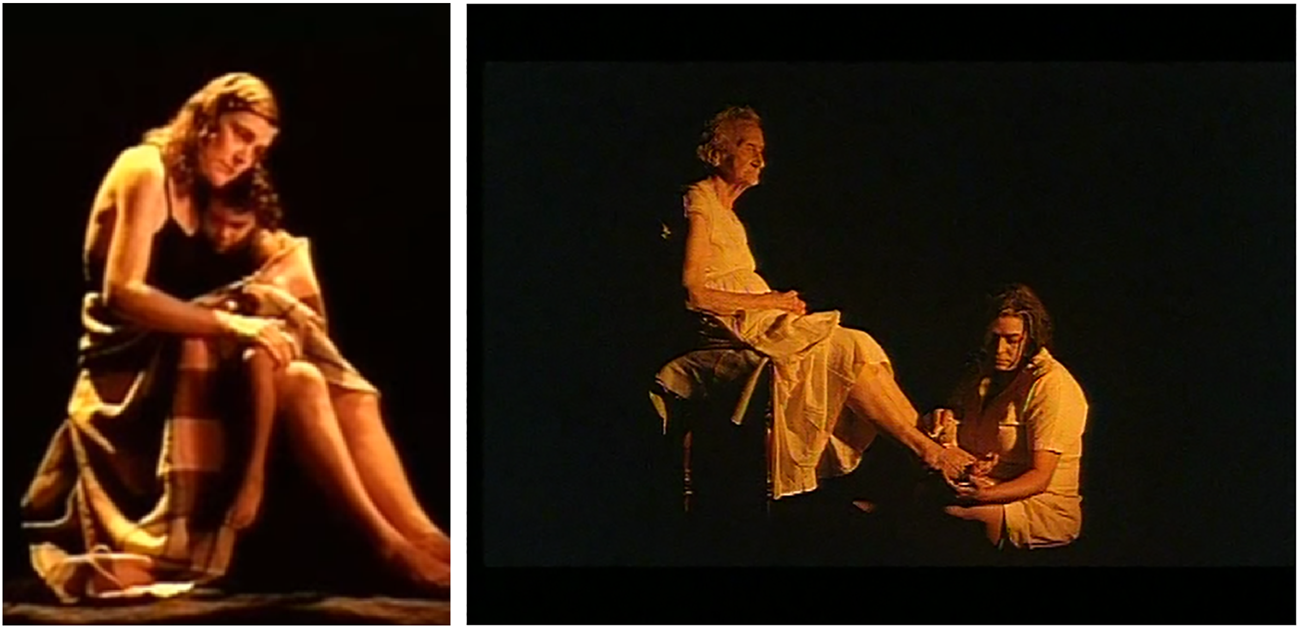
Despite fantasies of elsewhere, the daughter dutifully remains with her dying white mother as she recalls the imperfect but loving care that she received from her. She is trapped in what Linnell Secomb calls “the exchange economy of reciprocal colonial love”—an economy of intimacy that obligates the daughter to care for her mother who, in caring for her, isolated her from the other life of which she dreams (Secomb Reference Secomb2007, 92). This reciprocal exchange is clearly evoked in two scenes, shot against a black backdrop, that literally cast a soft, yet bright, light on the mother–daughter relationship (Figure 4). In the first, Pietà-like image, the young white mother holds her young daughter, draped across her lap, as she soothes her fears. In the second scene, mirroring the first, the mother's feet rest in her daughter's lap, as the adult child now cares for her aged mother. In neither scene do mother and daughter meet each other's gaze. Both appear pensive, lost in their own solitary reveries. They care for each other; yet each seems alone in the other's presence.
(color online) The exchange economy of reciprocal colonial love. Tracey Moffatt, Night Cries, 1998, Videotape 17 minutes, 36 seconds. Courtesy of the artist and Roslyn Oxley9Gallery, Sydney.

Night Cries is an unflinching portrayal of the psychic toll that colonialism takes on both white (settler) women and black (Aboriginal) women, caught in an intricate dance of joyless interdependence. As the old white woman's hand-braced fingers reach for food that she cannot grasp without the assistance of her daughter, the daughter reaches for a different life that was foreclosed to her long ago by enforced dependence on her white mother. As the caregiving daughter's exasperation and anger grows, the aged mother's only responses are to flinch and moan and groan in her troubled sleep.
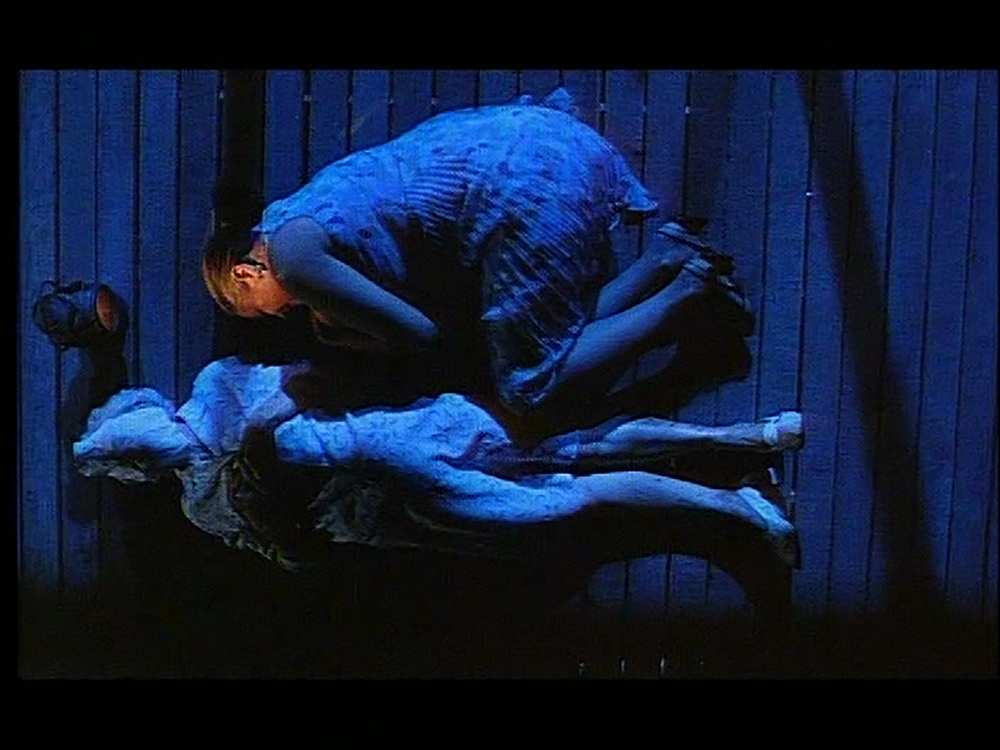
When the mother draws her last breath, the daughter does not seem relieved. She curls up in a fetal position beside her mother on the floor (Figure 5). Cast in a blue hue, the larger body of the daughter almost touches, but does not hold, the frailer, shrouded body of her white mother. The soundtrack features a loudly crying child. We do not know if she is mourning for this mother or another, for her lost past or her truncated future. The story ends without suggesting that she will be able to move beyond this or, if so, how.
(color online) No resolution, no closure. Tracey Moffatt, Night Cries, 1998, Videotape 17 minutes, 36 seconds. Courtesy of the artist and Roslyn Oxley9Gallery, Sydney.

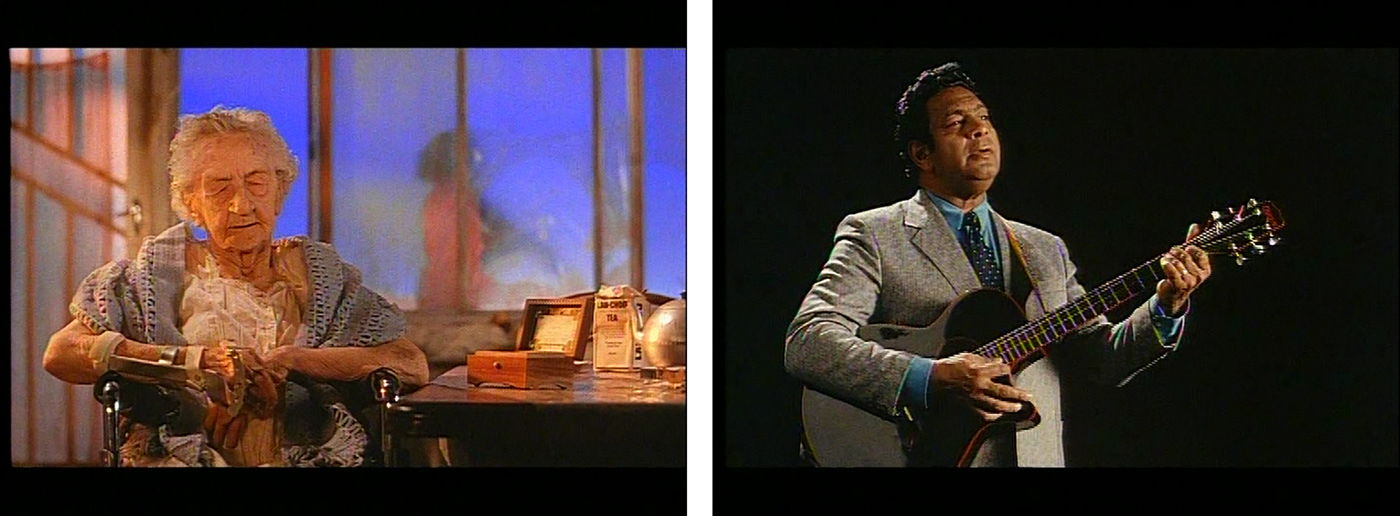
The short film speaks to the lasting legacies of adoption practices in Australia. From 1869 until the 1970s, children of Australian Aboriginal and Torres Strait Islander descent (who would later be known as “the Stolen Generations”) were removed from their families by government agencies and church missionaries with the sanction of state and federal parliaments.Footnote 3 In most cases, the children were placed into institutional care by religious organizations, with a significant number of young girls “fostered out” due to the perception that they were especially “at risk” in their Aboriginal homes and culture.Footnote 4 In both missionary schools and foster homes, Aboriginal children were assimilated into Anglo-Australian culture by teaching them English and training them for agricultural labor (boys) and domestic service (girls).Footnote 5 The training of Aboriginal girls as domestic servants for white families is evoked in Moffatt's film by the white uniform the daughter wears as an adult caretaker for her mother (Figure 1). Aboriginal singer Jimmy Little symbolizes the “era of the mission school where black Australians were re-educated and re-clothed in an attempt to whiten them” (Murray Reference Murray1990, 19). A “success” story of Australian assimilation, Little is an evangelical Christian whose first media role was in a 1960s Australian-made Billy Graham film. Opening and closing scenes (Figure 6) feature him singing his hit song, “Royal Telephone”:
Telephone to glory, oh, what joy divine!
I can feel the current moving on the line.
Made by God the Father for His very own,
You may talk to Jesus on this royal telephone.
Central's never busy, always on the line,
You can hear from heaven almost any time.
'Tis a royal service, built for one and all,
When you get in trouble, give this royal line a call.
(color online) Assimilationist framings. Tracey Moffatt, Night Cries, 1998, Videotape 17 minutes, 36 seconds. Courtesy of the artist and Roslyn Oxley9Gallery, Sydney

Little's framing presence as an Aboriginal man civilized through Christianity is mirrored in the daughter's caretaking of her dying mother. As the daughter tenderly washes her mother's feet, she evokes Christ's command to his disciples to “wash one another's feet” as he has humbly done for them (Figure 4).Footnote 6 Undertones of violence accompany even this gentle display of love toward her mother, however. As the foot-washing occurs, mother and daughter hum “Onward Christian Soldiers,” evoking the entanglement of Christianity, saviorism, and imperialismFootnote 7 and also the stoicism needed for mother and daughter to endure what their history has wrought.
The intermixture of violence and tenderness in the foot-washing scene mirrors that of an earlier scene, wherein the middle-aged Aboriginal daughter cracks a whip near where her infirm mother dozes—literally lashing out at her and, perhaps, at the inescapable predicament in which they are jointly situated. Interrupting the scene is a clip of Jimmy Little silently mouthing the words to “Love Me Tender” (Figure 7). In these and other scenes, the buried contradictions, tensions, and ambiguities of colonial love are starkly revealed.
(color online) The violence of colonized love. Tracey Moffatt, Night Cries, 1998, Videotape 17 minutes, 36 seconds. Courtesy of the artist and Roslyn Oxley9Gallery, Sydney.

Moffatt's critique of Australia's assimilationist past acknowledges the significance of that past in constructing present white–Aboriginal relationships. The past is never simply past and there is no pristine Indigeneity after assimilation. Aboriginal children raised in residential schools and/or in white foster or adoptive families cannot undo their training in Western culture. Indeed, Moffatt uses that training in making her art, unapologetically drawing on cultural tropes and techniques of Western cinematic production precisely to unsettle them.
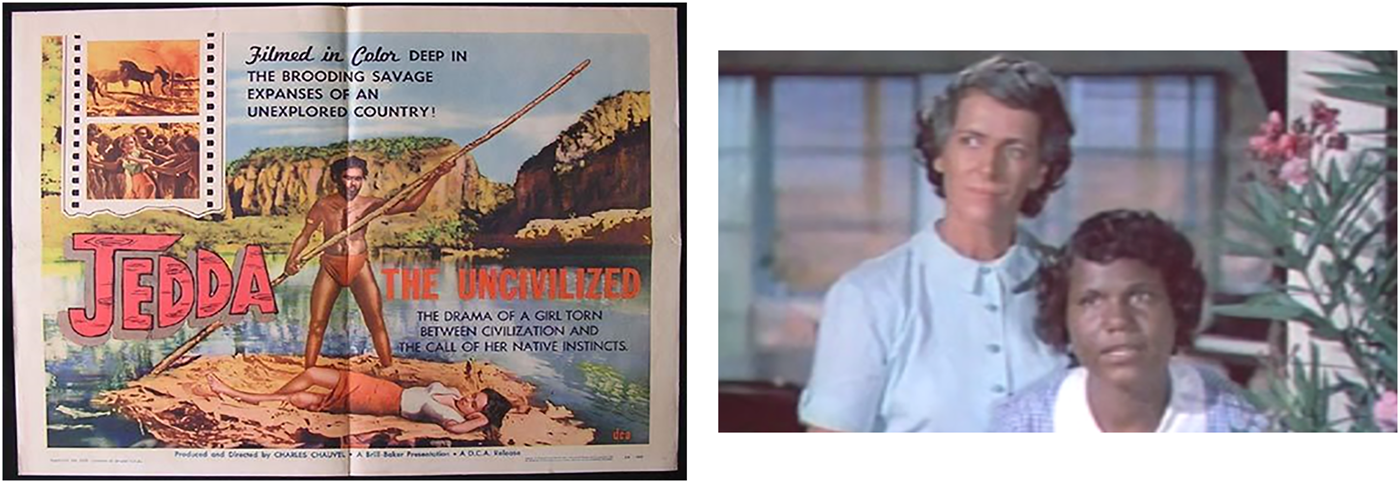
Night Cries is also a response to the ways in which white–Aboriginal relationships are mediated by Western representations of indigeneity. In the climactic flashback scene, the young Aboriginal girl becomes increasingly distressed as she is left alone on the beach by her mother and teased by two young boys who wrap her in strands of seaweed. At the peak of her distress, the strands of seaweed turn into streams of film tape that threaten to choke the young girl (Figure 3), thereby representing the terror not merely of being unwatched but also of being viewed through “racist regimes of representation” (Lloyd Reference Lloyd2014, 1056). Night Cries pushes back against those representational regimes by responding both narratively and aesthetically to a 1955 Australian film about the risks faced by young Aboriginal women who fail to properly assimilate (Figure 8).
(color online) Citationality: Jedda. Charles Chauvel, dir., Jedda the Uncivilized, 1955, 1 hour, 41 min, Australia.

Jedda (released in the UK as Jedda, the Uncivilised) is the story of an Aboriginal orphan girl raised by a white woman who teaches her European ways and forbids her to learn about her own culture. As a young woman, however, Jedda meets an Aboriginal man who lures her away from the white man who loves her, takes her on a treacherous journey back to his tribe (who reject her), and ultimately causes her death. Although starting as a family drama, Jedda transforms into an action film offering adventure, suspense, and the high drama of nation-building and jumping off cliffs underwritten by images of male Aboriginal savagery and female vulnerability (Morris Reference Morris2004).
The first Australian feature film to be shot in color, Jedda was also notable for its casting of two Aboriginal men in leading roles. Moffatt responds to Jedda in her casting and staging choices. Whereas Jedda casts well-known white actors against unknown Aboriginal men in a story filmed against expansive, vivid Australian landscapes, Night Cries casts popular Indigenous icons (Jimmy Little and Marcia Langton, a well-known Australian author, film critic, and Indigenous activist) against two unknown white actresses in a sequel that is filmed against a sparse interior set that looks out onto a clearly fake landscape on which little action occurs. Night Cries also interrupts the linear colonial narrative of Jedda by jarring scenes, sounds, and shifts in genre that force the viewer to observe it at a critical distance (Senzani Reference Senzani2007).
At the same time, Moffatt engages in a dialogue with the earlier film by extending its narrative into the present and asking us to imagine the relationship between Jedda—had she lived—and her mother, absent the mediating influences of husbands, fathers, and boyfriends. In this imagined future, the house has run down, its windows are dirty and patched, and the space of “settlement” has contracted (Periz Reference Periz1990, 16). As Meaghan Morris notes, the new frontier is now the domestic space, and it is no longer a frontier between two radically disparate cultures: “The identities of mother and daughter are too blurred and shifting for that. It is the frontier on which state policy impacts on the psyches of black and white women in a continuous, prolonged abrasion” (Morris Reference Morris2004).
Unsettling Philosophies of Motherhood
Moffatt's work suggests that addressing colonialism adequately requires making its domestic landscapes visible. Like Charles Chauvel's Jedda, traditional ethical, social, and political theory have largely ignored intimate, domestic, and familial life, erasing struggles based in the gendered politics of home and domestic labor in favor of more panoramic visions of political justice. Insofar as domestic space has been an invisible presence in philosophy, the ethics of care, including motherhood studies, has been an important corrective. Feminist studies of motherhood place domesticity, rather than great events, at the core of ethics and social theory.
At the same time, feminist philosophical studies of motherhood require unsettling. Released in 1989, the same year as Night Cries, the book that initiated feminist philosophical attention to the practice of mothering, Sara Ruddick's Maternal Thinking: Toward a Politics of Peace, has been widely critiqued for its focus on white, middle-class mothering within bio-normative families, its focus on normative training, and its desire for legitimacy (Bailey Reference Bailey1994; Lugones Reference Lugones2003; Khanna Reference Khanna2009). This criticism may seem unfair. Ruddick does, after all, struggle explicitly with the dilemma posed for maternal thinkers in raising children to be socially acceptable within cultural contexts that may be both sexist and racist. Moreover, she recognizes the tension between “passionate loyalties” to one's particular children and the “work of conscience” that demands widening one's vision to a consideration of the well-being of other children and other mothers (Ruddick Reference Ruddick1989, 177). Additionally, Ruddick notes how normative maternal practice may lend itself specifically to nationalism and xenophobia. Yet Ruddick's assumption that mothering practice lends itself to a politics of peace largely ignores “the violence it often takes to maintain perpetual peace” (Khanna Reference Khanna2009, 303). White wives and mothers who “shor[e] up colonial identity by maintaining proper domesticity” (Lloyd Reference Lloyd2014, 1053) may look peaceful in comparison to men who wage wars. Yet, as Moffatt reveals, training children to follow rather than resist dominant norms may do violence to the children subjected to those domestic practices—especially if those children are colonized female subjects.
Despite Ruddick's claim that “all mothers are ‘adoptive’” (51), she does not entertain actual practices of adoption. Adoption histories reveal the difficulties of ensuring the survival of Indigenous children adopted into white families, the challenges of helping adopted Indigenous children develop a strong sense of their familial and cultural belonging, and of the needed efforts to help adopted children deal with “adoption related grief and loss” (Keller Reference Keller2010; Reference Keller, Lintott and Sander-Staudt2015). Ruddick speculates—in the only reference to Indigenous peoples in her book—that many Native Americans would find her efforts to honor adoptive mothers a belaboring of the obvious. However, a focus on actual adoption practices and histories reveals the need to carefully distinguish between practices of informal adoption (“already richly inscribed in [Native] culture”) and practices of state-sanctioned adoption that have been tantamount to a form of cultural genocide (Ruddick Reference Ruddick1989, 54).
Ruddick's failure to engage the ways in which (white) mothering practices intersect with and frequently, if unwittingly, reinforce colonial and neocolonial projects are hardly her failure alone. Nancy Chodorow's account of the reproduction of mothering has been critiqued for drawing universal claims about mothering from ideals and practices that are culture-, race-, and class-specific (Chodorow Reference Chodorow1978; see also, for example, Spelman Reference Spelman1988; Flax Reference Flax1990; DiQuinzio Reference Diquinzio1993). Less often noted are the material consequences for colonized subjects that follow from exclusionary and essentialist theorizing about motherhood. For example, the assumption that mothers live in nuclear family homes and bear sole or primary responsibility for meeting a child's material and emotional needs and providing their moral training has played—and continues to play—a large part in depictions of Indigenous mothers as “unfit” (Jacobs Reference Jacobs2009; Scanlon Reference Scanlon2011).
Some French feminist philosophies of the maternal have also been critiqued as ethnocentric. Julia Kristeva's account of “maternal instinct” and of the maternal body as prediscursive (Kristeva Reference Kristeva1980) has been critiqued by Judith Butler as based on a “univocal conception of the female sex … as generative” (Butler Reference Butler1990, 91). Whereas Butler critiques Kristeva for her failure to countenance the possibility that (specific) paternal laws may produce the generative bodily instincts she describes, from Moffatt's perspective we might also call into question Kristeva's assumption that the (white and whitewashed) mother is generative and not, for example, complicit in genocide. Luce Irigaray's contention that women's identification with their mothers is damaging appears more promising in its refusal to romanticize the mother–daughter relation (Irigaray Reference Irigaray1993). However, Irigaray's diagnosis of female–female hostility invokes the devaluation of the feminine by a masculine principle—suggesting a singular female experience of patriarchy seemingly oblivious to the colonial dramas that have played out between women themselves. The adult daughter in Night Cries lashes out at her mother for reasons that both exceed and reconfigure the Irigarayan terror of becoming feminized.
Late twentieth-century care ethics based on maternalismFootnote 8 have also been critiqued for romanticizing an idealized (whitewashed) motherhood. Bat-Ami Bar On draws attention to Virginia Held's claim that “when the relationship between ‘mother’ and child is as it should be,” the caretaker cares for the child (and the child for the caretaker), not “because of universal moral rules” but instead from felt “love and concern” (Held Reference Held, Kittay and Meyers1987, 118; see Bar On Reference Bar On, Alcoff and Potter1993). Moffatt's depiction of colonized love problematizes such idealized notions of reciprocal caregiving along with the distinction between care and justice. In colonial and neocolonial regimes, care may be inextricably intertwined with injustice. This has been well documented by scholars analyzing global care chains extending from the global South to the global North—chains that separate migrant careworkers from their own children in order that they might earn a living caring for the children of mothers in a distant, more economically advantaged, country (Ehrenreich and Hochschild Reference Ehrenreich and Hochschild2003; Benhabib and Resnik Reference Benhabib and Resnik2009; Kittay Reference Kittay2009; Meghani Reference Meghani2015). In the most recent chapter of the domestication of genocide, the brown children of brown women who cross borders to work as nannies and housekeepers for white families may find themselves adopted by white families. Retelling “the story of neoliberal globalization from the perspective of the migrating mother-child dyad and the U.S. households where some work and others are raised,” Laura Briggs observes that church-based orphanages and transnational adoption may be among the very few options available to relatives of migrant mothers who cannot sustain the children left behind in countries where structural adjustment policies have decimated social-welfare systems (Briggs Reference Briggs and Parreñas2010, 49).
Although less often criticized as an exclusionary view of mothering, Adrienne Rich's widely cited account of the distinction between motherhood as an institution and motherhood as an experience may also require decolonizing (Rich Reference Rich1976). As Moffatt's retelling of the Jedda tale suggests, the experience of mothering remains haunted by the colonial project even after it is removed from a patriarchal context. Certainly, such haunting of the present by the past characterizes the experience of white mothers of Indigenous and other children of color who have been forcibly removed from their birth families and native communities. The experiences of Indigenous mothers and other mothers of color are likewise haunted by the persisting psychic, representational, and material legacies of colonialism. As Dorothy Roberts has argued, many maternal joys and sorrows are race- and culture-specific: “[m]ost white mothers do not know the pain of raising Black children in a racist society,” including the deep sorrow felt at realizing her child is “unwanted,” the daunting task of protecting her child against “innumerable messages that brand them as less than human,” and the constant fear for her child's life whenever that child leaves home (Roberts Reference Roberts and Fineman1995, 4–5). Similarly, many experiences of Indigenous mothering in settler colonial countries may be unique to those sharing particular histories—for example, the pain and frustration of having one's child registered as white by the State, and the double bind of choosing between preserving a child's cultural heritage or moving—or encouraging one's child to move—to urban environments in search of higher (colonial) education and employment opportunities (Lawrence Reference Lawrence2004).
One might argue that the exclusionary and essentializing tendencies of these early studies of motherhood are a sign of the times in which they were written. Indeed, these late twentieth-century texts bear the marks of a specific place and time, as all texts do. This observation comports with critiques of universalizing accounts of motherhood: norms and practices of mothering must be historically and culturally contextualized. To listen to Moffatt's Night Cries, however, is to also recognize that each generation of feminist texts also speaks to a specific inheritance and bequeaths that past lineage to future generations. Late twentieth-century Western feminist treatises on mothering bear an uncanny resemblance to early twentieth-century maternalist ideologies—situating (white) motherhood as a critically important and challenging occupation and justifying (white) women's presence in the public sphere “as an extension of their experience or socialization as mothers” (Jacobs Reference Jacobs2009, 89). Less obviously, late twentieth-century philosophies of motherhood also carried forward colonizing sentiments from an earlier era of maternal politics, namely the idea that white women bore responsibility for “saving” or “uplifting” women less fortunate than themselves.
Twenty-first-century feminist philosophers who have been witness to the critiques of an earlier generation of work on mothering are less likely to universalize mothering experiences than were their predecessors. Yet feminist theories of motherhood continue to focus largely on experiences and practices of white mothers without interrogating how those affective and domestic landscapes may be related to white motherhood's complicity in colonial and neocolonial projects.Footnote 9 Between 2008 and 2018, The Philosopher's Index lists 132 scholarly works focused on some aspect of mothering, motherhood, or maternity. These essays focus on a variety of topics including most commonly: reproductive technologies, abortion rights, maternal embodiment, pregnancy, breastfeeding, intensive mothering, maternal ambivalence, and mother-blaming. Like earlier feminist work, much of this work provides an important corrective to male philosophizing. At the same time, it inherits the (predominant) whiteness of both its contemporary authors and its historical progenitors. This inheritance shows up in both the choice of topics and the theoretical frameworks through which those topics are examined. Significantly more articles, for example, focus on infertility and assisted reproduction than on eugenics, sterilization, or adoption. And although most articles mention sex or gender explicitly in their abstracts, only two abstracts explicitly mention race or ethnicity; none of them mention colonialism or decolonization; nor do any mention Native, Indigenous, First Nations, or Aboriginal mothers.Footnote 10
The topics foregrounded by philosophies of motherhood are related to their citational lineage. Most recent philosophy articles on mothering place themselves citationally within a scholarly lineage featuring white foremothers rather than Indigenous and non-Indigenous foremothers of color. Ruddick and Rich, for example, are much more widely cited in the philosophical literature on motherhood than are late twentieth-century works by Cherrie Moraga or Viola Cordova. Moraga's work emphasizes (among other things) the violence of sundering blood connections, the racial complexities of intimacy and kinship, and the intertwining of conflicting racial, gender, and sexual politics in motherhood (Moraga Reference Moraga1983; Reference Moraga1993; Reference Moraga1997). Cordova speaks to the importance of knowing where one is from, linking home, belonging, and relationship to place and memories of place (Cordova Reference Cordova2002; Cordova and Hogan Reference Cordova, Hogan, Moore, Peters, Jojola and Lacy.2007).Footnote 11 Foregrounding these works in our scholarly lineage would result in explorations of kinship that were kin to Moffatt's own—explorations that contextualize, complicate, and implicate mothering in stories of coming together and falling apart against physical and cultural landscapes marked by colonial practices and struggles against them.Footnote 12
Feminist philosophies of mothering have frequently glossed over the imperialist projects and colonial histories that continue to shape and disrupt contemporary practices of intergenerational care, but Moffatt's film suggests ways to unsettle these patterns. Most obviously, Night Cries suggests that feminist philosophies of motherhood attend critically to concepts of neglect and abuse that excuse the violence inherent in practices of “good” (white) mothering, while continuing to foster practices of cultural genocide through removing children from Indigenous mothers and through the surveillance and forced assimilation of Indigenous mothers themselves. Doing so is especially critical when policies (for example, the 1978 U.S. Indian Child Welfare Act) intended to counteract systemic bias and reduce the overrepresentation of Indian children in child welfare systems is under siege (Hodge Reference Hodge2016). A decolonized politics of mothering would defend tribal sovereignty over matters of Indigenous child welfare while simultaneously interrogating the racialized politics of adoption, whereby white mothers continue to be the vehicle for “saving” and “civilizing” Indigenous children.
White motherhood's continued status as a functionary arm of (neo)colonialism requires that white feminists work to undo the ideas and institutions in which their (neo)colonial labors take place. This requires reimagining interfamilial and intrafamilial relationships in nonsentimental terms. An “imperial sentimental narrative” (Wexler Reference Wexler2000) that can be traced back to early settler colonialism continues to guide the white imaginary in shaping narratives of adoption of nonwhite native children as a drama of redemption and reconciliation. The form that this imaginary takes under globalization is an “antiracist transracial fantasy of postcolonial reconciliation, white cosmopolitanism, and a vision of a future global family” (Hübinette and Arvanitakis Reference Hübinette and Arvanitakis2012, 703). Moffatt's work rightly encourages suspicion about such reconciliation narratives as do other works by the now adult children of transracial and transcultural adoption (see, for example, Borshay Reference Borshay2000; Hübinette and Arvanitakis Reference Hübinette and Arvanitakis2012; Roorda Reference Roorda2015).
To illustrate the impossibility of escaping (or transcending) the tragic legacies of colonialism, Moffatt depicts a mother–daughter relationship that evolves but never resolves. Feminist philosophies of motherhood would benefit from also developing a philosophical imaginary that allows mothers and daughter to age, thereby revealing differently experienced and recalled events and enabling nondominant narratives of mothering to emerge. Unlike the infants and toddlers who currently permeate much of the mothering literature, teens and young adults may, and often do, insist on their difference and resist assimilationist parenting. This resistance need not lead to the child's demise, as per Jedda. But it will unsettle mother–daughter relations in ways that may be both painful and necessary. Philosophies of motherhood would be further transformed by including attention to aging mothers who, as per Night Cries, become vulnerable and dependent on their adult children (often, their daughters). The reversals of vulnerability and care that often take place over the familial life course allow for—indeed demand—transformation in relationships; these transformed relationships will nonetheless carry forward a historical legacy. Understanding such relations thus requires looking back rather than merely treating the present moment (as we are apt to do with infants) as a terra incognita to be domesticated as we please.
Unsettling Feminist Mentoring
Mentoring projects have become an important strand of feminist attempts to address the ubiquitous “diversity problem” in philosophy. But can they also decolonize philosophy and, if so, what would this look like? To answer this, it is important to be clear about the differences between diversifying and decolonizing philosophy.
The value of diversifying philosophy is widely shared by professional philosophers these days. Yet both holders of positions intended to diversify philosophy (“diversity hires”) and those tasked with diversifying their institutions (“diversity officers”) have expressed skepticism about diversity projects (see, for example, Ahmed Reference Ahmed2012; Vest Reference Vest2013b), noting that the rhetoric of diversity frequently coexists with racism and other social injustices. Certainly, diversity in the academy coexists with (indeed, may depend on) ongoing practices of settler colonialism that include commitments to state and private (settler-owned) property and Indigenous subordination.
To say that philosophy has a “diversity problem”—rather than, say, a “whiteness problem,” a “Eurocentrism problem” or a “settler problem,” erases ongoing practices of settler colonialism by: 1) shifting the subject from injustice (for example, racism, colonialism) to difference (for example, race, Indigeneity); 2) lumping together a wide variety of incommensurable differences (for example, Indigeneity, race, ethnicity, gender, sexuality, disability); and 3) positioning the problem as a problem for philosophy rather than one faced by Indigenous persons. In this way, diversity rhetoric positions philosophy as having a reputational problem to be solved by recruiting “diverse” bodies into the field—bodies that are then exploited to continue the project of diversifying philosophy.
White women were among the earliest “diverse” bodies to be included in philosophy and entrusted with its upkeep; as such, white women have frequently been tasked with mentoring “other” diverse bodies. One result is the creation of feminist spaces characterized by vexed cross-cultural relationships between and among white women and the women they mentor, who—like the protagonists in Moffatt's film—come together and move apart, sometimes tenderly and sometimes violently, against the stylized landscape of philosophy. Speaking of her own ambivalent relationship to feminism, Cree Métis philosopher Lorraine Mayer reminds us that today's unsettling feminist landscapes have a past. Histories of colonization that extend into the present may produce both “anticolonial rage” and defensive postures necessary for survival, turning contact between white feminists and their Indigenous students and colleagues into “a perpetual combat zone” (Mayer Reference Mayer2007, 34, 24; see also Moreton-Robinson Reference Moreton-Robinson2002; Hinsdale Reference Hinsdale and Peters2016).
The impossibility of disentangling colonial histories from how we encounter one another in the present does not excuse senior white women from reaching out to Indigenous students and colleagues who desire mentors, allies, or co-conspirators.Footnote 13 However, it does suggest the need for greater attention to how white women mentor and how that mentoring is received. To date, there has been little systematic data-collection regarding the success of mentoring initiatives. Moreover, data-collection efforts have focused largely on “success” as measured by institutions (for example, GPAs, graduation rates, admission to graduate school, job placement, tenure, and promotion). Although such measures are not irrelevant to the well-being of Indigenous women in the academy, institutional data tells a partial story at best. First, Indigenous peoples are largely “asterisked” in such datasets either because the statistical sample is too small to report as “meaningful” or because they are folded in with other underrepresented minorities (for example, Asian Pacific Islanders), thereby “remaking a collective-comprised tribal identity into an individualized ethnic identity” (Tuck and Yang Reference Tuck and Wayne Yang2012, 23). Second, institutional measures of success tell us nothing about the positive or negative effects of various styles of mentoring on the emotional, intellectual, spiritual, and physical well-being of those who receive such care. Data collection on subjective measures of success—such as whether a woman felt intellectually respected by her mentor(s) or supported in taking creative risks—will require feedback mechanisms that provide anonymity for participants who may fear backlash from professional gatekeepers or who may simply wish not to seem ungrateful. To begin this conversation, I focus below on the narratives of two Native feminist philosophers, bringing them into conversation with Moffatt's Night Cries.Footnote 14
In her 2011 Hypatia musing, “‘Fit,’ Mentoring, and Commitment,” Shay Welch describes isolation, a lack of potential role models and networking options, and silence as pervasive features of her experience in academic philosophy, arguing for the importance of mentoring in philosophy as a matter of “fit.” “Fit,” for Welch, refers both to issues of compatibility between a mentor and mentee and to mentoring as professional guidance enabling young scholars to “fit in”:
The mentoring that occurs between a student and her mentor spans the professional domain and spills over into the personal. The introduction to female writers whose voice sounds something like one's own, the warnings about predatory colleagues, the long lunches spent sharing insecurities, and the warm, prideful smiles and winks returned for delivered, brilliant work are all personal touches needed to enhance the lessons on professional writing, reviewing, and mock interviews. A strong mentoring relationship, and all the practices it assumes, can bring about a genuine feeling of “fit” and can open opportunities for a young scholar. Although some may argue that this list of personal touches is overstated and that philosophy is largely a solitary practice, they simply fail to notice that they've had such mentoring from the outset. (Welch Reference Welch2011, 890)
Welch urges the importance of mentoring relationships that go beyond the “strictly professional,” likening the purely professional mentoring of a student who idolizes a faculty member to a case of unrequited love (891). “A committed mentor,” as described by Welch, is involved; she “invests her own time, personal knowledge, and emotional energy grooming that student into her own new and improved professional being” (892). Welch also praises feminist organizations that have instituted formal mentoring programs for young scholars, noting “[i]t ought not to be on our watch that someone in our ranks falls through the cracks!” (890).
Welch's desire to be less isolated is perfectly intelligible; it can be lonely to be the sole feminist philosopher at an institution that is far removed, both geographically and reputationally, from the more cosmopolitan locales where one imagines that feminist ideas and networks thrive; such loneliness is exacerbated when one is dislocated from one's family and place of origin, as most academics are. Although not addressed to feminist philosophers, Moffatt's desolate landscapes and wordless narrative speak to this isolation and to the “silence” that Welch describes as “saturat[ing] the woman's and feminist's experience” (888).
At the same time, Moffatt's work teaches us to be wary of colonized intimacies. Senior white women who “groom” young Indigenous women to enter the profession bear an uncanny resemblance to the white foster and adoptive mothers who domesticated Aboriginal children. Thus, we might query whether feminist philosophy, like the transracially adoptive family, is involved in a drama of “redemption and reconciliation” driven by ideals of white cosmopolitanism. Even well-intentioned efforts to help members of underrepresented groups may replicate an “exchange economy of reciprocal colonial love”—an economy of intimacy that demands the recipient of mentoring care for philosophy (and philosophical traditions, canons, and methods) in return (Secomb Reference Secomb2007, 92).
Welch's language of “investment” and “grooming” sits uneasily against the backdrop of Moffatt's film, evoking an assimilationist picture of professionalization that remakes the Indigenous philosopher (like the musician Jimmy Little) in the colonizer's own image.Footnote 15 The “grooming” of the Indigenous subject takes time (most often women's time) as an investment in what Eve Tuck and K. Wayne Yang term “settler futurity” (Tuck and Yang Reference Tuck and Wayne Yang2012)—a future that extends and protects settlement projects (in this case European philosophies) by creating Indigenous ambassadors for those projects. Welch emphasizes the need for “commitment” from mentors, suggesting that “good mentoring practice involves attention to personal and emotional development in addition to professional skill development” (Welch Reference Welch2011, 891). Without disagreeing, one might query who determines what personal and emotional characteristics and professional skills are thought worthy of development? One might also ask whether personal and emotional well-being is something that can be “added” to professional skill development or whether professionalization as a philosopher stands in tension with the well-being of an Indigenous subject and, related to this, the Indigenous community to which she belongs.
White women's commitment to their Indigenous colleagues and students cannot erase—and may replicate—the history of “the academy as an arm of the settler state” (Grande Reference Grande, Tuck and Wayne Yang2018, 47). As Craig Wilder notes, the academy “never stood apart from American slavery—in fact it stood beside church and state as the third pillar of a civilization built on bondage”; similarly, it stood beside church and state in practices of genocide and dispossession of Indigenous peoples (Wilder Reference Wilder2014, 11). Although feminist philosophy, as a relatively new endeavor, was not an explicit part of that past, feminist philosophers and philosophies are not immune to its legacies.
White women mentors—like Ruddick's maternal thinkers—may struggle with the dilemmas posed by mentoring Indigenous students and colleagues to be professionally acceptable within academic contexts deeply tainted by histories and continued practices of settler colonialism. To stand a chance at decolonizing philosophy, feminist mentoring practices must first acknowledge the violence it takes to attain and maintain professional status in the academy. Like the white wives and mothers who maintain colonialism through domestic practices that look harmless—even kind—compared to the physical violence of male war-mongering, feminist mentors who maintain Eurocentric disciplinary norms through processes of professional training seem harmless—even kind—compared to male colleagues who may engage in violence ranging from intellectual combat to sexual harassment and assault. However, there are “heavy psychic, personal, and professional costs” to “academic passing” (Dotson Reference Dotson2011, 407), especially when privileged disciplinary standards of knowledge-production render other bodies of knowledge “unknowable,” silencing those who have such knowledge (Dotson Reference Dotson2014, 85).
During her relatively brief career as an academic, mixed-blood Seminole philosopher Jennifer Lisa Vest aimed to develop philosophical dialogues among Indigenous peoples that were unmediated by Eurocentric colonial philosophies. Like Welch, Vest acknowledges meaningful mentoring experiences during graduate school; her emphasis, however, is on a felt lack of support as a faculty member at two different universities after graduation. Although Welch dedicates her musing on mentoring to her mentors without whom, she says, she “would not be living [her] dream” (894), Vest's academic experiences more closely parallel Moffatt's tragic nightmare.
Describing “intimate sabotage” as among her most painful experiences in the deadly landscapes of academic philosophy, Vest expresses a deep distrust of white women who are “eager to portray themselves as allies of people of color,” but will turn their back on you in times of trouble (Vest Reference Vest2013a, 38). The shift from feeling supported to feeling sabotaged parallels a shift from being in geographical and academic locales where she had access to mentoring from senior Indigenous women and non-Indigenous women of color to situations in which such relationships were largely absent, leaving her largely dependent on white administrators and colleagues for her success and well-being. After a distressing and life-threatening encounter with the campus police at the second institution, Vest describes “three years of flashbacks, triggers, and night terrors” (37). She further describes her emotional landscape in a poem:
Vest's experience of what she terms the “postracial racist” academic landscape closely parallels Moffatt's depiction of the post-colonized Australian outback; it is an experience of pain, anger, confinement, and isolation in a space on which whiteness (re)enacts an intimate violence. Although the event that seemingly precipitates Vest's departure from the academy is overt, state-sanctioned violence against her brown body (she is left gasping for breath as police who have queried her right to be near campus deny her the heart medicine she needs from her car), it is the turning away of white women during the aftermath that she describes as leaving “longer lasting scars than abuse by strangers” (Vest Reference Vest2013b, 505).
Much as the child's felt abandonment by the white mother in Moffatt's film overlays the protagonist's mourning for her Aboriginal mother, Vest links the violence she experiences to that experienced by her academic foremothers who have been lost to her because of such violence. Framing her traumatic present are recollections of the loss of valued mentors:
My dissertation advisor, Professor Barbara Christian, a Black feminist literary scholar, while on her deathbed, told her mentees that the University had killed her. She cautioned us not to let it do the same to us. Another one of my professors, Latina Feminist scholar Norma Alarcón, was forced to early retire due to medical disability brought on by stress. Viola Cordova, one of the founders of academic Native American philosophy, and an important mentor for me as a Native philosopher, died in her fifties of ischemic stroke after a long stressful career working in untenured positions at numerous universities where she was marginalized. (Vest Reference Vest2013b, 485)
Vest's weeping—or screaming—into the velvet night, like Moffatt's Night Cries, evokes both her lost past and her truncated future. “The academy is killing women of color,” Vest notes, as she leaves it—but not its legacy—behind (485).Footnote 16
Together, Welch's and Vest's reflections on their experiences in philosophy embody the complex psychic landscapes portrayed by Moffatt in Night Cries and illuminate the contested terrains on which the academic mentoring of Indigenous women scholars takes place. As Welch suggests, feminist mentoring may be a necessary antidote to the isolation women experience in philosophy departments and a necessary accompaniment to professional success. Yet troublesome power dynamics, the entwining of violence and care in systems of professionalization, and the compromised trustworthiness of senior white women whose professional reputations depend on loyalty to settler institutions seem inescapable legacies of the colonial structures through which philosophy as a Euro-American discipline was formed and through which white and Indigenous women's relationships are mediated, combined with institutional conceptions of mentoring as normative training.
Listening to Indigenous women's accounts of life in the academy may cause us to reflect on the recruitment of Indigenous women (and men) into philosophy. And perhaps it should. The relocation of Indigenous students from tribal communities to university dormitories to study philosophy bears an unsettling resemblance to an earlier era's relocation of Indigenous students to residential schools that sought to “uplift” Aboriginal children through a colonial education. That said, questions about what best serves the well-being of Indigenous students, their families, and communities are not questions for settler women (or men) to answer. Indigenous families and communities may willingly make sacrifices for members who, it is hoped, may thrive in a new place offering fresh opportunities, including new opportunities to represent and serve their communities. Sadly, writings by Indigenous women suggest the academy is frequently debilitating rather than empowering for them. In addition to isolation and self-doubt, they report frustration, physical and emotional exhaustion, chronic fatigue and depression, hypertension, cardiac arrest, PTSD, and impaired mobility as symptoms of their tenure (Moreton-Robinson Reference Moreton-Robinson2002; Vest Reference Vest2013b).
Reports by Indigenous women, as well as by non-Indigenous women of color (see, for example, Dotson Reference Dotson2011), about the toxicity of many philosophy departments and the debilitating, possibly fatal, consequences of inhabiting those spaces suggest the need for radical honesty from white women (and others) concerning the whiteness of philosophy and its resistance to changeFootnote 17 together with a radical commitment to decolonizing philosophy. That commitment starts with critically interrogating our own practices and transforming our institutions. Together with Indigenous women and non-Indigenous women of color who are members of the profession, white feminist philosophers need to ask: How might feminist philosophers transform the space of mentoring as assimilation into a space of struggle and negotiation—a terrain of “radical friction” on which the success of Indigenous women as imagined by Indigenous women can be achieved? How can senior white women (and senior women of color) support the well-being of younger Indigenous women in ways that do not require grooming them to become one of philosophy's own? What philosophical practices might enable Indigenous women students and early career scholars to engage philosophy without having their bodies, ideas, and traditions isolated, terrorized, appropriated, or territorialized in the colonial encounter?
There are no easy answers to these questions. Disciplinary practices discipline. Yet, as Sara Ahmed reminds us and Moffatt's experimental film illustrates, we do not need to return our inheritance (Ahmed Reference Ahmed2006); the practitioners of a craft can push back against their disciplinary heritage and practices. Here are some ways in which feminist philosophers might “interrupt” the stories and structures of settlement (Simpson Reference Simpson2014) by “refusing the university” (Grande Reference Grande, Tuck and Wayne Yang2018).
1. Practicing interdisciplinarity: I have tried to refuse a particular disciplinary inheritance here, in part, by deliberately engaging an Indigenous filmmaker. In conversing across disciplinary lines, we might redraw territorial boundaries in an effort not to expand our own territory but instead to transform and unsettle the spaces we already inhabit. Working across disciplinary lines is a learned skill; it requires a willingness to depart from the traditions in which we are schooled, and to be and feel out of place even in what we previously imagined as “our own” disciplinary home (Lugones Reference Lugones2003). The development of interdisciplinary scholarship and teaching requires inter- rather than intradisciplinary mentoring, thereby unsettling presumptions that established scholars in one's own discipline make the best mentors, as well as the presumption that a good philosopher must receive disciplinary training.
2. Historicizing and remembering: Understanding Moffatt's work requires understanding Australian colonial histories, landscapes, and filmic imaginaries. Philosophers, like filmmakers and cinephiles, need to understand—and teach our students about—the colonial histories, landscapes, and cultural imaginaries that provide the larger context for past and present philosophical conversations (Lloyd Reference Lloyd2000). Philosophical canons and textbooks function like colonial archives; they are built on institutional structures that esteem certain kinds of knowledge (and modes of delivery) while erasing others. Collectively, we need to develop and teach practices of reading philosophy—including feminist philosophies—that are informed by history, economics, geography, and politics as well as by literature, science, and other academic and nonacademic knowledges, including Indigenous knowledges produced both inside and outside of universities. When we recollect academic philosophy's history as a lived history (rather than fetishizing ideas), we make room to mourn lost pasts and imagine alternative futures.
3. Being accountable: Sandy Grande notes that Indigenous women and non-Indigenous women of color who choose an academic path are answerable to the communities they claim as their own and that all women are answerable to those they claim to serve (Grande Reference Grande, Tuck and Wayne Yang2018, 61). Nonexploitative subject–subject relationships unsettle the subject–object relationships that have too often characterized philosophical thinking about difference and colonial practices of “uplift.” Mentoring relationships modeled on such subject–subject relationships make us “answerable to each other” both as academic colleagues and as persons inhabiting webs of relations that go beyond the academy. Like the mother–daughter duo in Moffatt's film, a senior white feminist scholar and an early career Indigenous feminist scholar have different vulnerabilities emerging from entwined, yet distinct, histories. Accountability to one another—both as individuals and as representatives of different but entangled communities—requires a mutual commitment to “engage, extend, trouble, speak back to, and intensify our words and deeds” (61). For white women especially, it also requires a deep commitment to “a politics of listening” (Weir Reference Weir and McClaren2017, 258).
4. Collaborating: In Moffatt's film, the night cries of both the adult daughter and the dying mother are linked to their isolation. Were the Aboriginal daughter not her adopted mother's only source of care—and had she not been solely dependent on her white mother as a child—perhaps the abrasions (and festering silence about their shared colonial history) would have been less pronounced. Collective action will not undo the legacies of colonialism inside or outside the academy. However, it can provide opportunities for community, solidarity, and shared physical, intellectual, and affective labor as differently situated parties attempt to work through rather than merely repeating the blind spots that close off the possibilities of transformation (Oliver Reference Oliver2001). Refusing philosophy as an arm of the settler colonial state starts with “a refusal of the individualist promise project of the settler state and its attendant institutions” (Grande Reference Grande, Tuck and Wayne Yang2018, 61). Such refusals include resisting systems of individualized inducements (awards and recognitions) that place academics in competition rather than collaboration with one another (61).Footnote 18
5. Improvising and experimenting: Moffatt develops a decolonial aesthetic, unsettling us through creative, disarming, disorienting juxtapositions of content, form and style. To decolonize philosophy requires attention to its style as well as its content. Gloria Anzaldúa's Borderlands, for example, moves the reader through stylistic innovations and stirring poetic images that unsettle the relationship between author and reader; the content of her argument is inseparable from the ongoing shifts between English and Spanish and Spanglish (and other dialects) and between poetry and prose (Anzaldúa Reference Anzaldúa2012). Likewise, Claudia Rankine's Citizen moves the reader through a poetic essay whose aesthetic layout incorporates art, photographs, and slogans (Rankine Reference Rankine2014). Intermingling deeply affecting personal revelations with piercing analysis and stunning visuals, Rankine's work unsettles the reader by zooming in on the everyday violence that accompanies the normalization of colonial relations. Decolonizing philosophy—including feminist philosophy—requires recognizing work such as Anzaldúa's and Rankine's as philosophically important, teaching it to our students and letting it speak to us. It also requires providing support to those who take philosophical risks by practicing a decolonial aesthetics.Footnote 19 Support mechanisms might include collaborative interdisciplinary mentoring relationships, sharing of material and other resources, conference and publishing practices that encourage innovation, and expanded, pluralistic criteria for hiring and promotion.
6. Interrupting “business as usual”: A politics of refusing the university does not require defection from the academy. However, a politics of refusal is theorized typically as an alternative to a politics of recognition (Simpson Reference Simpson2014; Grande Reference Grande, Tuck and Wayne Yang2018). Such a politics may be difficult to implement for those who do not have job security and require recognition in order to live less precarious lives. The burden of interrupting “business as usual” thus falls most heavily—albeit not exclusively—on tenured faculty and administrators. In committees, classrooms, professional organizations, faculty unions, strategic planning forums, and elsewhere, those with relatively protected positions can transform curricula, take pedagogical risks, reorganize professional structures, disrupt institutional policies of gentrification, challenge the values underlying hiring and promotion practices, and so on. While working together to decolonize academic practices and structures, feminist philosophers with already established careers might also refuse a politics of recognition by raising questions about the legitimacy of “those who are usually in the position of recognizing” (Simpson Reference Simpson2014, 11). By asking what gives those positioned to bestow recognitions the authority to do so, and how that authority might be redistributed, established feminist scholars might unsettle relations of power within departments and universities, as well as power relations between the academy and the nonacademic communities in and on which it has settled.
These interrelated suggestions for unsettling the spaces of philosophy—including feminist philosophy and practices of feminist mentoring—are not intended as an exhaustive list; nor are they intended as solutions to the pain erupting from the colonized intimacies (past and present) of the academy, including academic philosophy. They are simply one set of reflections in a much larger, unsettling conversation that begins—and must begin—with hearing the cries of Indigenous women as they continue to echo across philosophical (and other academic and nonacademic) terrains.
Hearing Night Cries
A common refrain of metaphilosophical critiques by Indigenous women concerns the inadequacy of abstract theories to lived experience (see, for example, Moreton-Robinson Reference Moreton-Robinson2002; Mayer Reference Mayer2007). Similar critiques are made by non-Indigenous women of color and by feminist philosophers, including white feminists studying motherhood (see, for example, Dotson Reference Dotson2014; Harbin Reference Harbin2014). However, white feminist philosophers have to date focused largely on the domestic and affective labors exacted from women both outside and within the academy. Feminists have been (rightly) frustrated at the absence of attention given to the experiences of caregivers both in the philosophical literature itself and in processes of tenure and promotion that overlook or undervalue women's disproportionate caregiving efforts—from raising children to advising students and mentoring colleagues. Until recently, however, white feminists have given little attention to the ways in which the care given has been experienced by its recipients. That such care, assiduously given and often at considerable personal and professional expense to the caregiver, may be experienced as oppressive to its recipients will be difficult (often, excruciating) to hear. Critiques of caregivers’ labors will also be difficult (sometimes impossible) to express. This is especially so when the child (in the home), student (in the classroom), or colleague (in the profession) remains dependent on such labor for their personal or professional survival.
Abrasions between settler women and Indigenous women came to the fore as the children of the Stolen Generations in settler nations came of age and as Indigenous women in the academy (as well as those who have left) gained personal, economic, and professional independence. Yet the critiques of Indigenous women may remain unintelligible to the white hearer. The mother in Moffatt's film would likely be puzzled by the charge that she had abandoned her daughter when she turned her back to her child for only a moment. The daughter's peers may be unable to conceive how their playful interaction could have been remembered or experienced as strangulation; this may seem a melodramatic rendering—or misremembering—of events to the white mother as well. And yet, for the caregiver or mentor to hear night cries as something other than “just a bad dream” (which, in settler colonial terminology, discounts them as unreal), she must grapple with the ways in which practices of care and relations of intimacy have been perverted and misshapen by colonial histories and neocolonial contexts. This will be unsettling. But as Moffatt's work illustrates, decolonizing colonized terrains—whether these be geographical, intimate, or disciplinary terrains—requires a feminist willingness to be unsettled.
As suggested here, decolonizing philosophy also requires active participation in unsettling academic methods, routines, and practices. Moffatt's work makes visible “a set of possible transformations of, as well as continuities within, enduring colonial power relations” (Lloyd Reference Lloyd2014, 1) that might actively inform our own work if we are able to listen to its night cries. By revealing the turbulent and shifting dissonance of intimacies between white women and Indigenous women under colonial policies of domestication, Night Cries holds important lessons not merely for filmmakers but for feminist philosophers as well. These lessons reside in both the content and the style of the film, in both the cultural memories it preserves and its techniques of interrupting and interrogating those memories, in both its lessons about coloniality and its decolonial sensibilities.
Shelley M. Park is a professor of philosophy and cultural studies at the University of Central Florida who lives and works on lands belonging to the Seminole peoples. Much of her work explores non-normative forms of mothering, kinship, home, and care. One strand of this work, featured in her book Mothering Queerly, Queering Motherhood (SUNY Press 2013) and elsewhere, concerns the troubling histories and consequences of transracial and transcultural adoption. A long time follower of Tracey Moffatt's work, she is immensely grateful for the artist's permission to share stills from“Night Cries”(1989) with the online readers of this essay.