INTRODUCTION
Psychiatric symptoms and disorders are common among patients with a terminal illness (Chochinov & Breitbart, Reference Chochinov and Breitbart2009; Dein, Reference Dein2003), and the beneficial role of psychiatry in the care of patients at the end of life has been well documented (Tremblay & Breitbart, Reference Tremblay and Breitbart2001; Fairman & Irwin, Reference Fairman and Irwin2013). Yet, according to Macleod (Reference Macleod2011), “The provision of specialist psychiatric care to the dying is both sporadic and inadequate.” Psychiatric complications at the end of life are often undiagnosed and untreated (Irwin et al., Reference Irwin, Montross and Bhat2011; Wilson et al., Reference Wilson, Chochinov and Skirko2007; Meier & Beresford, Reference Meier and Beresford2010), despite the growing evidence on efficacy and of the benefits of treatment in this setting (Shuster et al., Reference Shuster, Breitbart and Chochinov1999). Most palliative care physicians lack the confidence and skills to manage complex psychiatric conditions in their patients and are not specifically trained in psychopharmacology or psychotherapy (Meier & Beresford, Reference Meier and Beresford2010; Fairman & Irwin, Reference Fairman and Irwin2013). For this reason, there has been a recent interest in exploring to what extent psychiatrists are involved in palliative care, and what palliative care physicians want from their psychiatric colleagues. Patterson et al.'s (Reference Patterson, Croom and Teverovsky2014) recent survey of psychiatric involvement in palliative care services in the United States indicated that only 10% of program directors identified having a psychiatrist as a full- or part-time member of their team. Most respondents (71%) reported that they would like psychiatrists to be more involved with their service than they currently are.
Macleod (Reference Macleod2013) asserts that “few psychiatrists are to be found anywhere near a death bed,” and Patterson et al.'s (Reference Patterson, Croom and Teverovsky2014) survey seems to support this view. What remains unclear, however, is why this is the case. While resource issues may play some role in the limited availability of psychiatric services to patients at the end of life, it may be that psychiatrists often feel inadequately prepared to assess and treat medically ill and dying patients and therefore choose not to be involved in their care (Irwin et al., Reference Irwin, Montross and Bhat2011). Ganzini and colleagues (Reference Ganzini, Fenn and Lee1996) highlight an example of this lack of preparedness in their study of psychiatrists’ attitudes on physician-assisted suicide in Oregon, where only 2 of 312 surveyed psychiatrists reported having worked in a hospice setting and 15 in a nursing home setting, and 64% had no terminally ill patients in their practice. Only 6% of these psychiatrists were very confident, in the context of a single assessment, that they could determine if the patient had depression, thus impairing their judgment about physician-assisted suicide.
One could therefore hypothesize that it is not that psychiatrists are uninterested in this field, but rather that they are not adequately prepared for this work during the course of their training.
Many factors may contribute to suboptimal psychiatric assessment and management of patients at the end of life (Irwin et al., Reference Irwin, Montross and Bhat2011), such as the overlap in the symptoms caused by the psychiatric disorder and comorbid physical issues leading to difficulty in diagnosis (Chochinov & Breitbart, Reference Chochinov and Breitbart2009; Shuster et al., Reference Shuster, Breitbart and Chochinov1999); the belief that psychiatric symptoms are a normal part of the dying process (Dein, Reference Dein2003; Shuster et al., Reference Shuster, Breitbart and Chochinov1999); and the belief that patients at the end of life will not respond to treatment. Furthermore, consultation–liaison services may not always be available in some palliative care units or in other settings where patients with life-limiting illnesses are cared for (Shuster et al., Reference Shuster, Breitbart and Chochinov1999).
In examining the potential role for psychiatrists in the care of this population, and within multidisciplinary palliative care services, it is important to critically evaluate the education of psychiatrists for such roles and the needs related to training in this area. The study by Tait and Hodges (Reference Tait and Hodges2009) of psychiatry residents in Canada provided some insights into end-of-life care education in psychiatry through survey-based methodology. Their findings suggest that psychiatry residents feel poorly prepared to care for the existential, spiritual, and cultural needs of dying patients. Irwin et al.'s (Reference Irwin, Montross and Bhat2011) study of psychiatry residents in a U.S. training program sought to build on this work by examining the benefits of a palliative care clinical rotation on competence and knowledge in management of common issues in palliative care. They concluded that psychiatrists benefit from and want training in this area and advocated for further formal training opportunities within this setting.
For Australian trainees in psychiatry, there are some specific educational objectives related to psychological issues at the end of life in the Royal Australian and New Zealand College of Psychiatrists’ (RANZCP) training curriculum (RANZCP, 2009; 2010), but the extent to which they are addressed in training has not been formally studied. Our study aimed to build on the quantitative studies conducted by Tait and Hodges (Reference Tait and Hodges2009) and Irwin and colleagues (Reference Irwin, Montross and Bhat2011) in American settings in order to gain a more in-depth understanding of the experience of psychiatry trainees in caring for dying patients in the Australian context. We sought to explore the barriers to provision of psychiatric care, and to examine assessment and management in this context. We also sought to explore the extent to which psychiatry trainees are provided with formal teaching on psychiatric issues at the end of life and to gauge their level of confidence in assessment and management of these issues. Finally, we aimed to explore to what extent trainees felt that perceived barriers to provision of care might be addressed through enhanced education and training.
METHODS
Design
Semistructured interviews were conducted with psychiatry trainees regarding (1) their attitudes toward the role of psychiatrists in the care of patients with a life-limiting illness; (2) the needs of patients and their families in this context; (3) assessment of the level of trainee confidence in managing specific psychiatric symptoms and existential distress at the end of life; and (4) perceived differences in the provision of end-of-life psychiatric care compared to patients who are either medically well or have an acute reversible medical condition.
Participants and Recruitment
Trainees enrolled with the RANZCP in two metropolitan psychiatry training networks were invited to participate. Each network services a population of around 900,000 with one tertiary referral hospital as well as several large metropolitan hospitals in each catchment area. Specialist training in psychiatry is coordinated within these networks, providing supervised training rotations and formal education programs accredited by the RANZCP. During this time, trainees work under supervision in hospitals and outpatient clinic settings.
An invitation to be part of this study was circulated through the relevant training networks. Eligibility required completion of the mandatory clinical training in consultation–liaison psychiatry at some point in the past (a requirement within RANZCP fellowship training). Potential participants were able to contact the researcher directly via email or telephone to indicate their interest. Passive recruitment via word of mouth also occurred, with participants letting their colleagues know about the study and how to become involved.
Procedure
The interviews were conducted by BF or HP using open-ended questions designed to elicit key experiences without prompting any preconceived responses (see the interview format in the Appendix). The interviews were audiotaped and fully transcribed verbatim. Basic demographic information was collected, including age, gender, years of psychiatry training, cultural background, country of primary medical degree, and professional experience prior to commencing psychiatry training. Data collection continued until no additional topics were raised.
Analysis
Transcripts were deidentified by BF prior to being reviewed by the other investigators. They were analyzed using qualitative methods (Pope & Mays, Reference Pope and Mays2006; University of Auckland School of Psychology, 2014). The data were coded using participants’ own words, with subsequent collation of these codes revealing broad themes across transcripts. Transcripts were read individually by at least two investigators, and the results were then compared and discussed among the wider investigator group to ensure consistency of interpretation and maintenance of data integrity.
Ethical Considerations
Ethical approval was granted by the Northern Sydney Local Health District Human Research Ethics Committee (ref. no. 1209–303M). All participants received an information sheet and signed an informed consent form. Interviews were transcribed in a manner that did not identify participants, and all data were stored using a unique identification code to ensure that participants were not identifiable.
RESULTS
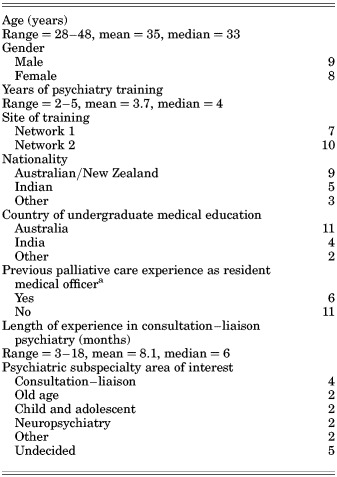
A total of 17 participants were recruited between October of 2012 and March of 2014, 14 of whom were interviewed over the telephone and 3 face to face. Interviews lasted between 30 minutes and an hour. Participants’ demographic details are shown in Table 1.
Demographic characteristics of participants (N = 17)

a Includes experience in medical oncology, radiation, oncology or hematology.
The themes identified in transcripts were categorized as follows: (1) the role and experience of the psychiatrist, (2) the patient interaction, (3) challenges faced within the system and its culture, (4) perspectives on diagnosis and treatment, (5) the personal professional experience of working with this patient group, and (6) the notion that there is an “educational famine” in this area of psychiatry.
Summaries and exemplars within these themes are presented below (numbers in brackets denote the deidentified participant's allocated code number).
The Role and Experience of the Psychiatrist
Overwhelmingly, trainees believed that psychiatrists had a role to play in the diagnosis and treatment of psychiatric conditions in the palliative setting, and they described adjustment disorder, depression, anxiety, delirium, suicidality, and capacity assessment as common triggers for referral. Managing psychiatric symptoms due to the effects of treatment or as a consequence of organic disease were also thought to play an important role. Managing the effects of steroid treatment or whole-brain radiotherapy were cited as examples of this.
Outside the sphere of treating psychiatric disorders, there were varying views on the role of psychiatry. Most trainees felt that providing supportive contact was appropriate even in the absence of a psychiatric diagnosis:
There is a much wider scope for supporting these kinds of patients who have a lot of needs and a lot of unanswered questions, and a lot of anxieties, a lot of concerns. [5]
Others, however, felt that their role was limited in the absence of a mental illness:
I still find it very challenging not being able to offer a great deal … like there's not a lot you can do if they don't have an actual psychiatric illness. [12]
Supporting family members were also considered as playing a key role:
In addition to just the patients, there's again a wider circle of their carers … looking at what kind of stress they are going through … and how their mental needs are being met. [5]
I feel that you can contribute in some way [to] family members and loved ones with the processing of the death and their grief. [7]
Trainees also described their role in enhancing communication between patients and their families, allowing them to discuss fears, guilt, anger, secrets, love, or whatever “elephant in the room”:
Often the patients don't wanna tell their families about their fears. And often the families don't wanna tell the patients about their fears, and sort of normalizing that, sort of, getting it all out in the open, I find actually helps people get a, sort of, greater sense of peace. [1]
To talk about the sensitive topics, with an ease that, you know … makes it very comfortable and almost, like a bit of a liberating experience for people. [7]
Some reported that they had been able to help families to give their loved ones “permission to give up” and that they had been able to work with family members to help them understand their own grief and loss:
I think psychiatry has a very important role … in terms of understanding that the family are going to struggle to express their conflict and complex feelings about it to the dying person. [17]
Trainees had different views regarding the role of psychiatry in managing spiritual distress. Many were comfortable exploring spiritual concerns and felt that this provided some solace to patients:
I have a pretty solid boundary about my own personal beliefs, which allows me to explore anybody's beliefs with comfort, I think. [17]
Others reported being discouraged from discussing spiritual issues by their supervisors:
I never start it, because when I did it once, as a very junior doctor, my boss said, “Look, this is not something that you do here. You have come here to do psychiatry. You're not a pastor.” [9]
Providing support and managing stress among treating staff was considered to be important, as was the education of clinicians around strategies to manage distress within the team:
The other role is support of the team—the oncologists who are incredibly burdened by their, their exposure to death and dying and their workload. [11]
You're working as much with the nurses and the doctors looking after the patient … trying to gently work around transference problems and their own avoidance of the patients. [2]
The Patient Interaction
Many trainees felt that part of their role was to improve the quality of life of patients through therapeutic engagement. They saw themselves as an “advocate,” someone who was “guiding” the patient through a difficult period, and supporting them to find sources of meaning in their life and this experience:
Forming a therapeutic alliance, trying to get them to see that we are on their side, and we are advocating on their behalf to best deal with this very, very difficult situation. [5]
Some reported feeling like this alliance was formed by taking on the role of facilitator or observer, rather than a medicalized, more traditional role. Sitting with the patient, listening to their concerns, allowing the patient to express their emotions, and then possibly be able to normalize these emotions were described as valuable aspects of these encounters:
Helping the patient understand what they're going through and sometimes even validating their emotions and saying that that's fine for them to feel the way they're feeling, but we're here to help if that's becoming quite distressing. [12]
Many felt that they were ill-prepared to talk to dying patients and described the experiences as not only confrontational but also anxiety-provoking. Some wondered whether they had been helpful to these patients, given their lack of experience:
Because if you haven't really dealt with a lot of patients who are that close to dying, you are not really sure what are the right things to say and what are the right resources that you can provide. [12]
Few trainees reported feeling comfortable with the distress of the patients and their families. They acknowledged that the ability to tolerate such distress would likely vary across trainees:
I'm probably more comfortable with distressed people than some of my colleagues … though I still think, in general, people who are drawn to psychiatry tend to be more comfortable with a demonstration of emotion than in other specialties. [1]
Challenges Faced within the System and Its Culture
Trainees identified systemic limitations that they thought were not compatible with the provision of optimal psychiatric care for those with a life-limiting illness. Many felt that consultation–liaison services were set up for crisis management and that there was a prioritization of care of physically well people in crisis over those who were dying. The latter were considered less urgent and their treatment needs less of a priority. These systemic difficulties translated into a nihilistic view of the treatment of the terminally ill by several trainees:
I often have encountered that debate of, you know, it's understandable that people are … are a bit miserable—They're going to die, and then … what is a tablet going to do? [7]
There is, in kind of some circles, I sense that it's futile to see somebody who's dying. [11]
There was a perception that time constraints were a significant factor in not being able to provide the type of care necessary for these patients and that the capacity for these patients to be followed up in a community setting was limited:
There are patients that, if you had enough time, you could provide some sort of supportive role for, but that's not always possible. [12]
Some expressed the view that treating medical teams were uncomfortable with any kind of expressed emotion and that grief and normal human reactions were pathologized, with many consultations coming in the midst of a crisis:
[They are] almost scared of patients showing their emotions, and, you know, referring off to psych because a patient became angry or a patient became sad. And then, us sort of coming in and saying, “Well, no. This is, this is, you know, sort of an appropriate display of human emotion.” [6]
Many also described how treating teams were “not confronting dying” and would feel as though they had failed should their patient die. In one instance, a trainee felt that they had to “maintain the lie” regarding the patient's prognosis (that it was better than it actually was). This led to a split in the treating team, which detrimentally affected the patients’ care:
They don't often think about dying or death, and so I've seen patients, and one in particular stands out in my mind, who haven't even had a discussion with his team that he was dying. The man on a street would have recognized that he was dying, but the team hadn't been able to have that discussion with him. [11]
The unrealistic expectation of consulting teams was also frequently raised, with a perception that teams expect psychiatrists to “fix the problem” and anticipating that there will be an “easy answer” to the patient's predicament.
Perspectives on Diagnosis and Treatment
There was a general feeling among trainees that making a psychiatric diagnosis in the setting of life-limiting illness was often inappropriate and cautioned against “pathologizing death and grief.” With respect to particular conditions, most felt comfortable making a distinction between depression and symptoms of advanced medical illness (e.g., malignancy), focusing on the psychological and cognitive aspects rather than biological symptoms:
… feelings of hopelessness, worthlessness, guilt, looking over their life and feeling lots of remorse and, and feeling like they never achieved anything. Those kinds of cognitive symptoms of depression, more so than the more, I guess, biological symptoms of depression, often help to tease out whether it was a question of depression versus demoralization and difficulty coping with a diagnosis or an illness, or purely physical symptoms of the illness. [11]
The context of distress was also seen to have an important bearing on management, with symptomatic treatments deemed to be more important than trying to ascertain causation or conducting an in-depth analysis of past history.
Those with a largely biological approach to treatment reported being less likely to be concerned about long-term adverse effects of medications in this setting, and some felt they would have a lower threshold for prescribing rapid-acting medications like benzodiazepines:
Sometimes you've got to use more and more aggressive drugs, a more aggressive approach, like using you know, antidepressant plus a lot of quick-acting benzo like Xanax. [13]
There were differing viewpoints on the relative merits of psychological and pharmacological approaches to management. Some felt that there was no role for psychotherapy, but many felt that there was an important role for supportive psychological therapies and that cognitive behavioral therapies or interpersonal therapy could play a role:
When you're dealing with someone with one month to live or two months to live and they're depressed, supportive therapy is going to win every time over medication. [14]
As trainees reflected on the challenges associated with the provision of psychological therapies at the end of life, concerns regarding the investment of time, the potential physical and emotional energy expenditure, and the risk of “opening a can of worms” were all mentioned as potential drawbacks to embarking on such an approach in this setting.
With respect to pharmacotherapy, there was a nihilistic view from some on its efficacy in this setting:
They're unlikely to work for a matter of weeks, so depending on the, you know, the prognosis of the patient, I would be seriously considering whether there was any point in starting an SSRI, for example, if they had a very, very short expected life. [11]
Despite a feeling by many that psychological therapies were the “mainstay” of treatment, there was a divergence in opinion as to whether trainees felt adequately equipped to provide this care:
Most psychiatrists should be able to deal with the dying issues, the grief, the acceptance issues, with what they've been trained with … you know, the skill of doing therapy, the skill of understanding the other person's perspective and guiding them through. [13]
We're skilled to do medications, and therapy comes second, and therapy's no longer a culture. It's now a, an opt-in procedure. [14]
Assessing suicidality was considered to be problematic, with difficulty distinguishing between a desire for hastened death in the context of suffering and suicidality due to a depressive syndrome. Some believed that it was “normal” to have suicidal ideation when one has a terminal illness, and that
wanting to end your life, to not continue suffering, is not an abnormal thing. [16]
The Personal Professional Experience
Working with dying patients was recognized as both challenging and satisfying. Some described patients sharing their life experiences as a “gift,” and others felt that the “reflections of people on their deathbeds [were] precious to be a part of” [7]. Another described feeling negatively affected by the experience:
Too many people who are dying are kind of left by the wayside … and the experience of seeing that kind of leaves you with an awful taste in your mouth regarding how we manage people's dying process. [11]
Formal supervision was widely viewed as valuable, allowing trainees to debrief about confrontational experiences, to explore their feelings, discuss system issues, and encourage self-care. Outside of formal sessions, the support of supervisors was also appreciated:
If a big situation happens where a person's about to die or has just died, the bosses tend to call you up and double-check on you. And they tend to follow you up for a few weeks to make sure that you've debriefed as much as you need to, and that if you need extra help, then they can help set that up for you. [14]
Personality traits in the clinician that were considered to be beneficial when looking after the terminally ill included having a calm and relaxed approach, having a sense of humor, being “a person as well as a doctor,” and not being afraid to express emotion. The importance of taking extra time with these patients was modeled by many supervisors and was considered to be vital in their care:
Giving the impression of unlimited time … the psychiatrist has to be with the patient, you know, giving [the sense that they have] got all the time that they need … not checking their watch. [1]
Establishing cooperative links with referring specialties and supporting them through their own patient challenges, the “liaison” aspects of this role were also seen as rewarding.
An Educational “Famine”
Trainees reported varying levels of experience with this patient group. This largely depended on where their training in consultation–liaison psychiatry was undertaken and which specialty attachments they had had. There were experiences that stood out, both rewarding and confrontational, but most felt that their volume of experience was not adequate to feel confident:
There's a particular, I guess, famine in this area, in terms of our experience and, you know, how to actually manage a lot of this stuff. [6]
Trainees felt that there was a lack of dedicated teaching specific to psychiatric issues at the end of life. Some recalled having had two or three hours of training, while most could not recall any. For the most part, they felt unprepared to talk with patients and their families about death and dying:
We spend, you know, all of our training fitting people into these diagnostic categories, and death and someone dying, and the grief that they have around that, or … isn't really covered very well. [6]
Psychiatrists who know about depression and pain and loss and bereavement should know about how people die. [11]
Most had a general preference for experiential learning and increased mentorship in this area rather than didactic teaching, although many felt that case-based discussion led by palliative care physicians and psychiatrists with psycho-oncology expertise would be useful. Many felt that having a basic understanding of what palliative care was, of what patients might expect, and of the common things that patients may ask would be beneficial. Having the ability to access information or resources within the field was also considered essential:
I guess having a better idea of treatments and common symptoms and how they are treated, because it's all quite confused at the moment, what actually happens, and what does it mean when a person is referred to palliative care, and what they can expect? Does it mean that they're … going to die within the next two weeks or … what actually … , is offered and what they can expect to happen? [12]
Some trainees thought that training in specialized communication skills would be useful. One trainee pointed out that such training should be conducted in a safe, nonconfrontational environment. Otherwise, it has the potential to be counterproductive.
DISCUSSION
Psychiatry trainees have little or no formal training in managing patients at the end of life, resulting in anxiety when faced with these patients. There is a clear perceived need among the trainees for training. The participants in our study agreed that there was a role for psychiatry in the care of patients with life-limiting illness and for the most part felt that this extended beyond the role of treating mental illness. While psychiatrists were most commonly seen as playing a role in the diagnosis and management of psychiatric disorders, the majority also felt that there was a need for psychiatrists to provide a supportive presence for patients and caregivers as they face the impact of life-limiting physical illness, and to support and educate the treating teams in managing the stress of working with this complex patient group.
Dein (Reference Dein2003) describes “the family as the unit of care” and highlights the importance of psychiatry in working with a patient's caregivers. The participants in our study described their role as not only helping caregivers process their grief and ensuring that their emotional needs are being met, but also facilitating communication between patients and caregivers, including managing conflict.
Interestingly, these roles were similar to those identified by palliative care experts as areas where psychiatrists can enhance patient care (Dein, Reference Dein2003; Patterson et al., Reference Patterson, Croom and Teverovsky2014; Ogawa et al., Reference Ogawa, Nouno and Shirai2011). It should be noted, however, that views were not unanimous; in fact, some trainees wondered whether they provided any value to patients in the absence of a psychiatric diagnosis, an issue raised by Fairman and Irwin (Reference Fairman and Irwin2013).
The main challenges raised by trainees in provision of care in this setting related to service constraints, including time and accessibility, nihilistic views of psychiatric care in life-limiting illness, and unrealistic expectations of treating teams. The nihilistic view is well described in the literature, with a belief that psychiatric symptoms are part of the dying process (Dein, Reference Dein2003; Shuster et al., Reference Shuster, Breitbart and Chochinov1999; Fairman & Irwin, Reference Fairman and Irwin2013). Ferrando (Reference Ferrando2000) argues with respect to depression that, while common, it cannot be considered a normative response to terminal illness. According to Shuster et al. (Reference Shuster, Breitbart and Chochinov1999), many patients and physicians do not understand that psychiatric illness at the end of life can respond to treatment. This is despite the fact that good evidence now exists that antidepressants are an effective treatment of depression in the palliative care population (Rayner et al., Reference Rayner, Price and Evans2011; Rhondali et al., Reference Rhondali, Reich and Filbet2012).
In a U.S. survey conducted by Patterson et al. (Reference Patterson, Croom and Teverovsky2014), palliative care physicians felt that psychiatrists focused on medication to the exclusion of therapy or building patient relationships. The participants in our study provided contrasting viewpoints on the role of psychiatry in life-limiting illness, with two approaches to care portrayed. One was a human contact/therapeutic alliance/psychological therapy approach (with merit even in the absence of a diagnosable mental disorder), and the other was a clinical/biological/pharmacological approach with a tendency toward a nihilistic view of psychiatric intervention in this setting. Fairman and Irwin (Reference Fairman and Irwin2013) postulate that the “emergence of palliative care coincided with a movement toward increasingly exclusive reliance on psychopharmacology, and away from psychotherapeutic modes of care.” In our cohort, lack of time or opportunity for follow-up were given as possible factors contributing to a perceived focus on pharmacological approaches, although the main reason participants provided for this was a lack of training in psychotherapeutic approaches. Dignity therapy (Chochinov et al., Reference Chochinov, Kristjanson and Breitbart2011) and meaning-centered psychotherapy (Breitbart et al., Reference Breitbart, Rosenfeld and Pessin2015) are specific approaches that have been developed for patients with life-limiting illness. Kahn (Reference Kahn2011) proposes that palliative psychotherapy “can use elements of psychodynamics, cognitive-behavioral therapy, psychopharmacology, pastoral counseling, coaching, and common sense.” Trainees in our study who advocated for the benefits of psychotherapeutic treatment felt that there was no one-size-fits-all approach and that features of many therapies can be utilized.
Interestingly, the psychiatry trainees in our study on the whole felt comfortable with the tasks of diagnosing psychiatric disorders in the setting of significant physical illness, in spite of the well-documented perception that the overlap of symptoms often poses a challenge (Chochinov & Breitbart, Reference Chochinov and Breitbart2009; Shuster et al., Reference Shuster, Breitbart and Chochinov1999; Fairman & Irwin, Reference Fairman and Irwin2013; Ng et al., Reference Ng, Crawford and Chur-Hansen2014).
Most of the trainees in our study had a sense that the patients appreciated and derived comfort from trainee involvement in caring for them, in keeping with Bloch and Kissane's (Reference Blosh and Kissane2000) observation that this patient group are particularly receptive to such help. Many trainees themselves reported finding their work with palliative patients rewarding and felt that they learned from the interactions.
In Patterson et al.'s (Reference Patterson, Croom and Teverovsky2014) survey of the perceived impediments to psychiatric involvement in palliative care, palliative care physicians felt that “psychiatry training is inadequate in the categories of end-of-life care and issues related to death and dying.” Irwin et al. (Reference Irwin, Montross and Bhat2011) also highlighted insufficient education as a reason for psychiatry residents having a lower level of comfort in dealing with palliative care issues. Likewise, in our study, most trainees stated that they felt uncomfortable talking to patients about dying and agreed their training did not adequately prepare them for dealing with end-of-life issues. In spite of some variance in opinion over the specific role of psychiatry in palliative care, there was a strong sense among the trainees in our study that psychiatrists should know about, and be comfortable dealing with, these issues. While not quantitatively measured in our study, this was in keeping with the results of Irwin et al.'s (Reference Irwin, Montross and Bhat2011) research, where 97% of residents surveyed either “agreed” or “strongly agreed” that psychiatrists should be trained in the psychiatric aspects of palliative care. Nearly all residents in that study felt that there was a need for a formalized curriculum to learn about palliative care, whereas in our study, while not formally asked of our participants, there was a sense that greater clinical experience would be valued over teaching around a set curriculum. Interestingly, the trainees in our study believed that they could learn more from palliative care physicians than from psychiatrists, which is consistent with the findings of Tait and Hodges (Reference Tait and Hodges2009).
LIMITATIONS AND FUTURE RESEARCH
Our research was limited by drawing on the experience of trainees from only two training networks. Furthermore, within these sites, self-selection of participants was a potential source of bias. Trainees who were less confident about managing patients at the end of life may have been less inclined to take part.
By virtue of the qualitative methods chosen, it is not possible to make assumptions about the generalizability of our data. The qualitative approach does, however, provide a more in-depth and rich description of the educational experiences in this group than would a survey approach. The interviews were conducted by two different clinician-researchers, which may have potentially influenced the data collected, although the use of a semistructured interview technique aimed at maintaining consistent questioning. The recruitment for and scheduling of interviews took place over a relatively long period (between October 2012 and March 2014) due to the limited availability of clinician-researchers to conduct the interviews and slower than anticipated recruitment. Most interviews were conducted by telephone, which may have impacted rapport and in-depth discussion, though some participants may have felt more comfortable about disclosing their personal experiences in this fashion.
Personal experiences relating to loss and death outside of professional roles were not specifically explored in our study, but they may be important in shaping clinicians' views and responses to the care of a dying patient. While these issues did not figure prominently among participants' comments, this would be a fruitful area for future research to examine the impact of such experiences upon psychiatry trainees with regard to their professional roles.
Future research may include evaluation of an education intervention among psychiatry trainees targeting one or multiple aspects of these findings—for example, a workshop on communication skills training with patients who have a life-limiting illness or an online teaching module about issues faced by patients with a life-limiting illness and the evidence around therapies in this setting. Provision of opportunities for psychiatry trainees to spend time in a palliative care rotation has already been suggested to enhance knowledge in this area (Balon et al., Reference Balon, Motlova and Beresin2016; Irwin et al., Reference Irwin, Montross and Bhat2011; Winer, Reference Winer2013). Developing formal links between training bodies in these disciplines may enable trainees to undertake accredited rotations in palliative care rather than being an “add-on” to training.
While leadership in training may come from psychiatrists with an interest or formal training in this area, as well as palliative care physicians, these skills should be regarded as core competencies for all psychiatry trainees rather than as a niche area.
CONCLUSION
The findings of our study suggest that, on the whole, psychiatry trainees feel inadequately prepared to provide psychiatric care for patients with life-limiting physical illnesses. While participants were relatively comfortable with the task of diagnosis of mental disorders, they were less confident about psychiatric management of patients with life-limiting illnesses and had contrasting views about the role of psychiatry in providing psychotherapeutic interventions within this setting. The study highlights a need for enhanced training of psychiatry trainees in the care of patients at the end of life and provides a basis for the development of a targeted educational program.
CONFLICTS OF INTEREST
The authors state that they have no competing interests to declare.
AUTHORS' CONTRIBUTIONS
JC and BK came up with the initial project concept. JC, BK, and BF designed the project. JC and BF secured project funding. BF and HP conducted all the interviews. BF analyzed and interpreted the data and attended regular analysis meetings with JC, ML, HP, and BK. BF made a first draft of the manuscript. All authors contributed to revising and making contributions to the manuscript. They also read and approved the final manuscript.
ACKNOWLEDGMENTS
We thank all the participants for their time and for their contributions to the study. Financial support was received from the Friends of Greenwich.
APPENDIX
Interview Questions
-
Overall, what experience have you had to date caring for patients with advanced life-limiting physical illness? As a resident, or while working as a psychiatry trainee?
-
What do you think is the role of psychiatry in caring for patients with a life-limiting physical illness in general?
-
What do you think are the main concerns for patients with a life-limiting illness?
-
What do you think are the main concerns for their families?
-
Could you describe your experience (as a psychiatry trainee) of caring for a patient or patients a with life-limiting illness or who was dying?. What was most difficult? What was most rewarding?
-
In regards to the difficulties, what do you think would have helped overcome these for you? Or might help other trainees in similar situations?
-
From your experience, how would you compare the assessment and management of distress or psychiatric illnesses in the context of a life-limiting illness compared with patients who are either medically well or who have an acute reversible medical condition. What, if any, are the differences?
-
■ Specific prompts: assessment and management of new onset of anxiety, depression, psychotic episodes, delirium.
-
■ Management of longstanding psychiatric illness.
-
-
How would you rate your level of confidence in areas such as:
-
■ Talking with a patient about dying? With families?
-
■ Discussing spiritual concerns of a patient or family members?
-
■ Assessing depression in a patient with a life-limiting physical illness?
-
■ Assessing suicide risk in such a patient? Responding to requests for assisted suicide?
-
■ Working with other clinicians involved in palliative care?
-
■ Talking with patients and/or families about grief?
-
■ Assessing complicated grief and treating bereavement-related problems?
-
■ Managing your own feelings when a patient is dying?
-
-
Sometimes people refer to concerns about loss of “dignity” for people who are dying. What are your views on this from your experience with patients? What factors might influence their sense of “dignity”? What do you think is meant by this term?
-
What have you observed in your psychiatric colleagues or experienced yourself in managing distress or psychiatric issues in patients with a life-limiting illness (vs. patients who are either medically well or who have an acute reversible medical condition)?
-
■ Specific prompts—for example, reactions to this work, views about working with dying patients, ways of coping.
-
-
I wonder if you might reflect on some of your supervisors and whether you feel there are any particular things about them or the way that they cope with looking after patients in this setting or things that they have taught you that have been valuable.
-
What system barriers are there?
-
What education have you had to date on palliative care or management of distress in patients with a life-limiting illness?
-
What education would you think would be useful for psychiatric trainees regarding the care of patients with a life-limiting physical illness?
-
What education would be useful in terms of communication with and/or counseling dying patients?
-
Demographics:
-
■ Age
-
■ Gender
-
■ Nationality
-
■ Country of primary medical degree
-
■ Year of psychiatry training
-
■ Experience in palliative care or oncology or general medicine/GP prior to commencing psychiatry training
-
■ Duration of consultation–liaison psychiatry training
-
■ Are you currently enrolled in advanced training? If so, what subspecialty training are you most interested in?
-