1. INTRODUCTION
Dowty (Reference Dowty1975: 585) asks: ‘Is a uniform semantic analysis of “the meaning” of the progressive in contemporary English possible?’. Indeed, the English progressive, expressed by the auxiliary be+-ing participle, is used in a large variety of contexts. It thus occupies a unique position from a cross-linguistic perspective (see, for instance, Comrie Reference Comrie1976: 32) and, consequently, its semantics has attracted much scholarly attention in the past few decades. However, as we will show in Section 2, many of these studies, apart from a few noteworthy exceptions (such as Adamczewski Reference Adamczewski1978 and Williams Reference Williams2002), refrain from establishing one basic meaning for the progressive, instead invoking various, seemingly unrelated, temporal and aspectual usage types (or senses) for this construction (expressing, e.g. temporariness, duration, etc.).
While we acknowledge that the English progressive is remarkably polysemous in its usage, it is our conviction that it nevertheless allows for a unified semantic analysis. In this paper, we will concentrate on the semantics of the English present progressive and contrast it with its direct counterpart in the present-tense paradigm, the simple present. We argue more specifically that, at the most schematic level of definition, the present progressive indicates epistemic contingency or non-necessity in the speaker's conception of current reality, as opposed to the simple present, which is analyzed as indicating structural necessity. We thus propose an essentially modal semantic core for the English present progressive, thereby drawing on previous work on the English present by Goldsmith & Woisetschlaeger Reference Goldsmith and Woisetschlaeger1982, Langacker Reference Langacker2001 and Brisard Reference Brisard and Brisard2002a and departing from truth-conditional semantic accounts of the modal nature of the English progressive, as presented in e.g. Dowty Reference Dowty1979 and Portner Reference Portner1998. In our view, this schematic, epistemic meaning is immanent in the various, more specific categories of use of the progressive that may be distinguished. In fact, a central claim in our analysis is that these different usage types of the English progressive can be systematically related to one another as well as to the schematic meaning of epistemic contingency via a number of independently motivated cognitive principles. We will provide an overview of the relevant usage types, based on the Santa Barbara Corpus of Spoken American English (Du Bois et al. Reference Du Bois, Chafe, Meyer and Thompson2000, in Section 5 below), leading to the establishment of a semantic network for the English present-progressive construction.
The theoretical assumptions and conceptual tools that have guided our analysis are taken from the framework of Cognitive Grammar (Langacker Reference Langacker1987, Reference Langacker1991) – the basic tenets of which will be introduced in Section 3. In Section 4, we will elaborate on the schematic meaning of the English present progressive, as opposed to that of the simple present, by comparing the epistemic status that these constructions assign to various types of situation in the speaker's conception of current reality. In the fifth and largest section of this paper, we present our corpus observations: this section contains a description of the various usage types of the present progressive in contemporary English, the conceptual relationships between them and their connection to the abstract meaning of epistemic contingency, as visualized in a semantic network. In Section 6, finally, we offer our concluding remarks. But to begin with, we will provide a brief summary of previous studies on the English progressive that have influenced the ongoing debate on its semantics.
2. PREVIOUS DESCRIPTIONS AND ANALYSES OF THE ENGLISH PROGRESSIVE
Although the body of research on the semantics of the progressive – sometimes also called the continuous or durative form – in contemporary English is vast, the majority of these studies seems to suffer from two general weaknesses: they often focus on purely temporal and aspectual notions and, moreover, typically fail to establish one basic meaning of the be+-ing construction.Footnote 2
A considerable number of aspecto-temporal usage types have been associated with the English progressive. An idea that goes back to at least Jespersen (Reference Jespersen1931: 178–180) is that the progressive creates a temporal frame encompassing a given reference point (see also Leech Reference Leech2004: 21–23). The implied point of view of the speaker/conceptualizer is located within the situation, i.e., she conceives of the situation as ongoing at the moment of speaking or at another non-present (but contextually given) reference point. This internal perspective – discussed in, among others, Declerck, Reed & Cappelle (Reference Declerck, Reed and Cappelle2006: 32–34) – is a defining characteristic of imperfective constructions (Comrie Reference Comrie1976: 24) and, consequently, the English progressive is classified accordingly in cross-linguistic descriptions of aspect. Declerck et al. (Reference Declerck, Reed and Cappelle2006: 33) further note that ‘a progressive representation implies that the speaker disregards the beginning and end of the situation’; in other words, the situation is construed as not necessarily complete. While Declerck et al. consider this use of the progressive as an implication of its imperfectivity, the notion of incompletion is advocated as one of its basic meanings by, for instance, Leech (Reference Leech2004; see also Palmer Reference Palmer1989: 55–56). Finally, two other notions that frequently appear in descriptions of the be+-ing form are temporariness (e.g. Mindt Reference Mindt2000) and duration (e.g. Palmer Reference Palmer1989), typically brought together under the semantic category of limited duration (Quirk et al. Reference Quirk, Greenbaum, Leech and Svartvik1985, Leech Reference Leech2004; see Scheffer (Reference Scheffer1975: 21–23) for an overview of similar proposals in earlier works, such as Joos Reference Joos1964).
More often than not, authors choose to abstain from opting for one of these aspecto-temporal usage types as the basic, schematic meaning of the English progressive, immanent in all of its uses (see Scheffer Reference Scheffer1975, Quirk et al. Reference Quirk, Greenbaum, Leech and Svartvik1985, Palmer Reference Palmer1989, Mindt Reference Mindt2000, Leech Reference Leech2004). Or, as Comrie (Reference Comrie1976: 38) puts it:
There are several idiosyncrasies in the use of the English Progressive that seem, at least in the present state of research, to militate against a general meaning being able to account for every single use of this form.
Ljung (Reference Ljung1980) devotes an in-depth study to these idiosyncratic uses, identifying a number of semantic principles underlying their occurrence (e.g. whether or not the situation denoted is immediately observable), but he does not unify them. When a basic meaning is advocated, it does not always seem to account for the linguistic data. How, for instance, does one reconcile Jespersen's time-frame analysis with the commonly attested use of the progressive construction to refer to future situations (as in I'm leaving tomorrow)?Footnote 3 This use is often treated as a subsidiary or secondary usage type, bearing no explicit link with other meanings of the be+-ing form, such as temporariness or duration; put differently, it is regarded as a case of homonymy. Other uses that apparently defy a monosemous account of the English progressive are those involving emotional connotations such as irritation, illustrated in (1) below, or tentativeness, as in (2) (examples taken from Mindt Reference Mindt2000: 249), or a re-identification/clarification of a previously mentioned situation, as in (3):Footnote 4
(1) What are you blaming me for now?
(2) I was wondering if it could, perhaps, be stolen.
(3) [In a discussion between a professor and his students about the discourse of civil rights activist Jesse Jackson]
… Well he says minorities
… He's smart.
He talks about minorities.
But he's really talking about African Americans. (SBC012)
Note, moreover, that in these examples, the use of the progressive does not seem to be primarily temporally or aspectually motivated. The same sentences (featuring the same contextual cues) in the simple present tense in fact appear grammatical, yet they sound anomalous. As we will see, examples such as (1)–(3), featuring the aforementioned emotional connotations, readily take a progressive construal, because they directly instantiate the basic modal meaning of the construction in English.Footnote 5
One way of covering these numerous and varied uses of the progressive while at the same time maintaining a monosemous analysis is by separating semantics from pragmatics and relegating interpretations such as those illustrated in (1)–(3) to the domain of pragmatics. This is done by Tharaud (Reference Tharaud, Lauze, Barceló and Patard2008), who proposes ‘progressiveness’ as the core meaning of the be+-ing form. Uses indicating attenuation, irritation or intensification are regarded as implicit (i.e., non-encoded) pragmatic inferences – drawn on the basis of contextual triggers in interplay with the principle of relevance (Sperber & Wilson Reference Sperber and Wilson1986) – and they are thus assumed not to have any relation with the semantics of the progressive as such. However, Tharaud's account fails to explain why we attest such a strong association of the progressive form with the aforementioned connotations (see Section 5 below), while this association is lacking for the simple present. Moreover, a strict division between semantics and pragmatics is in conflict with a usage-based approach to language, as adopted in the analysis presented in this paper (see Section 3.1 below).
Tharaud's (Reference Tharaud, Lauze, Barceló and Patard2008) analysis constitutes a critique of Adamczewski (Reference Adamczewski1978) and his associates. Unlike Tharaud, Adamczewski, whose work is rooted in the French enunciativist tradition (Benveniste Reference Benveniste1966; Culioli Reference Culioli1990, Reference Culioli1999), does propose to unify all the uses of the progressive in one analysis without invoking distinct levels of interpretation. Recognizing the deficiencies of purely aspecto-temporal accounts of the English progressive, he searches for the basic criterion for using this grammatical construction outside the realm of semantics, arguing that the be+-ing form functions as a kind of meta-operator at the discourse level, indicating that a situation is known to the speaker and hearer (i.e., the situation constitutes the theme of the utterance). However, his analysis of the progressive as a meta-operator which conveys given information does not hold for all its uses – as we will see, for instance, the progressive is frequently employed to introduce new situations that are surprising to the speaker – and it does not provide a distinctive feature that sets the present progressive apart from the simple present (which can also be used to refer to known information, as noted by, for instance, Furmaniak Reference Furmaniak2005). Moreover, Adamczewski's non-semantic analysis of a grammatical form is both undesirable and unnecessary given a cognitivist approach to language and semantics (see Section 3 below), as we will try to show in this paper. It should nevertheless be acknowledged that Adamczewski's work is seminal, because it shows that aspectual and temporal notions are insufficient to account for the attested polysemy.
The latter point is also recognized by Williams (Reference Williams2002), who proposes ‘susceptibility to change’ as the core meaning of the English progressive, thus advocating an integrated semantic analysis of be+-ing in non-aspecto-temporal terms. The notion of ‘susceptibility to change’ corresponds in many ways to the basic meaning of contingency we regard as central to the English progressive, yet Williams does not always make it clear how this meaning is concretely instantiated in the various uses of the progressive, or, as Kaltenböck (Reference Kaltenböck2003: 346) puts it ‘[w]hat is lacking is a clear separation of primary underlying meaning and derived (secondary) meanings … and a discussion of the type of relationships between them’.
In this paper, we attempt to fill this gap by describing the basic underlying meaning of the present progressive as essentially modal, while at the same time explicitly discussing the various uses of the construction, which will systematically be linked, via basic cognitive principles, to its schematic meaning, immanent in each of them (see the visualization in the form of a semantic network in Section 5.3 below). As such, it is not new to regard the English progressive as an essentially modal construction, which brings us to a body of literature which we have not discussed yet, i.e., formal studies of the semantics of the progressive. In Dowty's (Reference Dowty1977, Reference Dowty1979) interval-semantic approach, for instance, the progressive is analyzed as a modal operator, yet one of ‘deontic necessity’ rather than ‘epistemic contingency’. His account is geared to find a uniform semantic analysis for the English progressive in terms of truth conditions, i.e., to establish a set of possible worlds in which a proposition containing a progressive can be uttered truthfully. Problematic in this respect is the use of the progressive with accomplishment verb phrases (which involve an inherent endpoint), since, in such cases, the endpoint of the denoted event will not necessarily be reached. For instance, Max was running to the station does not necessarily entail that Max ran to the station, i.e., that he successfully completed the event (see Lascarides Reference Lascarides1988: 1).Footnote 6 This observation, called the ‘imperfective paradox’, has incited Dowty (Reference Dowty1979) to introduce into his analysis a deontic modal component in the form of inertia worlds, i.e., the set of worlds in which an event referred to by means of a progressive predicate can continue uninterrupted.
Dowty's (Reference Dowty1979) proposal has given rise to a large variety of formal semantic studies on the English progressive, such as Lascarides (Reference Lascarides1988), Asher (Reference Asher1992), Landman (Reference Landman1992), and Portner (Reference Portner1998) (for a criticism of the modal approach, see e.g. Bach Reference Bach1986 and other so-called event-based analyses). However, as will become clear later, all of these studies make theoretical assumptions different from ours and aim to solve problems of analysis different from those that we address. Although their main goal is to arrive at a monosemous account for the progressive, their most important obstacle in this respect is not so much the uses illustrated in (1)–(3) (which are, to our knowledge, mostly ignored in formal semantic approaches), but rather the different actional characteristics of verb phrases in the progressive (i.e., whether they are telic or not) and the different implications these characteristics have for a truth-conditional semantic account in terms of possible worlds. In our approach, we study the specific contexts in which the (present) progressive is actually used by speakers of English (irrespective of whether the denoted event is eventually completed) and try to explain why, in these contexts, the progressive is preferred to the simple present. This more subjectivist, usage-based approach (see Section 3.1 below) yields a modal account that is epistemic rather than deontic: it is concerned with the epistemological status of a situation that is given a present-progressive construal (i.e., the degree to which the situation is regarded as a structural part of the speaker's conception of reality). As will be shown in Section 4, our analysis theoretically and empirically elaborates on previous research on the epistemic meaning (component) of the progressive in English by Calver (Reference Calver1946), Goldsmith & Woisetschlaeger (Reference Goldsmith and Woisetschlaeger1982), Langacker (Reference Langacker2001), Brisard (Reference Brisard and Brisard2002a), and in early work by Dowty (Reference Dowty1975). Yet, we will not entirely discard the formal semantic analyses either: in spite of the important theoretical differences, these analyses will turn out to run parallel with ours in various ways as well (see Section 4).
3. CONCEPTUAL SEMANTICS AND CLAUSAL GROUNDING IN COGNITIVE GRAMMAR
In Cognitive Grammar (CG), all linguistic structures, patterns and restrictions are considered meaningful: phonological structures symbolize semantic structures. In fact, CG posits only three basic kinds of structure: phonological and semantic structures, and symbolic links between them (Langacker Reference Langacker1987: 328–368). This symbolic characterization holds for all linguistic structures – lexical or grammatical (Langacker Reference Langacker1987: 76–96). Accordingly, a grammatical construction such as the present progressive in English can be fully characterized in terms of a particular semantic structure that is conventionally associated with a specific phonological structure (be+-ing). In the following section, we will briefly outline the basic tenets of the conceptual approach to semantics that lies at the heart of this symbolic approach, restricting ourselves to those aspects that are most relevant for the present analysis. Then, Section 3.2 discusses tense and clausal grounding in CG.
3.1 Conceptual semantics
According to Langacker (Reference Langacker1987: 12), language forms ‘an integral part of human cognition’, which entails that there is no principled, rigid distinction between general cognitive processes and linguistic ability. However, only those conceptualizations that are conventionally symbolized by linguistic expressions form the substance of language. That is, language is a structured inventory of units conventionalized via well-established cognitive routines. This does not imply that units are to be sharply separated from structures that have not gained unit status (yet): structures may vary on a continuum ranging from very entrenched to very novel, depending on how frequently they are employed. Thus, CG advocates a usage-based approach to language (see Langacker Reference Langacker1987: 46). In the same spirit, Langacker denies the relevance of a sharp dichotomy between semantics (‘linguistic’ knowledge) and pragmatics (‘extra-linguistic’ knowledge) (Langacker Reference Langacker1987: 154–158). A linguistic expression is said to invoke ‘an open-ended array of conceptions pertaining in some fashion to the entity it designates’ (Langacker Reference Langacker and Brisard2002: 3), and so its semantic pole must also consist of various facets of meaning that are not all specifically linguistic. Which of these conceptions is given prominence in an actual linguistic utterance (a usage event) is crucially determined by co(n)textual cues.
Another central assumption in CG is that a symbolic unit, like the present progressive in English, is typically polysemous, as ‘its meaning represents a complex category’ (Langacker Reference Langacker, Kardela and Persson1995: 91; see also Langacker Reference Langacker1987: 76–78). Each linguistic category can be described in terms of a semantic network or map, in which the nodes are structural variants, i.e., senses or usage types. Such usage types may be conceived of as instantiations of a semantic core, arising in interaction with elements in the context and linked to one another by cognitively motivated categorizing relationships. Langacker distinguishes two basic kinds of categorizing relationship: elaboration and extension. Out of a schematic categorizing structure, a more specific structural variant can be derived by means of elaboration or adding more detail. The meaning of all linguistic entities can be characterized at various levels of precision, whereby more specific, elaborate structures fully instantiate an underlying schematic meaning, which is in turn said to sanction the more elaborated usage types (Langacker Reference Langacker1987: 66–68). If, on the other hand, there is some conflict between the structures of two related nodes, then the relation is one of extension (whereby one structure only partially sanctions the other one). In cases of extension, there is still enough perceived similarity between the two nodes. When, however, the elaborative distance between a node and a particular usage event becomes too large, then there is not even a relation of partial schematicity and the expression is regarded as ill-formed. Finally, in semantic networks built up of various such semantic nodes and categorizing relationships between them, some senses are typically more entrenched (i.e., more frequently attested) than others – the most entrenched are regarded as the prototypical usage types of an expression.
Specificity and, at the other end of the scale, schematicity are dimensions of construal, i.e., the ability of a speaker to conceive of and portray an entity in a variety of ways. Besides specificity, those aspects of construal that concern us most here are scope and profiling. The extent to which conceptual content is invoked by an expression is referred to as the scope of this expression. The overall conceptual content covered by the expression is called its maximal scope (MS). The immediate scope (IS), on the other hand, is that portion of the maximal scope that is immediately relevant for a particular linguistic purpose. It defines the ‘onstage’ region of a predication (i.e., its profile or conceptual designatum) that is given the highest degree of salience (Langacker Reference Langacker1987: 118). In the domain of time, scope defines both which portions of a situation are at issue and how a situation is to be related to others (notably, the situation of speech or ground). Profiling is closely related to scope (Langacker Reference Langacker1987: 183–189). It refers to the relative prominence that an entity has within the conceptualization that functions as its base (the figure that is set off against a ground). Any entity that represents the focus of attention (i.e., that is maximally prominent) within an expression's maximal scope constitutes the profile of this expression; this is the designated entity.
3.2 Tense and clausal grounding in Cognitive Grammar
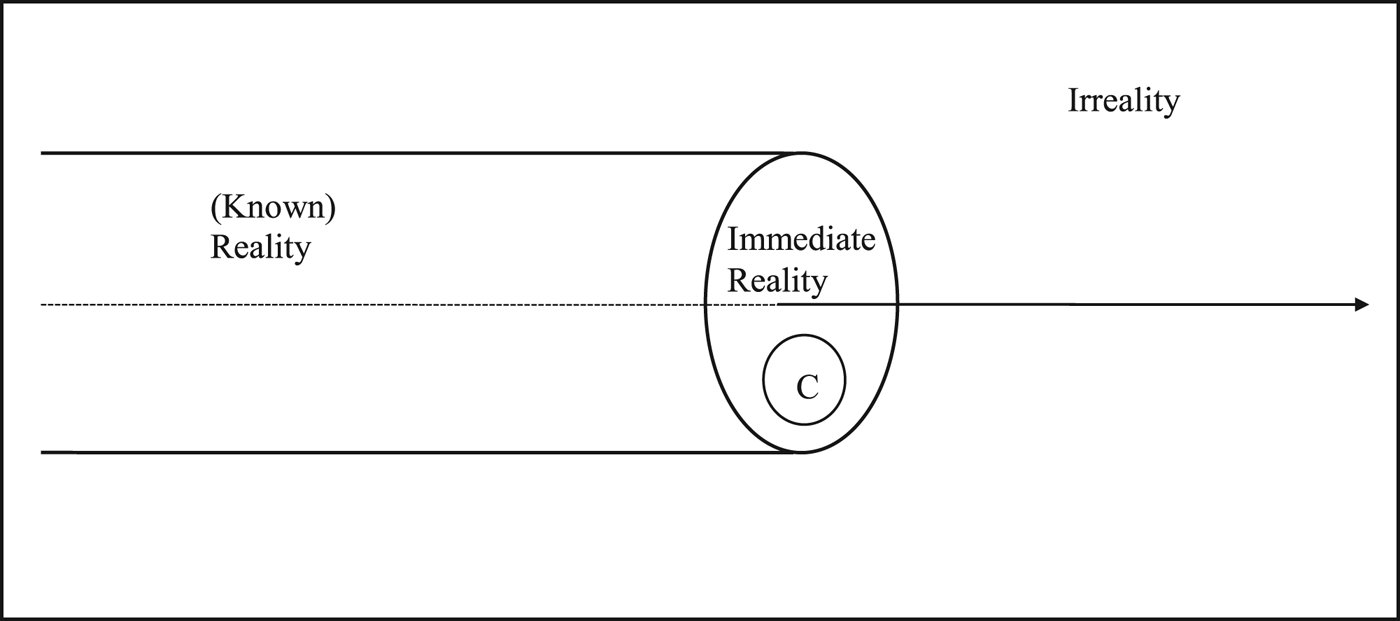
In this section, we will establish what happens with simple verb stems, such as jump and believe, when they are used in finite clauses like He jumps or She believed. Succinctly stated, a verb stem solely specifies a type of situation, whereas a full finite form designates an epistemically grounded instance of that type (Langacker Reference Langacker1987: 126–128; Reference Langacker1991: Chapter 6; Reference Langacker and Brisard2002).Footnote 7 The ground is generally defined in CG as comprising ‘the speech event, its participants, and its setting’ (Langacker Reference Langacker1987: 126). A finite clause incorporates some element that specifies the relation between the ground and the situation it profiles (i.e., the grounding relationship). For English finite clauses, these elements (i.e., grounding predications) are tense markers and modal auxiliaries, and the relation specified is always one involving an epistemic judgment as to the reality status of the situation referred to. In order to characterize these grounding predications at the most abstract level, Langacker (Reference Langacker1991: 240–246) refers to certain idealized cognitive models, involving ‘fundamental notions of the world and our place within it’ (Langacker Reference Langacker1991: 242). The first and most schematic model is the basic epistemic model. Starting from the observation that a conceptualizer (C) may, at any given point, accept certain situations as being real and others as not, Langacker (Reference Langacker1991: 242) distinguishes between (known) reality and irreality (i.e., everything the conceptualizer does not know or accept as real at that time). Reality is regarded as an evolving region, limited in time at the point of immediate reality (IR): the conceptualizer's reality in the latest stage of its evolution. This basic epistemic model is sketched in Figure 1, in which immediate reality is contained by the face of the cylinder that depicts evolving reality.
The basic epistemic model (Langacker Reference Langacker1991: 242).

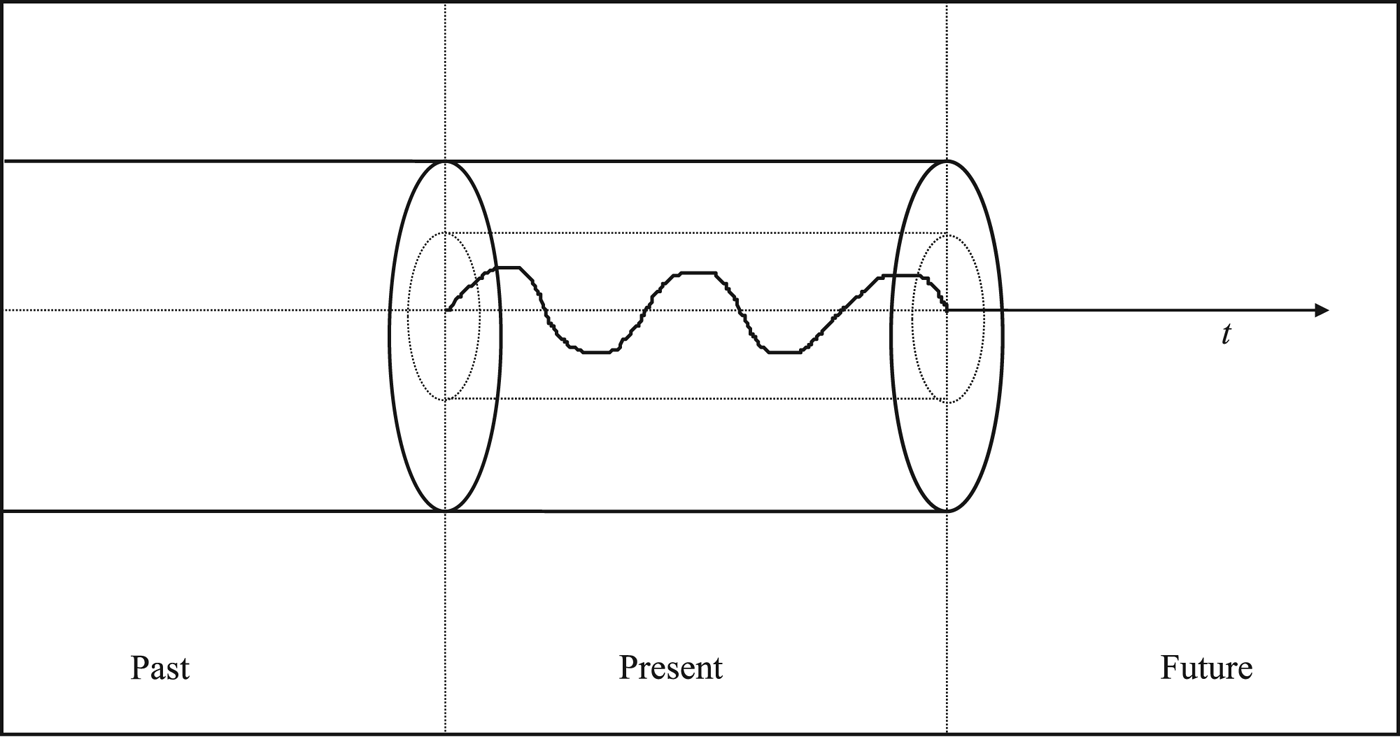
One elaboration of the basic epistemic model is the time-line model. This model invokes two additional notions: that of the ground, i.e., the locus of the speech event, which constitutes the immediate reality for the speech participants at the time of speaking, and that of time, i.e., the axis along which reality evolves, segmenting it into past, present and future (Langacker Reference Langacker1991: 243). Figure 2 illustrates this time-line model (the squiggly line indicates the speech event, which has a certain time depth, i.e., the time it takes to produce an utterance).
The time-line model (Langacker Reference Langacker1991: 244).
Tense predications can now be characterized schematically with reference to the basic epistemic model, but they can also be characterized at a more specific level by referring to the time-line model, which accounts directly for the more prototypical temporal values attached to tenses. The canonical temporal distinction between present and past (futurity is regarded as a modal notion, at least for the English verb paradigm; see Langacker Reference Langacker1991: 243) can be reinterpreted at a schematic level as ‘a proximal/distal contrast in the epistemic sphere’ (Langacker Reference Langacker1991: 245). Schematically, in other words, a present tense indicates that the designated situation is construed as immediate to the speaker, whereas the past tense conveys a sense of epistemic non-immediacy. At a more specific, temporal level, the past tense indicates ‘the occurrence of a full instantiation of the profiled situation prior to the time of speaking’ (Langacker Reference Langacker1991: 250), while the present tense is analyzed as indicating full and exact coincidence with the speech event (the ground). This means, by definition, that the present has the duration of the time of speaking, i.e., it is not punctual (as assumed in, for instance, Jespersen Reference Jespersen1931, Dowty Reference Dowty1979 and Comrie Reference Comrie1985). This modal and temporal characterization of the present tense, together with the guiding assumptions central to a conceptualist view on linguistic meaning, provide us with the basic tools for describing the semantics of the present progressive.
4. A SCHEMATIC CHARACTERIZATION OF THE SIMPLE PRESENT AND THE PRESENT PROGRESSIVE IN ENGLISH
In Section 3.2 above, the English present tense was called a clausal grounding predication: at an epistemic level, it locates a situation in the realm of immediate reality, while at a more specific, temporal level, it indicates full and exact coincidence with the time of speaking. This characterization is relevant for both the simple and the progressive variant of the present tense. However, as we will argue in the following sections, these aspectual variants confer a subtly different modal status on the situation they profile. In Section 4.2, we will offer an epistemic characterization of the present progressive, as opposed to that of the simple present, in line with Brisard Reference Brisard and Brisard2002a and Langacker Reference Langacker, Patard and Brisard2011.Footnote 8 A temporal account – which is complementary to this epistemic characterization (see Langacker Reference Langacker2001, Reference Langacker, Patard and Brisard2011) – will be proposed in Section 4.3. But first we need to give a brief outline of the actional features of English verbs (i.e., their lexical aspect), as these interact in important ways with the grammatical aspect of the two present-tense forms.
4.1 The English verb classes
On the basis of their grammatical behavior – their (in)compatibility with the progressive – Langacker (Reference Langacker1987: 254–267) divides English verbs into two actional classes: perfectives (e.g. run, open) and imperfectives (e.g. need, know). While we essentially agree with the semantic characterization Langacker proposes for these two classes, we will adopt in this study the more common terms ‘dynamic’ and ‘stative’, instead of ‘perfective’ and ‘imperfective’, since the latter are generally reserved for categories of grammatical, rather than lexical, aspect.
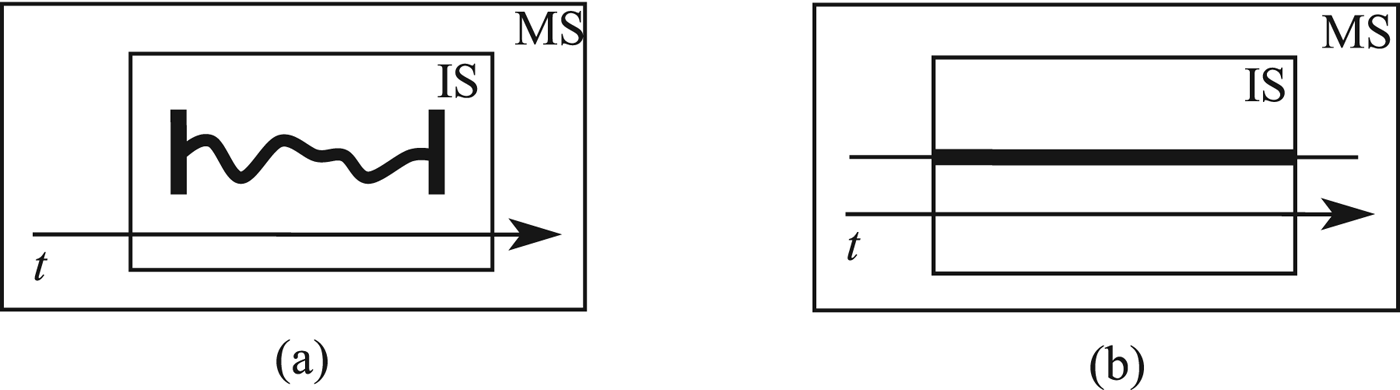
Dynamic verbs profile situations that are typically internally heterogeneous (indicating a change of state) and bounded within the immediate temporal scope (IS), while stative verbs involve situations that are homogeneous (not involving change) and unbounded within the immediate temporal scope. A stative situation is thus constant through time: it persists beyond the immediate scope (i.e., it continues in the expression's maximal scope (MS)) and remains qualitatively identical at every point in time at which it is manifested. However, only that part of this unbounded and homogeneous situation that falls within the immediate scope constitutes its profile (since an expression's profile is necessarily confined). The profile of states can thus be regarded as a representative sample of a larger continuous situation. The opposition between dynamic and stative verbs is diagrammatically rendered in Figures 3a and 3b, where the profile is indicated in bold.Footnote 9
(a) Dynamic verb (not grounded); (b) stative verb (not grounded).
According to Langacker (Reference Langacker, Patard and Brisard2011), perfective (or dynamic) verbs subsume three of the four classic Vendlerian actionality classes, namely activity, accomplishment and achievement verbs (Vendler Reference Vendler1957). Naturally, Langacker's imperfective verbs correspond to Vendler's stative predicates. However, a closer look reveals that there are some notional differences between Langacker's and Vendler's accounts. In the Vendlerian tradition, activities such as running or sleeping, which do not involve an inherent endpoint, are not regarded as bounded (a term that is, moreover, usually confined to descriptions of grammatical aspect). Langacker (Reference Langacker1987: 261–262), on the other hand, assumes boundaries, i.e., points of inception and termination, for all non-stative situations (i.e., events always have ‘some limit’). Yet, the most crucial distinction between stative and dynamic verbs resides in the epistemological characteristics of the situations they denote. For instance, in order to distinguish between situations such as sleeping, being comatose and nodding off for a second (Michaelis Reference Michaelis2004: 11), one needs at least to have access to the events in their entirety. For states, there is no such requirement. In other words, the essential distinction between stative and dynamic situations resides in the contractibility of the former: any random segment of a state constitutes a valid instance of this state as a whole. Dynamic situations, bounded and typically heterogeneous, cannot be divided into identical sub-events that are representative of the event as a whole, and they are therefore non-contractible. Note that an event such as sleeping (as well as wearing a shirt or holding a broom, for instance) has a homogeneous profile, which illustrates that heterogeneity is not an indispensable feature of events (the heterogeneity indicated in Figure 3a thus represents the prototype) (Langacker Reference Langacker1987: 261–262; Michaelis Reference Michaelis2004: 9–12). Still, despite their state-like properties, such homogeneous activities are referred to by verbs that qualify as dynamic in English, as is reflected in their incompatibility with the non-progressive form to refer to the present. This is again a consequence of the fact that it requires more than just one random portion of an event, homogeneous or not, to identify it.
The grammatical requirement for dynamic verbs in English to take the present-progressive form (if they are to refer to an instance of an event at issue that is ongoing at the time of speaking) is taken as a symptom of their dynamicity. That is why, in English, this can be used as a heuristic to identify dynamic verbs in the first place. Obviously, there are limits to this test: it cannot simply be transferred to other languages that have a non-obligatorily and less frequently used present progressive, and it does not always yield a clear cut-off line for certain verbs with varied uses (compare Belgium lies between the Netherlands and France and The man is lying on the beach – see also Section 4.3 below). Moreover, like any convention, this rule of English grammar can also be exploited: in those cases where a prototypically stative verb is used with the progressive – a phenomenon commonly known as coercion (de Swart Reference Swart1998, Michaelis Reference Michaelis2004) – this verb is construed as bounded (and heterogeneous) within that particular expression's scope, i.e., it is categorized as dynamic, exhibiting all the actional features typical of this class (in Section 5 below, we will encounter and analyze some examples of coercion).
4.2 The simple present and the present progressive: A modal characterization
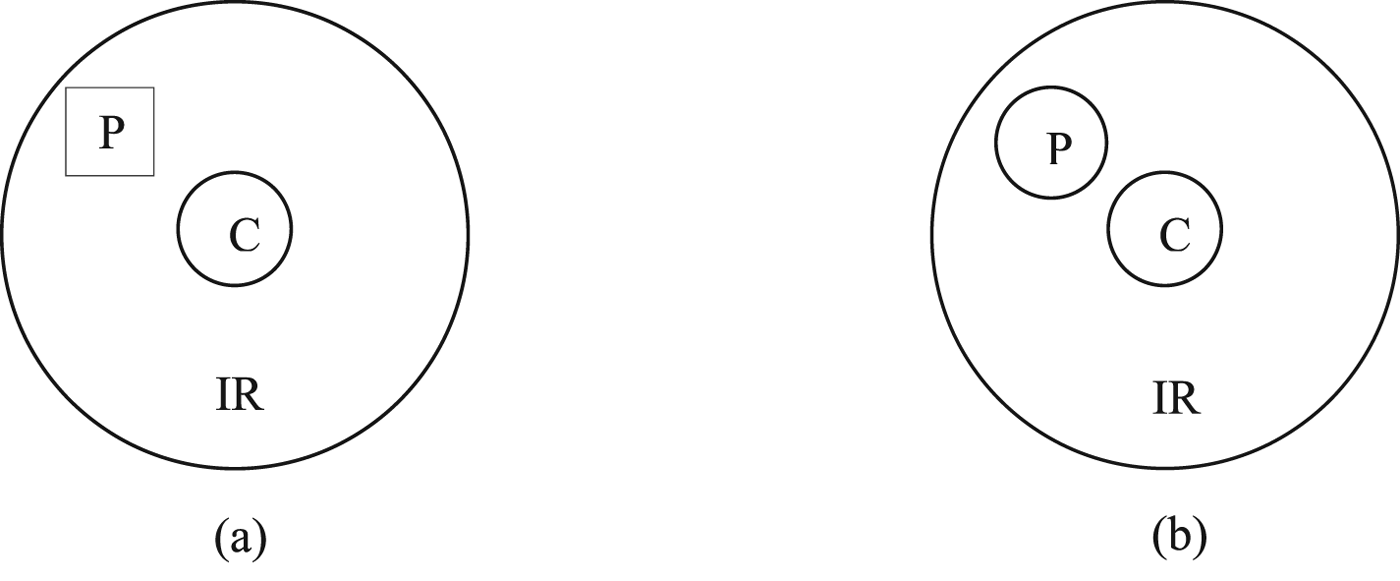
Both the simple present and the present progressive are present-tense constructions: their use indicates that the situations they profile are considered as part of the conceptualizer's immediate reality. At any given moment, a speaker's immediate reality, which is dynamic and thus changing over time, comprises not only what she is currently experiencing, but also culturally transmitted, general knowledge which is ‘always, if implicitly, present at a pre-reflective stage’ (Brisard Reference Brisard and Brisard2002a: 265). Hence, using a present-tense form entails either that the speaker is currently experiencing a situation (via perception or internal awareness) or that she regards this situation as constitutive of her world (and thus always true). In both cases, the situation is construed as epistemically immediate to the speaker at the time of speaking: mentally, it can be grasped immediately, either by accessing the current contents of her perceptual awareness or by retrieving it from the stock of structural knowledge she has about the world. In our view, the basic semantic difference between the simple present and the present progressive, which is relevant for all their uses, resides in the consolidated status of an immediately real situation, or the absence of such a status. More particularly, the simple present indicates that a situation constitutes a structural part of the speaker's conception of immediate reality: its current reality is to be expected and predicted. The present progressive, on the other hand, construes a situation (real though it may be) as a contingent part of immediate reality, i.e., its presence or actualization is not seen as necessary and could not have been particularly expected or predicted at the time of speaking. This modal contrast between the simple present and the present progressive is illustrated in Figures 4a and 4b (taken from De Wit & Brisard Reference De Wit and Brisard2009), in which P stands for the profiled situation that belongs to the ground (or immediate reality, IR). In Figure 4a, P is boxed so as to indicate its structural status (it is ‘epistemically controlled’), while in Figure 4b, the unconsolidated status of P is indicated by means of a circle.
Modal opposition simple present and present progressive: (a) simple present, structural situation; (b) present progressive, contingent situation.
This modal opposition between the simple present and the present progressive in English partially echoes a brief discussion by Calver (Reference Calver1946), who defines the common meaning for all uses of the simple present as ‘the constitution of things (logical, physical, psychological, essential, etc.)’, while ‘the present progressive is the tense of mere occurrence’ (Calver Reference Calver1946: 323). A similar idea is taken up by Dowty (Reference Dowty1975), who assumes that the contrast between the simple and the progressive form reflects an ‘essence/accident’ opposition, which, as Dowty notes, appears to underlie many contrasting syntactic constructions in the English language. However, he unduly reduces this ‘essence/accident’ contrast to an opposition between permanent and temporary situations. As we will see later in this section and as is also acknowledged by Dowty (Reference Dowty1975: 584–585) himself, such a ‘temporary/permanent’ distinction does not seem to capture all the uses of the progressive, which leads him to the conclusion that various (other) semantic criteria interplay in the semantic characterization of the be+-ing construction. A uniform approach is also lacking in Goldsmith & Woisetschlaeger (Reference Goldsmith and Woisetschlaeger1982), who separate the aspectual use of the progressive from, what they call, its ‘metaphysical’ (essentially modal) use (Goldsmith & Woisetschlaeger Reference Goldsmith and Woisetschlaeger1982: 83). In their ‘metaphysical’ uses, the simple present and the present progressive in English are said to linguistically reflect the epistemological opposition between structural (substantial) and phenomenal (accidental) properties of the world known to a conceptualizer at a given moment. For their aspectual uses, however, this epistemological contrast is not considered to be relevant. While our analysis clearly draws on the modal characterizations proposed by Calver (Reference Calver1946), Dowty (Reference Dowty1975) and Goldsmith & Woisetschlaeger (Reference Goldsmith and Woisetschlaeger1982), we will further develop and generalize them, arguing that the present progressive construes situations as phenomenal, i.e., contingent, in all of its uses, rather than in a specific subset only, and that it thus contrasts with the structural meaning conveyed by the simple present.
In view of these definitions of the English simple present and present progressive, it can be explained why the simple present naturally collocates with stative verbs to refer to the present (see the examples in (4) below), but not with dynamic verbs (barring some exceptional contexts, such as performative uses, see also Section 5.2.2 below), as illustrated in (5).
- (4)
(a) I know your name (right now).
(b) Your keys are on the table (right now). (cf. Brisard Reference Brisard and Brisard2002a: 268)
- (5)
(a) *John drinks/opens the door/wears a shirt (right now).
(b) *Your keys lie on the table (right now).
When dynamic verbs are used with the simple present, a general-validity interpretation (habitual or generic) arises. Stative verbs, with their unbounded and homogeneous profile (allowing the prediction of subsequent identical states based on previous observation or knowledge of a state), denote situations that are constitutive of the speaker's conception of reality and they therefore readily go with the simple present. On the other hand, the boundedness and (prototypical) heterogeneity of the events referred to by dynamic verbs make such verbs incompatible with the structural meaning of the simple present (again, barring some exceptional contexts such as performative expressions), unless they are actually given a general-validity interpretation (generic or habitual, both of which can be considered ‘stative’ concepts). It is important to note that terms such as ‘structural’ or ‘constitutive’ are essentially epistemic notions, and that they should not be equated with temporal concepts like ‘infinity’ (Brisard Reference Brisard and Brisard2002a: 268–270). This explains why an expression such as (4b) above, though most likely limited in duration, can nevertheless constitute an immediately consolidated part of the speaker's reality.Footnote 10 Consider, for instance, the contrast between (4b) and (5b), also discussed by Dowty (Reference Dowty1979: 173–180). Since the use of the progressive is obligatory in (5b), we may assume that lie denotes an event in this context. In Dowty's interval-semantic analysis of verbal aspect, the epistemological distinction between states and events in terms of (non-)contractibility is taken to entail that a stative predication is true at moments, whereas dynamic predications can only be true at (sufficiently large) intervals (Dowty Reference Dowty1979: 175). He convincingly argues that this distinction is also relevant for examples such as (4b) and (5b), which objectively seem to refer to the same situation:Footnote 11
Consider … the information that can be gleaned from a single frame of a motion picture film. A frame showing a book on the surface of a table does not really tell us whether the book is remaining stationary on that table or is sliding across the table, possibly on its way sliding off onto the floor. Yet it may be that The book is lying on the table is only true if the book remains stationary for at least a short period …. In support of this claim, suppose that a book is being slid across a series of carefully juxtaposed tables of absolutely equal height. If I am standing in front of one of these tables in the middle of the series, it seems that I can truthfully utter The book is on this table at any time that the book is wholly over the surface of the table in question (assuming, perhaps contrary to the fact, that I can utter the sentence very, very quickly!). But if my intuitions serve me correctly, I cannot truthfully say The book is lying (sitting etc.) on this table at any time as long as the book is in motion. If this distinction is a real one (and the judgment is admittedly subtle), then the truth conditions for these verbs do require that the object of which they are predicated remain stationary in over-all position for more than one moment, hence they could plausibly be supposed to be true only at intervals, not moments. (Dowty Reference Dowty1979: 176–177)
In other words, like any other state, the situation ‘the book is/the keys are on the table’ remains qualitatively identical for a while and thus constitutes a structural necessity even if it only be for a short time span (such as the time it takes for the book to be slid across the tables). The same analysis holds for the stative auxiliary be as part of the progressive construction (as in The boy is running home): the idea of necessity evoked by the simple-present tense marking on the auxiliary is restricted to the time it takes for the situation [the boy runs home] to occur. By using the progressive construction with its stative auxiliary, the profiled portion of the situation is turned into something state-like (see Michaelis Reference Michaelis2004 on the stativizing function of the progressive). However, as we will see in the next section, the progressive construction as a whole marks the situation's contingency on account of the immediate scope contributed by the -ing participle (see Figure 7 below).
4.3 Temporal dimensions of the opposition between the simple present and the present progressive
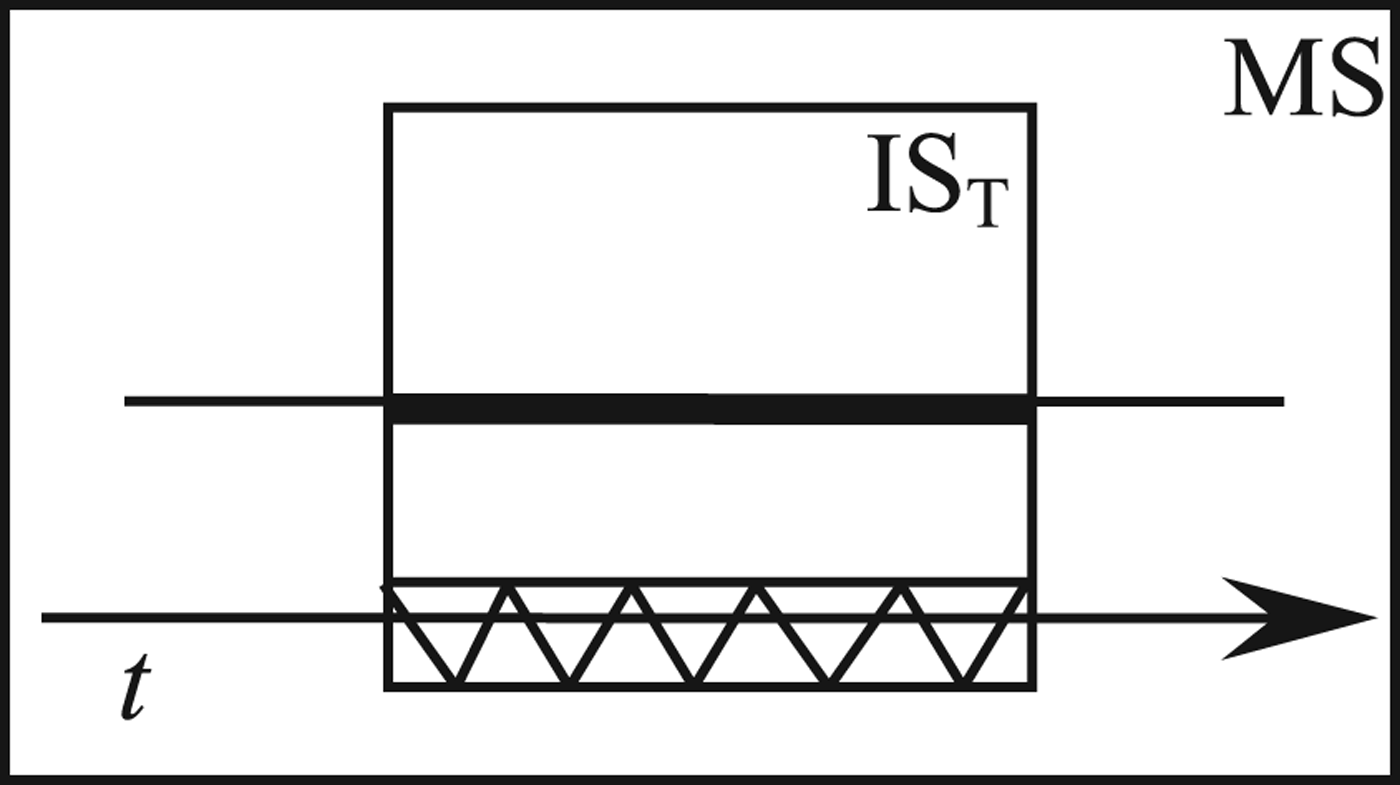
The modal account of the English present-tense constructions can be further elaborated at a more specific, temporal level (see Langacker Reference Langacker2001). Crucial in this regard is the interaction between the nature of the profile imposed by the tense marker and the lexical aspect (stative or non-stative) of the profiled situation. By virtue of their inherent contractibility, stative situations are perfectly compatible with the profile imposed by the present tense. The present-tense marker imposes an immediate (temporal) scope (IST) that coincides fully and exactly with the time of speaking, delimiting a segment that is, like any other sample of the state, representative of the overall stative situation. The situational profile thus constitutes a full instance of this situation type, as in Figure 5 (in which the speech event is indicated by the boxed squiggly line).
Present tense with stative verbs (Langacker Reference Langacker2001: 262).
Habitual and generic statements are very much like states, the only difference being that in such cases of generalization it is not so much an actual situation, but rather a cognitive (‘virtual’, in Langacker's terms) construct that is made coincidental with the speech event (see also Dowty Reference Dowty1979: 177–178). Once a conceptualizer deems there to be ‘enough’ individual occurrences of the same singular situation (e.g. John smoking a cigarette), she makes a generalization (e.g. John smokes) and it is this generalization (rather than the individual occurrences that make up the generalization) that is consulted at the time of speaking. Given the fact that such generalizations are unbounded and remain qualitatively identical over time, they are contractible and can thus be construed as fully and exactly coincidental with the ground.Footnote 12
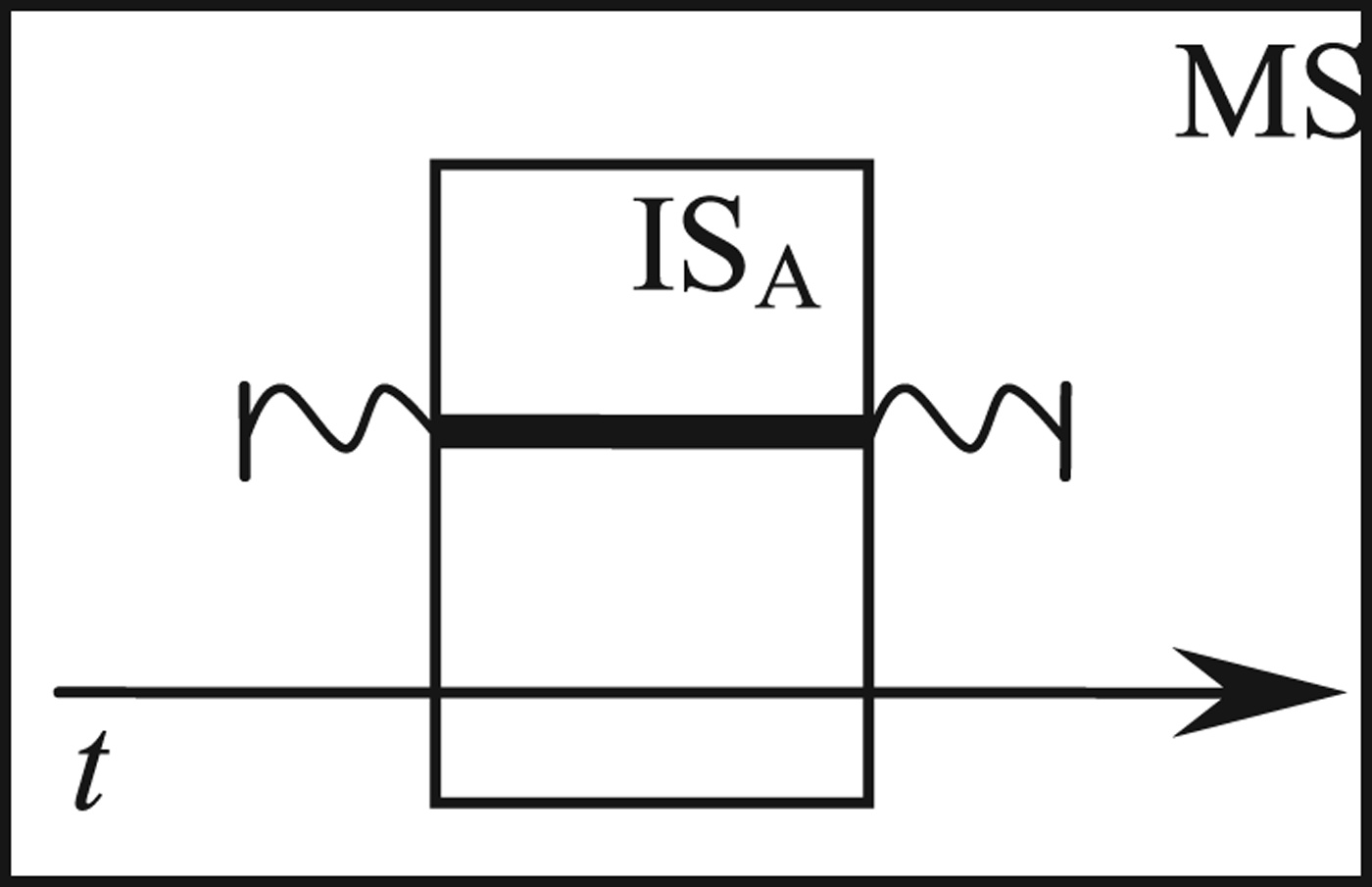
In non-general-validity contexts, a present-tense construal of events is less straightforward (Langacker Reference Langacker1991: 251–252; Reference Langacker2001: 263). First of all, Langacker points to a ‘durational problem’, i.e., the fact that ‘the length of an event is generally not equal to the length of the speech event describing it’ (2001: 263). But there is an ‘epistemic problem’ as well, as it is hardly possible for a speaker to identify an event without having observed at least a part of it – the speaker does not have the appropriate knowledge yet to do so. In other words, the combination of dynamic verbs, profiling events, and present-tense marking by means of the simple present is typically infelicitous. Whenever these durational and epistemic problems arise, speakers of English have to resort to the progressive to enable present-time reference. As an imperfectivizing construction, the progressive ‘zooms in’ on an event, thus creating an internal perspective on this event, disregarding its boundaries (Smith Reference Smith1997: 73–75).Footnote 13 Crucial in this respect is the role of -ing, which imposes the aspectual immediate scope (ISA) that restricts the profile of the dynamic process it applies to by excluding its endpoints and not paying any particular attention to the qualitative differences of a sequence of successive states, nor to how they build up a complete picture of a finalized event (Langacker Reference Langacker2001: 258).Footnote 14 Resulting from this internal perspective is an imperfective expression that is just like a state: unbounded and homogeneous within the boundaries of the immediate scope. It is important to note, however, that the progressive construction, as opposed to genuine statives, still indicates that the original situation is bounded beyond the immediate scope in the background. Figure 6 shows how the progressive derives a stative profile from an originally bounded and heterogeneous event (without any indication of the grounding relationship).Footnote 15
The participle -ing, not grounded (Langacker Reference Langacker2001: 259).
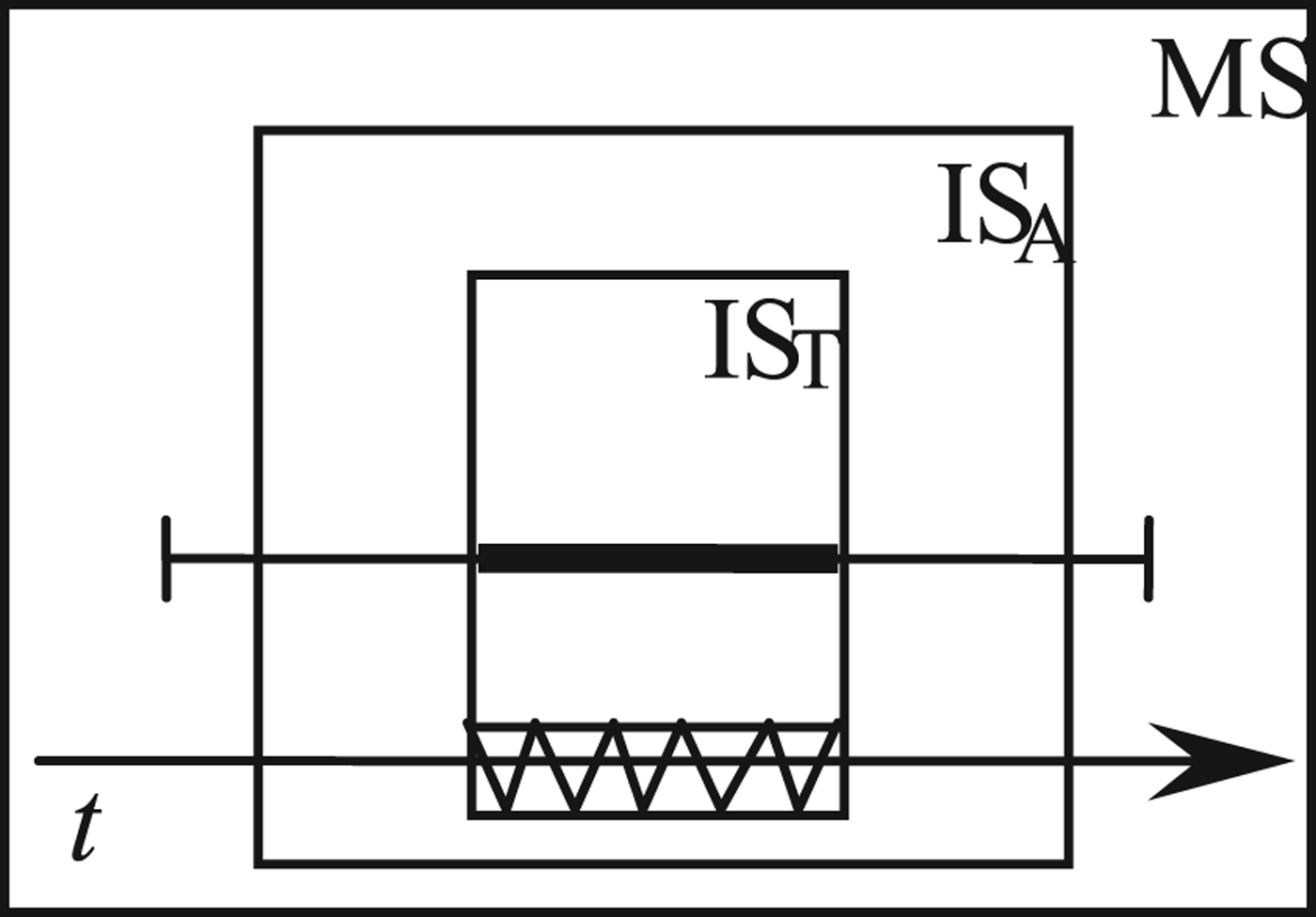
The immediate scope imposed by the progressive is purely aspectual, i.e., non-grounding: it does not make any specifications about the relation between the profiled situation and the time of speaking, as opposed to the immediate scope imposed by tense markers (Langacker Reference Langacker2001: 259). Hence, present-progressive constructions are characterized by two immediate scopes applying to different levels of organization – one scope (ISA) is intermediate aspectual, the other (IST) is temporal and represents the final step in the process of grounding a clause. First, the -ing participle profiles a derived imperfective situation, by imposing ISA on an originally dynamic configuration. Next, the present tense, marked on the auxiliary be, imposes the second immediate scope ISTwithin ISA, coincidental with the time of speaking (Langacker Reference Langacker2001: 260). This second immediate scope thus applies to a configuration that has already been imperfectivized. As Figure 7 shows, the resulting profile (i.e., focus of attention, see Section 3.1 above) is a representative segment of an imperfective, state-like situation, coinciding with the speech event.
Present progressive.
When a verb that is normally stative is combined with the progressive, the configuration is the same as that in Figure 7. By using the progressive, the dynamicity of the original state is increased (in that, for instance, it requires more effort or control to be maintained) and its limited duration is reflected in the presence of boundaries in the background. Hence, the stative situation is recategorized as a dynamic one (Michaelis Reference Michaelis2004). At the same time, the progressive imperfectivizes the inner part of this derived dynamic situation (i.e., it turns it into a state within the immediate scope imposed by the -ing form), so that it can be made to coincide with the ground (IST).
How does this temporal account, focusing on issues of ‘full and exact coincidence’ with the time of speaking, tie in with the modal characterization of the simple present and the present progressive in terms of, respectively, structural necessity and contingency in immediate reality? Crucial here is the combination of the internal perspective imposed by the present progressive and the backgrounded boundaries that are by definition implied in its semantic configuration in any of its uses. In such a configuration, the conceptualizer has an incomplete view of the situation and, therefore, less than certain knowledge about its culmination. In formal semantic analyses, this lack of full knowledge is assumed to lie at the heart of the ‘imperfective paradox’ and raises the question which conditions need to be fulfilled so that the intended endpoint can indeed be reached (see Section 2 above). In our analysis, we conceive of the internal perspective conveyed by the progressive on a bounded situation as having epistemic rather than deontic implications: situations that cannot be fully perceived by the conceptualizer are by definition not structural, i.e., they are contingent. This does not only hold for telic events that are given a progressive construal, but for all dynamic situations, as these are all, by definition, bounded. It thus seems that the English progressive has inherited the epistemic and temporal traits associated with individual occurrences of events, the majority of which do not represent anything structural.
The epistemic and temporal values of the English simple present in terms of structural necessity and full and exact coincidence with the time of speaking have been analyzed in detail in, respectively, Brisard (Reference Brisard and Brisard2002a) and Langacker (Reference Langacker2001).Footnote 16 The present paper purports to do the same for the direct counterpart of the simple present, namely the present progressive. The results of a corpus-based investigation into the usage types of the be+-ing form and their relation to the schematic characterization of this construction in terms of contingency in immediate reality constitutes the topic of Section 5.
5. THE TEMPORAL AND MODAL USAGE TYPES OF THE ENGLISH PRESENT PROGRESSIVE
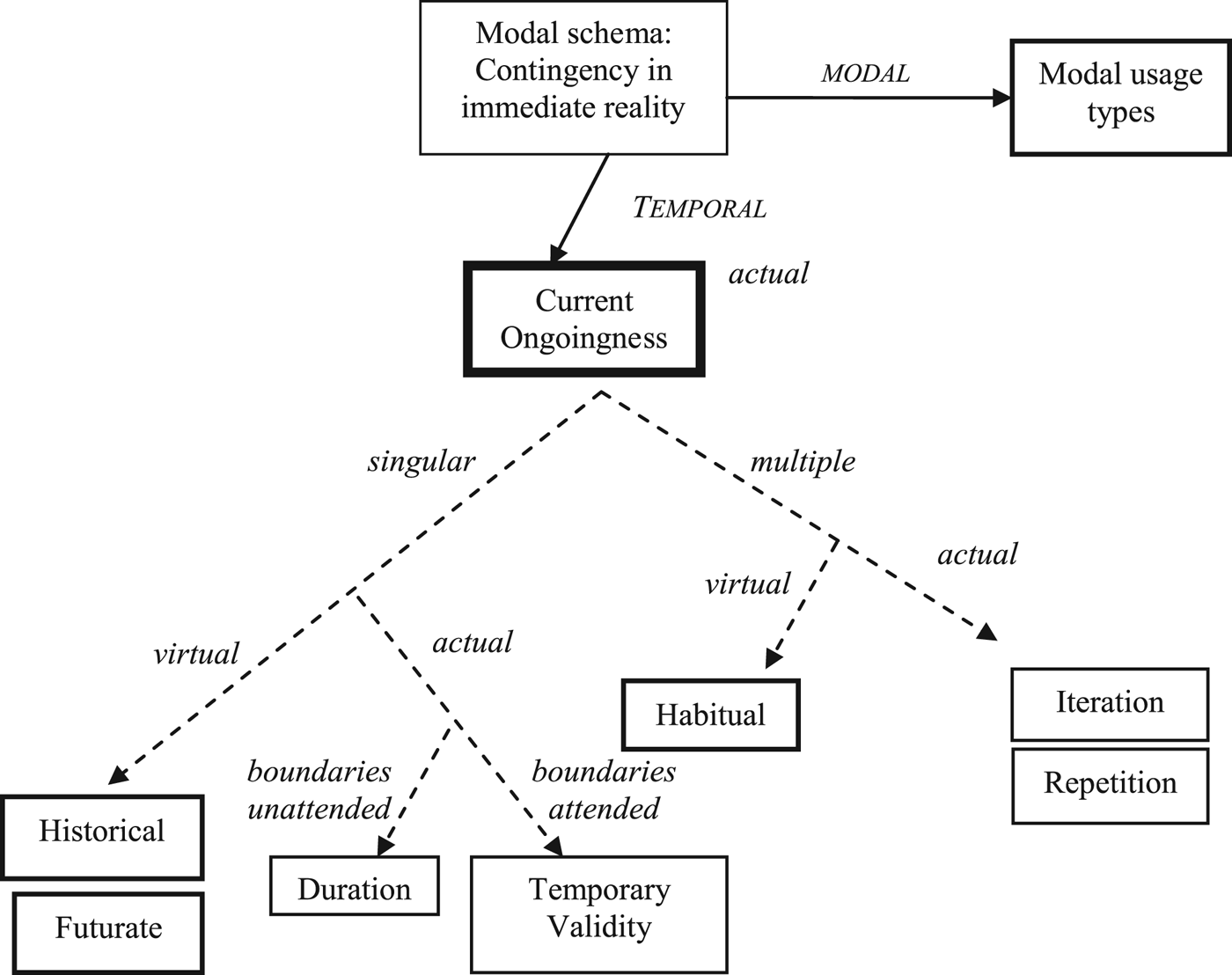
This section provides a detailed corpus-based description of the various specific temporal as well as modal usage types of the English present progressive, with systematic indications, in the form of a semantic map or network, of how these usage types are related to one another and to the schematic meaning of this construction via a set of cognitively motivated mechanisms. Given the intimate connection between the use of the present progressive and the time of the speech event, we have opted for an oral corpus, namely the Santa Barbara Corpus of Spoken American English (Du Bois et al. Reference Du Bois, Chafe, Meyer and Thompson2000). A total of 332 contextualized targets have been collected, each of which has been classified as instantiating a particular usage type, on the basis of contextual cues found in the surrounding linguistic context. For example, only those examples which contain clear indications of a limited temporal scope/relevance, such as an adverbial of time (e.g. today, this year), have been classified as instances of the usage type Temporary Validity.Footnote 17 One might object that, in those cases, the meaning of temporariness ought not to be ascribed to the present progressive, but rather to those contextual elements. However, in line with Langacker (Reference Langacker1987: 304–306), we assume that elements in the context may elaborate schematic elements present in the meaning of a construction, such as the schematic conception of boundaries in an expression's maximal scope. Since such an elaboration can only take place if the meanings of the construction and the contextual element are compatible, i.e., if they can be integrated into the same schematic and coherent configuration, we regard context as a reliable indication of the relevance of a particular meaning element.
In our classification of the different usage types of the progressive, special attention has been paid to modal connotations that are not, strictly speaking, the mere result of locating a situation in immediate reality (such as, among others, surprise, irritation and level of intensity). These will be especially relevant when the use of the present progressive, rather than the simple present, can only be motivated by referring to extra-temporal concerns on the part of the speaker. In those cases, we posit a modal, rather than temporal, motivation for using the present progressive.
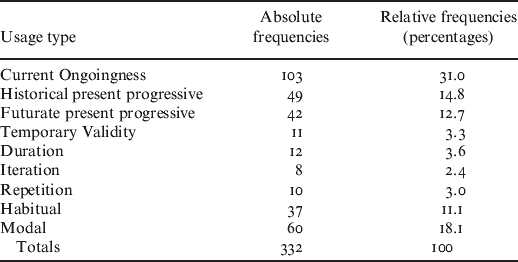
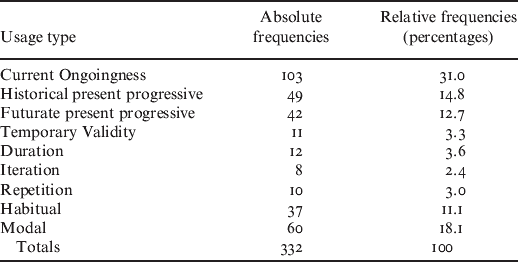
Table 1 lists the frequencies of the different usage types, aspecto-temporal and modal, of the present progressive.
Frequencies of the usage types of the present progressive in the Santa Barbara Corpus.
In the first part of this section, we will discuss those usage types that clearly involve temporal coincidence with the time of speaking. It will be shown that modal connotations such as the ones just mentioned may accompany the use of the progressive even in these so-called purely ‘temporal’ usage types.Footnote 18 An overview of these connotations will be given in Section 5.2 below, in which we also offer evidence for the existence of purely modal usage types, which directly instantiate the meaning of contingency in (immediate) reality, without any necessary implication of temporal coincidence. In Section 5.3, finally, we summarize our corpus findings in terms of a semantic network of the various usage types representing the English present progressive.
5.1 Temporal usage types
5.1.1 Current Ongoingness
All examples that involve singular events that are actually ongoing at the time of speaking without any further qualifications have been classified as instantiations of the usage type Current Ongoingness, which turns out to be the most entrenched category. These examples illustrate the prototypical aspecto-temporal meaning of the progressive: they indicate full and exact coincidence between the time of speaking and a representative part of an imperfectivized situation, the boundaries of which are implied in the background of the overall conception. Current Ongoingness is a ‘neutral’ category in comparison to the others: no further qualifications need to be added in terms of special temporal or modal features of the profiled situation. As we will see, all the other aspecto-temporal usage types of the progressive can be analyzed as further extensions of this category.
In the following example, the emphasis is put on the here-and-now of the speaker as she produces the utterance. The event involved is typically one that is not considered structural (the speaker has just given the colander to Pete, who is using it at the time of speaking, but not by way of some kind of habit) and that does not coincide fully with the time of speaking (Pete's use of the colander may be assumed to extend beyond the boundaries of this singular speech event). Furthermore, nothing more is being suggested in terms of categorizing Pete's use of the colander as in some way exceptional, surprising, etc.
(6) Do you want… You could use the lettuce washer, cause Pete's using the colander. Where's the lettuce washer? You know, the salad spinner thing? (SBC003)
In some cases, the scope of the ‘now’ which is being referred to is much more extended:
(7) He is such a weirdo. This is the type of person that is like a hermit. … Never came down out of the mountains. He doesn't have any… He doesn't know what's going on in this world. (SBC001)
The relevance of what ‘is going on’ extends considerably beyond the current speech event, yet it may still be construed as at least partly overlapping with that same speech event. Observe that the use of the present progressive in this example indicates that the event is regarded as phenomenal rather than structural, even though what ‘goes on in this world’ is relevant for a long stretch of time. That is, given the contingent quality conveyed by the progressive, its use would not be felicitous in a similar (constructed) example that unequivocally involves a structural type of event:
(8) ?He doesn't know that people are building houses in this world.
Also belonging to this usage type are examples such as (9):
(9) [A university professor to his students]
American democracy is dying. I want you to put that whole phrase in black and white. American democracy is dying, and I want you to try to think of why. (SBC012)
This example involves a telic predicate, implying an inherent endpoint. Since the use of the progressive leaves implicit whether or not the endpoint of the telic situation is actually attained (recall the formal semantic analyses referred to in Sections 2 and 4 above), some authors have proposed a basic meaning of ‘incompletion’ for the English progressive (recall Section 2). Yet, as these senses arise only with accomplishment verbs, we propose not to analyze them as separate usage types, but rather as illustrations of Current Ongoingness, noting in addition that they necessarily entail incompletion due to their telic nature.
5.1.2 Virtual ongoingness
The following two usage types, Historical (Section 5.1.2.1) and Futurate present progressive (Section 5.1.2.2), together form one type of extension of Current Ongoingness. In examples belonging to these categories, it is not an actual event, but rather a virtual representation of an event that is construed as coinciding with the time of speaking, and thus as part of the conceptualizer's immediate reality.Footnote 19 The Historical present progressive involves the internal, mental replay of an event that happened in the past, while the Futurate use of the present progressive invokes the current (mental) availability of an event that is expected to happen in the future (Langacker Reference Langacker, Patard and Brisard2011). Both uses constitute a more subjective variant of Current Ongoingness, since no actual event is objectively going on at the time of speaking (see Langacker Reference Langacker and Brisard2002 on subjectivity).
5.1.2.1 Historical present progressive
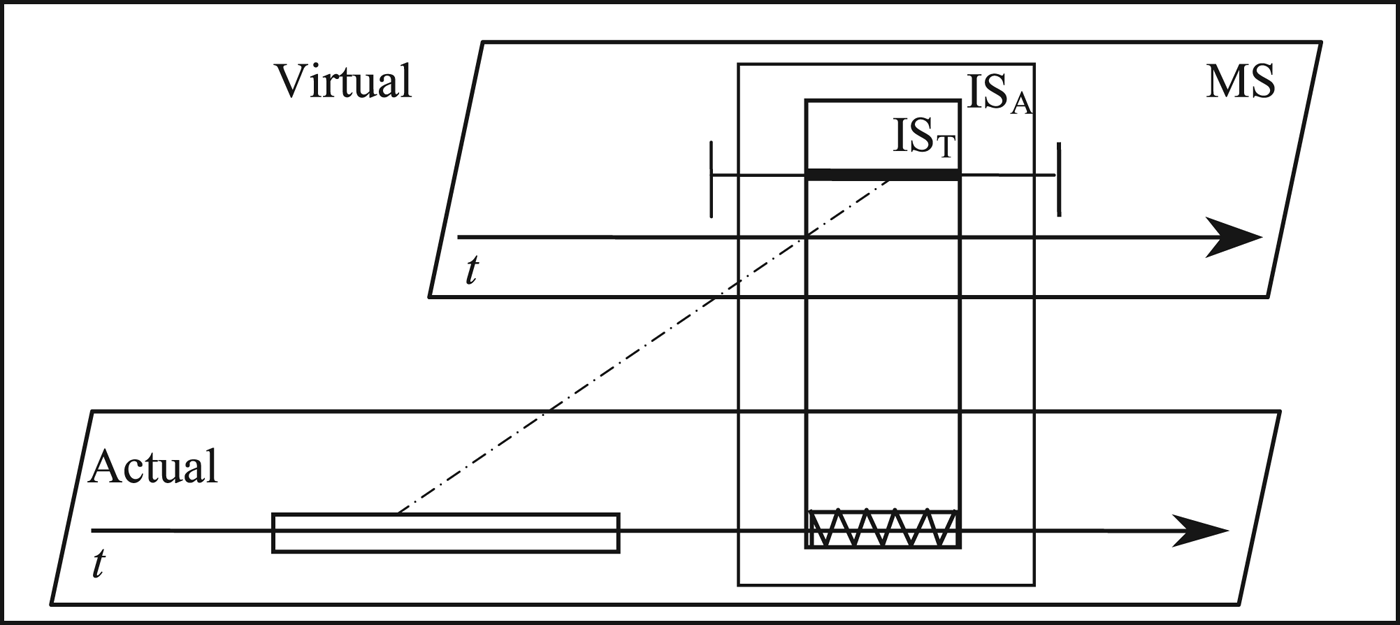
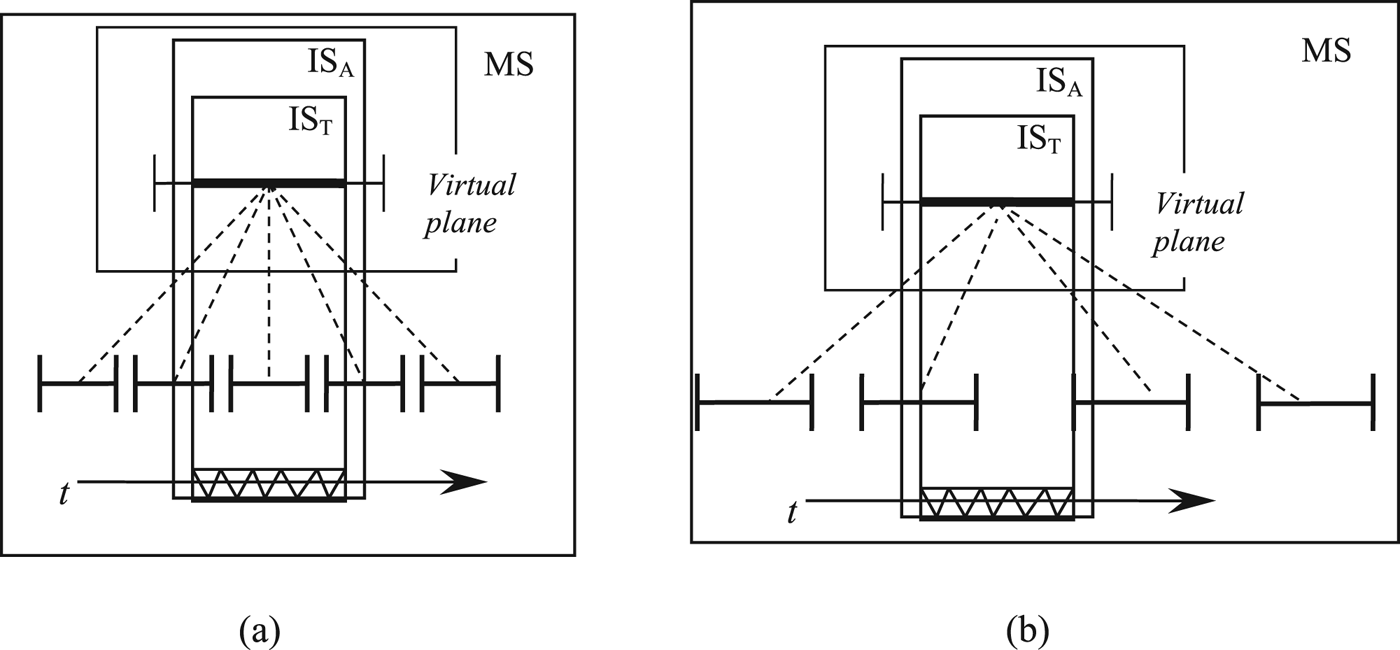
Figure 8 – which elaborates Figure 7 by invoking a virtual plane of representation – illustrates a present-progressive construal of a situation that is actually (objectively) past.
Usage type: Historical present progressive.
As can be seen, there is no actual coincidence between a representative segment of the event and the time of speaking: it is a virtual construct of this past event that is made, by the speaker, to coincide with the ground. Just like with narrative uses of the simple present, past events are rendered livelier, which is why this Historical present is typically exploited in narratives. Examples (10) and (11) illustrate the use of present-tense forms in the narration of past events:
(10) She has her wedding ring on. And it's like she's with this guy and they're kinda like all over each other. And I'm thinking, well, I guess that's her husband … but the thing is, you know, she's kind of all sophisticated and everything and I'm thinking, you know, this guy, I can't really believe that guy's her husband. … And of course later on I find out it's not her husband. So I'm thinking, you know, I don't know what'sgoing on here. (SBC002)
(11) Two weeks ago I'm watching TV, and David Horowitz is going to have this former car radio thief on? (SBC006)
The use of the simple present to describe past events typically foregrounds the profiled situation (in a way similar to what ‘genuine’ perfective-aspect markers do in narration): each successive situation is construed in its entirety, whereby the beginning of one entails the completion of the other. In (10), the only non-stative (and non-imperfectivized) situation, which is also the one that gets topicalized in this fragment, is marked by the simple present (find out). The Historical present progressive, in contrast, features in backgrounded contexts that set the scene for the more topical past events or comment on them (as with the various uses of I'm thinking in (10)) (see Jespersen's (Reference Jespersen1931) time-frame analysis).
The fact that past backgrounded events are reported by means of the present progressive is also compatible with their more incidental (i.e., contingent) nature. As pointed out by Van Bogaert (Reference Van Bogaert2009: 245–257), verbs such as think and guess typically take the progressive (in the past as well in the present) when the speaker wants to present her thoughts and guesses in a more tentative manner, i.e., when she is still in the process of making up her mind (see Section 5.2.1 below on the link between tentativeness and contingency). Using the progressive in an utterance which entails that the speaker has completed her thought process, such as (12), would therefore sound quite odd.
(12) [A pupil enthusiastically raises her hand and replies to the teacher]
?I'm thinking the answer is 6!
More generally, backgrounded situations are typically regarded as non-consolidated (i.e., ‘in process’) and therefore naturally take the progressive. On the other hand, simple-present construals of past events suggest more of an inevitable quality (given the speaker's knowledge of what has already happened), due to the strong association between the English simple present and general validity/predictability in the paradigm of the present.
Naturally, all other usage types that will be analyzed as extensions of Current Ongoingness may also involve uses in which a virtual rather than an actual event is profiled (e.g. Temporary Validity or Habitual in the past, using a present progressive).
5.1.2.2 Futurate present progressive
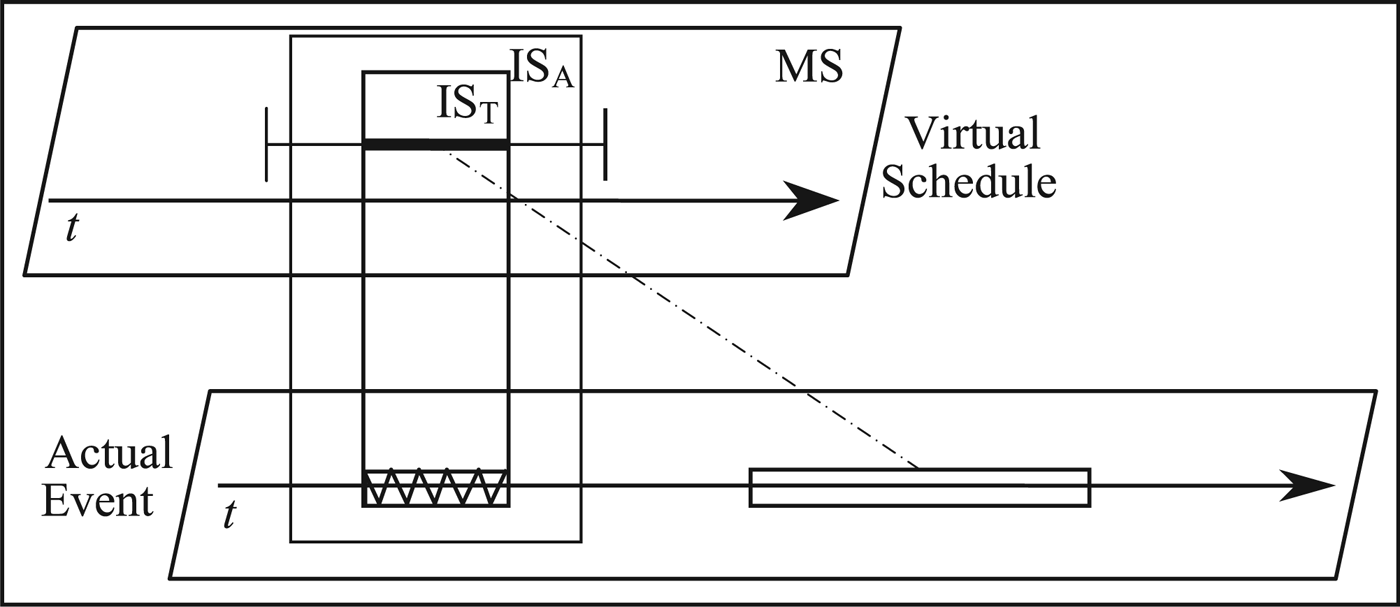
The Futurate present progressive can be regarded as the future counterpart of the Historical present progressive, and thus as another extension of Current Ongoingness. Again, as shown in Figure 8, it is not the actual occurrence of an event, but rather a mental (virtual) representation of this event, that coincides with the time of speaking. One might regard the virtual plane of representation thus conjured up as a kind of schedule that can be consulted at the time of speaking (Langacker Reference Langacker2001, Reference Langacker, Patard and Brisard2011).
Usage type: Futurate present progressive.
Representing a situation as part of immediate reality while it is actually yet to occur indicates a high degree of certainty on the part of the speaker with regard to the future occurrence of this situation. Futurate uses of the simple present and the present progressive differ primarily in terms of the modal status they confer upon the future situation. As recognized by, among others, Wekker (Reference Wekker1976), Brisard (Reference Brisard2001) and Williams (Reference Williams2002) and in line with the schematic characterization we propose, the simple present indicates that the future occurrence of a situation is regarded as inevitable, while a Futurate progressive typically indicates a confident prediction (which is, by definition, liable to human fallacy and thus contingent). Its use therefore appears out of place whenever the future event is certain to occur (because, e.g. it happens on a fixed basis), as in (13), or when, on the other hand, the speaker has no certainty at all about the future occurrence of an event, because it is, for instance, out of her control, as in (14):
(13) ?The sun is rising a minute earlier on 10 May.
(14) [The speaker knows a couple that recently split up]
?I don't know if they're ever getting back together.
On the other hand, the Futurate progressive is felicitously used when the future situation is presented as arranged in the present (15) or its occurrence can be envisaged on the basis of (actually or mentally) current observations (16):
(15) What we have set up is, Matt's going up to Chicago, at LCL's office, on… for… Monday evening, Tuesday and Wednesday training. The Monday evening and Tuesday training will be very specific for him. (SBC014)
(16) Twenty minutes later they were kinda like… all over each other. You know, kissing, et cetera. And I was thinking, it looks like these people aren't going home alone tonight.Footnote 20 (SBC002)
The present progressive can also be used to refer to the subject's current intention or volition vis-à-vis a future event (which again involves prediction with a relatively high degree of certainty). It can thus even occur in contexts that are normally preserved for will, such as the apodosis of a conditional clause:
(17) He's already talking, if this thing goes the way they think it is, next fall he's wanting to start looking at expanding that storage facility.
The fact that example (17) involves want – a predicate that is normally construed as stative, but that has now been coerced into a dynamic verb by virtue of the progressive – indicates that, as a marker of future time too, the present progressive can be used in a fairly broad array of contexts, as long as they are in line with the construction's basic meaning.
Observe also that the use of the Futurate present progressive can be exploited to express a prohibition, as in (18):
(18) She just looks at me, she kind of nods her head and she's going: ‘Auntie Lina's here again, I'm leaving.’ So she wants to go out on the balcony. I grab her again. ‘You wanna go outside? You gotta go downstairs, but you're not going out on the balcony. Cause knowing you, you're gonna fall off.’
Interestingly, the same prohibition expressed by means of an imperative (Don't go out on the balcony) is not as forceful as its counterpart in the progressive. In cases such as (18), the speaker uses the progressive in the context of an indirect speech act (Searle Reference Searle, Cole and Morgan1975). Directly, the speaker describes/predicts what is (not) going to happen. Indirectly, however, she thereby forces the hearer to conform to this description. In other words, by describing a future (negative) state of affairs as actualizing, the speaker does not leave any choice to the hearer, whose future actions she represents as already being determined. Consequently, orders or prohibitions are markedly strong if they are expressed by means of the Futurate present progressive. They even appear to be stronger than orders and prohibitions expressed by means of the simple present (as in You don't go out on the balcony), which represents the state of affairs as more factual – as reflected in its natural occurrence in polite instructions, e.g. First you remove the plastic, then you open the lid, etc. – and involving less intensity (see Section 5.2.1 below on the relation between the use of the progressive and intensification).
5.1.3 Prominence of boundaries
The semantic categories of Temporary Validity and Duration instantiate the meaning of Current Ongoingness, constituting, more particularly, extensions of it, but they can be distinguished from the previous categories on the basis of the relative prominence conferred upon the situational boundaries within the expression's maximal scope. Temporary Validity features in those uses in which the boundaries are very salient (yet unprofiled), whereas the category Duration involves highly non-salient boundaries.
5.1.3.1 Temporary Validity
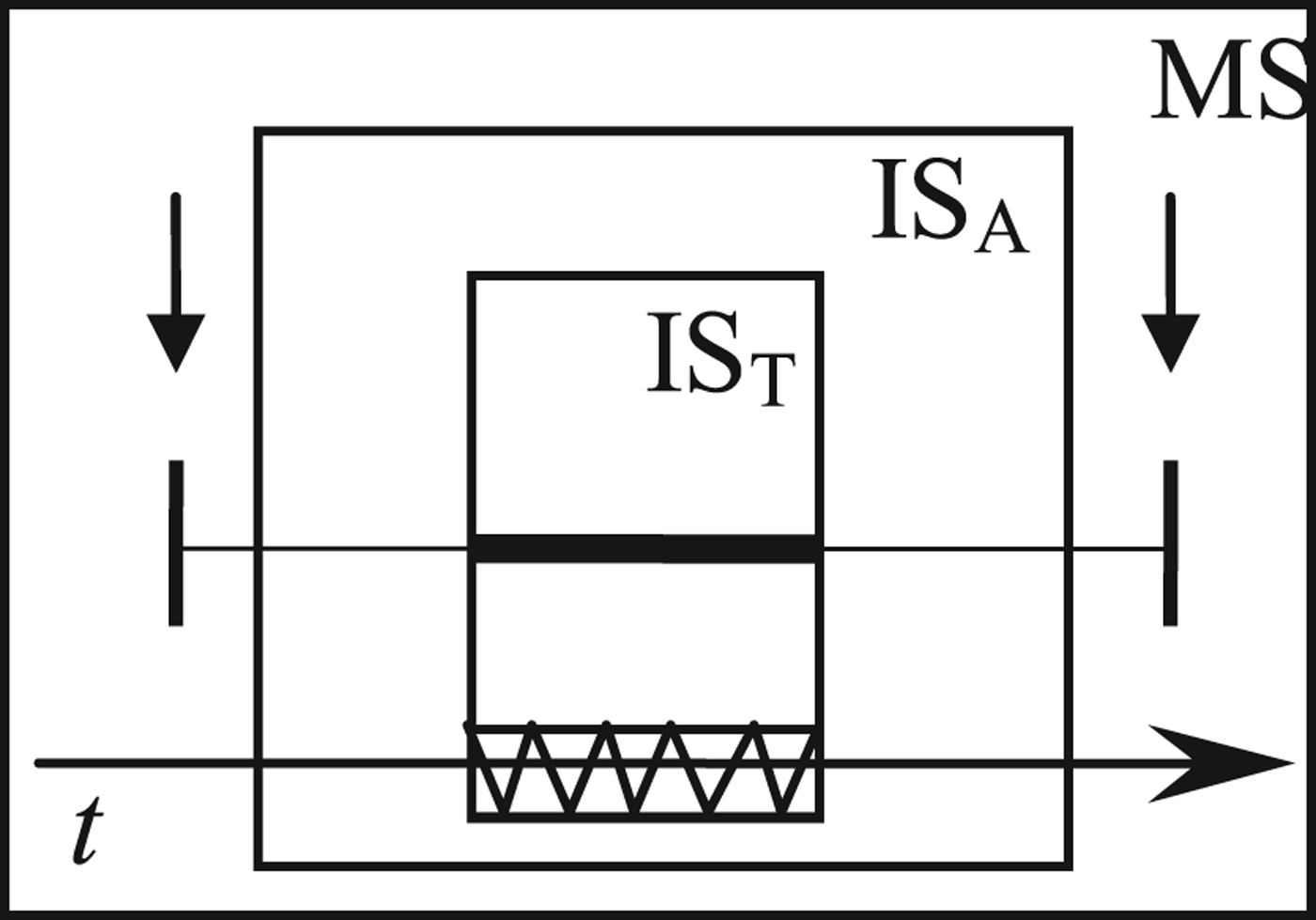
The use of the progressive almost always involves situations that are implicitly bounded in time.Footnote 21 Yet, the targets belonging to the category of Temporary Validity confer maximal prominence on the situational boundaries (without actually profiling them), as illustrated in Figure 10.
Usage type: Temporary Validity.
Only observations with clear contextual indications of temporariness, such as this year in example (19), have been classified as belonging to this category:
(19) It's hard because, the hatchet man actually in the group is Ed. Ed's the one that'll come in, and he'll go ahead and say, this is what needs to be done.… But Fletcher'll kind of sit there and kind of go: ‘Well, mhm, well, let me see, that… that seemed to be okay, but I'll have to think about it.’ He's real wishy-washy. … So they're kind of suffering that… from that this year. Not having that on there. (SBC006)
This example also exhibits a sense of tentativeness (note kind of), a connotation that directly reflects the incidental status of the profiled situation in the speaker's immediate reality (see Section 5.2.1 below).
5.1.3.2 Duration
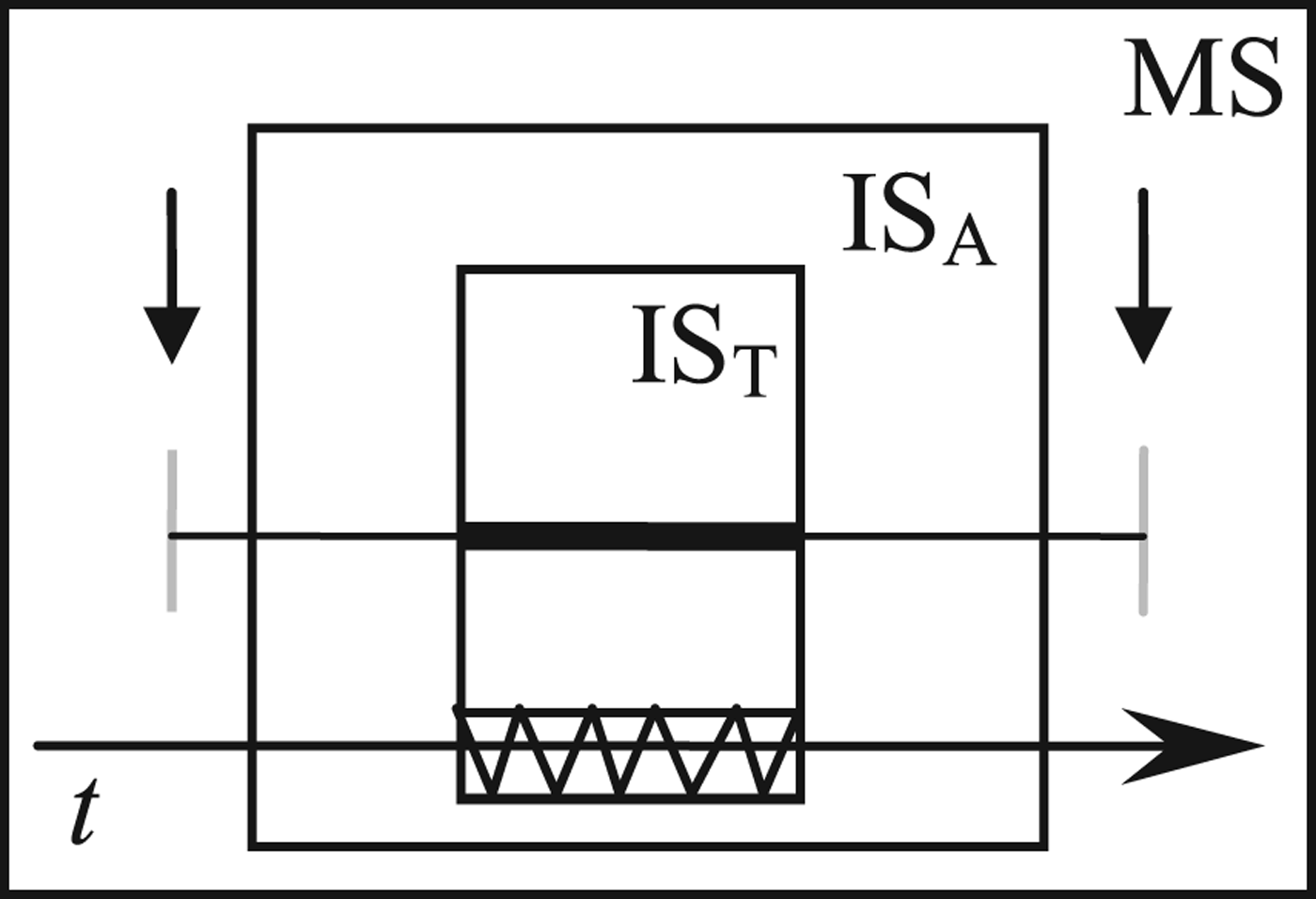
Constructions that have been classified as Durative uses of the progressive can all be paraphrased with the expression keep on, and the implicit boundaries involved are made minimally prominent. In other words, the speaker does not attend to the boundaries of the situation, which may be assumed to exist objectively for the relevant situation. In Figure 11, the boundaries in the expression's maximal scope are bleached.
Usage type: Duration.
Consider (20) as an illustration of the usage type Duration:
(20) RICKIE: And then the whole time under here, he'd just look. I mean, he looked so hard that it was, like, burning. …
REBECCA: So then, and then, he sort of pulled the paper aside, and he's still staring at you?
(SBC008)
Notice that this example also involves a sense of irritation. As can be predicted from the previous characterization of dynamic vs. stative verbs (Section 4.1 above), the relative downplaying of the boundaries of a dynamic situation should result in a corresponding loss of dynamicity, as its configuration will come closer to that of a stative predication. This loss of dynamicity may then manifest itself in terms of the designated event being construed as not leading to any endpoint (the subject will just go on staring) and lacking momentum. Thus, in (20), the speaker conveys a sense of homogeneity by stressing the persistence of the same activity.Footnote 22 It seems therefore that Durative progressives can be regarded as the most imperfectivized of all the usage types of the present progressive: not only are the situational boundaries construed as highly non-salient, but the designated event is also made relatively homogeneous. The difference, then, between enduring events and actual states resides, epistemically speaking, in the non-structural status of the former.
5.1.4 Multiple events
While the progressive canonically imperfectivizes singular, uninterrupted events, it can also zoom in on a series of repeated events (Twaddell Reference Twaddell1960: 7; Brisard Reference Brisard and Brisard2002a: 260). Consider, for instance, the punctual verb blink in (21):
(21) Sally's blinking.
The repetition of a short dynamic event yields a higher-order construct, representing the event type that is repeated, and it is this higher-order construct, which is necessarily virtual, on which the progressive zooms in, thus allowing for a present-time reading. The categories discussed under this heading – Iteration, Repetition and Habituals – all involve such a series of multiple events in actuality, rather than one, together making up a third group of extensions of Current Ongoingness.
Both Iteration and Repetition still relate to the actual circumstances of the speech event: at least a part of one of the actual events coincides with the ground and so the higher-order construal, albeit a virtual construct itself, still relates to actuality. Iteration involves a quick, intense succession of contiguous short events (which collectively make up one coherent episode), whereas Repetition refers to the repetition of possibly longer events that stand on their own, with some time between each single event. Figures 12a and 12b illustrate this higher-order construal for Iteration and for Repetition, respectively.
A series of multiple events with actual coincidence: (a) usage type: Iteration; (b) usage type: Repetition.
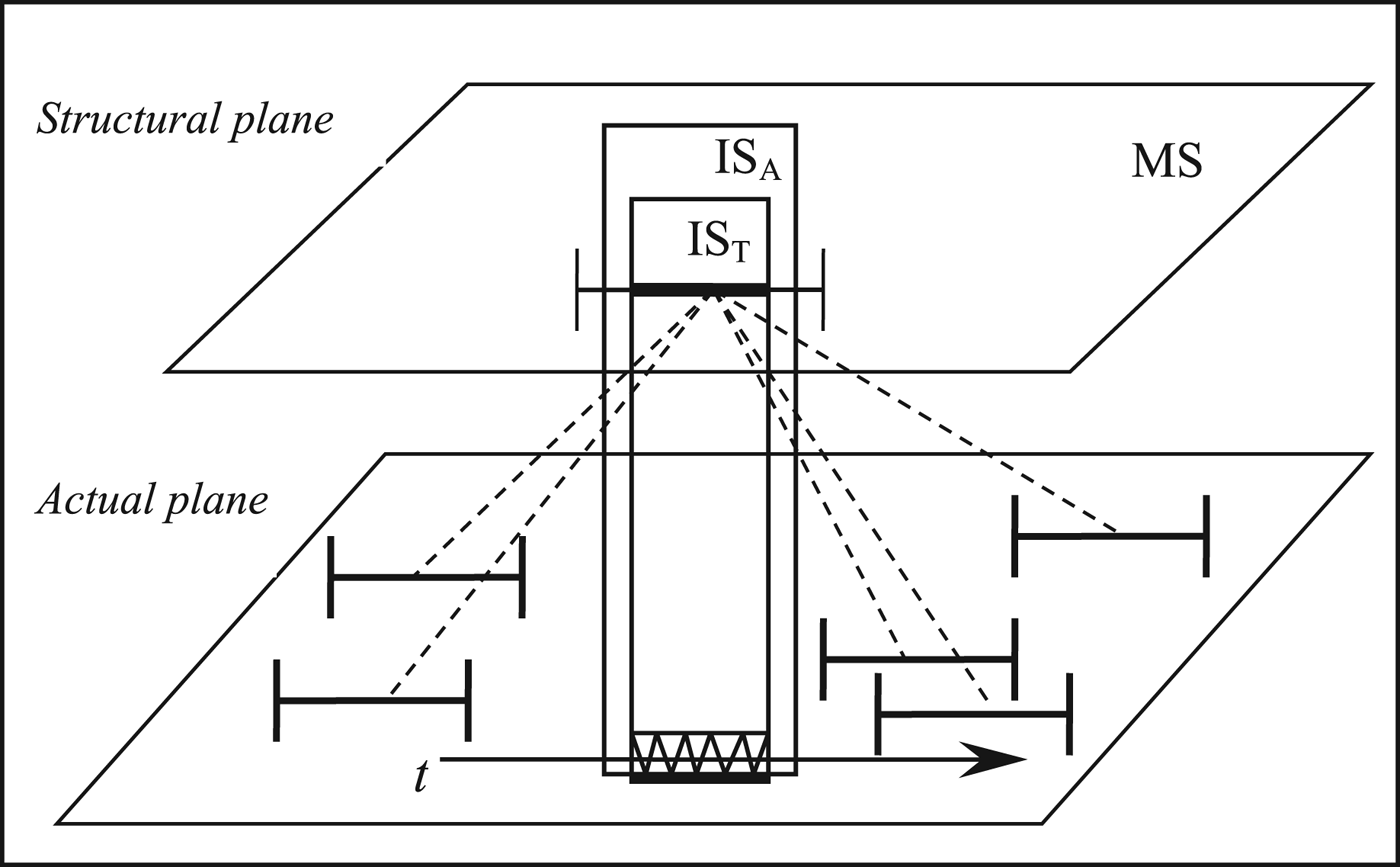
Habituals, on the other hand, invoke a structural level of representation, covering an open-ended set of actual instantiations which may occur at any random moment in time (possibly, but not necessarily, in the present too). This plane is equally virtual but it represents structural knowledge of the world (in contrast with Iterative and Repetitive, whereby the virtual construct merely represents the commonalities of a number of events occurring in and around the present and which, together, may still be construed as anything but structural). This is illustrated in Figure 13.
Usage type: Habitual.
Note that in all three cases, the virtual event is imperfectivized, meaning that an internal perspective is adopted (in line with the meaning of the progressive).
In the following sections, we will study these three categories in more detail.
5.1.4.1 Iteration
Prototypically, Iterative progressives involve punctual or very short events, as these can be repeated in rapid succession. In example (22), part of a past narrative, a short event (beat) is iterated and a representative part of the higher-order representation of this series of events is made to coincide with the ground:
(22) They're beating me like this. I don't even know how you can do that. You're dancing with them and they're beating you just like this.
Most examples of Iteration will also involve a sense of intensification, as clearly present in (22), which reflects the elevated energy level required to maintain iteration, as opposed to what is required for a canonical one-time action.
5.1.4.2 Repetition
Compared to Iteration, Repetition constitutes a fairly ‘neutral’ category: as mere repetition does not require situations to be strictly contiguous, the sense of intensity accompanying this use is not so prominent. Example (23) involves events (thinking and moving in) that are repeated in and around a moment in the past (every time I got up), but that are nevertheless construed as present. Clearly, the reoccurrence of these events is not generalized enough to describe them as habits (i.e., they are tied to a specific occasion).
(23) I remember, like, I went there with this person… It's kind of funny… This person did not want to dance. So she's just gonna watch. So, every once in a while I'd get up and dance, and it's like, when I'd come back, I mean, there was some guy there, sitting in my chair. Every time I got up, I'm thinking, God, these guys don't waste any time. I mean, you turn your back and there's somebody moving in. (SBC002)
5.1.4.3 Habitual present progressive
Since Habituals are general-validity statements, one would expect them to be marked by the simple present (rather than the present progressive) in English, as, in fact, they often are. In (24), for instance, the present progressive, conveying a contingent meaning, is not compatible with the structural nature of the denoted habit:
(24) [In a conversation with a colleague on the morning train to work]
I drink/*am drinking my whisky after dinner. I've always done so.
Yet, a habit in itself may also be thought of as incidental with regard to the ground, in which case the present progressive is used. Such ‘contingent habits’ are typically construed as temporary, moreover, which makes them the virtual counterparts of Temporary Validity uses: the latter evoking a single event, and the former multiple events in actuality.
(25) I was gonna ask a doctor, I'm like: What's wrong with me that I'm sleeping so much? (SBC013)
(26) ROY: Was supposed to be right in between the perfect weather and all that stuff? And they ended up getting early winter storms. Or late monsoon storms. Or whatever.
MARILYN: Yeah, whatever… It was atypical weather.
ROY: Everywhere we've been, in the past several years, everybody's talking about how, the weather just isn't normal.
(SBC003)
Notice that in none of these examples is there an actual coincidence between the profiled series of events and the time of speaking (in (25), for instance, the speaker can obviously not actually be sleeping while she is talking). Therefore, as shown in Figure 13, a virtual, structural plane of representation needs to be invoked to allow full and exact coincidence with the time of speaking. This virtual higher-order construal reflects the potential of habits to occur at any moment in time, including the present.
Another possible motivation for using the present progressive to refer to Habitual situations is to convey modal, instead of temporal, qualifications linked to the meaning of contingency. As can be derived from the context (what is wrong with me?, atypical weather), (25) and (26) clearly involve a sense of surprise and perhaps even irritation. Consider also (27), in which the progressive intimates intensification, not just in the event itself, but also in its affirmation by the speaker as real (really really):
(27) I mean that's twelve bucks, every time I can go out, and trim my own horse's hooves. … But I always have somebody that really knows what they're doing for the horses that I'm really really using. (SBC001)
This example is of particular interest because the progressive is not used here to indicate temporariness, but only to convey a sense of intensity. We will return to this issue in Section 5.2.2.
5.2 Modal connotations and modal usage types of the English present progressive
In the preceding description of the usage types of the English present progressive, we have come across such modal (i.e., non-temporal, subjective) qualifications as surprise, tentativeness and intensification. In Section 5.2.1, we will give a systematic overview of these modal connotations and relate them to the core meaning of the English present progressive. That they are part and parcel of the semantics of the progressive becomes even more apparent when we consider examples in which there is no temporal motivation at all for using the progressive (i.e., one would expect a simple present, on a non-modal or neutral reading, since no issues of temporal alignment or ‘zooming in’ seem to be at play): we regard these uses, which will be discussed in Section 5.2.2, as crucial for our analysis, as they constitute direct evidence for the existence of a modal scheme in the semantic configuration of the English present progressive.
5.2.1 Modal connotations
Given the fact that the (actual or virtual) present-time occurrence of non-structural situations, referred to by means of the present progressive, could not have been predicted or expected, such situations often give rise to a sense of surprise on the part of the speaker, as in (28):Footnote 23
(28) They were supposed to go up at the end of August, when they usually run. And… the fish weren't running this year, you know, it's like everywhere. Nothing's doing what it's supposed to, anymore, anywhere.
(SBC003)
In (29), the speaker, who is talking about shoeing horses, is referring to a clearly atypical way of standing:
(29) And that's another thing we had to learn in the class you know,… just had to learn our safety of, where to stand and how to stand. You have to stand like these certain ways, and, oh, and it's a killer on your back, cause you're standing like this.
(SBC001)
Note that events designated by posture verbs such as stand, and also lie and sit, typically involve control and active investment on the part of the subject to be maintained when they are given a progressive construal. This sense of investment is obviously heightened with atypical postures.
Closely related to notions of surprise and atypicality are emotional overtones of irritation or indignation, of which we have encountered various examples in the previous sections as well – see for instance, (20), (25) and (26) above. These concrete emotions also tie in with the progressive's basic meaning in terms of contingency: with events that have an atypical status, the speaker potentially has more reason for irritation than with situations that she regards as typical, presumably partly because events, when presented as atypical, can be remedied in response to the friction they cause (it is, for example, of no use to try to prevent the sun from rising in the east, or to be irritated by it).
Another modal connotation associated with the use of the progressive is that of (the speaker's) tentativeness, as in (19) above, as well as in example (30), in which the speaker is trying to come up with an explanation as to why many people refrain from voting:
(30) I agree with what he was saying, but I think maybe one of the reasons could be they're not being represented. They don't think they're being represented.
(SBC012)
The tentativeness here, first of all, pertains to the (perceived) less than full realization of the event (for instance, due to a lack of investment or lowered intensity). But, as has already been mentioned in Section 5.1.2.1 on the backgrounded uses of the progressive, by representing an event as a non-structural part of (immediate) reality, the speaker can somewhat downplay the statement she is making. This use of the progressive is particularly common in the expression of a wish, though usually in combination with a past tense (e.g. I was actually hoping that …). Notice that (30) involves a passive construction. On the whole, the progressive passive is quite rare in our data and it only came into existence in the late Modern English period, as one of the final stages in the process of grammaticalization of the English progressive (see Kranich Reference Kranich2010). This marginal status is most likely due to the stative profile of the composite expression be+-ed participle. Since statives are usually not marked by the progressive, it is only in those cases in which the speaker has reasons to construe the passivized situation as bounded and incidental (i.e., as dynamic) that the progressive will be used.Footnote 24
Finally, intensification is another non-temporal, subjective notion commonly associated with the use of the progressive, which again reflects the marked (qualified) status of the designated situations. We have already cited a number of examples of intensifying uses of the progressive (see (20), (22) and (27) above), and in the following section we will discuss some additional cases.
Note, again, that the use of the progressive rather than the simple form in an example such as (27) is not required for aspecto-temporal reasons: a simple-present marking would be equally acceptable, yielding a more neutral description of a situation that is considered by the speaker to be structural (if not typical). Contrasting examples of the present progressive with their simple-present counterpart thus shows a clear modal difference – a difference that is, importantly, grammatically marked by means of the opposition between the simple and the progressive form, rather than being conveyed by some contextual element.Footnote 25
5.2.2 Modal usage types
By modal usage types we mean those usage types that, rather than evoking certain associations that are compatible with the progressive's basic meaning, directly instantiate the modal schema of this construction (and its accompanying configuration – see Figure 4b). These involve uses that are primarily epistemically, rather than temporally, motivated. The primary point of using the progressive lies in expressing a subjective evaluation of an objective state of affairs. To begin with, let us have a closer look at some additional examples of intensifying uses of the progressive:
(31) If you're a woman, those guys'll be all over you. I swear it! … I'm not dancing with guys. All I can say is, the women aren't all over me. (SBC002)
(32) [On how to punish children]
Well, I'm telling you, withholding goodies works. (SBC004)
These examples, as well as example (27) above (the horses that I'm really really using), are particularly interesting in terms of what they reveal about the speaker's subjective attitude. Both (27) and (31) involve habits of the speaker that are not restricted in time. In (31), the speaker is saying that he refuses to dance with guys (it is not just a habit of him not to), while in (27) the speaker seems to imply a distinction between horses that are used occasionally and those that are ‘really’ used. Both examples stress the reality of a state of affairs, but a reality which, in contrast to unqualified affirmations of the same situations (I don't dance, the horses that I really use) needs to be confirmed again and again. It is the latter quality of the realities represented here that could arguably be responsible for the use of the progressive (the contingency of their re-affirmation, rather than the situations themselves). This is even more apparent in example (32), which involves a performative verb (Austin Reference Austin1962, Searle Reference Searle1969). Typically, these performative constructions select the simple present to refer to the event that comes about as the speaker is speaking. Since the reality of the act of telling in itself cannot be at issue, it is again the confirmation of the reality that is signaled by the progressive, or rather the contingent nature of this confirmation. Contingency, here, does not apply to the objective scene that is reported, but to the speech act that reports it; one could call this ‘illocutionary contingency’.
The following examples also involve various verbs of communication ((35) is a repetition of (3)):
(33) JIM: Now I think a hundred fifty dollars is a lot to maintain a self-directed IRA.
FRED: So you mean that you… we could pass that back to the customer? That's what you're saying? (SBC014)
(34) ALINA: But the Black guy's father works with the uhm CIA.
LENORE: Oh, you're kidding. (SBC006)
(35) [In a discussion between a professor and his students about the discourse of civil rights activist Jesse Jackson]
Well, he says minorities. He's smart, he talks about minorities. But he's really talking about African Americans. (SBC012)
Examples such as these have been ignored by many previous analyses of the present progressive. One important exception is Ljung (Reference Ljung1980), who coins the term ‘interpretative’ for such uses and describes them as giving ‘the speaker's interpretation of some behaviour that somebody is engaged in’ (Ljung Reference Ljung1980: 69). These interpretative uses are also dealt with in the French enunciativist tradition: the attestation of cases such as these has led Adamczewski (Reference Adamczewski1978) to analyze the progressive as a ‘meta-operator’ with an anaphoric function (see Section 2), while Larreya (Reference Larreya1999), in a similar vein, speaks of a process of (linguistic) re-identification marked by the progressive. Indeed, in these examples, as opposed to the performative in (32), the designated situation does not refer to an event that is actually ongoing at the time of speaking, but instead evokes and re-classifies a situation that has occurred before, in (33) and (34), or that occurs regularly, as in (35). In (33) and (34), the speaker refers to something that has actually been said (right) before the time of speaking. Unlike with the Historical present progressive, though, this virtual construct is not so much invoked for reasons of narrative vividness, i.e., to convey a sense of current ongoingness or to background an event. Rather, by using the present progressive, it is indicated that the precise nature of the relevant speech event is not entirely obvious (otherwise the speaker would not have felt the need to spell it out (again)). That is, the interpretation of the situation (what is being said) is not consolidated in the current circumstances, which is why the use of the simple present tense in (33) and (34) would sound inappropriate. A similar analysis can be proposed for (35), the only difference being that the virtual plane invoked does not profile a singular event that is actually past, but rather a higher-order construct corresponding to a series of events together referring to a habit (see Figure 13). Again, just like with examples (27) and (31), the habit that is being referred to is ‘intensified’ by means of the progressive. Example (35) is of particular interest here as the designated habit is first rendered by means of a simple present, while, in the final sentence, the speaker switches to the present progressive without there being any aspecto-temporal reason for doing so. The motivation for this switch is, once more, modal in nature: whereas the speaker first refers to something given or structural (i.e., what is repeatedly observed), the final statement, solely by virtue of featuring a progressive form, calls this into question and suggests a reappraisal of the same (virtual) situation.
In view of these examples, we can conclude that the epistemic schema we propose for the present progressive in English is not only instantiated in its aspecto-temporal usage types, but it also turns out to be a direct motivation in contexts where the progressive is used to designate situations that the speaker wants to construe as real, yet unconsolidated in her model of reality. The existence of such ‘purely modal’ usage types – which have often been discarded as purely pragmatically derived, if treated at all (see Section 2) – constitutes additional evidence in favor of an essentially modal semantic analysis.
5.3 A semantic network for the English present progressive
In Figure 14, a semantic map shows how the different meanings of the English present progressive are related to one another via a number of conceptual branching principles: ‘temporal versus non-temporal’, ‘actual versus virtual’, ‘boundaries attended versus boundaries unattended’ and ‘singular versus multiple’. This semantic network visualizes how we propose to bring the various uses of this polysemous construction together in one unified account. The common underlying modal schema, ‘contingency in immediate reality’, constitutes this construction's semantic core, giving rise to numerous instantiations in the temporal as well as the modal domain. Temporal and modal usage types elaborating and extending the scheme do so in interaction with specific contextual types, whereby a relation of elaboration is indicated by a non-interrupted arrow, while extension is depicted by means of an interrupted arrow. In addition, there is room, in this network, to pay attention to relative frequencies marking the different usage types (the bolder the box, the more entrenched the usage type). Note that we posit the meaning of ‘Current Ongoingness’ as the construction's prototype, both in terms of its frequency of use and because it seems to be the default meaning that arises when the progressive is used in (aspectually and modally) neutral contexts.Footnote 26 This prototypical temporal meaning further branches off into categories involving a series of repeated events (‘multiple’) and those involving singular events that extend the meaning of Current Ongoingness in some other way (‘singular’). The next branching principle, ‘actual vs. virtual’, is relevant for both singular and multiple events and allows us to distinguish Historical present, Futurate and Habitual uses of the present progressive from uses in which an event is actually ongoing at the time of speaking. Singular (non-virtual) events can extend the progressive's prototypical temporal meaning in yet another way: by emphasizing the situational boundaries or, on the other hand, by leaving them unattended.
A semantic network of the English present progressive.
6. CONCLUSION
In this paper, we have proposed a unified analysis of the semantics of the present progressive in contemporary English, according to which the core meaning of this polysemous construction is essentially modal. Due to the presence of the present-tense auxiliary be, the present progressive grounds a situation in the speaker's immediate reality, just like the simple present does. Yet, the simple and the progressive form differ from one another in terms of the modal qualification they confer upon the designated situation: while the use of the simple present indicates that the profiled situation is considered to be a structural part of the speaker's conception of reality, the present progressive denotes non-structural, contingent situations, whose actualization at the time of speaking could not have been predicted. On the basis of corpus data, we have shown how this epistemic meaning of contingency in immediate reality gives rise to various temporal usage types – always characterized by a full and exact coincidence between (a representative part of) the situation at issue and the ground and often featuring modal connotations that are tied to the meaning of contingency – as well as to uses that are purely modally motivated (i.e., where a simple present would convey the same temporal information but a different modal status). The basic theoretical tenets for the present progressive's schematic characterization and the conceptual tools for analyzing the empirical data have been taken from CG, as laid out by Langacker (Reference Langacker1987, Reference Langacker1991).
This analysis purports to fill a gap in the extant literature on the English (present) progressive by proposing one basic meaning for this construction which is not temporal or aspectual and to which all its more specific uses can be systematically related. At the same time, this study conjures up a number of issues that require further investigation. It needs to be verified, for instance, how the meanings and uses of the past progressive in English tie in with those of its present counterpart. It would be equally interesting to compare the semantics of the present progressive in American (and British) English to its equivalents in other varieties of English, so as to find out whether the epistemic motivations for its various uses are attested in ‘outer circle’ Englishes as well. Hopefully, the study presented in this paper outlines a useful framework to tackle these and other possible paths of investigation.