Introduction
In the paediatric population, parotid lesions necessitating surgery are uncommon and their pathology is varied. Few surgeons undertake parotid surgery in children on a regular basis, so it can be difficult for any one individual to develop experience in this area. The range of parotid lesions seen in children differs substantially from that seen in adults, and the decision to proceed to surgery is not always clear-cut. For example, some of the most common pathology, such as haemangioma and atypical mycobacterial infection, may be treated without surgery in many cases.
We present our experience of paediatric parotidectomies performed in the last 10 years at the Royal Hospital for Sick Children, Glasgow. We aimed: to document the range of pathology found in children; to determine whether investigation differed, compared with adult lesions; to discuss the particular surgical difficulties encountered; and to identify any ways to reduce the incidence of complications.
Method
We performed a retrospective case note review of patients who had undergone parotidectomy between 1 January 1999 and 31 December 2008. Cases were identified by searching the hospital's pathology database for parotid specimens. Cases were also identified from the operative logbooks of the surgeons in the otolaryngology department. Children undergoing partial or total parotidectomy were included, but those undergoing only parotid biopsy, parotid duct ligation or parotid cyst aspiration were excluded.
Information from patients' paper case records and from the computerised Hospital Information Support System were then obtained and reviewed. We recorded the following data: age of presentation, sex, investigations, treatment, histopathological diagnosis, post-operative complications, post-operative health and length of follow up. Assessment of Frey's syndrome and facial nerve weakness were based on clinical examination alone. One of our patients underwent initial parotidectomy within our centre but subsequent revision parotidectomy at another institution; her case records were obtained from both hospitals. Another patient was discharged from our department and followed up by ENT staff in another hospital; her case records were also obtained from both hospitals.
Results
Presentation
Twenty-one patients underwent parotidectomy within the 10-year study period. The age at presentation ranged from eight weeks to 13 years (median, five years). Eight patients (38 per cent) were male and 13 (62 per cent) female. Presentation was primarily with a facial mass in 16 patients (76 per cent), cervical lymphadenopathy in one (5 per cent), facial mass with facial muscle weakness in one (5 per cent), facial mass with discharging sinus in one (5 per cent), facial pain in one (5 per cent) and facial mass with discoloured overlying skin in one (5 per cent). The right parotid was involved in 14 cases (66 per cent) and the left in seven (34 per cent). There were no cases of bilateral parotid involvement.
Investigation
Investigation varied according to clinical presentation. Ultrasonography (US) was the most common investigation, being performed in 18 children (86 per cent). Computed tomography was performed in two children (10 per cent) and magnetic resonance imaging in five (24 per cent). Six children (29 per cent) underwent fine needle aspiration cytology (FNAC) and one (5 per cent) incisional biopsy. In three children, the diagnosis was purely a clinical one, with no investigations performed prior to surgery.
Treatment delays
In two cases, there was a significant delay (up to 22 weeks) between presentation to primary care and referral to the hospital surgical service, in both cases because the children were initially referred inappropriately to the paediatric medical service. Of these two children, one had a lymphatic malformation and the other an atypical mycobacterial infection.
Although the majority of children were operated upon within a very short time of being seen by the surgical service (usually four to five weeks), four children were notable for having a delay of more than 20 weeks. In two cases, this was to enable antibiotic therapy to clear infection within first branchial cleft anomalies prior to excision (requiring 22 and 27 weeks, variously). In one further case, the delay was to allow a trial of antibiotic therapy for atypical mycobacterial infection, which failed to halt disease progression over a 42-week period. In the remaining case, however, there was a delay of 31 weeks between seeing the surgeon (and this was the one case in which the surgeon was not an otolaryngologist, but rather from another specialty) and undergoing surgery to excise a pleomorphic salivary adenoma.
Surgery
Twenty-two parotidectomies were carried out on the 21 patients studied. Sixteen of these 22 procedures were superficial parotidectomies, and the remaining six were total parotidectomies. None of the procedures involved facial nerve sacrifice. Two consultant otolaryngologists performed 20 of the operations, while the remaining two parotidectomies were conducted on the same child by surgeons from another specialty.
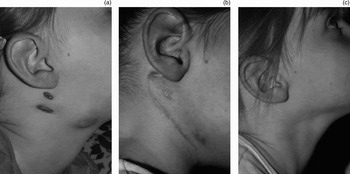
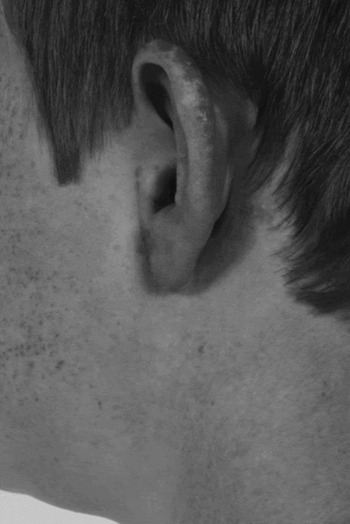
Modified Blair (cervicomastoid-facial) incisions were used for 15 of the children (Figure 1), while six children (all operated upon after 2005) underwent parotidectomy via a facelift incision (Figure 2). Continuous intra-operative facial nerve monitoring (NIM-Pulse; Medtronic Electronics, Minneapolis, Minnesota, USA) was used for all procedures performed after 2003, comprising 15 of the 22 parotidectomies. Prior to 2003, hand-held facial nerve stimulators were used for all procedures.
Atypical mycobacterial infection. (a) The child at presentation, with masses in the parotid and submandibular regions; unfortunately, she also had two chronically discharging upper neck wounds after incision and drainage of cold abscesses in her local hospital prior to referral to our unit. (b) The same child one month after superficial parotidectomy (modified Blair incision), level one to three selective neck dissection and excision of the discharging sinuses. (c) The same child three months after surgery.

Child three months after excision of a parotid lymphoma (thought pre-operatively to be a pleomorphic salivary adenoma) using a facelift incision.

Patients were followed up for a minimum of one year (range, one to 10 years; median, four years).
Pathology
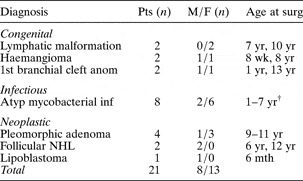
The pathology encountered is listed in Table I. The most common disease process encountered was atypical mycobacterial infection (8.38 per cent; Figure 1). Other types of pathology, in descending order of frequency, were: pleomorphic adenoma (four patients, 19 per cent), lymphatic malformation (two, 10 per cent), haemangioma (two, 10 per cent), first branchial cleft anomaly (two, 10 per cent), follicular non-Hodgkin's lymphoma (two, 10 per cent) and lipoblastoma (one, 5 per cent).
Patients'* final pathological diagnoses

* n = 21 children. †Median 3 years (yr). Pts = patients; M = male; F = female; surg = surgery; wk = weeks; anom = anomaly; atyp = atypical; inf = infection; NHL = non-Hodgkin's lymphoma; mth = months
Complications
No cases of permanent facial nerve palsy occurred. Mild transient facial nerve palsy occurred in five patients (23 per cent), all of which resolved spontaneously within a month. Four of these five cases underwent surgery prior to 2003, with use of a facial nerve stimulator. There was one case of permanent marginal mandibular branch palsy, in a patient with extensive atypical mycobacterial infection in the submandibular region as well as in the parotid (Figure 1). It was the submandibular clearance rather than the parotidectomy that was believed to be the cause of this patient's palsy. She was also the only patient to suffer a transient facial nerve palsy after 2003, when intra-operative use of a facial nerve monitor became routine.
Gustatory sweating (Frey's syndrome) occurred in four children (19 per cent), but was judged by patients to be mild in all cases. Treatment options were discussed, but in all of these cases the decision was made to manage the problem expectantly.
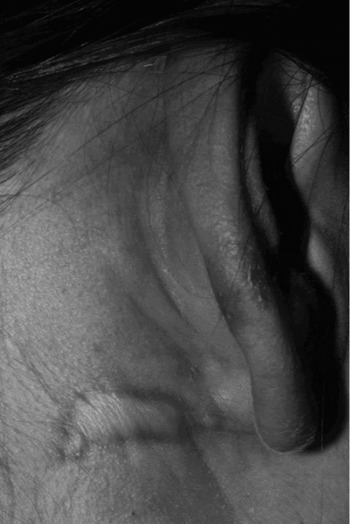
Hypertrophic scarring, characterised by raised, thickened scars with discomfort (Figure 3), occurred in three children (14 per cent). In all cases, the hypertrophic segment was located in the part of the wound below and posterior to the lobule. Of these three cases, two required treatment with topical corticosteroids, and symptoms settled after 11 months and 3.5 years, variously. The remaining case was mild and treatment was not requested. The choice of surgical incision did not obviously affect the incidence of hypertrophic scarring (which occurred after one in six facelift approaches, versus two in 15 modified Blair approaches).
Hypertrophic scar in a facelift parotidectomy wound.

One wound infection occurred but settled quickly with oral antibiotics, with no adverse cosmetic effect.
Numbness over the great auricular nerve distribution was reported by three patients, with one case resolving within a follow-up period of 16.5 months.
One case of disease recurrence occurred in this series. This was a deep lobe pleomorphic adenoma, operated upon by surgeons from another specialty. Recurrence occurred approximately 3.5 years after the original total parotidectomy. Revision surgery with post-operative radiotherapy was required.
Discussion
It is clear that the range of pathology seen in children with parotid masses is very different to that seen in adults. Our results are comparable to other series in this regard,Reference Smith and Charles1, Reference Orvidas, Kasperbauer, Lewis, Olsen and Lesnick2 with congenital lesions (29 per cent) and infectious lesions (38 per cent) being more common than in adult series where neoplasms of most common (33 per cent of our series). It should be borne in mind that these are figures for the proportion of parotid lesions proceeding to surgery, and that the true incidence of some lesions will be much higher. Haemangiomas of the parotid, for example, are very common but the vast majority do not require surgery. Surgery is only required for biopsy if the diagnosis cannot be established on clinical or radiological grounds, or for excision in the occasional cases that fail to involute. Two cases in our series were excised for these reasons.
Similarly, some cases of atypical mycobacterial infection may settle with antibiotic treatment, obviating the need for surgery, although such infection is more often extensive (as shown in Figure 1) and resistant to treatment. It has been our experience that surgery is often required for complete eradication of disease, as we have described previously.Reference Fraser, Moore and Kubba3 Atypical mycobacterial infection usually presents in young children aged approximately three years, as in this series.
The most common neoplasm in our series was pleomorphic salivary adenoma. As reported in other series,Reference Fraser, Moore and Kubba3–Reference Rodriguez, Vargas, Robson, Perez-Atayde, Shamberger and McGill5 these tend to present in older children. Our cases were all in children aged nine to 11 years. One of these children had a deep lobe tumour which was incompletely excised and which recurred three years later. Her presentation with recurrence was typical, in that recurrent tumours tend to be bigger than expected from clinical examination, lie at a deeper level and are commonly multicentric.Reference Bradley6–Reference Stennert, Wittekindt, Klussmann, Arnold and Guntinas-Lichius10 Recurrence rates for pleomorphic adenoma range from 1 to 9 per cent in adults,Reference Stennert, Wittekindt, Klussmann, Arnold and Guntinas-Lichius10–Reference Wennmo, Spandow, Emgard and Krouthen14 but are possibly as high as 20 per cent in children.Reference Shikhani and Johns15 Tumour recurrence is a result of spillage of tumour cells, due to cutting the pseudocapsule or cutting microprojections that extend outside the pseudocapsule;Reference Harell, Levy and Elam16 it has been suggested that the smaller facial structures present in children lead to an increased risk of cutting the pseudocapsule.Reference Shikhani and Johns15
Surgery is often particularly difficult for the kinds of parotid lesions encountered in childhood. Lymphatic malformations are typically extensive, infiltrative lesions that do not respect tissue planes, and this was certainly the case for the two such cases in our series. Both were large and involved the deep lobe, requiring total parotidectomy. In both cases, the dissection was noted to be very difficult because of the diffuse, infiltrative nature of the lesion. Anomalies of the first branchial cleft can also be very challenging to excise because of their variable relationship to the facial nerve. The tract of the anomaly may run above, between or below the branches of the facial nerve.Reference Waldhausen17 Both cases of this type in our series were type II anomalies containing cartilaginous elements in the duplication of the external auditory canal; in one, the facial nerve was found deep to the lesion.
• Parotidectomy is not commonly performed in children
• Indications for surgery differ significantly from those in adults, with congenital anomalies and infections being commonest
• Management of these conditions requires detailed knowledge of their natural history and treatment options
• Paediatric parotid lesions are best managed by surgeons with specific skills and experience in this area
It can be seen from the above that the surgeon operating on parotid lesions in children faces particular challenges, and that experience in adult parotid surgery may not in itself be enough to ensure optimal outcomes. The surgical procedures required for atypical mycobacterial infection, first branchial cleft anomaly and lymphatic malformation are very difficult. The same is probably also true for pleomorphic adenoma, in that recurrence rates in children appear to be higher than those in adults. Many types of pathology are specific to children, and the surgeon therefore needs to have a knowledge of their natural history and treatment options, particularly with regard to atypical mycobacterial infection and branchial anomalies.
A different approach to investigations may also be required. Fine needle aspiration cytology was only used in our series prior to 2002. We have found it to be less useful in children than in adults, for a number of reasons. Firstly, the commonest pathology in adults is epithelial neoplasm, for which FNAC is very accurate. Its accuracy is greatly reduced in the case of paediatric lymphoid tumours, embryonal tumours and vasoformative lesions. Secondly, FNAC can lead to skin breakdown and sinus formation in cases of atypical mycobacterial infection. Finally, FNAC is poorly tolerated in young children without general anaesthesia, which is difficult to justify when the diagnostic yield is low. In our view, FNAC may have a limited role in older children with suspected pleomorphic adenoma, but no role as a routine investigation in younger children. We find imaging much more helpful, particularly US, which is well tolerated in children and carries no radiation risk.
Conclusion
For the reasons discussed, we believe it important that parotid surgery in children be concentrated in the hands of a small number of paediatric specialists. Our own practice has evolved as our experience has increased. We have introduced routine facial nerve monitoring, with a consequent reduction in the incidence of transient facial nerve palsy. We have also introduced the more cosmetically acceptable facelift incision,Reference Terris, Tuffo and Fee18, Reference Nouraei, Al-Yaghchi, Ahmed, Kirkpatrick, Mansuri and Singh19 as well as modifying our approach to investigation as described above.