Introduction
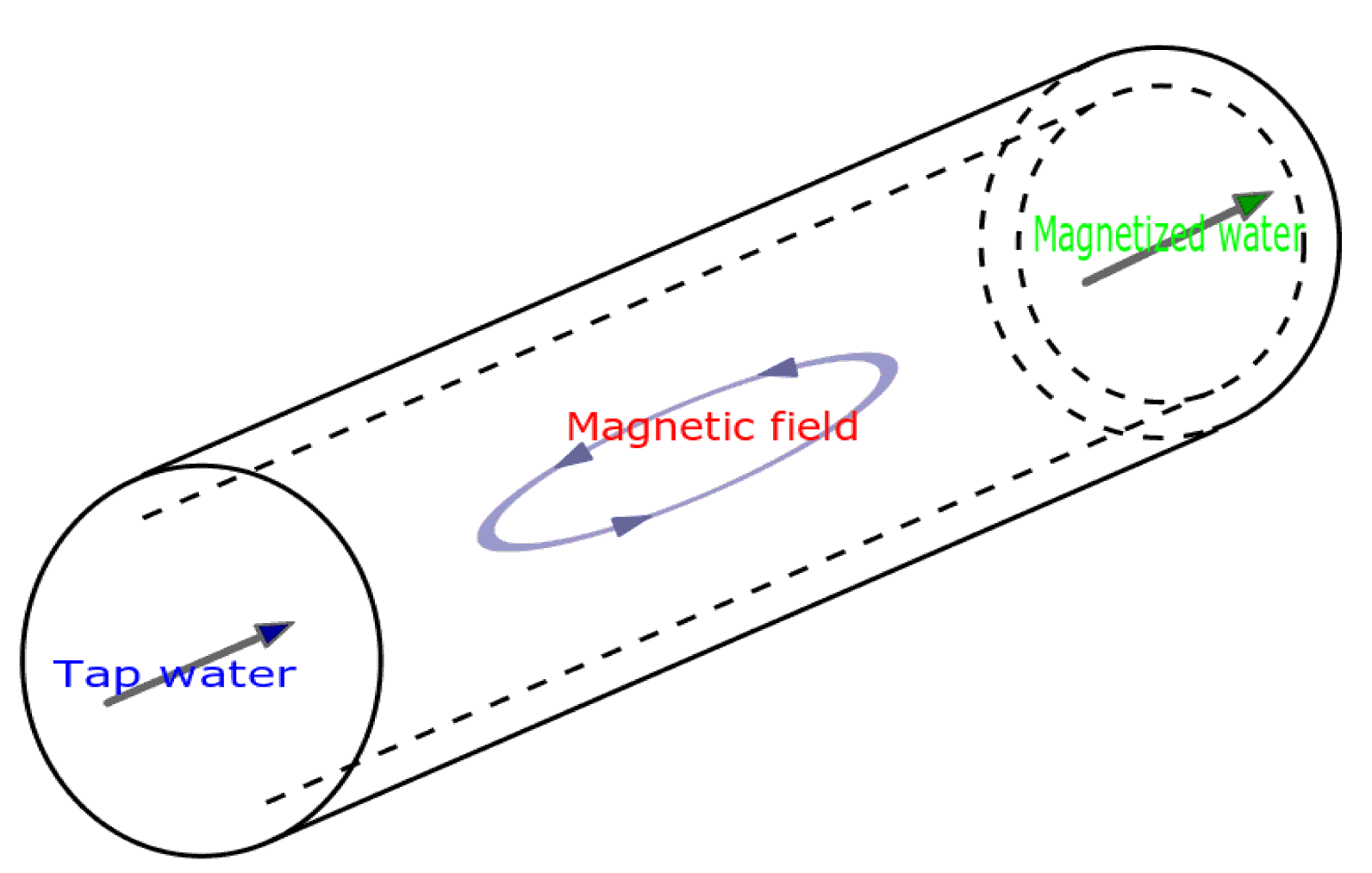
Water is considered as the most important nutrient for animals. It makes up over 98% of all molecules in the body and it is necessary for biological processes including growth, production, digestion, lactation and electrolytes balance (Lardy and Stoltenow, Reference LARDY and STOLTENOW1999). Magnetic treatment of water has wide application in varied fields, including poultry production (Khalil et al., Reference KHALIL, SHEBL, KOSBA, EL-SABROUT and ZAKI2016). When tap water (ordinary water) passes throughout a magnetic field (Figure 1), a physical interaction between the magnetic field and the moving electric charge is produced and properties can be changed. Exposing water to a magnetic field can affect the mineral content of water and its effects depend on the strength of the magnetic field and exposure time (Ebrahim and Azab, Reference EBRAHIM and AZAB2017). Positively charged ions, such as calcium and magnesium, and negatively charged ions, such as carbonate and sulphate, are directed toward each other with increased velocity and become more energised. Consequently, this improves the biological activity of solutions, positively affecting the performance of animals (Khudiar and Ali, Reference KHUDIAR and ALI2012). The changes of biological properties of natural water after being magnetised could improve water quality by increasing both electric conductivity and the dielectric constant (Ibrahim, Reference IBRAHIM2006).
Tap water is magnetised by passing it throughout a magnetic device.

Effect of magnetised drinking water on poultry health
Physics shows that water changes weight under the influence of magnetic fields, as more hydroxyl (OH-) ions are created to form alkaline molecules to reduce acidity. The drinking of alkaline water has a beneficial influence on poultry health (Olteanu et al., Reference OLTEANU, CRISTE, MARIANA and SURDU2012), although a maximum pH 8 is set for global water standards for poultry. When providing magnetised water, a decrease in mortality and diseases was detected by Wasef (Reference WASEF1996), as well as a decrease in feed consumption and an improvement in feed conversion ratio were observed by Sagbaug (Reference SAGBAUG2003). In contrast, Alhassani and Amin (Reference ALHASSANI and AMIN2012) showed that there were no significant differences in feed conversion ratio and mortality between tap water and magnetised water. Mitre (Reference MITRE2018) found that magnetised water did not influence feed conversion ratio in male broiler chickens.
Exposure of tap water to an electromagnetic field might have an anti-inflammatory effect (Jasti et al., Reference JASTI, WETZEL, AVILES, VESPER, NINDL and JOHNSON2001), and could stimulate the production of cytokines, mediating an enhanced immune response (Simko and Mattsson, Reference SIMKO and MATTSSON2004). Kamel et al. (Reference KAMEL, RASHEED, HASSAN and QADER2016) reported that magnetised water could influence innate and adaptive immune responses and inhibit the primary immune response (IgM) of rabbits against bacterial infections. Magnetised drinking water (6000 gauss) could be a useful method for improving water quality for geese, enhancing their physiological and immunological systems (El-Hanoun et al., Reference EL-HANOUN, FARES, ATTIA and ABDELLA2017). Additionally, magnetic water is effective as an anti-oxidant, protecting cells and tissues from the harmful effects of various acids and oxygen ions (Al-Nueimi and Al-Badry, Reference AL-NUEIMI and AL-BADRY2014). Magnetic water induces a positive influence on the absorption and metabolism in the body and this, in turn, caused increases in the viability of cells and immunity while decreasing lipid peroxidation biomarkers (MDA and TBRS), which improve the body's tolerance to pollutants and protects the body from the harmful effects of free radicals (Attia et al., Reference ATTIA, ABD EL HAMID, AL-HANOUN, AL-HARTHI, ABDEL- RAHMAN and ABDELLA2015). El-Katcha et al. (Reference EL-KATCHA, SOLTAN, EL NAGGAR and FARFOUR2017) found that the magnetised drinking water could improve immune response and intestinal health in growing Pekin ducklings. The magnetised drinking water could improve antibody titres of broiler chicks against Newcastle disease vaccine at 35 d of age and phagocytic activity (macrophages) by about 42.9 %, 14.0 % respectively compared with those that drank tap water (El-Katcha et al., Reference EL-KATCHA, SOLTAN, EL-SHOBOKSHY and KASSER2018). Moreover, it could reduce total bacterial count in jejunum and colon of broiler chicken by about 9.9% and 27.2% respectively. These results are supported by those obtained by Anne et al. (Reference ANNE, FRANCIS and SILAS2016), who reported a maximum disinfection efficiency of 82.2% for bacteria exposed to a magnetic flux of 10 mT for 6 h and proved that a magnetic field can be used to inhibit E. coli. Generally, microbiota plays an important role in growth and health of chickens by contributing in the enhancement of nutrient absorption and the immune system. Additionally, the bacterial community in the intestinal is involved in generating a protective barrier which lines the gut and prevents the growth of pathogenic bacteria. Magnetised water could have a large disinfection effect on harmful bacterial community in chickens.
Effect of magnetised drinking water on poultry's productive performance
Rona (Reference RONA2004) reported that magnetic drinking water increased growth rate, shorted the fattening period and improved meat quality of broiler chickens. In agreement, Al-Fadul (Reference AL-FADUL2006) concluded that magnetisation of water changed water properties (e.g. more alkaline), which consequently improved the productivity of broiler chickens. The magnetised drinking water profoundly improved villus height and muscle thickness in the jejunum of broiler chickens. El-Hanoun et al. (Reference EL-HANOUN, FARES, ATTIA and ABDELLA2017) found that magnetised tap water improved body weight (+19.6%) and feed conversion rate (-18.2%) as well as renal and hepatic functions in geese. Magnetised water improved growth performance and feed efficiency of growing Pekin ducklings (El-Katcha et al., Reference EL-KATCHA, SOLTAN, EL NAGGAR and FARFOUR2017). In contrast, Al-Mufarrej et al. (Reference AL-MUFARREJ, AL-BATSHAN, SHALABY and SHAFEY2005) reported that magnetic drinking water has no significant effect on the productive performance and carcass quality of broiler chickens. Alhassani and Amin (Reference ALHASSANI and AMIN2012) showed that body weight, feed conversion ratio and production performance were not significantly different for birds receiving tap water or magnetised water.
However, Jassim and Aqeel (Reference JASSIM and AQEEL2017) indicated that the usage of ionised alkaline drinking water for broiler chickens could improve some physiological traits such as haemoglobin concentration and haematocrit, but had no effect on other blood parameters and liver enzymes. Al-Hilali (Reference AL-HILALI2018) concluded that magnetised water could improve all biochemical and physiological properties in Japanese quail, which may help improve productivity. Ebrahim and Azab (Reference EBRAHIM and AZAB2017) found that there was an improvement in water quality when exposed to magnetic field, with a considerable change in the pH, salinity, total hardness, dissolved solids, conductivity, dissolved oxygen, organic matter and total count of bacteria. This could improve blood and biochemical parameters as well as antioxidant status in animals (Ebrahim and Azab, Reference EBRAHIM and AZAB2017). However, Gilani et al. (Reference GILANI, KERMANSHAHI, GOLIAN, GHOLIZADEH and MOHAMMADPOUR2014) reported that magnetised drinking water had no adverse effect on blood parameters.
Sasso broiler chicks, that were provided magnetised drinking water, had greater (P<0.05) body weights at market age than the control receiving tap water (1914 and 1838 g; respectively). Daily water consumption in the magnetised water group were greater (P<0.05) than in the control (1.77 and 1.24 ml/bird/day; respectively) (Mahmoud et al., Reference MAHMOUD, SOLIMAN, BAHIE EL DEEN and EL SEBAI2017).
In research on Lohmann Brown hens, El-Sabrout and Hanafy (Reference EL-SABROUT and HANAFY2017) found that magnetised water enhanced eggshell quality by increasing shell thickness and weight, but had no effects on egg yield or weight. However, El-Sabry et al. (Reference EL-SABRY, CHARAL, MCMILLAN and LAVERGNE2018) found that magnetised water had no effect on egg production and egg mass. The hens that were provided magnetised water had thicker and heavier (P<0.05) eggshells than the tap water control (0.36 and 0.33 mm, 59.00 and 57.62 g; respectively). The levels of blood Ca and P in the magnetised water group were greater (P<0.05) than in the control (32.60 and 27.62 mg/dl, 6.78 and 4.55 mg/dl; respectively; El-Sabrout and Hanafy, Reference EL-SABROUT and HANAFY2017). Magnetised water, particularly with high gauss (more than 10000 gauss) works to make calcium more available to the hen and enhance eggshell quality without negative effects on the hen. Hassan et al. (Reference HASSAN, ATTIA, EL-SHEIKH and ABDELKADER2018) concluded that productive performance, physiological response and egg shell quality of Gimmizah chickens were improved due to magnetised water (2000 gauss). Wang et al. (Reference WANG, CHAO and YANG1998) reported that magnetic water increased efficiency in the biological and biochemical reactions of sperm cells. Al-Daraji and Aziz (Reference AL-DARAJI and AZIZ2008) revealed that the quality and quantity of the semen of roosters that received magnetised water were significantly better than those of tap water. In agreement, El-Hanoun et al. (Reference EL-HANOUN, FARES, ATTIA and ABDELLA2017) reported that the semen quality of geese that drank magnetised water was better than those receiving tap water.
Conclusions
This review demonstrated that magnetised drinking water could contribute to enhancing health and productivity of poultry. Magnetised water, particularly with high gauss (more than 1000 gauss), could improve growth for broilers and enhance some egg production traits for hens.
Conflict of interest
The authors declare that there is no known conflict of interest associated with this publication.