Introduction
Bipolar disorder (BD) and schizophrenia (SZ) are complex mental disorders characterized by poor psychosocial functioning (Van Rheenen & Rossell, Reference Van Rheenen and Rossell2014a) and impaired cognition extending across both social and non-social domains (Gogos, Joshua, & Rossell, Reference Gogos, Joshua and Rossell2010; Rossell, Van Rheenen, Joshua, O’Regan, & Gogos, Reference Rossell, Van Rheenen, Joshua, O’Regan and Gogos2014; Rossell & Van Rheenen, Reference Rossell and Van Rheenen2013; Van Rheenen & Rossell, Reference Van Rheenen and Rossell2013b, Reference Van Rheenen and Rossell2014b, Reference Van Rheenen and Rossell2014c; Van Rheenen & Rossell, Reference Van Rheenen and Rossell2014d). There is a growing literature suggesting that these latter deficits are strongly predictive of the former; with impairments in facial emotion recognition in particular, often cited as a potentially important contributing factor for impaired interpersonal functioning (Brekke, Kay, Lee, & Green, Reference Brekke, Kay, Lee and Green2005; Kee, Green, Mintz, & Brekke, Reference Kee, Green, Mintz and Brekke2003).
In the SZ literature, there have been some attempts to determine the underlying mechanisms associated with these emotion recognition aberrations, with findings pointing toward a potential role for general cognitive ability as well as perceptual face processing per se (Fakra, Jouve, Guillaume, Azorin, & Blin, Reference Fakra, Jouve, Guillaume, Azorin and Blin2015; Joshua & Rossell, Reference Joshua and Rossell2009; Kohler, Bilker, Hagendoorn, Gur, & Gur, Reference Kohler, Bilker, Hagendoorn, Gur and Gur2000; Sergi et al., Reference Sergi, Rassovsky, Widmark, Reist, Erhart, Braff and Green2007). In the BD literature, however, there has been far less attention focused on these lines of enquiry (Van Rheenen, Meyer, & Rossell, Reference Van Rheenen, Meyer and Rossell2014).
Sufficient processing of visual information and the use of appropriate face processing strategies are a necessary pre-requisite for intact facial emotion recognition. In SZ, impaired performance on face processing tasks suggests that a failure of these prerequisites may at least partially account for some of the facial emotion recognition impairments commonly observed in the disorder (Bortolon, Capdevielle, & Raffard, Reference Bortolon, Capdevielle and Raffard2015; Joshua & Rossell, Reference Joshua and Rossell2009; Rossell et al., Reference Rossell, Van Rheenen, Joshua, O’Regan and Gogos2014; Shin et al., Reference Shin, Na, Ha, Kang, Yoo and Kwon2008). In BD, no studies have comprehensively investigated the use of typical face processing strategies in and of themselves, although there have been some attempts to address the influence of basic face processing ability in emotion recognition studies in BD (Addington & Addington, Reference Addington and Addington1998; Getz, Shear, & Strakowski, Reference Getz, Shear and Strakowski2003; Van Rheenen & Rossell, Reference Van Rheenen and Rossell2013a). This generally occurs in the context of control tasks that require the discrimination of gender or identity.
Such tasks, when used as a proxy for face processing ability, are limited since the discrimination of faces can be accomplished on the basis of matching local featural information (such as the eyebrows or the nose) in a piecemeal manner (Duchaine & Weidenfeld, Reference Duchaine and Weidenfeld2003). Yet a large body of research shows that the use of top-down processing strategies that incorporate facial information more globally, may be an even more important means of face recognition than the processing of isolated featural information (Tanaka & Farah, Reference Tanaka and Farah1993). Thus, normal performance on gender or identity discrimination tasks does not necessarily suggest normal face processing ability. As a result intact performance on such tasks is not sufficient to conclude intact face processing in BD generally (Duchaine & Weidenfeld, Reference Duchaine and Weidenfeld2003).
Typically, face processing requires the initial identification of a normal facial configuration represented by two eyes, above a nose, above a mouth. As all faces share this same first-order relationship, face perception also relies on the processing of spatial relationships between elements in the face, including the distances between local features (Maurer, Reference Maurer2002). This second-order configural processing is an important top-down perceptual skill for distinguishing identities, but also for the appropriate identification of facial expressions that reflect subtle muscular changes in the spatial positioning and relationships between local features (Bombari et al., Reference Bombari, Schmid, Schmid Mast, Birri, Mast and Lobmaier2013; Derntl, Seidel, Kainz, & Carbon, Reference Derntl, Seidel, Kainz and Carbon2009; Fakra et al., Reference Fakra, Jouve, Guillaume, Azorin and Blin2015).
A known proxy for the use of configural strategies is the facial inversion effect, which describes performance impairments in the processing of faces when they are inverted by 180° (Renzi et al., Reference Renzi, Schiavi, Carbon, Vecchi, Silvanto and Cattaneo2013). Given that this effect is substantially less pronounced when faces are digitally manipulated to express changes in featural rather than spatial information, the extent of disruption for the processing of inverted compared to the upright faces is widely recognized as representing the extent to which second-order configural face processing strategies are relied on during face recognition (Maurer, Reference Maurer2002). Indeed, significant research shows a differential effect in which there is an absence or smaller inversion effect on featural compared to second-order configural processing tasks in the healthy population (Freire, Lee, & Symons, Reference Freire, Lee and Symons2000; Leder & Bruce, Reference Leder and Bruce2000).
In patients with SZ, there is evidence that shows that there is a reduction in susceptibility to this facial inversion effect compared to controls (Shin et al., Reference Shin, Na, Ha, Kang, Yoo and Kwon2008). The implications that this has for emotion processing has been demonstrated recently, in a study indicating that a smaller inversion effect reduces the capacity for accurate identification of emotional expressions in this disorder (Fakra et al., Reference Fakra, Jouve, Guillaume, Azorin and Blin2015). Given increasing evidence that BD patients have similar, albeit less severe cognitive deficits in emotion recognition as their SZ counterparts (Van Rheenen & Rossell, Reference Van Rheenen and Rossell2014c), it is possible that the configural processing deficits that have been previously found in SZ extend to BD as well.
To explore this notion we aimed to investigate the use of configural face processing strategies in BD; the first study of its kind to our knowledge. Here, we examined performance differences in a sample of individuals with BD and SZ compared to controls. We expected that, in controls, upright faces would be processed more accurately and efficiently than inverted faces, but that this effect would be more pronounced for manipulations of second-order relationships than local featural elements. Given evidence of impaired configural processing in SZ alongside preferential processing of local (compared to global) information (Schwartz Place & Gilmore, Reference Schwartz Place and Gilmore1980; Silverstein et al., Reference Silverstein, Uhlhaas, Essex, Halpin, Schall and Carr2006; Wells & Leventhal, Reference Wells and Leventhal1984), we expected that the SZ group would be less susceptible to the configural inversion effect than controls, with BD patients’ performance falling intermediate to the two other groups. The relative strength of the configural over featural inversion effect in the BD group and the effect of current symptomatology on face processing in the clinical groups generally, remained open questions.
Method
This study was approved by the relevant Hospital and University review boards and abided by the Declaration of Helsinki. Written informed consent was obtained from each participant before the study began.
Participants
The clinical sample comprised 28 individuals with BD-I and 28 individuals with SZ. Patients were recruited via community support groups and community care units and were all out-patients. Diagnosis was ascertained using the Structured Clinical Interview for DSM-IV (SCID) (First, Spitzer, Gibbon, & Williams, Reference First, Spitzer, Gibbon and Williams1996). Current symptomology was acquired using the Beck Depression Inventory (BDI) (Beck & Steer, Reference Beck and Steer1987) and the Positive and Negative Syndrome Scale (PANSS) (Kay, Fiszbein, & Opler, Reference Kay, Fiszbein and Opler1987): global positive, negative, general, and composite scores were calculated. All BD patients were tested during a period of clinical stability (i.e., not currently meeting criteria for a mood or psychotic episode) as determined by the investigators via their SCID interview; however, 12 BD individuals were considered to be depressed on the basis of their BDI score (≤10). Sixteen SZ patients were considered to have current psychotic symptoms (PANSS P1 and/or P3 scores >3). None of the patients included in the sample experienced any co-morbid Axis 1 diagnoses at the time of testing.
A sample of 28 healthy control participants was recruited via newspaper advertisements. Control participants were excluded if they had any history of psychiatric disorder or a first degree relative with SZ, BD, or Schizoaffective Disorder (based on the SCID). In addition, participants from all three groups met the following criteria: (a) no history of neurological disorder or head trauma, (b) no diagnosable current drug or alcohol abuse disorder and no illicit drug use in the previous 24 hr, (c) English spoken as first language, (d) aged between 18 and 65 years, (e) estimated premorbid IQ >85 based on the National Adult Reading Test (NART) (Nelson & Willison, Reference Nelson and Willison1991), and (f) no electroconvulsive therapy in the past 12 months.
Within the BD group, one patient was taking antipsychotic medication alone (atypical); four were taking mood stabilizers alone; six were taking antipsychotics (all atypical) and mood stabilizers; six were taking antidepressants and mood stabilizers; two were taking antipsychotics (all atypical), antidepressants, and mood stabilizers; one was taking an antidepressant and an antipsychotic (atypical); one was taking an antidepressant and a benzodiazepine; one was taking a mood stabilizer and a sedative; one was taking an antipsychotic (atypical), mood stabilizer, and a benzodiazepine; one was taking an antipsychotic (atypical), mood stabilizer, and an anti-cholinergic; and three were medication free.
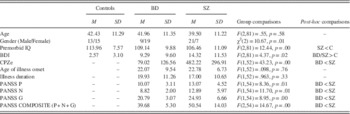
Within the SZ group, 15 patients were taking antipsychotic medication alone (1 typical, 14 atypical, 2 combination); 4 were taking antipsychotics (4 atypical, 1 combination) and an antidepressant; 1 was taking an antipsychotic (atypical) and a mood stabilizer; 1 was taking a combination of an antipsychotic (atypical), an antidepressant, and a mood stabilizer; 1 was taking an antipsychotic (atypical), antidepressant, and a benzodiazepine; 3 were taking antipsychotics (atypical) and benzodiazepines; 2 were taking antipsychotics (atypical), benzodiazepines, and anti-cholinergic; and 1 was medication free. Group averages of chlorpromazine (CPZ) equivalents are given in Table 1.
Demographics and clinical characteristics of the sample

BD=bipolar disorder; BDI=Beck Depression Inventory; CPZe=chlorpromazine equivalents; PANSS=Positive and Negative Syndrome Scale; SZ=schizophrenia.
Materials
Featural and second-order configural face processingFootnote 1
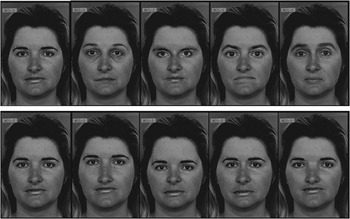
Featural and spacing manipulation sets were used to assess the facial inversion effect after featural and configural change. Both tasks had the same design and face stimuli, however, differed in the type of manipulation completed. The featural set manipulated the features of the face while maintaining consistent configural information. The spacing set manipulated the spatial distances between features, that is second-order configural face information. The two stimuli sets were created using gray-scaled emotionally neutral faces from the Pictures of Facial Affect series (Ekman & Friesen, Reference Ekman and Friesen1976). One white adult female face was selected as the template face and digital manipulations were made in line with previous work (Freire et al., Reference Freire, Lee and Symons2000). For the featural set, the eyes, nose, and mouth were selected from four other female faces and digitally pasted over the features in the template face. Thus, four manipulations in addition to the template face were created, resulting in five distinct face images. The eye-nose-mouth replacement features did not differ in brightness or contrast to the template face. Furthermore, they were selected to closely match the iris size and width of the nose and mouth to that of the template face. This clearly altered the featural information within the original template face, while maintaining the configural information as well as external features. While featural manipulation may result in slight alterations in the configural information, care was taken to minimize these changes.
For the spacing set, the eyes (and eyebrows) were either moved horizontally in or out by 2 pixels, or the eyes and mouth were moved vertically down or up by 3 pixels. Thus, like the featural task, four manipulations in addition to the template face were created, resulting in five distinct face images. This disrupted the second-order configural information within the template face, while maintaining the featural and first-order information. All face images were 320×480 pixels in size. During stimuli editing, the blurring tool was used to maintain continuity of skin shade. Therefore, all face manipulations were subtle, resulting in normal looking faces with careful attempts made to avoid distinctiveness or grotesqueness. Figure 1 presents an example of the task stimuli.
Featural Manipulation (top) and Spacing Manipulation (bottom).

Face pairs were presented on the screen for 8 s, followed by a fixation cross (+) for 500 ms in between each trial. Participants were required to determine if the two faces presented were the same or different. This discrimination design was selected to minimize the memory demand apparent in other similar tasks (LeGrand, Mondloch, Maurer, & Brent, Reference LeGrand, Mondloch, Maurer and Brent2001). Responses were made via a two-button press. Participants were instructed to respond as quickly yet as accurately as possible to indicate whether the faces were the “same” or “different.” As soon as the participant responded, the task progressed to the next trial. The buttons were labelled so participants would not forget which button was which.
After reading the instructions, participants completed three practice trials for each task. Thereafter, for both tasks, each of the five face images was paired with itself eight times and each other twice (once to the left, once to the right), creating a total of 80 face pairs; thus, half of the face pairs showed identical (same) faces and the other half showed different faces. Each face pair was presented in upright and inverted orientation, thus participants completed 160 randomized trials for each task. The order of task completion was counterbalanced.
Statistical Analysis
Demographic and clinical group differences were assessed via Chi-Square tests or one-way between-groups analysis of variance (ANOVA) with post hoc Fisher’s least significance difference (LSD) tests. Given group differences in premorbid IQ and gender, a validity check was performed to examine associations between these demographic variables and accuracy, response time and difference scores (i.e., upright-inverted performance scores on the featural and spacing tasks) on the face processing tasks using Pearson’s/Spearman’s correlations (alpha set at a conservative p<.01 to correct for multiple testing) in each of the three groups. As neither of the variables significantly correlated with these demographic variables in any of the groups, we did not covary for them in subsequent analyses.
As the featural and spacing tasks shared the same design, we incorporated both tasks into a two (task; featural or spacing)*two (orientation; upright, inverted)*three (group; controls, BD, SZ) repeated measures ANOVA with post hoc Fisher’s LSD tests to investigate differential effects of featural and configural manipulation on performance. Follow-up paired samples t tests separated by group were used to compare performance on upright and inverted conditions as well as the inversion difference scores in both spacing and featural tasks to each other. Independent samples t tests comparing each group to each other were used to compare the inversion difference score (i.e., performance in the upright minus the inverted condition) on the spacing task. Effect sizes were calculated in Cohen’s d and for clarity, are only reported in positive form in text. Pearson’s correlations were used to examine associations between clinical symptomatology and task performance in the clinical groups. All post hoc/follow-up tests and correlations were corrected using a conservative α of p<.01.
Results
Demographics
As can be seen in Table 1, the SZ patients had a significantly lower premorbid IQ than controls. PANSS and BDI ratings in SZ patients were significantly higher than for BD patients. SZ patients were also on a higher average dose of antipsychotics in CPZ equivalents. There were no group differences between SZ and BD groups in terms of age, age of illness onset or illness duration.
Featural and Spacing Task Analysis
Accuracy
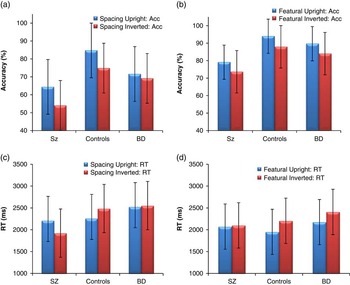
Figures 2a and 2b show accuracy performance for the spacing and featural tasks across groups. There was a main effect of task (F(1,81)=145.11; p<.001) and orientation (F(1,81)=68.151; p<.001) with all participants performing better in the featural (M=84.72; SD=13.44) compared to the spacing (M=69.78; SD=13.83) task (d=1.24), as well as in the upright (M=80.57; SD=12.75) compared to the inverted (M=73.93; SD=13.07) orientations (d=0.51). A main effect of group (F(2,81)=21.61; p<.001) indicated that SZ patients (M=67.78; SD=11.29) performed worse than controls (M=85.37; SD=7.03) overall (p<.001; d=1.87), with BD patients (M=78.60; SD=11.36) performing significantly better than the former group (p<.001; d=0.96) and worse than the latter (p<.01; d=0.72).
Group performance on the Spacing and Featural Tasks. (a) Accuracy—Spacing Task. (b) Accuracy—Featural Task. (c) Response time—Spacing Task. (d) Response time—Featural Task. Error bars represent standard deviations. Acc=accuracy; RT=response time.

There were trends for an orientation*group (F(2,81)=2.61; p=.08) interaction. Significant task*group (F(2,81)=3.86; p=.03) and task*orientation*group (F(2,81)=4.86; p<.01) interactions were also present. Follow-up analysis revealed that the SZ group showed an inversion effect on both the spacing (t(27)=5.63; p<.001) and the featural tasks (t(27)=2.62; p=.01). Similarly, the control group also showed a significant inversion effect on the spacing task (t(27)=5.03; p<.001) and the featural task (t(27)=4.36; p<.001). In contrast, the BD group showed a significant inversion effect on the featural task (t(27)=4.72; p<.001) but not the spacing task (t(27)=1.48; p=.15). There was a trend for a significantly stronger inversion effect (i.e., the difference score) for the spacing compared to the featural task for SZ patients (t(27)=2.33; p=.03) only (see Figure 3a).
Effect size differences between the Featural and Spacing inversion effects (difference scores) across groups. (a) Accuracy and (b) response time; *p<.01 larger inversion effect for Spacing over Featural Task; ~p<.01 reverse inversion bias favouring the Featural over Spacing Task; ^p<.01 larger reverse Spacing inversion effect compared to normal Featural inversion effect in SZ; note that although it appears that the normal Spacing over Featural inversion effect is evident in the SZ group, the Spacing inversion effect, albeit larger compared to the Featural inversion effect, was in reverse. Note larger inversion effects in the Featural compared to the Spacing Task are represented as negative. Error bars represent standard deviations.

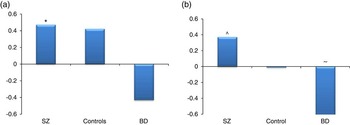
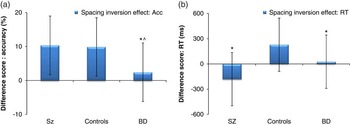
Comparison of the spacing inversion effects across groups indicated that BD patients were significantly less susceptible to the effect relative to controls (t(54)=2.92; p<.001; d=0.78) and SZ patients (t(54)=3.77; p<.001; d=0.86). There were no differences in the strength of the spacing inversion effect between the SZ and control groups (all p’s >.05). Figure 4a presents a graphical representation of these difference scores across groups.
Difference scores (i.e., extent of inversion effect) on the Spacing Task per group; (a) accuracy difference score and (b) response time difference score. Note the lack of inversion effect on the Spacing Task for both accuracy and response time in the BD group. *p<.01 compared to controls; ^p<.01 between clinical groups. Note the opposite response time effect in the SZ group. Error bars represent standard deviation. Acc=accuracy; RT=response time.

Response time
Figures 2c and 2d shows response time performance for the two tasks across groups. There was a main effect of task (F(1,80)=14.17; p<.001) and orientation (F(1,80)=5.34; p<.01) with all participants responding faster in the featural (M=2151.98; SD=466.16) compared to the spacing (M=2328.68; SD=550.19) task (d=0.35), as well as in the upright (M=2199.34; SD=438.47) compared to the inverted (M=2281.8152; SD=540.85) orientations (d=0.08). A main effect of group (F(2,80)=4.04; p=.02) indicated that SZ patients (M=2075.28; SD=498.52) had shorter latencies compared to BD patients (M=2415.95; SD=433.39) overall (p<.01; d=0.73). Although SZ patients were faster than controls (M=2225.14; SD=402.10; d=0.30) and BD patients were slower overall, neither difference was significant (both p’s >.05; C/BD d=0.41).
Significant task*group (F(2,80)=4.52; p<.01), orientation*group (F(2,80)=10.13; p<.001), task*orientation (F(1,80)=19.55; p<.001) and task*orientation*group (F(2,80)=4.10; p=.02) interaction effects were also present. Follow-up analyses indicated that on the featural task, both the BD (t(27)=−4.61; p<.001; d=0.45) and control (t(27)=−6.90; p<.001; d=0.58) groups showed an inversion effect by performing significantly faster in the upright compared to the inverted condition. A featural inversion effect was not apparent in the SZ group, however (i.e., performance did not significantly differ across conditions (t(27)=−.37; p=.72; d=0.05). On the spacing task, the control group showed the normal inversion effect (t(27)=−5.75; p<.001). As performance speed did not significantly differ across upright and inverted conditions in the BD group (t(27)=−.44; p=.66), a spacing inversion effect was not apparent. The SZ group on the other hand showed a trend for a reverse inversion pattern, responding faster in the inverted compared to the upright spacing condition (t(26)=2.36; p=.03).
Analyses of the extent of the inversion effects across the featural and spacing tasks indicated a larger difference score for the former compared to the latter (t(27)=−4.25; p<.001) in the BD group, while the difference score was larger for the latter compared to the former in the SZ group (t(26)=−2.78; p≤.01). There was no significant difference in the strength of the inversion effect on the featural and spacing tasks in the control group (t(27)=.47; p=.64). Figure 3b provides a graphical representation of effect sizes of the difference scores between these two tasks for each of the three groups.
Comparison of the spacing inversion effect across groups indicated that BD patients were significantly less susceptible to the inversion effect relative to controls (t(54)=2.81; p<.01; d=0.75). Significant differences in the strength of the effect were evident for the SZ group compared to controls (t(38.57)=4.66; p<.001; d=1.26), while a trend-level difference was also evident comparing the two clinical groups (t(53)=−2.12; p=.04; d=0.57; see Figure 4b).
Post hoc Analysis
Given that the mean accuracy performance on the spacing task in the SZ group was just above chance level, we re-ran all within-group analysis in the SZ group removing patients whose spacing inversion error rate was above 50% (n=9). This was to further understand whether the unexpected inversion effect in this group was related to the particularly poor performance on the inverted condition in some SZ individuals. However, this analysis yielded no difference to the response time or accuracy results.
Correlations with Symptom Scores
There were no correlations between any of the variables of interest and symptomatology scores on the PANSS or BDI in any of the groups.
Discussion
Despite the potential for impaired perceptual face processing to contribute to the facial emotion recognition deficits that are increasingly replicated in BD and SZ research, there has been limited attention focused on the extent to which typical face-processing strategies are used in patients with these disorders; particularly BD. Here, we examined a group of individuals with BD and SZ compared to controls, in the first study to examine and contrast featural and configural face processing in these disorders.
In terms of control performance, we were able to replicate the normal inversion effect for the second-order configural processing task (Freire et al., Reference Freire, Lee and Symons2000), which suggests that healthy individuals do process upright faces more efficiently than inverted faces. Furthermore, mean accuracy inversion differences between the spacing and featural tasks indicated that faces that had been featurally manipulated were not as vulnerable to this effect compared to faces that had been configurally manipulated. Although this difference was not significant, the effect was in the medium size range. Taken together, this pattern of results speaks to claims that face inversion disrupts configural processing more so than featural processing, suggesting that there may be different mechanisms involved in these two face-processing strategies, at least in part (Leder & Bruce, Reference Leder and Bruce2000; Schwaninger, Lobmaier, Wallraven, & Collishaw, Reference Schwaninger, Lobmaier, Wallraven and Collishaw2009).
The most prominent finding of the current study was the absence of an inversion effect on the measure of second-order configural processing in BD, where the strength of the inversion effect was substantially lesser than that found in the SZ and control groups. This, coupled with an abnormal preferential inversion effect for the featural task over the spacing task suggests that in the BD group, there is impairment in the processing of second-order configural face information in the context of a disproportionate reliance on featural face processing. This is further supported by an absence of group differences in the strength of the inversion effect on the featural processing measure in BD patients compared to controls, together with indications that the lack of configural inversion effect in this group was likely attributable to accuracy impairments (relative to controls) for the processing of upright faces, which are primarily reliant on second-order configural processing. This is as opposed to improved performance (relative to controls) for inverted faces, which are reliant on featural or “object” information (see Figure 2a for a visual comparison of performance in both conditions between BD vs. controls.).
Furthermore, a reverse inversion pattern was evident for some individuals with BD (see negative error bar in Figure 4a, for example), which suggests that these individuals processed inverted faces more efficiently than upright faces. This pattern certainly speaks to the assertion that inverted faces activate a more general visual processing mechanism, that is, one that processes isolated facial features or “objects”; in these BD individuals, this mechanism appears to be intact and unable to compensate for aberrant processing of upright configurally manipulated faces (de Gelder, Bachoud-Lévi, & Degos, Reference de Gelder, Bachoud-Lévi and Degos1998; Farah, Wilson, Maxwell Drain, & Tanaka, Reference Farah, Wilson, Maxwell Drain and Tanaka1995). In combination, these findings are consistent with the theory that inversion increases dependence on featural processing at the expense of configural processing efficiency (Maurer, Reference Maurer2002), and suggest that featural but not configural face processing is intact in this group.
The prediction that the SZ group would be less susceptible to the facial inversion effect compared to controls was not supported by the current accuracy findings. This is in direct opposition to several recent studies that have demonstrated disturbed second-order configural processing in this disorder (Fakra et al., Reference Fakra, Jouve, Guillaume, Azorin and Blin2015; Joshua & Rossell, Reference Joshua and Rossell2009; Shin et al., Reference Shin, Na, Ha, Kang, Yoo and Kwon2008). The response time findings for the SZ group did, however, support an argument for disturbed second-order configural processing, although this was unexpectedly revealed in the context of a reverse inversion pattern. Therefore, it is suggested that the lack of a significant accuracy inversion effect seen here, likely reflects the product of a speed versus accuracy trade-off in patients with SZ.
Indeed, a main effect of orientation indicated that inverted faces were more difficult to process overall. On the second-order configural task, this effect appeared to be even more pronounced in the SZ group, such that mean-level performance in SZ patients (vs. controls) was lower in both the upright and inverted conditions, but response latencies were substantially increased for the latter condition only. This effect remained when participants performing at chance level on the inverted condition were removed. In light of known deficits in speed of processing and psychomotor behavior in SZ, this unusually increased response time in the presence of a pronounced accuracy error rate in the inverted spacing condition, potentially indicates a lack of effortful responding in this group in this arguably more challenging condition; it is certainly plausible that had this impulsive responding been normalized or decreased compared to controls as usually occurs in patients with SZ, performance in the inverted condition would have improved. Consequently, this would likely have reduced the extent of the inversion related differences between the two orientation conditions, which would be in line with the existing literature.
While this suggestion is purely speculative, the growing literature indicating a performance preference for the processing of local over more global top-down facial information in SZ patients does speak to the contention that a speed versus-accuracy trade-off masked an observation of reduced susceptibility to the facial inversion effect in SZ here (Chen, Nakayama, Levy, Matthysse, & Holzman, Reference Chen, Nakayama, Levy, Matthysse and Holzman2003; Johnson, Lowery, Kohler, & Turetsky, Reference Johnson, Lowery, Kohler and Turetsky2005). Regardless, it is unlikely that any alterations in response latency would have been enough to compensate entirely for aberrant accuracy performance in this group, since SZ patients consistently show impaired group-level performance on perceptual and emotion recognition tasks in general (Johnson et al., Reference Johnson, Lowery, Kohler and Turetsky2005; Rossell et al., Reference Rossell, Van Rheenen, Joshua, O’Regan and Gogos2014; Rossell, Van Rheenen, Groot, Gogos, & Joshua, Reference Rossell, Van Rheenen, Groot, Gogos and Joshua2013). Consistent with this, worse performance in SZ across both the spacing and featural tasks in general suggests that abnormalities in face specific (upright-configural) and more general visual processing mechanisms (inversion-featural) contribute to abnormalities on face processing tasks in SZ.
In sum, our results indicate significant accuracy impairments on measures of face processing in SZ and highlight impairment in the use of second-order configural face processing strategies in BD compared to controls. However, despite the novelty of these latter findings, our results should still be interpreted within the confines of some limitations. First, although based on existing measures, the facial processing tasks were newly developed in our lab and have not been validated in other clinical samples. This notwithstanding, ceiling performance was not evident on either the featural or spacing tasks, and both tasks did reliably reveal group differences and support the facial inversion pattern expected in controls.
In future studies we aim to replicate these findings with the same methodology. Second, given that patients were on different medications, we could not adequately control for medication effects. Although we found no significant bivariate correlations between CPZ equivalent scores and task performance, these scores only account for a subclass of the medications in use in the sample. Thus, it remains possible that other medications may have still had an influence on performance. Third, there was a gender imbalance across participants from each of the three groups. Although provisions were made to explore gender as an influential factor within initial correlation analyses, future investigations should attempt to include equal numbers of males and females across groups. Finally, it should be noted that the BD and SZ groups had significant differences in their positive, negative, and general symptomatology scores, with many of the patients with SZ demonstrating moderate—severe psychotic symptoms. Although there were no correlations between PANSS scores and face processing performance in either the BD or SZ groups, it remains possible that differences in the clinical state of individuals in both groups partially affected the results.
Despite these limitations, our novel study does shed light on the use of typical face processing strategies in BD and SZ, suggesting impairment in second-order configural processing for BD and a more generalized impairment in the processing of faces for SZ. Importantly, configural face processing enables the distinction of individual facial identities and also likely aids in facial expression recognition (Bombari et al., Reference Bombari, Schmid, Schmid Mast, Birri, Mast and Lobmaier2013; Derntl et al., Reference Derntl, Seidel, Kainz and Carbon2009; Fakra et al., Reference Fakra, Jouve, Guillaume, Azorin and Blin2015). It is, therefore, possible that emotion recognition impairments in some individuals with BD and SZ may be related to subtle deficits in the processing of the spacing and distances between local features. Future studies would do well to examine this further.
Acknowledgments
Drs. Joshua and Van Rheenen contributed equally to this work. This work was supported by an NHMRC early career fellowship (TEVR), a Menzies Foundation Scholarship (NJ) and the Harold and Cora Brennan Trust Grant as well as the Marian & E.H. Flack Trust. The authors declare that they have no conflicts of interest
Supplementary Materials
For supplementary material/s referred to in this article, please visit http://dx.doi.org/doi:10.1017/S1355617716000412