1. Introduction
Considered one of the most important aspects of animal biology (Bonner, Reference Bonner2006), body size results from numerous biotic and abiotic factors (Bell, Reference Bell2014). Vertebrate size variations over geological time have received considerable attention (Sander & Clauss, Reference Sander and Clauss2008; Geiger et al. Reference Geiger, Wilson, Costeur, Sánchez and Sánchez-Villagra2013). Comparatively, marine invertebrates have been less studied (Lamsdell & Braddy, Reference Lamsdell and Braddy2009; Klug et al. Reference Klug, De Baets, Kröger, Bell, Korn and Payne2015; Sigurdsen & Hammer, Reference Sigurdsen and Hammer2016). For instance, it is well agreed that low temperatures can be responsible for the large sizes of modern marine invertebrates (i.e. Bergmann’s rule; Timofeev, Reference Timofeev2001; Moran & Woods, Reference Moran and Woods2012). Nevertheless, if this was the sole parameter controlling body size, all taxa at high latitudes should be larger than genera found at lower latitudes. This is rarely the case because size variations occur locally in a specific palaeoenvironment, as a result of changes in water depth, oxygenation, predation, nutrient availability or even physical disturbances caused by storm events (Saleh et al. Reference Saleh, Candela, Harper, Polechovà, Pittet and Lefebvre2018).
During the Ordovician Period, Morocco was part of the Gondwana margins, at high latitudes, close to the South Pole. The Fezouata Shale was deposited in the Zagora region in Morocco, under cold waters at the transition between two major evolutionary events: the Cambrian Explosion and the Great Ordovician Biodiversification Event (Martin et al. Reference Martin, Vidal, Vizcaïno, Vaucher, Sansjofre, Lefebvre and Destombes2016 b). In this formation, two sedimentary intervals have yielded thousands of exceptionally preserved fossils belonging to different groups such as arthropods, echinoderms, molluscs and sponges (Vinther et al. Reference Vinther, Van Roy and Briggs2008, Reference Vinther, Parry, Briggs and Van Roy2017; Van Roy et al. Reference Van Roy, Orr, Botting, Muir, Vinther, Lefebvre, El Hariri and Briggs2010, Reference Van Roy, Briggs and Gaines2015 a; Martí Mus, Reference Martí Mus2016; Lefebvre et al. Reference Lefebvre, Guensburg, Martin, Mooi, Nardin, Nohejlová, Saleh, Kouraïss, El Hariri and David2019). A striking feature of this formation is extreme body size fluctuations at both taxon and assemblage scales between localities and even between different levels of the same locality (for further details, see Ebbestad, Reference Ebbestad2016; Lefebvre et al. Reference Lefebvre, Allaire, Guensburg, Hunter, Kouraïss, Martin, Nardin, Noailles, Pittet, Sumrall and Zamora2016; ELO Martin, unpub. PhD thesis, University of Lyon, 2016; Saleh et al. Reference Saleh, Candela, Harper, Polechovà, Pittet and Lefebvre2018). Trilobites occur in all sites from the Fezouata Shale and show a large body-size range in this formation. Abundant and spectacular specimens of very large trilobites were found at Ouled Slimane near the Tansikht bridge (Rábano, Reference Rábano1990; Fortey, Reference Fortey2009; Lebrun, Reference Lebrun2018). In this study, the sedimentological and taphonomic contexts of levels with large trilobites from the Fezouata Shale are elucidated, in order to contribute to the understanding of body-size fluctuations in the geological record (see also Lamsdell & Braddy, Reference Lamsdell and Braddy2009; Klug et al. Reference Klug, De Baets, Kröger, Bell, Korn and Payne2015; Sigurdsen & Hammer, Reference Sigurdsen and Hammer2016).
2. Geological and palaeoenvironmental context
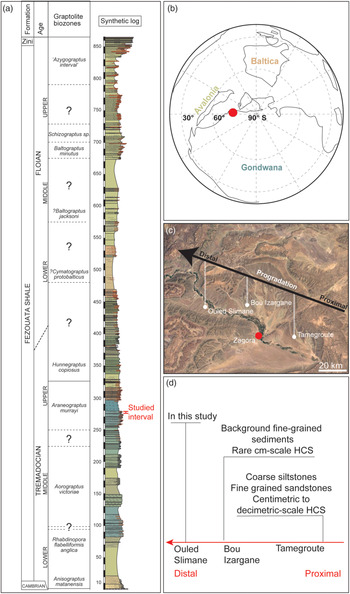
A long-term transgression at the beginning of the Ordovician Period created epicontinental seas on the Gondwana margins in the Southern Hemisphere (Torsvik & Cocks, 2011, Reference Torsvik, Cocks, Harper and Servais2013). The Fezouata Shale Formation (Fig. 1a) was deposited in a cold-water sea at high latitudes (over 60° S), close to the South Pole (Fig. 1b) (Torsvik & Cocks, Reference Torsvik, Cocks, Harper and Servais2013; Martin et al. Reference Martin, Pittet, Gutiérrez-Marco, Vannier, El Hariri, Lerosey-Aubril, Masrour, Nowak, Servais, Vandenbroucke, Van Roy, Vaucher and Lefebvre2016 a). Sedimentary rocks of this formation consist of blue-green to yellow-green siltstones (Destombes et al. Reference Destombes, Hollard, Willefert and Holland1985). The 900-m-thick succession of the Fezouata Shale (Fig. 1a) was deposited in a storm/wave-dominated environment with a minor influence of tides (Vaucher et al. Reference Vaucher, Martin, Hormière and Pittet2016). In this environment, sedimentological structures indicate a deepening trend from the SE to the NW (Fig. 1c) as shown in Vaucher et al. (Reference Vaucher, Pittet, Hormière, Martin and Lefebvre2017). The most proximal settings during late Tremadocian time (A. murrayi Zone) therefore occur near Tamegroute (about 20 km ESE of Zagora; Fig. 1c) (Saleh et al. Reference Saleh, Candela, Harper, Polechovà, Pittet and Lefebvre2018). In this locality, sedimentary rocks comprise coarse siltstones to fine-grained sandstones showing hummocky cross-stratifications (HCS) of centimetre- to decimetre-scale wavelengths (Vaucher et al. Reference Vaucher, Martin, Hormière and Pittet2016) (Fig. 1d). Intermediate settings of the Fezouata Shale occur in Bou Izargane in the Ternata plain about 20 km north of Zagora (Fig. 1c). In this setting, sedimentary rocks are characterized by finer siltstones and more abundant background sediments than in Tamegroute, in addition to the presence of storm events with up to centimetre-scale HCS (Saleh et al. Reference Saleh, Pittet, Perrillat and Lefebvre2019) (Fig. 1d). The average sedimentation rate in this area was estimated ~79 m/Ma (Saleh et al. Reference Saleh, Pittet, Perrillat and Lefebvre2019). The progradation model proposed by Vaucher et al. (Reference Vaucher, Pittet, Hormière, Martin and Lefebvre2017) suggests that the Ouled Slimane area is associated with more distal settings (Fig. 1c). A field campaign was organized in 2019 to better constrain the depositional environment of this locality (see Section 3).
General geographical context of the Fezouata Shale. (a) Stratigraphic sequence of the Fezouata Shale with the studied interval. (b) Location of Morocco during Early Ordovician time near the South Pole (modified from Vaucher et al. Reference Vaucher, Pittet, Hormière, Martin and Lefebvre2017). (c) Deepening trend in the Fezouata Shale from the SE to the NW (modified from Vaucher et al. Reference Vaucher, Pittet, Hormière, Martin and Lefebvre2017), with the study localities Ouled Slimane, Bou Izargane and Tamegroute indicated. (d) Proximal to distal relative position of the three localities studied here: Ouled Slimane, Bou Izargane and Tamegroute. HCS – hummocky cross-stratifications.

As for the faunal content of the different sites, all three localities yielded diverse assemblages of marine invertebrates (Saleh et al. Reference Saleh, Candela, Harper, Polechovà, Pittet and Lefebvre2018). However, Tamegroute is characterized by sessile epibenthic taxa (bivalves, brachiopods) that are about half the size of those in Bou Izargane (Saleh et al. Reference Saleh, Candela, Harper, Polechovà, Pittet and Lefebvre2018). Size variations in the Fezouata Shale between localities are not limited to brachiopods and bivalves. Trilobites also show body-size discrepancies between localities. The largest trilobites from the Fezouata Shale are found at Ouled Slimane (Rábano, Reference Rábano1990; Fortey, Reference Fortey2009; Lebrun, Reference Lebrun2018).
3. Materials and methods
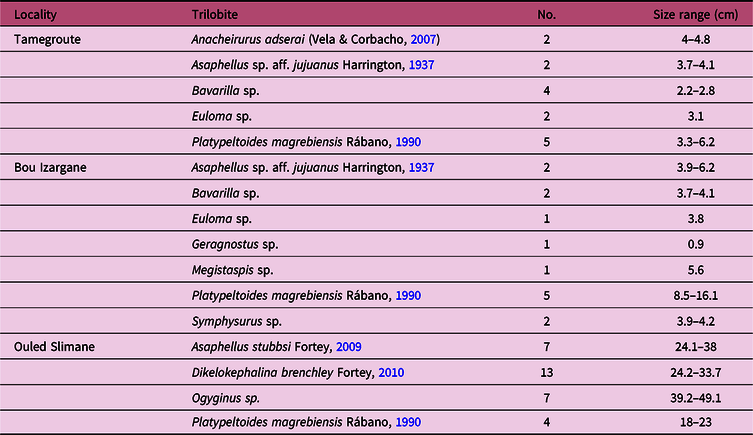
Two successive field campaigns were carried out in the Zagora region in 2018 and 2019 and two cores were obtained. The first core (c. 13 m) was drilled in the intermediate setting of Bou Izargane. The second core (c. 2.5 m) was made in Ouled Slimane, crossing the interval in which large trilobites were discovered. Both cores correspond strictly to the same stratigraphic interval in the Araneograptus murrayi biozone (Vaucher et al. Reference Vaucher, Martin, Hormière and Pittet2016; Saleh et al. Reference Saleh, Candela, Harper, Polechovà, Pittet and Lefebvre2018). Cores were described for their lithology, grain size, depositional sedimentary structures and bioturbation intensity and size at the University of Lausanne, Switzerland, and are currently deposited at the University of Brest. All levels crossed by cores were repeatedly sampled from 2004 to 2017, and yielded a large number of fossils (most of them are deposited in the collections of the Cadi-Ayyad University, Marrakesh). Trilobite taxa and assemblages discovered in these levels are determined at the specific or generic level. The size distribution of trilobites was investigated between localities by measuring the full length of individuals from the anterior margin of the cephalon to the posterior margin of the pygidium. The sizes of representatives of the trilobite genus Platypeltoides, which occurs in all localities (Table 1), were measured based on the sagittal length of the pygidium, including articulation half ring.
Trilobite diversity, abundances and sizes in the studied localities from the Lower Ordovician of the Fezouata Shale

The current taxonomy of Platypeltoides is uncertain. Platypeltoides magrebiensis Rábano, Reference Rábano1990 was the only species of this genus reported from the Fezouata Shale (Rábano, Reference Rábano1990; Martin et al. Reference Martin, Vidal, Vizcaïno, Vaucher, Sansjofre, Lefebvre and Destombes2016 b). Recently, Corbacho et al. (Reference Corbacho, Lopez-Soriano, Lemke, Morrison and Hammond2018) described four species of Platypeltoides from Morocco. The differences between these species are based on genal spine morphologies, the position of the eyes and the presence/absence of an anterior border (Corbacho et al. Reference Corbacho, Lopez-Soriano, Lemke, Morrison and Hammond2018). There are several issues with the definition of the new species. First, the morphology of the genal spine changes remarkably during ontogeny (Chatterton, Reference Chatterton1980; Chatterton & Speyer, Reference Chatterton, Speyer and Kaesler1997; Park & Choi, Reference Park and Choi2009; Laibl et al. Reference Laibl, Fatka, Budil, Ahlberg, Szabad, Vokáč and Kozák2015) and differences in the position of eyes can be an effect of taphonomic compression (see Hughes & Rushton, Reference Hughes and Rushton1990 for detailed explanation). Second, genal spines in Moroccan trilobites are often artificially modified by local collectors (Gutiérrez-Marco & García-Bellido, 2018). Most importantly, species other than P. magrebiensis are based on the description of a single specimen (P. hammondi Corbacho & López-Soriano, Reference Corbacho and López-Soriano2016; P. carmenae Corbacho et al. Reference Corbacho, Lopez-Soriano, Lemke and Hammond2017) or four specimens (P. cuervoae Corbacho & López-Soriano, Reference Corbacho and López-Soriano2012). Consequently, until more material is found and a comprehensive revision of the genus is performed, we consider P. magrebiensis as the only valid species and refer all our material to it.
4. Results
4.a. Trilobite size and preservation
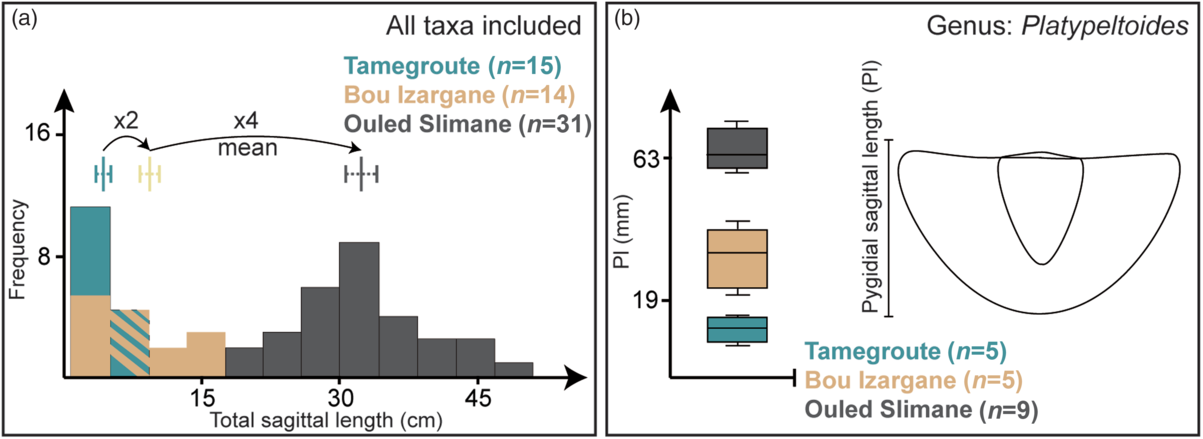
The most diverse trilobite assemblage is found in the intermediate setting locality, Bou Izargane (i.e. seven taxa; Table 1). Four of these taxa are also found in the more proximal site of Tamegroute. Platypeltoides magrebiensis is the only taxon that is found across the proximal-distal axis (Table 1). The mean total sagittal length of all trilobite taxa recorded in the distal site of Ouled Slimane is 32.4 cm (median = 31.9 cm; standard deviation (SD) = 1.41 cm; n = 31), which is four times larger than the mean total sagittal length of all trilobites recorded in Bou Izargane (mean = 7.37 cm; median = 5.9 cm; SD = 1.21 cm; n = 14), and eight times larger than the mean total sagittal length of all trilobites recorded in Tamegroute (mean = 3.78 cm; median = 3.7 cm; SD = 1.24 cm; n = 15) (Fig. 2a; and online Supplementary Tables S1 and S2, available at http://journals.cambridge.org/geo). Total sagittal lengths of trilobite forming the assemblages in Ouled Slimane, Bou Izargane and Tamegroute are statistically normally distributed (Shapiro-Wilk test, P value: 0.97, 0.23 and 0.4, respectively) (online Supplementary Table S3). Trilobite size variations between two contiguous localities (i.e. Ouled Slimane and Bou Izargane, Bou Izargane and Tamegroute) are significantly different (t-test, P value: 3.85 × 10⁻¹⁴ and 0.006, respectively; see online Supplementary Table S4). The increase in size between proximal and distal sites is not only evidenced between assemblages, but also between different species belonging to the same group (e.g. Asaphellus belonging to asaphids, and Platypeltoides belonging to nileids; Table 1).
Trilobite size fluctuations in the Fezouata Shale. (a) General body size patterns, all taxa included, in Ouled Slimane, Bou Izargane and Tamegroute. (b) Differences in the pygidial sagittal length of Platypeltoides magrebiensis between localities.

The mean pygidial sagittal length including axial half ring of Platypeltoides in Ouled Slimane is 6.3 cm (median = 6.2 cm; SD = 0.5 cm; n = 9), which is twice as long as than the mean pygidial sagittal length recorded in Bou Izargane (mean = 3.3 cm; median = 3.5 cm; SD = 0.84 cm; n = 5) and four times as large as the mean mean pygidial sagittal length recorded in Tamegroute (mean = 1.29 cm; median = 1.32 cm; SD = 0.35 cm; n = 5) (Fig. 2b, see online Supplementary Tables S5 and S6 for detailed measurements and summary statistics). Pygidial sagittal length measurements for Platypeltoides are normally distributed in Ouled Slimane, Bou Izargane and Tamegroute (Shapiro-Wilk test, P value: 0.39, 0.76 and 0.19 respectively; see online Supplementary Table S7). Pygidial sagittal length variations for Platypeltoides between Ouled Slimane and Bou Izargane, in addition to those between Bou Izargane and Tamegroute, are statistically significantly different (t-test, P value: 0.0012 and 3.5×10⁻⁶, respectively) (online Supplementary Table S8).
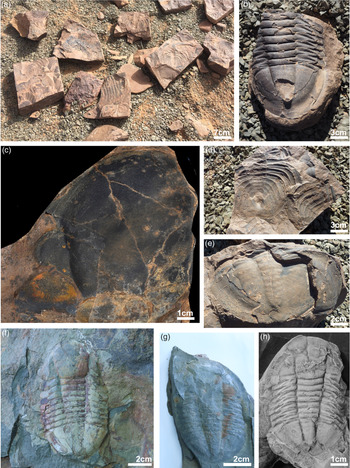
Trilobites from Ouled Slimane are preserved in silicified, quartz-rich concretions. Some are disarticulated and others are complete (Fig. 3a–e). Trilobites from the two other localities are preserved in shales (Fig. 3f–h).
Trilobites from the Fezouata Shale, Morocco. (a–e) Large trilobites from Ouled Slimane preserved in concretions. (a) External moulds of trilobites not picked up by collectors. (b) Thorax and pygidium of Platypeltoides magrebiensis. (c) Incomplete cranidium of Platypeltoides sp. (d) Part of the thorax and pygidium of Dikelokephalina brenchleyi. (e) Pygidium of Asaphellus stubbsi. (f) Normal-sized Symphysurus sp. from Bou Izargane. (g, h) Normal-sized Platypeltoides magrebiensis from (g) Bou Izargane and (h) Tamegroute preserved in shales (AATGR0aOI132).

4.b. Sedimentological context
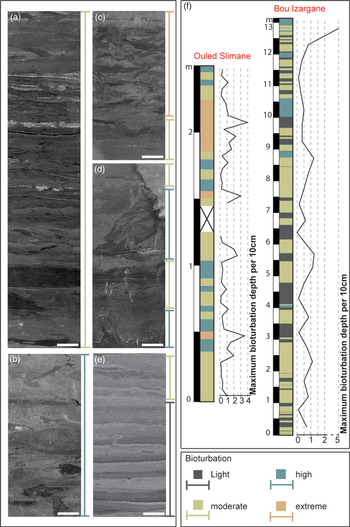
The background sediments in Bou Izargane in the Fezouata Shale consist of very fine siltstones to claystones (Fig. 4a–d). In Bou Izargane, coarse siltstone event deposits are abundant (Fig. 4e). Event deposits have an erosive base and show occasionally HCS (Fig. 4e). In Ouled Slimane, event deposits are rare and consist of quartz silts that are finer than in Bou Izargane (generally < 40 µm) (Fig. 4a). When they occur, they do not exceed 1 cm in thickness and lack HCS (Fig. 4a). Bioturbation occurs in all cores but it shows variations in both depth and intensity. Some intervals are only lightly bioturbated with a bioturbation depth of around 1 mm, while others are highly bioturbated with a bioturbation depth of a few centimetres (Fig. 4f). Intensity of bioturbation varies from light (< 10% of sedimentary rocks showing evidence of biological activity) to moderate (10–30% of sedimentary rocks showing evidence of biological activity), high (30–70% of sedimentary rocks affected by biological activity) and extreme (> 70% of sedimentary rocks reworked by biological activity). The used scale for the studied cores is simplified after the bioturbation index in Taylor & Goldring (Reference Taylor and Goldring1993). However, there is no direct correlation between bioturbation depth and intensity. Some intervals can be extremely bioturbated with a bioturbation depth that does not exceed a few millimetres (Fig. 4c). Generally, sediments from Ouled Slimane are more extensively bioturbated than in Bou Izargane in terms of both intensity of their traces and their depth (Fig. 4f). In Bou Izargane, bioturbation is generally less than 1 cm in depth (Fig. 4f).
Drilled sedimentary rocks from Ouled Slimane and Bou Izargane. (a) Core sediments from Ouled Slimane showing the dominance of background clayey to silty sediments with rare, coarser-grain-event deposits. Bioturbation intensity variations between intervals at Ouled Slimane from (a) light to (b) high and (c) extreme. (d) Biotubation depth of a few centimetres in Ouled Slimane. (e) Core sediments from Bou Izargane are less bioturbated and more affected by storm deposits. (f) Bioturbation intensity and depth along the core in Ouled Slimane and Bou Izargane. All scale bars are 1 cm in length.

5. Interpretation and discussion
5.a. Depositional environment and preservation
In marine settings, grain sizes are indicative of the distance travelled from the source by sediments (Nichols, Reference Nichols2009). In the Fezouata Shale, coarse grains are found towards the south east, closer to the source, compared with finer sediments that are mainly deposited in the basin (Vaucher et al. Reference Vaucher, Martin, Hormière and Pittet2016, Reference Vaucher, Pittet, Hormière, Martin and Lefebvre2017). Furthermore, the abundance of storm events is indicative of the energy of the depositional environment (Nichols, Reference Nichols2009; Perillo et al. Reference Perillo, Best and Garcia2014). Stacked storm events designate a shallow unstable environment that is constantly agitated by waves (Nichols, Reference Nichols2009). In these agitated settings, waves generate orbitals in the water column that decrease in size with depth, leaving oscillation traces such as HCS on the sea floor (Vaucher et al. Reference Vaucher, Martin, Hormière and Pittet2016, Reference Vaucher, Pittet, Hormière, Martin and Lefebvre2017). The deeper the water column, the smaller are the HCS. The presence in the Fezouata Shale of very fine siltstones to claystones with a scarce presence of storm events and an absence of HCS therefore indicate that the sedimentary succession at Ouled Slimane was deposited relatively far from the source in a stable environment that was rarely agitated by storm waves. In the Fezouata Shale, Ouled Slimane is the most distal locality. Despite being distal in position, an abundant bioturbation (i.e. light, high and extreme) with variable depth (from a few millimetres to 4 cm) and a high diversity of trace fossils are observed in the sedimentary succession in Ouled Slimane. This confirms that this environment was colonized by benthic organisms and shows that little to no chemical stress (i.e. related to nutrients and oxygen availability) occurred in the bottom of the water column, but also, at least, in surface sediments.
In the Fezouata Shale, two modes of preservation have been evidenced. The first mode, consisting of the preservation of both mineralized and soft-bodied taxa in shales, is well understood (Martin et al. Reference Martin, Pittet, Gutiérrez-Marco, Vannier, El Hariri, Lerosey-Aubril, Masrour, Nowak, Servais, Vandenbroucke, Van Roy, Vaucher and Lefebvre2016 a; Saleh et al. Reference Saleh, Pittet, Perrillat and Lefebvre2019). Living organisms of the Fezouata Biota colonized the sea floor and were repeatedly buried in situ by event deposits (Vaucher et al. Reference Vaucher, Pittet, Hormière, Martin and Lefebvre2017). The second mode consists of preservation in concretions, and the processes underlying it are more complex (McCoy et al. Reference McCoy, Young and Briggs2015 a, b). Siliceous concretions similar to those preserving large trilobites at Ouled Slimane have been described from distal settings of the Fezouata Shale by Gaines et al. (Reference Gaines, Briggs, Orr and Van Roy2012) and Vaucher et al. (Reference Vaucher, Pittet, Hormière, Martin and Lefebvre2017). The original siliceous material for the formation of these concretions comes from more proximal localities (Vaucher et al. Reference Vaucher, Pittet, Hormière, Martin and Lefebvre2017). However, the growth of these concretions was controlled by the decay rates of dead animals covered by event deposits (Gaines et al. Reference Gaines, Briggs, Orr and Van Roy2012). Permissive anoxic conditions are established when a large carcass is decaying, leading to mineral overgrowth around decaying carcasses (Gaines et al. Reference Gaines, Briggs, Orr and Van Roy2012). This model was used to explain the preservation of giant and complete invertebrates in situ in the Fezouata Shale (i.e. radiodonts such as Aegirocassis; Gaines et al. Reference Gaines, Briggs, Orr and Van Roy2012; Van Roy & Briggs, Reference Van Roy and Briggs2011; Van Roy et al. Reference Van Roy, Daley and Briggs2015 b). The presence of partially articulated and complete large trilobites in the concretions from Ouled Slimane argue, in a similar way to Aegirocassis, in favour of an autochthonous preservation. If transport occurred, it was most likely limited and from the same distal setting (i.e. a few metres only).
5.b. Body-size fluctuations
Many trilobite genera included in this study have also been discovered from other high-latitude (peri) Gondwanan localities. For instance, the Třenice and Mílina formations (upper Tremadocian; Czech Republic) have yielded a large number of trilobites comparable in size to those found in Tamegroute and Bou Izargane (i.e. total sagittal length of Anacheirurus c. 3.5 cm, Euloma c. 2.5 cm, Platypeltoides c. 5.5 cm, Geragnostus c. 0.6 cm; see e.g. Mergl, Reference Mergl2006). Other assemblages of similarly sized trilobites are known in the upper Tremadocian Saint-Chinian Formation, France (i.e. total sagittal length of Euloma c. 3.3 cm, Geragnostus c. 1.1 cm, Megistaspis c. 3.9 cm, Symphysurus c. 3.4 cm; Thoral, Reference Thoral1935; Capéra et al. Reference Capéra, Courtessole and Pillet1975, Reference Capéra, Courtessole and Pillet1978; Courtessole & Pillet, Reference Courtessole and Pillet1975; Courtessole et al. Reference Courtessole, Pillet and Vizcaïno1981). Euloma was also found in the upper Tremadocian Vogtendorf Formation of Germany with a total sagittal length of c. 5.5 cm (Sdzuy et al. Reference Sdzuy, Hammann and Villas2001).
Although rare in the fossil record, occurrences of large trilobites are not restricted to the lower part of the Fezouata Shale. Other known occurrences include, for example: the Cambrian Series 2 Emu Bay Shale, Australia (Holmes et al. Reference Holmes, Paterson and Garcıa-Bellido2020); the Cambrian Series 2 to Miaolingian Jbel Wawrmast Formation of Morocco (Geyer, Reference Geyer1993); the Early Ordovician ‘Schistes à Gâteaux’ Formation, France (Thoral, Reference Thoral1946; P. Bérard, unpub. PhD thesis, University of Montpellier, 1986); the Middle Ordovician Valongo Formation, Portugal (Rábano, Reference Rábano1990; Gutiérrez-Marco et al. Reference Gutiérrez-Marco, Sá, García-Bellido, Rábano and Valério2009); the Late Ordovician Churchill River Group, Canada (Rudkin et al. Reference Rudkin, Young, Elias and Dobrzanski2003); and the Middle Devonian Onondaga Limestone, New York, USA (Whiteley et al. Reference Whiteley, Kloc and Brett2002). In general, the largest trilobites occur in a wide array of environments. Some of them were reported from low-latitude nearly equatorial areas, in shallow-water carbonates (Whiteley et al. Reference Whiteley, Kloc and Brett2002; Rudkin et al. Reference Rudkin, Young, Elias and Dobrzanski2003) or deeper, but still nearshore siliciclastic deposits (Paterson et al. Reference Paterson, García-Bellido, Jago, Gehling, Lee and Edgecombe2016). Others come from high latitudes (over 60° S) of the West Gondwana margin, where they are preserved either in distal mudstones (Gutiérrez-Marco et al. Reference Gutiérrez-Marco, Sá, García-Bellido, Rábano and Valério2009), fine-grained sandstones and shales (Geyer, Reference Geyer1993), and concretions (Thoral, Reference Thoral1946; P. Bérard, unpub. PhD thesis, University of Montpellier, 1986). The best analogue for the Ouled Slimane assemblage is therefore probably the Early Ordovician fauna described in the ‘Schistes à Gâteaux’ of the Cabrières area (eastern-most part of the southern Montagne Noire; P. Bérard, unpub. PhD thesis, University of Montpellier, 1986). In this region, similarly sized concretions (70–100 cm in diameter) formed under comparable depositional settings yielded abundant remains of both disarticulated and fully articulated large trilobites belonging to Asaphidae and Nileidae (P. Bérard, unpub. PhD thesis, University of Montpellier, 1986). During Early Ordovician time, the Montagne Noire area was situated at relatively high latitudes, not far away from the Anti-Atlas area, on the western margin of Gondwana. In general, high latitudes and consequently low temperatures are often considered as the main explanatory factor for trilobite gigantism (Gutiérrez-Marco et al. Reference Gutiérrez-Marco, Sá, García-Bellido, Rábano and Valério2009; Klug et al. Reference Klug, De Baets, Kröger, Bell, Korn and Payne2015). Given the widespread distribution of large trilobites in various latitudes and facies, it is unlikely that there is only one single controlling mechanism of trends toward larger sizes. Indeed, the trilobite size fluctuations within the Fezouata Shale in a comparatively restricted area suggest that, despite high latitudes, other factors must be taken into consideration.
In the Fezouata Shale, differences in size distribution between localities can be the result of numerous mechanisms and conditions (ontogeny, size sorting due to transport, oxygenation and/or nutrient availability; Saleh et al. Reference Saleh, Candela, Harper, Polechovà, Pittet and Lefebvre2018). Transport-induced size sorting is unlikely to explain the size discrepancies of trilobites in general and Platypeltoides in particular. When current-related sorting occurs in marine environments, small individuals are more easily transported than larger ones, and they are consistently displaced towards more distal settings (Johnson, Reference Johnson1960; Fagerstrom, Reference Fagerstrom1964). The opposite pattern for trilobites is observed in the Fezouata Shale. Furthermore, all previous surveys made on brachiopods, bivalves, echinoderms and trilobites from this part of the Fezouata Shale have concluded that most fossils were preserved in situ (with occasional limited transport), because delicate anatomical structures were preserved (Saleh et al. Reference Saleh, Candela, Harper, Polechovà, Pittet and Lefebvre2018). Brachiopods of the Fezouata Shale frequently have their setae preserved (Saleh et al. Reference Saleh, Candela, Harper, Polechovà, Pittet and Lefebvre2018) and, in many cases, the most fragile skeletal elements of stylophoran echinoderms remained connected to the rest of the body (Martin et al. Reference Martin, Lefebvre, Vaucher, Zamora and Rabano2015; Lefebvre et al. Reference Lefebvre, Allaire, Guensburg, Hunter, Kouraïss, Martin, Nardin, Noailles, Pittet, Sumrall and Zamora2016, Reference Lefebvre, Guensburg, Martin, Mooi, Nardin, Nohejlová, Saleh, Kouraïss, El Hariri and David2019). As trilobites had a chitinous, partially biomineralized exoskeleton (Teigler & Towe, Reference Teigler and Towe1975), their remains are frequently preserved in marine Palaeozoic deposits (Speyer & Brett, Reference Speyer and Brett1986). Given that post-mortem processes are insufficient to explain the size distribution seen in the Fezouata Shale (this study; Saleh et al. Reference Saleh, Candela, Harper, Polechovà, Pittet and Lefebvre2018), the presence of large trilobites in only the most distal palaeoenvironments is taken as representative of the original size distribution of organisms. The increase in trilobite size from shallow proximal to deep distal localities in the Fezouata Shale is consistent with observations of crustacean body-size fluctuations in modern marine environments, in which large animals are found in deep-water settings (Horikoshi, Reference Horikoshi, Horikoshi, Nagata and Sato1986; Timofeev, Reference Timofeev2001).
The increase in size between proximal and distal localities may be related to ontogeny (e.g. Laibl et al. Reference Laibl, Fatka, Cronier and Budil2014), with younger (and therefore smaller) developmental stages favouring shallower environments, and older and larger ones preferring deeper settings. If this was the case all taxa should be found in all localities, which is not true for the Fezouata Shale. For instance, Ouled Slimane seems to entirely lack small- and medium-sized taxa (e.g. Bavarilla, Anacheirurus, Euloma), with the exception of Platypeltoides magrebiensis (Table 1 and online Supplementary Table S1). Dikelokephalina and Ogyginus are present in Ouled Slimane, but are absent in more proximal sites (Table 1 and online Supplementary Table S1). Ontogeny alone does not explain size discrepancies observed for Platypeltoides magrebiensis, because the material measured here consistently excluded juvenile stages (defined by the number of thoracic segments). Even if future work shows a correlation between changes in habitats and developmental stages of some trilobites, this fails to explain why older and bigger individuals preferred deeper environments. There must therefore have been external biotic and abiotic conditions that selected for larger bodies in a deeper setting and smaller bodies in more proximal environments.
Oxygen availability is an abiotic parameter that can influence the body-size distribution of marine taxa (Zeuthen, Reference Zeuthen1953). It is suggested that large sizes are dictated by oxygen availability rather than by temperature in modern polar ecosystems (Chapelle & Peck, Reference Chapelle and Peck1999). Oxygen concentration correlates with the general trend in marine gigantism during the Palaeozoic Era (Vermeij, Reference Vermeij2016), and a direct connection (i.e. in magnitude) between Palaeozoic gigantism and atmospheric hyperoxia was also established using a mathematical model based on oxygen transport limitation (Payne et al. Reference Payne, Groves, Jost, Nguyen, Moffitt, Hill and Skotheim2012). In contrast, benthic individuals tend to have smaller sizes in oxygen minima zones (i.e. Lilliput effect; Twitchett, Reference Twitchett2007). However, for instance in Tamegroute, the bottom of the water column was oxic, leading to the development of diverse assemblages on the sea floor (Saleh et al. Reference Saleh, Candela, Harper, Polechovà, Pittet and Lefebvre2018).
Another abiotic factor that can limit size growth is nutrient availability (Booth et al. Reference Booth, Ruhl, Lovell, Bailey and Smith2008). Nutrients are generally more abundant in proximal sites near the source (Rowe et al. Reference Rowe, Clifford, Smith and Hamilton1975; Philippart et al. Reference Philippart, Cadée, van Raaphorst and Riegman2000; Wang et al. Reference Wang, Wang and Zhan2003). The occurrence of a relatively high and diverse bioturbation in Ouled Slimane (Fig. 4a–d) suggests that nutrients were not a limiting parameter. This interpretation is in accordance with the presence of diverse planktonic microorganism assemblages in the deepest settings of the Fezouata Shale (Nowak et al. Reference Nowak, Pittet, Vaucher, Akodad, Gaines and Vandenbroucke2016).
Storm turbulences generate another abiotic stress in shallow environments (Barry & Dayton, Reference Barry, Dayton, Kolasa and Pickett1991; McAlister & Stancyk, Reference McAlister and Stancyk2005). Storms transport sediments that can cause the suffocation of both sessile and mobile invertebrate taxa in proximal sites (Tabb & Jones, Reference Tabb and Jones1962). Storms can also increase the input of fresh water to the sea, with the resulting change in water column salinity causing heavy mortalities (Tabb & Jones, Reference Tabb and Jones1962; Barry & Dayton, Reference Barry, Dayton, Kolasa and Pickett1991). Furthermore, although exoskeleton formation in arthropods is mainly constrained by biotic parameters, the major source of calcium used for exoskeleton calcification is exogenous, and comes from the waters where the organisms live (Luquet, Reference Luquet2012). In sea water, the concentration of calcium is generally very high (Luquet, Reference Luquet2012), but freshwater input during a storm may alter calcium availability for biomineralization in shallow waters, inhibiting marine arthropods from attaining large sizes. However, during the Ordovician Period, even the shallowest settings from the Fezouata Shale in Morocco were extremely far from the shore (more than 1000 km away; Guiraud et al. Reference Guiraud, Bosworth, Thierry and Delplanque2004). It is therefore more likely that the impact of storms on living organisms was more related to transport of sediment and obrution events rather than calcium and salinity fluctuations. This sediment-induced stress was evidenced in proximal localities of the Fezouata Shale, regularly killing sessile epibenthic taxa and thus inhibiting them from attaining large sizes (Saleh et al. Reference Saleh, Candela, Harper, Polechovà, Pittet and Lefebvre2018). This stress decreased from proximal to distal localities, allowing organisms to attain larger sizes in deeper environments (Saleh et al. Reference Saleh, Candela, Harper, Polechovà, Pittet and Lefebvre2018). However, mass mortality is not generally the trend for arthropods in storm-dominated modern shallow-marine environments, except in the cases of supercritical events (Conner et al. Reference Conner, Day, Baumann and Randall1989). In regions that are seasonally affected by storms, arthropods are able to migrate to more stable environments (Conner et al. Reference Conner, Day, Baumann and Randall1989). Pink shrimp individuals are known to leave shallow waters to deeper environments about 96 kilometers offshore during a hurricane (Tabb & Jones, Reference Tabb and Jones1962), and similar shelter-seeking behaviour is observed during the storms season in spiny lobsters (Hunt et al. Reference Hunt, Butler and Herrnkind1994). It is likely that trilobites, similarly to modern vagile arthropods, were able to adapt against physical instabilities and were little affected by storm turbulences. Some of them even showed collective behaviour by migrating during storm seasons, in a similar way to extant spiny lobsters (Vannier et al. Reference Vannier, Vidal, Marchant, El Hariri, Kouraiss, Pittet, El Albani, Mazurier and Martin2019).
The occurrence of large trilobite individuals in deep waters may also indicate a lack of predators in these settings (Rex, Reference Rex1976), as heavy predation is known to limit body size (Horikoshi, Reference Horikoshi, Horikoshi, Nagata and Sato1986). Cephalopods, major predators in both Ordovician and modern marine ecosystems (Cherel & Hobson, Reference Cherel and Hobson2005; Kröger et al. Reference Kröger, Servais and Zhang2009 a), are absent in Ouled Slimane, although they are relatively common in more proximal localities of the Fezouata Shale (Kröger & Lefebvre, Reference Kröger and Lefebvre2012). Their absence from the distal setting preserved at Ouled Slimane is in good accordance with the observation that their initial Furongian – Early Ordovician diversification was restricted to relatively shallow environments (Kröger et al. Reference Kröger, Zhang and Isakar2009 b). The lack of predation pressure from cephalopods in distal marine environments in general during the Cambrian – Early Ordovician period may explain the numerous occurrences of large trilobites in distal settings globally during this time interval (e.g. Fezouata Shale, ‘Schistes à Gâteaux’, see also Section 1: Introduction), and the rarity of large trilobites in younger deposits more or less coincides with the palaeoecological diversification of cephalopods into deeper settings during Middle Ordovician time (Kröger et al. Reference Kröger, Servais and Zhang2009 a). The environmental conditions of the distal Fezouata Shale setting were therefore characterized by a lack of storms and predators and an abundance of oxygen and nutrients, all of which are conducive to the local occurrence of large trilobites.
Supplementary material
To view supplementary material for this article, please visit https://doi.org/10.1017/S0016756820000448
Acknowledgments
This paper is a contribution to the TelluS-Syster project ‘Vers de nouvelles découvertes de gisements à préservation exceptionnelle dans l’Ordovicien du Maroc’ (2017), and the TelluS-INTERRVIE projects ‘Mécanismes de préservation exceptionnelle dans la Formation des Fezouata’ (2018) and ‘Géochimie d’un Lagerstätte de l’Ordovicien inférieur du Maroc’ (2019), all funded by the INSU (Institut National des Sciences de l’Univers, France), CNRS. This paper is also a contribution to the International Geoscience Program (IGCP) Project 653 ‘The onset of the Great Ordovician Biodiversification Event’. ACD’s contribution is supported by Grant no. 205321_179084 from the Swiss National Science Foundation. LL was supported by Research Plan RVO 67985831 of the Institute of Geology of the CAS and by the Center for Geosphere Dynamics (UNCE/SCI/006). The authors thank Juan Carlos Gutiérrez-Marco for graptolite identification. The authors are also thankful to Anna Żylińska and an anonymous reviewer for their helpful and constructive remarks.
Declaration of interest
None.