Clostridium difficile (C. difficile) infection (CDI) in children is an increasing problem in the United States. Children are susceptible to both community-associated (CA) and hospital-acquired (HA) infections, and CDI is a complicating factor in several pediatric diseases.Reference Pant, Deshpande, Altaf, Minocha and Sferra 1
Previous reports in hospitalized children have demonstrated an increasing trend in the rate of CDI among hospitalized children in the United States.Reference Nylund, Goudie, Garza, Fairbrother and Cohen 2 However, the most recent study data pertain to 2009, and more recent trends in pediatric CDI are unknown. CDI in children is associated with a number of medical conditions;Reference Pant, Deshpande, Altaf, Minocha and Sferra 1 however, this relationship has not been well studied. Therefore, our aim was to determine the most recent national trends for pediatric CDI, both in an overall context and as a complicating factor in other medical disorders.
METHODS
We utilized the Kids’ Inpatient Database (HCUP-KID) from 2003 to 2012, previously validated for the study of pediatric disease.Reference Witt, Weiss and Elixhauser 3 A description and study methods are detailed elsewhere.Reference Deshpande, Pant, Anderson, Donskey and Sferra 4 The International Classification of Diseases, Ninth Revision, and Clinical Modification (ICD-9-CM) diagnostic code for CDI (00845) identified cases.Reference Nylund, Goudie, Garza, Fairbrother and Cohen 2 , Reference Deshpande, Pant, Anderson, Donskey and Sferra 4 , Reference Pant, Anderson and Deshpande 5 Our study population consisted of children 1–17 years of age classified into 4 age groups. We also evaluated CDI rates in 7 medical disorders strongly associated with the infection: inflammatory bowel disease (IBD), solid organ transplant (SOT), human immunodeficiency virus (HIV) infection, hematopoietic stem cell transplantation (HSCT), neoplastic disease, fungal infection, cystic fibrosis (CF), and pancreatitis.Reference Nylund, Goudie, Garza, Fairbrother and Cohen 2 , Reference Deshpande, Pant, Anderson, Donskey and Sferra 4 We also assessed the CDI incidence trends among children with and without medical comorbidities, which were determined by the Elixhauser comorbidity index.Reference Elixhauser, Steiner, Harris and Coffey 6 Statistical analyses included the Cochrane-Armitage test.Reference Deshpande, Pant, Anderson, Donskey and Sferra 4
RESULTS
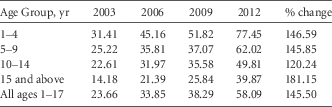
During the study period, a total of 7,070,485 discharges were recorded for children 1–17 years of age; 0.38% children (n=26,644) were diagnosed with CDI. A significant increasing trend in CDI incidence was observed among hospitalized children, overall and in each age group (Table 1). From 2003 to 2012, the combined incidence increased from 24.0 to 58.0 CDI discharges per 10,000 discharges per year (145%; P<.001). Increases in CDI rates ranging from 120% to 181% were observed among the different age groups (P<.001), with the greatest increase in children 15 years of age and above. The 1–4-year age group demonstrated the highest incidence of CDI during each triennial study period (P<.001).
Incidence of Clostridium difficile Infection among Hospitalized Children 1–17 Years of Age

NOTE. Incidence is expressed as CDI cases per 10,000 discharges per year. CDI incidence increased in all age groups from 2003 to 2012 (P<.001, Cochran-Armitage test for trend). Data from the Healthcare Cost and Utilization Project Kids’ Inpatient Database (HCUP-KID). Sponsored by the Agency for Healthcare Research and Quality.
From 2009 to 2012, pediatric CDI incidence continued to rise in all age groups, with a combined increase of 52% (P<.001). The greatest increase was observed in the 5–9-year age group (67%; P<.001).
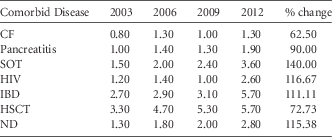
CDI rates increased in each of 7 medical disorders strongly associated with pediatric CDI (Table 2). The highest incidence of CDI was observed among children with a diagnosis of HSCT or IBD (5.7 cases of CDI per 100 discharges for both diseases). The greatest rate of CDI increase was in children who had undergone SOT (140% from 2003 to 2012; P<.001).
Incidence of Clostridium difficile infection (CDI) among Hospitalized Children 1–17 Years of Age as a Complicating Factor in 7 Medical Conditions Strongly Associated with the Disease

NOTE. Incidence is expressed as CDI cases per 100 discharges for the specific condition per year. CDI incidence increased in all 7 medical conditions from 2003 to 2012 (P<.001, Cochran-Armitage test for trend). Data from the Healthcare Cost and Utilization Project Kids’ Inpatient Database (HCUP-KID). Sponsored by the Agency for Healthcare Research and Quality.
IBD, inflammatory bowel disease; SOT, solid organ transplant; HIV, human immunodeficiency virus infection; HSCT, hematopoietic stem cell transplantation; ND, neoplastic disease; CF, cystic fibrosis.
The majority of hospitalized children with CDI (74.1%) had at least 1 medical comorbidity. The incidence of CDI increased in substantially among children with and without other medical conditions; however, the rate was greater among children with at least 1 other medical comorbidity (145% vs 115%; P<.001).
DISCUSSION
Our results from the KID indicate that from 2003 to 2012 the incidence of CDI among hospitalized children increased by 145%. Each age group in our study exhibited an increasing trend in CDI incidence. Increased trends in pediatric CDI cases had been reported earlier, dating from 1997–2006.Reference Zilberberg, Tillotson and McDonald 7 Our results confirm that this trend was sustained in recent years, evidenced by a 52% increase from 2009 to 2012.
CDI in children is associated with several disease conditions resulting in increased hospital stays and costs.Reference Nylund, Goudie, Garza, Fairbrother and Cohen 2 We analyzed the trend in C. difficile cases as a complicating factor in 7 of these medical disorders and observed that the highest incidence of infection was in children with a diagnosis of HSCT or IBD. The greatest increase in incidence occurred among children who had undergone SOT. The rate of CDI increase was significantly greater among children with at least 1 other medical comorbidity, suggesting an association between increased CDI rates and more frequent hospitalizations in children with diseases such as IBD.
The underlying cause or causes for the increase in pediatric CDI cases remain speculative. Young children demonstrate higher rates of asymptomatic C. difficile carriage, and real-time polymerase chain reaction (PCR) assays for CDI are frequently positive among hospitalized children both with and without diarrhea.Reference Leibowitz, Soma, Rosen, Ginocchio and Rubin 8 It is possible that more frequent CDI testing by clinicians in the pediatric age group has contributed to the increased disease incidence observed in this study. Recently, Nylund et alReference Nylund, Eide and Gorman 9 reported that the use of proton pump inhibitors (PPIs) are a risk factor for the development of CDI in children. In recent years, the use of PPIs has increased in the pediatric age group.Reference van der Pol, Smits, van Wijk, Omari, Tabbers and Benninga 10
We are aware of several limitations pertaining to this study. We relied solely on the use of ICD-9-CM codes for case identification. The recent increased incidence of CA CDI may be a significant contributing factor to our observations. However, using the KID data, we were not able to assess for CA CDI or differentiate between CA and HA infections. The KID system does not track individual patients; therefore, it was not possible to determine recurrences or readmissions related to CDI.
Our study demonstrates an increase in the incidence of CDI among hospitalized children in the United States from 2003 to 2012. The increased incidence of CDI occurred in all pediatric age groups and with several diseases known to be strongly associated with CDI. In view of the deleterious effect of CDI on hospitalized children, further studies should address the impact of CDI on these pediatric diseases.
ACKNOWLEDGMENTS
Financial support: No financial support was provided relevant to this article
Potential conflicts of interest: A.D. reports having received a research grant from 3M and Clorox. C.J.D. reports having received research grants from Merck, GOJO, Clorox, Steris, and Pfizer. All other authors report no conflicts of interest relevant to this article.