Introduction
Dementia caregivers (CGs) are thought to be at an increased risk of psychological and physical health problems compared to non-caregivers (NCGs) because the challenges of providing dementia care can lead to chronic and often severe levels of stress (Pinquart and Sorensen, Reference Pinquart and Sorensen2003). More recently, researchers have considered whether the stresses associated with providing dementia care might also impact on CG's own cognitive functioning (Fonareva and Oken, Reference Fonareva and Oken2014). Several studies have reported that CGs have poorer performance than NCGs on cognitive domains such as processing speed (de Vugt et al., Reference de Vugt2006; Vitaliano et al., Reference Vitaliano, Zhang, Young, Caswell, Scanlan and Echeverria2009; Oken et al., Reference Oken, Fonareva and Wahbeh2011), working memory (e.g. Mackenzie et al., Reference Mackenzie, Wiprzycka, Hasher and Goldstein2009), and delayed recall (e.g. de Vugt et al., Reference de Vugt2006; Mackenzie et al., Reference Mackenzie, Wiprzycka, Hasher and Goldstein2009). Furthermore, a population-based study on more than a thousand married couples over the age of 65 years reported that spouses of people with dementia were 1.62 times more likely to develop incident dementia than individuals whose spouses were dementia free, even after accounting for risk factors such as age, sex, education, socio-economic status, and Apolipoprotein E (APOE) genotype (Norton et al., Reference Norton2010).
Most of the existing research on caregiving and cognition has been carried out in the context of the traditional stress and health framework; greater stress exposure (e.g. level of care-recipients’ physical disabilities and behavioral and psychological symptoms of dementia (BPSDs)) is thought to lead to chronic psychological stress in CGs, and this in turn stimulates a physiological stress response and thereby illness and cognitive decline (Vitaliano et al., Reference Vitaliano, Murphy, Young, Echeverria and Borson2011). However, few studies have explicitly tested this model in the context of CG cognition with most assuming that CG groups are exposed to and experience higher levels of stress than NCGs. Oken et al. (Reference Oken, Fonareva and Wahbeh2011) did report that dementia CGs experienced higher stress and had poorer performance on measures of attention and executive functioning than NCGs; however, they found no evidence that stress mediated the relationships between CG status and cognitive performance. Nevertheless, their analysis was based on a very small sample and they did not statistically test the significance or size of the indirect effect. Furthermore, it is unclear whether greater objective stress exposure in CGs predicts poorer cognitive performance. A greater focus on mediators and moderators is required to gain a more in-depth understanding of how the challenges of dementia care are associated with CG cognitive functioning.
In the current study, we tested whether greater psychological stress among CGs mediated a relationship between greater CG stress exposure (severity of care-recipient BPSDs) and poorer cognitive functioning. In addition, we examined the role of two protective factors that might weaken relationships between stress exposure, psychological stress, and poorer CG cognitive functioning: self-efficacy and cognitive reserve (CR). Moderation analysis helps to explain the conditions under which relationships are observed; for example, when relationships exist or for whom. Teasing out such moderation effects is important because overall relationships may conceal important trends in the data that exist only in subgroups. For example, stress may not predict poorer cognitive functioning among all CGs; it may only be associated with cognition among those who have fewer resources for managing stress or those already at increased risk for cognitive decline. Identifying subgroups of CGs who may be more vulnerable to caregiving stressors would allow us to deliver more tailored interventions and to ensure that support is given to those who need it most.
Previous research has highlighted the importance of self-efficacy in protecting CGs from adverse psychological outcomes. For example, self-efficacy has been found to moderate the relationship between care-recipient BPSDs and CG depressive symptoms (Rabinowitz et al., Reference Rabinowitz, Mausbach and Gallagher-Thompson2009) and CG burden (Zhang et al., Reference Zhang, Guo, Edwards, Yates and Li2014). Self-efficacy refers to an individual's assessment of his or her ability to complete a specific task successfully (Bandura, Reference Bandura1997). When faced with a potentially stressful situation, individuals with greater self-efficacy are more likely to view the situation as a challenge and exert themselves to overcome the challenge. Conversely, those low in self-efficacy are more likely to doubt their capacity to manage the situation, give up more easily, and develop negative emotions in response to the problem (Zhang et al., Reference Zhang, Guo, Edwards, Yates and Li2014). Thus, CGs with greater self-efficacy may experience less psychological stress in response to care-recipient BPSDs and this, in turn, may decrease their vulnerability to cognitive dysfunction.
CR may also serve as a protective factor by moderating relationships between stress and cognitive functioning. CR is a concept proposed to explain repeated observations of a mismatch between the degree of age- or disease-related neural pathology and the clinical manifestation of that pathology. CR is invoked to explain epidemiological and other findings of an association between intellectually enriching experiences, such as education, occupational attainment, and engagement in mentally stimulating leisure activities, and reduced the risk of Alzheimer's disease (AD), dementia, and age-related cognitive decline. The CR hypothesis proposes that these experiences can change the morphology and function of the brain in a way that allows some individuals to sustain greater amounts of damage to their brain before demonstrating deficits in cognitive function (Stern, Reference Stern2009). Although specific mechanisms underlying CR are not fully understood, it is hypothesized that neural implementation takes two forms: neural reserve and neural compensation, with the former referring to efficiency, capacity, and flexibility of an individual's neural networks and the latter to the use of alternative brain structures or networks to compensate for damage (Stern, Reference Stern2009). Thus, CGs with high CR may be less vulnerable to the effects of stress exposure on a cognitive function because CR may function to moderate the relationship between experienced psychological stress and cognitive performance. Variables associated with CR such as educational and occupational attainment, and measures of premorbid IQ are typically used as proxy variables to estimate CR (Harrison et al., Reference Harrison, Sajjad, Bramer, Ikram, Tiemeier and Stephan2015). For the current study, premorbid IQ was estimated using the National Adult Reading Test (NART). Previous research investigating literacy as a proxy indicator of CR has demonstrated associations with decline across a range of cognitive domains in older adults, controlling for age, education, and other potential confounding variables (Manly et al., Reference Manly, Schupf, Tang and Stern2005).
We used moderated mediation regression analysis to examine whether a negative relationship between stress exposure and cognitive functioning through psychological stress is contingent on self-efficacy and CR. Moderated mediation analysis is appropriate when a mediating process that explains the relationship between an independent variable and the dependent variable is expected to differ in terms of strength and/or direction across levels of the moderator. Thus, it can be used to examine the specific conditions under which indirect relationships occur. We hypothesized the following points.
-
1. Psychological stress would mediate a relationship between greater CG stress exposure (severity of care-recipient BPSDs) and poorer executive functioning.
-
2. Self-efficacy would moderate the relationship between BPSD severity and psychological stress such that BPSD severity would be a stronger predictor of stress among CGs with lower self-efficacy.
-
3. CR would moderate the relationship between psychological stress and executive functioning such that the association between higher stress and lower executive functioning would be stronger among CGs with lower CR.
The theoretical model underlying our analytic approach is depicted in Figure 1. Our analysis focused on executive functioning because executive dysfunction is the best cognitive predictor of functional decline (Cahn-Weiner et al., Reference Cahn-Weiner, Malloy, Boyle, Marran and Salloway2000); thus, problems with executive functioning are likely to have a greater impact on CGs’ ability to provide care for the person with dementia than problems with other cognitive domains. Furthermore, executive functions are mediated by the prefrontal cortex, the brain region that responds with the greatest sensitivity to stress (Arnsten, Reference Arnsten2009); nevertheless only two previous studies on cognitive functioning among dementia CG have included measures of executive functioning (Oken et al., Reference Oken, Fonareva and Wahbeh2011; Corrêa et al., Reference Corrêa2015) and both were based on very small CG samples (n ≤ 31).
The theoretical moderated mediation model.

Methods
Participants
CGs were recruited through media and local advertisements, community gatekeepers, including public health nurses, and a broad range of organizations for CGs, people with dementia, and/or the elderly. Inclusion criteria required participants to be over the age of 50 years and caring for a co-habiting spouse or common-law partner with a diagnosis of dementia of Alzheimer's type, Parkinson's disease, or other primary degenerative dementia. Of the 370 eligible CGs identified, 253 (68.38%) participated in the study after giving written informed consent. Ethical approval for the study was obtained from the School of Psychology Research Ethics committee in Trinity College Dublin.
Measures
Demographics and covariates
Data were collected on participants’ age, gender, and health and behavioral risk factors for dementia and cognitive decline; in line with previous research (Pertl et al., Reference Pertl, Lawlor, Robertson, Walsh and Brennan2015), these were selected based on work by Barnes and Yaffe (Reference Barnes and Yaffe2011) who detail the evidence for seven potentially modifiable risk factors for AD and cognitive decline that have received the strongest support in the literature: (1) cognitive inactivity (conceptualized as low educational attainment), (2) physical inactivity, (3) obesity, (4) being a current smoker, and having a history of (5) hypertension, (6) diabetes, and (7) depression. Education was measured in years. Low educational attainment was defined as less than a high school diploma or equivalent. Participants who fell into the low activity category based on their responses to the Brief International Physical Activity Questionnaire (Craig et al., Reference Craig2003) were considered physically inactive. Participants with a body mass index (BMI) greater than 30 were considered obese. To calculate BMI, participants’ height (cm) was measured using a stadiometer and weight (kg) was measured using a standard clinical weighing scales. Participants were asked to self-report whether they had ever been diagnosed with hypertension or diabetes, and whether they had ever sought help from a doctor for an emotional problem, such as anxiety or depression. Participants’ current level of depression, assessed using the Centre for Epidemiological Studies Depression (CES-D) scale (Radloff, Reference Radloff1977), was also included as a covariate in the analysis. The CES-D consists of 20 items assessing depressed affect, lack of positive affect, somatic symptoms, and interpersonal difficulties during the preceding week. A total summed score (ranging from 0–60) can be calculated with higher scores indicating greater depressive symptomology. In the current sample, Cronbach's α was 0.78.
CG stress exposure: severity of care-recipients’ behavioral and psychological symptoms of dementia (BPSDs)
The number and severity of the care-recipients’ BPSDs were assessed using the Neuropsychiatric Inventory Questionnaire (NPI-Q; Kaufer et al., Reference Kaufer2000). The NPI-Q is a retrospective (one month) CG-informant questionnaire that covers 12 neuropsychiatric symptom domains: delusions, hallucinations, agitation/aggression, dysphoria/depression, anxiety, euphoria/elation, apathy/indifference, disinhibition, irritability/lability, aberrant motor behaviors, night-time behavioral disturbances, and appetite/eating disturbances. Scores are obtained for the total number of symptoms (range 0–12) and the severity of symptoms (range 0–36). The NPI-Q has demonstrated adequate test-retest reliability and convergent validity (Kaufer et al., Reference Kaufer2000). In the current samples, Cronbach's α was 0.73 for symptoms and 0.80 for severity.
Psychological stress
CG stress was measured using the four-item Perceived Stress Scale (PSS-4) (Cohen et al., Reference Cohen, Kamarck and Mermelstein1983), a widely used psychological instrument that assesses how unpredictable, uncontrollable, and overloaded participants find their lives. The total score ranges from 0 to 16, with higher scores indicating more perceived stress. The PSS-4 has good internal reliability and adequate test–retest reliability and is suggested for use in cases where very short scales are required (Cohen et al., Reference Cohen, Kamarck and Mermelstein1983). In the present sample, Cronbach's α was 0.72.
Executive functioning
Executive functioning was measured using the Color Trails Test (CTT; D'Elia et al., Reference D'Elia, Satz, Uchiyama and White1996) interference index (CTT-II; calculated by subtracting the CTT-1 raw score from the CTT-2 raw score and dividing this by the CTT-1 raw score). The CTT-II assesses executive functioning by separating the impact of simple perceptual sequence tracking, processing speed, and sustained attention (required for CTT-1 and CTT-2) from the more complex executive divided attention and sequencing skills (required for CTT-2). Trail making tests have been shown to be very sensitive to the progressive cognitive decline associated with dementia, even in early stages of the disease, and poor performance on the more complex trial is associated with problems with complex activities of daily living (Lezak et al., Reference Lezak, Howieson and Loring2004). Higher scores on CTT-II indicate poorer executive functioning.
Moderators: self-efficacy and pre-morbid IQ
The Fortinsky dementia-specific caregiver self-efficacy scale (Fortinsky et al., Reference Fortinsky, Kercher and Burant2002) was used to assess self-efficacy for symptom management (six items). Statements such as “How certain are you right now that you can handle any problems like memory loss, wandering, or behavioral problems” are rated on ten-point Likert scales ranging from “not at all certain” (1) to “very certain” (10). The scale has demonstrated good internal consistency; in the current study, Cronbach's α was 0.82.
CR was assessed using the NART (Nelson and Willison, Reference Nelson and Willison1991). The NART involves asking participants to read aloud a list of 50 irregularly pronounced words. Participants’ responses were audiotaped and error scores were independently determined by two researchers after the assessment using the NART training tape. Estimates of crystallized abilities such as vocabulary and reading are often used to indicate premorbid intellectual capacity because of their stability in early dementia; previous research suggests that literacy level is a more sensitive proxy for CR than years of education (Manly et al., Reference Manly, Schupf, Tang and Stern2005).
Analysis
We calculated descriptive statistics for gender, age, educational level, and health-related risk factors for dementia and used Pearson correlations to examine relationships between the hypothesized predictors and psychological stress and executive functioning. We used Hayes (Reference Hayes2013) PROCESS macro to carry out mediation, moderation, and moderated mediation analyses using SPSS. First, we assessed whether BPSD severity predicted executive functioning both directly and indirectly through perceived stress using ordinary least squares path analysis (PROCESS model 4). Next, we assessed the extent to which the relationship between BPSD severity and psychological stress – the first stage of the theoretical model depicted in Figure 1 – was moderated by self-efficacy (PROCESS model 1). We then assessed the extent to which the relationship between stress and executive functioning – the second stage of the theoretical model depicted in Figure 1 – was moderated by CR, controlling for BPSD severity. Finally, we combined the moderation and mediation results by testing the conditional indirect relationship between BPSD severity and executive functioning, through perceived stress, as a function of self-efficacy and CR. Gender, age, educational level, health-related risk factors for dementia, and current level of depression were included as covariates in all models. The significance of the indirect relationships was tested using bias-corrected bootstrap confidence intervals (CIs; Hayes, Reference Hayes2013); the dataset was randomly resampled 10,000 times with replacement. The index of moderated mediation was used to test the moderators of the indirect relationship.
Results
Descriptive analyses
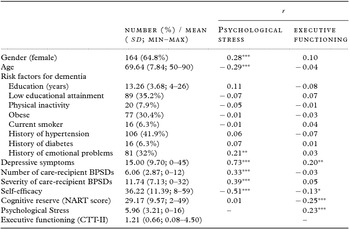
Table 1 presents the sample characteristics and the means, standard deviations, and inter-correlations for the key study variables. Gender, age, BPSD severity, and current level of depression were significantly associated with stress; however, of the risk factors for dementia, only history of emotional problems was significantly correlated with executive functioning. Higher stress and lower CR were significantly related to poorer executive functioning.
Sample characteristics and correlations with stress and executive functioning

Note. BPSDs = Behavioral and psychological symptoms of dementia, CTT-II = Color Trails Test Interference Index, NART = National Adult Reading Test.
*p < 0.05, **p < 0.01, ***p < 0.001.
Does CG psychological stress mediate the association between care-recipient BPSD severity and executive functioning?
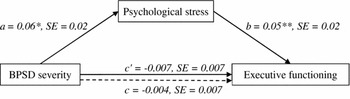
We estimated the total, direct, and indirect relationships between BPSD severity and executive functioning through psychological stress. BPSD severity did not directly predict executive functioning (Figure 2, path c; Table 2, Model 3); however, BPSD severity was indirectly associated with executive functioning through stress. As can be seen in Figure 2 (path a), CGs who cared for care-recipients with more severe BPSDs reported higher levels of stress than those whose care-recipients had less severe BPSDs (Model 1), and CGs with higher levels of stress had poorer executive functioning (path b, Model 4; indicated by a higher CTT-II score). A bias-corrected bootstrap CI for the indirect effect (ab = 0.003, SE = 0.002) based on 10,000 bootstrap samples was entirely above zero (0.001 to 0.007). The completely standardized indirect effect indicated that an increase of one SD in BPSD severity (7.13) was associated with an increase 0.03 of an SD in executive functioning score (i.e. 0.66 * 0.03 = 0.02). There was no evidence that BPSD severity predicted executive functioning independently of its relationship with perceived stress (path c’, Model 4).
Path coefficients for simple mediation analysis of BPSD severity on executive functioning through perceived stress. Note. Dashed line denotes the effect of BPSD severity on executive functioning when stress is not included as a mediator. a, b, c, and c’ are unstandardized regression coefficients.

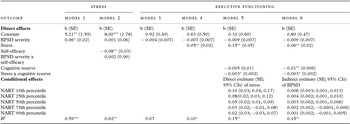
Regression model coefficients for the prediction of stress and executive functioning

Note. Seven dummy-coded variables (assessing risk factors for dementia) and current level of depression were included in all models and were entered simultaneously with all other variables, but their coefficients are not reported here. Conditional indirect effects are bootstrapped estimates of indirect effects of BPSD severity on executive functioning through psychological stress. *p < 0.05, **p < 0.01, ***p < 0.001.
Does self-efficacy moderate the relationship between BPSD severity and CG stress?
To test whether the relationship between BPSD severity and psychological stress was moderated by self-efficacy, we estimated a model predicting psychological stress from BPSD severity, self-efficacy, and their product, controlling for covariates (Table 2, Model 2). The interaction between BPSD severity and self-efficacy was not a statistically significant predictor of psychological stress (effect estimate = 0.002, 95% CI = −0.002 to 0.005, p > 0.05). As no evidence of moderation was observed, self-efficacy was not included as a moderator in the final moderated mediation analysis.
Does cognitive reserve moderate the relationship between CG psychological stress and executive functioning?
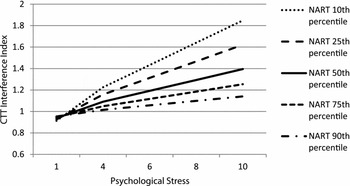
To test whether the relationship between psychological stress and executive functioning was moderated by CR, we estimated a model predicting executive functioning from psychological stress, CR, and their product, controlling for covariates and BPSD severity (Table 2, Model 5). This analysis revealed that the relationship between stress and executive functioning was dependent on CR (effect estimate = −0.003, 95% CI = −0.0065 to –0.0001, p = 0.04); whereby the strength of the negative relationship between psychological stress and executive functioning decreases as CR increases (see Figure 3). The Johnson-Neyman significance region was 33.59, indicating that for CGs who scored above this value on the NART (35.74% of the sample), there is no significant relationship between stress and CTT-II score.
Moderating effect of cognitive reserve (National Adult Reading Test score) on the relationship between psychological stress and executive functioning (Color Trails Test-Interference Index).

Does cognitive reserve moderate the indirect relationship between BPSD severity and executive functioning through CG psychological stress?
As evidence of moderation of one of the paths in a mediation model is not sufficient to claim moderation of mediation, we carried out a moderated mediation analysis to test whether the indirect relationship between BPSD severity and executive functioning through psychological stress was moderated by CR using the PROCESS model 14. As expected, the results revealed a significant interaction between stress and CR (see Table 2, Model 6); the higher the level of CR (i.e. the higher the NART score), the weaker the indirect relationship between BPSD severity and executive functioning through psychological stress. However, the 95% bootstrap CI for the index of moderated mediation (estimate = −0.0002, se = 0.0001) included zero (−0.0005, 0.0000); therefore, the hypothesis that CR moderates the indirect relationship was not supported.
Discussion
Our results indicate that exposure to more severe behavioral and psychological challenges associated with dementia predicts poorer CG executive functioning indirectly through psychological stress. These findings are in line with the model of CG stress and cognitive functioning of Vitaliano et al. (Reference Vitaliano, Murphy, Young, Echeverria and Borson2011). There was no evidence that greater stress exposure was directly associated with executive functioning; the findings therefore highlight the role of CGs’ subjective interpretation of potential stressors. Nevertheless, of note, the indirect relationship between BPSD severity and cognitive functioning was only marginally significant, and the completely standardized indirect effect indicated that the increase in the CTT-II score associated with an increase of one standard deviation in BPSD severity was small. Though BPSD severity was a significant predictor of psychological stress, and stress in turn predicted executive functioning, these factors explained very little additional variance (1% in stress and 3% in executive functioning respectively) after depression and other risk factors were included (results not presented). Thus, it is likely that other factors play a greater role in contributing to CG stress and executive performance; in addition to depression, such factors could include social isolation and loneliness, less social and cognitive engagement, and physical inactivity (Vitaliano et al., Reference Vitaliano, Murphy, Young, Echeverria and Borson2011).
To our knowledge, only one previous study examined whether greater stress mediated a relationship between the challenges of dementia care and CG executive functioning (Oken et al., Reference Oken, Fonareva and Wahbeh2011). Though others have examined the role of psychological morbidity, such as depression (de Vugt et al., Reference de Vugt2006; Vitaliano et al., Reference Vitaliano, Zhang, Young, Caswell, Scanlan and Echeverria2009), anxiety (de Vugt et al., Reference de Vugt2006), and various conceptualizations of distress (Vitaliano et al., Reference Vitaliano, Echeverria, Shelkey, Zhang and Scanlan2007; Mackenzie et al., Reference Mackenzie, Wiprzycka, Hasher and Goldstein2009), as a mediator with mixed results, all of these studies used CG/NCG status as a predictor rather than examining whether greater exposure to objective stressors among CGs predicted cognitive performance. Therefore, ours is the first study that demonstrates that the degree of exposure to dementia stressors among CGs is important. Furthermore, we built on previous studies by going beyond the causal step regression approach of Baron and Kenny (Reference Baron and Kenny1986) to mediation analysis by statistically testing the significance and the size of our proposed indirect relationships.
In line with our hypothesis, the relationship between psychological stress and executive functioning was dependent on CR. As CGs’ CR increased, the strength of the observed association between psychological stress and executive functioning decreased. Indeed, stress was not a significant predictor of executive functioning for CGs who had an NART score of 34 or higher. This finding is in line with the CR hypothesis and the idea that having greater CR helps to protect CGs from the adverse effects of stress on executive functioning. To our knowledge, ours is the first study to directly test whether CR moderates the relationship between self-reported stress and cognitive performance. We assessed CR using the NART, a measure of premorbid IQ, and a commonly used proxy indicator of CR. Future research could examine whether other proxy indicators of CR (for example, continued engagement in cognitively stimulating social activities) play a protective role. If such factors moderate relationships between stress and cognition, there may be potential for delaying cognitive decline in CGs through interventions aimed at maintaining or increasing CR.
Although care-recipient BPSD severity was a significant indirect predictor of executive functioning through stress in CGs with low CR, we found no evidence that CR moderated the indirect relationship between CG stress exposure and executive functioning through psychological stress. Although this finding appears paradoxical, finding evidence that a dependent variable is significantly related to a predictor at some values of a moderator does not establish that the effect of the predictor depends on that moderator (Hayes, Reference Hayes2013). Thus, although our findings do support CR as a moderator of the direct relationship between psychological stress and executive functioning, they do not provide statistical evidence of an interaction in the indirect model. This is not surprising, given the small size of the observed indirect relationship.
Contrary to our expectations, self-efficacy did not moderate the relationship between BPSD severity and psychological stress. This contrasts previous research that suggests that CGs with greater self-efficacy beliefs have greater resources to manage potential stressors associated with dementia, and therefore, are less likely to experience psychological distress in response to such challenges. It is possible that the use of different psychological measures at least partly explains this discrepancy in results, whereas previous studies (Rabinowitz et al., Reference Rabinowitz, Mausbach and Gallagher-Thompson2009; Zhang et al., Reference Zhang, Guo, Edwards, Yates and Li2014) focused on depressive symptoms and burden, our study assessed perceived psychological stress. Conceivably greater self-efficacy does not affect whether BPSDs are perceived as stressful by CGs, but only whether negative emotions, such as depression and burden, develop in response to the experience of stress.
Of note, executive functioning was not the only cognitive domain assessed in our study. However, given its strong association with physical functioning and the vulnerability of prefrontal processes to stress, we theorized that CG stress would be a stronger predictor of executive functioning than other cognitive processes and that executive dysfunction would play a greater role in CGs’ ability to provide care. Examination of the other cognitive domains assessed in the current study revealed that psychological stress also mediated an indirect relationship between stress exposure and processing speed, assessed using the CTT-1; however, there was no evidence that CR moderated the relationship between psychological stress and processing speed (results not presented). This suggests that CR may play a greater role in maintaining executive functioning, a prefrontal cognitive process, than processing speed, which is thought to draw on a wider array of brain regions. It is also possible that CR only emerged as a moderator of executive functioning, because there is more theoretical overlap between these two constructs. Indeed, previous studies investigating construct validity of CR have demonstrated that the construct is related to executive function but have also supported the validity of CR as a distinct construct (e.g. Siedlecki et al., Reference Siedlecki, Stern, Reuben, Sacco, Elkind and Wright2009). As noted by Siedlecki et al. (Reference Siedlecki, Stern, Reuben, Sacco, Elkind and Wright2009), it is perhaps unsurprising to find some overlap between CR and executive function, since executive function tasks typically involve abilities such as problem solving and mental flexibility, which could be considered important elements of skills and processes accumulated though the enriching experiences conceptualized to reflect CR.
No significant relationships were observed between psychological stress and any other cognitive domains assessed (immediate or delayed verbal recall, visuo-construction and visual memory, working memory, or verbal fluency; results not presented). These findings are in line with those of Oken et al. (Reference Oken, Fonareva and Wahbeh2011) who found that dementia CGs only had significantly poorer performance on measures of attention and executive functioning but not word-list memory tasks. Although the impact of stress on hippocampal atrophy is well documented, evidence that even mild uncontrollable acute stress can impact on prefrontal cognitive processes and that chronic stress causes architectural changes in prefrontal dendrites suggests that the prefrontal cortex is most vulnerable to the effects of stress (Arnsten, Reference Arnsten2009). Nevertheless, we did not observe any significant relationships between stress and working memory, which is also a prefrontal cognitive process.
Limitations
Our study has a number of limitations. We tested relationships between BPSD severity, stress, and executive functioning in a cross-sectional design; therefore, it is possible that the direction of hypothesized relationships was reversed. For example, rather than stress affecting CG executive functioning, it is also conceivable that executive functioning affects CG stress or self-efficacy; we cannot make any causal claims based on our findings. Furthermore, we were unable to take other factors, such as the duration of CG stress or care-recipient BPSDs, or the type of care-recipients’ dementia, into account. Care-recipients’ dementia diagnoses varied and included, for example, AD, vascular dementia, Lewy body dementia, and fronto-temporal dementia; the challenges associated with these dementias vary and the level of CG stress associated with them is also likely to vary depending on the nature and the stage of the disease. Furthermore, we used a composite measure of BPSD severity to assess caregiver stress exposure in our analysis; however, some BPSDs may contribute more to CG burden than others (Ornstein and Gaugler, Reference Ornstein and Gaugler2012).
Conclusion
Our study builds on previous research on the association between stress and cognitive function. Our findings suggest that CGs exposed to more severe stressors associated with dementia may be at a greater risk of problems in executive functioning. As executive functions are necessary for the planning and organization of behavior, executive dysfunction is likely to affect a person's ability to care for oneself and for others. This would have serious implications for the health and well-being of family CGs, who are currently the main providers of dementia care worldwide. Nevertheless, the observed relationships were relatively weak and their clinical significance remains to be established, especially as they were based on cross-sectional data and the direction of causality could not be established. Furthermore, we found no evidence that greater stress was associated with poorer performance on any other cognitive domains, including other prefrontal processes like working memory. As our findings did not support a relationship between stress and executive functioning among CGs with high CR, they are in line with the idea that targeting CR could help to reduce the risk of cognitive dysfunction among CGs and other populations who experience high levels of stress. However, additional research is needed to investigate whether modifiable factors that help to maintain CR in later life play such a protective role, and longitudinal and intervention studies are needed to determine the temporal relationships between caregiver stress and executive dysfunction.
Conflict of interest
None
Declaration of authors’ roles
M Pertl supervised the data collection, carried out the statistical analysis, and wrote the paper. C Hannigan assisted with the data analysis and with writing the paper. S Brennan, I Robertson, and B Lawlor designed the study and assisted with the paper.
Acknowledgments
The authors would like to thank Alan Galvin, Jennifer Rogers, and Katie O'Donnell who collected the data for this study. This work was funded by the Alzheimer Society of Ireland and the Health Research Board under the Medical Charities Research Scheme [grant number MRCG/2012/8] and supported by the Atlantic Philanthropies [award number 11024].