In recent years, numerous studies have sought to assess how well the public’s preferences are reflected in government. Such studies have focused on ideological congruence (e.g., Powell Reference Powell2000; Blais and Bodet Reference Blais, Nadeau, Gidengil and Nevitte2006; Powell Reference Powell2006; Golder and Stramski Reference Golder and Stramski2010; Golder and Lloyd Reference Golder and Lloyd2014) and the representation of policy preferences, variously defined (Erikson, MacKuen and Stimson Reference Erikson, MacKuen and Stimson2002; Hobolt and Klemmemsen Reference Hobolt and Klemmemsen2005; Hobolt and Klemmensen Reference Hobolt and Klemmensen2008; Soroka and Wlezien Reference Soroka and Wlezien2010). These are valuable contributions, but they rely on measures of preferences that, like all others, have limitations. Using ideological self-placement assumes that preferences can be represented along a single dimension, while policy opinions expressed in surveys may not be based on true attitudes (Zaller Reference Zaller1992). Here we propose another approach to measuring preferences and their representation in government. We show that citizens have preferences for various political parties, which go beyond vote choice, and that we can evaluate the extent to which these preferences are reflected in the composition of governments. The closer the link between citizens’ party preferences and the composition of government is, the better the performance of electoral democracy. We show in this study how this standard can be used to ascertain the relative performance of proportional representation (PR) and majoritarian systems (non-PR).
Ever since scholars began studying representation, much attention has focused on the impact of electoral systems on the quality of democratic representation. A number of studies emphasized the relationship between the proportion of votes received by the various parties and their seat share in the legislature (see, especially Rae Reference Rae1967; Taagepera and Shugart Reference Taagepera and Shugart1989), with the purpose of determining how that relationship varies according to factors such as the electoral formula and district magnitude. Unsurprisingly, that research found a stronger correspondence between vote share and seat share in PR systems and more importantly in large district systems.
Another stream of research was opened up by Powell (Powell Reference Powell2000; Powell Reference Powell2006), who, in his groundbreaking work, argued that scholars should focus on the representation of voters’ preferences in government. Democracy is about allowing ordinary citizens to influence indirectly (through their votes) the decisions that are made by their representatives. Such a perspective has two major implications. The first is that when one looks at the consequences of electoral systems, attention should shift from the legislature to the executive, where actual decisions are made in parliamentary systems. The second is that the relevant input is not ballots but rather citizens’ preferences.
Powell’s perspective has been extremely influential. There has been an explosion of research, pioneered by Powell himself, on how well governments represent voters, and on how the quality of representation is affected by institutional variables such as the electoral system. Because of the availability of huge cross-national data sets such as the Comparative Study of Electoral Systems (CSES), it is now possible to determine how close governments are to voters on the left-right ideological scale. A number of studies suggest that PR systems produce greater ideological congruence between voters and governments (Huber and Powell Reference Huber and Powell1994; Powell Reference Powell2000; Powell and Vanberg Reference Powell and Vanberg2000; McDonald, Mendes and Budge Reference McDonald, Mendes and Budge2004; McDonald and Budge Reference McDonald and Budge2005; Powell Reference Powell2006; Budge and McDonald Reference Budge and McDonald2007). Other analyses find no significant difference between PR and non-PR systems (Blais and Bodet Reference Blais, Nadeau, Gidengil and Nevitte2006; Golder and Stramski Reference Golder and Stramski2010; Golder and Lloyd Reference Golder and Lloyd2014). Powell (2009) explains this “ideological congruence controversy” by pointing to the atypical period covered by recent analyses (1996–2004). Golder and Lloyd (Reference Golder and Lloyd2014), however, using cluster-robust standard errors and cluster-robust bootstrap standard errors, find a significant difference between PR and non-PR systems in only one of the post-war decades and no overall difference during this period. They also find that, while PR systems produce more ideological congruence in legislatures, they produce less congruence in government, controlling for legislative congruence. Finally, Golder and Lloyd show that majoritarian systems are associated with greater variation in legislative ideological congruence but that PR systems have more variability in government congruence. They argue that the coalition-building process implied by proportional systems both decreases ideological congruence and increases its variability.
The main limitation of research on ideological congruence is that it is entirely based on the left-right scale as an indicator of citizens’ views. While it is the best available single indicator of citizens’ and parties’ overall ideological orientations, it is less valid in some countries and periods than in others, and it is obviously a very partial measure of people’s preferences, especially in multidimensional electoral markets.
Other authors have focused on the representation of citizens’ policy priorities (Hobolt and Klemmemsen Reference Hobolt and Klemmemsen2005; Hobolt and Klemmensen Reference Hobolt and Klemmensen2008), their preferences for spending on different areas of government policy (e.g., Soroka and Wlezien Reference Soroka and Wlezien2010), and their “mood” for more or less government spending (Erikson, MacKuen and Stimson Reference Erikson, MacKuen and Stimson2002). These approaches also make important contributions to our understanding of representation. However, they are generally limited in the number of countries for which they have data, making it difficult to analyze how representation varies across institutions. We are only aware of two such studies that have looked at the opinion-policy link with a sufficient number of cases to be able to assess the impact of electoral systems. Wlezien and Soroka (Reference Wlezien and Soroka2012) find that plurality systems have greater policy responsiveness. Kang and Powell (Reference Kang and Powell2010), on the other hand, find similar responsiveness in both systems.
We propose in this paper a new perspective on how citizens’ preferences are reflected in government. While previous research is about citizens’ ideological or policy preferences, we focus on their party preferences. Voters vote mostly for partiesFootnote 1 and legislative elections in non-presidential systems are ultimately about which party (or parties) will form the government. We make the plausible assumption that voters want the parties they like the most to be in government and the parties they dislike the most to be out of government, and thus, at the aggregate level, democracy works best when governing parties are better liked than non-governing parties. We compare the capacity of PR and majoritarian elections to deliver such an outcome.
Party preferences are shaped to a large extent by voters’ ideological orientations as well as their opinions about specific policy issues. However, they are influenced by many other factors, in particular voters’ judgments about parties’ competence. In other words, elections are not only about issue positions. They are also about valence (Clarke et al. Reference Clarke, Sanders, Stewart and Whiteley2004). Because elections are not only about issues or ideologies, an important criterion for assessing the performance of electoral democracy is whether the parties voters like exercise power in government and the parties that they dislike have little or no power.
Our standard of performance is not unrelated to ideological congruence and policy responsiveness. In order for ideological congruence or policy responsiveness to take place, parties citizens like more, which presumably are closer to their own positions, must occupy more seats in government. The difference between the party preference perspective, on the one hand, and the ideological congruence and policy responsiveness approaches on the other, is that the former focuses on how citizens feel about parties rather than on what drives those feelings. Obviously, party preferences are only one measure of preferences and, like other measures, they are imperfect. However, as we show below, citizens do have meaningful party preferences. It does make sense, therefore, to assess the extent to which they are reflected in government.
We use party preferences instead of the vote as our reference point because vote choice is affected by strategic considerations that lead some citizens to vote for a party that is not their first choice, because their preferred party is perceived to be non-viable (Cox Reference Cox1997). A vast literature has documented the presence of a significant amount of strategic voting, in PR as well as in majoritarian elections (Blais and Nadeau Reference Blais and Carty1996; Alvarez and Nagler Reference Alvarez and Nagler2000; Blais et al. Reference Blais and Nadeau2001; Gschwend Reference Gschwend2007; Abramson et al. Reference Abramson, Aldrich, Blais, Diamond, Diskin, Indridason, Lee and Levine2010; Meffert and Gschwend Reference Meffert and Gschwend2010). According to one study, in a typical election, about a quarter of voters vote for a party that is not their first choice (Blais et al. Reference Blais, Lachat, Hino and Doray-Demers2011). Vote choice is thus different from party preferences and from a normative perspective priority should be given to citizens’ preferences.
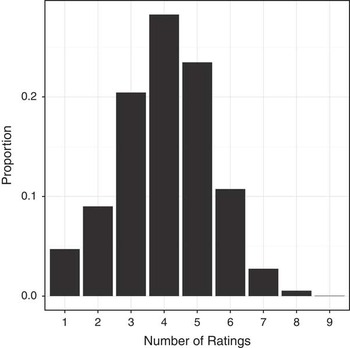
Another reason for preferring party preferences over vote choice is that vote choice does not fully reflect preferences. Voters frequently have second choice parties that they like almost as much as their first choices. People also often strongly dislike some parties. This is particularly important to keep in mind given the literature showing that negative evaluations are often more powerful than positive ratings (see e.g., Soroka Reference Soroka2014). Figure 1 shows the proportion of citizens in the elections covered by this paper who had distinct preferences for parties.Footnote 2 We can see that the mode, the median, and the mean are for people to give four different ratings (on the 0–10 scale) to the various parties. Most people thus have a set of distinct preferences among the various parties, and their vote choice does not fully inform us about these preferences.Footnote 3
How many distinct like–dislike scores do respondents give?

There are two key contrasting perspectives in the literature on what elections are supposed to accomplish (Lijphart Reference Lijphart1999; Powell Reference Powell2000). On the one hand, the majoritarian perspective involves concentrating all power in the single-party citizens prefer over all others. This vision has generally been seen as entailing that the party that gets a plurality of votes should be in government and the others excluded. On the other hand, the proportional (Powell Reference Powell2000) or consensual (Lijphart Reference Lijphart1999) view involves representing as many citizens as possible in the government-formation and policy-making processes. In terms of votes, this means that as many voters as possible should find the party they voted for represented in the legislature and/or cabinet.
Both perspectives have been formulated with respect to the translation of votes into legislative and cabinet seats. It is unclear what kind of translation of party preferences into cabinet seats proponents of each perspective would advocate. Nevertheless, we propose two criteria that we think advocates of proportionality and majoritarianism would subscribe to. The first is the proportion of citizens whose most liked party is in government. Proponents of the proportional view would argue that as many citizens as possible should have a representative of the party they vote for in government. With party preferences, the norm would be that as many citizens as possible find their most liked party in government.
The majoritarian vision is about giving power to the first choice party of the citizenry as a whole, in other words, to the top aggregate preference. If we only had access to first choice preferences, we might assert that the party that is the most liked party of the largest proportion of voters should be in government. However, we do have access to all preferences, so we can determine which party is the most liked overall, considering all citizens’ feelings about each of the parties, and observe whether that party is in government.
Given that we have access to citizens’ sets of preferences for all parties, there is no reason to limit ourselves to criteria related to the first preferences of all citizens (criterion 1) or to the single most preferred party overall (criterion 2). We thus propose a third and richer criterion, which takes into account each citizen’s evaluations of each of the parties as well as the intensity of these preferences, and ascertains how liked the governing parties are, overall, relative to the opposition parties. According to this perspective, electoral democracy works best when the governing parties are better liked than the opposition parties.
Why might we expect PR to perform better or worse than majoritarian systems with respect to these various criteria? Non-PR systems tend to reward large and regionally concentrated parties in the legislature, while harming small parties with small and dispersed support. PR generally produces a closer reflection of vote choice in the legislature. As a result of greater proportionality, there are more parties represented in the legislature under PR and the government is usually a coalition of two or more parties while in majoritarian systems the outcome is typically the formation of a single-party government (Katz Reference Katz1997).Footnote 4 In short, political systems can perform better or worse on our criteria because of disproportionality itself or because of the inclusion of more parties in government.
We expect PR to perform better with respect to criterion 1 (Hypothesis 1). In a majoritarian system, the party that gets to form the government typically gets a plurality but not a majority of the vote (Blais and Carty Reference Blais and Bodet1987; Blais and Carty Reference Blais and Carty1988). Furthermore, some of its support is likely to come from voters who prefer small parties but do not vote for them because they are not viable. PR elections, on the other hand, produce multi-party coalitions that are more likely to include a wider array of voters’ first preferences. Thus, a greater proportion of citizens should find that their most liked party is in government in PR systems, because more parties are in government.
We expect majoritarian systems to perform better than PR systems with respect to the second criterion, according to which the most preferred party overall should be in government (Hypothesis 2). As PR systems typically have multi-party coalitions and the formation of these coalitions is somewhat detached from electoral results, there is a higher probability that the coalition government will not include the most liked party. The more parties there are in government, the more likely a coalition of parties successfully manages to exclude the overall most liked party. Furthermore, in majoritarian systems, the most liked party, which generally is a large party, benefits from disproportionality, and we should thus expect non-PR to increase the chances of that party being in government. However, majoritarian systems, especially first past the post systems, sometimes produce anomalous outcomes, whereby the party with the most votes does not win a plurality of the seats and thus does not form the government (Shugart Reference Shugart2008). Nevertheless, we still predict that, all in all, the goal of having the most preferred party in government is met more often in majoritarian systems.
What about our third and most important criterion, that is, ensuring that the governing parties, overall, will be better liked than the non-governing parties? We expect majoritarian systems to perform better on this front (Hypothesis 3). The basic reason is the presence of coalition governments under PR. This has one good consequence, as it increases the number of citizens whose most preferred party is in government. It also has an important negative effect, as it means the inclusion in the coalition government of parties that are not much liked by many people. We thus expect that the more parties there are in government, the less liked governing parties are compared with non-governing parties.
Table 1 summarizes our expectations of how the electoral system and the number of parties in government affect performance on each of our criteria.
Expectations

Note: PR=proportional representation.
The Data
We use the four modules of the CSES that are currently available. Each of these contains a party like/dislike question in which respondents are asked to rate each party on a 0–10 scale where “0 means that you strongly dislike that party and 10 means that you strongly like that party.” This is a straightforward question that taps how much voters like or dislike each of the parties and is thus our indicator of citizens’ party preferences. This is in line with prior research on strategic voting that uses party feeling questions as indicators of sincere preferences (Blais et al. Reference Blais and Nadeau2001; Abramson et al. Reference Abramson, Aldrich, Blais, Diamond, Diskin, Indridason, Lee and Levine2010; Blais et al. Reference Blais, Lachat, Hino and Doray-Demers2011).Footnote 5
CSES collaborators are asked to request evaluations of the six most relevant parties, or even more if necessary. Of the 87 election studies included in our analysis, 29 have questions about six parties, 38 cover more than six (12 have seven parties, 15 have eight, and 11 have nine), and 20 include less than six.
As in previous studies (e.g., Golder and Stramski Reference Golder and Stramski2010), we focus on lower house elections in non-presidential democracies. We adopt the criterion used by Cheibub, Gandhi and Vreeland (Reference Cheibub, Gandhi and Vreeland2010) to distinguish between presidential and non-presidential systems: non-presidential regimes are those in which the government is responsible to the legislative assembly. The only exceptions to our use of this standard are cases where the president plays such a predominant role in cabinet formation that legislative elections have essentially no influence on government composition (see below). Our sample includes 87 legislative elections held in 35 countries. In total, 74 of the elections were held under PR and ten were under non-PR. The non-PR elections were in Australia, Canada, France, and Great Britain. There are also three elections held under mixed systems in Japan and Thailand (see Online Appendix for a list of elections).Footnote 6
We include all lower house election studies in non-presidential democracies included in CSES modules 1, 2, and 3, as well as those available in module 4 as of April 2015, except the 1998 Ukrainian election and the elections in Taiwan, as these were held under the presidential-parliamentary variant of semi-presidentialism, in which presidents have more control over the cabinet and legislatures have less power than in the other variant, premier-presidentialism (Shugart Reference Shugart2005). Austria is also considered presidential-parliamentary. In that country, however, parties effectively control the recruitment of presidents, and power is shared between two parties, all of which limit the power of the president (Müller Reference Müller1999, cited in Shugart Reference Shugart2005). Therefore, we have decided to retain the 2008 and 2013 elections in Austria, in spite of the formal constitutional powers of the president. In all the countries that we have included, a new cabinet was formed within a few months of the legislative election.Footnote 7
For each party included in the CSES election studies, we have the distribution of ratings it gets from the electorate, on the one hand, and the proportion of seats it had in the cabinet that was formed after the election, on the other.Footnote 8 With that information, we are able to compare the performance of majoritarian and PR systems with respect to the three criteria outlined above. Note that we only consider one government per election.Footnote 9
We perform the following analyses. We first simply compare PR and non-PR systems. We then examine the relationship between various measures of performance and three indicators of proportionality: a simple dummy variable that equals 1 for elections conducted under PR and 0 for majoritarian elections,Footnote 10 a disproportionality index (Gallagher Reference Gallagher1991), and mean district magnitude (MDM). MDM was calculated by dividing the total number of seats by the total number of districts.Footnote 11 The PR dummy variable is the simplest and most direct, but also the crudest indicator. The Gallagher index has the advantage of being an encompassing measure of the degree to which the distribution of seats in the legislature departs from the distribution of votes but the disadvantage of being affected by decisions made by the parties as well as by the rules themselves (Cox Reference Cox1997, Chapter 9). MDM (see, e.g., Coppedge Reference Coppedge1997; Clark and Golder Reference Clark and Golder2006) has the advantage of being a purely institutional indicator but the disadvantage of tapping only one element (district magnitude) of the electoral system, leaving aside other aspects such as the presence of legal thresholds. We thus have three explanatory variables: a dummy for whether the election is held under a PR or a non-PR system, the degree of disproportionality, and MDM. In the latter two cases, as is usual in the literature, we use a logarithmic transformation of the variables.
In order to assess the influence of the mediator variable mentioned above, we include a variable corresponding to the number of parties in cabinet.Footnote 12 We expect the differences in the performance of PR and majoritarian systems to be explained in good part by the fact that the former usually lead to the formation of multi-party coalition governments. We add two control variables that may also affect the quality of representation. First, we include the level of economic development, measured by the GDP per capita of the country the year each election was held, in current US dollars, from the World Bank (2014). Second, we control for the overall level of democratic development, measured by the average of the Political rights and Civil liberties scores, published by Freedom House (2014) in Freedom in the World, for each country the year the election was held.
To analyze the relationship between our three indicators of proportionality and our three criteria of performance, we use Bayesian methods.Footnote 13 Conventional frequentist methods assess how often a particular result would be at least as distant as an estimate from the value posited by a “null” hypothesis if we were to repeat a sampling procedure a large number of times. In order for frequentist hypothesis tests to make sense, we must assume that we can repeatedly sample from an underlying population. Bayesian approaches, on the other hand, give us the plausibility of a particular hypothesis given our particular sample of data. There is no focus on how often a particular result is to occur if we take samples a large number of times. This Bayesian approach is more reasonable when the assumption of replicability is unrealistic, as typically occurs in the social sciences (see, e.g., Gill Reference Gill2008; Jackman Reference Jackman2009). Given that our units of analysis are elections, it would be unrealistic to claim that repeated sampling is possible.Footnote 14
Inference in Bayesian analysis does not involve confidence intervals or significance tests. Rather than using cut-offs, like 0.05, for null hypothesis significance tests, with Bayesian methods we interpret the results of an analysis by describing the posterior distributions of the parameters of interest. This can be done by stating the proportion of a parameter’s posterior distribution that is in a given range, for example, greater than or less than 0. This is essentially how confident we can be that the coefficient is positive or negative.
Findings
Criteria 1: How Many Citizens Have Their Preferred Party in Government?
We would hope that as many people as possible find that their preferred party is in government rather than in the opposition. As a matter of fact, on average, 49 percent of citizens are in such a fortunate situation in the 87 elections covered by our study. The proportion ranges from a low of 28 percent in Norway (1997) to a high of 70 percent in Finland (2011).Footnote 15
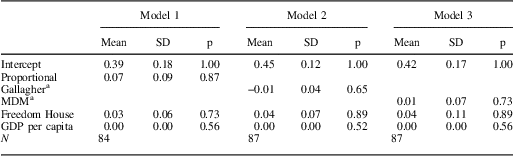
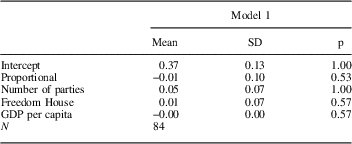
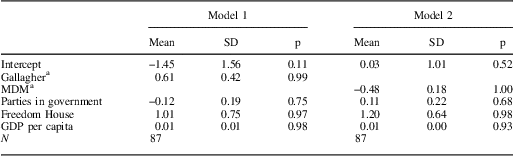
Do PR systems do better on this criterion? The answer is yes. On average, 50 percent of citizens get their most liked party in government under PR, compared with 43 percent in non-PR elections (see Table 2 for main results). The linear regression results in Table 3 show that everything else being equal the percentage of citizens whose most liked party is in government is 7 points higher under PR.Footnote 16 Likewise, that percentage is higher as the disproportionality index gets lower and as MDM gets higher, in other words, in more proportional systems.Footnote 17 However, the level of confidence that we have in this conclusion is only high for the PR dummy, where it is 87 percent. This relationship is due to the number of parties in government. Table 4 shows the results of a model including this variable and shows that the coefficient on the PR dummy drops considerably and the coefficient on the number of parties in government is positive and the level of confidence in it being positive is very high (nearly 100 percent).Footnote 18
Main Results

Note: PR=proportional representation.
Criterion 1: Proportion with Most Liked Party in Cabinet

Note: MDM=mean district magnitude; GDP=gross domestic product.
a We used the log of these variables.
Criterion 1: Proportion With Most Liked Party in Cabinet (With Number of Parties)

Note: GDP=gross domestic product.
As expected, then, more people have their preferred party in government under PR, and this is due to the fact that PR leads to the presence of more parties in cabinet. On this first criterion, PR elections perform somewhat better.
Criterion 2: Is the Most Liked Party in Government?
Perhaps the simplest question of all is whether voters manage to get the party that they like the most overall in government. For this, we compute the mean ratings of all the parties in each election. We identify the party that is most liked overall, and we determine whether that party is in government or not.
All in all, the most liked party was in government in 76 of the 87 elections, that is, 87 percent of the time. Is the criterion better achieved in majoritarian systems? The answer is yes. The most liked party was in government after each of the ten non-PR elections, while that was not always the case following PR elections. In fact, in 11 PR elections out of 74 (15 percent), the most liked party found itself in the opposition. That was the case in the following elections: Denmark (2007), Estonia (2011), Israel (1996), the Netherlands (2006), the Netherlands (2010), New Zealand (1996), Norway (1997), Portugal (2002), Slovakia (2010), Spain (1996), and Sweden (2006).
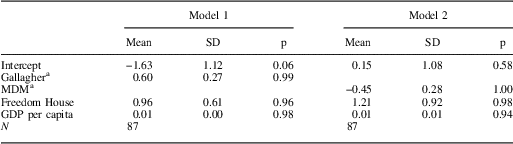
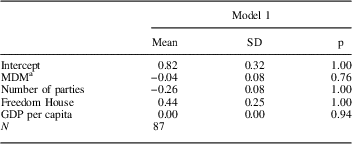
Table 5 presents the results of probit regressions of a dichotomous variable indicating whether the most liked party was in cabinet or not on each of our explanatory variables, with the exception of the proportional dummy, which was dropped because it perfectly predicts the outcome,Footnote 19 as well as the two control variables. The table shows that the most liked party was more likely to be in government in systems with higher disproportionality and with lower district magnitude. Our analysis leads us to be highly confident (at least 99 percent) in these differences. As anticipated, the probability of the most liked party being in government is higher under majoritarian elections. This probability increases by 8 percentage points when going from an election with MDM of 1 to one with MDM of 10. Table 6 shows models with the number of parties in government added. We can see that the relationship between proportionality and the probability of the most liked party being in government persists and is thus not due to the number of parties who join governing coalitions but instead appears to be due to the disproportionality of the electoral system itself. In all non-proportional cases, the most liked party has a higher seat share than vote share.Footnote 20
Criterion 2: Most Liked Party in Cabinet

Note: MDM=mean district magnitude; GDP=gross domestic product.
a We used the log of these variables.
Criterion 2: Most Liked Party in Cabinet (With Number of Parties)

Note: MDM=mean district magnitude; GDP=gross domestic product.
a We used the log of these variables.
Criterion 3: Are Governing Parties Better Liked Than Non-Governing Parties?
The previous criteria focus on each individual’s single most liked party (criterion 1) or the single party that is most liked overall (criterion 2). The last criterion considers how all voters rate all the parties in government, in comparison with all opposition parties.
We developed a measure that captures the utility that each individual derives from having a given set of parties in government and another set of parties in opposition. The greater the overall differential in ratings given to governing parties relative to those given to non-governing parties, the higher an individual’s net global utility is. We weight each respondent’s like/dislike score for each party according to its share of seats in the legislature, so that small parties count less than big ones. The more positive the difference between weighted mean ratings of governing and non-governing parties, the higher the individual’s net utility. We then calculate the citizens’ overall mean relative utility for each election.Footnote 21
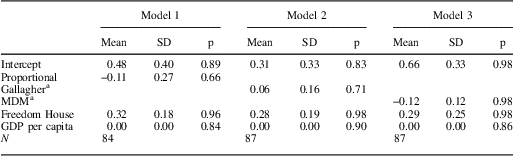
All in all, governing parties are better liked than opposition parties in 82 of the 87 elections. The mean rating given to governing parties is 5.2 while the opposition parties get 4.2 on average, which yields a mean net utility of +1.0. The mean differential is slightly more positive in non-proportional systems: a gap of 1.03, compared with 0.97 in PR systems.
Table 7 shows that elections held under the majoritarian rule, where the result was more disproportional, and with smaller district magnitudes produce governments that are better liked, in comparison with opposition parties. The three coefficients point in the same direction though only in the latter case do we reach a high level of confidence (99 percent). There thus is some evidence that majoritarian systems perform slightly better on this criterion. The gap predicted by model 3 between the mean ratings of governing and non-governing parties is 0.28 lower when MDM is 10 than when MDM is 1. Table 8 shows the results from a model including MDM and the number of parties. We can see that the value of the coefficient on MDM drops to a third of its previous value, while the coefficient on the number of parties in government is negative and has a high level of confidence. Thus, the lower performance of more proportional systems on this criterion is mostly due to the greater number of parties in government in those systems.
Criterion 3: How Much More Liked are Governing Parties Compared with Opposition Parties?

Note: MDM=mean district magnitude; GDP=gross domestic product.
a We used the log of these variables.
Criterion 3: How Much More Liked are Governing Parties Compared with Opposition Parties? (With Number of Parties)

Note: MDM=mean district magnitude; GDP=gross domestic product.
a We used the log of these variables.
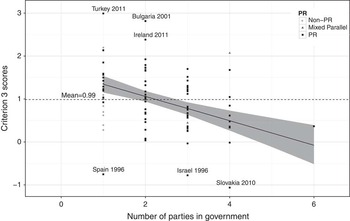
As with criterion 1, the number of parties in government appears to be a key variable determining how well citizens’ party preferences are reflected in government. Figure 2 shows the relationship between differences in evaluations of government and opposition parties, on the one hand, and the number of parties in government, on the other, along with 90 percent confidence bounds. The three elections with the highest scores and the three with the lowest scores are labeled. We can see the clear negative relationship between the dependent variable and the number of parties in government.
Criterion 3: How liked are governing parties, compared with non-governing parties? Note: PR=proportional representation.

Discussion
We have reviewed three different ways of evaluating how well citizens’ party preferences are reflected in the composition of governments that are formed after legislative elections, and we have tested three hypotheses about the capacity of majoritarian and PR elections to produce good outcomes. The first hypothesis was that more voters would have their most preferred party in government under PR. We have found some evidence that this is the case and that it is due to the creation of coalition governments in proportional systems.
The second hypothesis was that the most liked party overall is more often in government in majoritarian elections. That hypothesis is clearly confirmed. This result may not be surprising as it is precisely what majoritarian elections are supposed to accomplish: put in government, the party that has the greatest support in the electorate. But it is still interesting to see that the actual outcomes correspond in this case to the conventional assumption. We have also shown that non-proportional systems perform better on this criterion because of the nature of the electoral system and not because of the existence of multi-party coalition governments.
But we have argued that the most meaningful criterion when using party preferences to assess representation consists in determining how much more liked governing parties are overall than opposition parties. This criterion has the advantage of taking into account how (strongly) citizens feel about each of the parties instead of considering only each person’s first preferences (first criterion) or only the single party that is most liked overall (second criterion). On this front, we find that majoritarian elections perform somewhat better.
Why are governing parties less liked, overall, under PR? The main reason is simply that PR elections usually produce coalition governments. As mentioned above, the governments that were formed after PR elections were made up of at least two parties 81 percent of the time, while all the majoritarian elections included in this study led to single-party governments.
This raises the question of why governing parties are less liked compared with opposition parties when there are coalition governments. The main reason is simply that larger parties tend to be better liked overall than smaller parties and that coalition governments are more likely to include smaller, less liked parties. The mean evaluations of the governing party in a single-party government and of the largest party in a coalition government are nearly identical: 5.48 and 5.41, respectively. The average rating of coalition parties with <20 percent of seats in cabinet is 3.87, not much higher than the mean rating of parties that end up in the opposition under coalition governments, 3.80. The process of coalition-making entails the inclusion of small parties in government, and many of these small parties are not liked by many voters. Coalition governments, as we have shown, tend to increase the proportion of citizens whose most liked party is in government. However, this entails including in government some parties that are not liked by many other citizens. There is thus a trade-off between satisfying a greater proportion of first choices and satisfying overall preferences.
Conclusion
There are many ways to evaluate the performance of electoral systems. We have proposed a simple and original standard in this paper: the degree of correspondence between citizens’ party preferences and the party composition of the cabinet. We have argued that this standard makes a lot of sense as elections are very much about which party(ies) will have the opportunity to form the government. Our approach is based on the rather plausible assumption that people prefer to be governed by parties that they like and that they prefer parties that they dislike to be in opposition. From that perspective, a good voting system should maximize the probability that governing parties are better liked, overall, than opposition parties.
We have developed three criteria for assessing how well citizens’ party preferences are reflected in the composition of government. The first two are particularly simple and straightforward. They are about the capacity of an election to maximize the proportion of citizens whose preferred party is in government and the probability that the party that is most liked overall is in government. These criteria are interesting but they are also limited. The former only takes into account people’s first preferences while the latter considers only the single party that is preferred in the aggregate. We have argued for a more complete measure, which incorporates citizens’ feelings about all parties as well as their intensity. This criterion is the difference between the ratings given to the governing parties and the ratings obtained by the opposition parties. The greater the difference, the higher voters’ net utility, and the better electoral democracy works. We have shown that, on this crucial criterion, majoritarian systems perform somewhat better than PR, mainly because the latter produces coalitions in which some of the smaller partners are not very much liked by many voters.
A key feature of our approach is that it is based on citizens’ ratings of parties. As mentioned above, these data, which are available in most election studies and most importantly in the largest election data set (CSES), have a clear advantage over vote choice. Conceptually, we are interested in citizens’ preferences, and the party like/dislike ratings have greater face validity than vote choice as an indicator of preferences, particularly since vote choice is also likely to incorporate strategic considerations. We have also shown that most citizens have more than two distinct party evaluations, which means that their vote choice does not fully account for how they feel about parties. Furthermore, such ratings provide richer information since they inform us about how much each individual likes or dislikes each party in contrast to vote choice, which only tells us which single party the person supports.
Some readers may infer that this study demonstrates that majoritarian elections are superior to PR elections. Such a conclusion is not warranted. The verdict about which is the best electoral system depends on value judgments. The standard that we have explored in this study, the correspondence between citizens’ party preferences and the party composition of governments, is just one of many to consider in the debate over the merits and limits of electoral systems (see Blais Reference Blais1991). Moreover, we have shown that electoral systems have different effects on different criteria. While coalitions formed under PR lead to the inclusion of more citizens’ most liked parties in government, these same coalitions allow smaller less liked parties to enter government, leading to overall lower ratings of governing compared with non-governing parties. Moreover, the proportionality in electoral results under PR makes the inclusion of the overall most liked party less reliable than in majoritarian systems. In short, before concluding that one system is better than the other, we must decide which aspects of citizens’ preferences matter the most.
Our claim is rather that the yardstick that we have proposed and examined in this study is a meaningful one that has been neglected in prior research. We hope to have contributed to filling an important gap in the literature and we also hope to spur further work, with additional measures of how well the composition of government reflects citizens’ party preferences.
Appendix: Elections in Data set
Proportional
Albania 2005, Austria 2008, Austria 2013, Belgium 2003, Bulgaria 2001, Croatia 2007, Czech Republic 1996, Czech Republic 2002, Czech Republic 2006, Czech Republic 2010, Denmark 1998, Denmark 2001, Denmark 2007, Estonia 2011, Finland 2003, Finland 2007, Finland 2011, Germany 1998, Germany 2002, Germany 2005, Germany 2009, Germany 2013, Greece 2009, Greece 2012, Hungary 1998, Hungary 2002, Iceland 1999, Iceland 2003, Iceland 2007, Iceland 2009, Iceland 2013, Ireland 2002, Ireland 2007, Ireland 2011, Israel 1996, Israel 2003, Israel 2006, Italy 2006, Latvia 2010, Montenegro 2012, the Netherlands 1998, the Netherlands 2002, the Netherlands 2006, the Netherlands 2010, New Zealand 1996, New Zealand 2002, New Zealand 2008, New Zealand 2011, Norway 1997, Norway 2001, Norway 2005, Norway 2009, Poland 1997, Poland 2001, Poland 2005, Poland 2007, Poland 2011, Portugal 2002, Portugal 2005, Portugal 2009, Romania 1996, Romania 2004, Slovakia 2010, Slovenia 1996, Slovenia 2004, Slovenia 2008, Spain 1996, Spain 2000, Spain 2004, Spain 2008, Sweden 1998, Sweden 2002, Sweden 2006, Turkey 2011.
Non-Proportional
Australia 1996, Australia 2004, Australia 2007, Australia 2013, Canada 1997, Canada 2004, Canada 2008, France 2007, Great Britain 1997, Great Britain 2005.
Mixed
Japan 1996, Thailand 2001, Thailand 2006.