
Introduction
The adoption of alphabetic writing from the Phoenicians, and its adaptation, by the Greeks sometime in the eighth century BC, was one of the most critical developments in world history. The ramifications were almost immediate and far-reaching. For the first time, writing was not limited to a scribal class serving a ruling or religious elite, whether in Mesopotamia, Egypt, the Levant or in the syllabic Linear B world of the Mycenaean palatial system. As I have stated elsewhere:
Henceforth, a bard could reach across centuries to relate a real or imagined world of heroes [Homer], a woman could write poetry [Sappho], a farmer could write of works and days, even on the birth of gods [Hesiod], a playwright could construct figures of high tragedy or slapstick comedy [Aeschylus, Sophocles, Euripides, Aristophanes], a seasoned traveler could recount his journeys and the customs of the peoples he chanced across [Herodotus], a failed and frustrated general could write a history of a war [Thucydides], and any male citizen could scratch on a potsherd the name of whomever he wished to ostracise (Papadopoulos 2014: 192).
Writing was invented independently in three places: first in Sumer, southern Mesopotamia, the oldest example being from c. 3200 BC at Uruk (Michalowski Reference Michalowski and Woodard2004) and in Egypt soon after (Loprieno Reference Loprieno and Woodard2004); Chinese script appeared by the middle of the second millennium BC (Peyraube Reference Peyraube and Woodard2004); and in Mesoamerica, Maya glyphs first appeared c. 300 BC (Bricker Reference Bricker and Woodard2004). Mesopotamian cuneiform was the most widely used system of writing before the alphabet, which was first developed in western Asia in the second millennium BC (Isserlin Reference Isserlin, Boardman, Edwards, Hammond and Sollberger1982; Naveh Reference Naveh1982) and, indeed, most alphabets can ultimately be traced back to the west Semitic alphabet (Sass Reference Sass2005).
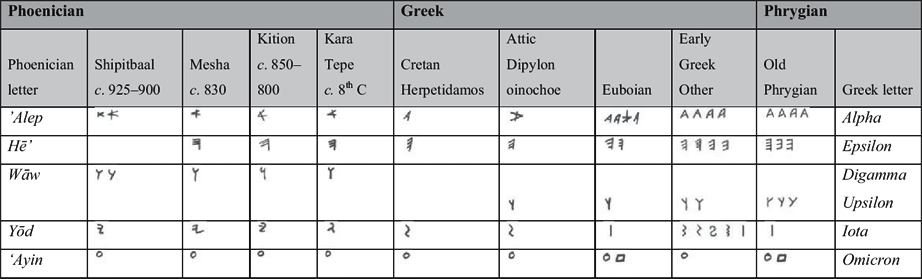
Of importance here is that the west Semitic alphabet was introduced, adopted and adapted to the specific cultural context of Early Iron Age Greece. Drawing on new archaeological finds, notably from Eretria and Methone, in the context of linguistic evidence, this paper reassesses the place(s) where the Greeks—and Phrygians—adopted and adapted the Phoenician/Aramaic alphabet to create their own. There are many locales where Greek and Semitic speakers co-existed in the Mediterranean. As Barry Powell (2002: 193) noted: “Greeks and Semitic Levantines mixed in the Orontes estuary, Euboia, Boiotia, Samos, Crete, Cyprus, and Italy”. Other locales have also been suggested, not least the Nile Delta, although the evidence from Egypt largely post-dates the adoption and adaptation of the Phoenician alphabet by the Greeks. Often neglected in discussions of the Greek adoption of the Phoenician alphabet is the remarkable agreement among the Greek and Phrygian vowels, to such an extent that they could not have been adopted from the Semitic script independently (Table 1). The signs for the vowels are taken from Semitic script but represent Semitic sounds largely superfluous to Greek and Phrygian phonology that were at hand and available for use as signs for vowels, which Semitic ostensibly lacks (Young Reference Young1969: 255): ’ālep (α: alpha), hē’ (ε: epsilon; cf. ḥêṯ [η: eta]), yod (ι: iota), ‘ayin (ο: omikron) and wāw-upsilon (υ: upsilon) (Jeffery 1989: 21–42). The similarity in the vowels is such that it demands a place of adoption and adaptation that includes Phrygians, not just Greeks and Phoenicians. Before enumerating the various locales where the adoption/adaptation occurred, it is important to review the new information from Eretria and Methone.
Comparison of Phoenician, Greek and Phrygian vowels, adapted from Coldstream (Reference Coldstream1977: 297, fig. 94), but showing only the Greek vowels. The Euboian column is based on vowel forms for Pithekoussai and Lefkandi; the Old Phrygian column is based on the eighth-century inscriptions from Gordion (Young Reference Young1969); the Early Greek Other column is based on Jeffery (1989: 23, fig. 1, alpha 3–5). Most of the letters are shown retrograde.

The new evidence from Eretria and Methone
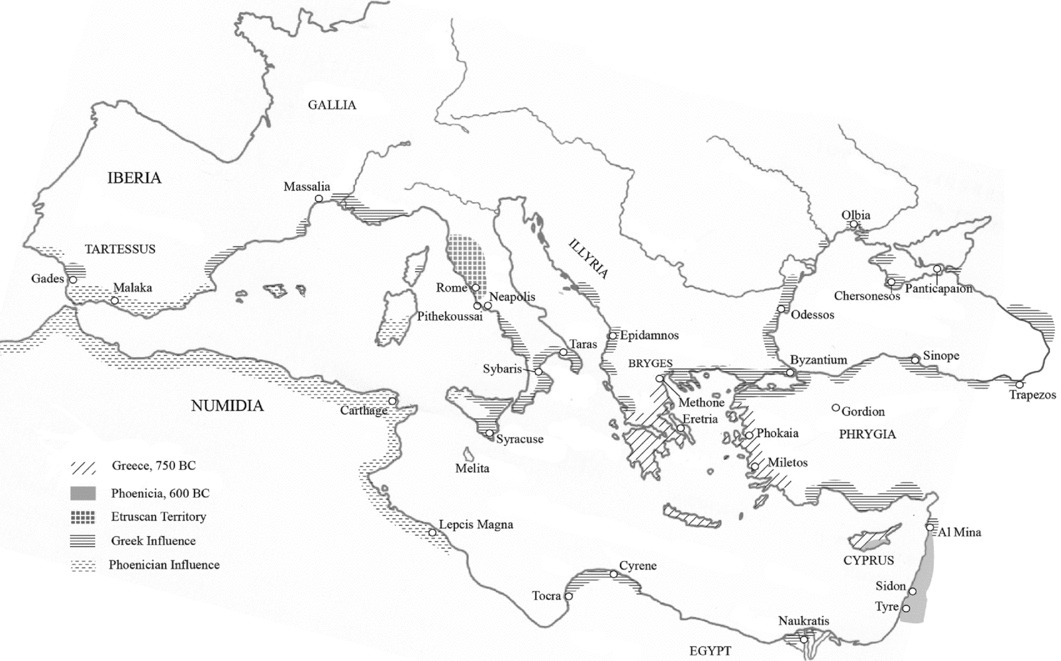
Eretria, in central-western Euboia, is the traditional metropolis (mother-city) of Methone, in Pieria (Macedonia), strategically located near the delta of the Haliakmon River and at the south-eastern edge of the Thermaic Gulf (Bessios et al. Reference Bessios, Tzifopoulos and Kotsonas2012) (Figure 1). Early Euboian settlers found in Methone a thriving settlement that was continuously occupied from the Final Neolithic period, through the Bronze Age, Early Iron Age, Archaic and Classical periods. The city was destroyed by Philip II in 354 BC (Bessios et al. Reference Bessios, Tzifopoulos and Kotsonas2012: 44, fig. 1).
Map of the Mediterranean showing some of the sites mentioned in the text and the main spheres of Greek, Phoenician and Etruscan influence (© Christine Johnston, Myles Chykerda & John Papadopoulos).

The new finds from Eretria were encountered in the sanctuary of Apollo Daphnephoros, the majority dating to the Late Geometric period (750–700 BC). They were published in exemplary detail by Kenzelmann Pfyffer et al. (Reference Kenzelmann Pfyffer, Theurillat and Verdan2005) in eight categories: I) small open vessels for drinking (42 inscriptions, 3 painted or inscribed before firing, the remainder inscribed after firing; nos. 1–42); II) large krater with post-firing inscription (no. 43); III) small closed vessels, 4 post-firing inscriptions (nos. 44–47); IV) amphorae (14 inscriptions, 2 before firing, the remainder after firing, nos. 48–61); V) large coarse vessel (inscription before firing, no. 62); VI) ostraka, inscriptions on already broken sherds (nos. 63–64); VII) inscription on a spindle-whorl or bead (no. 65); and VIII) solitary Semitic inscription.
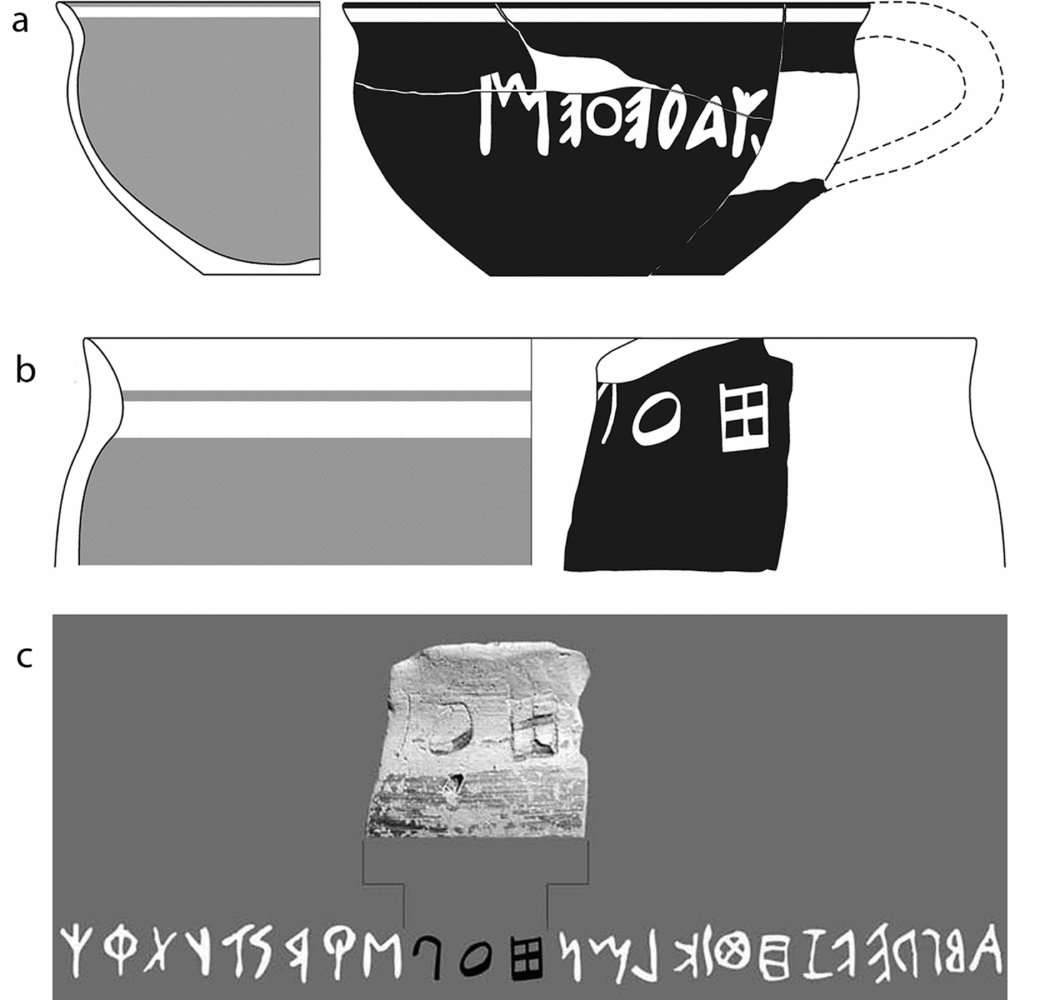
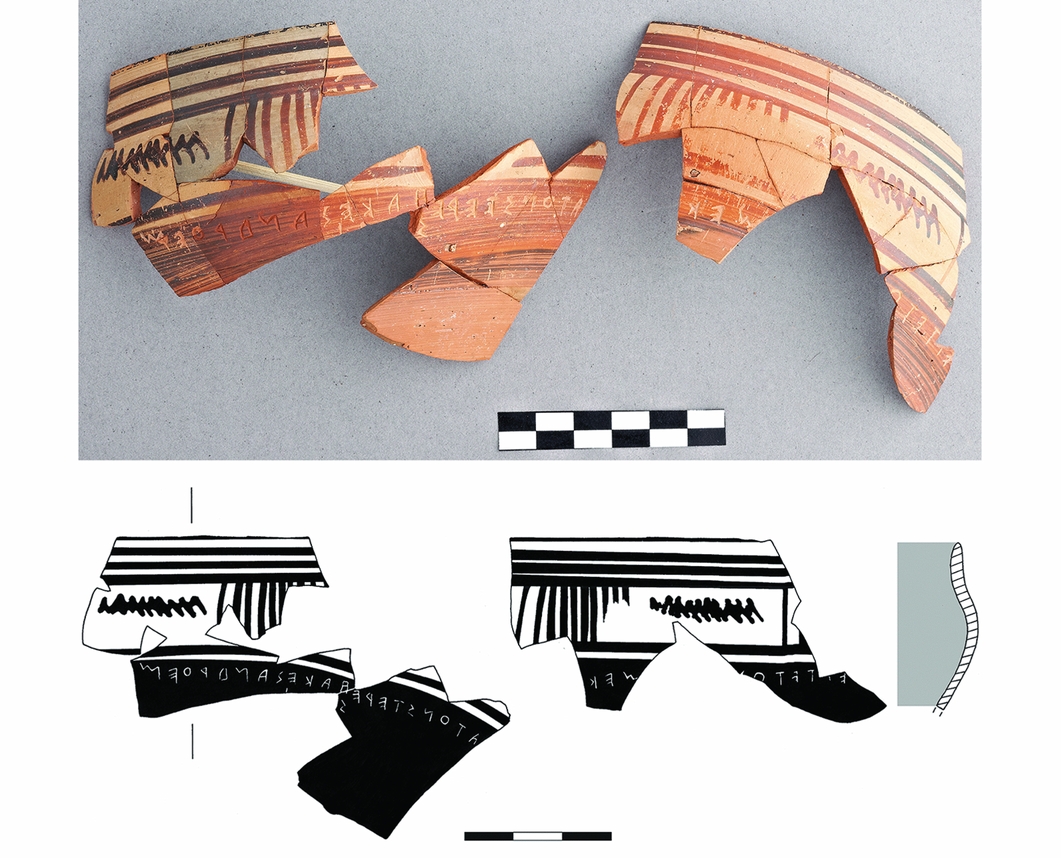
Of these 66 marks, I illustrate only two, both painted or incised before the vessels were fired, both small open vessels: one dipinto and one inscription (Figure 2). The latter preserves a small portion of an abecedarium, written retrograde (from right to left) (Figure 2b & c; Bourogiannis Reference Bourogiannis, Garbati and Pedrizzi2015: 162, fig. 3), by someone practising to write the entire alphabet. Both were made by potters working at Eretria in the Late Geometric period; they are not post-firing marks, which could have been written later, although they were from secure contexts of the second half of the eighth century BC. More remarkable is that these very early dipinti and graffiti were not made by scribes serving a ruling elite, but by potters, a point that speaks volumes as to the extent and use of literacy during this early period when the Greek alphabet was being developed (cf. Johnston Reference Johnston and Hägg1983).
Two one-handled cups from Eretria, all Euboian Late Geometric: a) FK00382, painted possessive in white paint on exterior of body: ←]λχαδεοεμι; b) three preserved letters incised on exterior of body: ←]⊕οπ[(courtesy Swiss School of Archaeology in Greece); c) fragment 2b reconstructed as an abecedarium.

Euboian Middle Geometric cup fragment from Eretria (FK90657), with Semitic inscription KPLŠ (retrograde). Courtesy Swiss School of Archaeology in Greece.

Eretria has also yielded an even earlier Middle Geometric (850–750 BC) cup fragment, of local fabric, with a Semitic inscription KPLŠ, written retrograde after firing (Kenzelmann Pfyffer et al. Reference Kenzelmann Pfyffer, Theurillat and Verdan2005: 76–77, no. 66) (Figure 3). The inscription could be Phoenician or North Syrian or Cilician, and must have been written by a Semitic speaker, whether a trader or eastern resident alien (cf. Bourogiannis Reference Bourogiannis, Garbati and Pedrizzi2015). Indeed, evidence for immigrant craftsmen on Crete and in Corinth is clear, including examples from the earlier Iron Age (Hoffman Reference Hoffman1997; Morris & Papadopoulos Reference Morris, Papadopoulos, Rolle, Schmidt and Docter1998).
Dating to the late eighth and seventh centuries BC, the Methone marks (Bessios et al. Reference Bessios, Tzifopoulos and Kotsonas2012; Tzifopoulos Reference Tzifopoulos2013)—pre- and post-firing—are roughly contemporary with the corpus from Pithekoussai, also pre- and post-firing inscriptions (Bartoněk & Buchner Reference Bartoněk and Buchner1995). The Methone marks are all the more extraordinary because they are found on pottery from all over the Greek world and beyond, in the heart of the Aegean (Clay et al. forthcoming). In this, the largely seventh-century-BC material from Kommos in southern Crete shares a good deal in common with Methone and Eretria, and a few of the inscribed pieces from Kommos are late eighth century (Csapo Reference Csapo1991; Johnston 1993, 2005; Csapo et al. Reference Csapo, Johnston, Geagan, Shaw and Shaw2000). Kommos and other sites in the Aegean reinforce the significance of the Aegean as a place of experimentation for the alphabet.
The new Methone inscriptions were found in a deposit in the so-called hypogeion, a large rectangular underground basement, over 11m deep (Bessios et al. Reference Bessios, Tzifopoulos and Kotsonas2012: 39–60). The deposit yielded, among other things, 191 pottery vessels or fragments with inscriptions, mostly post-firing, but some pre-firing. Of these, 30 were found in the upper portion of the deposit dating to the seventh–sixth centuries; the remainder date to the late eighth or early seventh century BC. Among this pottery, 25 pieces had early alphabetic inscriptions (see Table S1 in online supplementary material): 22 are securely dated on the basis of stratigraphy and style to the late eighth–early seventh centuries BC; three are later (late seventh or early sixth century); one is mid fourth century BC. Although many of the alphabetic inscriptions are in the Euboian epichoric alphabet, the range of pottery shapes inscribed, the eclectic nature of the inscriptions themselves and the provenances of manufacture are staggering.
The range of material on which the Methone inscriptions were inscribed is noteworthy and different to those of Eretria, where most of the inscriptions are found on locally produced pottery. Among the transport amphorae alone (see online supplementary material, Table S1), there are inscriptions on local Methonaian (2), Samian (4), Lesbian (1), Attic SOS (2), Chian (1) and three uncertain amphorae. Additional alphabetic inscriptions are found on five locally manufactured Thermaic Gulf drinking vessels, a locally made jug, three imported Euboian skyphoi, an Aeolian grey-ware drinking cup and a skyphos of uncertain provenance.
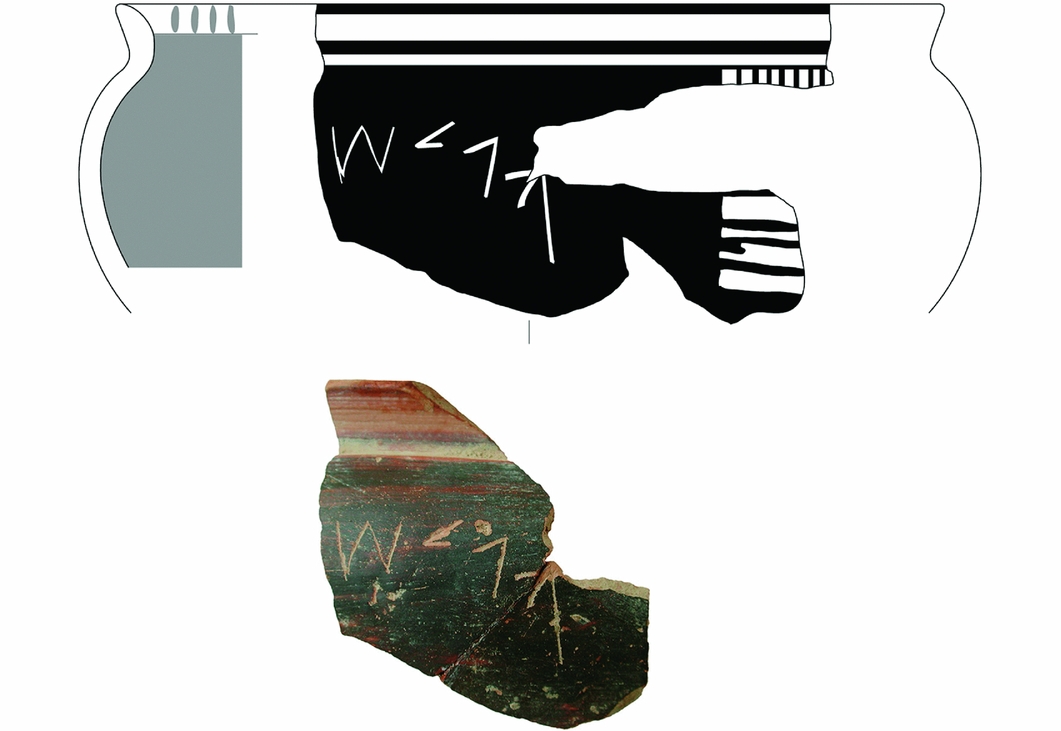
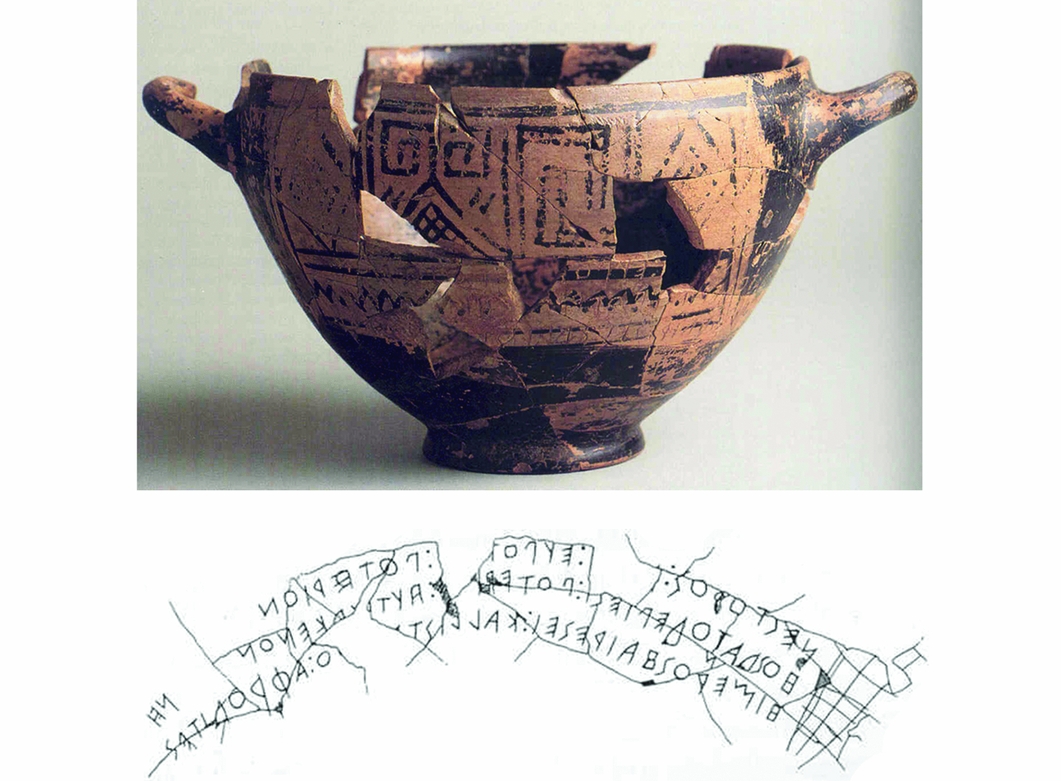
Two alphabetic inscriptions from Methone are illustrated. The first is the imported Euboian skyphos dating to c. 720 BC (Figure 4). The cup and inscription are fragmentary, but the main thrust of the inscription, as reconstructed and translated by Tzifopoulos (Reference Tzifopoulos2013: 30–31), is clear: “I am [the cup?] of Hakesandros”, the text concluding with a threat: -μ]άτων στερήσ [ετ]αι to the would-be drinker who may lose his eyes ([ὀμμ]άτων), his money ([χρημ]άτων), his cakes ([πεμμ]άτων), even his pain ([πημ]άτων) (cf. Bessios et al. Reference Bessios, Tzifopoulos and Kotsonas2012: 339–43; Janko Reference Janko2015: 3). The inscription is in iambic verse, and, as such, the cup is a ‘speaking object’ introducing its owner, Hakesandros. It presents, in the language of a curse, to any would-be wrongdoer, the formula of the loss of his or her money (or whatever). In this, the language of Hakesandros's cup is akin to the cup of Nestor from Pithekoussai, which carries a similar curse (Figure 5; Faraone Reference Faraone1996). Tzifopoulos (Reference Tzifopoulos2013: 30) compares these cups and other vessels against the backdrop of an epigraphic habit within a sympotic context: wine, jokes, literary games and writing.
Fragmentary Euboian skyphos found at Methone, with a ‘curse’ inscription incised after firing; Meth 2248.

Late Geometric kotyle of east Greek (north Ionian) fabric, found at Pithekoussai on Ischia, with an inscription in the Chalcidian (Euboian) alphabet.

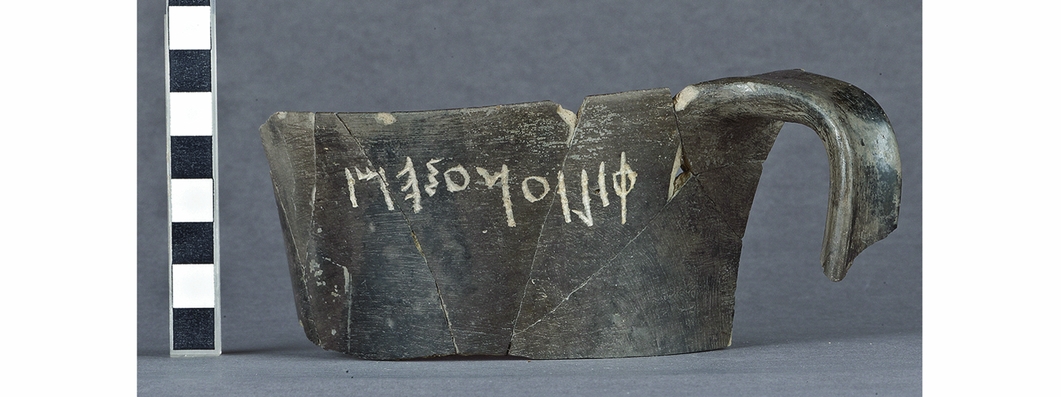
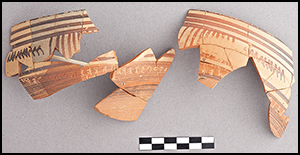
The second vessel is also an import: an Aeolian grey-ware, vertical-handled cup, probably from Lesbos (Figure 6). The inscription is much simpler: “I am [the cup] of Philion” or “I belong to Philion”. By engraving his name on a pot used in the context of communal drinking, Philion exhibited his literacy while also ‘insuring’ his property (Tzifopoulos Reference Tzifopoulos2013: 36–37).
Drinking cup from Lesbos found at Methone, with an inscription incised after firing; Meth 2249, late eighth to early seventh century BC.

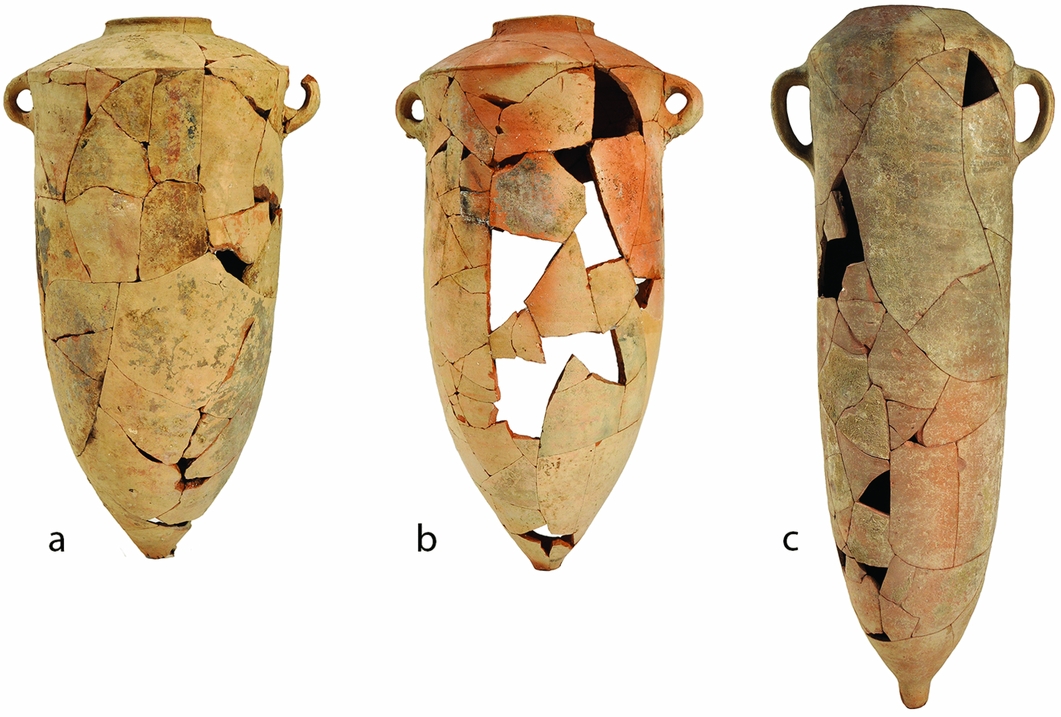
Although there are, to date, no Semitic inscriptions from Methone, the site has some of the best preserved and earliest Phoenician amphorae in the Aegean (Kasseri Reference Kasseri, Kephalidou and Tsiafaki2012: 300–303, 307, figs 1–2). The hypogeion has produced several from the late eighth to early seventh centuries BC, two of which are illustrated (Figure 7a & b); and the destruction deposit of the site in 354 BC revealed another (Figure 7c), dating to the first half of the fourth century BC. These Phoenician commodity containers point to contact with Greeks and Phoenicians over time.
Three Phoenician amphorae from Methone (a–b from the hypogeion, late eighth–early seventh century BC; c from the destruction deposit of Philip II in 354): a) Meth 2033; b) Meth 2034; c) Meth 3878 (photographs by Ian Coyle).

Where and when did the adoption and adaptation of the Phoenician alphabet occur?
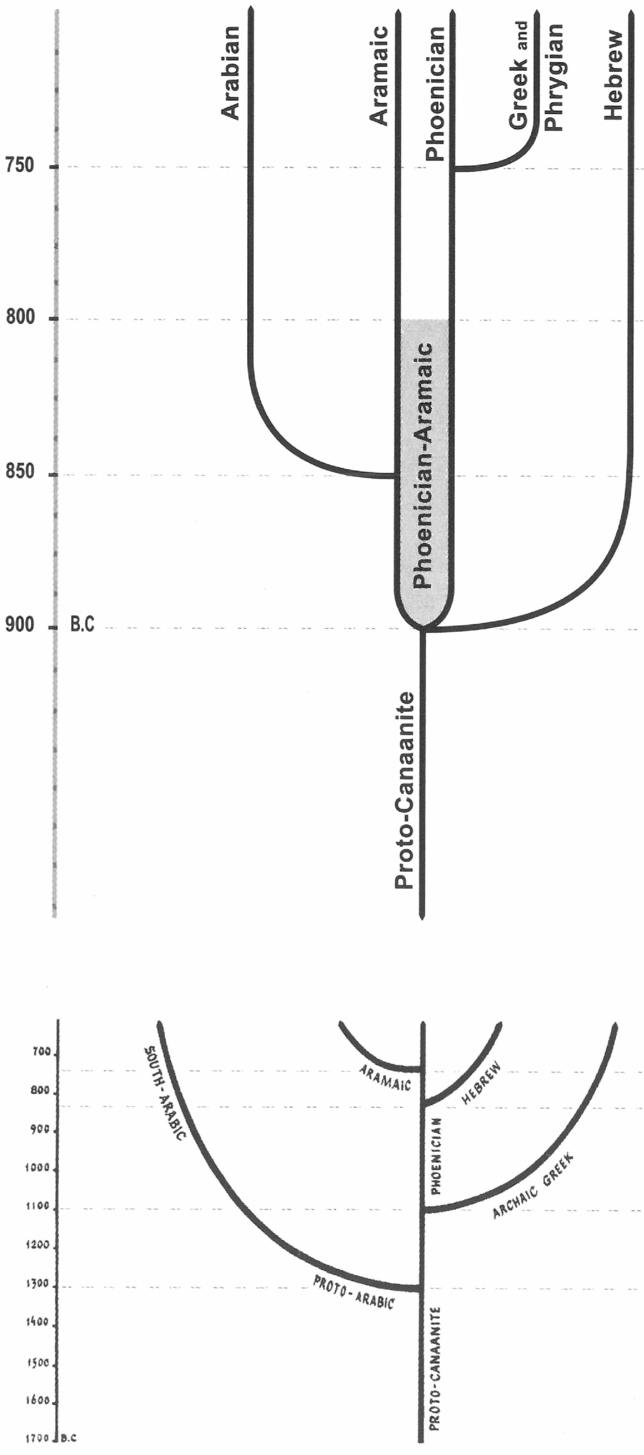
The growing number of non-alphabetic Early Iron Age potters’ marks (Papadopoulos Reference Papadopoulos1994, forthcoming), and contemporary post-firing marks in the Aegean, point to a time before there was an alphabet and allows us to return to the critical issues of where and when Greeks adopted and adapted the Phoenician/Aramaic alphabet (Figure 8; compare the schematic language family trees drawn up by Naveh (Reference Naveh1982: 10) and Sass (Reference Sass2005: 12)).
Schematic family tree of the early alphabetic scripts (with the pertinent segment of the tree in Naveh (Reference Naveh1982: 10) below). After Sass (Reference Sass2005: 12) (prepared by Christine Johnston).

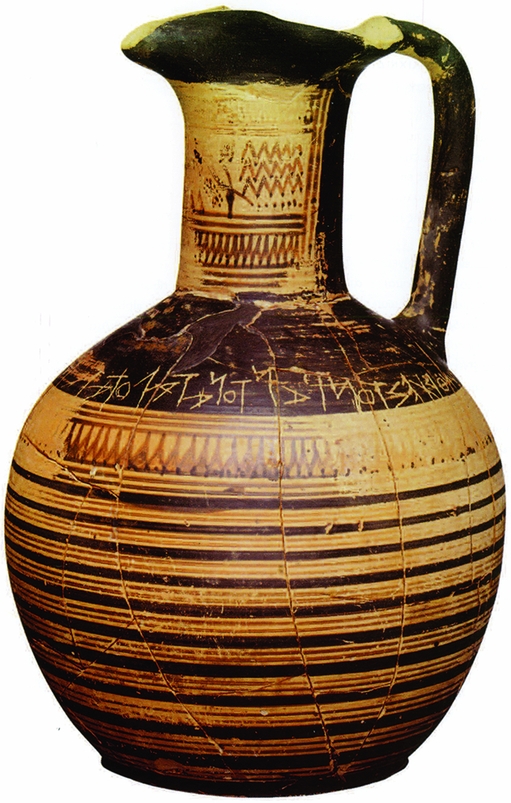
In terms of chronology, the evidence from Eretria, Methone and Pithekoussai only corroborates what is already known. The latest date for the adoption and adaptation would be around 750 BC, in keeping with the earliest Greek inscriptions, such as the Dipylon oinochoe (Figure 9), and with Semitic prototypes. As Sass (Reference Sass2005: 145) has shown, after the middle of the eighth century BC, several Phoenician and Aramaic letters evolved away from the shapes that served as models for the corresponding Greek letters (this is despite Naveh's Reference Naveh1982 arguments for the adoption occurring earlier, c. 1100 BC). The latest evidence, based primarily on letter forms, would suggest that a date range of c. 825–750 BC can be reasonably well substantiated by the Semitic evidence (Sass Reference Sass2005: 145).
The Dipylon oinochoe, Athens, National Museum 192 [2074], with the inscription: “He who, of all the dancers, now performs most daintily, this is his”.

The issue of where the transmission or adoption occurred is more problematic. There are three alternatives for the mother script of Greek: it could have been exclusively Phoenician, Phoenician/Aramaic, or Phrygian deriving from Phoenician (Sass Reference Sass2005: 133–52). As for the physical place(s) where the adoption and adaptation occurred, several areas in the Mediterranean have been suggested, from Al Mina in the east to Pithekoussai in the west (Figure 1). Cyprus has loomed large in this discussion, especially the Phoenician settlement at Kition, as has Euboia and other Aegean islands, including Rhodes and Crete (Powell Reference Powell1991: 12–18; Kenzelmann Pfyffer et al. Reference Kenzelmann Pfyffer, Theurillat and Verdan2005: 76–77). The problem is well framed by Sass (Reference Sass2005: 149): “The fact that at least four different locations for the adoption could be defended so eruditely and with such excellent arguments [. . .] indicates that the evidence presented thus far is perhaps less forthcoming than one would wish”.
For Herodotus, writing in the fifth century BC, the place of transmission—directly from Phoenicians—was mainlandGreece, specifically Boiotian Thebes, adjacent to the Euboian Gulf and the Aegean beyond. Whatever date Herodotus (Histories 5.58; Jeffery Reference Jeffery and Brice1967: 153) had in mind, he does not mince his words:
These Phoenicians who came [into Boiotia] with Kadmos [. . .] after settling in this district introduced to the Greeks many kinds of learning (didaskalia) and particularly writing (grammata), which did not previously exist among the Greeks.
In the same passage, he goes on to note:
At first they [the Greeks] used the same script as all Phoenicians use. Then, as time went on, they changed, with the language (phonē), the shape (rhythmos) also of the letters. At this time, the Greeks occupying most of the land round them were Ionians. These learnt the letters from Phoenicians, and reformed a few of them and used them, but in this usage spoke of them by name as ‘Phoenician’ (Phoinikēia)—as was just, the Phoenicians having brought them to Greece [. . .] I personally have seen Cadmeian writing (Kadmeia grammata) in the precinct of Ismenian Apollo in Thebes, incised on three tripods, and for the most part similar to the Ionic.
Thebes was where Phoenician Kadmos settled and married Harmonia, and where he introduced writing. Of course, the evidence of Herodotus should be taken with a pinch of salt, but one noteworthy feature of the adoption of the alphabet in his scheme is the proximity of Ionian Greeks and the use of Ionic letters in the process. Herodotus also observes that these Ionians reformed a few of the Phoenician letters for their own use. When the shapes of the letters of Greek and Phrygian vowels are compared with the Phoenician symbols from which they derive (Table 1), there is a noticeable similarity between Ionic and Old Phrygian letter forms. This is perhaps clearest in the case of the iota (Phoenician yōd), which is usually a crooked iota in most Greek scripts, except for west Ionic (i.e. Euboian)—and Phrygian—although it is found by the early seventh century in several other regions of Greece.
In most accounts of the adoption of the alphabet, the general view is that Greek was adopted from the Phoenician, and Phrygian was then adapted from Greek. This interpretation is complicated by the strong similarity of the Greek (especially Euboian) and Phrygian vowels, which argues for Phrygian agents in addition to Phoenicians and Greeks. Jeffery (1982: 822) argues that, on the balance of the evidence, a limited area of origin of the Greek alphabet seems more likely. She favours Al Mina in the estuary of the Orontes River on the northern coast of Syria as a promising candidate, with its Greek pottery from Euboia—and elsewhere—and evidence for Greeks dwelling among west Semitic speakers, and where Phrygians also had early contact (Jeffery 1982: 822–23; see also Young Reference Young1969: 256). One problem with the Orontes region as the place where the Greeks and Phrygians adopted and adapted (in this case the Aramaic script) lies in the transmission back to both the Aegean and Phrygia of the newly minted script. This may work for the vowels but not for all the consonants (although the Phrygian and Greek vowels are similar, the same is not true for their respective consonants: see Krebernik Reference Krebernik, Rollinger, Luther and Wiesehöfer2007). Had Al Mina been the place of origin, one would expect much more overlap in the letter forms of Greek and Phrygian consonants.
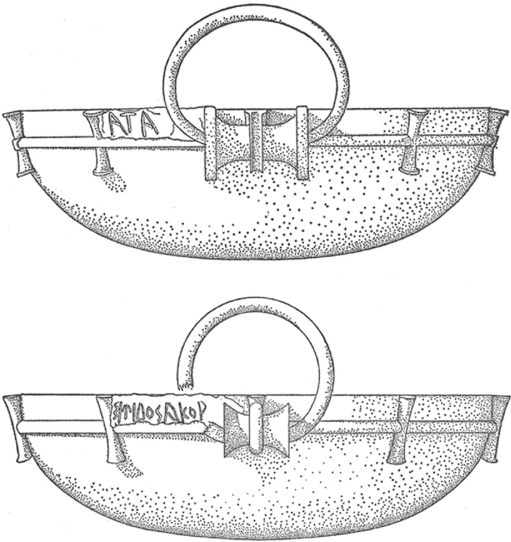
A more promising candidate is the northern or central Aegean and western Asia Minor. The overlap of the shared vowels in both Phrygian and Greek seems to rule out an adoption independent of one another: “Either the Phrygian script was adopted from the Phoenician and subsequently the Greek from the Phrygian, or vice versa” (Sass Reference Sass2005: 147; cf. Young Reference Young1969: 265). Phrygian or Greek precedence, however, relies on the thorny issue of absolute chronology (Papadopoulos 2014: 184–86). This is not the place to enter this debate, but there is no shortage of Old Phrygian inscriptions securely dated to the middle and second half of the eighth century BC (Young Reference Young1969: 255–57), as early as any Greek inscriptions, and one (Young Reference Young1969: 257, no. 29; Brixhe & Lejeune Reference Brixhe and Lejeune1984: G-104) is now securely dated to 800–790 BC (Sams Reference Sams and Rose2012: 65, fig. 4.16). Two examples are illustrated, both magnificent bronze ring-handled bowls from the tomb beneath the Great Tumulus at Gordion (Young Reference Young1969: 258, fig. 1, nos. 33, 25; Figure 10). On both vessels there are alphas, and on one (25), there are straight iotas, and the standard omicron; on two contemporary inscriptions, we find the three-barred epsilon and the upsilon that is typical of both early Greek (especially Euboian), epichoric and Phrygian. The recently published evidence for Phrygian chronology seems to favour Phrygian chronological precedence, although the matter remains unresolved (Rose & Darbyshire Reference Rose and Darbyshire2011; Sams Reference Sams and Rose2012).That Greek writing in turn inspired Etruscan (and indirectly Latin, via Etruscan, together with other native Italic alphabets—Oscan, Umbrian, South Picene, Venetic) is beyond doubt. Less certain is the assumption that Greek writing also ‘jumped to Phrygian’ as some scholars still maintain (e.g. Powell 2002: 109).
Two Phrygian bronze bowls from the tomb beneath the Great Tumulus at Gordion dating to the second half of the eighth century BC (Young Reference Young1969: 258, fig. 1, nos. 25 & 33).

I would temper Sass's statement by not insisting on either Phrygian or Greek priority, but allowing instead the possibility of a place where Greeks and Phrygians, not just Greeks and Phoenicians, interacted in collaboration. A few decades ago various places seemed probable—Cyprus, most of the coastal Levant, Italy, the Nile Delta—but the primacy of many of these as possibilities for the adoption and adaptation diminish on account of the Phrygian complexities.
In Italy, there is also a very early inscription from Osteria dell'Osa, the cemetery of ancient Gabii, in Latium, east of Rome, that cannot be later than 775–770 BC, and perhaps earlier (Bietti Sestieri Reference Bietti Sestieri1992: 184–85; Ridgway Reference Ridgway1996; Sass Reference Sass2005: 155–56). The inscription EYLIN, is most often read as Greek: εὔλιν[ος], ‘good at spinning’ (Ridgway Reference Ridgway1996; Janko Reference Janko2015: 15), but this is little more than a guess and has been too enthusiastically embraced. Janko (Reference Janko2015: 15) tried to read it in the opposite direction, as Latin—ni lue, ‘do not pay’—but cogently notes problems with such a reading. In many ways, the Gabii inscription muddies the waters, and may well not be Greek. Sass (Reference Sass2005: 155) prefers to see it as a pre-Greek retrograde imitation of Phoenician letters, adding that it is a “nondescript scribble on a non-Greek object from a non-Greek context. . .it may be preferable to regard the. . .graffito as a pseudo-inscription—an ineffectual attempt by an illiterate person to reproduce some letters”. There is much to commend this view.
Whatever the nature of the Gabii inscription, there is no documented evidence for Phrygians in Italy. So where were Greeks and Phrygians co-existing? As noted, Jeffery favoured the North Syrian (or Cilician) coast, while others, most recently Woodard (Reference Woodard1997, Reference Woodard2014), have argued for Cyprus as places where Greeks and Phoenicians (but not Phrygians) co-existed. As Woodard (2014: 146–49) observes, the Phoenician consonantal script, together with the two pre-alphabetic Greek writing systems of Linear B and the Cypriot syllabary, all played their part in the historical continuum of Greek literacy and the formation of the alphabet. The influence of the Cypriot syllabary is perhaps greatest for particular consonantal strings. Whether or not the Greek adapters of the Phoenician alphabet were literate in the Cypriot syllabary is a moot point. What is clear is that the adoption and adaptation of the Phoenician consonantal script did not happen wholescale at one particular time. The case of the vowels, however, demands an alternative narrative involving both Greek and Phrygian players working together over a relatively short period. Here, the north Aegean ancestry of the Phrygians, as related by Herodotus (Histories 7.73; de Sélincourt Reference de Sélincourt2003: 441), is intriguing:
This people [the Phrygians], according to the Macedonian account, were known as Briges during the period when they were Europeans and lived in Macedonia, and changed their name at the same time as, by migrating to Asia, they changed their country.
As related by Herodotus, Phrygian, although an Indo-European language, and in spite of its geographic location, does not belong with the Anatolian sub-group of Indo-European languages, such as Hittite or Lycian, but is much more closely connected with Greek (Brixhe & Lejeune Reference Brixhe and Lejeune1984; Brixhe Reference Brixhe and Woodard2004). Most recently, Blakely (Reference Blakely2012: 163–64) has collected material on Phrygians and Phoenicians on the northern Aegean island of Samothrace. Her arguments (Blakely pers. comm.) revolve around two points: first, the possibility that the toponym Dindymene (inscribed on a sherd from Samothrace) may refer to an Anatolian (Phrygian) mountain. Second, the Kabeiroi, who number among the gods of Samothrace, are Phrygians (according to various ancient sources, and also a number of Byzantine lexicographers, and derive their name from Mt. Kabeiros in Phrygia). Samothrace is not the only northern Aegean island with Phoenician complexities: both Herodotus (2.44) and Pausanias (5.25.12) mention Phoenician presence on Thasos. Additional evidence of Phoenician pottery and writing in the northern Aegean has recently come to light from Karabournaki, Torone and Stageira (Tiverios Reference Tiverios, Stampolidis and Giannikouri2004; Fletcher Reference Fletcher2008; Vainstub Reference Vainstub and Lemaire2014).
A related issue is the relationship of the Phrygian language to that of the Thracians living along the northern coast of the Aegean. As Woodard (2004: 12) notes: “The Phrygian language does show certain similarities to Thracian, and some linguists have argued for linking the two in a single linguistic unit (Thraco-Phrygian)”. The appropriateness of such a sub-grouping remains uncertain, largely due to the dearth of conclusive evidence (Brixhe Reference Brixhe and Woodard2004), but it is in keeping with the testimony of Herodotus.
There is additional literary evidence for the close contact of Phrygians and Greeks. As DeVries (Reference DeVries and DeVries1980: 33) noted, Herodotus (1.14) claimed that a splendid wooden throne, on display at Delphi, was a gift of Midas, the Phrygian king of the late eighth to seventh centuries BC, and stories traceable back to the fourth century had Midas taking a wife from the East Greek city of Kyme. Phrygian fibulae and bronze bowls of eighth–seventh-century date have been recovered at sanctuaries in eastern and mainland Greece, and at Gordion, the Phrygian capital, there are sherds of Greek vases dating to the decades before and after 700 BC. Even Plato (Cratylus 410–14) has Socrates cite several words that are common in both Greek and Phrygian, not least the words for fire (pyr), water (hydōr) and dog (kyōn).
There is thus a confluence of evidence—the growing number of alphabetic inscriptions in the Aegean, the similarity of Phrygian and Greek vowels, the testimony of Herodotus—that places the adoption and adaptation of the alphabet squarely in the Aegean. Various places in this region thus emerge as contenders: not only Euboia, but especially the northern Aegean, not just Methone (arguably less so Crete and the Dodecanese).
Greek mythology, albeit a late tradition, furnishes another northern Aegean locale where Greek and Phrygian letters (Phrygia grammata) commingled: Troy. The critical evidence is in Apollodoros's Bibliotheca (Vatican Epitome 3.8), where Odysseus ‘planted’ in the Greek camp a letter (deltos) written in Phrygian, as though to Palamedes from Priam; the letter fell into the hands of Agamemnon and the fate of Palamedes was sealed (Jeffery Reference Jeffery and Brice1967: 152). It is telling that ‘Phrygian’ in ancient sources often means ‘Trojan’; that is, that Greeks of the Classical era regarded the Trojan language as Phrygian.
As one of the most prominent harbours in the northern Aegean in the later Bronze and Early Iron Age with control of the Thermaic Gulf, Methone, with its Phoenician imports and over 20 early alphabetic inscriptions from a secure context, emerges as one of those places where Greeks, Phoenicians and Phrygians may very well have done business together: not only an emporion par excellence, intimately networked in the international world of the eastern Mediterranean, but a locale where Semitic, Greek and Phrygian letters may have coalesced.
Coda
My argument is based more on circumstantial than direct evidence. Herodotus, for example, did not have archival references, but only oral sources. His evidence demonstrates that by the fifth century BC, Greeks had already noticed phenomena, such as similarities between words and names in Greek and Phrygian. His stories are explanations of observations, ways of accounting for the contemporary world; although interesting, they do not provide direct evidence of past realities. But his stories are not negated by the archaeological evidence.
Crucial to my argument are the Greek and Phrygian vowels, and that their ‘invention’ can have happened only once and in one place, with the consequence that all the various Greek, Phrygian and Italic alphabets ultimately derive from a single original moment. My fixation on this moment has obscured an equally important issue: the rapidity with which the idea of vowels spread. The new material presented here reinforces the existing patterns of finds, and emphasises the way in which we move rapidly from a Greek world without writing in the ninth century to one where writing is used for casual purposes, even jokes, in the context of communal drinking by 725 BC at the latest. It is remarkable that the invention of a new form of communication is adopted so widely within so few years—akin to the invention and spread of email in the late twentieth century—but in a world in which we have not been inclined to think that there was anything by way of appropriate infrastructure.
Acknowledgements
I am grateful to many friends and colleagues for discussions on various aspects connected with this paper, especially Athena Athanassiadou, Manthos Bessios, Sandra Blakely, Alan Johnston, Antonis Kotsonas, Sarah Morris, Anne Kenzelmann Pfyffer, Kostas Noulas, Brian Rose, Yannis Tzifopoulos, Samuel Verdan, Brent Vine, Roger Woodard and two anonymous referees.
Supplementary material
To view supplementary material for this article please visit http://dx.doi.org/10.15184/aqy.2016.160