

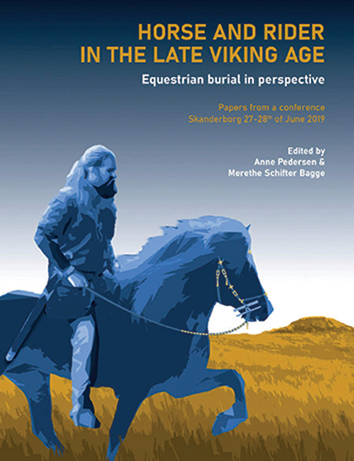
In 2012, an archaeological survey was undertaken prior to a residential development at Fregerslev, East Jutland, Denmark. As archaeologists worked to excavate a Viking-Age burial ground, including two inhumations, parts of a “richly decorated horse harness were found lying immediately below the topsoil in the outline of a large feature cut into the subsoil” (p. 9). This was suspected to be a chamber burial measuring some 10m2—a huge and potentially very significant burial, as no equestrian burials had been excavated in Denmark since 1983. Investigations in 2016 revealed that the find was in danger of further degradation. Highly acidic soil resulted in nearly all organic matter in this relatively shallow burial being eaten away, and thus conventional methods of excavation were inappropriate. The burial was excavated in 2017, with large blocks of earth within the burial chamber being stabilised and lifted for micro-excavation and investigation in the laboratory—a process that is still ongoing (Sulas et al. Reference Sulas2022).
The volume under review reports preliminary results and background information that represent a highly collaborative and interdisciplinary effort to understand the burial and situate it within regional and wider Eurasian contexts. The book is generously and beautifully illustrated, encouraging wide engagement with all aspects of the material, and is supported by the project website (http://www.vikingfregerslev.dk/). It provides an excellent literature review and deep subject knowledge concerning horses in burials in Denmark and other areas. The global context of horses in burials is widened by Karo's Slovenian study and Daim's study on Eurasian equestrianism.
I will share here some aspects of the volume which most interested me. Scientific methods used to approach the evidence of Fregerslev are clearly explained and provide fulsome assessment of the advantages and limitations of in situ and ex situ methods. “Although time-consuming, the micro-excavation method has proved its value and much information has been retrieved that would most likely have been lost or severely limited in a traditional excavation” (p. 53). Part I illustrates how archaeosciences yielded information about the date and methods of burial, but answers to other questions, such as the identity of the deceased, must be deduced by scholars.
Notwithstanding the possibility that this burial chamber may have been robbed, it is impossible to ascertain whether weapons or more diagnostic grave goods were originally present. Bagge and Hertz state: “It should be mentioned that our expectations of finding weaponry in the grave are based on traditional assumptions about the relationship between grave goods and sex/gender, which is why the deceased at Fregerslev is assumed to be male” (p. 30). Gender is usually assigned on the basis of extant grave goods, but perhaps we should not assume the gender of the individual too quickly. A quiver of arrows, for example, should be considered “multifunctional objects” and not specifically gendered (Gardeła Reference Gardeła2021: 107). Moreover, equestrian equipment and horses are not confined to any particular gender presentation (Gardeła Reference Gardeła2021: 109–12). In such a careful investigation as Fregerslev, it may be instructive to discuss what can be said with certainty, rather than making assumptions. As further supported recently by the evidence of amulets from Ribe, the horse and rider motif is commonly associated with both men and women. The imagery in Maria Nørgaard's paper invites us to consider that the rider was not necessarily a man.
Arne Jouttijärvi discusses the choice of brass fittings for the Fregerslev harness “which were golden in colour” (p. 122). While high-status goods within a grave are usually precious metals such as gold and silver, with copper and lead alloys seen as poorer substitutes, it is worth noting that the best modern horse tack is made of cast brass, which is unmatched in both strength and durability by other alloys (J. Dunbar & Z. Palliser, pers. comm.). The golden colour of the tack may have been secondary to the function for the maker and the user.
As a point of order, the verse from Haraldskvæði, cited by Bagge & Hertz and Pedersen in relation to equestrian burials, refers to how skalds (poets) were treated and attired by the king, and not warriors (Fulk Reference Fulk and Whaley2012: 91). A contribution on the poetic evidence of horse and rider in poetry would have deepened understanding of what horse and rider could mean within the Old Norse-speaking world. Equestrian ability was considered a significant accomplishment, and social mobility necessitated physical mobility, either by water in ships or by land on horses, and for storytellers and poets, as well as warriors. Such riding ability was praiseworthy and linked to status throughout the early medieval world, east and west.
Rúnar Leifsson's study of the importance of the horse in Icelandic burials is instructive, highlighting that 41 per cent of Viking-Age burials contain horses. Rúnar Leifsson suggests that the “short-term popularity” of these burials “reveals socio-political competition and a clash of identities in the new society” (p. 267). One could say that equestrian burials in Iceland, Denmark and elsewhere represent a rather short-lived burial fashion of an elite who were literally jockeying for position within society.
I especially appreciated discussion of discrete items in the burial. Was the feed bag at Fregerslev used to pacify the horse as it was sacrificed for burial, or was it placed there afterwards to care for the animal in death? What is the relationship between the cross-shaped strap mounts found at Fregerslev with similarly shaped ‘open-work lozenge brooches’ regularly found by metal detection in the Danelaw? Sometimes the small things—the micro-excavations—can reveal the most. I look forward to more knowledge as the investigations continue.
This volume is well produced and thoroughly researched, resulting in good return for the research project, and setting a standard of excellence in excavation and collaboration. This well-priced volume has a broad appeal, and I would recommend it to anyone interested in the Viking Age and early medieval period, and especially to students and practitioners of archaeology.


