

Upon arriving in Heathrow from Lusaka this June, I was met with semi-aggressive cross-questions about my visa and passport from a fellow Muslim hijabi immigration officer. She was just doing her job, but I wondered where her parents and grandparents travelled from, half wanting to return the interrogation and confront her with the irony of our interaction in a country that doesn’t really belong to either of us. My reception when entering Berlin later was different. A blonde-haired lady was pleased to know why I entered the country: to see the Berlin Biennale and write about it. The curatorial team of the Biennale kindly wrote a letter in support of my long-term Schengen visa application – an act of allyship few European institutions would extend themselves to.
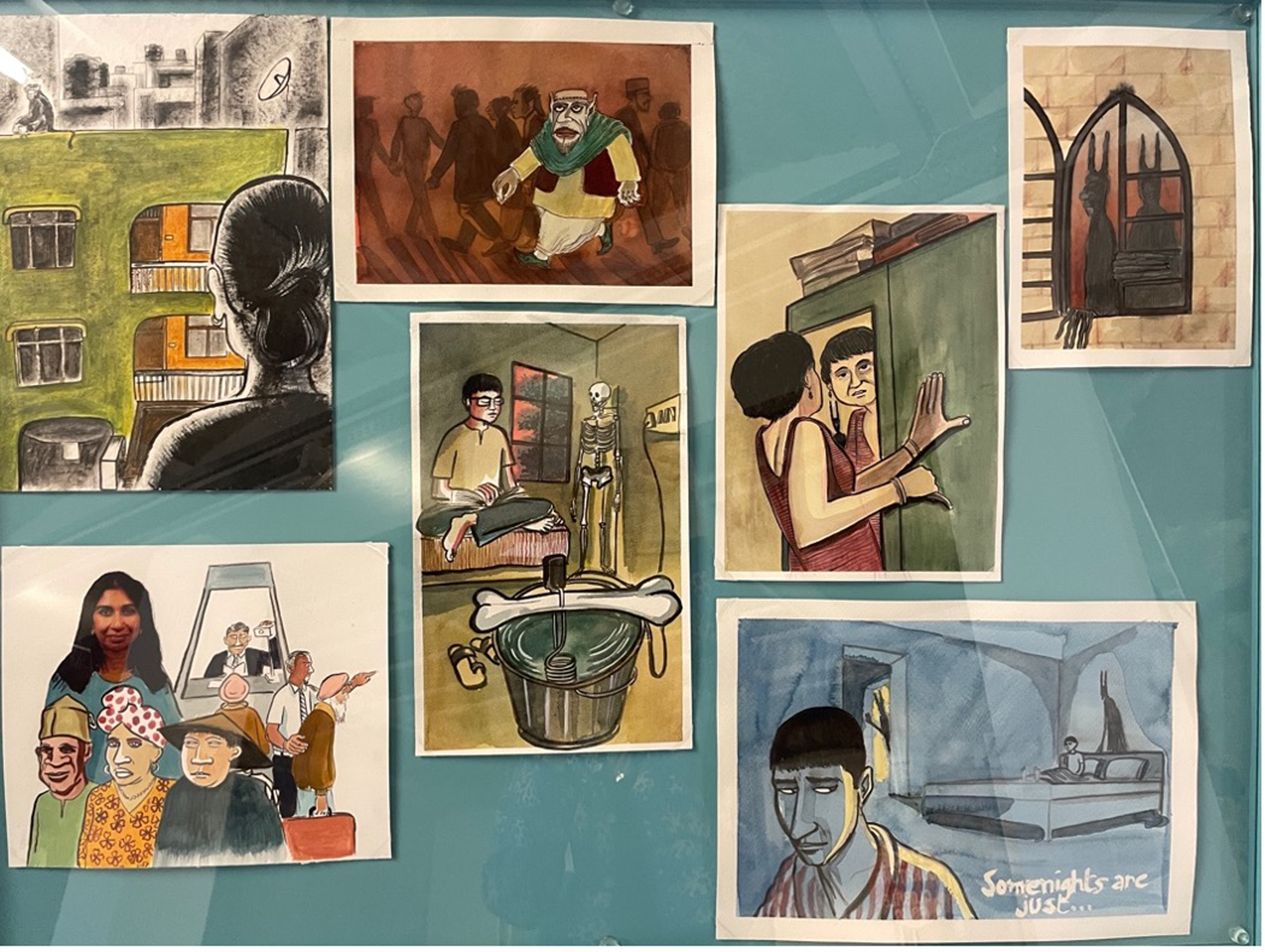
My experience at Heathrow is echoed, if not narrated scene for scene, in Sarnarth Banerjee’s work at the KW Institute for Contemporary Art.Footnote 1 As an Indian graphic-novelist based in Berlin, he uses humour and satire to explore the emotional realities of diasporic and dislocated communities. In his series of drawings and audio works in Critical Imagination Deficit, he states that at border control you are often met with someone who looks like you – a Brown or Black Other. A ‘friendly native’,Footnote 2 an ‘informer’, or better yet: a Djinn (Figure 1).
S. Banerjee, Critical Imagination Deficit. Installation view, 13th Berlin Biennale, KW Institute for Contemporary Art, 2025. © Sarnath Banerjee; photo: Sana Ginwalla.

Djinns are invisible beings that live amongst us. They see us, but we cannot see them. They have lives of their own in spaces that we believe belong only to us ‘humans’. They exist in our homes, our cities, our streets; they are present on our commutes between cramped buses and trains. My grandfather would often relay elaborate and fabricated stories about Djinns when we visited him in Gujarat as children, and a maulana at my madrassah in Lusaka would tease that I was a Djinn because of my last name.
The sweaty talcum-powdered Djinn in Sarnarth’s comic-book style story is a police informer, because after all ‘the best way to control a native is by using another’.Footnote 3 I start to consider the Djinn as a concept rather than the scary unseen being that lived in my grandfather’s attic in Kosamdi. In the context of the Biennale, Sarnath’s character of the Djinn takes shape as the fugitive, the migrant, the deviant, the fox.
Nothing about my experience at Heathrow was postcolonial. Or perhaps that is the reality of postcoloniality: the bureaucratic nightmares of ‘Empire’ have now transformed into internalized racial profiling, employing the ‘Other’ to surveil their fellow ‘Other’. Somehow, being the most hyper-visible non-white person in the West will make you invisible, and then the state will use that to surveil others that look like you.
But indeed, as Sarnarth puts it (in a way that made me giggle) – ‘nobody wakes up feeling postcolonial in Delhi’.Footnote 4 Nor in Lusaka, Ankleshwar or Rangoon – cities that my parents and grandparents have called home. I argue that we cannot talk about ‘decolonization’ and ‘post-colonialism’ (or ‘deco-poco’ as Sarnarth abbreviates), when colonization continues to be exercised (yet hardly taught) in educational, bureaucratic or immigration systems. How can we talk about decolonization when countries like Palestine, Sudan, or Congo are currently experiencing a form of colonization? Why is our framework of history continually centring the word ‘colonial’? Does it not give it too much power?
However, I run the risk of being the migrant that plays the game too and making this article written in English a ‘cemetery of dead words’,Footnote 5 as Banerjee puts it. After all, Europe must understand us through its own terms. But what would looking at ourselves look like when it’s on our own terms? What dictionary of non-colonial or pre-colonial vocabularies do we have to reference? The work I do with Everyday Lusaka Gallery and a counter-archive called Zambia Belonging began as a resistance to centring how the West thinks/imagines/visualizes us, and instead, make work for a gaze that is local/intimate/mirrored.
The concept of this thing unseen, invisible and feared by the oppressor continued to resonate through the biennale, especially in the works from Zambia. The Berlin Biennale has consistently engaged with artists from Africa. The previous edition by Kader Attia in 2022 reckoned with Europe’s relationship with the ‘Global South’, asking how colonial damage can be repaired, rooting its focus on restitution and the ‘decolonization’ of art.Footnote 6 In this year’s edition, its curator is Italy-based Indian curator Zasha Colah who spent her formative years in Lusaka. It is no surprise then that alongside artists from Myanmar, North East India, Kashmir, Turkey, Kazakhstan, China, and Germany, there was a substantial number of artists showing from countries in Africa that often fall into obscurity on global art stages.
Artists showing from Africa included Daniella Bastien (Mauritius), Memory Biwa (Namibia), Helena Uambembe (Angola and South Africa), Fredj Moussa (Tunisia) and Huda Lutfi (Egypt). Sudan’s presence was felt through artist Elshafe Mukhtar and The People’s Tribunal on the Systematic Targeting of Women Activists in Sudan. There were also three artists from Zambia where I was born and raised – to my Indian parents who were born and raised in Burma. A total of sixty countries were present at the Biennale, an intentional decision that sought to do away with North–South identity politics, and distinctions of authoritarian states and democracies.
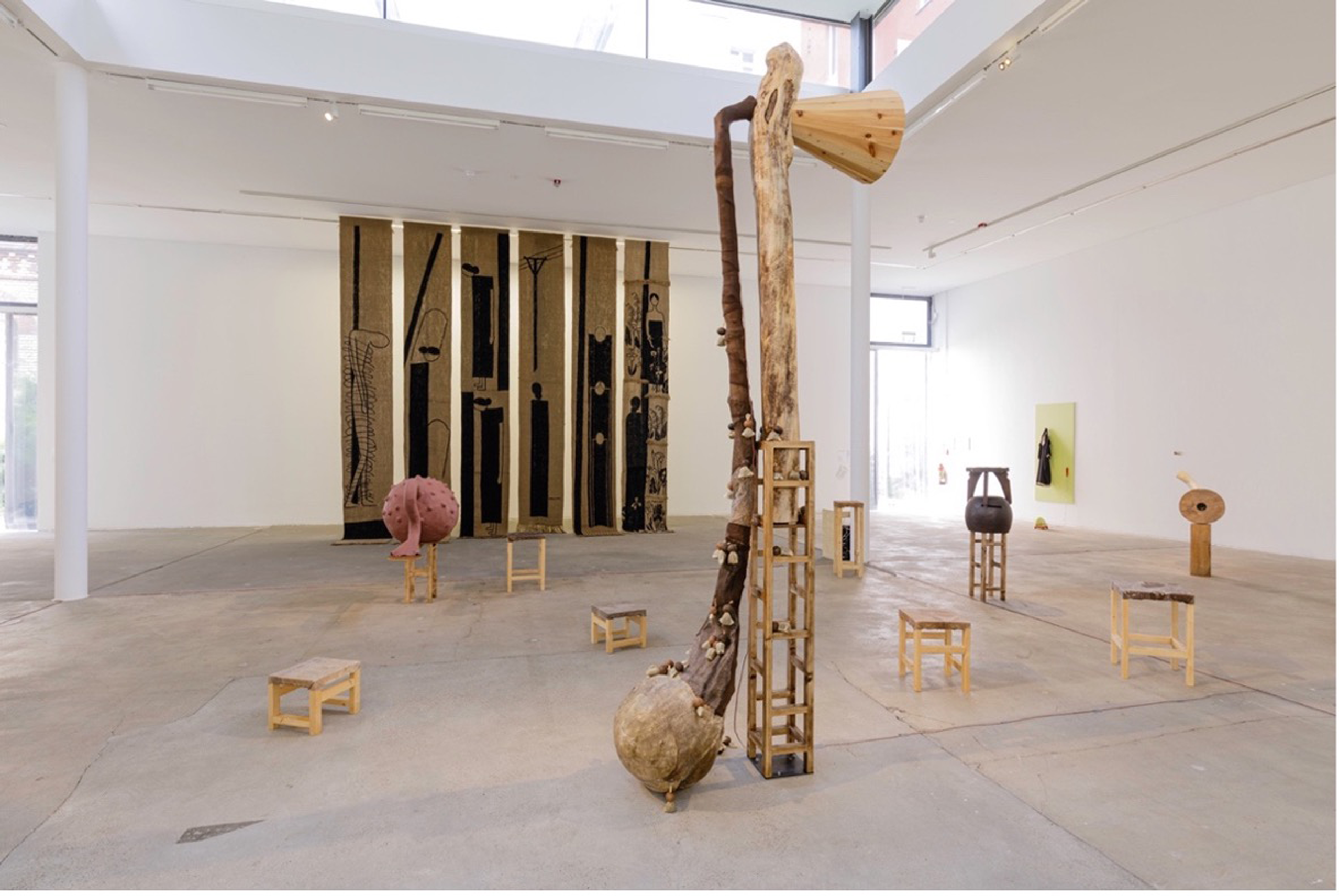
In hearing the wailing women from the sculptures whose forms are borrowed from drums, baskets or stools, Zambian artist Anawana Haloba’s Looking for Mukamusaba – An Experimental Opera presented intergenerational conversations weighted with an eerie tension. Mukamusaba – meaning ‘You shall fear her/them’ or ‘The one who embodies greatness’ in the Lozi language of South-Western Zambia and NambiaFootnote 7 – emerges as a central matriarch whose head resembles the shape of a megaphone used in protests (Figure 2). In the crowd of this protest – which takes stage in the main hall of the Biennale at the KW – there lies a trans-temporality of voices echoing from various forms punctuated with textures of copper, horn and wood. Alongside Mukamusaba’s voice, we hear various ‘female Fanons’,Footnote 8 as Haloba regards them, from Zambia’s history such as Alice Lenshina – a self-appointed prophetess and rebel leader who founded an African independent church called the Lumpa Church. The opera also calls upon the spirit of Lucy Sichone – a lawyer, journalist, human rights activist and member of the United National Independence Party (UNIP) that led Zambia to independence.
Installation view, 13th Berlin Biennale, KW Institute for Contemporary Art, 2025; image: Eberle & Eisfeld. Front: Anawana Haloba, Looking for Mukamusaba – An Experimental Opera, 2024/25. © Anawana Haloba; Sammlung Hartwig Art Foundation. Back (from left to right): Iris Yingzen, Garden of Hope, 2025. © Iris Yingzen; Han Bing and Kashmiri Cabbage Walker, Walking the Cabbage in Berlin, 2025. © Han Bing & Kashmiri Cabbage Walker.

Calling from a threshold we ‘humans’ cannot reach, the female characters of Haloba’s experimental opera speak in acerbic satire, or unadorned gnashing pain, or seething anger, or foetal innocence, from the ruins and the rubble. Speaking from Sudan, from Congo, from Ukraine, and through the entire opera from Palestine, they ask if we can hear them. They discuss clean energy deals and rape as a weapon of war. A voice from a distant place, perhaps Germany, hears them but allegedly does not have the ‘mandate’ to respond. ‘The G-word [genocide] is now applicable’, Mukamusaba says, ‘but we can only say it/with our hands covering our mouths or a mouth full of bitter leaves.’Footnote 9 How do we clear our tongues from rehearsed illusions of solidarity so that we can speak?
Silence and invisibility are addressed directly in Haloba’s monuments of the silenced, and what might be read as silence or invisibility in this Biennale actually feels like a loud scream trapped in a jar. An allyship and solidarity of artists outside Western art-consciousness have been pulled together from a range of corners across countries, generations, and political contexts to foxily acknowledge the plight of Palestine. In Germany, we walk amidst characters from simultaneous wars. They wail in grief and anger: ‘As our breaths slowly diminish, so do you become blind to our pain/your ears can no longer hear us, nor can your eyes see us.’Footnote 10 Devoid of their visibility, their existence is recovered in an honourable oral ode.
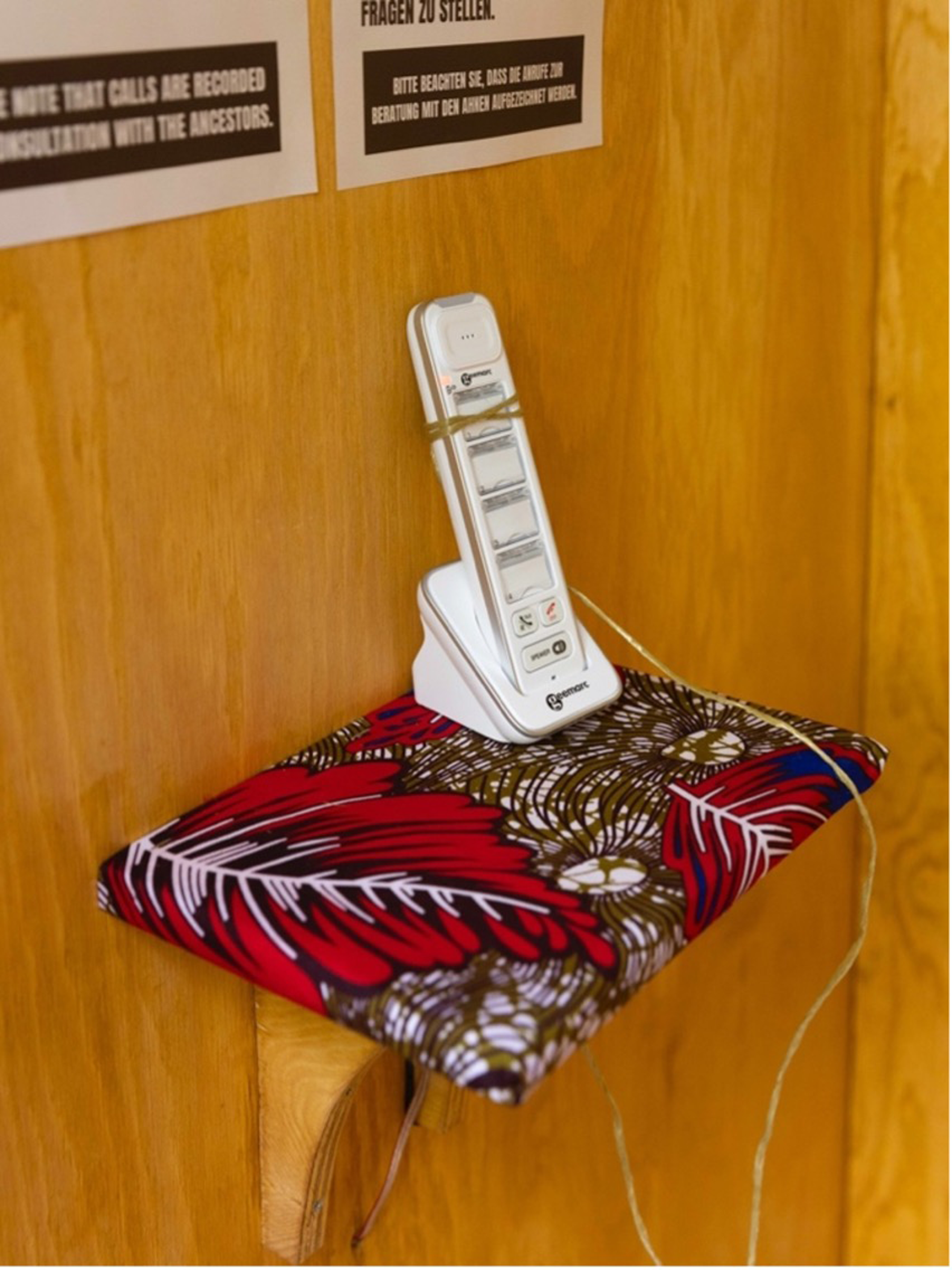
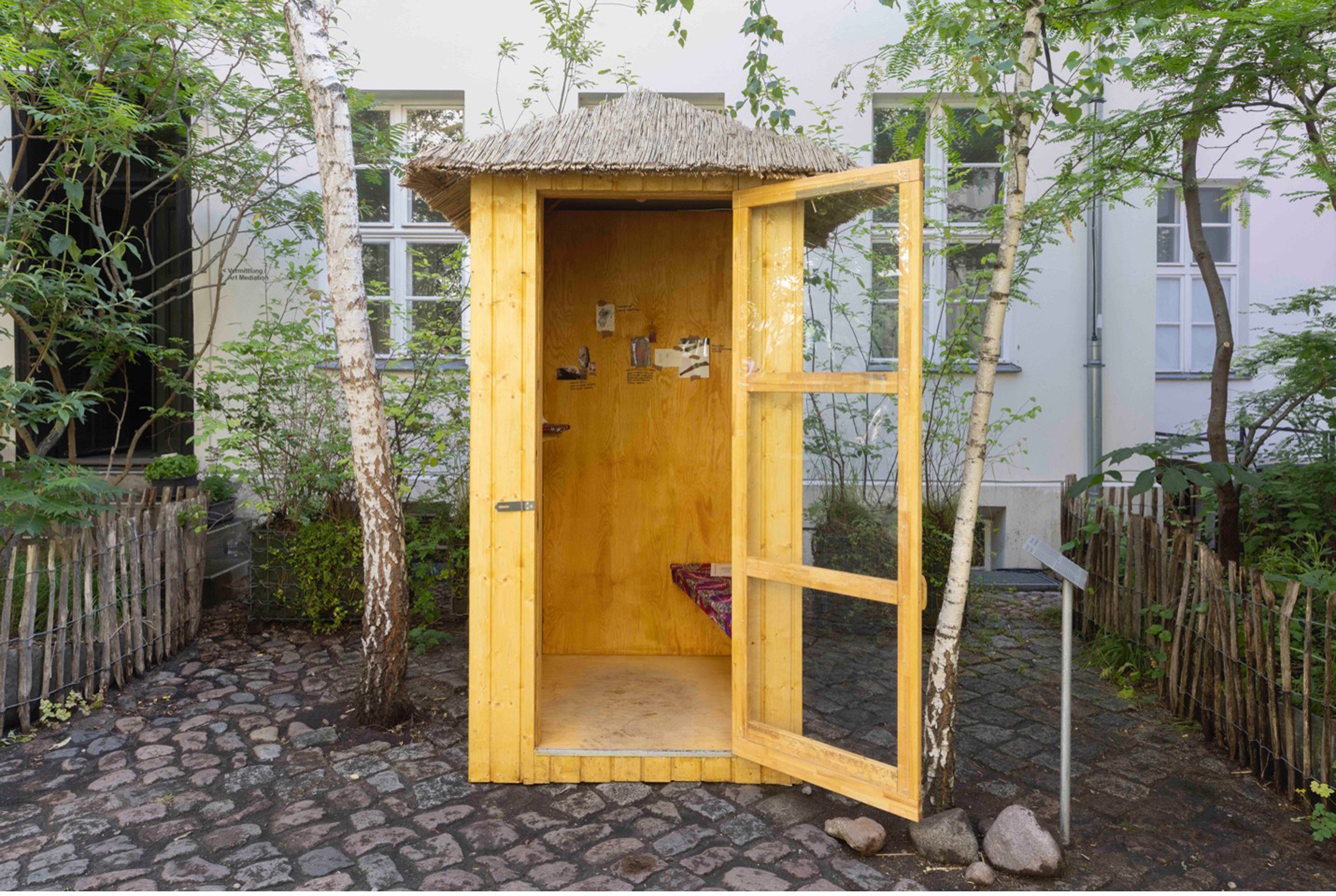
Both Isaac Kalambata and Bwanga ‘Benny Blow’ Kapumpa further reckon with the threshold between that which is tangible and unseen in the context of Zambian traditional beliefs. Many of those practising in the colonial period as well as today were and are outcast due to violent legal, educational and spiritual interruptions regulated by colonial and religious ideologies. ‘Benny Blow’ modernizes the appearance of the traditional healer or ng’aka, characterized by a ‘Dr Bwanga’ who offers his advice via a telephone to sitters in his booth (Figure 3). While the visual language of the posters that plaster the texture of Lusaka’s walls, streetlights and telephone poles does not quite translate into Benny’s iteration here, his take on this digital divinity and our relationship with the ‘algorithm’ offer a futuristic imagination of how we might seek to ‘bring back lost lovers’ or cure other twenty-first century ailments. Doctor Bwanga in Berlin offers his advice in a space that almost reads as a confession booth but instead of stained glass and mahogany, we stand under a thatched roof with a transparent window looking out into the world (Figure 4). And Dr. Bwanga? He’s not there. He’s somewhere else – maybe an algorithm, maybe a fox, maybe a witch.
‘Dr Bwanga’ offers his advice via a telephone to sitters in his booth.

B. ‘Benny Blow’ Kapumpa, Doctor Bwanga in Berlin, 2025. Installation view, 13th Berlin Biennale, KW Institute for Contemporary Art, 2025. © Bwanga ‘Benny Blow’ Kapumpa; photo: Eike Walkenhorst.

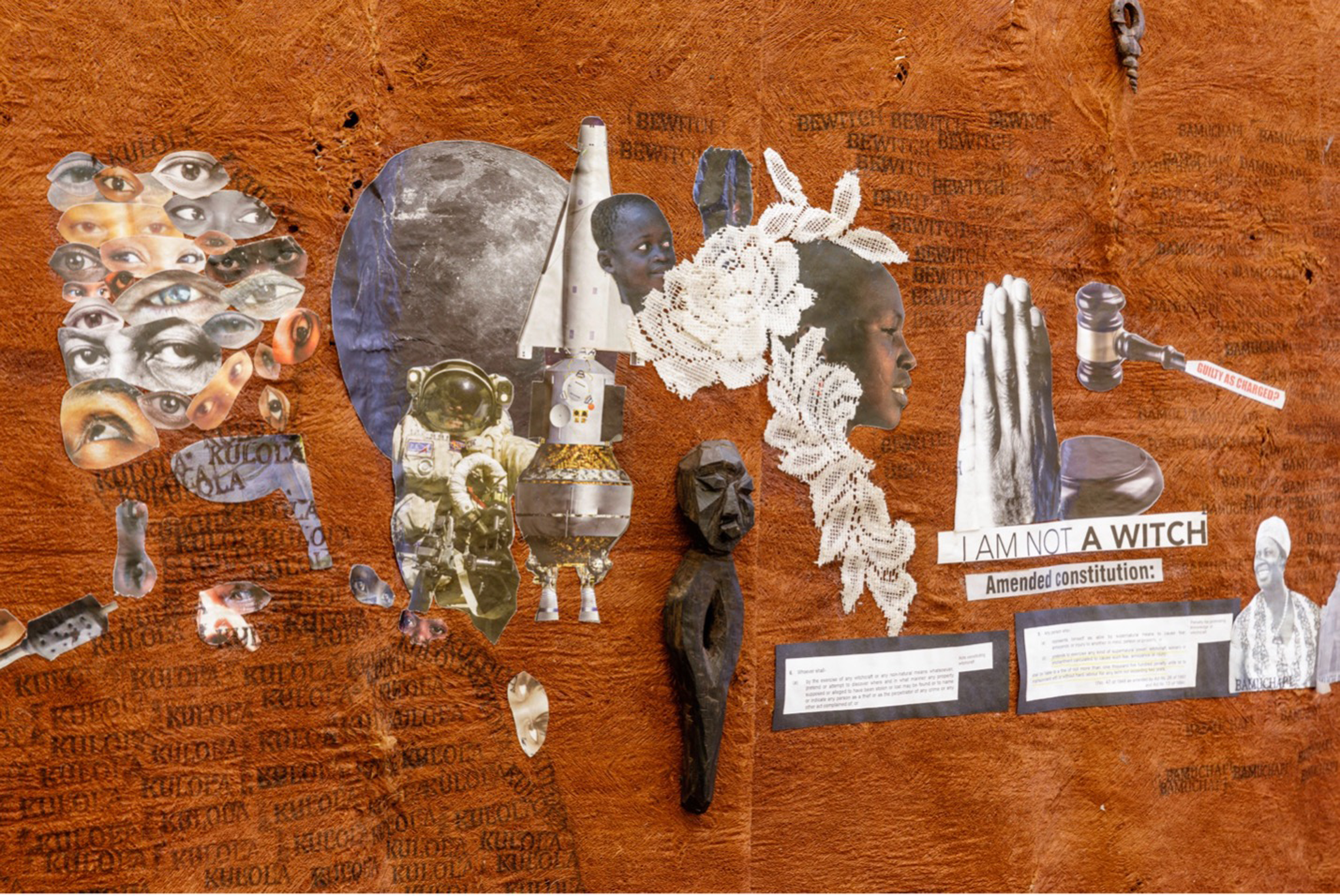
While you might read the term ‘witch’ as something evil that must be feared, Kalambata’s work tries to redeem its connotations and make visible how the colonial campaign sought to silence traditional healers in the name of capitalism. His works on bark cloth weave together text from the Zambian 1914 Witchcraft Act in an attempt to discuss traditional medicine, healing, and the infrastructures of care that were deliberately dismantled in the name of progress and profit (Figure 5). The expansion and occupation of land didn’t just disrupt access to healing plants, it meant that access to key healing ingredients were denied to those who required them. But somehow this layer feels absent from the work. The materials hold weight, but the composition of discussions across land, medicine, magic and God feels incomplete – still in search of a missing note that would allow us to acknowledge what cannot be seen.
I. Kalambata, Bamucapi [Witchfinders], 2025. Installation view, 13th Berlin Biennale, Former Courthouse Lehrter Straße, 2025. © Isaac Kalambata; image: Eberle & Eisfeld.

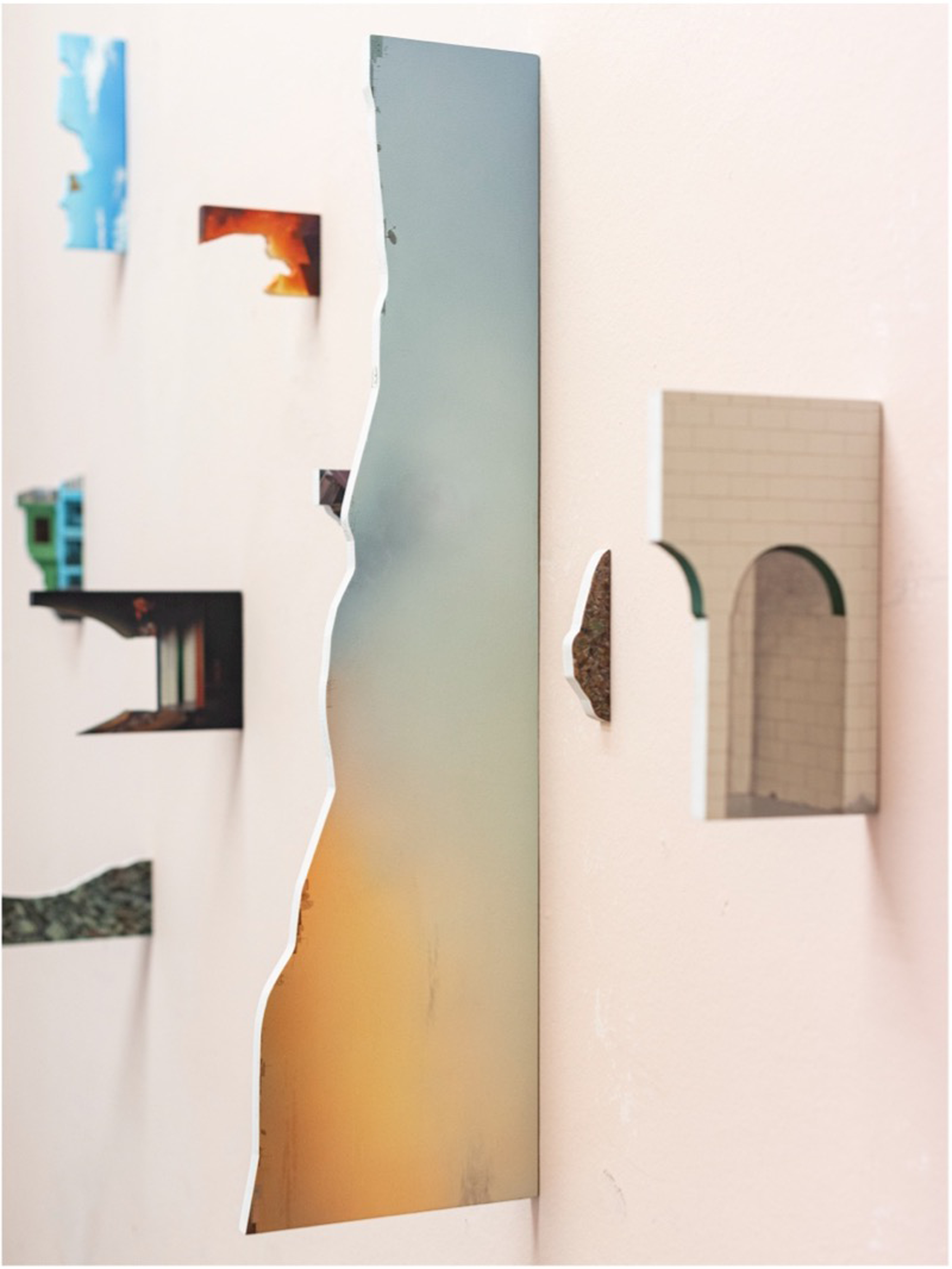
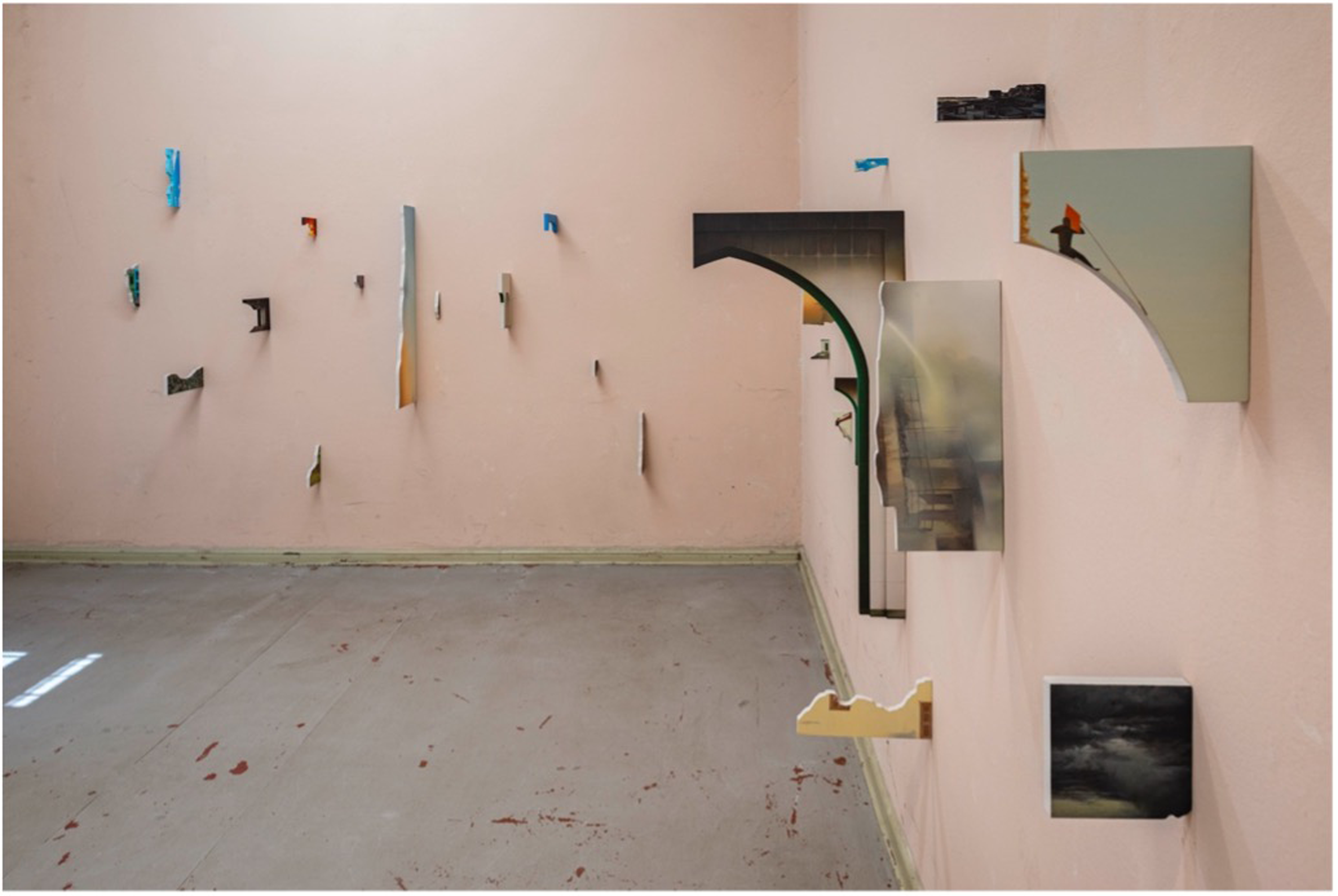
This push and pull between erasure and presence/absence and articulation, is also held tightly in Salik Ansari’s Altar of Absences, a work that zooms in on another kind of state violence: demolition as weapon. In India, bulldozer justice has become a shorthand for retribution against the marginalized – where homes and livelihoods are razed in the name of law, often without due process. Ansari doesn’t show us the victims or the devastation but instead paints the object that caused it on forms that resemble shrapnel. These artworks jut out of the wall as archives of wreckage (Figure 6). On one side, we may see an excavator’s jaws mid-air, framed like an accidental photo taken by a bystander, while the other shows fumes across a blackened sky. The installation reads like a torn newspaper collage of censored archives of images pulled from lands wracked by erasure and ongoing genocide (Figure 7). At the time of writing this article, the aerial image of Gaza filmed from a Jordanian aircraft’s food-aid drop in August 2025 resonated in the same breath – a stark, bird’s-eye view of a city now shaped by mass demolition. Ansari describes the absence in his work as a ‘living, shapeshifting scar’Footnote 11 – a wound denied the opportunity to heal.
S. Ansari, Altars of Absences, 2025. Installation view, 13th Berlin Biennale, Former Courthouse Lehrter Straße, 2025. © Salik Ansari; Sakshi Gallery, Mumbai; image: Raisa Galofr.

S. Ansari, Altars of Absences, 2025. Installation view, 13th Berlin Biennale, Former Courthouse Lehrter Straße, 2025. © Salik Ansari; Sakshi Gallery, Mumbai; image: Raisa Galofr.

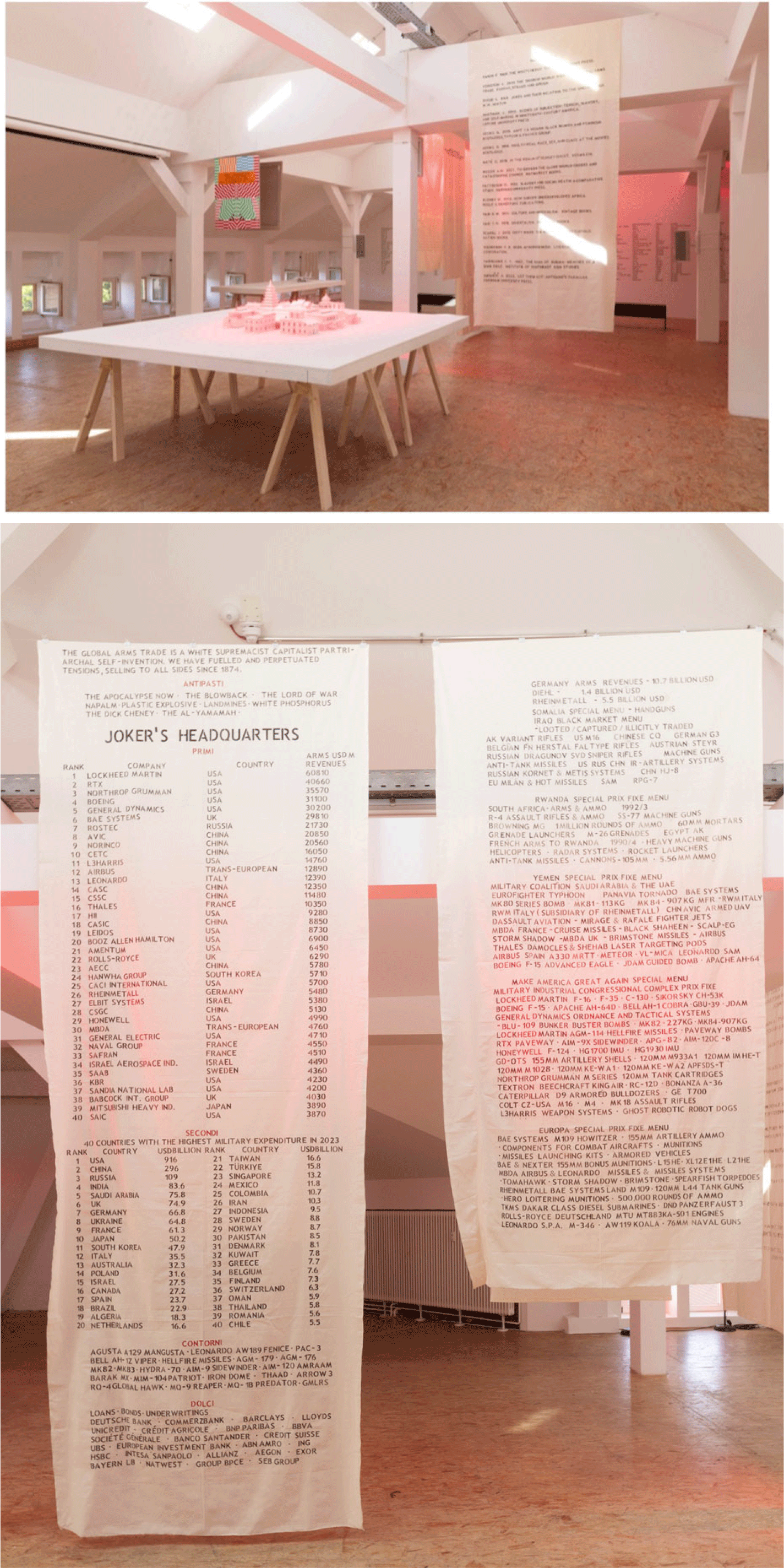
Grupa Spomenik insists that genocide is fully speakable. But the language of contemporary forensic science posthumously quantifies victims of genocide into nexuses of identity politics in a manner that no longer allows us to regard the deceased as humans, but as homogenized ‘identified missing persons’ devoid of political agency. Climbing into the attic of the KW, we enter the Joker’s Headquarters: the crescendo of the Biennale’s cry. Sawangwongse Yawnghwe comes from Shan State in Myanmar, the ancestral home of my maternal grandmother and her forebears. In this installation, a model of the Shan Palace – once a tourist site and now occupied by the military – is imagined as Yawnghwe’s museum of the future (Figure 8a). The model occupies a red-tinted room drenched in quantifiable evidence of weapons of mass destruction (Figure 8b). The work lays bare the deep entanglement of militaries and nations complicit in arms production that fuels war and genocide. The militarization of cultural, historic, and art sites within the Biennale context is glaring. The Joker’s Headquarters no longer reads as satirical dystopia, but rather as a bold act of solidarity amidst soft power and pervasive surveillance.
S. Yawnghwe, Joker’s Headquarters. Gesamtkunstwerk as a Practical Joke (C’est le Premier Vol de l’Aigle) [It’s the eagle’s first flight], 2025, installation view, 13th Berlin Biennale, KW Institute for Contemporary Art, 2025. © Sawangwongse Yawnghwe; image: Diana Pfammatter; Eike Walkenhorst.

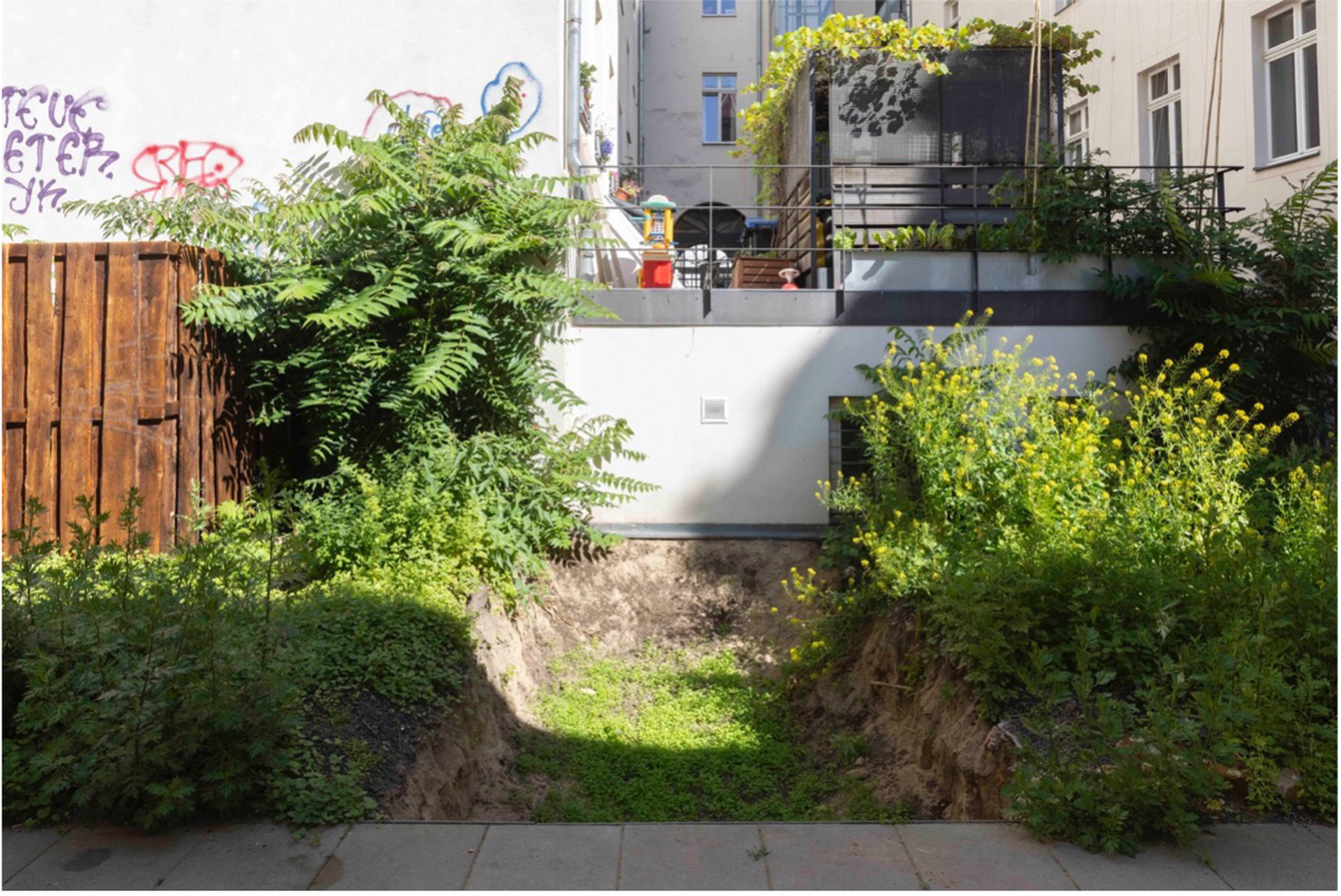
Grupa Spomenik also writes that ‘in the post-war context, contemporary scientific and religious institutions tend to holophrase the politics of terror’,Footnote 12 but to disrupt this and acknowledge the insurmountable excess and surplus of matter of destruction, ‘one has to begin in the ditch, so to speak, in an open grave, in the holes of the torn social fabric which scream for a radical political confrontation with the status quo maintained by the process of re-association’.Footnote 13 This metaphorical ditch finds a literal echo in the story of Nge Nom, who launched a Civil Disobedience Campaign days after Myanmar’s military coup in 2021. My distant experience and memory of this coup is linked to the four emergency flights my Burmese aunt had to take from Zambia to reach Rangoon to rescue her mother, my great-aunt. Nge Nom’s The Ditch brought the realities of the oppressed to the fore. Her flight was between fences and gardens, aided by elderly civilians. The line between survival and solidarity is etched into the soil itself in her installation composed of mud, water, plants, and a wooden fence (Figure 9). This site of trauma becomes a tribute to intergenerational resistance and the fierce intelligence of youth-led dissent.
N. Nom, The Ditch, installation view, 13th Berlin Biennale, KW Institute for Contemporary Art, 2025. © Nge Nom; image: Eike Walkenhorst.

Reading about Nge Nom’s Civil Disobedience Campaign reminded me of my first encounter with the term in the context of Zambia’s own independence struggle: the Chachacha movement led by Kenneth Kaunda and UNIP in the early 1960s. This non-violent protest, inspired by Gandhi, was Kaunda’s chant for Britain to ‘face the music’ of Zambian independence. In both cases, young people, armed with song and intergenerational solidarity, confronted colonial structures of power. Political resistance erupted from beneath, from ditches occupied by those long silenced.
I must admit that it was largely an act of ‘national’ service and personal inquiry that led me to the Biennale. Knowing that the countries most of my family claim as ‘home’ – India, Burma and Zambia – were represented, I felt compelled to hear the voices of makers from these places so entangled with my own ancestry, now positioned on a global art stage. While I work closely with artists in Zambia, my relationship with India and Burma is more domestic, shaped primarily through family, food, language and the rituals of home.
I have always felt somewhat removed from the lived realities of these places. I am not privy to their political or social textures in the way those on the ground are. It took traveling to Berlin – with a letter from the Biennale – to encounter a reality of Burma and India I had never directly known. There, I met the work of artists affected by the same political forces that displaced my family: the military crackdowns of 2021, of 2007 and of the 1960s. It was a jarring moment of recognition – of how little I know and how the aftermaths of migration, displacement, and genocide shape our lives in ways that feel both distant and inherited. Sarnath Banerjee warned of making a ‘cemetery of dead words’,Footnote 14 and I worry I may have done just that. After all, what can writing really do when the violence is still happening? When Gaza is being flattened, again. When solidarity feels like a whisper inside a sealed jar.
But maybe that whisper matters. Maybe it collects and crescendos, awakening the Djinn to cross the threshold and finally crack it open.