1 Introduction
According to Quirk et al. (Reference Quirk, Greenbaum, Leech and Stratvik1985) and Jackendoff (Reference Jackendoff2010), phrasal verbs (PVs) in Present-Day English (PDE) can be divided into three types, shown in (1).Footnote 2
- (1)
(a) Free (compositionally formed), non-idiomatic constructions (e.g. go across, go past, sail around)
(b) Partially idiomatic constructions (e.g. chatter away, find out, cut up)
(c) (Fully or highly) idiomatic constructions (e.g. bring up ‘rear,’ turn up ‘make an appearance’) (see Quirk et al. Reference Quirk, Greenbaum, Leech and Stratvik1985: 1162–3, Jackendoff Reference Jackendoff2010: 226–49)
In non-idiomatic PVs, a motion verb occurs with a directional phrase and the meaning of the whole sentence is fully predictable. In partially idiomatic PVs, however, the semantics of the whole verb phrase is not so transparent. The word ‘partially’ here means that the particle carries a kind of aspectual meaningFootnote 3 rather than a spatial meaning and the meaning of the whole sentence is still predictable.Footnote 4 Given the standard assumption that grammaticalization involves a change from a more lexical / less grammatical item to a less lexical / more grammatical one, the English directional adverbs whose spatial meanings change into an aspectual one can be seen as cases of grammaticalization (Bybee Reference Bybee1985: 152). It has been pointed out that aspectual uses of directional adverbs were not fully established in the Old English (OE) and Middle English (ME) periods (e.g. Hiltunen Reference Hiltunen1983; Brinton Reference Brinton1988). According to Tanabe, who examines composite predicates (e.g. take a walk) and PVs based on data from the Paston Letters written in the Early Modern English (EModE) period, there are few combinations with a particle whose meaning is not locative in EModE (Tanabe Reference Tanabe, Brinton and Akimoto1999: 127–8). Hence, to better understand the development of partially idiomatic PVs, the usage of PVs in EModE and in the Late Modern English (LModE) period needs to be investigated.Footnote 5
The third type of PVs, namely, fully or highly idiomatic PVs, such as make out (‘understand’) and put out (‘extinguish’), carry idiomatic meanings which are rarely predictable from their constituents. From a cognitive point of view, we can say that these expressions have undergone idiomatization as explained in (2).
(2) Idiomatization can be described as ‘the process of finding the pattern and assigning a new meaning which cannot be deduced from the constituents’. (Akimoto Reference Akimoto and Powell1995: 588)
Interestingly, many of the PVs that fall under this type are made up of native (motion) verbs and native (directional) adverbs. This means that these words have been spoken repeatedly or habitually in daily conversations since early English. It is probable, then, that the idiomatization of this type of PVs can be seen in the history of English. In order for us to understand the distribution of fully or highly idiomatic PVs, as well as that of the other two types, we should examine English texts written in less formal styles, such as diaries and private (but not formal) letters. To this end, in this article we examine PVs mainly from two corpora, given in (3), which contain colloquial types of text written between the fifteenth and eighteenth centuries.
- (3)
(a) Corpus of Early English Correspondence Sampler (CEECS) in the ICAME Corpus Collection
(b) Penn Parsed Corpus of Modern British English (PPCMBE) (subcorpora tagged [diary] and [private letters] only)
In the latter part of this article, we will try to analyse the distribution of the PVs from EModE to LModE from the standpoint of historical cognitive linguistics. As suggested above, PVs in PDE involve at least two kinds of historical changes, namely, grammaticalization and idiomatization. In recent grammaticalization research, however, there is no consensus on whether, and to what extent, these linguistic changes are related to each other, and consequently it remains unclear how partially idiomatic PVs and (highly) idiomatic PVs should be analysed from a historical cognitive perspective. On the basis of the work of Brinton & Traugott (Reference Brinton and Traugott2005), it is proposed in this article that there are at least two types of idiomatization in the history of English: that caused by grammaticalization and that caused by lexicalization. The partially idiomatic PVs show idiomatization caused by grammaticalization, whereas the idiomatic PVs show idiomatization caused by lexicalization.
In order to explain theoretically these descriptive characterizations of idiomatization, we employ a Usage-Based Model of grammar, developed by Langacker (Reference Langacker, Barlow and Kemmer2000) and Bybee (Reference Bybee2006, Reference Bybee2010). Specific proposals in this article are summarized in (4).
- (4)
(a) The idiomatization of partially idiomatic PVs is caused by grammaticalization, which involves repeated schema extractions leading to productivity.
(b) The idiomatization of (fully or highly) idiomatic PVs is caused by lexicalization, which involves the ‘conserving effect’, whereby a highly entrenched linguistic expression with high frequency resists further language change.
Among the various particles which occur in PVs in English, away and out are focused on here for the following reasons. First, they are both English native adverbs with no prepositional usesFootnote 6 but they underwent grammaticalization differently in some aspects. Moreover, as observed by Hiltunen (Reference Hiltunen and Kastovsky1994) and Claridge (Reference Claridge2000) among others, they show different frequency and productivity in the history of English: while away did not become very frequent or productive between EModE and LModE, out became quite frequent and productive especially from EModE onwards.
The organization of this article is as follows. Section 2 describes the diachronic distribution of PVs with the particles away and out appearing in EModE and LModE prose. Section 3 discusses the relationship between grammaticalization and idiomatization with special reference to Brinton & Traugott (Reference Brinton and Traugott2005). Section 4 offers a usage-based analysis of the historical development of the PVs, and section 5 presents the concluding remarks.
2 Historical development of PVs with away and out
2.1 The Old and Middle English periods
Before examining the distribution of the PVs with away and out in EModE and LModE, let us touch on their development in earlier English. Brinton (Reference Brinton1988) investigates aspectual usages of particles in the history of English and claims that away (OE form: onweg or aweg) and out (OE form: ut) in (5) may have some kind of aspectual meaning even in OE and ME.
(5)


On the other hand, as she acknowledges, it can be difficult to decide from OE and ME texts whether the uses have a spatial or an aspectual meaning. Example (6) is a case in point.
(6)

Keeping such difficulties with the interpretation of PVs in mind, Hiltunen (Reference Hiltunen1983) and Tanabe (Reference Tanabe, Brinton and Akimoto1999) assert that most verb–adverb combinations in OE and ME primarily had physical or concrete (i.e. less idiomatic) meanings, and that PVs with aspectual or idiomatic meanings were not so frequently used, at least by late ME.Footnote 7 Given these observations, it is safe to conclude that the aspectual meanings of the particles were not fully established by ME, but were developing gradually during this period.
2.2 The Early and Late Modern English periods
2.2.1 Corpora examined
Details of the two corpora used to examine and compare the development of the PVs with away and out for EModE and LModE are shown in table 1.
Size and time range of the two corpora (*values in parentheses indicate the words examined in this article)

The CEECS, which will be examined in section 2.2.2, is a concise version of the Corpus of Early Modern English Correspondence, composed of about 2.7 million words. The CEECS contains the non-copyrighted materials retrieved from this larger corpus and is around one-sixth of the size, although its time span is comparable. The CEECS contains 194 informants, which seems to offer a good basis from which to determine the uses of PVs in EModE.
The PPCMBE, on the other hand, which will be examined in section 2.2.3, consists of about one million words and includes various genres of texts written between 1700 and 1914. Since this article focuses on colloquial texts in LModE, from these genres we pick up only DIARY (69,584 words) and PRIVATE LETTER (66,362 words) content, accounting for 135,946 words (14.3% of the entire corpus).
2.2.2 Corpus of Early English Correspondence Sampler
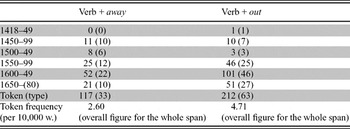
2.2.2.1 Distribution of examples. The token and type frequencies of the PVs with away and out appearing in the CEECS are shown in table 2.
Distribution of phrasal verbs with away and out taken from the CEECS (values in parentheses indicate type frequency)

Before the mid sixteenth century, the token and type frequencies of the PVs with away are very low; those of the PVs with out are also relatively low. For both kinds of PVs, the token and type frequencies increased thereafter, with the PVs with out increasing to around twice the numbers of the PVs with away.
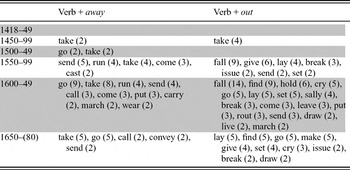
Table 3 shows the type of verbs that the two particles occur with. (For brevity, verbs whose token frequencies in each of the period are fewer than 2 are omitted.)
Frequency of verb–particle combinations (cases with fewer than 2 instances are omitted)

2.2.2.2 Phrasal verbs with away. Away tends to occur exclusively with motion verbs such as take, go and send. Most of the PVs with away express physical motion of a concrete subject referent. An example is given in (7).
(7) . . . so as I can neither goe my jorney nor hope to see you, if you goe away on Wensday, before your retorne into the contry, which I am extream sory for;. . .
(1616, LUCY RUSSEL, 37)
Goe away in (7) expresses a physical motion by combining the motion verb goe (‘go’) with the directional adverb away. Away in (8), on the other hand, is ambiguous between a directional meaning and aspectual (perfective) one.
(8) . . . Sir Thomas Fairfax also went away before I could certifie; and Sir Edward (who hathe taken great paines in this matter) was in the contrie, I did not know where, nor when he would retourne; (1602, A MATTHEW HUTTON 1, 164–5)
According to the OED, the first instances of away which carry an aspectual (continuative) meaning (as in work away) appear in 1562 (example: I with ale, and ale with me wag away. J HEYWOOD Prov. & Epogr. (1867) 90). It can be presumed, therefore, that the aspectual meanings of away were not pervasive in EModE.
There are no clear instances in the CEECS of PVs with away that carry fully or highly idiomatic meanings (e.g. give away (‘present’)) or of instances where away has a purely aspectual function.Footnote 8
2.2.2.3 Phrasal verbs with out. Hiltunen (Reference Hiltunen1983, Reference Hiltunen and Kastovsky1994) points out that, in comparison to the PVs with away, PVs with out came to be used more and more frequently from EModE onwards, regardless of the text types in which they were used. Changes in the frequency of PVs with out are shown in table 2. The uses of these PVs range from compositional and partially idiomatic to idiomatic. These are illustrated in examples (9) through (11), respectively. In particular, out in (10a, b) has a perfective aspectual meaning, while give out and make out in (11) seem to have the idiomatic meanings of ‘to proclaim’ and ‘to demonstrate, prove’, respectively.
(9) God willing, after Easter I come to Windsore, though if Austen be returned I se no reason but you may stepp out hether. (1625, RICHARD MOUNTAGUE, P I, 65)
- (10)
(a) I finde myselfe so trobled lest sinistar tales might delude you, my good brother, that I haue willingly found out this messanger, whom I knowe most sincere to you and a true subiect to me, to carry unto you my most sincere meaning toward you, . . . (1587, QUEEN ELIZABETH, 41)
(b) for all his vital parts wear so decayed, as, by the judgment of the doctors, he could hardly have lived out a year, which nobody that looked on him could have suspected;. . . (1625, LUCY RUSSEL, 125–30)
- (11)
(a) That the prince of Parma, hearing of my aryvall, chaft very much, and semed greatly to be deceaved that hir majesty wold send as she hath donn, ‘but’, sayth he, ‘ther ys no remedye but one; we must gyve out brutes that the queen of England hath offerd talk of peace, which wyll brede presently jelosye in the states heads, . . .’ (1586, A ROBERT DUDLEY, 71)
(b) If the truth of this can be made out, there might be good use made of it in makeing it publique,. . . (1659, JOHN JONES, 278)
As these examples indicate, in contrast to the PVs with away, those with out show a wider variety of usage in EModE, encompassing all three types of PVs given in (1).
2.2.3 Penn Parsed Corpus of Modern British English
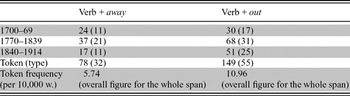
2.2.3.1 Distribution of examples. Among the subcorpora which comprise the PPCMBE, I picked up 15 texts tagged [DIARY] and [PRIVATE LETTER], and following the corpus design of three time spans, I show the distribution of PVs with away and out in table 4.
Distribution of phrasal verbs with away and out taken from the PPBMCE

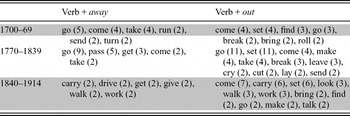
Table 5 shows the type frequency of the verbs which occur with away and out found in the PPCMBE, where, again, token frequencies fewer than 2 are omitted.
Frequency of verb–particle combinations (cases with fewer than 2 instances omitted)

2.2.3.2 Phrasal verbs with away. We will consider first the PVs with away appearing in the corpus. The examples in (12a, b) are purely compositional (non-idiomatic), while away in (13a, b) has a continuative aspectual meaning.
- (12)
(a) Matthew Dickie went away before breakfast. I went to dine at Coilsfield. At Mauchline met with Lord Hailes going to Barskimming.
(1776, BOSWELL 43. 241–4)
(b) Such clouds I have watched for hours, hoping that they would pass away because they were the only cloud in the sky, but though always in motion, these troublesome vapours keep continually in the same place. . . (1835, RUSKIN 16. 416–17)
- (13)
(a) The morning was so wet that I was afraid we should not be able to see our little visitor, but Frank who alone could go to Church called for her after service, & she is now talking away at my side & examining the Treasures of my Writing-desk drawer; -very happy I believe; not at all shy of course. (180X, AUSTEN 178. 401–3)
(b) Then I got to the Castle, was greeted smilingly by the familiar police and flunkies; found Childers upstairs, everything all exactly the same – the rooms very comfortable, and Miss Williams working away next door. We did a lot of work, went right through all the strong-room papers, looked at everything, and I went through a whole batch of typewritten papers which had not been gone through before. Then we lunched and worked away quietly; then caught 4.25. (190X, BENSON 138. 880–9)
In each of the examples in (14) below, take away can be more or less idiomatic to mean ‘diminish or detract (from something)’.
- (14)
(a) The chief answer the Tories made use of against the Bill was that it was against the liberty of the subject to take away the ancient law of the Kingdom in which every subject was entrusted and by which he was to be tried by his country among his friends and acquaintances. (1716, RYDER 184. 641)
(b) We have had a great and fine day in the house on the second reading the bill for taking away the heritable jurisdictions in Scotland. (174X, WALPOLE 5, 27. 613)
However, the instances of take away with seemingly idiomatic meaning may be interpreted metaphorically, meaning that if some portion of something is taken away (in a physical sense), the rest of the whole may lose its weight or significance. Many of the idiomatic uses of the PVs with away seem to be based on metaphor and metonymy, meaning that they are non-literal; however, as we have seen above, their idiomatic meaning can still be easily guessed from the activity denoted by the verbs.
2.2.3.3 Phrasal verbs with out. Let us turn now to the PVs with out. The examples in (15) involve compositionally formed PVs, which express physical (15a) and metaphorical (15b) motion.
- (15)
(a) Daniel was watching for us at the door of the George, and I was knowledged very kindly by Mr. and Mrs. Marshall, to the latter of whom I devoted my conversation, while Mary went out to buy some gloves. (180X, AUSTEN 187. 599–600)
(b) My brother William talks with them with the greatest freedom but without any guard upon his words. His talk with them is prodigiously silly and sometimes a blunt thing comes out from him that is affronting and, . . . (1716, RYDER 164. 97–100)
Out in (16) can be interpreted either lexically (i.e. spatially) or aspectually, and it seems possible to say that in each of these examples out reinforces or supports the verb's meaning.
- (16)
(a) I have so many cousins, and uncles and aunts, and bloods that grow in Norfolk, that if I had portioned out my affections to them, as they say I should, what a modicum would have fallen to each! (174X, WALPOLE 5, 15. 360)
(b) Three days the masses of stone continued falling and the dust was so great and so thick that at Turin it was supposed that an immense volcano had broken out among the Alps. (1835, RUSKIN 1, 13. 347–8)
(17) My dear Mother – I purposed writing to you two nights ago, as you might perhaps notice on the Newspaper; but a little man came in, and occupied the whole evening I designed for you. It turned out, however, to be ‘probably just as well’: for next day there arrived Jack's Roman Letter; which now can go along with mine to make the bargain better. (1835, CARLYLE 2, 299. 653–7)
2.4 Similarities and differences between away and out
As can be seen from tables 2 and 4, out becomes increasingly frequent, especially in LModE. The token frequency per 10,000 words is 10.96 in LModE, which is twice as high as that in EModE (4.71). Although difficult to show numerically, it seems that out expanded its meaning from directional to aspectual or from directional to idiomatic in EModE. Evidence that out expanded its directional meaning comes from its rivalry with forth, which was, according to Weman ([Reference Weman1933] 1967) and Hiltunen (Reference Hiltunen1983), one of the most frequent directional adverbs in OE through ME. Akimoto (Reference Akimoto, Dalton-Puffer, Kastovsky, Ritt and Schendl2006) observes that forth was subsequently replaced by out in some phrasal verbs, as shown in the examples in (18).
- (18)
(a) sue forth → sue out (OED s.v. sue 12.b.)
(b) dress forth → dress out (OED s.v. dress 7.d.)
(c) issue forth → issue out/forth (OED s.v. issue 1.a.)
(d) stand forth → stand out (in the sense of ‘to be conspicuous’)
(e) send forth → send out
(f) speak forth → speak out (Akimoto Reference Akimoto, Dalton-Puffer, Kastovsky, Ritt and Schendl2006: 25)
Forth rather quickly became less and less frequent, at least after LModE (Claridge Reference Claridge2000; Los Reference Los, Kay, Horobin and Smith2004; Ishizaki Reference Ishizaki2009; de Smet Reference De Smet, Traugott and Trousdale2010), and its directional and aspectual meanings were taken over partially or entirely by other adverbs or particles such as out (perfective) and on (continuative).
In contrast to out, as far as the data in tables 2 and 4 are concerned, the token and type frequencies of away also increase, but we have few examples of PVs with away that are highly idiomatic, and none that have a purely aspectual meaning.
Although the token frequency of away was about half that of out between EModE and LModE, as the following examples from PDE in (19) suggest, away came to be used as an aspectual marker in the same way as out.
- (19)
(a) He kept writing away at his books. (Bolinger Reference Bolinger1971: 104)
(b) Ivan worked/toiled/labored away. (Jackendoff Reference Jackendoff2010: 258)
In (19a, b), away carries an iterative and continuative meaning, respectively. The preservation of the aspectual meanings of away in PDE is intriguing when we compare it with forth; the latter once had both directional and aspectual meanings, but these fell nearly out of use after the eighteenth century and its aspectual meanings were largely replaced by out. Thus, the fact that away develops its aspectual usage in PDE suggests that, despite the difference particularly in token frequency with out, it is a fully fledged grammatical formative in PDE in the same way as out,Footnote 9 with some different connotations.
The examples in (20) are of PVs with away that are midway between being partially and fully idiomatic in PDE.
- (20)
(a) Bill slept the afternoon away.
(b) We're twistin’ the night away. (Jackendoff Reference Jackendoff2010: 250)
These examples contain the so-called ‘time-away’ construction; its constructional meaning is that the time specified was wasted by doing an activity denoted by the verb. Unlike (19a, b) where away depicts an atelic situation, this construction depicts a telic (or perfective) situation as a whole. Since this construction can occur only with atelic activity verbs, we can say the telicity depends exclusively on away. On the other hand, examining the syntactic and semantic properties of this construction, Jackendoff (Reference Jackendoff2010) concludes that it is a distinct kind of ‘construction’ in the sense of construction grammar (e.g. Goldberg Reference Goldberg1995), which is tantamount to saying that this construction is idiomatic.
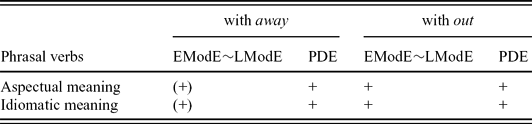
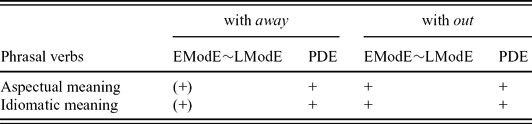
From the observations of scholars cited so far, we could presume that away and out differ from each other particularly in respect to their frequency, especially after about the mid EModE period. More specifically, after this period, out increased both its token and type frequencies, whereas away showed no increase in type frequency. However, even if away was less frequent than out, the aspectual function of away in PDE was still widely observed, as the examples in (19) illustrate. Table 6 summarizes the distribution of the PVs with away and out, respectively, in the different periods.
Summary of the distribution of PVs with away and out, where (+) in parentheses indicates the property in question is not always clear
3 Grammaticalization, lexicalization and idiomatization
So far, we have examined how in less formal, colloquial styles of text written in EModE and LModE, the token and type frequencies of PVs with out increased from EModE onwards, whereas those of away did not always do so. On the other hand, PDE has some examples which show that they did undergo grammaticalization and idiomatization. How, then, can we descriptively characterize these developments? A number of analyses have been proposed to clarify the conceptual relation between grammaticalization and idiomatization. Here we will focus on the method proposed by Brinton & Traugott (Reference Brinton and Traugott2005), which seems to be one of the most promising theories of grammaticalization. First, Brinton & Traugott make a distinction between grammaticalization and lexicalization, defining them as in (21) and (22), respectively.
(21) Grammaticalization is the change whereby in certain linguistic contexts speakers use parts of a construction with a grammatical function. Over time the resulting grammatical item may become more grammatical by acquiring more grammatical functions and expanding its host-classes. (Brinton & Traugott Reference Brinton and Traugott2005: 99)
(22) Lexicalization is the change whereby in certain linguistic contexts speakers use a syntactic construction or word formation as a new contentful form with formal and semantic properties that are not completely derivable or predictable from the constituents of the construction or the word formation pattern. Over time there may be further loss of internal constituency and the item may become more lexical. (Brinton & Traugott Reference Brinton and Traugott2005: 96)
They propose that the difference between grammaticalization and lexicalization lies in their productivity, defined in (23) as follows.
(23) (We understand) productivity as the ‘[a]bility of word-forming elements to be used to form new linguistic expressions’; [it] is a gradient concept. (Brinton & Traugott Reference Brinton and Traugott2005: 92)
In addition to (21) and (22), Brinton & Traugott note the relationships between grammaticalization, lexicalization and idiomatization in (24) and (25).
(24) Grammaticalization also typically involves loss of concrete and literal meanings (idiomatization, bleaching) counterbalanced by the strengthening and eventual semanticization of more abstract and general meaning contextually derived in bridging contexts. (e.g. the contextually derived implicatures of futurity derivable from certain uses of the literal motion expression be going to come to be salient.) (Brinton & Traugott Reference Brinton and Traugott2005: 100, emphasis mine)
(25) Lexicalization often involves semantic and pragmatic idiomatization, i.e., the semantic components lose their compositionality (e.g., black market refers to neither a market nor anything literally black). (Brinton & Traugott Reference Brinton and Traugott2005: 97, emphasis mine)
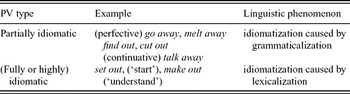
As the descriptions in (24) and (25) indicate, Brinton & Traugott regard idiomatization as involving both grammaticalization and lexicalization. More precisely, an expression in its productive as well as less or non-productive form may undergo idiomatization. That is to say, in Brinton & Traugott's framework, there are at least two kinds of idiomatization: that which comes from grammaticalization and that which comes from lexicalization.Footnote 10 Brinton & Traugott (Reference Brinton and Traugott2005) also assert that both grammaticalization and lexicalization undergo changes in semi-productive constructions. Grammaticalized elements develop from less to more productive; lexicalized elements develop from more to less productive. With these assumptions in mind, let us consider how development of PVs can be described. In partially idiomatic PVs, aspectual elements such as away and out belong to grammatical categories and, although there are differences in the extent to which they underwent grammaticalization, they become productive over time. This means that partially idiomatic PVs enter into grammaticalization. On the other hand, (fully or highly) idiomatic PVs enter into idiomatization through certain verb-adverb combinations, and such processes become less productive. These observations are summarized in table 7.
Proposed descriptive characterization of partially idiomatic and idiomatic PVs

A problem may arise here with the historical development of away. As mentioned earlier, away is seen as an instance of grammaticalization, in the same way as out, because its aspectual meanings are attested in PDE. However, judging from the data presented in section 2, away seems to be less grammatical than out at least in EModE and LModE. This lower degree of grammaticalization seems due to the fact that, unlike out, away underwent lexicalization (namely, on weg (< PDE on the way, away)) in the initial stage of development and thereafter started to undergo grammaticalization, perhaps by means of metaphor (from physical path to abstract path) or by means of metonymy (from path focus to endpoint focus).
4 Historical cognitive analysis of the phrasal verbs
Thus far, we have descriptively characterized the historical development of the partially idiomatic and idiomatic PVs with away and out. In what follows, I will propose a historical cognitive analysis of the development of these PVs based on a Usage-Based Model, developed by Langacker (Reference Langacker1987, Reference Langacker, Barlow and Kemmer2000), Tomasello (Reference Tomasello2003) and Bybee (Reference Bybee2006, Reference Bybee2010), among others.
4.1 Basic assumptions of the Usage-Based Model
The Usage-Based Model approach to language is used in research by many cognitive and functional linguists. It is based on the notion that a speaker's grammatical knowledge is acquired through communicative situations or ‘usage events’ in a bottom-up fashion. Although grammatical knowledge itself is naturally a highly abstract entity and it is stored in the brain, it is built up on the basis of actual instances of use that we come across in daily life. Through repeated experiences of usage, a specific linguistic expression becomes conventionalized and stored in the brain as an abstract symbolic unit called a (construction) schema, which can range from a morpheme to a larger assembly of linguistic units. A schema enables us to characterize (or categorize) rapidly not only familiar but also unfamiliar linguistic expressions, and to retrieve them from the brain easily, because it serves as a sort of knowledge structure on the basis of which the expressions are comprehended and produced.
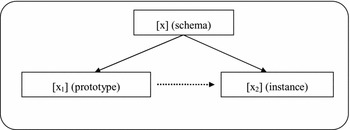
It is commonly assumed that these schemas are not fixed but rather are dynamic organizations, subject to creative extension and reshaping with language use (Kemmer & Barlow Reference Kemmer and Barlow2000). Consider figure 1.
A network model (cf. Langacker Reference Langacker1987: 373)

When lexical item x1 is a typical instance of a category, it is recognized as a ‘prototype’ of that category (Rosch Reference Rosch1975). The prototype is a conceptual unit already established and stored in the speaker's brain. If the instance x2 is judged to be similar to the prototype x1 regardless of some degree of difference, the instance is taken to be an ‘extension’ of the prototype. The categorization based on similarity is indicated in figure 1 by dotted arrows. In order for both x1 and x2 to be sanctioned as a member of the same category, the schema, which is extracted from both the configurations, is necessarily updated as it is. The recognition of expressions by virtue of the schema is indicated by solid arrows.
The constructional schema given in figure 1 can explain the diachronic change, as explained by Bybee (Reference Bybee2010).
(26) In usage-based theories change occurs as language is used, and it can be implemented by means of small changes in distributional probabilities over time. There is no need to postulate massive restructuring taking place in the space of one generation. (Bybee Reference Bybee2010: 114–15)
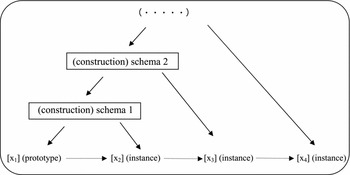
This statement can be theorized by modifying the schema given in figure 1, as in figure 2.
Language change in the Usage-Based Model framework

Language users try to form a category based on prototypical instances in the first place. However, as they encounter more and various usages, the category tends to change gradually by modification and/or updating of the (construction) schema. This is a cognitive process in which linguistic users extract the schema based on similarity and commonality. Some linguistic expressions may contribute to form another abstract schema. It seems unreasonable, though, to think that our brains are so flexible that a schema continues to be modified or updated throughout life. Moreover, because conveying information or messages to others is one of the principal purposes of language use, it is scarcely possible to imagine that a schema would change enough in the short term to prevent us from communicating with others. Thus, when the community to which we belong accumulates a certain level of experience, the (construction) schemas for linguistic expressions become stabilized, not only in the individual dimension but also in the social/cultural dimension. In view of life expectancy, human beings can typically talk directly to and live with two or three generations in their communities and language must be available to communicate between the different generations. Consequently, from the perspectives of the Usage-Based Model, language change is assumed to occur gradually rather than rapidly and logically rather than illogically or unexpectedly.
4.2 Frequency effects and diachronic language change
As we have seen above, the Usage-Based Model can be utilized to explain the diachronic change of language as well and our daily experiences are quite important for language change in general. In the Usage-Based Model, such daily experiences are scaled by the frequency of language use. It is well known that there are two types of frequency, namely, token and type, and they are distinguished conceptually as they have different effects on the storage, activation and processing of linguistic expressions, all of which directly or indirectly affect language change.
Taking token frequency first, once a linguistic expression acquires a unit status in our brain on the basis of token frequency, it may resist further linguistic change. This is known as the ‘conserving effect’. For instance, English has what we call ‘irregular’ and ‘regular’ verbs, as in (27) and (28), respectively.
(27) Irregular verbs
go (-went-gone), drive (drove-driven), make (made-made), set (-set-set), etc.
(28) Regular verbs
talk (-talked-talked), walk (-walked-walked), etc.
As is well known, irregular verbs in PDE were not always irregular throughout the history of English; some irregular verbs reflect regular paradigm patterns in earlier English and other irregular verbs developed idiosyncratically.Footnote 11 These verbs have been in daily use since OE and they are stored independently of other productive -ed past tense forms as the result of the conserving effect. Another interesting fact about this effect is what we call ‘two-way past tense forms’, as illustrated in (29).Footnote 12
(29) burned/burnt learned/learnt smelled/smelt (Bybee Reference Bybee2006: 111)
This alternation in form is restricted to somewhat less frequently used verbs; the irregular verbs frequently used in daily life such as felt, kept and slept never allow it.Footnote 13 Regardless of whether they are morphological constituents or sentences (like proverbs), linguistic expressions with extremely high token frequency are stored independently in our brain as conventional units in order to process them easily.
Next, with respect to type frequency, once we regard a linguistic expression as a conventional unit, which represents compositional meanings in the first place, a further abstract schema might be extracted from it in the second stage of development. This kind of development results from the similarity and generality of the expressions for ease of comprehension and production. For example, the past tense form -ed (as in walked) exhibits high type frequency in English, compared with -t or -d (as in kept), so the former is analysed to be more schematic than the latter.
Once an abstract (construction) schema is established in the brain based on the increase in type frequency, language users begin to apply it to other expressions. The property of permitting novel combinations of linguistic expressions is measured as productivity (as defined in (23) above). The Usage-Based Model attempts to explain language change based on cooperative interaction between frequency and productivity. In this model, the entrenchment of a linguistic expression has to do with how frequently it is used (token frequency) and the increase in type frequency contributes to determining the degree of productivity of the linguistic expression.Footnote 14 While it is not the only factor determining productivity (e.g. Bybee Reference Bybee2006: chapters 5–6), it seems reasonable to think that type frequency explains the increase or decrease of productivity.
4.3 Explaining the historical developments
4.3.1 Idiomatization caused by grammaticalization
It seems easy to predict grammaticalization phenomena in terms of the Usage-Based Model. As the token frequency of an expression increases, it becomes more generalized and forms an abstract schema, which may further lead to an increase in type frequency. Once the type frequency of an expression increases, it becomes more entrenched and is stored in the brain as an abstracted (construction) schema, which makes it available for other types of expression. In the course of this process, an expression comes to be productive. Under the Usage-Based Model, grammaticalization can be seen as a repeated schema extraction process occurring in a unidirectional way – from a concrete meaning to an abstract meaning or from a lexical meaning to a grammatical or functional meaning.
With the above discussion in mind, let us consider how out underwent grammaticalization. It was not always used frequently in earlier English, but it became frequent after EModE. As shown in table 2, as the usage of out expanded from the mid sixteenth century onwards, more and more abstract schema for out were extracted, resulting in linguistic expressions with out becoming more productive. Forth, which overlapped with out in EModE in the meaning of ‘outward direction’ (see also de Smet Reference De Smet, Traugott and Trousdale2010 for an extensive study), was frequently used in OE and ME, but it fell into disuse after EModE. As out underwent grammaticalization after EModE, PVs with forth were replaced by those with out, as we saw in (18), with little semantic change. This replacement is possible because the PVs illustrated in (18) are semi-idiomatic.Footnote 15
Away also underwent grammaticalization in the course of development. The token frequency of away was not so prominent and it occurred almost exclusively with motion verbs. Although based on limited data, it appears that continuative and perfective aspectual meanings were extracted as abstract schema on the basis of the type frequency, especially from around LModE to PDE.
4.3.2 Idiomatization caused by lexicalization
This type of idiomatization can occur when the token frequency of collocated words is either extremely high (e.g. free combinations between native English words) or extremely low (e.g. fossilized expressions). Let us concentrate on the former first. Most of the verbs and adverbs of PVs are native words and they have repeatedly co-occurred since OE. In accordance with the Usage-Based Model presented here, the extremely frequent occurrence of particular expressions checks the forming of (construction) schemas because of the conserving effect, as in the case of irregular verbs, which are almost exclusively native English verbs.
PVs with out were not so frequently used in OE and ME, and it is supposed that the co-occurrence of out with verbs was not frequent enough for there to be a conserving effect. As token frequency increased from EModE onwards, out became frequently used with native English verbs to form fully or highly idiomatic expressions, regardless of whether or not it underwent grammaticalization in the history of English.
In the case of away, on the other hand, this native adverb began to undergo lexicalization by the early OE period, due to frequent occurrences of on and weg (<PDE way). The grammaticalization of away proceeded thereafter. As Brinton & Traugott (Reference Brinton and Traugott2005: 96) observe, lexicalized expressions are semantically contentful and this may serve in the first place to resist further change. Furthermore, in comparison with out, away does not show high token or type frequencies in EModE or LModE, which are the requirements for idiomatization caused by grammaticalization or lexicalization, respectively. Thus, even if away is a native adverb in English, it would seem highly unlikely that it occurred with native verbs to form idiomatic meaning by around the LModE period.
Let us turn to the case when the collocated words are not always native in nature. As pointed out above, most of the verbs used with away and out in those periods are native motion verbs, but some verbs such as cast, take, march, convey, issue, carry and sally in tables 3 and 5 are not native English verbs. Except for take, which had entered English by the late OE period, these non-native verbs appeared in English after around the thirteenth century. Since foreign words were not frequently used in the first place, collocations of these verbs with away/out were not so tight even in the Early and Late ModE periods. Consequently, in such PVs the constituents started to combine freely in the first place in non-idiomatic senses, as in (30), and after away/out grammaticalized, the verbs occur with the grammaticalized elements to take on their partially idiomatic meanings.
- (30)
(a) Dearest Lady Your letter which ought to have come on tuesday came not till wednesday. Well, now I know that there is no harm I will take a chaise and march away towards my own country. (1775, JOHNSON, 2, 39.797–800)
(b) Sir Alexander Dick had called yesterday when I was abroad, and asked my wife and Miss Cuninhame and me to dine there today. His coach came and carried us out. (1776, BOSWELL, 51.550–2)
5 Concluding remarks
In this article, I have attempted to describe and explain the historical developments of PVs with away and out in EModE and LModE from the perspective of the Usage-Based Model of language and in line with the theory of grammaticalization and lexicalization advocated by Brinton & Traugott (Reference Brinton and Traugott2005). First, based on examination of two historical corpora (CEECS and PPCMBE), we saw that the token frequency of the PVs with out increased from the mid-sixteenth century onwards, and at the same time its type frequency increased. In contrast, the token and type frequencies of the PVs with away did not always increase, at least around the LModE period.
Second, it was shown that away and out in PDE can be analysed as instances of grammaticalization in the sense of Brinton & Traugott (Reference Brinton and Traugott2005), but that they differ in their degree of grammaticalization and lexicalization. Specifically, as a result of increases in token and type frequencies by LModE, out became idiomatized through both grammaticalization and lexicalization, whereas away was less idiomatized by either process.
Finally, it was shown that idiomatization caused by grammaticalization and that caused by lexicalization can be naturally accommodated within the Usage-Based Model approach to examine historical language change, an approach which proposes that token and type frequencies of linguistic expressions play different roles in their diachronic (in)variability.