Introduction
General medicine has a long tradition in developing tools and equipment that support the diagnostic process and treatment of patients. Not surprisingly, the costs of such equipment now-a-days make up a substantial proportion of current healthcare budgets (i.e. 10–40%; Reference Cascarino1), and the growing complexity of current technology and equipment is likely to increase that percentage even further.
In (clinical) psychiatry the use of objective measurement devices, let alone high tech equipment, is still rare. Psychiatric diagnostic processes are still depending heavily on the observations, experience, and skills of a diagnosing psychiatrist or psychologist. Of course, the rise of neuroimaging techniques such as EEG, CAT, MRI and fMRI have strongly increased the possibilities to study brain anomalies in psychiatric patients, but nevertheless, establishing a psychiatric diagnosis is still based on the (behavioural) criteria described in DSM-IV (2), which have to be observed and assessed by a human diagnostician.
Many of the major challenges of mental health care, however, are not dealing with the specific diagnostic categories presented in the DSM-IV, but with the behavioural manifestations and problem behaviours that stem from mental illnesses. Aggressive and disruptive behaviour, for instance, are the main causes for involuntary psychiatric admission, even though aggressive behaviour is not a specific diagnostic category in the DSM-IV. Nevertheless, psychiatric professionals are expected to be able to ‘predict' dangerousness and violence risks of individual psychiatric patients, for instance when having to judge about the necessity of forced pharmacological treatment or whether it is safe enough to discharge a patient. In other words, assessments about aggression risks have to be made, without it being an official psychiatric illness in terms of the DSM-IV, and without having access to measurement tools or equipment that can assess a state of physiological hyper arousal, let alone an assessment that can objectively ‘predict' imminent aggression.
A well-known technique to assess psychological arousal (Reference Critchley3) is to measure skin conductance levels (SCLs), and to evaluate rapid changes in skin conductance in response to triggers (skin conductance responses; SCRs). Although widely used in experimental psychological research, for instance in patient samples suffering from phobia (Reference De Jong, Merckelbach, Arntz and Nijman4), this technique has relatively seldom been used in (locked) psychiatric admission settings (Reference à Campo, Merckelbach, Nijman, Allertz and Yeates-Frederikx5). One of the obvious reasons for this is that measuring skin conductance, until recently, required a substantial amount of equipment to which a patient had to be attached to obtain these assessments. As technology advanced, however, it now becomes possible to measure SCLs and SCRs by means of small wearable devices in the form of regular watches or wrist bands (Reference Picard6,Reference Westerink, Ouwerkerk, de Vries, de Waele, Van Den and Van Boven7). In fact, such new high-technology devices can be used to assess various psycho-physiological parameters, among which the SCL, without the patient being restricted (i.e. having to sit in one place), or being bothered by these measurements in any way. This provides opportunities to measure psycho-physiological changes in psychiatric patients during their regular ward life, even when they are in a state of acute psychiatric crises.
To illustrate the potential this development may have for research on the treatment of severely agitated and aggressive psychiatric patients, we provide a case description of a patient in crisis on whom a skin conductance measurement device in the form of a watch (see Fig. 1) was piloted. The aim of our pilot study was to explore whether continuous assessments of SCL in daily clinical practice of a locked psychiatric ward may be able to capture increases in arousal of psychiatric patients, even before actual observable agitation and aggressive behaviour are visible. The device also assessed the amount of activity and motions made by the patient during the day, as increased physical activity in general is associated with increases of the SCL.
The wearable devices used to asses SCL and activity of psychiatric patients.

A pilot study
Between 21 April and 12 May 2010 a pilot study was performed at one of the locked intensive care wards of a psychiatric hospital in Eindhoven, The Netherlands. This pilot study was authorised by the medical ethical committee for research with psychiatric patients in The Netherlands (i.e. the Metigg), as well as by the technical and ethical committee of Philips Research. Potential participants were informed about the study, and were asked for written informed consent if they were willing to participate. Patients who consented wore a mobile skin conductance device from 16:00 h to 22:00 h. The personal caregivers of patients wearing a skin conductance watch were instructed to log any event or behaviour that struck them in a diary made for this purpose. Apart from that, agitation and potential aggressive behaviour were documented each half hour, using a brief 11 item checklist called the Social Dysfunction and Aggression Scale (SDAS; Reference Wistedt, Rasmussen and Pedersen8). It is important to note that the caregivers providing these assessments of the condition and behaviour of the patient had no knowledge of, or access to, the SCLs of the patients while they were making their observations. The skin conductance data were only retrieved from the mobile wrist device after the measurement session had ended at 22:00 h. One of the first pilot cases is presented below. It concerns an anecdotal case, meant to illustrate the potential usefulness of assessments like this for psychiatric crisis intervention research.
The case of Mrs A
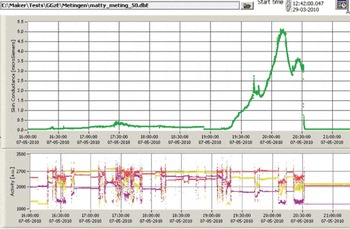
On 29 March 2010, Mrs A., a young woman in her early twenties, suffering from schizophrenia, agreed to participate in the study. She was feeling relatively well when asked to participate, rating her own tension level to be a ‘6' on a scale from 1 to 10. Her behaviour throughout the day indeed showed no signs of hostile or agitated behaviour till 20:00 h. That is to say, no observations on agitated or disruptive behaviour whatsoever were noted by her personal caregiver in the diary, and all SDAS ratings performed twice per hour were zero, until 20:00 h. From 20:00 h to 20:30 h, however, changes in the behaviour of Mrs A were noted by her personal caregiver, and her behaviour deteriorated after that. For the period between 20:00 h and 20:30 h her personal caregiver noted in the diary that the patient showed signs of ‘both anger and desperation'. On the SDAS this was expressed in elevated scores on the items assessing ‘Non-directed verbal aggressiveness', ‘Irritability', ‘Negativism', ‘Dysphoric mood' and ‘Socially disturbed behaviour'. Yet, no physical aggressive behaviour was recorded on the SDAS for that time frame, and the personal caregiver of Mrs A tried to verbally deescalate and calm the patient. Between 20:30 h and 21:00 h, however, Mrs A's condition got worse. On the SDAS pertaining to that time frame, physical aggression, apart from verbal aggression, was reported. In the period between 20:30 h and 21:00 h in which the physical aggression was reported, the patient was encouraged and observed to make attempts to contain herself (i.e. at about 20:10 h, for instance; the assessment of physical motion also shows this period of reduced physical activity), but in the end Mrs A was smashing and throwing plates and glassware in the kitchen of the ward and pulled off the skin conductance watch (i.e. just past 20:30 h; Fig. 2).
SCL (in microSiemens; upper half of the screen) of and the amount of activity of Mrs A (lower half of the screen) on 29 March 2010.

Interestingly, when studying the SCL of Mrs A in retrospect, it became clear that her skin conductance had already been rising well before 20:00 h (Fig. 2), although no reports on agitation or aggression were made in the Diary or with the SDAS for the time frame between 19:30 h and 20:00 h. In fact, as can be seen in Fig. 2, the SCL of Mrs A had been starting to rise sharply from about 19:20 h onwards, and eventually rose to over 5 µS between 20:00 h and 20:30 h, whereas the baseline had been around 0.5 µS throughout the day.
Discussion
The fact that the patient's SCL increased markedly during the period of the visible aggressive behaviour, in our opinion, is not what makes this case report of particular interest. The finding that the tension in Mrs A, as detected by the skin conductance watch, appears to already have been building well before the first behavioural signs of aggression were noticeable, however, may have important implications for aggression prevention. This observation fits well with the experience of psychiatric caregivers that aggressive outbursts of psychiatric inpatients often seem to be preceded by a long period of tension building (Reference Kuijpers, Needham, Callaghan, Palmstierna, Nijman and Oud9,Reference Nijman, Merckelbach, Allertz and à Campo10), but this first rise in arousal may hardly translate itself in observable disruptive behaviour. Possibly, by measuring SCLs on a continuous basis in patients who are at a high risk of becoming violent, without this procedure having to interfere with patients' daily lives, may be helpful to make the very first stages of tension building visible and quantifiable. This may open new avenues for intervening at an earlier stage than currently is the case, and to evaluate the effects of such interventions. Because of the obvious limitations of the current case study, however, the present findings cannot in any way be regarded as proof that rising SCLs will have predictive validity on imminent violent conduct of psychiatric inpatients. The case findings presented in this paper could, for instance, simply be the result of a spurious correlation, or a chance finding. The current pilot study however, to a large extent was performed to test the feasibility of conducting mobile skin conductance assessments in the hectic, locked ward environment, with the aim of preparing for a large-scale study in which a group of (potentially aggressive) patients are monitored in a structured manner during their entire admission. Only with such a study, the predictive validity of continuous SCL assessments on aggressive behaviour can be reliably assessed and quantified. Although anecdotal, the current experiences with Mrs A, in our opinion, warrant such a future study on the usefulness of continuous SCL measurements on patients who are in a state of acute psychiatric crisis. If such a quantitative future research would find (robust) associations between rises in SCLs and disruptive and aggressive behaviour, one might also consider to give patients real time access to their own current stress levels in a later study, so that patient may learn to recognise, and possibly cope with, building tension themselves at an earlier stage. These techniques, of course, have been used earlier in various biofeedback therapies. Wearable devices, however, make it possible to receive the feedback on a continuous basis, in real life, and even in the hectic situation of a locked ward environment. In other words, the fact that the device is in the form of a watch allows to perform assessments around the clock with the most difficult patients. The use of real time psycho-physiological assessments, in our opinion, may give a boost to research on understanding and preventing inpatient aggression. It has proven difficult in the past to take aggressive patients who are in acute psychiatric crisis to the laboratory, but we now can take the laboratory to the patients in a portable form.
Potential conflicts of interest
M.O. is employed by Philips Research in Eindhoven, and was involved in the development of the wearable psycho-physiological assessment device. All other authors have no potential conflicts of interest to declare.