INTRODUCTION
Dasyprocta punctata is one of the 11 species which comprise the genus Dasyprocta, common name agouti (Eisenberg Reference EISENBERG1989). Agoutis are medium-sized (3 kg) rodents that make up a high percentage of biomass in tropical forests, and are important not only as prey for a variety of predators including humans (Aliaga-Rossel Reference ALIAGA-ROSSEL2004, Eisenberg & Thorington Reference EISENBERG and THORINGTON1973, Terborgh et al. Reference TERBORGH, LOPEZ, NUÑEZ, RAO, SHAHABUDDIN, ORIHUELA, RIVEROS, ASCANIO, ADLER, LAMBERT and BALBAS2001), but also because of its role as a seed predator and disperser (Asquith et al. Reference ASQUITH, TERBORGH, ARNOLD and RIVEROS1999, Hallwachs Reference HALLWACHS, Estrada and Fleming1986, Henry Reference HENRY1999, Peres et al. Reference PERES, SCHIESARI and DIAS-LEME1997, Silvius Reference SILVIUS2002, Silvius & Fragoso Reference SILVIUS and FRAGOSO2003, Smythe Reference SMYTHE1978). Documenting the spatial scale at which frugivores move is important because it suggests how quickly fallen seeds may be found, and sets the distance that seeds could be dispersed. Knowledge of the movements of animals that feed at seasonally fluctuating fruiting patches is also of general interest because it allows for the quantification of the influence of food distribution on animal behaviour (Cowlishaw Reference COWLISHAW1997, Ylonen et al. Reference YLONEN, PECH and DAVIS2003).
Only a few studies have described the movement patterns for any members of genus Dasyprocta, typically with small sample sizes (D. leporina: 3–9 ha, n = 9 animals, Jorge & Perez Reference JORGE and PEREZ2005, Silvius Reference SILVIUS1999, Silvius & Fragoso Reference SILVIUS and FRAGOSO2003; 3.9 ha for a single D. punctata, Rodriguez & Vaughan Reference RODRIGUEZ and VAUGHAN1985). However, there has been no description of habitat preferences or the intensity at which Dasyprocta uses space, which is likely to affect the frequency at which it encounters fallen seeds. The importance of small and medium-sized terrestrial rodents as seed depredators and dispersers is widely recognized. For example, studies on species of spiny rat (Proechimys spp.) and acouchy (Myoprocta exilis) have shown that their movements generate complex seed shadows that might affect forest structure (Adler & Kestell Reference ADLER and KESTELL1998, Adler & Levins Reference ADLER and LEVINS1994, Forget Reference FORGET1991, JansenReference JANSEN2003).
We studied the spatial ecology of the Central American agouti (D. punctata Grey 1842) by radio-tracking nine animals and visually tracking three additional ear-tagged individuals on Barro Colorado Island, Panama. We describe their home-range size and intensity of space use, and relate these factors to food distribution and predation risk.
METHODS
Study area
The study took place at the Smithsonian Tropical Research Institute on Barro Colorado Island (BCI, 9°9′N, 79°52′W), a 15.6-km2 protected island in Panama, covered with tropical moist and semi-deciduous forest of several successional stages (Dietrich et al. Reference DIETRICH, WINDSOR, DUNNE, Leigh, and Windsor1996). Rainfall averages 2600 mm y−1 with a seasonal dry period from January until early May. There is a strong fruiting seasonality with peaks during the rainy season and early dry season (Adler Reference ADLER1998, Foster Reference FOSTER, Leigh, Rand and Windsor1996).
The January to December 2003 study period extended across the dry and rainy seasons. BCI has an intact community of interspecific competitors and predators of agoutis except for the absence of the white-lipped peccary (Tayassu pecari) and irregular presence of jaguar (Panthera onca). Agoutis are a regular prey item for ocelots (Leopardus pardalis) and puma (Puma concolor), both of which are common on BCI (Aliaga-Rossel et al. Reference ALIAGA-ROSSEL, MORENO, KAYS and GIACALONE2006, Moreno et al. Reference MORENO, KAYS and SAMUDIO2006). We found no evidence that any agoutis were fed by humans during this study or in the recent past (i.e. there was no evidence of affinity for the research station dining hall). Breeding can occur at any time of the year, but the peak season is between late April and the middle of May (Aliaga-Rossel pers. obs., Smythe Reference SMYTHE1978).
Capture methods
Agoutis were captured and handled following SUNY-ESF IUCACC approved methodology. We used ten Tomahawk live traps from 7 January to 5 February and from 20 February to 20 March 2003 in different locations across approximately 1.5 km2. Traps were baited with bananas (Musa sp.) and corn (Zea mays), camouflaged with vegetation, and left open for 12 h per day and checked every 3–4 h. One agouti was also successfully re-captured by using a Teleinject dart rifle.
Captured agoutis were anaesthetized with 0.8 mg kg−1 of Telazol (Tilamine hydrochloride + Zolazepam) and were sedated within 5–10 min after injection. Captured animals were sexed, weighed, measured (Aliaga-Rossel Reference ALIAGA-ROSSEL2004), and fitted with a Telonics radio-collar or ear tagged. After handling, animals were kept in traps and observed until they fully recovered from sedation before being released.
Radio-tracking
Individuals were located 1 d after capture using a standard ground-based triangulation method (Kenward Reference KENWARD2001). All radio-tracking was done on foot from mapped trails marked at 100-m intervals. Telemetry accuracy tests (n = 5), indicated that error was < 5 m. Daily data were taken for each agouti by triangulation, with less than 10-min lag time between taking subsequent bearings. For many of these radio-locations we confirmed fixes through visual observation of the animal. We minimized disturbance to the animal by spending little time in sight, and moving away promptly if the animal showed sign of stress.
Animals were tracked at least once per day, from approximately 07h00 to 12h00, and from 14h30 to 18h00. Some locations were also recorded at night (from 19h00 to 01h00). Structures used by agoutis such as burrows, gaps in the forest, and sleeping spots were also recorded and mapped using a Global Positioning System unit (GPS, Garmin 12XL). The habitat type for all the sightings was also noted. All sightings of ear-tagged agoutis were also recorded and used to determine their home-range areas.
Estimation of home range
We used the software programs ArcView GIS 3.3 (ESRI Environmental Systems Research Institute, Redlands, California, USA) and Animal Movement with the Home Range extensions to calculate agouti home ranges. The minimum convex polygon (MCP) has been the most commonly used approach for calculating animal home ranges, thus we estimated home-range areas using this approach to permit comparisons with existing published studies on agoutis (Jorge & Perez Reference JORGE and PEREZ2005, Silvius & Fragoso Reference SILVIUS and FRAGOSO2003). We also estimated the home range area with the Fixed-kernel method (Burgman & Fox Reference BURGMAN and FOX2003, Seaman & Powell Reference SEAMAN and POWELL1996).
All fixes were used to determine home-range size at the 100% minimum convex polygon (MCP) level. We also estimated home-range size with a 95% MCP and fixed-kernel estimator using only locations separated by 30 min. These fixes were considered to be biologically independent as this was sufficient time for the agoutis to transverse their entire home range (Doncaster & MacDonald Reference DONCASTER and MACDONALD1997). Using these independent data, we estimated the 95% (Fk95%) and 50% fixed-kernel isopleths (Fk50%) with least-square cross-validation (LSCV). Because this parameter varied among individuals we calculated the median (LSCV) for all individuals and used this single value in the final fixed-kernel analysis (Millspaugh & Marzluff Reference MILLSPAUGH and MARZLUFF2001, Seaman & Powell Reference SEAMAN and POWELL1996). We used this Fk50% as the core area, representing areas receiving concentrated use by resident animals, where at least 50% of localizations occurred (Blundell et al. Reference BLUNDELL, MAIER and DEBEVEC2001, Samuel et al. Reference SAMUEL, PIERCE and GARTON1985).
Movement patterns
On seven occasions, three agoutis (2 males and 1 female) were intensively tracked from 05h30 to 18h00 (more than 12 h of continuous data) with radio-locations determined every 30 min or less. These data were used to measure short-term movements and identify associations between agoutis and habitats. Distances travelled between locations derive from straight-line calculations between two points. These distances provide minimum estimates of how far animals travelled in a day, and helped determine the areas and features used most frequently. To estimate the area potentially searched per day by agoutis, we buffered each of these day paths with a 5-m strip. Given the lack of information on possible olfactory and visual perception in Dasyprocta; this is a conservative estimate of area of detection for this species (Aliaga-Rossel pers. obs, SmytheReference SMYTHE1978).
Density
Assuming agoutis occupy all available habitats within the study site the density of adult agoutis in our study area was estimated based on home-range size and overlap (Fuller et al. Reference FULLER, YORK, POWELL, DECKER and DEGRAAF2001, Garant & Crête Reference GARANT and CRÊTE1997).
Determinants of space use
We examined habitat selection by individual agoutis within their home ranges in relation to the location of important fruit trees, tree-fall gaps, and dens. We exhaustively searched all terrain of each agouti's 100% MCP area (in and around 25 m of the estimated border) to map the location of three species of tree and the location of agouti refuges. These three tree species, Astrocaryum standleyanum L.H. Bailey, Attalea butyracea (Mutis ex L. f.) J.G.W. Boer (synonym: Scheelea zonensis), and Dipteryx panamensis (Pittier) Record & Mell, were used as models of food tree abundance and distribution because they are key food resources for agoutis at BCI and elsewhere (Smythe Reference SMYTHE1978, Smythe et al. Reference SMYTHE, GLANZ, LEIGH, Leigh, Rand and Windsor1996, Terborgh Reference TERBORGH and Soulé1986). All features were georeferenced relative to fixed landmarks, or using a GPS. All trees that were large enough to produce fruit were mapped, although fruiting and non-fruiting individuals were not distinguished. We recorded the location of dens or refugees during early morning and late-evening tracking of collared agoutis.
We compared the density of fruit trees in 95% and 50% kernel home range to see if agoutis centred their home range on especially productive areas. We also noted the location of refuges related to these core areas. We analysed the data using t-tests and correlations with the software program STATISTICA.
RESULTS
Seven male and five female agoutis were trapped, anaesthetized and measured. Nine agoutis were fitted with radio-collars, and the rest were ear-tagged. One juvenile removed its radio-collar after 9 d. We did not statistically examine the home range for the juvenile because we collected too few fixes; however, we do report its home-range size (Table 1).
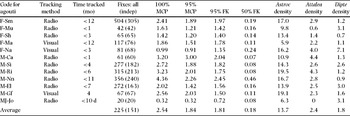
Home-range characteristics for 12 agoutis (Dasyprocta punctata). The sex of the agouti is indicated at the start of the individual code (F: female, M: male). Fixes were judged independent (indep) if separated by > 30 min. Home-ranges sizes (ha) based on the Minimum Convex Polygon (MCP 100%), 95% MCP, Fixed Kernel 95% (FK) method, and core area size (FK 50%). The juvenile agouti MJ-jo is not included in summary statistics due to its small data size (< 10 d of tracking). Food tree density is number of trees ha−1 of 100% MCP. Astroc = Astrocaryum standleyanum, Attalea = Attalea butyracea, Dipte = Dipteryx panamensis.

No agoutis were injured during capture and most showed no adverse effects from capture or collaring; one animal did get its front leg stuck under the collar but was able to remove it on its own without any other consequences. The collar of male M-Nn captured in March stopped functioning between September and October; however, we continued to track this agouti using visual sightings, which was facilitated by his association with the radio-collared female F-Sm. Only two collared animals, a male (M-Elo) and a female (F-SM), were still alive at the end of the study (7 and 13 mo, respectively, after their captures), and an ear-tagged female (F-Ma) near the laboratory was still alive as of June 2007. A total of 2178 locations were recorded for all agoutis. Four of the radio-collared agoutis were killed by ocelots in the dry season (Aliaga-Rossel et al. Reference ALIAGA-ROSSEL, MORENO, KAYS and GIACALONE2006); thus seasonal comparisons of home ranges are made with data for only four agoutis, the first such comparison for this species.
Estimates of home range and core area
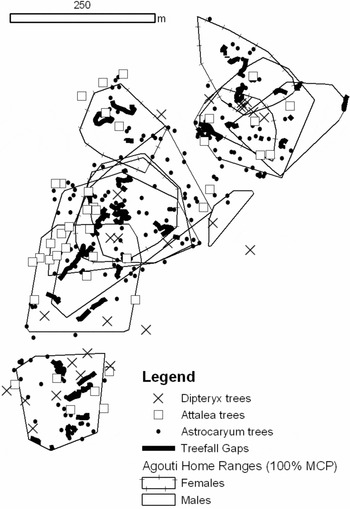
Home-range size for all agoutis using MCP (100% of locations, Figure 1) ranged from 0.99–4.36 ha (mean ± SE = 2.56 ± 0.29, n = 11); from 2.02–4.36 ha (mean ± SE = 3.02 ± 0.33, n = 6) for males, and 0.99–2.41 ha (mean ± SE = 1.66 ± 0.23, n = 5) for females (Table 1). Fixed-kernel range-size at 95% ranged from 1.56–2.45 ha (mean ± SE = 1.86 ± 0.17, n = 6) for males and 1.34–1.97 ha (mean ± SE = 1.58 ± 0.13, n = 5) for females. Male ranges were almost twice as large as female agouti home ranges (using MCP 100% contour line), but were only marginally statistically different using the fixed-kernel method set at the 95% level (t-test t = 0.09, df = 9, P > 0.05).
Home range (100% Minimum Convex Polygon) of the agouti (Dasyprocta punctata) on Barro Colorado Island, Panama, Central America.

The greatest number of locations (n = 504) was for the female agouti F-Sm, with locations recorded from 30 January to 28 December 2003. This individual's home-range size of 2.40 ha (MCP), and 1.97 ha (Fk95%) was the largest of any female studied, however home-range size did not increase substantially after 1 mo of tracking.
All home ranges had one or two high-use areas, usually situated in the centre of the range. The fixed-kernel 50% estimate for the core areas ranged 0.07–0.46 ha (average = 0.165, SE = 0.033, n = 11) and included 17–47% of all fixes. Core areas always included main refuges of climber thickets as indicated by Samuel et al. (Reference SAMUEL, PIERCE and GARTON1985).
There was a high degree of overlap between agouti home ranges. This included overlap between marked (Figure 1) and unmarked individuals that were residents of the area. For radio-collared animals this overlap was 20% to 57% among females; and 37% to 91% for males. Adult males tolerated the presence of one or more females and juveniles (91% overlapped of an adult male range with a juvenile); although, they exhibited aggressive behaviour towards other adult males, that might prevent higher overlap.
Daily movement pattern
The mean daily movement distance by the agoutis followed throughout the day was 831 ± 215 m (n = 7), with 33.9% of their time being spent in their core areas. When individuals reached the edge of the home-range area they exhibited patrolling and marking behaviour. To estimate the area searched per day by an agouti we conservatively presumed that they could detect food within 5 m of their path, resulting in a single day average of 0.65 ha covered (0.40–0.85 ha).
Densities
Given an average male's home-range (100 MCP) size of 3.0 ha, and assuming an overlap between animals, we calculate that there are three adult agoutis per home range (a male and two females) (Figure 1). Using this information we calculate the adult density of agoutis in the study area at 100 km−2 (using fixed-kernell 95 a density of 161 km−2).
Habitat selection
The palm Astrocaryum standleyanum was very common in the study area, averaging 13.7 ha−1 within agouti home ranges (Table 1). Thus, radio-tracked animals had access to a large number of A. standleyanum trees (average: 36, range: 16–73) within their home range but fewer A. butyracea or D. panamensis trees. The densities of A. butyracea trees did not vary across the different agouti home ranges (correlation between number of trees and territory area, r2 = 0.97, P < 0.001), while the densities of A. standleyanum and D. panamensis were variable across agouti territories (correlation between number of trees and territory area, not significant).
Comparing the density of food tree species in the core home range area with the non-core home range area, there was no significant difference for A. standleyanum in the core area (16.4 ha−1 versus 9.4 ha−1; t = 1.9, df = 11, P = 0.08), and neither for the other two tree species (D. panamensis 2.1 ha−1 vs. 1.8 ha−1, t = –0.24, df = 11, P > 0.1; A. butyracea 2.6 ha−1 versus 2.2 ha−1, t = –0.33, df = 11, P > 0.1). All core areas contained an individual major sleeping and resting sites.
DISCUSSION
We observed significant overlap in home-range areas for neighbouring individuals. In contrast, Smythe (Reference SMYTHE1978) who also worked at BCI, found that Dasyprocta punctata maintained areas of exclusive use, as did Silvius & Fragoso (Reference SILVIUS and FRAGOSO2003) for the agouti D. leporina in Brazil. Note however that in the latter study the radio-tracked individuals were captured in areas far from one another and so were unlikely to have overlapped.
Home-range size and density
The agouti ranges in our study were smaller (1–4 ha, MCP method) than reported for D. leporina in Brazil (3.5–9.0 ha, Jorge & Perez Reference JORGE and PEREZ2005, Silvius & Fragoso Reference SILVIUS and FRAGOSO2003), but similar to the 3.9 ha reported for a single female D. punctata in Costa Rica (Rodriguez & Vaughan Reference RODRIGUEZ and VAUGHAN1985). A previous study on BCI reported slightly smaller home ranges (1–1.5 ha) than we found (Smythe Reference SMYTHE1978), which might be expected as these were calculated from mark-resight data and not radio-telemetry fixes.
The differences in space use and density between our study and those of D. leporina could be due to differences in body size, patterns of food availability, or predation. Dasyprocta leporina in Brazil is 30% larger (average 4.45 kg) than D. punctata (average 3.47 kg) (Aliaga-Rossel Reference ALIAGA-ROSSEL2004, Eisenberg Reference EISENBERG1989, Silvius Reference SILVIUS1999, Smythe Reference SMYTHE1978, Smythe et al. Reference SMYTHE, GLANZ, LEIGH, Leigh, Rand and Windsor1996), which might at least partly explain their more extensive spatial use, independent of other ecological differences between the sites (Jetz et al. Reference JETZ, CARBONE, FULFORD and BROWN2004). We do not believe that low predation risk on BCI explains these differences in home-range sizes, as studies at BCI of both D. punctata and local predators suggest intensive predation; for example, our agouti population experienced a 0.69 annual mortality from predation (Aliaga-Rossel Reference ALIAGA-ROSSEL2004, Aliaga-Rossel et al. Reference ALIAGA-ROSSEL, MORENO, KAYS and GIACALONE2006). Furthermore, BCI agoutis made up 28.4% of puma diet and 22% of ocelot diet in the 4 y preceding this study (Moreno et al. Reference MORENO, KAYS and SAMUDIO2006). Predators apparently regularly cross the 200-m distance between BCI and the National Parks on the mainland (IBID), eliminating any potential for an ‘island effect’ influencing our results (Moreno et al. Reference MORENO, KAYS and SAMUDIO2006).
A higher abundance of food, or differences in the spatial distribution of food, may offer another explanation for the higher agouti density observed on BCI. Unfortunately, data are not available to compare across these studies. Although other competitors for food are present (Agouti paca, Peccari tajacu, Sciurus granatensis), one major food competitor, the white-lipped peccary (Tayassu peccari), is absent from BCI but present in the Brazilian sites where agouti space use has been studied (Fragoso Reference FRAGOSO1999, Jorge & Perez Reference JORGE and PEREZ2005, Silvius & Fragoso Reference SILVIUS and FRAGOSO2003). Regardless of type of fruit crops produced or their amount, this difference in the potential competitor community may result in more available food at BCI, leading to smaller agouti home ranges and higher densities. Seasonality of food could also affect home-range size and sociality, with larger home ranges needed to adapt to highly seasonal food availability, and possibly allowing for more social activity (i.e. Resource Dispersion Hypothesis, Carr & Macdonald Reference CARR and MACDONALD1986, Johnson et al. Reference JOHNSON, KAYS, BLACKWELL and MACDONALD2002).
Likewise, our agouti density estimated from these home ranges (100 km−2 using MCP, 161 km−2 using Fk95) is higher than those reported from other areas (c. 40 ind km−2 in Brazil, Jorge & Perez Reference JORGE and PEREZ2005, Silvius & Fragoso Reference SILVIUS and FRAGOSO2003; 5.2 ind km−2 in Peru, Janson & Emmons Reference JANSON, EMMONS and Gentry1990). Two previous estimates of agouti density on BCI calculated from mark-resight data (Smythe Reference SMYTHE1978) and transect surveys (Wright et al. Reference WRIGHT, GOMPPER and DE LEON1994) found similar, although lower values (84 ind km−2) than our study. It is unclear if this relative density difference represents a steady increase in agouti density over time, three snapshots of a naturally fluctuating population, differences in methodology, or variation across sites within BCI.
Female agoutis on BCI used slightly smaller home ranges than males, a result also found by Silvius & Fragoso (Reference SILVIUS and FRAGOSO2003) and suggested by Smythe (Reference SMYTHE1978) for BCI. However, Jorge & Perez (Reference JORGE and PEREZ2005) reported no sexual differences in home-range size for D. leporina. Larger male ranges are common among many mammal species, particularly in polygamous species (Eisenberg Reference EISENBERG1989), where males seek to increase the number of potential mates they encounter. Our results on home-range overlap and size suggest that on BCI agoutis may exhibit a polygamous mating system, as suggested by Eisenberg (Reference EISENBERG1989), rather than the strict monogamous system suggested by Smythe (Reference SMYTHE1978). Furthermore, agoutis in areas of high home-range overlap tended to exhibit higher tolerance levels between home-range co-inhabitants, although every encounter observed between males resulted in aggressive behaviour and the chasing of the intruder out of the home area. Individuals with relatively large home-range areas may have greater difficulty detecting intruding animals, especially in complex forest environments with limited visibility. This would potentially decrease aggressive encounters between individuals and permit some overlap in home-range areas (Aliaga-Rossel Reference ALIAGA-ROSSEL2004).
Determinants of space use
The use of space by D. punctata represents its adaptation to the pressures of finding food, avoiding predators, and reproducing. Because our study site was relatively uniform in habitat type, we focused on specific habitat features relative to these pressures by mapping all possible major food trees and potential anti-predator refuges (dens and tree-fall gaps). Smythe (Reference SMYTHE1978) suggested that agoutis centre their home- ranges on important fruit trees, and our quantitative analysis found support for that in higher densities of one of their preferred foods, A. standleyanum, in core areas. In addition major sleeping and refugee sites were all located close to or within core areas, suggesting that agoutis are central-place foragers around the distribution of refuges. These refuges probably function primarily to avoid predation as suggested by Smythe (Reference SMYTHE1978). The tree species included in our habitat analysis are key landscape elements for D. punctata as noted by Smythe et al. (Reference SMYTHE, GLANZ, LEIGH, Leigh, Rand and Windsor1996) and Glanz et al. (Reference GLANZ, THORINGTON, GIACALONE, HEANEY, Leigh, Rand and Windsor1996).
Implications for seed movement
We found that an agouti searches roughly 35% of their total home range each day suggesting that agoutis probably encounter most fallen fruit in their home range within 1–3 d. Given their attachment to refuges, we predict that most cached seeds are moved towards their refuges (burrows in the ground and dense vegetation thickets; Aliaga- Rossel Reference ALIAGA-ROSSEL2004). Given their 1–4 ha range size, the total distance that seeds are likely to be moved before caching could be no greater than a home range diameter (140 m to 200 m) and most likely less than half of this.
ACKNOWLEDGEMENTS
We thank Kirsten Silvius, Martin Wikelski, Allan Drew and Dudley Raynal for their comments on initial drafts of this manuscript. Thanks to Ricardo S. Moreno, Paula Capece, Vilma Fernandez, Eloisa Lasso, Jason Isabelle and Lindsay Cray for assistance in the field. Thanks to Dr Egbert Leigh Jr. for his advice and help in the field, and to all the crew of the Smithsonian Tropical Research Institute, Panama. Enzo, thanks the Fulbright/LASPAU/OAS program, and STRI's Automatic Radio Tracking system (ARTS) project for financial support. Thanks to Judy Kays, Tamara McGuire and the three anonymous reviewers for their comments to the manuscript.