


INTRODUCTION
Many marine invertebrates with planktonic larval stages exhibit selectivity during settlement on a surface (Keough, Reference Keough1998; Jeffery, Reference Jeffery2002). Substratum selection represents a critical behaviour during settlement because the right choice can have a significant impact on their fitness (Herbert & Hawkins, Reference Herbert and Hawkins2006; Pardo et al., Reference Pardo, Palma, Prieto, Sepulveda, Valdivia and Ojeda2007). Settlement of marine larvae is generally influenced by a wide range of factors like physical, chemical and biological cues (Pawlik, Reference Pawlik1992; Bers & Wahl, Reference Bers and Wahl2004; Faimali et al., Reference Faimali, Garaventa, Terlizzi, Chiantore and Catteneo-Vietti2004). Physical cues such as light, gravity, surface orientation and colour may be important for the recruitment of benthic larval forms on a surface (James & Underwood, Reference James and Underwood1994; Rittschof et al., Reference Rittschof, Forward, Cannon, Welch, McClary, Holm, Clare, Conova, McKelvey, Bryan and Van Dover1998; Taylor et al., Reference Taylor, Southgate and Rose1998; Su et al., Reference Su, Huang, Yan and Li2007).
Shaded and dark coloured surfaces attract more marine larvae than well-illuminated and light coloured surfaces (Dahlem et al., Reference Dahlem, Moran and Grant1984). While shade is the partial darkness due to the interception of light rays, colour is defined as a visual attribute of objects that results from the light they emit or transmit or reflect. The influence of the colour of a substratum on the recruitment of a fouling community was initially observed by Visscher (Reference Visscher1928). According to Bakus (Reference Bakus, Thompson, Nagabushanam and Sarojini1988), test panel colour seems to be more important for settling larvae than panel position. Similarly, Swain et al. (Reference Swain, Herpe, Ralston and Tribou2006) emphasized the importance of considering colour of the paint along with other factors when undertaking short-term testing of antifouling coatings.
Understanding the role of the physical and chemical properties of a substratum on the settlement of a fouling community is fundamental in terms of optimizing the performance of coatings designed to reduce biofouling. Extensive research has been carried out on the physical, chemical and biological characteristics of surfaces that promote or prevent fouling (Yule & Walker, Reference Yule and Walker1984; Holmes et al., Reference Holmes, Sturgess and Davies1997; Callow & Callow, Reference Callow and Callow2000). However, compared to the other factors affecting the settlement of benthic organisms on hard substrata, colour has received relatively little attention and only a few experimental studies have been done on this aspect. Studies on the reaction of the larval forms of the fouling organisms to colour will be of commercial value in determining the colours of antifouling paints for testing (Daniel, Reference Daniel1963). Hence, in the present study, an attempt has been made to observe the recruitment of the fouling community on different coloured substrata. The main objective of this study was to investigate whether differences in surface colour influence the recruitment of a macrofouling community.
MATERIALS AND METHODS
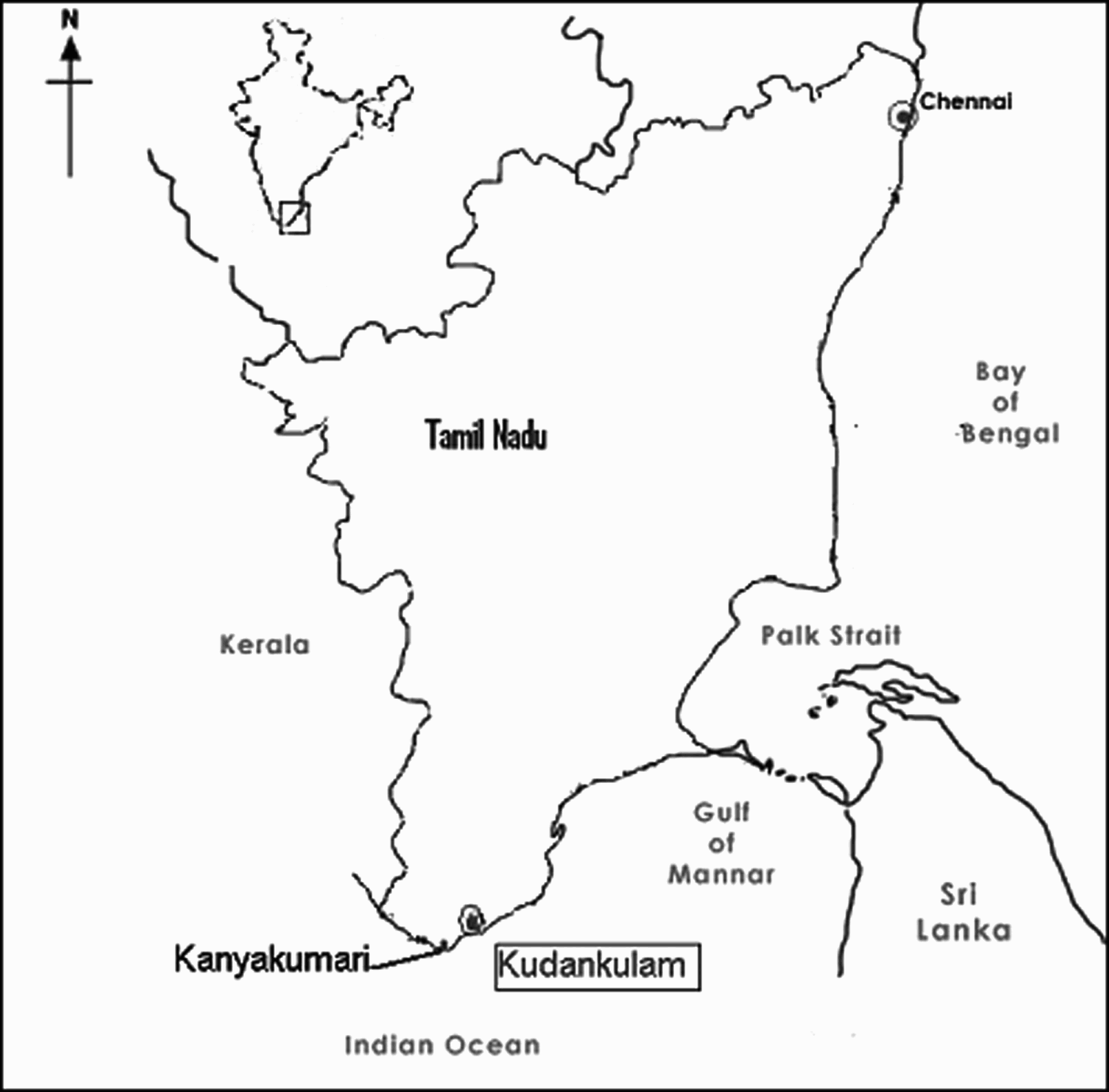
The study was carried out at Kudankulam (8°9′N and 77°39′E) on the east coast of India. Kudankulam is located in the distal end of the Gulf of Mannar (Figure 1). Seasons at Kudankulam can be classified into pre-monsoon (June–September), monsoon (October–January) and post-monsoon (February–May). The wind direction is north–north-easterly from June to December and changes to westerly during the rest of the period. The seabed is sandy with soft substrata and few rocky reefs.
Map showing the study area.
Acrylic sheets were used as test panels (10 × 10 × 0.3 cm) for the present study. Commercially available red, green, blue, white and yellow coloured acrylic sheets were used for panel preparation. The panels were fixed onto a wooden raft in vertical position in such a way so as to keep a 10 cm distance between panels. The raft was submerged in the coastal waters at 1 m depth from the mean sea level on a short-term basis (15 days' duration). For the evaluation of temporal variability, the investigation was carried out over a period of five months from February to June 2005. The panels (in replicate, N = 6, same raft) were retrieved after 15 days of submersion and preserved in 5% neutral formalin for further analysis. The test panels were analysed for the total biomass (dry weight), species composition and abundance of the fouling community. The total biomass of the fouling community was estimated after carefully scraping the fouling organisms into a Petri plate and weighing them in a balance. The dry weight of the entire fouling assemblage from the panels was noted by drying them at 60°C to constant weight and expressed as g.dm−2.
Barnacles and tubeworms were counted manually after separating them into different species or groups. The abundance of colonial fouling organisms was estimated using the random point sampling technique (Nandakumar, Reference Nandakumar and Subramoniam1998) and expressed as percentage of coverage on test panels. For this purpose, a quadrat of the same size as the panel was marked with points at 1 cm intervals on a transparency sheet. This sheet was laid over the panel and the area covered by colonial forms within 10 randomly chosen 1 cm2 quadrats on the test panel was recorded. The results were presented for a submersion period of 15 days on a monthly basis (i.e. mean ± SD of 6 × 2 = 12 panels for each month) in order to analyse the temporal variability (relation to submersion month).
To test the variability of fouling community recruitment between different coloured substrata, the data were analysed by two-way ANOVA using MS-Excel. Colour and month were considered as two independent factors for the ANOVA. The post-hoc Tukey test was also carried out between different colour treatments.
RESULTS
Results showed that the fouling community recruitment was considerably high on red and blue coloured panels. The total biomass of the fouling community showed significant variations between different coloured panels and also between months (two-way ANOVA; Table 1). The biomass (dry weight) values varied between 0.201 ± 0.03 and 2.9 ± 0.25 g.dm−2 on red coloured panels. The biomass values ranged between 0.375 ± 0.06 and 3.37 ± 0.21 g.dm−2 on blue and 0.104 ± 0.008 and 1.52 ± 0.07 g.dm−2 on green coloured panels. On white coloured panels, the total biomass of the fouling community varied between 0.226 ± 0.036 and 1.36 ± 0.11 g.dm−2. Yellow coloured panels showed a biomass value between 0.194 ± 0.006 and 1.21 ± 0.11 g.dm−2 during the study (Figure 2). Biomass values were high during the month of May on all panels except the green ones. Green coloured panels showed the maximum value during June. Generally, the total biomass values were very low during February on all the panels. The post-hoc Tukey test indicated that the biomass of the fouling community on blue coloured panels significantly varied from yellow and green ones (Table 2). The biomass of the fouling community that settled on red coloured panels also varied significantly from yellow and green coloured panels. Comparisons of other colour treatments did not show significant variations (Table 2).
Total biomass of the fouling community recruited on different coloured acrylic panels (mean ± SD, N = 12).

Two-way ANOVA (analysis of variance) of fouling community recruitment on different coloured acrylic panels (colour and month as factors).

*, significant at 5% level.
Post-hoc Tukey test of total fouling biomass on different coloured panels.

*, P < 0.05.
Barnacles, tubeworms, colonial ascidians and errant forms like polychaetes and amphipods were the common foulers that recruited on the panels. Of these, the recruitment patterns of barnacles, tubeworms and ascidians were considered in detail. Among the barnacles, Amphibalanus amphitrite (=Balanus amphitrite) was the dominant species that recruited on the panels. Barnacle recruitment was high on red and blue coloured panels and low on white and yellow panels. The abundance of Amphibalanus amphitrite on red coloured panels varied between 32 ± 3 (February) and 378 ± 20 no.dm−2 (May). On blue coloured panels, the number of barnacles varied from 10.5 ± 2.1 (March) to 532 ± 95 no.dm−2 (April). On green panels, barnacle abundance ranged between 15 ± 0.4 (February) and 142 ± 13 no.dm−2 (May). The density of barnacles on white and yellow coloured panels showed a maximum of 53 ± 6 and 28 ± 3 no.dm−2 respectively (Figure 3) during May. Barnacle recruitment was high during April and May and low during February. Statistical analysis of barnacle recruitment indicated a significant variation among the different coloured surfaces and also between months (Table 1). The Tukey test showed that the recruitment of barnacles on red coloured panels significantly differed from white and yellow coloured panels (Table 3). Barnacle recruitment on blue coloured panels also varied significantly from that on green, white and yellow coloured panels.
Recruitment pattern of Amphibalanus amphitrite (=Balanus amphitrite) on different coloured acrylic panels (mean ± SD, N = 12).

Comparison of Amphibalanus amphitrite (=Balanus amphitrite) recruitment on different coloured panels (post-hoc Tukey test).

*, P < 0.05.
The tubeworms recruited on the panels mainly belonged to the family Sabellariidae. The abundance of sabellariids was high on red and low on yellow coloured panels. On red coloured panels, the number of recruits varied between 7 ± 1 (March) and 14 ± 1.4 no.dm−2 (May). The abundance of sabellariids on yellow coloured panels ranged from 2 ± 0.3 (February) to 8 ± 0.7 no.dm−2 (May). The number of sabellariids recruited on white coloured panels varied from 2 ± 0.2 (February) to 8 ± 0.7 no.dm−2 (April) and on blue coloured panels, the number of individuals varied from 9 ± 0.8 to 12 ± 0.9 no.dm−2 (March). On green coloured panels, a maximum of 8 ± 1 no.dm−2 was observed during May and a minimum of 3 ± 0.5 no.dm−2 in February (Figure 4). Two-way ANOVA showed a significant variation in tubeworm recruitment between different coloured panels and also between panel submersion months (Table 1). The post-hoc Tukey test indicated that tubeworm recruitment on red colour panels varied significantly from green, white and yellow coloured ones (Table 4). Similarly, sabellariid recruitment on blue coloured panels showed significant variation from green, white and yellow coloured panels.
Recruitment pattern of tubeworms (sabellariids) on different coloured acrylic panels (mean ± SD, N = 12).

Comparison of sabellariid recruitment on different coloured panels (post-hoc Tukey test).

*, P < 0.05.
Ascidians belonging to the genus Didemnum were the dominant colonial forms recruited on the test panels. The colonial ascidians' recruitment on red coloured panels varied from 12 ± 1.7 (June) to 80.5 ± 3.5% (February). On blue coloured panels, ascidian coverage ranged between 11.15 ± 1.3 (June) and 68 ± 4.8% (February). On white coloured panels, a maximum coverage of 49 ± 5.6% was observed during February and a minimum of 13 ± 2.8% was observed in June. The recruitment of ascidians on yellow coloured panels varied between 9 ± 2 (June) and 38 ± 2.8% (February). Ascidian coverage on green coloured panels ranged from 7 ± 0.9 (June) to 38.5 ± 4.9% (February). In general, ascidian recruitment was high on red and blue coloured panels and low on yellow and green coloured panels. Peak recruitment was observed during February and it was very low during June on all the panels (Figure 5). Two-way ANOVA revealed a significant variation in ascidian recruitment between different coloured panels and also among the months (Table 1). However, the post-hoc Tukey test did not show any significant variation between colour treatments (Table 5).
Recruitment of colonial ascidians (Didemnum spp.) on different coloured acrylic panels (mean ± SD, N = 12).

Comparison of ascidian recruitment on different coloured panels (post-hoc Tukey test).

DISCUSSION
In the present study, the variations found in the recruitment of the fouling organisms between different coloured panels indicated that surface colour has some influence on recruitment. Fouling community recruitment on blue and red coloured panels was significantly different from green, white or yellow coloured ones. However, no significant effect was observed between blue and red or white, green and yellow coloured panels. The reaction of larval forms to colour may be due to a complex of factors involving the quantities of radiant energy absorbed or reflected (Daniel, Reference Daniel1963). The higher recruitment of invertebrates on red, blue and black surfaces may be due to the preference of larvae for darker, deep colour and less reflective substratum (Su et al., Reference Su, Huang, Yan and Li2007). For example, the barnacle, Amphibalanus amphitrite preferentially recruited on red or blue coloured panels. It is possible that they may prefer to settle on surfaces that do not reflect much light (e.g. dark colours).
The cypris larvae of barnacles are positively phototropic during the early stages and are most sensitive to green light (Visscher & Luce, Reference Visscher and Luce1928). But at the time of attachment they are negative to light and tend to move to darker areas (McDougall, Reference McDougall1943). Yule & Walker (Reference Yule and Walker1984) also reported that the tenacity of cyprids was much greater on darker coloured surfaces. The Tukey test revealed that the magnitude of ascidian recruitment between different coloured panels was not significant. This indicates that the factors responsible for settlement and recruitment vary between species, as they may have different requirements and respond to specific cues (Crisp, Reference Crisp, Grant and Mackie1974; Raimondi, Reference Raimondi1988).
Similar to barnacles, tubeworm recruitment was also high on red and blue coloured panels. The preference of some benthic groups for darker coloured surfaces has previously been demonstrated in a number of studies. Swain et al. (Reference Swain, Herpe, Ralston and Tribou2006) observed higher settlement rate of the seaweed Ulva sp. and tubeworm Spirorbis sp. on black surfaces. Saucedo et al. (Reference Saucedo, Bervera-Leon, Monteforte-Sanchez, Southgate and Monsalvo-Spencer2005) observed that the larvae of the pearl oyster Pinctada mazatlanica (Hanley) recruited more on the red/black colour combination collector than that on green coloured ones. Su et al. (Reference Su, Huang, Yan and Li2007) also reported that red and blue colour plastic sheets attracted significantly more larvae of the pearl oyster Pinctada martensii than green and yellow coloured sheets. Furthermore, Daniel (Reference Daniel1963), while studying the factors influencing the recruitment of fouling organisms at the Madras coast (east coast of India), observed that red and black coloured surfaces attracted cyprids in larger numbers than green and grey coloured panels.
The results also showed considerable temporal variability in fouling community recruitment during the study period. Temporal variability in fouling community abundance has been mainly linked with larval availability (Pineda, Reference Pineda1994), wind-driven currents (Hawkins & Hartnoll, Reference Hawkins and Hartnoll1982) and internal waves (Shanks, Reference Shanks1983). Since the panels were submerged mainly during the post-monsoon season, it is not clear whether the same results could be obtained if the experiments were carried out during pre-monsoon and monsoon seasons. But the number of replicates both within each submersion period and over a temporal scale in the present study provides sufficient data to explain the variability of fouling community recruitment among different coloured surfaces.
In general, the present study demonstrates that the recruitment of fouling communities on artificial substrata is greatly affected by substratum colour. Furthermore, it should be noted that marine invertebrate larvae contacting a substratum during exploration of potential habitats for settling are exposed to chemical and physical cues derived from surface-associated microorganisms (O'Connor & Richardson, Reference O'Connor and Richardson1996). It should also be noted that the link between the colour of the surface and viable cell numbers (biofilm community) in a surface has been established by Pitts et al. (Reference Pitts, Hamilton, McFeters, Stewart, Willse and Zelver1998). Hence, more studies related to the formation of biofilms on different coloured surfaces may improve our understanding in this field. The present study showed that the colour of the substrata should be taken into consideration along with other factors when interpreting results from short-term biofouling studies (ecological studies to test various hypotheses or antifouling trials). For practical reasons, the colour of the substratum used for biofouling studies should be kept as similar as possible. The results also suggested that light coloured surfaces would be preferable for marine applications. Further studies on the development of micro- and macrofouling communities on different coloured surfaces from other regions are also necessary to ascertain the influence of surface colour on biofouling.
ACKNOWLEDGEMENTS
We thank the Ministry of Earth Sciences, Government of India for providing financial assistance. We also thank two anonymous referees for their valuable comments.



