1 Introduction
The usual development of Old English (OE) (e)ald in words such as ‘old’ in Scots is to auld (i.e. [ɑːld]~[ɔːld]) via Older Scots (OSc) [aʊld], reflecting the development of this sequence in northern dialects generally (Luick Reference Luick1940: 603; Orton et al. Reference Orton, Sanderson and Widdowson1978: Ph132-3; see also figure 3 in this article). But in some Scots dialects other pronunciations of these words, reminiscent of dialects of English south of the Ribble–Humber Line, are found. These forms, of the type owld (e.g. [ʌuld]), are found in various parts of Lowland Scotland, with particular concentrations in the far north and southwest. Origins in Irish English and possibly English in England have been suggested for this feature of Scots (Johnston Reference Johnston and Jones1997b: 488–9; Macafee Reference Macafee, Kirk and Dónall2001: 125) but these hypotheses have not been explored, and the most detailed account of the historical phonology of Scots, Aitken & Macafee (Reference Aitken and Macafee2002: 61–2), instead argues for an endogenous origin of both auld and owld. This proposed double endogenous development of OE (e)ald is problematic in a number of ways. Firstly, it requires an unmotivated split in the development of this sequence. Secondly, it fails to explain the geographical patterning of owld in Scots dialects, which is suggestive of other explanations. Thirdly, it ignores the occurrence of similar forms in northern English dialects which closely mirror the development of this vowel in the Midlands and south of England and which have been assumed to represent exogenous changes in these dialects (Orton Reference Orton1933: 20; Hedevind Reference Hedevind1967: 127).
In this article, I examine the history of these developments in Scots in comparison to their development in dialects of English in England. The lack of evidence for the owld development in OSc, as revealed for example in the From Inglis to Scots (FITS) database (Alcorn et al. Reference Alcorn, Karaiskos, Kopaczyk, Los, Maguire and Molineauxforthcoming), suggests that these forms are of relatively recent origin (whereas the auld forms are recorded throughout the history of Scots). Crucially, seventeenth- and eighteenth-century sources for the pronunciation of Standard English, including the Eighteenth-Century English Phonology Database (ECEP Reference Beal, Sen, Yáñez-Bouza and Wallis2015; see also Beal et al. Reference Beal, Sen, Yáñez-Bouza and Wallis2020), reveal that the owld pronunciations were in fact a feature of some early forms of Standard English, and their existence in Irish English suggests that they were once widespread. Furthermore, several characteristic features of Irish English have spread into southwest Scotland (Maguire Reference Maguire and Hickey2012), and the distribution of owld forms in the area fits this pattern.
Thus, I argue, Scots owld forms are not the result of an endogenous development, but have their origin in English; in the case of southwest Scotland at least in part from Irish English, and there and elsewhere in Scotland from early forms of Standard English. How is it, then, that these forms of English origin are, on the one hand, found in Scots, but, on the other, do not exist in modern Scottish Standard English (SSE)? The answers to these questions are, I suggest, related. owld forms were once a feature of SSE, but have been replaced by the usual goat vowelFootnote 1 in these words (e.g. [oːld]), characteristic of other forms of Standard English in England and elsewhere. The result of this change is that owld has been reinterpreted in Scotland as ‘not Standard’, and thus has become localised as a ‘Scots’ variant in a range of dialects, alongside or replacing original auld.
This article is structured as follows. In section 2, I outline the ‘standard’ account of the development of the vowel in words like ‘old’ in English and Scots. In section 3, I discuss owld forms of words like ‘old’ in Scots and possible explanations for their origin. In section 4, I explore exogenous origins of owld forms of ‘old’ in Early Modern English (EModE), and in section 5 I suggest a way in which these became established in dialects of Scots. In section 6, I summarise the findings of this article, highlighting the role of contact with varieties of English in the development of Scots, and noting the importance of sources such as the FITS and ECEP databases for understanding the historical phonology of Scots and English.
2 The ‘standard’ account of the development of OE (e)ald
In order to understand the origins of owld pronunciations in Scots dialects, it is necessary to outline the history of words with OE (e)ald (e.g. bold, cold, hold and old, in this article referred to as the ‘old’ set; cf. Johnston Reference Johnston and Jones1997b: 488). Throughout this article, I use forms of the word ‘old’ (e.g. (e)ald, auld, owld, old) to represent this group.
West Germanic *ɑ fronted to *æ in most environments (including before *lð) in the ancestor of OE (Ringe & Taylor Reference Ringe and Taylor2014: 146–8, 184), so that, for example, *ɑlðɑz ‘old’ became Pre-OE *æld. The Pre-OE sequence *ælC was subject to different developments in Anglian and Saxon dialects. In the Anglian dialects to the north, *æ before an l + C cluster was retracted to a, so that the Anglian OE form for ‘old’ was ald (Ringe & Taylor Reference Ringe and Taylor2014: 184). In the southern West Saxon and Kentish dialects, *æ instead broke to ea before an l + C cluster, giving eald (ibid.), though these forms were replaced by the Anglian ald type at an early date (Wyld Reference Wyld1927: 119).
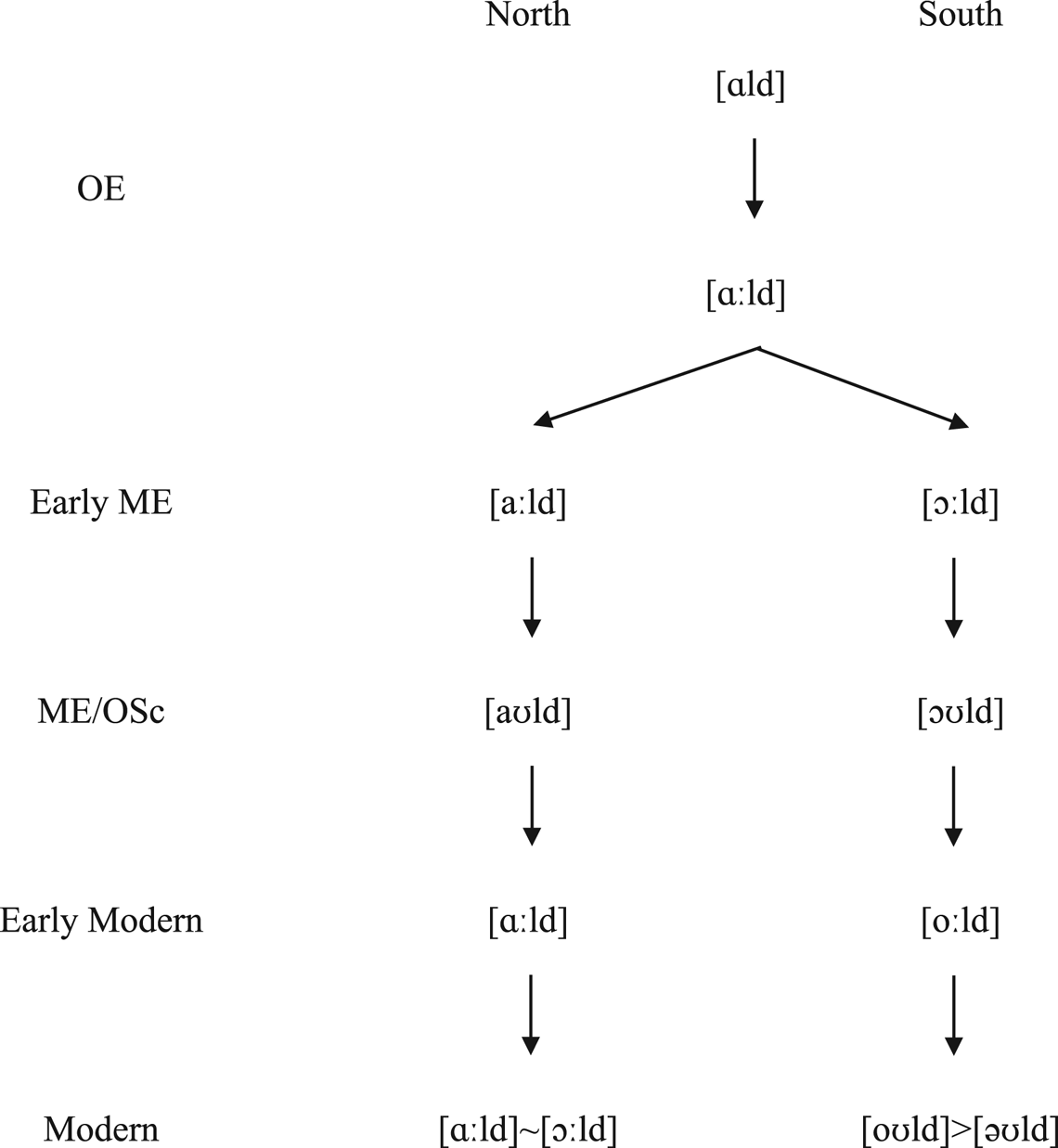
Given that the short vowel in words of this type occurred before a voiced coda cluster, it was subject to Homorganic Lengthening (Minkova Reference Minkova2014: 165–70) in the OE period of the same sort that created the long vowel in OE cild ‘child’ ([ʧild] > [ʧiːld], later > [ʧaɪld]). Thus ald became [ɑːld]. We know this change occurred from Middle English (ME) spelling evidence (Minkova Reference Minkova2014: 167) and from the subsequent development of the vowel. In the early ME period, one of the most well-known changes that separated dialects north and south of the Ribble–Humber Line took place: OE [ɑː] remained a low vowel and fronted to [aː] in the north, whilst it raised and rounded to [ɔː] in the Midlands and south (Lass Reference Lass and Blake1992: 46–7). This meant that words like ‘home’ (OE hām) and ‘stone’ (OE stān]) became [haːm] and [staːn] in the north and [hɔːm] and [stɔːn] in the south. The results of this change are visible in modern dialects of English and Scots, with Scots dialects and English dialects in the far north having unrounded front vowel reflexes in words of this type (e.g. [steːn], [stɪən]), contrasting with rounded back vowel developments (e.g. [stɔːn], [stəʊn]) in Midland and southern English dialects (see Wakelin Reference Wakelin1972: 89, 103; Anderson Reference Anderson1987: 112, 115). The same pattern holds for words like ‘old’, which became [aːld] in the north, but [ɔːld] in the south (as illustrated, additional changes aside, by the contrast between Scots auld and Standard English old).
The southern and Midland form [ɔːld] could itself, via the Great Vowel Shift (GVS; Lass Reference Lass and Lass2000: 72–85), give us the EModE form [oːld] that underlies Modern Standard English [əʊld] (Dobson Reference Dobson1957: 805–6, 809; Kökeritz Reference Kökeritz1953: 229–31). But in fact it seems that the vowels in both the northern [aːld] and southern [ɔːld] forms were subject to diphthongisation before the following coda /l/. This was part of a wider diphthongisation of pre-OSc and early ME low and back vowels before coda /l/. Typically this affected short /a/ and /ɔ/, the results being [aʊ] (e.g. ‘all’ [al] > [aʊl]), [ɔʊ] (e.g. ‘colt’ [kɔlt] > [kɔʊlt]), and, with further complications, short /ʊ/ (e.g. ‘shoulder’ [ʃʊldər] > [ʃʊʊldər], i.e. [ʃuːlder], which subsequently became [ʃɔʊldər]) (Luick Reference Luick1940: 603–10; Molineaux Ress et al. Reference Molineaux Ress, Kopaczyk, Maguire, Alcorn, Karaiskos, Los, Alcorn, Los, Kopaczyk and Benjamin2019). But the change also affected [ɔː] and [aː] before coda /ld/, though not before coda /l/ alone (e.g. in whole, which in the south remained [hoːl], in the north [haːl]). Thus we get the hypothetical change [aːld] > [aːʊld] in northern dialects, and the hypothetical change [ɔːld] > [ɔːʊld] in southern dialects. I say hypothetical here, since it appears to be the case that there was a constraint against diphthongs with long nuclei at this stage in the history of English and Scots. Lass (Reference Lass and Blake1992: 50) states that ‘The Middle English length system did not allow for diphthongal length contrasts of the Old English type, e.g. **/ɔ˘u/ vs /ɔu/, one behaving like a short vowel and the other like a long. Middle English allowed only monomoric (simple) and bimoric (two-piece complex) nuclei.’ Thus these sequences quickly or immediately became [aʊld] and [ɔʊld] in the north and south respectively.
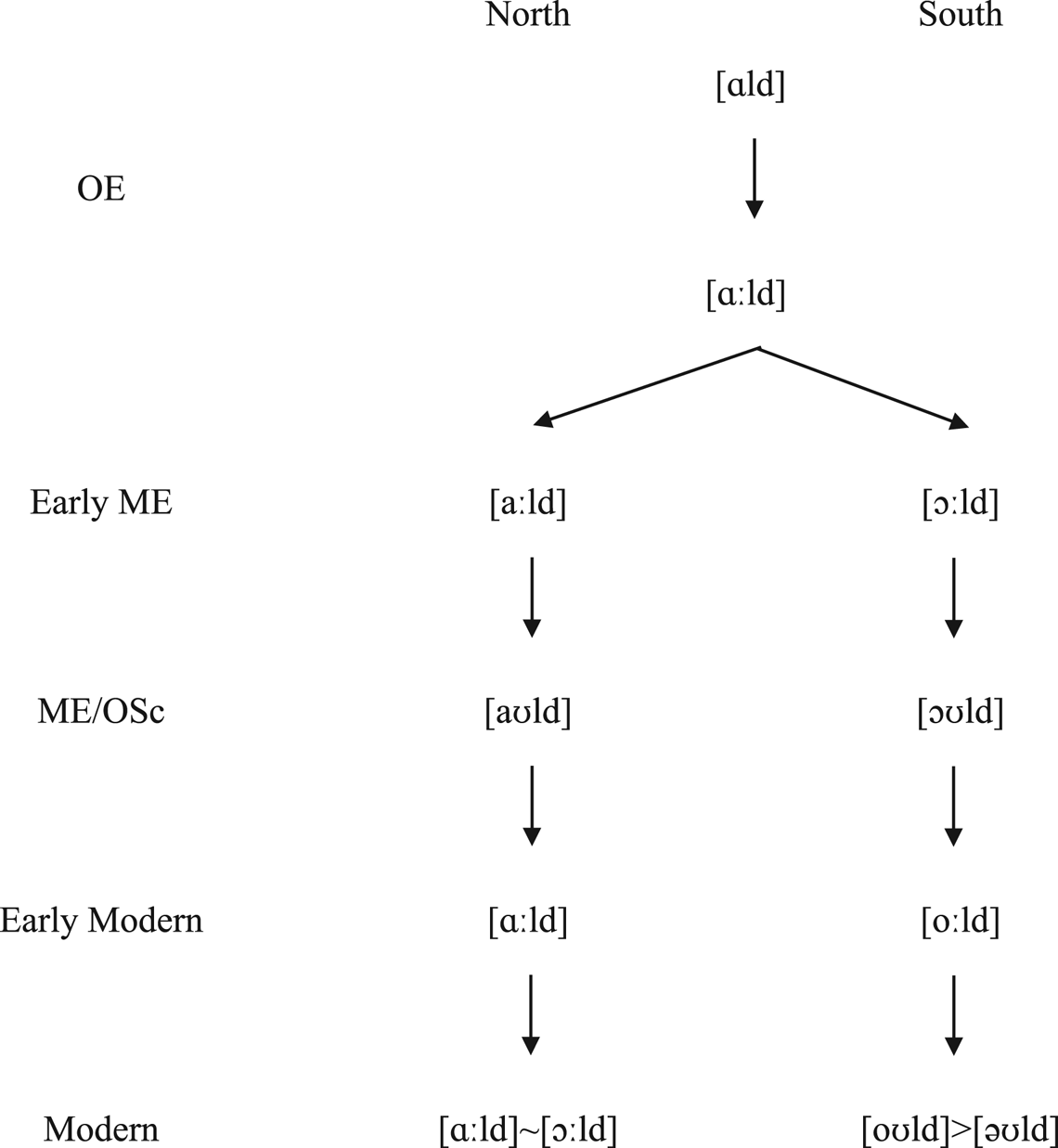
The Modern Scots (ModSc) [ɑːld]~[ɔːld] pronunciations derive from these OSc [aʊld] forms by the usual monophthongisation of the [aʊ] diphthong in the language and the lack of L-vocalisation before [d] after [aʊ] (Aitken & Macafee Reference Aitken and Macafee2002: 61–2; Johnston Reference Johnston and Jones1997a: 90). This lack of L-vocalisation was shared by some Cumbrian dialects, but most far northern English dialects had L-vocalisation in this environment too (Orton Reference Orton1933: 18–20). From the resulting northern ME form [aʊd] derive modern northern dialect forms such as [ɔːd] and [aːd], probably via [ɑːd]. The Scots equivalent of ‘hold’, haud, also lost [l], probably as a result of developments of weak, unstressed forms of the word rather than as an extension of this northern English change (Aitken & Macafee Reference Aitken and Macafee2002: 62; Johnston Reference Johnston and Jones1997a: 90). Modern Standard English [əʊld] does not derive directly from ME [ɔʊld], but rather results from a further monophthongisation of ME [ɔʊ] to [oː]. This change, not found in all modern dialects (see Anderson Reference Anderson1987: 130), resulted in merger with ME [ɔː], which had raised to EModE [oː], as noted above. This EModE [oː] vowel subsequently diphthongised in some southern English dialects (including the ancestor of RP English), so that the sequence of developments was ME [ɔʊld] > EModE [oːld] > pre-RP [oʊld] > RP [əʊld] (Dobson Reference Dobson1957: 581, 691). These and the Scots developments of auld are summarised in figure 1.
Developments of the old set in the north and the south
3 owld in Scots
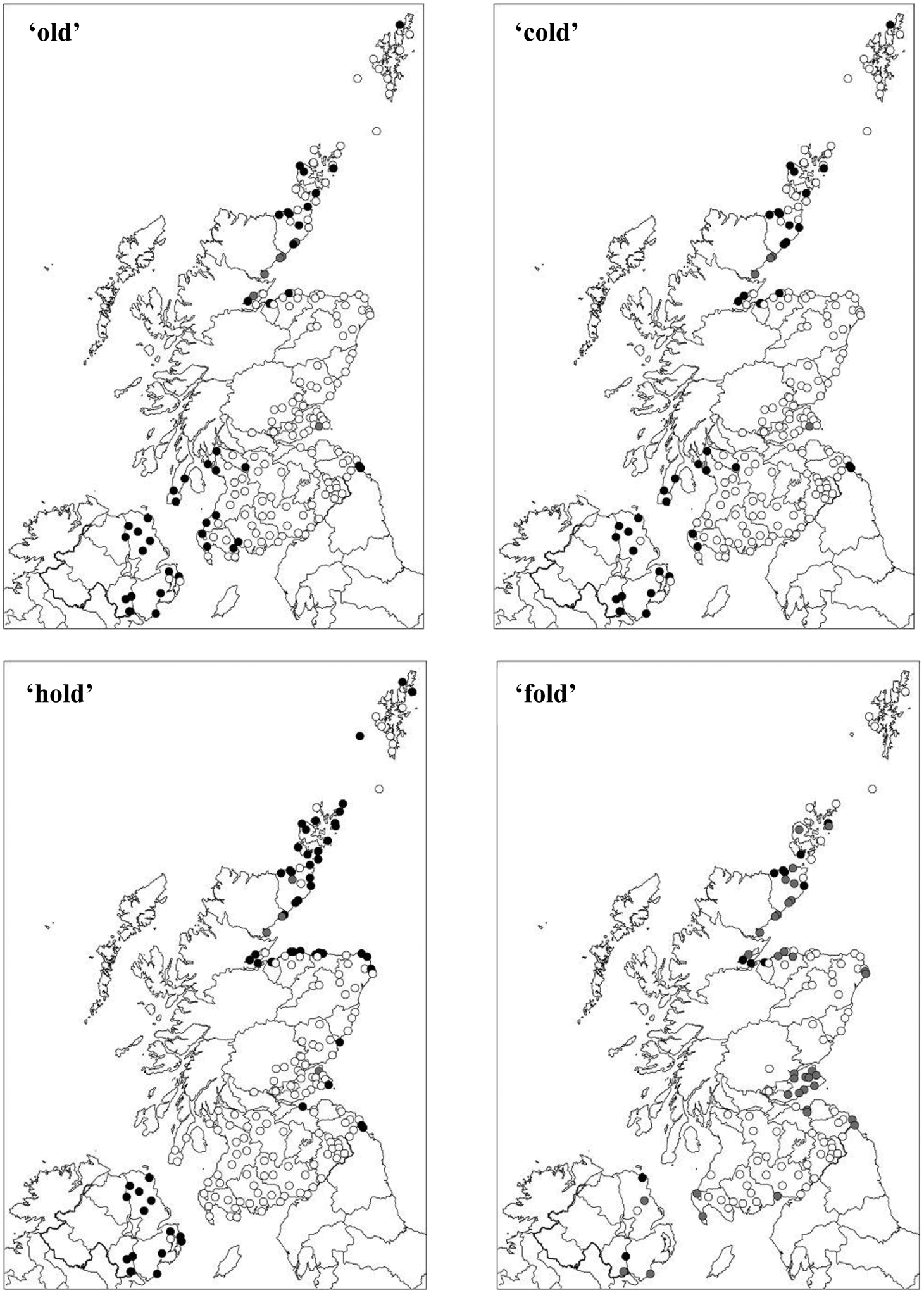
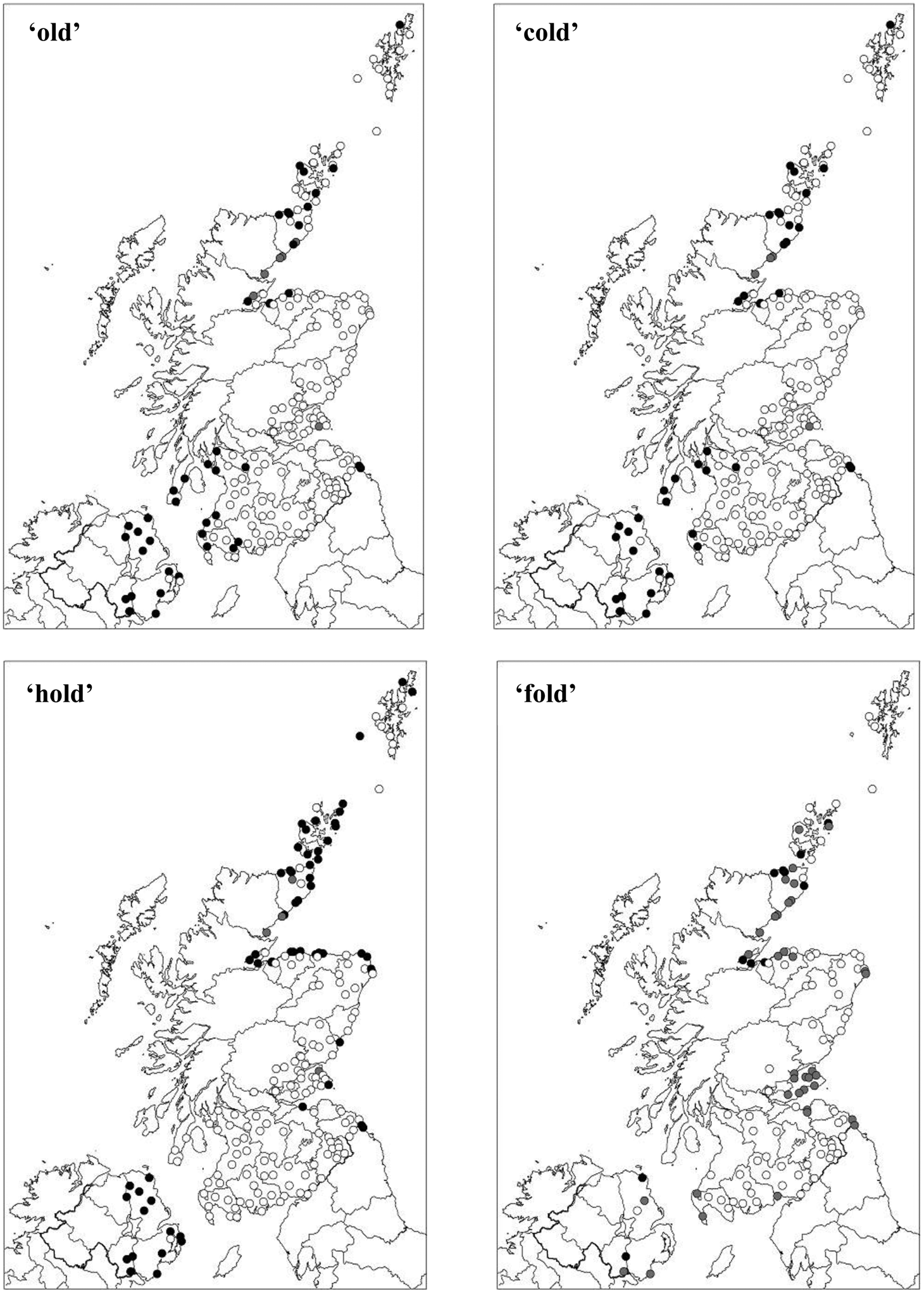
The ‘standard’ account thus explains the origins of auld in Scots and of forms such as [ɔːd] and [aːd] in northern England. But there are other forms of words in the old set in Scots which are not explained by the changes outlined in section 2. These forms are typically represented in writing with the spelling <owld> (or sometimes <ould>), indicating an [ʌu]-type diphthong in Scots, which is the usual reflex of OSc [ɔʊ], not of OSc [aʊ]. These pronunciations are most common in northern Scotland (especially from Orkney to Moray), and in southwest Scotland (see Johnston Reference Johnston and Jones1997b: 488–90 and Macafee Reference Macafee, Kirk and Dónall2001: 124–5), though an [ʌu]-type vowel in hold, alongside haud-type forms, is fairly widespread across Scotland (see figure 2).
Realisations of ‘old’, ‘cold’, ‘hold’ and ‘fold’ as documented in LAS3a
The ‘standard’ account does not explain these forms in Scots, especially since these dialects otherwise keep the reflexes of OSc [aʊ] and [ɔʊ] completely distinct. As was discussed in section 2, there was no rounding of OE [ɑː] in the northern dialects of early ME that gave rise to Scots, and a change from OSc [aʊ] to [ɔʊ] is otherwise unattested. How, then, do we explain the appearance of these owld forms in often peripheral varieties of Scots?
Two explanations have been offered by previous researchers. The first is that some of these forms, specifically those in southwest Scotland, may have an exogenous origin. Johnston (Reference Johnston and Jones1997b: 490) states of these owld pronunciations, which are found ‘in Glasgow and the vicinity, along the Clyde coast, near Wigtonshire and in Argyll’, that ‘There can be no doubt that in this area, these forms are an importation from Hiberno-English’ (see also Macafee Reference Macafee, Kirk and Dónall2001: 125). Pronunciation of old words with the vowel typical of the mouth lexical set is a well-known characteristic of traditional dialects of Irish English, including Ulster English and most varieties of Ulster Scots (Gregg Reference Gregg1985: 58–9; Harris Reference Harris1985: 159–60), and the geographical proximity of these southwest Scots dialects to Ireland is certainly suggestive of a link. I return to this idea in section 4. But Johnston (Reference Johnston and Jones1997b: 489–90) does not think that this can be the explanation for owld forms in other parts of Scotland, and instead suggests that they may have developed through an endogenous change (again, see also Macafee Reference Macafee, Kirk and Dónall2001: 125). In North Northern Scots, he suggests (Reference Macafee, Kirk and Dónall2001: 489) that the development of this vowel in the old set is connected with ‘diphthongisations before voiced velars’ (e.g. before /g/ in dog), though he notes that /l/ is often clear in North Northern Scots dialect, casting some doubt on such an explanation. He also suggests (ibid.) that a similar process may explain the owld forms in Orkney and Shetland, and that ‘These may result from early raising of a retracted /ɑld/ to /ɔld/ in Older Scots days’, or that they may be loans in these Insular dialects from North Northern.
In neither case are these suggestions on the origins of owld pronunciations taken further, though Macafee (Reference Macafee, Kirk and Dónall2001: 125) notes that ‘there is no convincing contemporary evidence for ould in earlier periods’, since in OSc ‘the few <o(u)> spellings that occur are late enough to be anglicisations’. But Aitken & Macafee (Reference Aitken and Macafee2002: 61–2) suggest an endogenous change by which these owld forms may have developed in Scots. Rather than positing a change from pre-OSc [aːld] to OSc [aʊ] (a diphthong with various origins that existed in the language already), they envisage an initial development, around the start of the fourteenth century, of pre-OSc [aːld] to ‘[ɑu] or [au]’, with local variation in the precise realisation of the vowel. Aitken & Macafee (ibid.) suggest that although the [au] variant merged with [aʊ] in OSc, the [ɑu] variant, due to its retracted nucleus, merged instead with OSc [ɔʊ]. That is, the dialect variation in outcome of the breaking of pre-OSc [aː] before [ld] led to separate mergers of this vowel with pre-existing vowels in OSc. Aitken & Macafee hypothesise that both changes were complete by 1400, so that [au] and [ɑu] were short-lived intermediate steps. In the case of [au], which merged with OSc [aʊ], this produced auld forms for words in the old set, whilst the [ɑu] variant, merging with OSc [ɔʊ], produced the seemingly anomalous owld forms of these words. [au] > [aʊ] > auld was the dominant development, whilst [ɑu] > [ɔʊ] > owld was a development restricted to peripheral dialects in the north and southwest which has probably been subject to replacement by auld throughout its history (Aitken & Macafee Reference Aitken and Macafee2002: 62).
Aitken & Macafee's suggestion appears to offer an explanation for the presence of owld as well as auld in traditional Scots dialects. But their suggestion is not without problems, some of which are acknowledged by Aitken & Macafee. Firstly, it is not clear what the motivation for the split between [au] and [ɑu] was. Aitken & Macafee (Reference Aitken and Macafee2002: 61) suggest that these two variants were geographically conditioned, i.e. that [au] was characteristic of dialects in some areas and [ɑu] of dialects in other areas. But whilst owld forms in ModSc dialects are typical of particular parts of Scotland (especially the far north and the southwest), they are far from being exclusive in those areas. So whilst owld forms are common in Orkney, Caithness, Ross and Cromarty, and Nairn, for example, there are dialects in these areas which were only recorded with auld forms in the third volume of the mid-twentieth-century Linguistic Atlas of Scotland (LAS3; Mather & Speitel Reference Mather and Speitel1986), including Westray in Orkney, Brough in Caithness, Cromarty on the Black Isle and Auldearn in Nairn. Most other dialects in this area have auld forms for at least one word in the old set, often two, which means that even in this area owld forms are not necessarily usual. All of this could be the result of the replacement of owld forms by auld forms in the history of the language, but if so it has been thorough, especially in some dialects in the middle of the owld zone.
Secondly, owld pronunciations are not as geographically restricted as Aitken & Macafee (Reference Aitken and Macafee2002) suggest. Johnston (Reference Johnston and Jones1997b: 490) notes their existence in Edinburgh, West Lothian and ‘even sometimes in the eastern Borders’, in addition to their northerly and southwesterly distributions. Our main source of information on the phonology of ModSc dialects is LAS3, which provides data for the pronunciation of four old words (‘cold’, ‘fold’, ‘hold’ and ‘old’) from 188 locations across Lowland Scotland, east Ulster and north Northumberland (see Maguire (forthcoming a) for an overview of the methods and data of LAS3). Of these four words, ‘fold’ is least commonly recorded with an owld form, with only sporadic examples of fowld being found in the far north and in Ulster. In fact, it is not uncommonly recorded with the typical goat vowel (e.g. [oː]) in locations across Scotland (see figure 2), evidencing SSE influence on traditional Scots dialects. ‘old’ and ‘cold’ on the other hand are commonly recorded as owld and cowld in the far north, the south-west, in north Northumberland and in Ulster (see figure 2), conforming to the pattern described by Aitken & Macafee. But howld forms of ‘hold’ are rather more widespread (see figure 2), being recorded not only in the far north, the southwest, north Northumberland and Ulster, but also sporadically in Banffshire and Aberdeenshire, Angus, Fife and Midlothian, dialects which otherwise have no owld forms in old words. In all Scots-speaking areas, these are found alongside L-less haud forms. If owld forms of old words are the result of specifically local (i.e. far northern and southwest) developments of pre-OSc [aːld] to [ɑuld], which have been subject through the history of the language to replacement by auld forms, why are these howld forms found (sporadically at least) across Lowland Scotland? Aitken & Macafee's hypothesis does not explain the distribution of these pronunciations, nor does influence from Irish English.
Thirdly, as Aitken & Macafee (Reference Aitken and Macafee2002: 62) acknowledge, there is essentially no evidence for owld forms in OSc. If pre-OSc [aːld] became OSc [ɔʊld] via [ɑuld], we might expect some <ou> or <ow> spellings of old words in our OSc sources (which begin in the late fourteenth century), given that this change is hypothesised to have been complete by 1400. Aitken & Macafee (Reference Aitken and Macafee2002: 62) note that of the few such spellings in OSc sources, all examples other than a single instance of <old> = from Aberdeen in 1447 are very late (i.e. from the sixteenth and seventeenth centuries) and may reflect anglicisation (as indeed may the earlier <old> = spelling). In fact, they note that the first record of <cowld> in Scots is from the nineteenth century. The Dictionary of the Older Scottish Tongue (DOST 1921–2002) confirms Aitken & Macafee's analysis: there are no recorded owld-spellings of ‘fold’; cowld is only recorded from the nineteenth century (and then in Ulster); owld-type spellings of ‘old’ are recorded in the mid sixteenth and seventeenth centuries; and howld forms are absent from OSc, though there are some <hold> = spellings from the seventeenth century. Likewise, the FITS database of OSc texts, dating from 1475 to 1500, contains only a single <hold> = spelling of ‘hold’ (from Nairn in 1490, out of 648 <a(u)> spellings of this word in the whole corpus) and no instances of owld-spellings of words in the old set. In other words, it appears to be the case that there is no definite evidence of the development of owld-type pronunciations of the old set in the OSc period.
There is one last problem with the idea that the owld forms derive from merger of pre-OSc [aːld] with OSc [ɔʊld] (via [ɑu]). Although OSc /l/ failed to vocalise after [aʊ] before /d/, so that we get ModSc forms such as [ɑːld] and [ɔːld] for ‘old’, it vocalised after OSc [ɔʊ] before /d/, in the word gold (OSc [gɔʊld] > [gɔʊd]) and in variants of mould ‘soil’ which did not derive from earlier forms with HL (OSc [mɔʊld] > [mɔʊd]). This L-vocalisation was a fairly late process in the OSc period (see Molineaux Ress et al. Reference Molineaux Ress, Kopaczyk, Maguire, Alcorn, Karaiskos, Los, Alcorn, Los, Kopaczyk and Benjamin2019). For example, DOST records no instances of L-vocalisation in the OSc period in these words, whilst the FITS database records a single instance of <gowd> from Fife in 1463, alongside five instances of <gold>. If OSc forms of old words with [ɔʊld] (from [aːld] via [ɑuld]) did exist, they too should have been subject to L-vocalisation, producing ModSc L-less forms such as [ʌud]. But there are no such forms in Scots, so it seems likely that the ModSc owld forms of the old words cannot derive from Aitken & Macafee's suggested OSc [ɔʊld] pronunciations.
The four problems identified here suggest that the hypothesised endogenous origin of owld pronunciations of old words in Scots given in Johnston (Reference Johnston and Jones1997b) and Macafee (Reference Macafee, Kirk and Dónall2001) and developed in Aitken & Macafee (Reference Aitken and Macafee2002) is not tenable. The alternative hypothesis, that these forms have their origin in exogenous influence on Scots, including from Ireland, is also not unproblematic, given the distribution of owld pronunciations, but I discuss how these problems might be overcome in the following sections.
4 Exogenous origins of owld
If an internal origin for owld pronunciations of old in Scots does not work, then one or more external origins for them must be reconsidered. An Irish origin for the owld forms in southwest Scotland, as suggested in Johnston (Reference Johnston and Jones1997b) and Macafee (Reference Macafee, Kirk and Dónall2001), is eminently possible given that these forms are usual in traditional varieties of English in Ireland, given that these pronunciations in southern Scotland are clustered in the far southwest and around the Firth of Clyde, two areas which have had substantial contact with northern Ireland, and given that other features of Irish English are also found in this part of Scotland.
owld pronunciations of the old set (as well as of other words with ME and EModE [ɔʊl], e.g. bolster, bowl, mould, roll, shoulder), with a vowel that is the same as the one found in the mouth lexical set, are a well-known feature of traditional dialects of Irish English (Wells Reference Wells1982: 427). owld pronunciations are common in Ulster Scots (USc) too, though auld forms are also found. These pronunciations must ultimately have an English origin, given that they are found across Ireland, an issue which I return to below. However, Gregg (Reference Gregg1985: 58–9) suggests that the owld forms in USc might in fact be inherited from Scots in Scotland, due to their preponderance in the dialect. But this presupposes that owld forms were usual in the seventeenth-century Scots input to Ulster, something we have no other evidence of, and a spread of owld forms into USc from Ulster English, replacing auld pronunciations to a large degree, fits better with the distribution of these forms in Ireland and Scotland more generally and with other clear signs of Irish English influence on the dialect.
The obvious clustering of owld forms in southwest Scotland around the Firth of Clyde and in the far southwest is suggestive of a source in northern Ireland in itself, but when we add to this the fact that other features of Irish English origin are also found in these areas, then the case for an Irish origin of owld in this part of Scotland is bolstered. Two obvious cases are the merger of /ɛr/ in the ‘serve’ subset of the nurse lexical set and /er/, the typical vowel of the square lexical set, and yous/yees forms of the second-person plural pronoun. The merger of /ɛr/ and /er/ is typical of Ulster English dialects (Wells Reference Wells1982: 444), but is also found in Glasgow and north Lanarkshire (Macafee Reference Macafee1994: 225–32; Mather & Speitel Reference Mather and Speitel1986: 131) and Wigtonshire (Mather & Speitel Reference Mather and Speitel1986: 184–9), and given that this merger is common in Ulster but is not typical of Scots, an Irish source for the feature is likely.
The second-person plural form yous/yees is a well-known feature of Irish English (Joyce Reference Joyce1910: 88), but it is also found in Scots dialects, especially in the southwest. In the unpublished data underlying LAS3, yous/yees forms were recorded in Renfrewshire, Lanarkshire, Ayrshire and Wigtonshire, and sporadically elsewhere in the Central Belt (see Maguire Reference Maguire and Hickey2012). Given that these forms are not typical of Scots more generally and do not appear to have a long history in the language, a spread from (northern) Ireland into southwest Scotland is likely, with subsequent spread in Scotland from this area.
A number of other features are shared between Ulster English, Ulster Scots and southwest Scots dialects in Scotland, but given that they represent conservative forms rather than innovations, it is not clear whether they indicate spread from Ireland to Scotland, or shared retentions in both areas. Thus, [eː]-type pronunciations of words in the ‘meat’ lexical set (i.e. those words in the fleece lexical set that had ME/OSc [ɛː]) are typical of traditional Irish English varieties, and are also characteristic of Wigtonshire Scots (Johnston Reference Johnston and Jones1997b: 458; Macafee Reference Macafee, Kirk and Dónall2001: 122). Similarly, lowered but still rounded pronunciations of the vowel typical of the strut lexical set, in the range [ɵ]-[ö]-[ɔ̈], are typical of both Irish English dialects and of dialects of Scots in Wigtonshire (with similar [ɤ] pronunciations found in Kirkcudbrightshire) (Johnston Reference Johnston and Jones1997b: 478; Macafee Reference Macafee, Kirk and Dónall2001: 122–3).
Given that some features of Irish English have spread into southwest Scotland, it is quite possible, then, that owld pronunciations of the old set in this area also have their source in Ireland. But this Irish source cannot explain the distribution of owld pronunciations in the far north or elsewhere in Scotland. If owld forms have an English origin in Ireland (as discussed below), then it is likely that they also have an English origin in Scotland. But how has this apparently English feature worked its way into Scots dialects?
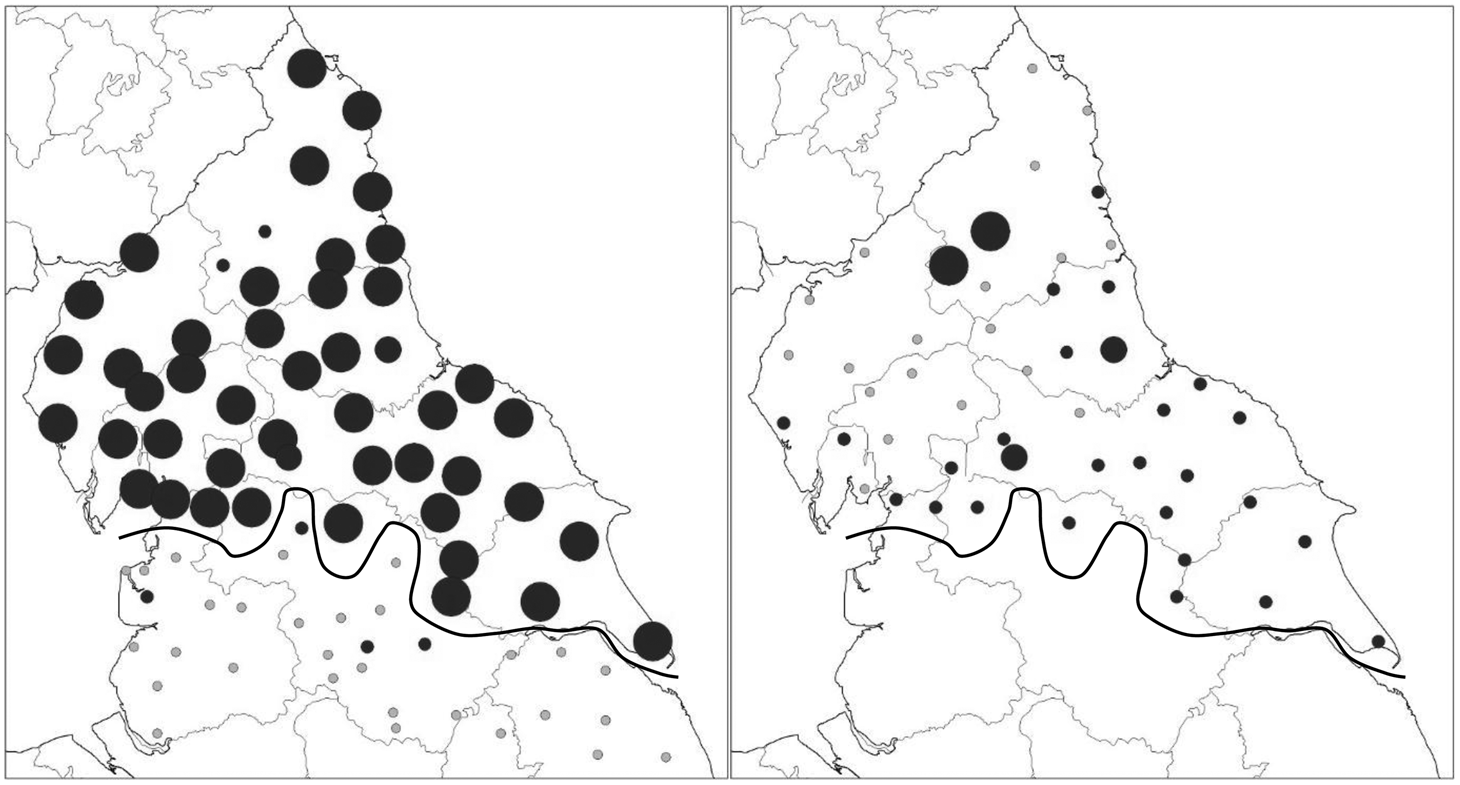
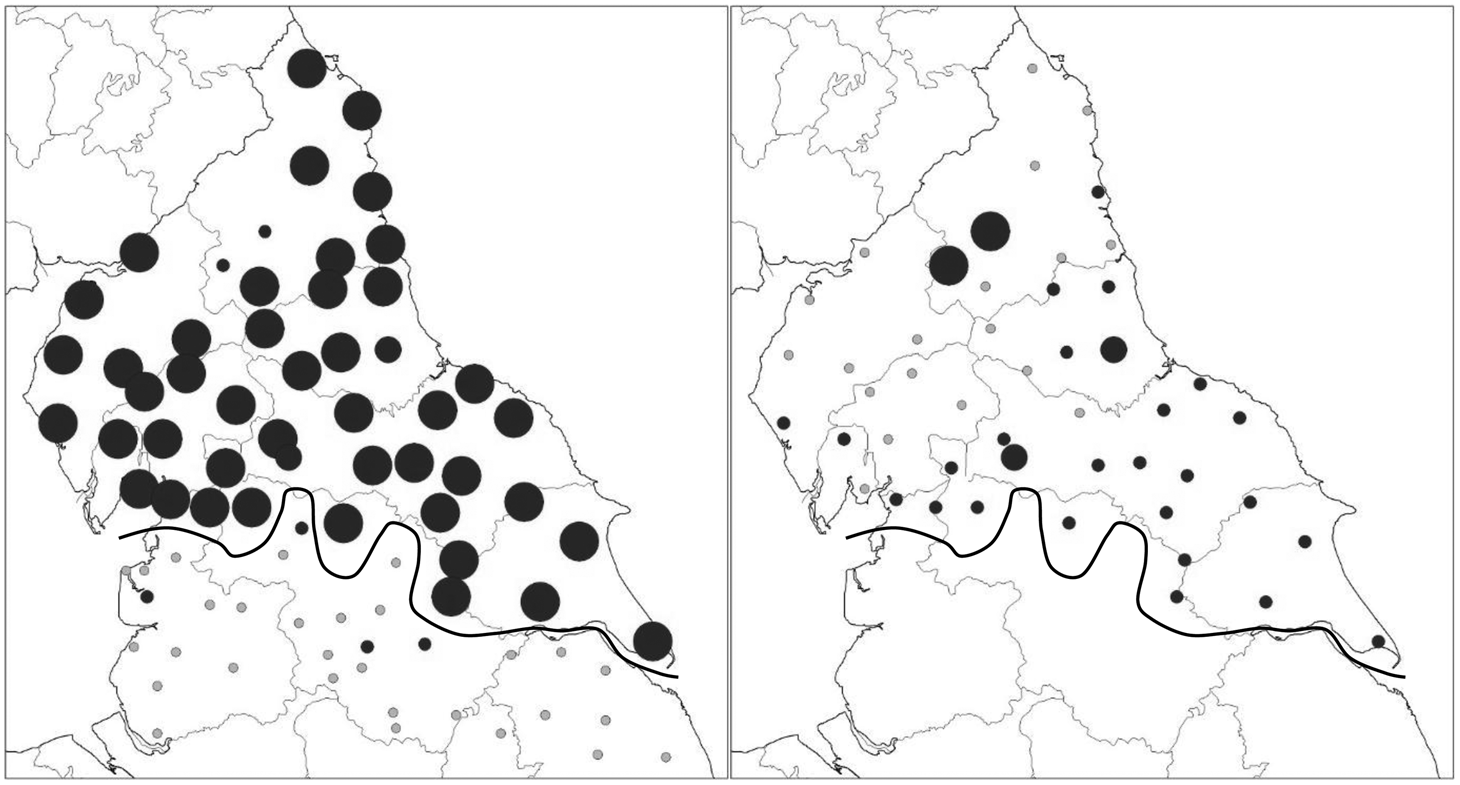
One notable feature of the distribution of owld forms is that they are not just found in Scotland. They are also fairly common in the far north of England, in those areas which had ME [aʊ] in old words, producing auld and, especially, aud forms in this set (see section 2). This can be seen in the LAS3 data for (north) Northumberland (Mather & Speitel Reference Mather and Speitel1986: 191–2; see also figure 2), but such forms are well recorded in other sources for northern English dialects. The maps in figure 3, based on the Survey of English Dialects (SED; Orton & Dieth Reference Orton and Dieth1962-71) responses to questions about the words ‘cold’ and ‘old’,Footnote 2 show two things. The first map shows the distribution of au(l)d forms in northern England in the words ‘cold’ and ‘old’, which are essentially restricted to territory north of the Ribble–Humber Line.Footnote 3 An isogloss has been added to indicate the boundary between northern and non-northern developments. The second map shows locations north of this line which have been recorded with some owld (or, occasionally, owd) forms in these words.
au(l)d and owld in northern England
These owld forms in the far north of England have previously been assumed to have an origin further south in England and/or in Standard English. Orton (Reference Orton1933: 20) suggests that [ɑʊld] pronunciations of old words in the County Durham dialect of Byers Green reflect early borrowings from Standard English, in contrast to native [ɑːd] pronunciations. Orton suggests that these borrowings came into the dialect at a time (‘the late 14th century’) when the ME dialect from which Standard English derived had [ɔʊld] ([ɑʊ] in the Byers Green dialect being the usual reflex of ME [ɔʊ]). Likewise, Hedevind (Reference Hedevind1967) records /auld/ forms of old words alongside /aːld/ forms in the traditional dialect of Dentdale in northwest Yorkshire. Hedevind (Reference Hedevind1967: 127) argues that the /aːld/ forms reflect the native development of northern ME [aʊld] (there being no L-vocalisation in this environment in this dialect, a feature which it shares with Cumbrian and Scots dialects), whilst the /auld/ forms (/au/ being the usual Dentdale development of ME [ɔʊ]) ‘may be borrowings from adjacent N[orth]Midl[and] (La[ncashire] or Y[orkshire]) dialects or else from e[arly]St[andard]E[nglish] ould forms’.
The spread of ‘North Midland’ (including the southern northern counties) features into the neighbouring Dentdale dialect is not unlikely, but the fact that these forms are found much further north in England (e.g. in Northumberland and Durham) suggests that the North Midlands might not be the source of owld forms in the far north. There is not really much evidence of a wider North Midland influence on these dialects, and in most cases these owld forms have no L-vocalisation, whilst L-vocalisation (i.e. owd) is typical of the North Midlands. L-vocalisation also appears to be typical of native far northern development of ME [ɔʊld] (as in gold and mould ‘earth’), so these L-full forms are doubly anomalous.
If the far northern owld forms did not come from the north Midlands, then a source in some form of Standard English seems likely, as both Orton (Reference Orton1933) and Hedevind (Reference Hedevind1967) suggest. That such forms might have this source is not at all unreasonable, given the extensive influence that Standard English has had on traditional dialects of English in the far north and elsewhere over the past few centuries. Orton (Reference Orton1929: 128), for example, stated of Northumberland that ‘The current vernaculars in this county are not necessarily pure. It is indeed beyond question that they have been corrupted to a large extent by extraneous influences, and that they have absorbed a great deal from Standard English in the course of the last four or five centuries.’ Whilst Orton's terminology is old-fashioned, he was undoubtedly right that traditional English dialects had ‘absorbed a great deal from Standard English’. For example, the split in the development of OE [ɑː] discussed in section 2 is reflected in far northern English dialects typically having an [ɪə]-type vowel in words like both, home, stone and whole, whilst traditional dialects south of the Ribble–Humber Line have an [ʊə], [oː], [oʊ] or [əʊ]-type vowel reflecting a rounded back development of this vowel (Wakelin Reference Wakelin1972: 102–3). But in the traditional English dialects recorded in the SED, back rounded vowels in this set of words were actually fairly common in dialects north of the Ribble–Humber Line (see Anderson Reference Anderson1987: 100–1, 104–6, 112, 115), speaking of considerable influence from Standard English over the centuries.
So a source for this alternative vowel in old words in northern dialects in earlier forms of Standard English is not unreasonable. And indeed, such forms are known to have been current in English, in old words and in other words that had ME [ɔʊl], in the Early Modern period, including in some standard varieties of it (Dobson Reference Dobson1957: 691–2, 809; see also Kökeritz Reference Kökeritz1953: 245). Dobson (Reference Dobson1957: 691) suggests, on the basis of rhymes and spellings, that these Early Modern Standard English owld and owl forms had the same vowel as was typical of the mouth lexical set. Originating in ME [uː], the typical mouth vowel diphthongised in the GVS, becoming [ʌu] in EModE, and ultimately [aʊ] in Present-day English. Dobson hypothesises that although ME [ɔʊ] normally became [oː] in EModE, late ME [ɔʊ] before coda [l] in words like bolster (early ME [ɔl] > late ME [ɔʊl]) and old (early ME [ɔːl] > late ME [ɔʊl]) sometimes became [uː] as a result of assimilation ‘by the raising influence of a back l’ (ibid.). This [uː] was then subject to the GVS, giving [ʌu] in these words. Thus we can, following Dobson, assume [ʌu] in the old set in at least some forms of EModE.
Dobson's explanation of the identity, in at least some forms of EModE, of the vowel in the mouth and old sets (as well as in some other words with ME [ɔʊl]) works on the assumption that diphthongisation of ME [uː] was late enough to also affect words with the late ME change of [ɔʊl] > [uːl]. The traditional chronology of these changes certainly fits with this, the diphthongisation of ME [uː] beginning in the early fifteenth century, becoming [ʌu] by 1600 (Lass Reference Lass and Lass2000: 80; Luick Reference Luick1940: 562; Stenbrenden Reference Stenbrenden2016: 239), and diphthongisation of [ɔːld] to [ɔʊld] dated to the fifteenth century (Luick Reference Luick1940: 603). Given that a recent analysis of the history of the GVS changes suggests that [uː] diphthongised as early as the late thirteenth and early fourteenth centuries in parts of the Midlands (Stenbrenden Reference Stenbrenden2016: 239–61), such a chronology may not work, in which case we would need to posit a late ME change of [ɔʊl] directly to [ʌul] (rather than via [uːl]), merging with the diphthong reflex of earlier ME [uː]. Whichever of these solutions is correct, it seems that there is good evidence for merger of the vowel in the old and mouth sets in some forms of EModE, and Dobson (Reference Dobson1957: 692) suggests that ‘it must once have been a widespread variant’, given its appearance in a range of modern English dialects.
Further evidence for [ʌuld] being a widespread variant in the old set in EModE is furnished by Irish English. As was noted previously, traditional dialects of Irish English have the same vowel in the old set (‘owl(d)’) as they do in the mouth lexical set. The same development is apparent in other words derived from ME [ɔʊl], e.g. in bolster. Irish English derives for the most part from the seventeenth-century British plantations and settlements of Ireland, and traditional Irish English dialects, in both the north and south, are phonologically close to the Early Modern ancestor of Standard English (Lass Reference Lass1990; Maguire Reference Maguireforthcoming b). This is a result of substantial input from the Midlands and south of England and the effects of new dialect formation, which led to levelling of minority regional British English variants in the formation for Irish English. In other words, the presence of owl(d) in Irish English not only points to its presence in EModE in England, but also indicates that variants of old (and other words with ME [ɔʊl]) with the typical mouth vowel were common enough in the input to resist levelling and to become generalised in the formation of these new forms of English in Ireland. As Ellis (Reference Ellis1869: 194–5) puts it, ‘The sound (ou) is however, heard in (ould) Ireland … in which again the Irish were only following the fashion of the English in the xvii th century.’
The widespread existence of owld pronunciations of the old set in the Early Modern period, including in some forms of Standard English, gives us a means by which they could have entered northern English dialects. However, owld pronunciations of the old set are not found in Standard English in the present-day, of course, in Ireland or elsewhere, and this situation appears not to be recent. Pronunciation dictionaries published in the second half of the eighteenth century, which recommended ‘correct’ usage, almost all indicate pronunciations of these and other ME [ɔʊl] words with the same vowel as the goat lexical set more generally. Of the eleven pronunciation dictionaries contained in the ECEP database, seven contain no instances of the typical mouth vowel in old words or other words with ME [ɔʊl].Footnote 4 If owld (and other owl) pronunciations were found in some forms of Early Modern Standard English, they had been replaced by pronunciations with the typical goat vowel over the course of the seventeenth and eighteenth centuries.
However, the ECEP database reveals that owld pronunciations of old words, and owl pronunciations of other words with ME [ɔʊl] still existed in the second half of the eighteenth century. Not surprisingly, given that these pronunciations are still current in Ireland today, Thomas Sheridan notes ‘bowld’ and ‘cowld’ (i.e. [bɔuld] and [kɔuld] according to the ECEP interpretation of Sheridan's transcriptions) as Irish pronunciations of English ‘bo2ld’ and ‘co2ld’ (i.e. [boːld] and [koːld]) in his appendix on ‘Rules to be observed by the Natives of Irelandin order to attain a just Pronunciation of English’. The ECEP database also includes alongside [moːld] and [oːld] the pronunciations [mɒuld] and [ɒuld] for mould/mold and old from John Walker's Critical Pronouncing Dictionary of 1791. Walker, who was born in Middlesex, makes the following point in his entry for mould, which he also references in the entry for old:
There is an incorrect pronunciation of this and and similar words, chiefly among the vulgar, which is, sounding the word as if it were written mo-oold. The sound is often heard among incorrect speakers, where there is no diphthong, as in cold, bold, sold, &c. pronounced bo-oold, co-oold, so-oold, &c. while the true pronunciation of these words has nothing of the u or oo in it, but is exactly like foal'd, sol'd, cajol'd, &c. the preterits of the verbs to foal, to sole, and to cajole, &c. For there is no middle sound between owl and hole; and the words in question must either rhyme with howl'd or foal'd; but the last is clearly the true pronunciation.
That is, some people in late eighteenth-century England pronounced words in the old set with the vowel typical of the mouth lexical set and, although Walker states that this pronunciation is used ‘chiefly among the vulgar’ (emphasis mine), the implication is that it was used by some speakers who should, in his opinion, have known better.
But Walker is the only source in the ECEP who indicates that such pronunciations of the old set existed in England in this period, and it appears that pronunciations of the owld type had been largely lost in the Standard English of the region by this time. But three other lexicographers included in the ECEP give pronunciations of other words which had ME [ɔʊl] with the mouth vowel, suggesting that although it was not recorded in the old set, the merger of ME [ɔʊl] with the vowel in the mouth set was also a feature of some northern varieties of Standard English. One of these was Thomas Spence of Newcastle upon Tyne in northeast England who, as the ECEP indicates, gave the vowel [aʊ] (typical of the mouth lexical set) in mould/mold, poultry and shoulder, although he gave the vowel [oː] in bold, colt, old, roll, soldier and soul. A similar pattern is also indicated by two lexicographers from north of the Scottish–English border. The ECEP reveals that James Buchanan, in his 1757 New English Dictionary, indicated that the words mold/mould, poultry and shoulder had [ɔu], the usual mouth vowel, in contrast to [oː] in soul and [ɒ] in bold, colt and soldier. Similarly, the ECEP indicates that John Burn, of unknown origin, but whose Pronouncing Dictionary of the English Language was published in Glasgow, gave the vowel [au] (typical of the mouth lexical set) in shoulder, but [oː] in bold, colt, mould/mold, old, poultry, roll, soldier and soul. Assuming that these cases do not represent confusion on the part of the lexicographers due to the <ou> vowel spellings in these words, these pronunciations indicate that mouth-like realisations of some words with ME [ɔʊl] were current in the second half of the eighteenth century in northern Britain.
If the widespread existence of owld pronunciations in the Early Modern period and indeed into the second half of the eighteenth century provides a means of explaining their presence in far northern English dialect, then there is every reason to think that they can also explain the existence of owld in Scots, especially given the indications that owl pronunciations of words with ME [ɔʊl] were found in some eighteenth-century varieties of Standard English in Scotland. I turn to the issue of explaining how this might have come about, and why the owld forms in Scotland have the distribution they do, in the next section.
5 Explaining how owld forms became part of Scots
owld pronunciations of old words were widespread in EModE, not just in regional dialects, but also in some forms of Standard English. They persisted in mainstream varieties into the second half of the eighteenth century, as indicated by Walker's warning against their use, though they were clearly on the wane by this time if the evidence in the ECEP is anything to go by.
All of this means that owld forms of old would have been commonly encountered by seventeenth- and eighteenth-century Scottish learners of English. After the Union of Crowns in 1603, upper-class and increasingly middle-class people from Scotland began to adopt English, resulting in a new form of Standard English influenced in its phonology by Scots, ‘Scottish Standard English’ (SSE; see Aitken Reference Aitken and Trudgill1984a, Reference Aitken and Trudgill1984b and Maguire Reference Maguire and Hickey2012). A major factor in the development of the phonology of SSE was that speakers applied the vowel phonemes of Scots, including their realisations, to the lexical incidence of vowel phonemes in Standard English. For example, confronted with a Standard English diphthong of an [ʌu]-type in words like house, mouth and out, Scottish learners substituted their native [ʌu] diphthong, found in words like colt, grow and roll, for Scots [u] in these words. Likewise, Scots [u], found in words like house, mouth and out, was used as an equivalent of Standard English [uː] in words such as boot, good and soon, which had [ø] or the like in Scots.
Had Scots speakers, who in the seventeenth century had [ɑː]~[ɒː] in the old set (auld, etc.), been exposed only to Early Modern Standard English [oː] in these words, then SSE would have developed only [oː] pronunciations of them, this vowel already existing as a Scots vowel phoneme in words such as boat, coal and rose. But given that forms of EModE, including some varieties of Standard English, had [ʌu] in the old set, Scots learners of English would naturally have used their native [ʌu] diphthong (see above) to represent it, resulting in pronunciations such as [ʌuld]. Although such forms are not recorded in the Scottish sources in the ECEP, the existence of the equivalent diphthong in the words mould/mold, poultry and shoulder in Buchanan's and Burn's dictionaries suggests just such a change. Both poultry and shoulder traditionally have [u] (with no following /l/) in Scots, whilst mould/mold was usually [møld] (or the like) in Scots, although L-less [mʌud] forms also existed (see section 3). Assuming that Buchanan's and Burn's phonetic transcriptions of these words are not simply due to orthographic confusion, they represent the replacement of Scots [u] and [ø] with [ʌu], after the model of some forms of Early Modern Standard English. It is in this way, I suggest, that owld forms became part of early SSE.
With the development of SSE in Lowland Scotland, a situation of diglossia arose, with English acting as the ‘high’ language and Scots as the ‘low’ language (see Maguire Reference Maguire and Hickey2012). This meant that Scots speakers were increasingly exposed to these standard forms, as SSE became more and more prominent in Scotland through education, printed media and the church (cf. Dieth Reference Dieth1932: xvii-xx). It is inevitable that SSE pronunciations should have affected Scots usage to a degree, especially as the diglossic relationship between Scots and English morphed into a diaglossic one (i.e. a social dialect continuum) in more recent centuries in many areas (see Aitken Reference Aitken and Trudgill1984b and Maguire Reference Maguire and Hickey2012). This alone might explain how owld forms came to be used alongside, or even in place of, auld forms in some Scots dialects. But in fact the loss of owld in Standard English, including in Scotland, in the eighteenth century would have increased the chances of it becoming part of Scots. As long as owld was a feature of SSE, in contrast to auld, speakers of Scots could identify the first as ‘standard’ and the second as ‘Scots’, and use them accordingly. But once owld began to be replaced in SSE with old, the status of owld would become uncertain. The question Scots speakers were faced with was ‘Is owld “standard” (apparently not, given that old appears to be the “correct” form), or is it “Scots” (maybe, if it is not “standard”)?’. In other words, if owld no longer indexed ‘standard’ (i.e. SSE) speech for Scots speakers who knew the pronunciation, then it must have been a ‘non-standard’ (i.e. non-SSE) form, which in the Scottish context essentially meant ‘Scots’. That is, the loss of owld in SSE would have led to its reinterpretation as a Scots form, giving it a new life alongside or instead of auld in Scots dialects. In other words, owld was ‘localised’ in Scots (cf. Meyerhoff & Niedzielski Reference Meyerhoff and Niedzielski2003), and it is likely that a similar explanation can be given for the existence of owld forms in far northern England.
The ECEP database indicates that owld was lost in Standard English in the eighteenth century, including in Scotland. But given that Standard varieties are inevitably geographically and socially distributed, it stands to reason that changes will not affect all speakers of them at the same time. When old began to replace owld in SSE, it is likely to have done so in the central part of Scotland, where most speakers of SSE lived. In more remote, peripheral parts of Scotland, such as the far north or the south west, older patterns in SSE would have survived for longer. This means that owld pronunciations of old in SSE could have been around for a lot longer in these areas than in central Scotland, giving them even more time to become part of the local Scots dialects, and this, I suggest, is the explanation for the prominence of owld in the far north of Scotland and, to an extent at least (influence from Irish English also being a part of the story), in southwest Scotland.
As is indicated in figure 2, howld for ‘hold’ has a somewhat wider distribution than owld and cowld. If this is not just an accident arising from the small sample of words, it may be that early SSE howld was more likely to be taken into local Scots dialects due to the significant difference between the traditional Scots (haud) and the SSE (howld) pronunciations, or, more likely, because the Scots haud form was often unstressed and phonetically reduced, and howld may have been interpreted as a stressed version of the word, with no obvious competing form in Scots.
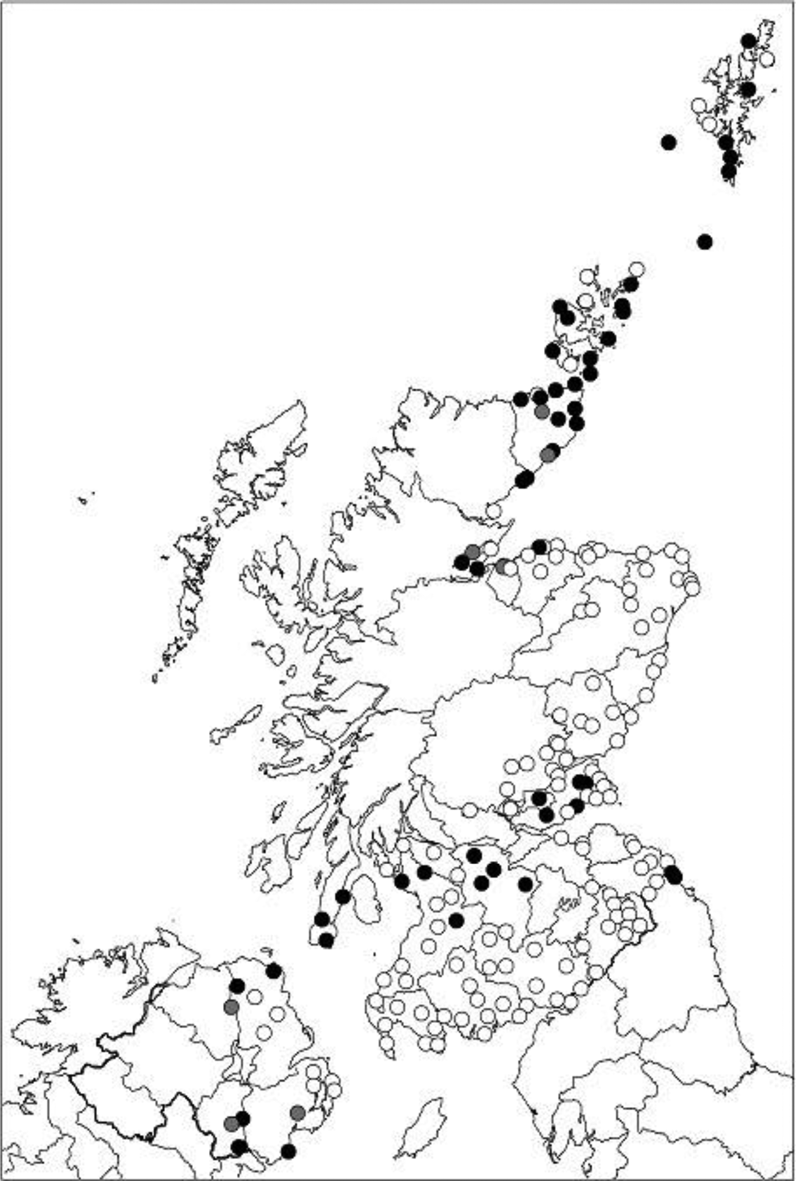
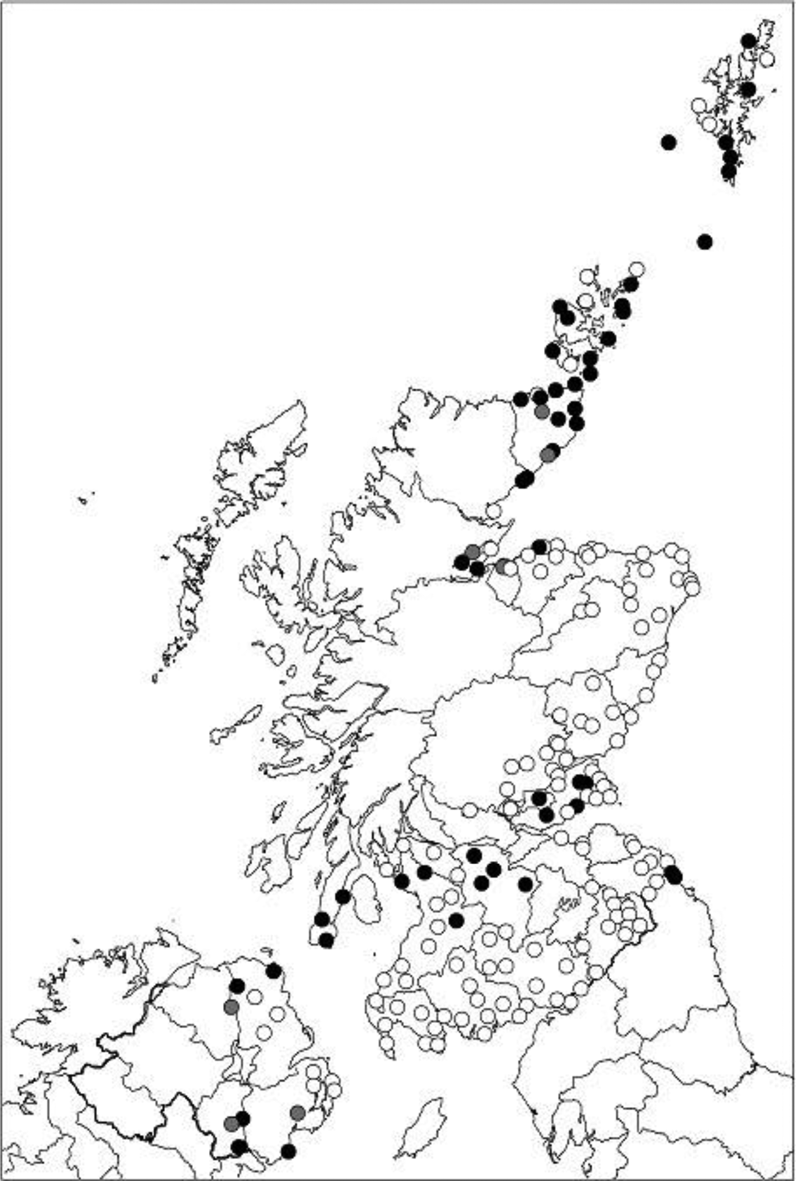
This analysis, then, suggests that owld forms in Scots have their origin in EModE, specifically in early SSE, and that they became established in some Scots dialects specifically because they were replaced in SSE by old, so that they were interpreted as non-standard, and hence Scots themselves. The peripheral distribution of owld pronunciations in Scotland reflects the survival of an older layer of SSE pronunciation in Scotland, one which had been replaced at an earlier date by old forms in the central Lowlands. If this analysis is correct, it follows that there should be other such examples, that is, pronunciations originating in EModE which became part of early SSE but which were replaced by later Standard English forms, and which live on in peripheral Scots dialects. A probable example is found in the pronunciation of the word for ‘one’ in Scots dialects. Most Scots dialects recorded in LAS3 have a version of general Scots ane (e.g. [en], [in], [jɛ̈n]). But a range of dialects in the far north and the southwest, and occasionally elsewhere, were recorded with wan (e.g. [wan]) or, occasionally won (e.g. [wɔn]) pronunciations of this word (see figure 4). Although Aitken & Macafee (Reference Aitken and Macafee2002: 173–4) suggest an internal explanation of this form, its realisation, distribution and absence in OSc (DOST contains only seventeenth-century examples, whilst the FITS corpus includes no such forms) all speak against such a development. The fact that wan/won forms are common in Irish English suggests that they were a feature of EModE too, and were, like owld, likely to have existed in early SSE and to have become established in especially peripheral Scots dialects in the same way (with additional input from Irish English in the southwest).
Realisations of ‘one’ as documented in LAS3a
6 Conclusions
The existence of owld-type pronunciations of old words in Scots dialects is anomalous, since they fail to fit with established changes to OE (e)ald to the north of Ribble–Humber Line. They thus demand an explanation, and two options have been examined in this article, an internal one, suggested by Johnston (Reference Johnston and Jones1997b) and expanded by Aitken & Macafee (Reference Aitken and Macafee2002), and an external one (from two sources), considered by Johnston (Reference Johnston and Jones1997b) and Macafee (Reference Macafee, Kirk and Dónall2001). None of these previous analyses pursues the origins of owld forms in detail. However, the close analysis of the history and distribution of these owld forms in this article suggests that the internal explanation suggested by Aitken & Macafee is untenable, and that an external explanation is preferable.
The two possible external sources, Irish English and English in England, are ultimately connected, having a source in Early Modern Midland and southern English owld developments of the old set that were also a feature of some early forms of Standard English. Although an Irish English origin for the southwest Scottish instances of owld is likely, in part at least, especially given that other features of Irish English have made their way into southwest Scots, this cannot be the explanation for the existence of these forms elsewhere in Scotland. But the presence of owld forms in EModE (including some forms of Standard English in the period) and in eighteenth-century English, together with evidence of their spread into northern English dialects, provides an explanation for these forms in Scots. It is likely that they were a feature of the English learned by Scots in the seventeenth century and perhaps even the eighteenth century, and would thus have become part of early SSE. As such, speakers of Scots would have been exposed to them and, in as much as they learned English, they would have used them. But as was the case in England, owld forms were, for the most part, ousted by old forms in the eighteenth century. This process would have begun in SSE in central areas of Lowland Scotland, with varieties of SSE in more peripheral areas of Scotland retaining owld forms for longer. With the loss of their ‘standard’ association, owld forms were reintepreted as ‘non-standard’, i.e. ‘Scots’ and, for some speakers in some areas at least, became part of the local dialects. That is, owld forms became localised. An early loss of these owld forms in central varieties of SSE and their continued use in SSE in peripheral areas would explain why these forms are particularly characteristic of dialects in the far north and in the southwest (though in this latter area influence from Ireland was also likely to have been a factor).
This article highlights the importance of considering not only internal developments in the phonological history of Scots (as amply illustrated in Aitken & Macafee Reference Aitken and Macafee2002; Johnston Reference Johnston and Jones1997a, Reference Johnston and Jones1997b), but also English influence on the language through the centuries. English and Scots have always been closely related and share many changes, and it is likely that some of these changes represent influence from the south, especially via standard forms of the language (see Maguire et al. Reference Maguire, Alcorn, Molineaux, Kopaczyk, Karaiskos, Los and Ritt2019 for further illustration). Whilst there were many independent changes in the two languages, we must always bear the possibility in mind that phonological changes in the history of Scots, sometimes shared by northern English dialects, can have an exogenous origin too.
This article also highlights the importance of new databases of historical varieties of English and Scots for understanding their phonological development. Databases such as FITS and the ECEP provide us with a unique window into the historical phonologies of English and Scots, shedding new light on the origins of many features. This article gives one example of how they can help us untangle a phonological puzzle, and they will prove important in the further elucidation of the intertwined phonological histories of English and Scots.