1. INTRODUCTION
With the development of intense short-pulse laser with intensities up to ~1021 W/cm2 at 0.8–1 µm wavelength and pulse duration ≤ 1 ps, electron acceleration by laser plasma interaction (Esarey et al., Reference Esarey, Sprangle, Krall and Ting1996; Sprangle et al., Reference Sprangle, Esarey and Ting1990; Sprangle & Esarey, Reference Sprangle and Esarey1992) has emerged as a major area of research. The three routes, viz., laser wakefield accelerator (Tazima & Dawson, Reference Tazima and Dawson1979; Hogan et al., Reference Hogan, Bames, Clayton, Decker, Deng, Emma, Huang, Iverson, Johnson, Joshi, Katsouleas, Krejcik, Lu, Marsh, Mori, Mugglli, O'connell, Oz, Siemann and Walz2005; Robinson et al., Reference Robinson, Geddes, Esarey, Leemans, Michel, Nagler, Nakakmura, Plateau, Schroeder, Shadwick, Toth, Tilborg, Hooker, Bruhwiler, Cary and Michel2006; Pukhov et al., Reference Pukhov, Gordienko, Kiselev and Kostyukov2004), the laser beat wave accelerator (Ebrahim, Reference Ebrahim1994; Liu & Tripathi, Reference Liu and Tripathi1994; Prasad et al., Reference Prasad, Singh and Tripathi2009; Dyson & Dangor, Reference Dyson and Dangor1991), and ponderomotive acceleration (Kawata et al., Reference Kawata, Kong, Miyazaki, Miyauchi, Sonobe, Sakai, Nakajima, Masuda, Ho, Miyanaga, Limpouch and Andrew2005; Andreev et al., Reference Andreev, Platonov and Kawata2009; Badziak et al., Reference Badziak, Glowacz, Jablonski, Parys, Wolowski and Hora2005; Kumar et al., Reference Kumar, Gupta and Sharma2006; Liu & Tripathi, Reference Liu and Tripathi2005; Laska et al., Reference Laska, Jungwirth, Krasa, Krousky, Pfeifer, Rohlena, Velyhan, Ullschmied, Gammino, Torrisi, Badziak, Parys, Rosinski, Ryc and Wolowski2008; Prasad et al., Reference Prasad, Singh and Tripathi2009) have been pursued vigorously and the electron acceleration approaching a GeV energy is being achieved. In these schemes, ponderomotive force plays the basic role, it can directly accelerate the electrons or excite a large amplitude plasma wave that can accelerate the electrons. The ponderomotive acceleration has been intensively investigated theoretically and experimentally, and compared with other acceleration methods (Nakamura, Reference Nakamura2000; Nakamura et al., Reference Nakamura, Mima, Sakagami, Johzaki and Nagatomo2008; Lotov, Reference Lotov2001; Balakirev et al., Reference Balakirev, Karas and Levchenko2001, Reference Balakirev, Karas, Levchenko and Bornatici2004; Geddes et al., Reference Geddes, Toth, Van Tilborg, Esarey, Schroeder, Bruhwiler, Nieter, Cary and Leemans2004; Faure et al., Reference Faure, Glinec, Pukhov, Kiselev, Gordienko, Lefebvre, Rousseau, Burgy and Malka2004; Mangles et al., Reference Mangles, Murphy, Najmudin, Thomas, Collier, Dangor, Divall, Foster, Gallacher, Hooker, Jaroszynski, Langley, Mori, Norreys, Tsung, Viskup, Walton and Krushelnick2004; Reitsma et al., Reference Reitsma, Cairns, Bingham and Jaroszynski2005; Li et al., Reference Li, Ishiguro, Skoric, Takamaru and Sato2004; Reitsma & Jaroszynski, Reference Reitsma and Jaroszynski2004; Hoffmann et al., Reference Hoffmann, Blazevicv, Ni, Rosmej, Roth, Tahir, Tauschwitz, Udrea, Varentsov, Weyrich and Maron2005; Mourou et al., Reference Mourou, Tajima and Bulanov2006; Joshi, Reference Joshi2007; Hora, Reference Hora2006, Reference Hora2007; Hora et al., Reference Hora, Miley, Azizi, Malekynia, Ghoranneviss and He2009; Shi, Reference Shi2007; Nickles et al., Reference Nickles, Ter-Avetisyan, Schnuerer, Sokolink, Sandner, Schreiber, Hilscher, Jahnke, Andrew and Tikhonchuk2007; Chen et al., Reference Chen, Unick, Vafaei-Najafabadi, Tsui, Fedosejevs, Naseri, Masson-Laborde and Rozmus2008; Kulagin et al., Reference Kulagin, Cherepenin, Hur, Lee and Suk2008; Limpouch et al., Reference Limpouch, Psikal, Andreev, Platonov and Kawata2008). A fast moving electron at the front of the pulse can gain large energies when its velocity acquires a value greater than the group velocity of the laser before reaching the pulse peak. So that it always remains ahead of the peak.
Hartemann et al. (Reference Hartemann, Fochs, Le Sage, Luhmann, Woodwrth, Perry, Chen and Kermen1995) have studied ponderomotive acceleration in detail in vacuum by one-dimensional (1D) plane wave pulses and two-dimensional (2D) Gaussian pulses. In 1D, the electron gains energy during the rising front of the pulse, the rear acts as a backward ponderomotive force, and slows down the electron to original energy. In 2D, the laser of finite spot size suffers diffraction divergence. Hence, by the time the rear of the pulse catches the electron, accelerated by the front, its amplitude has reduced due to diffraction, and net retardation by the rear ponderomotive force is less, and the electron is left with net energy gain. Liu and Tripathi (Reference Liu and Tripathi2005) have studied the 1D ponderomotive acceleration and ponderomotive force assisted plasma wave acceleration of electrons in a gas jet plasma.
The temporal evolution of the intensity profile for a wide range of laser and plasma parameters, for long pulses (longer than the plasma period, τ0 > τp) has been simulated by Mora and Antonsen (Reference Mora and Antonsen1997). Considering matched beam propagation, the steepening of the front of a short laser pulse (τ0 = τp) has been numerically studied and reported by Esarey et al. (Reference Esarey, Schroeder, Shadwick, Wurtele and Leemans2000). The asymmetry in the intensity distribution of a short laser pulse with matched laser beam condition has been simulated by Gordon et al. (Reference Gordon, Hafizi, Penano, Hubbard and Ting2003), they have reported stretching of the front and compression of the back of the pulse. Sprangle et al. (Reference Sprangle, Penano and Hafizi2001) reported simulation of long and short pulse propagations in plasma channels and showed that the front of the laser pulse gets steepened. Faure et al. (Reference Faure, Glince, Santos, Ewald, Rousseau, Kiselev, Pukhov, Hosokai and Malka2005) have reported pulse front sharpening that is confirmed by three-dimensional (3D) particle-in-cell simulations. Upadhyay et al. (Reference Upadhyay, Tripathi and Pant2001) have developed an analytical theory for it.
In this paper, we examine the effect of axial plasma inhomogeneity on short pulse laser propagation and consequently ponderomotive acceleration of electrons. We incorporate the relativistic mass nonlinearity in the refractive index of the plasma. In underdense plasma, a low amplitude portion of the pulse travels with a smaller group velocity than the high amplitude portion. Thus, the front of the pulse gets sharpened whereas the rear gets elongated. The ponderomotive force associated with the distorted pulse accelerates the electrons directly. The electrons at the pulse front initially have a speed lower than the group speed of the laser pulse (v e < v g) and the ponderomotive force pushes them forward. As the electrons are run over by the pulse front, these see the large amplitude of the pulse and continue to accelerate. If the intensity of the pulse is high enough (greater than a certain threshold I th) the electrons acquire a velocity equal to the local group velocity before being overtaken by the pulse peak. The ponderomotive force is still positive and the electrons continue to be accelerated with v z > v g until they eventually leave the pulse. In a plasma with positive density gradient, I th is expected to decrease with the density scale-length.
In Section 2, we develop a 1D model for nonlinear propagation of laser pulse in axially inhomogeneous plasma in the Wentzel-Kramers-Brillouin approximation. The initial temporal profile of the pulse is taken Gaussian and its evolution with the distance of propagation is studied. In Section 3, we study the ponderomotive acceleration of electrons. A discussion of results is given in Section 4.
2. PULSE DISTORTION
Let us begin with the propagation of a linearly polarized continuous wave laser in inhomogeneous plasma in  direction. In the Wentzel-Kramers-Brillouin approximation, the electric field of the laser can be written as

where η is the refractive index of the plasma, given by

and

where γ is the relativistic gamma factor, ωp = (4πne 2/m)1/2, −e and m are the electronic charge and rest mass, a 0 = eA 0/η0mωc is the normalized laser amplitude at z = 0 and η0 = η at z = 0. From Eqs. (2) and (3),
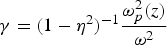
or
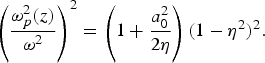
For a linear plasma density profile
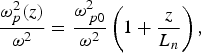
Eq. (4) can be written as

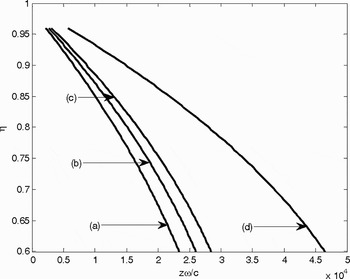
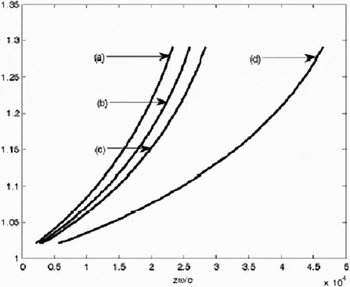
where zω/c is the dimensionless distance along which the laser propagates and L nω/c is the dimensionless plasma scale length. We have solved Eq. (6) numerically for different values of the parameters to obtain the variation of laser amplitude with distance, for a 02 = 1 − 4, ωp02/ω2 = 0.02 − 0.1, L nω/c = 1000. In Figure 1, we have plotted the refractive index as a function of normalized distance of propagation zω/c for different values of. a 02 and ωp02/ω2. In Figure 2, we have plotted a/a 0versus the normalized distance zω/c, for different values of ωp02/ω2 and a 02. Figure 1 shows that the refractive index η decreases with the distance of propagation. The rate of decrease is slower at larger values of a 0. This is due to the fact that the refractive index increases with relativistic increase in electron mass. It is easy to conjecture from here that in case of a pulse, the large amplitude fraction (Fig. 6) of the pulse would move faster than the low amplitude portion. As the ratio ωp02/ω2 is decreased the refractive index decreases less rapidly. Figure 2 shows the effect of plasma swelling on the enhancement of laser amplitude. The normalized laser amplitude rises less rapidly with z for higher values of a 02. The rate of swelling is slower with decreasing ωp02/ω2.
Variation in refractive index η with the normalized distance zω/c, for L nω/c = 1000, (a) a 02 = 1, ωp02 = 0.03 (b) a 02 = 2, ωp02 = 0.03 (c) a 02 = 3, ωp02 = 0.03 and (d) a 02 = 1, ωp02 = 0.02.

Variation in normalized laser amplitude a/a 0 with the normalized distance zω/c for the same parameters as in fig. 1.

Now consider the propagation of a 1D laser pulse in plasma. We presume the shape of the pulse at z = 0 as Gaussian, i.e.

For z > 0,
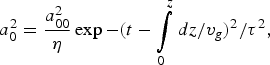
where v g = c(1 − ωp2/ω2γ)1/2 is the group velocity of the laser in the plasma. The laser imparts an oscillatory to electrons and modifies their mass m e = m(1 + a 02/2)1/2. With the relativistic mass effect in the group velocity, Eq. (7) turns out to be
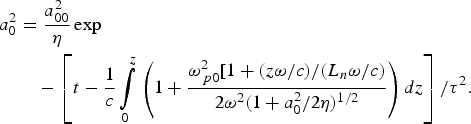
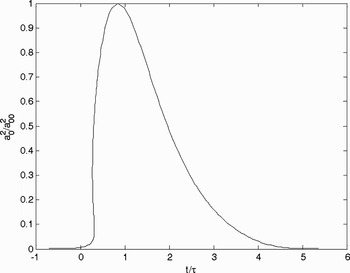
This is an integral equation; we have numerically solved it after writing the integral part as a sum of terms at small intervals, and using the previous value of a 0 to evaluate the next term. The used parameters are ωp02/ω2 = 0.03, ωτ = 30, a 00 = 3 at zω/c = 825 and L nω/c = 1000. The pulse temporal profile is shown in Figure 3. As the pulse propagates in the plasma (i.e., zω/c increases) the front of the pulse gets sharpened. The pulse front sharpening occurs because the different portions of the pulse travel with different group velocities.
Temporal profile of an initially Gaussian pulse after traveling a normalized distance zω/c = 825 for a 00 = 3, ωp02/ω2 = 0.3 and L nω/c = 1000.

3. ELECTRON ACCELERATION
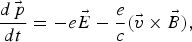
Now consider the interaction of a fast moving electron with the laser pulse. The equation governing the electron momentum is
where,

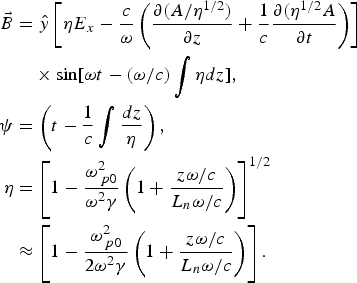
We have assumed that ∂A/∂t = ωA and for an initially Gaussian pulse A 2 = A 02e −t 2/τ2. Expressing d/dt = v zd/dz, the x and z components of Eq. (9) can be written as
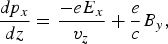
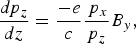
These equations are supplemented with


The time averaged equation for p z gives

where  is the ponderomotive force, which is a function of refractive index η.
We introduce dimensionless quantities a 0 = eA/mωc, X → ωx/c, Z = ωz/c, L n → L nω/c, P x = p x/mc, P z = p z/mc, T = ωt. In terms of these quantities, Eqs. (12)–(15) can be written as follows:
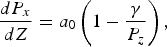
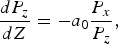


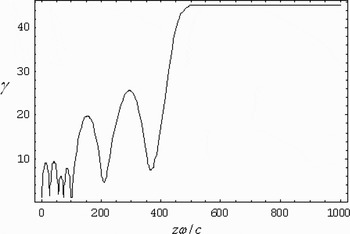
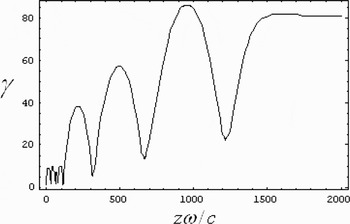
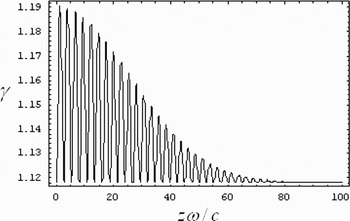
We numerically solve Eqs. (16)–(19) to investigate the electron dynamics. In Figures 4–6, we have plotted the electron energy γ as a function of normalized distance zω/c for different parameters. In Figure 4, we have drawn γ versus zω/c for normalized laser amplitude a 00 = 3, ωp02/ω2 = 0.02, X(0) = 0, ωτ = 20, T(0) = 0, P x(0) = 0.1, and P z(0) = 0.7 at L nω/c = 1000, here the electron got accelerated up to the value of γ = 44 MeV. In Figure 5, we have plotted the electron energy as a function of normalized distance zω/c for the parameters a 00 = 3, ωp02/ω2 = 0.02, X(0) = 0, P x(0) = 0.1, P z(0) = 0.7, ωτ = 40, T(0) = 0, and L nω/c = 1000. From this figure it has been observed that the energy gain got enhanced with the increased value of ωτ and reached up to a maximum value of 82 MeV for the said parameters. In Figure 6, the plot for γ versus zω/c has been drawn for the different normalized laser amplitude a 00 = 0.3 with different values of initial momenta P x(0) = 0.0, P z(0) = 0.5, and zω/c = 100, X(0) = 0, for L nω/c = 1000 with the higher value of normalized laser pulse duration ωτ = 60 at T(0) = 0 and we see that the energy gain by an electron is very little and this because of significant reduction in normalized laser amplitude and initial momenta.
Electron energy γ as a function of normalized distance zω/c for the parameters P x(0) = 0.1, P z(0) = 0.7, X(0) = 0, T(0) = 0, a 00 = 3, ωp02/ω2 = 0.02, ωτ = 20, and L nω/c = 1000.

Electron energy γ as a function of normalized distance zω/c for the parameters P x(0) = 0.1, P z(0) = 0.7, X(0) = 0, T(0) = 0, a 00 = 2, ωp02/ω2 = 0.02, ωτ = 20, and L nω/c = 1000.

Electron energy γ as a function of normalized distance zω/c for the parameters P x(0) = 0, P z(0) = 0.5, X(0) = 0, T(0) = 0, a 00 = 0.3, ωp02/ω2 = 0.02, ωτ = 60, and L nω/c = 1000.

4. DISCUSSION
A large intensity laser pulse is significantly distorted due to nonlinearity induced by the relativistic mass effect. The group velocity of the laser is an increasing function with growing laser intensity. Consequently, the laser peak travels faster than the low intensity front causing pulse front sharpening. The pulse shape changes with time and the ponderomotive potential barrier associated with the pulse becomes time dependent. This distortion occurs in the form of shock formation at the front as seen by Pukhov and Meyer-ter-Vehn (Reference Pukhov and Meyer-Ter-Vehn1996) in particle-in-cell simulations and critically depends on laser frequency and laser amplitude. For a laser intensity I L ≈ 3 × 10¹⁹ W/cm2 in a plasma of n 0 = n c/10 (where n c is the critical density of the plasma) at 1 µm wavelength, shock formation occurs at a distance L s ≈ 900 µm. As one goes to higher frequencies, the shock length increases and is typically L s ≥ 100cτ. This is due to an increase in refractive index and group velocity. L s decreases with laser intensity and scales inversely as the ratio of plasma density to critical density. However, at lower frequencies (ω < ωc), the refractive index decreases with laser intensity and v g <<v gmax. The shock length is very small and distortion sets in at the onset of the laser pulse. The shock formed thus is exploited in electron acceleration.
Further, the ponderomotive acceleration mechanism due to the interaction of a laser pulse with an electron with an arbitrary initial energy in axially inhomogeneous low density plasma has been analyzed. An electron gains energy during the rising part of the laser pulse and loses it during the trailing part. However, if the laser intensity is high and the spot size is small, an electron can escape from the field of the pulse and can retain some energy. An electron experiences the action of ponderomotive deceleration at the trailing part of the pulse with a lower intensity as compared to acceleration at the rising part, and thus gains net energy. It was shown that the maximum energy of the electron grows linearly with a 0; i.e., the field strength of the laser and relativistic factor of laser group velocity. For the typical parameters, a 00 = 3, ωp02/ω2 = 0.02, zω/c = 2000, X(0) = 0, P x(0) = 0.1, P z(0) = 0.7, L nω/c = 1000 and T(0) = 0, the maximum value of γ is 82 MeV. In practical applications, the ponderomotively accelerated ultrahigh energy electrons in the rising front of the pulse can be easily extracted by impinging the laser pulse onto a solid target (Yu et al., Reference Yu, Bychenkov, Senyoku, Yu, Sheng and Mima2000). The pulse will then be reflected and the high energy electrons released into the target without suffering the ponderomotive deceleration in the trailing part of the pulse. In conclusion, this scheme of direct electron acceleration by laser pulse in inhomogeneous plasma provides additional electron acceleration which will be utmost significance to the ignitor concept of laser driven fusion.
ACKNOWLEDGEMENT
This work is supported by the Indian Space Research Organization, Department of Space, Bangalore, Government of India.