Introduction
Tanaidacea are almost an exclusively marine order of the Peracarida with 1304 species distributed worldwide (World Register of Marine Species 2010, http://www.marinespecies.org/aphia.php?p=taxdetails&id=1133 accessed on 20 April 2010). The majority of the studies on this group has focused on their taxonomy and little is known about their food preferences and ecology (Błażewicz-Paszkowycz & Ligowski Reference Błażewicz-Paszkowycz and Ligowski2002). Most of the species are free-living on soft sediments where they feed on deposited organic materials. However, examples of grazers, predators and scavengers have also been recorded (Błażewicz-Paszkowycz & Ligowski Reference Błażewicz-Paszkowycz and Ligowski2002 and references therein). Tanaids may live in tubes or tunnels constructed from sand grains, mud and detritus, glued by the secretions from tegumental glands (Holdich & Jones Reference Holdich and Jones1983, Hassack & Holdich Reference Hassack and Holdich1987). A few examples of tanaidacean species have been reported to exhibit interactions with different taxa of both invertebrates and vertebrates (Larsen Reference Larsen2005). These associations, however, have been only loosely defined ecologically. In most cases, tanaids seem to associate with other invertebrates for shelter, such as in the case of sponges (e.g. Stebbing Reference Stebbing1900, Brown Reference Brown1958). For example, the tanaidacean Charbeitanais spongicola Bamber & Bird, Reference Bamber and Bird1997 has been considered to be an obligate sponge-dweller (Bamber & Bird Reference Bamber and Bird1997). Brown (Reference Brown1958) reported the occurrence of the tanaids Leptochelia savignyi (Kröyer, 1842), Sinelobus stanfordi (Richardson, 1901) and Parapseudes spongicola Brown, Reference Brown1958 in the canals of several sponges and detected no damage for either associates and thus hypothesized a ‘protective’ association. Similarly, Chimonides & Cook (Reference Chimonides and Cook1981) found a species of Heterotanais to be closely associated with the bryozoan Selenaria maculata (Busk, 1852) and suggested that the tanaidacean not only gained a refuge, but also fed on overgrown algae and detritus, hence removing these from the surface of the colony. A remarkable example of the ecological flexibility of this group of crustaceans is that of Hexapleomera robusta (Moore, 1894), originally described in a commensal relationship with sea turtles but also known to associate with the Caribbean manetee Trichecus manatus manatus L., 1758, where the tanaidacean lives as a probable ‘commensal epibiont’ (Morales-Vela et al. Reference Morales-Vela, Suárez-Moralesa, Padilla-Saldívara and Hearda2008).
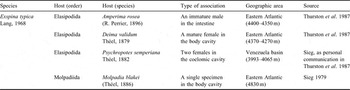
Below shelf depths, Exspina typica Lang, Reference Lang1968, a cosmopolitan, coldwater (< 4°C), stenothermal species, was reported to be associated with elasipodid and molpadid holothuroids by Thurston et al. (Reference Thurston, Billett and Hassack1987). The first record of this association was that of Sieg (Reference Sieg1979), who found E. typica in the coelomic cavity of the holothuroid Molpadia blakei (Théel, 1886). However, due to the material being badly damaged, this finding was disputed and considered an artefact of collection. It is possible that the host's evisceration could have placed the tanaidacean in the proximity of the host's body cavity (see discussion in Thurston et al. Reference Thurston, Billett and Hassack1987). The association between E. typica and other holothuroid hosts was later considered real by Thurston et al. (Reference Thurston, Billett and Hassack1987). They found some tanaids in two species of well preserved hosts and reported a few of Sieg's unpublished records, therefore increasing the host pool (Table I). Thurston et al. (Reference Thurston, Billett and Hassack1987) suggested that this association could be defined as ‘internal parasitism’ or ‘inquilinism’, although the interpretation was simply based on the fact that tanaids may occur inside holothuroids, without giving any ecological characterization.
List of previous records of Exspina typica reported in association with different holothuroid hosts.

In the present contribution, the relationship between E. typica and deepwater holothuroids is investigated in a study of live material collected from the Ross Sea, Antarctica. In particular, the in vivo observations indicate that E. typica is able to dig galleries in the skin of its host and that the relationship can be defined as parasitism.
Material and methods
The examined material was collected during the IPY-CAML cruise, carried out in 2008 in the Ross Sea by the RV Tangaroa (NIWA, Wellington, New Zealand). A rich catch of ‘sea pigs’, holothuroids belonging to the species Protelpidia murrayi (Theel, 1879) was obtained from station 70 (76°46.5′S, 167°50.16′E, 724 m) where an Orange Roughy Trawl (ORH) was deployed on a muddy bottom. More than 700 holothuroids accounting for 115 kg were collected. Immediately after collection, holothuroid hosts were carefully examined for the possible presence of parasitic molluscs and, during this investigation, some unidentified tanaids were noticed through the transparent body wall of the holothuroid. Specimens were then observed in vivo and photographed in the laboratory, after having isolated a piece of the host's skin. Voucher material is deposited in the NIWA Invertebrate Collection (NIC) in Wellington (NZ), under the catalogue numbers 36391 and 36393.
Results
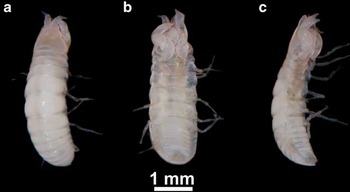
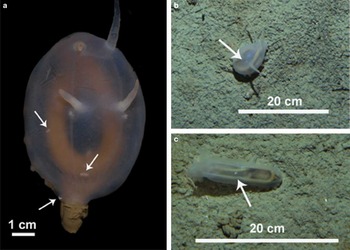
More than 700 specimens of Protelpidia murrayi were collected at station 70 and only five parasitic tanaids were obtained from two specimens of P. murrayi. The calculated infestation rate of 0.28% is probably an underestimate as this association was not immediately detected when host screening began (due to the study being initially devoted to another kind of parasitic association involving eulimid molluscs). The tanaids were identified as Exspina typica Lang, Reference Lang1968 (Fig. 1) and were found within the coelomic cavity of the holothuroid hosts. The E. typica specimens were clearly visible through the transparent skin of P. murrayi (Fig. 2a, top arrows).
Specimen of Exspina typica. a. Dorsal view, b. ventral view, c. lateral view.

Exspina typica specimens inside their hosts. a. Specimen of Protelpidia murrayi with tanaids in the coelomic cavity (arrows). b.In situ image of Protelpidia murrayi carrying tanaid (arrow) in the coelomic cavity (frames tan0802_069_0232 from NIWA DTIS archive). c.In situ image of Laetmogone violacea Théel, 1879 carrying tanaid (arrow) in the coelomic cavity (frames tan0802_069_0222 from NIWA DTIS archive).

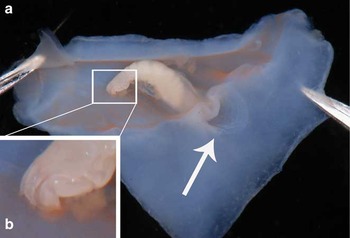
All but one of the tanaids was attached to the internal side of the host tegument (i.e. the side facing the coelomic cavity). The one exception was found at the exterior of the holothuroid after its partial evisceration (Fig. 2a, lower arrow) and was probably present in the intestine prior to evisceration. The zone where the tanaids were attached to the host's tegument appeared as a circular whitish area that was later attributed to the heads and claws of E. typica specimens inserted into the host's skin. One exposed specimen was observed still alive and seen emerging from a tunnel dug in the body wall of the holothuroid (Fig. 3a, arrow) and appeared to be chopping tissue fragments (Fig. 3b). In order to verify how common this association was, we viewed the photographs obtained at station 69 (76°48.23′S, 157°52.24′E, 691 m), which corresponded to the DTIS (Deep Towed Imaging System) transect run in the same area prior to the trawl. These DTIS observations enabled us to see more specimens of tanaids living in the body wall of other P. murrayi specimens (Fig. 2b) and of another transparent deepwater holothuroid, Peniagone vignoni Hérouard, 1901 (Fig. 2c).
‘Skin-digging’ activity of E. typica on the holothuroid host's skin as observed in vivo after the removal of a tegument fragment. a. A specimen just protruding out of the tunnel excavated in the holothuroid body wall and facing the inner side of the tegument, towards the coelomic cavity. The arrow indicates the hole as it can be seen in the thickness of the tegument, after having cut it with a scalpel blade. b. Detail of the claws caught in the moment of ‘chopping’ away a tissue fragment.

Discussion
In the Southern Ocean tanaids are represented by 166 species (Register of Antarctic Marine Species http://www.scarmarbin.be/rams.php?p5taxdetails&id51133, accessed on 19 April 2010), which have been studied taxonomically since the end of the nineteenth century (e.g. Beddard Reference Beddard1886a, Reference Beddard1886b, Hodgson Reference Hodgson1902, Reference Hodgson1910). Their important role in soft-bottom communities has only been pointed out recently (Lowry Reference Lowry1975, Richardson & Hedgpeth Reference Richardson and Hedgpeth1977, Sicinski Reference Siciṅski1998) due to their visibly high densities (Dayton & Oliver Reference Dayton and Oliver1977, Delille et al. Reference Delille, Guidi and Soyer1985, Jażdżewski et al. Reference Jażdżewski, Jurasz, Kittel, Presler, Presler and Sicinski1986, Błażewicz-Paszkowycz & Jażdżewski Reference Błażewicz-Paszkowycz and Jażdżewski2000, Błażewicz-Paszkowycz & Sekulska-Nalewajko Reference Błażewicz-Paszkowycz and Sekulska-Nalewajko2004).
There are no records of parasitic or commensal tanaids from Antarctica. Even E. typica, which was found in the Weddell Sea (Vanhöffen Reference Vanhöffen1914, Sieg Reference Sieg1986) and along the Scotia Arc (Kudinova-Pasternak Reference Kudinova-Pasternak1975), was always recorded as a free-living species.
With the newly-collected material of E. typica, we can now give a definitive clarification of this ‘symbiotic association’ after having observed in vivo specimens of this species living in the coelomic cavity of P. murrayi. One of these specimens (Fig. 3) was fortunately observed still alive and actively ‘digging’ through the host skin producing tunnels up to 1 cm. Although it was not possible to ascertain whether or not the removed skin was also ingested, this behaviour seems to be strictly connected to alimentation purposes rather than to the need of finding a shelter. This strongly indicates E. typica as a true parasite rather than displaying inquilinism, commensalism or kleptocommensalism. Morphologically, E. typica appears to be poorly adapted for its parasitic life style. The lack of setation in the maxillule, the reduction of the mandibular molar and the endites of maxillipeds have been observed in other families including Agathotanaidae (Lang Reference Lang1971a), Anarthruridae (Lang Reference Lang1971b) and Mirandotanaidae (Błażewicz-Paszkowycz & Bamber Reference Błażewicz-Paszkowycz and Bamber2009), but the full reduction of maxillule setation is so far known only in E. typica. The bifurcated and sharply tipped dactyli in the pereopods (see Lang Reference Lang1968, pp. 188–191) might be also considered a parasitic adaptation employed for anchoring the crustacean in the soft tissue of the host. The grossly enlarged pleon of E. typica found also in members of the Mirandotanaidae is a mystery, although it is suspected to have a special function in brooding or food reservoir. Our studies on E. typica allow us to conclude that expanded pleon might be filled up with lymphoid fluid, as reported by Kudinova-Pasternak (Reference Kudinova-Pasternak1991), rather than used as a store of host's blood as suggested by Larsen (Reference Larsen2005) for Mirandotanais vorax Kussakin & Tzareva, 1974.
Considering all the available data about E. typica, it seems that this tanaidacean prefers to live in association with deepwater epibenthic Elasipodida holothuroids (such as P. murrayi and Peniagone vignoni, here documented as new hosts of E. typica, as well as the already known hosts Amperima rosea, Deima validum and Psychropotes semperiana) (Table I), which have the softest body wall among all the orders of Holothuroidea (O'Loughlin, personal communication 2010). However, the other known host, the burrower Molpadia blakei (Order Molpadida) (Table I), is characterized by a thicker skin. Therefore, the apparent preferential association with the soft bodied Elasipodida might be an artefact due to the easy detection of the parasites through the almost transparent body wall of the hosts.
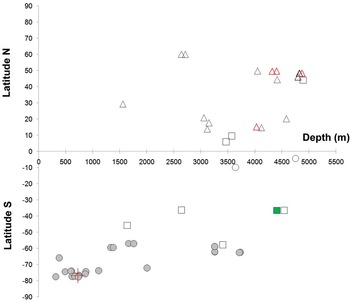
It seems premature to evaluate any real preference for a specific holothuroid host group, but it is clear that this association typically occurs in deepwater environments, between 500 and 5000 m (Fig. 4). In the Southern Hemisphere, there is also a significant depth-latitude correlation (y = 0.0102x−81.505, r = 0.774, n = 36, P<0.001) which indicates that this association becomes shallower as the latitude increases. Presently it is not possible to verify if this represents a case of polar emergence or submergence, as no molecular data are yet available to pinpoint the source population.
Latitudinal and bathymetric distribution of E. typica, both free-living and in association with holothuroid hosts, including literature and present data. Triangles = Atlantic records, white squares = Pacific Ocean, green square = type locality of E. typica, white circles = Indian Ocean, grey circles = Southern Ocean. Records of tanaid-holothuroid relationships (Sieg Reference Sieg1979, Thurston et al. Reference Thurston, Billett and Hassack1987) are highlighted in red. Red cross refers to present data.

Despite the uncertainty in the host preference by E. typica, this kind of parasitic association represents another example of partnerships occurring in Antarctic deepwaters. Such associations are probably more common than previously thought and the ecological impact has still to be properly understood and quantified in these environments (Schiaparelli et al. Reference Schiaparelli, Alvaro, Bohn and Albertelli2010).
Further studies of existing museum material or newly collected specimens will contribute to better define tanaids’ host choice and assess its occurrence and incidence in worldwide deepwater basins.
Acknowledgements
We would like to acknowledge the crew of the Tangaroa expedition ‘IPY-CAML TAN0802’ for logistic support during the cruise. We are indebted to the New Zealand Ministry of Fisheries (MFish) and NIWA (Wellington) for the financial support of the cruise and related study activities. The study was also partially financed by the Polish National Project (MNiSW) 51/N-IPY/2007/0. We thank Mark O'Loughlin (Marine Science Department, Museum Victoria, Melbourne, Australia) for advice and help during the present study. Two anonymous reviewers are acknowledged for their useful comments on the manuscript. This is CAML contribution 56.