INTRODUCTION
The island site of Xaltocan, located in the northern Basin of Mexico, was a thriving regional center in the Early and Middle Postclassic (a.d. 900–1350), controlling many of the towns in the surrounding region, practicing extensive raised-field agriculture, and participating in long-distance trade networks (Brumfiel Reference Brumfiel and Blanton2005c). Households in Xaltocan processed and exchanged goods derived from the surrounding lake in nearby markets (De Lucia Reference De Lucia2013; Gibson Reference Gibson1964:336, 342), and also obtained items, including pottery and obsidian, through exchange (Brumfiel Reference Brumfiel and Brumfiel2005b; Hodge and Neff Reference Hodge, Neff and Brumfiel2005). Previous studies using neutron activation analysis (NAA) have demonstrated that Xaltocan produced both plain and decorated pottery (Nichols et al. Reference Nichols, Brumfiel, Neff, Hodge, Charlton and Glascock2002; Stoner et al. Reference Stoner, Millhauser, Rodríguez-Alegría, Overholtzer and Glascock2014); however, evidence of pottery manufacture in Xaltocan has not previously been identified despite extensive survey and excavation. Household-based pottery production is often difficult to document because it was small in scale and evidence for manufacture may not be visible in surface remains, especially at sites with deeply stratified deposits. For this reason, we have had little understanding of how production was organized in non-workshop contexts. It is important, however, to document less-visible forms of production in order to better understand the role of domestic economies in broader networks of exchange.
In this article, we use multiple lines of evidence to look at household ceramic production in Xaltocan. Using NAA, we examine utilitarian vessels and serving wares from Early Postclassic (a.d. 900–1200) households to look at patterns of production and exchange within Xaltocan. We also examine archaeological evidence for ceramic manufacture to better understand the intensity and organization of production in households. Ethnographic research on pottery-producing households in Mexico (D. Arnold Reference Arnold1985, Reference Arnold2018; P. Arnold Reference Arnold1991; Deal Reference Deal1998; Shott Reference Shott2018; Stark Reference Stark1984; Williams Reference Williams2017, Reference Williams2018) provides invaluable data to help interpret archaeological signatures related to ceramic production through ethnographic analogy. It is important, however, that we do not assume continuity in household organization or production strategies, given that modern contexts have been influenced by colonialism, globalization, and tourism.
We find that Early Postclassic households produced a wide variety of ceramic types, including plain and decorated pottery, while also engaging in the production of other types of goods derived from lake resources. Pottery was produced for household and local consumption on a small scale and we argue that consistency in paste recipe identified through NAA reflects a localized community of practice. Unlike ethnographic contexts, where household production is often associated with poverty, in Early Postclassic Xaltocan households had access to agricultural land and trade goods. Understanding household production in a growing community such as Xaltocan is crucial to interpreting broader economic systems and the ways in which commoners both participated in and influenced the growth and development market systems in Postclassic central Mexico.
HOUSEHOLD MULTICRAFTING AND COMMUNITIES OF PRACTICE
Multicrafting
Ceramic production systems have been theorized at length by other archaeologists (Costin Reference Costin1991, Reference Costin2000; Peacock Reference Peacock1982; Rice Reference Rice1987; Santley et al. Reference Santley, Arnold and Pool1989; Sinopoli Reference Sinopoli1991; van der Leeuw Reference van der Leeuw1977), so we only provide a brief discussion here. Archaeologists traditionally characterized ceramic production as either full-time or part-time in intensity, where full-time production is thought to be specialized, skilled, and associated with nonresidential workshops; and part-time production is thought to be unspecialized, less-skilled, and associated with domestic contexts (Costin Reference Costin1991, Reference Costin2000; Peacock Reference Peacock1982; Rice Reference Rice1987:189; Santley et al. Reference Santley, Arnold and Pool1989; van der Leeuw Reference van der Leeuw1977). According to this model, pottery produced at the household level is thought to be simpler in form, more variable, and less sophisticated in manufacture than pottery produced by full-time, workshop specialists (Sinopoli Reference Sinopoli1991:101). Thus, more finely decorated and standardized ceramics would derive from specialized workshops and simpler, utilitarian vessels would be produced in household contexts (Peacock Reference Peacock1982). Brumfiel and Earle (Reference Brumfiel, Earle, Brumfiel and Earle1987), considering the role of production within the broader political economy, divided specialization into “attached” and “independent,” with attached specialization controlled and sponsored by elites and independent specialization lacking elite control.
These models of ceramic production systems, however, do not apply neatly to ancient Mesoamerica, given that almost all craft production took place in households and not specialized workshops (De Lucia Reference De Lucia2013; Feinman Reference Feinman, Skibo and Feinman1999; Feinman and Nicholas Reference Feinman, Nicholas, Feinman and Manzanilla2000, Reference Feinman, Nicholas, Manzanilla and Hirth2011; Hirth Reference Hirth2009a, Reference Hirth2009b; Otis Charlton Reference Otis Charlton, Hodge and Smith1994). Further, archaeologists have found that Mesoamerican households often engaged in more than one craft activity, or multicrafting, as a form of diversification (De Lucia Reference De Lucia2013; Feinman Reference Feinman, Skibo and Feinman1999; Feinman and Nichols Reference Feinman, Nicholas, Manzanilla and Hirth2011; Hirth Reference Hirth2009a, Reference Hirth2009b; Otis Charlton Reference Otis Charlton, Hodge and Smith1994). Multicrafting often occurs where overlapping technologies can be used to produce different products (Feinman Reference Feinman, Skibo and Feinman1999; Otis Charlton Reference Otis Charlton, Hodge and Smith1994). At Otumba, Mexico, for example, figurine workshops made a variety of ceramic objects including figurines, utilitarian vessels, censers, toys, stamps, whistles, spindle whorls, and other clay items (Otis Charlton Reference Otis Charlton, Hodge and Smith1994:204; Charlton and Charlton Reference Otis Charlton, Charlton, Manzanilla and Hirth2011:242). Crafting was also often contingent, where multiple goods were produced as part of the process of making a single commodity (Hirth Reference Hirth2009a:22). For example, researchers found that maguey fiber (possibly cloth-producing) workshops, also produced objects, including ceramic spindle whorls and fiber processing tools, that may have been used in fiber production or for market exchange (Nichols et al. Reference Nichols, McLaughlin and Benton2000).
Craft production in ancient Mesoamerican households likely occurred only intermittently, as it would have been affected by other household activities, resource availability, or agricultural cycles. Thus, Hirth (Reference Hirth2009a) argues that traditional distinctions made by archaeologists between full-time and part-time production are not necessarily relevant to production in ancient Mesoamerica. Rather than focusing on the amount of time spent on one particular craft activity, Hirth (Reference Hirth2009a:21) defines intermittent crafting as the “discontinuous or periodic craft production that takes place within domestic contexts alongside other subsistence pursuits” and highlights the overall contribution of craft production to the domestic economy. In addition, Flad and Hruby (Reference Flad and Hruby2007) argue that the production of products for exchange outside of the household does not require that producers be free from other domestic tasks such as agriculture. Unlike models of part-time and full-time specialization, intermittent crafting and multicrafting are not mutually exclusive concepts, and may be more relevant to the domestic economies of ancient Mesoamerica (Hirth Reference Hirth2009a).
There is little evidence to suggest that elites were heavily involved in or controlled household-based production, given that workshop contexts are rare in much of ancient Mesoamerica and there is little evidence for large-scale storage of goods (Feinman and Nichols Reference Feinman, Nicholas, Rosenswig and Cunningham2017:261). According to Feinman and Nicholas (Reference Feinman, Nicholas, Manzanilla and Hirth2011:46), when production is taking place within many households, “the direct control of these economic activities would have been nearly impossible to centrally control at the many points of domestic manufacture.” Instead, households may have produced surplus goods for exchange to gain access to goods or resources that were not locally available. Such production is often secondary in importance to agricultural production and serves to supplement agricultural activities. For example, Arnold (Reference Arnold1991:26) notes that ceramic production in the Tuxtlas region of Mexico takes place primarily during the dry season and can be delayed until all agricultural activities are completed, as all household labor is needed in the fields. Pottery production in particular may have served as a survival strategy for poorer households. Ethnographic studies of household ceramic production suggest that potting serves as an important risk minimization or buffer strategy in years of crop failure and to supplement income in nonagricultural seasons (D. Arnold Reference Arnold1985:99; P. Arnold Reference Arnold1991:26; Deal Reference Deal1998:43; Netting Reference Netting1993; M. Stark Reference Stark1991; Wilk Reference Wilk1997). Cross-culturally, potters often belong to lower-status households and production is sometimes seen as a strategy that households are forced into during difficult times or due to lack of access to land (Arnold Reference Arnold1985:226; Deal Reference Deal1998:25; Graves Reference Graves and Longacre1991; Peacock Reference Peacock1982:23; Rice Reference Rice1987; Shott Reference Shott2018:33).
Pottery Production and Social Identity
Given that production in ancient Mesoamerica was largely household-based, potters would have learned production techniques within the household, likely through family members. In addition to skill and the desire to learn, potters would have required strong social networks, as learning to make pottery necessitates a close relationship with a potter willing to provide the time and energy needed to teach a novice (Deal Reference Deal1998:27; Fowler Reference Fowler2011:193). Modern potters often learn their craft from immediate family members or relatives (Arnold Reference Arnold1991:30; Gosselain Reference Gosselain2000:193; Williams Reference Williams2017:36). Consequently, ethnoarchaeology has demonstrated that recipes, manufacturing techniques, and production sequences (chaínes opératoires) are associated with pottery traditions and can often be sensitive indicators of social groups; thus, social networks become reflected in pottery technology (Fowler Reference Fowler2011, Reference Fowler2015; Gosselain Reference Gosselain2000; Stark et al. Reference Stark, Bishop and Miksa2000). As such, we can think about common participation in pottery production as intimately tied to social identity, or as comprising a community of practice (Lave and Wenger Reference Lave and Wenger1991). As explained by Lave and Wenger (Reference Lave and Wenger1991:35), learning is situated and “the mastery of knowledge and skill requires newcomers to move towards full participation in the sociocultural practices of a community.” New manufacturing techniques tend to be rare, except when a potter relocates or seeks to produce a new type of vessel (Gosselain Reference Gosselain2000:192). Thus, whereas stylistic variation can change rather rapidly as decorations can be easily copied, clay processing and manufacturing techniques tend to be more conservative and stable, changing slowly and are more likely to reflect enduring social identities (De La Fuente Reference De La Fuente2011:247; Fowler Reference Fowler2011:198, Reference Fowler2015:9; Gosselain Reference Gosselain2000; Sassaman and Rudolphi Reference Sassaman and Rudolphi2001; Stark et al. Reference Stark, Bishop and Miksa2000:298). Given the conservative nature of manufacturing techniques, the distinctiveness of paste recipes, and the sensitivity of compositional data, it is possible that variation in compositional data could even reflect individual production units (Costin Reference Costin2000:388).
AN EARLY POSTCLASSIC REGIONAL CENTER IN THE BASIN OF MEXICO
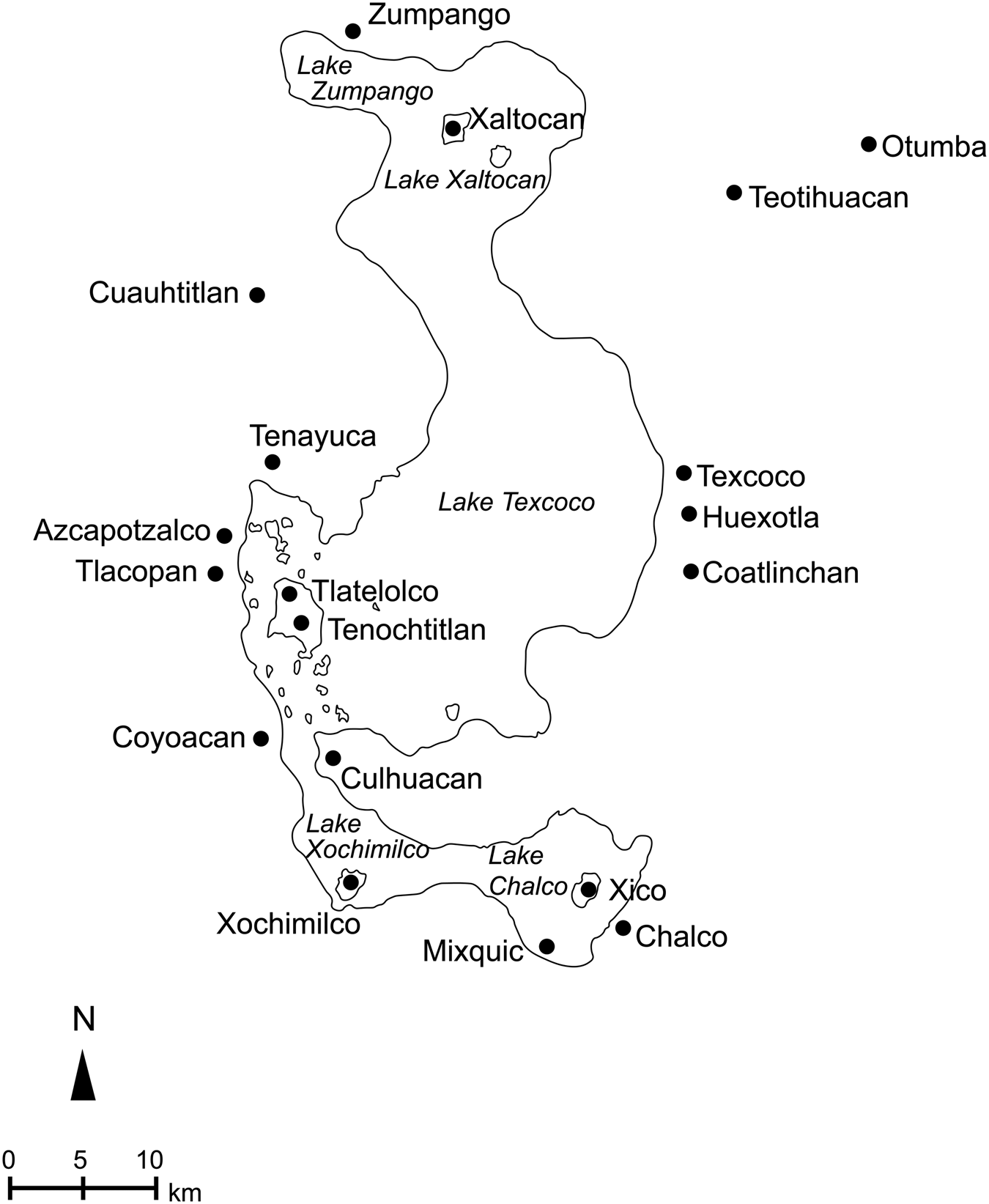
Xaltocan was an island community located in the middle of Lake Xaltocan, in the northern Basin of Mexico (Figure 1). Xaltocan was founded before the rise of the Aztec Empire at the beginning of the Early Postclassic, around a.d. 900 (Brumfiel Reference Brumfiel and Brumfiel2005a, Reference Brumfiel and Brumfiel2005b). Historic accounts suggest Xaltocan had become the capital of the Otomi nation by a.d. 1220, controlling much of the northern Basin and collecting tribute from surrounding villages (Carrasco Pizana Reference Carrasco Pizana1950:258–259; Gibson Reference Gibson1964:440). The lake system in the Basin of Mexico was highly productive, and throughout much of Xaltocan's history its inhabitants sold many goods obtained from lake resources at regional markets, such as fish, reed mats, and waterfowl (De Lucia Reference De Lucia2011, Reference De Lucia2013; Gibson Reference Gibson1964; Roush Reference Roush and Brumfiel2005). With the collapse of nearby Tula (ca. a.d. 1150), Xaltocan expanded its influence and may have gained control over surrounding resources (Brumfiel Reference Brumfiel and Blanton2005c; Morehart and Eisenberg Reference Morehart and Eisenberg2010). The Anales de Cuauhtitlan state that, by the mid-thirteenth century, Xaltocan had become embroiled in a war with Cuauhtitlan and was conquered by the Tepanecs in a.d. 1395 (Bierhorst Reference Bierhorst1992:75). Along with the other city-states in the Basin of Mexico, Xaltocan was eventually incorporated into the Aztec Empire (Bierhorst Reference Bierhorst1992:60; Hicks Reference Hicks, Marcus and Zeitlin1994).
Valley of Mexico, showing reconstructed lake levels and major archaeological sites. Illustration by Brian Ma.

In Early Postclassic central Mexico, there was a marked increase in regional exchange compared to the prior Epiclassic (a.d. 650–900)—a period of conflict and limited economic interaction (Crider Reference Crider2013; Hirth Reference Hirth, Diehl and Berlo1989; Nichols et al. Reference Nichols, Brumfiel, Neff, Hodge, Charlton and Glascock2002; Nichols et al. Reference Nichols, Elson, Cecil, de Estrada, Glascock and Mikkelsen2009; Sanders et al. Reference Sanders, Parsons and Santley1979). During the Early Postclassic, the regional exchange of ceramics from urban centers, particularly the exchange of decorated vessels, began to increase (Nichols et al. Reference Nichols, Brumfiel, Neff, Hodge, Charlton and Glascock2002, Reference Nichols, Elson, Cecil, de Estrada, Glascock and Mikkelsen2009). Nichols et al. (Reference Nichols, Elson, Cecil, de Estrada, Glascock and Mikkelsen2009) argue that political boundaries imposed limitations on exchange, as there were only two major production and stylistic zones, including Mazapan pottery, found in the eastern and northern Basin, and Aztec I Black-on-Orange pottery, present in the southern Basin, Cholula, Xaltocan, and southwest Puebla. Nonetheless, pottery moved across political boundaries in the southern and western regions of the Basin of Mexico (Nichols et al. Reference Nichols, Brumfiel, Neff, Hodge, Charlton and Glascock2002, Reference Nichols, Elson, Cecil, de Estrada, Glascock and Mikkelsen2009). As argued by Hodge and Minc (Reference Hodge and Minc1990:433), the Early Postclassic can best be described as having noncentralized market exchange, in which exchange occurred freely among polities within confederations but was constrained by confederation borders. Crider (Reference Crider2013:125) further argues that Aztec I users in the southern Basin and Xaltocan may have “formed an economic and political wedge between the eastern and western Basin,” limiting interactions between these regions. The presence of a wide diversity of imported goods in all commoner contexts indicates that goods, including ceramics, were obtained through marketplace exchange (Hirth Reference Hirth1998).
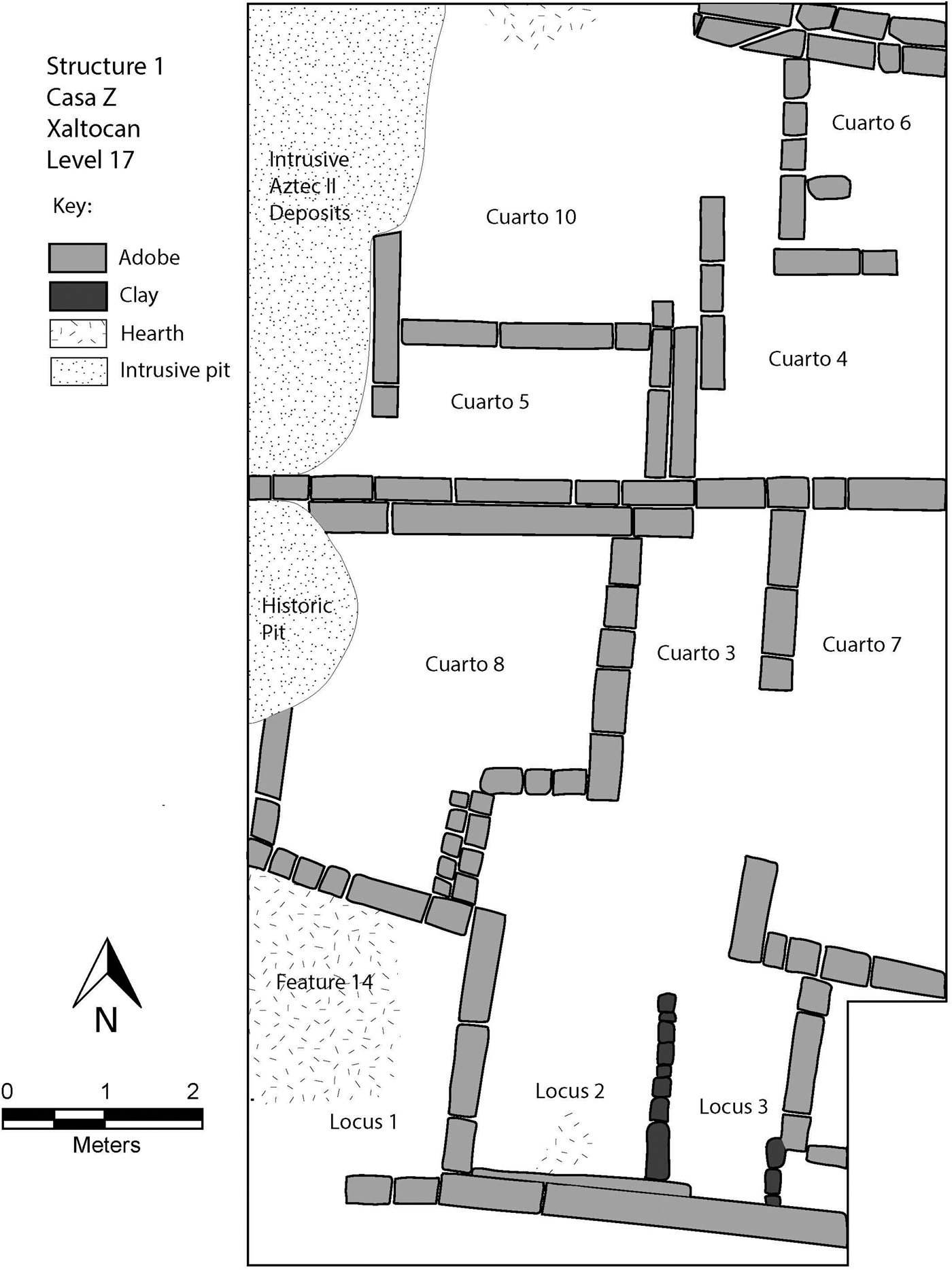
Despite over three decades of archaeological research in Xaltocan, including extensive surveys and excavations by multiple researchers, we have had little understanding of the contexts of ceramic production in Xaltocan. NAA has demonstrated that ceramics, including Aztec I Black-on-Orange pottery, were produced in Xaltocan (Crider Reference Crider2011; Nichols et al. Reference Nichols, Brumfiel, Neff, Hodge, Charlton and Glascock2002; Stoner et al. Reference Stoner, Millhauser, Rodríguez-Alegría, Overholtzer and Glascock2014); however, archaeological evidence for ceramic production has been scarce. At Xaltocan, unmixed Early Postclassic deposits with Aztec I Black-on-Orange pottery were primarily associated with the period between a.d. 900–1250 (Brumfiel Reference Brumfiel and Brumfiel2005a; De Lucia Reference De Lucia2011). Five Aztec I domestic units have been excavated across Xaltocan, including Casa G, Casa Y, Casa Z Structure 1, Casa Z Structure 2, and Op Zoc (Brumfiel Reference Brumfiel2009; Brumfiel and Rodríguez-Alegría Reference Brumfiel and Rodríguez-Alegría2010; De Lucia Reference De Lucia2011; De Lucia and Overholtzer Reference De Lucia and Overholtzer2014). The following analysis focuses on data from Casa Z Structure 1 (Figure 2), a multi-room, multi-household domestic structure, as this is the only excavated context in Xaltocan where evidence for ceramic production has been identified. As has been demonstrated elsewhere (De Lucia Reference De Lucia2011, Reference De Lucia2013), Casa Z Structure 1 was inhabited by commoners that engaged in various activities, including mat-making, fish-processing, bone tool production, and weaving. Radiocarbon dates associated specifically with Aztec I occupational contexts in Structure 1 date primarily to the mid-twelfth through mid-thirteenth centuries a.d., with 2-sigma calibrated ranges as early as a.d. 1000–1170 and as late as a.d. 1220–1290 (Brumfiel Reference Brumfiel2005d:Table 1; De Lucia Reference De Lucia2011:Table 1.2). A 2-sigma calibrated date of a.d. 1040–1260 (intercept a.d. 1180) was taken directly from the kiln discussed below (Brumfiel Reference Brumfiel2005d:15). Because of good contextual data associated with deep deposits, Xaltocan provides an important case study for understanding the production and circulation of ceramics in Early Postclassic Mexico.
Plan layout of Structure 1, showing location of Feature 14 in the southwest corner. Note hearths in Cuarto 10 and Locus 2 are significantly smaller than Feature 14. Illustration by De Lucia.

COMPOSITIONAL ANALYSES IN THE BASIN OF MEXICO
NAA of ceramics has been used extensively in the Basin of Mexico to study political and exchange networks (Brumfiel and Hodge Reference Brumfiel, Hodge, Mastache and Parsons1996; Crider Reference Crider2011, Reference Crider2013; García Chávez Reference García Chávez2004; Garraty Reference Garraty2006, Reference Garraty2013; Hodge Reference Hodge1992; Hodge and Minc Reference Hodge and Minc1990; Hodge and Neff Reference Hodge, Neff and Brumfiel2005; Hodge et al. Reference Hodge, Neff, James Blackman and Minc1993; Minc Reference Minc1994, Reference Minc2009; Minc et al. Reference Minc1994; Nichols et al. Reference Nichols, Brumfiel, Neff, Hodge, Charlton and Glascock2002; Stoner et al. Reference Stoner, Millhauser, Rodríguez-Alegría, Overholtzer and Glascock2014). Geochemical analyses of ceramic artifacts aimed at studying artifact provenance within the Basin were first undertaken in the 1970s (Abascal-Macías Reference Abascal Macías1974; Abascal-Macías et al. Reference Abascal Macías, Harbottle and Sayre1974; Branstetter-Hardesty Reference Branstetter-Hardesty1978) and expanded by Hodge and colleagues during the late 1980s and early 1990s (Hodge Reference Hodge1992; Hodge et al. Reference Hodge, Neff, James Blackman and Minc1993; Minc et al. Reference Minc1994). Compositional analyses of ceramic artifacts from the Basin of Mexico have continued since the completion of these pioneering studies, and at present the database of the Archaeometry Laboratory at the University of Missouri Research Reactor (MURR) contains compositional data for almost 6,000 artifacts, clay sources, and tempering agents from the region. Compositional reference groups used for comparisons in this study are thus based on prior studies (Neff and Glascock Reference Neff and Glascock2000; Neff et al. Reference Neff, Ciliberto and Spoto2000; Nichols et al. Reference Nichols, Brumfiel, Neff, Hodge, Charlton and Glascock2002; Stoner et al. Reference Stoner, Millhauser, Rodríguez-Alegría, Overholtzer and Glascock2014), and are described in detail by Nichols et al. (Reference Nichols, Brumfiel, Neff, Hodge, Charlton and Glascock2002) and Stoner et al. (Reference Stoner, Millhauser, Rodríguez-Alegría, Overholtzer and Glascock2014).
Ceramic compositional groups Xaltocan-1, Xaltocan-2, and Xaltocan-3, have been defined from ceramics collected at Xaltocan, suggesting that they came from clay sources in the northern Valley (Nichols et al. Reference Nichols, Brumfiel, Neff, Hodge, Charlton and Glascock2002:36). Stoner et al. (Reference Stoner, Millhauser, Rodríguez-Alegría, Overholtzer and Glascock2014) further subdivided the Xaltocan-1 reference group into Xaltocan-1a and Xaltocan-1b, where Xaltocan-1a is similar to ceramics produced at Cuauhtitlan and Xaltocan-1b is distinctive to Xaltocan. Xaltocan pastes have a characteristic high-sodium, high-potassium chemical signature likely reflecting the use of raw materials from the local brackish lake environment (Stoner et al. Reference Stoner, Millhauser, Rodríguez-Alegría, Overholtzer and Glascock2014). Stoner et al. (Reference Stoner, Millhauser, Rodríguez-Alegría, Overholtzer and Glascock2014) conclude that the unique signature of Xaltocan pottery is the result of cultural practices, such as the use of salty water or salty clays in the production process, that remained consistent through time. Experimental analysis reveals that high sodium levels become fixed during the firing and cannot be leached from the ceramics so that Xaltocan ceramics can be easily sourced throughout the Basin (Stoner et al. Reference Stoner, Millhauser, Rodríguez-Alegría, Overholtzer and Glascock2014). Previous NAA studies have also found that imported ceramics in Xaltocan derived from multiple production centers including Cuauhtitlan, the Tenochtitlan/Culhuacan region, Chalco, Cholula, and an unidentified source in the southern Basin (Crider Reference Crider2011; Hodge and Neff Reference Hodge, Neff and Brumfiel2005; Nichols et al. Reference Nichols, Brumfiel, Neff, Hodge, Charlton and Glascock2002). The following research builds upon these previous studies of interaction and exchange and situates ordinary households within this regional framework.
NEUTRON ACTIVATION ANALYSIS
Although this analysis focuses on a ceramic complex from a single structure, previous excavations conducted by Brumfiel and colleagues in Xaltocan (Brumfiel Reference Brumfiel and Brumfiel2005b, Reference Brumfiel2009; Brumfiel and Rodríguez-Alegría Reference Brumfiel and Rodríguez-Alegría2010) have provided a sitewide perspective, with data collected from test pits and surface surveys across the site. This analysis, therefore, allows us to look more closely at ceramics produced and used at the household level in comparison to previous sitewide studies. Additionally, because these data derive from stratified horizontal excavations, ceramics can be analyzed from sealed contexts.
Over 12,400 utilitarian and decorated sherds were analyzed from the excavations of Casa Z Structure 1. De Lucia recorded multiple technological attributes of ceramics, including paste color (using Munsell Soil Color Charts), temper, evidence of overfiring, and usewear. Temper identification was performed using a hand lens (20× magnification) and follows methodological criteria outlined by Orton and Hughes (Reference Orton and Hughes2013:Appendix 1). Additionally, form, paint color, slip, burnishing, and decorative motifs were also documented. Of this collection from Structure 1, a sample of 102 ceramic sherds, both decorated and plainwares, were selected and submitted for NAA at MURR. The sample includes 65 plain utilitarian sherds (25 ollas, 25 comales, and 15 bowls) and 37 decorated sherds (21 Black-on-Orange, 6 Black-on-Red, 4 Brown Incised, 5 Red-on-Buff, and 1 Studded Brazier). Samples were selected from multiple, sealed contexts across the structure and different stratigraphic levels that represent pre-Aztec contexts. As such, the samples represent the range of occupation of Structure 1. Utilitarian samples were selected to represent a diversity of forms and variants within each category in order to determine if rim form varied according to location of production (e.g., high-wall versus flat comales or recurved rim jars versus upright rims). As discussed below, given that virtually all plainware sherds sourced locally to Xaltocan, form attributes were not found to correlate with production location.
Decorated sherds were selected to represent a diversity of design motifs and paste colors to determine if different paste colors or styles were associated with different locations of production. De Lucia (Reference De Lucia2011, Reference De Lucia2018) discusses design motifs of decorated wares in greater detail elsewhere. Because previous studies have focused primarily on decorated wares (Crider Reference Crider2011; Hodge and Neff Reference Hodge, Neff and Brumfiel2005; Nichols et al. Reference Nichols, Brumfiel, Neff, Hodge, Charlton and Glascock2002), the goal of this study is to emphasize plainwares and to compare results from Structure 1 to sitewide trends. This sample adds to previous samples from Xaltocan tested at MURR including 153 sherds by Brumfiel (Nichols et al. Reference Nichols, Brumfiel, Neff, Hodge, Charlton and Glascock2002), 47 sherds by Hodge and Neff (Reference Hodge, Neff and Brumfiel2005), and 37 sherds by Crider (Reference Crider2011), among others. In addition, Peters (Reference Peters2002) analyzed 160 plain utilitarian sherds by NAA at the University of Michigan Phoenix Lab and Ford Nuclear Reactor facilities.
The NAA and multivariate statistical techniques used to analyze compositional data from the Structure 1 sample have been described elsewhere (Baxter Reference Baxter, Lock and Moffett1992; Baxter and Buck Reference Baxter, Buck, Ciliberto and Spoto2000; Bieber et al. Reference Bieber, Brooks, Harbottle and Sayre1976; Bishop and Neff Reference Bishop, Neff and Allen1989; Glascock Reference Glascock and Neff1992; Neff Reference Neff1994, Reference Neff, Ciliberto and Spoto2000, Reference Neff, Glowacki and Neff2002); thus, only a brief summary is provided here. NAA was performed at MURR by Boulanger and Glascock and consisted of two irradiations and three gamma counts for each specimen (Glascock Reference Glascock and Neff1992; Glascock and Neff Reference Glascock and Neff2003). A short irradiation was performed through a pneumatic-tube irradiation system, in which specimens were irradiated for 5 seconds at a neutron flux of 8 × 10¹³ n/cm2 per second and then subjected to a 720 second gamma count. The second irradiation consisted of 24 hours at a neutron flux of 5 × 10¹³ n/cm2 per second, with two counts subsequently performed: one for 1,800 second after seven days of decay, and the second count for 8,500 seconds after three weeks of decay.
The two irradiations and three gamma counts allow detection and quantification of 33 elements, and these abundances are tabulated in parts per million (ppm). As is often the case with pottery from the Basin of Mexico, nickel (Ni) was determined to be at or below detection limits in a majority of the specimens. It was therefore omitted from consideration during subsequent statistical analyses. Statistical analysis of the remaining data was performed on base-10 logarithms of the elemental abundances to compensate for differences in magnitude between major and trace elements.
NAA Results
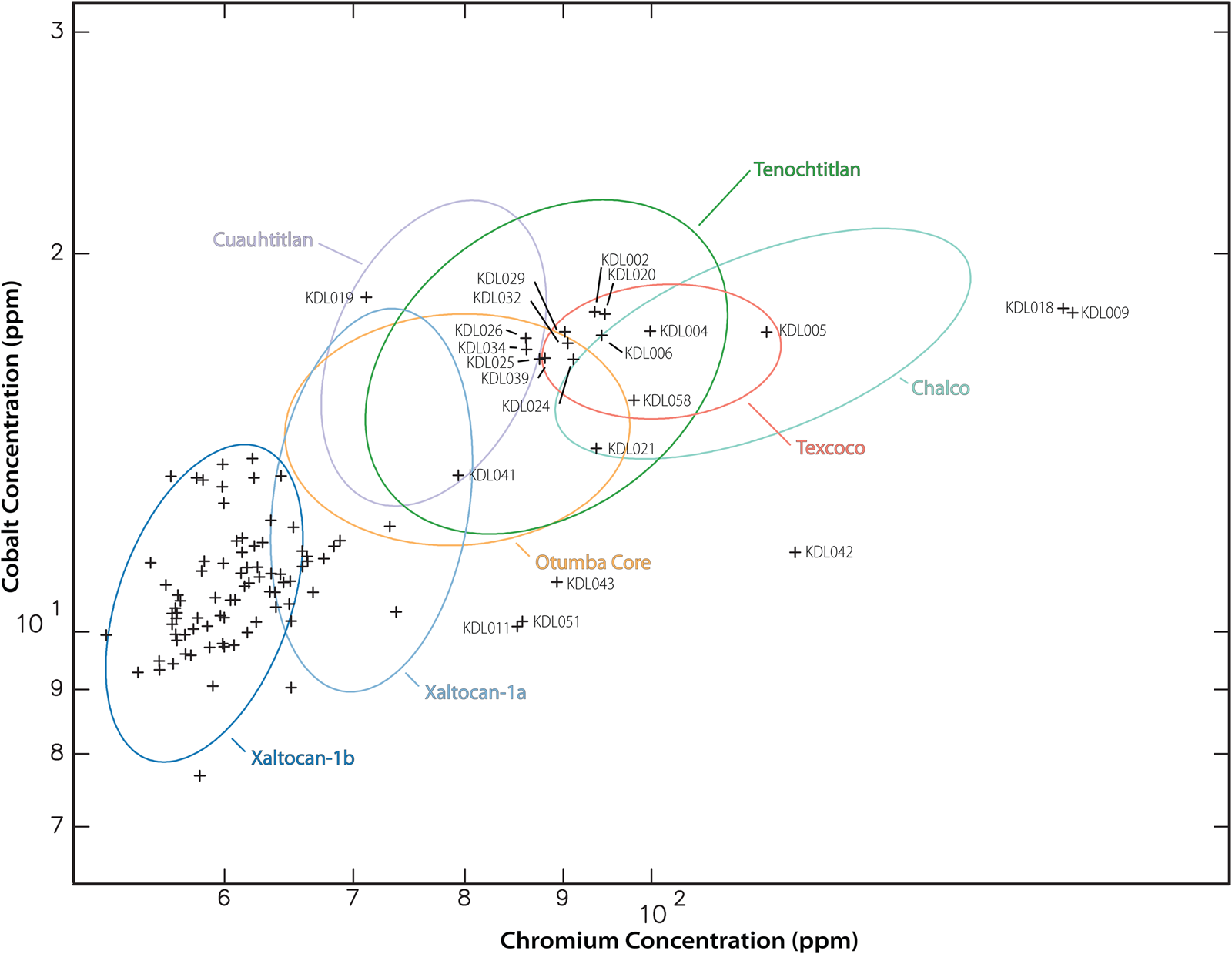
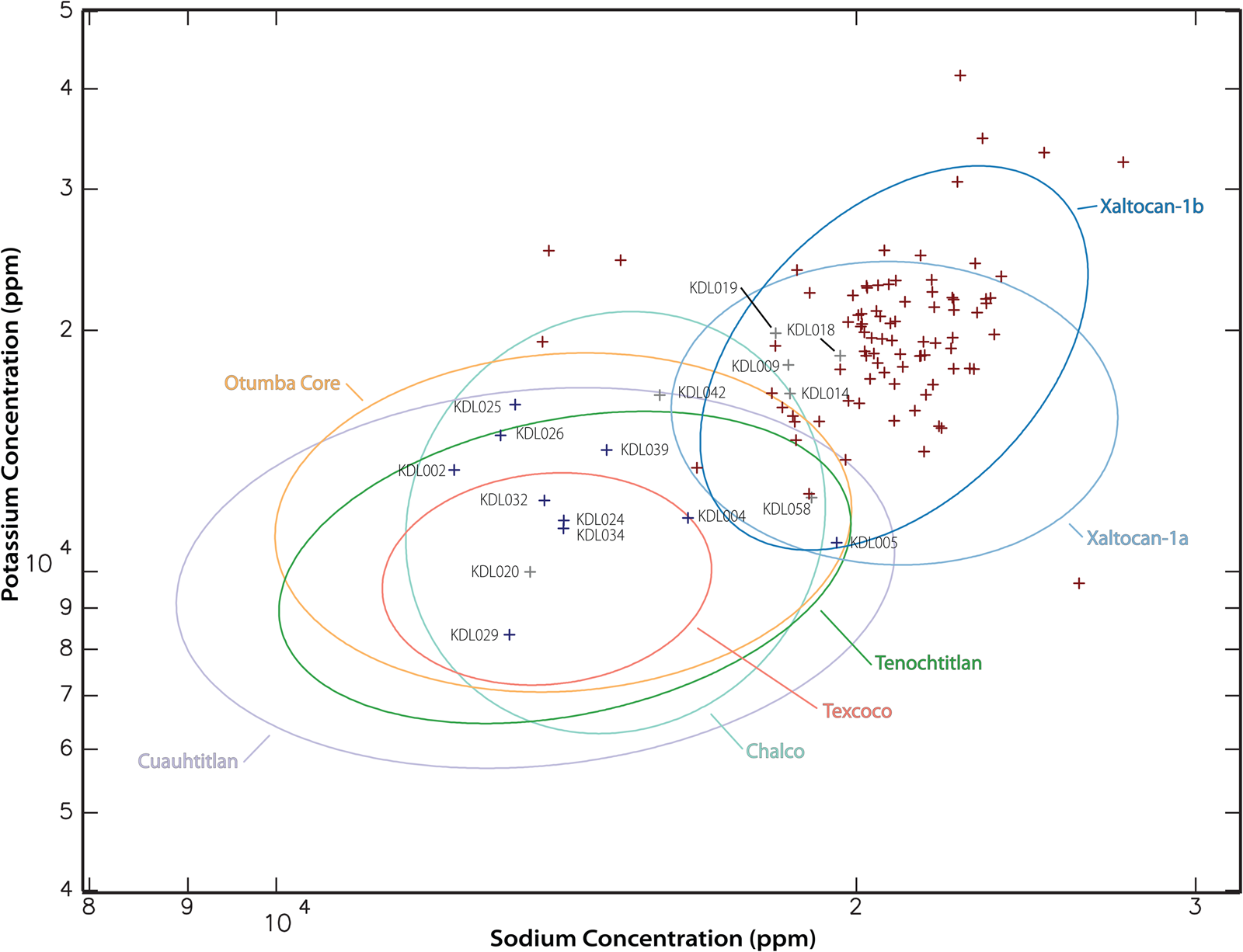
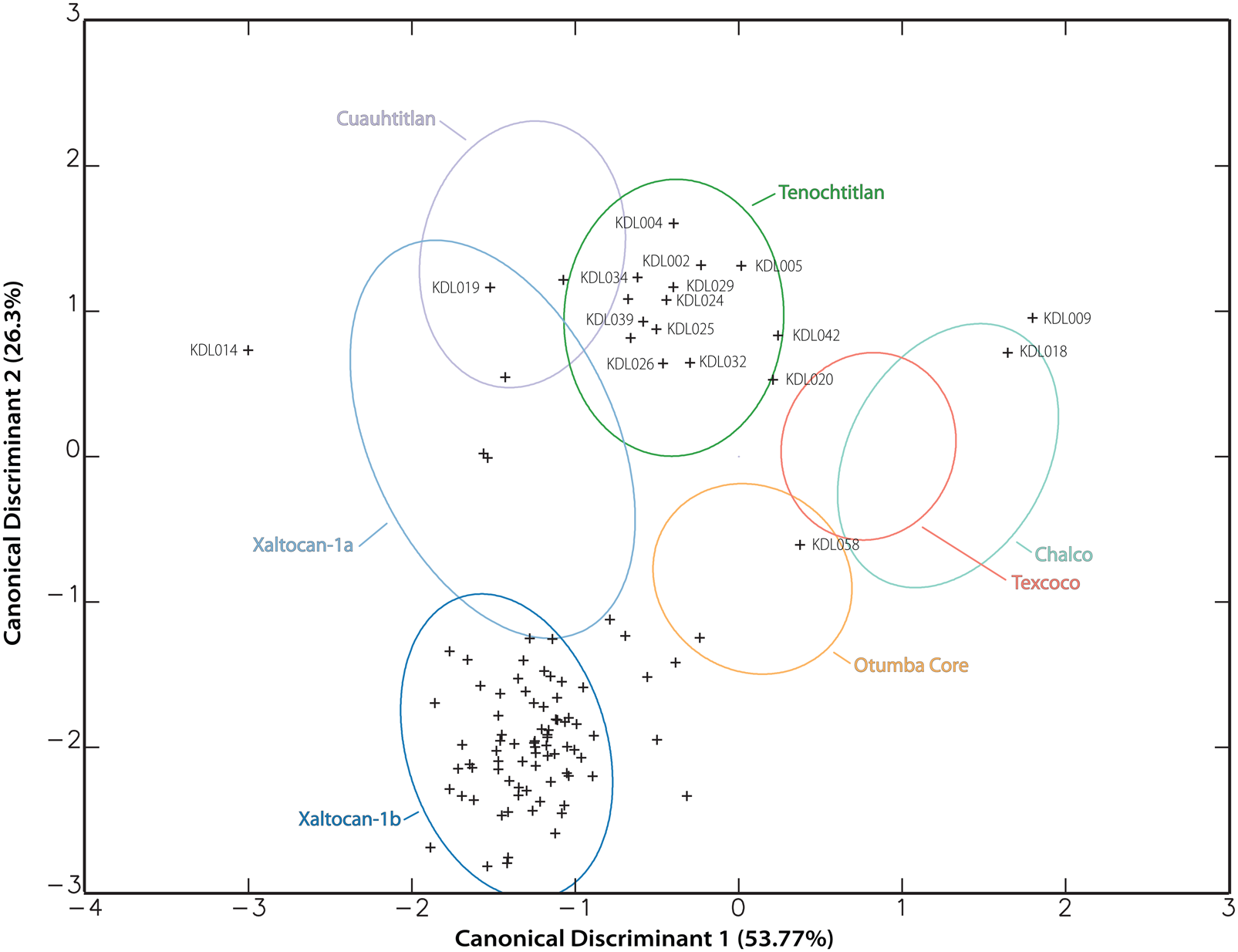
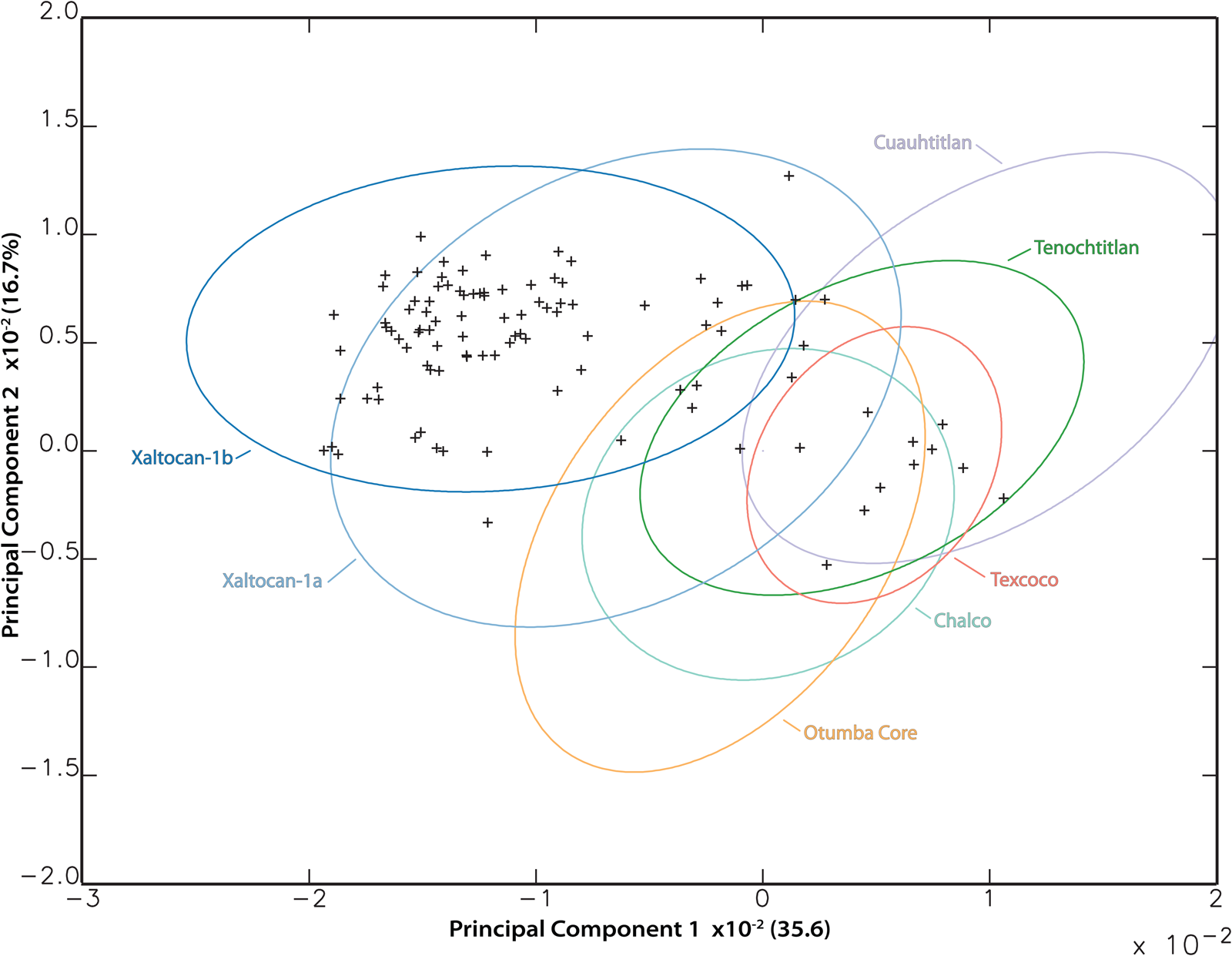
Principal components analysis of the combined Basin of Mexico database indicates that greater than 90 percent of the cumulative variance in the database is explained by 12 PCs. Biplots of the PCA scores suggest subgroup patterning within the newly analyzed sample from Structure 1. A majority of the specimens show enrichment in alkali and alkaline elements, whereas several specimens show enrichment in multiple rare earth elements (REEs) and transition metals. Projecting these data against previously defined compositional groups for the Basin of Mexico suggests that most of the specimens share compositional affinity with the Xaltocan-1 reference group, specifically the Xaltocan-1b compositional subgroup defined by Stoner et al. (Reference Stoner, Millhauser, Rodríguez-Alegría, Overholtzer and Glascock2014). The extreme degree of overlap of most Basin of Mexico compositional groups in multivariate space precludes unequivocal assignment of some of the newly analyzed specimens based solely on elemental abundances, PC scores, or discriminant functions. We therefore outline a consensus-based approach for assigning our specimens to any single compositional group. Bivariate plots of elemental concentrations, as well as plots of multivariate (i.e., PC and CD) axes (Figures 3–6) suggest that a majority of specimens in the newly analyzed sample are compositionally similar to the Xaltocan-1b subgroup. Of note is the strong degree of clustering shown by samples in these plots, suggesting a relatively uniform composition from Structure 1 compared to the somewhat variable compositional profile of the broader Xaltocan-1 group defined and used by earlier studies in the region (compare with Peters [Reference Peters2002] and Nichols et al. [Reference Nichols, Brumfiel, Neff, Hodge, Charlton and Glascock2002]). Such clustering may reflect a more consistent mixture of clay and temper (i.e., paste recipe) used in the production of these specimens than that which is currently represented by other compositional groups in the region.
Bivariate plot of chromium and cobalt concentrations showing newly analyzed samples (+) from Structure 1 (both plainware and decorated) and previously defined Valley of Mexico compositional groups. Ellipses represent the 90-percent confidence interval of group membership. Newly analyzed samples that do not appear to fit the Xaltocan-1 compositional profile are labeled with University of Missouri Research Reactor analytical identification numbers.

Bivariate plot of sodium and potassium, showing newly analyzed samples (+; both plainware and decorated) and previously defined Valley of Mexico compositional groups. Ellipses represent the 90-percent confidence interval of group membership. Newly analyzed samples that do not appear to fit the Xaltocan-1 compositional profile are labeled with University of Missouri Research Reactor analytical identification numbers.

Bivariate plot of the first two discriminant axes for the VOM database. Samples assigned to the Xaltocan-1 compositional group are shown (+), potential outliers are labeled with University of Missouri Research Reactor analytical identification numbers. Ellipses represent the 90-percent confidence interval of group membership.

Bivariate plot of the first two principal components calculated for the entire Valley of Mexico (VOM) database. Newly analyzed samples (both plainwares and decorated) are shown, as are ellipses representing the 90-percent confidence interval of group membership for previously defined VOM compositional groups. This plot explains 49.3 percent of the cumulative variance in the dataset.

Mahalanobis distance–based probabilities of group membership were calculated for the newly analyzed specimens from Structure 1 (Supplemental Tables 1–4). Because of the somewhat variable composition of Basin of Mexico ceramics and the high degree of overlap in compositional space of previously defined reference groups, we calculated group membership probabilities in three manners. One set of probabilities was derived using the entire 32-element dataset. A second set of probabilities was calculated using a subset of elements considered by Neff and Glascock (Reference Neff and Glascock2000) to best discriminate source materials within the Basin of Mexico. Finally, a third set of group-membership probabilities was derived from the first 12 PCs for the Basin of Mexico database (accounting for more than 90 percent of the cumulative variation). As a last step in the analysis, these data were projected onto discriminant axes calculated using the major Basin of Mexico compositional reference groups. Final group assignments were based on a consensus of Mahalanobis distance-based probabilities, as well as canonical discriminant plots.
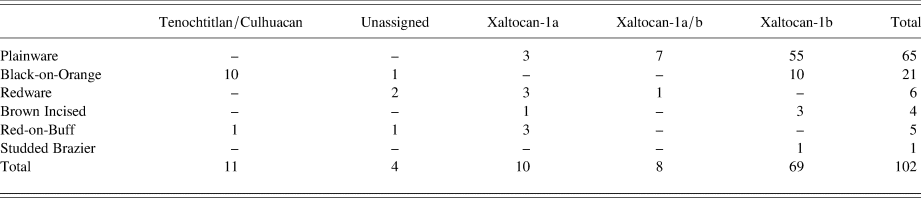
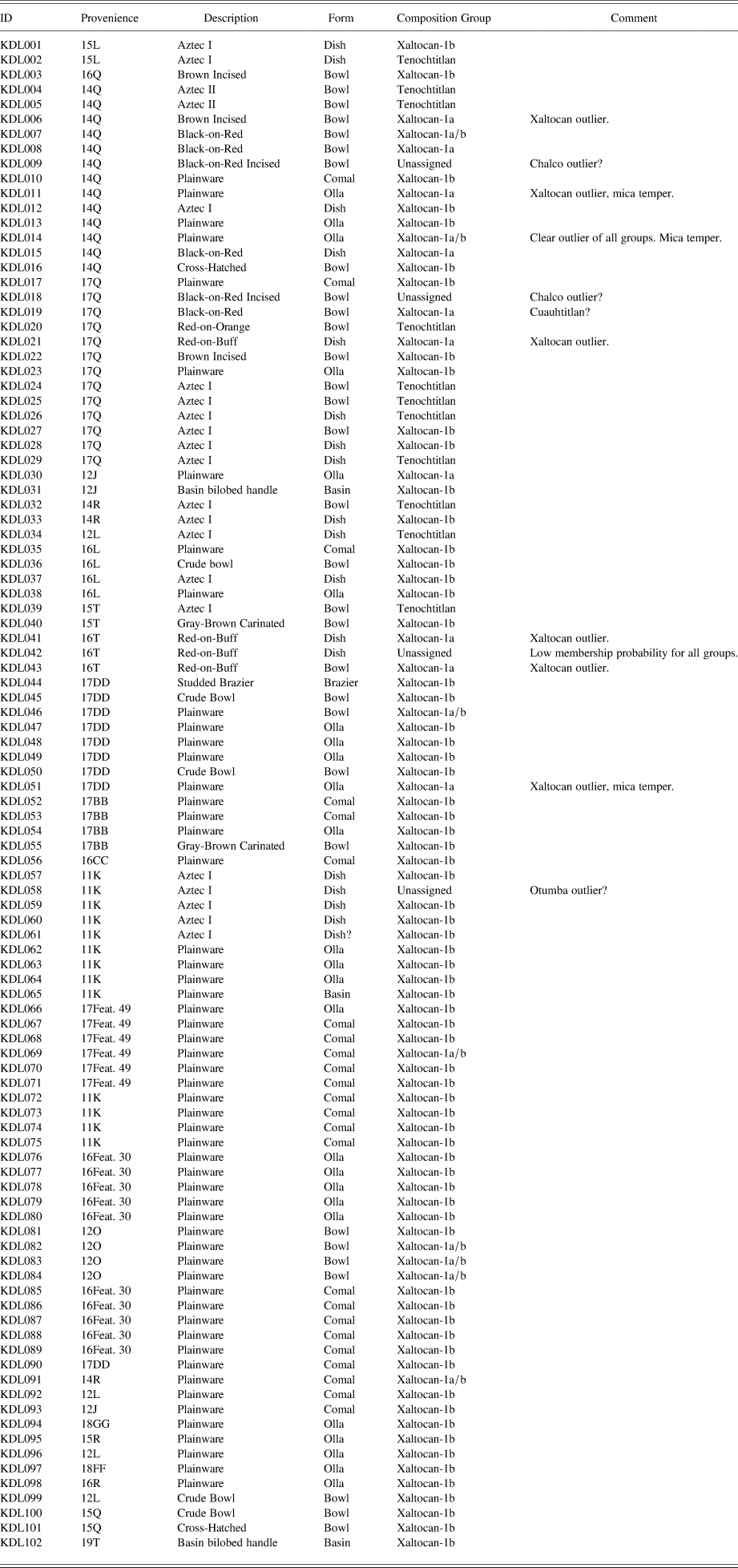
The results of these analyses suggest that the majority of specimens sampled from Structure 1 can be confidently assigned a provenance associated with the site of Xaltocan. These are primarily plainwares, though Black-on-Orange wares and other decorated types are represented in small percentages (Tables 1 and 2). A small proportion of specimens appear to be associated with ceramic production in the vicinity of Tenochtitlan (most likely Culhuacan). These specimens are almost exclusively sand-tempered Black-on-Orange wares. The compositional affiliations for each specimen are listed in Table 3. It is notable that virtually all plainwares in the Structure 1 sample are assigned a Xaltocan provenance (i.e., Xaltocan-1b). Four plain olla sherds, three of which contain mica temper, are all generally assignable to the broad Xaltocan-1 group, but their overall best assignment is to the Xaltocan-1a subgroup associated with a diverse group of pastes made with saline-rich raw materials obtained from lakeshore deposits along the northern end of Lake Xaltocan. Mica temper is not present in any of the other samples. Mica may be found naturally in clay indicating that this clay derived from a different clay source, or the clay may have been tempered with crushed micaceous rock (Rice Reference Rice1987:410).
Percentages of sherds from Structure 1, Xaltocan, assigned to compositional groups from the Tenochtitlan/Culhuacan region compared to the Xaltocan-1 group.

Cross tabulation of group assignments by pottery type of Structure 1 sample showing number of sherds produced in the Tenochtitlan/Culhuacan region compared to the Xaltocan-1 group.

Contexts and descriptions of sourced ceramics.

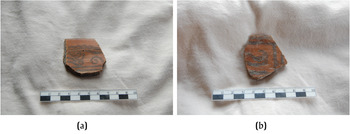
The presence of nonlocal decorated wares, including Black-on-Orange sherds that appear to have been produced near Tenochtitlan/Culhuacan, indicates that the inhabitants of Structure 1 engaged in some exchange. Yet, the overwhelming compositional signature represented in the sample is one of local production—regardless of ceramic ware. One unexpected outcome of this study was the relatively confident assignment of sherds to the Xaltocan-1b reference group. Compositional studies in the Basin of Mexico are notoriously difficult because of broad chemical similarities in regional clay sources. Almost all of the sherds sampled from Structure 1 show strong internal clustering within the Xaltocan-1b group (except for the imported wares). This clustering pattern indicates that a consistent mixture of clay and temper was used. As noted above, Stoner et al. (Reference Stoner, Millhauser, Rodríguez-Alegría, Overholtzer and Glascock2014) observe that the Xaltocan-1b paste recipe is almost exclusively found at Xaltocan and is rarely identified in other locations and therefore they argue that it represents local production and consumption. Our data strongly support this conclusion. All of the plainwares assayed here fall into the broader Xaltocan-1 group, but it was particularly surprising to find that some decorated wares including Black-on-Orange (Figure 7), Brown Incised, and Studded Braziers cluster in the Xaltocan-1b subgroup with plainwares.
Example of Aztec I Black-on-Orange sherds sourced to (a) the Tenochtitlan/Culhuacan composition group and (b) Xaltocan-1b composition group. Photographs by De Lucia.

The current results from Structure 1 are distinct from the pattern identified by a sitewide study of plainwares conducted by Peters (Reference Peters2002) at Xaltocan. Peters selected 40 Early Postclassic plainwares from test excavations conducted by Brumfiel across the site of Xaltocan including Operation I, Operation M, Operation G, and Operation T (Peters Reference Peters2002:150). Peters (Reference Peters2002:152) found that in Aztec I contexts, local plainwares constituted 70 percent of plain ceramics and 12.5 percent were supplied by western Lake Texcoco (Cuauhtitlan). The additional samples were assigned to groups of unknown provenience. Thus, Peters found that 30 percent of plainwares collected from across the site were imported, whereas this study demonstrates that over 95 percent of the plainwares from Structure 1 were likely locally produced.
The results from Structure 1 are also different from the results obtained by Nichols and colleagues (Reference Nichols, Brumfiel, Neff, Hodge, Charlton and Glascock2002). They analyzed 153 decorated sherds from Xaltocan with NAA and identified three composition groups associated with production in Xaltocan including Xaltocan-1, Xaltocan-2, and Xaltocan-3. They analyzed sherds derived from multiple excavated contexts across the site and included Redwares (Black-on-Red, Black and White-on-Red, and Red-on-Buff) and Black-on-Orange (Aztec I–IV) decorated sherds and figurines. They found that sherds from Early and Middle Postclassic contexts were assigned to the Xaltocan-1 and the Xaltocan-2 subgroups and one figurine was assigned to the Xaltocan-3 subgroup.
The greater degree of clustering shown by the samples from Structure 1 compared to previous analyzes at Xaltocan reflects a consistency in paste recipe used in the production of these vessels. Different potters use different processing techniques such as mixing clays, removing nonplastics, or adding tempers, which alters the clay composition (Fowler et al. Reference Fowler, Middleton and Fayek2019). Even when different potters use the same clay source, Fowler et al. (Reference Fowler, Middleton and Fayek2019) demonstrate that finished vessels reveal compositional differences from the clay source due to processing techniques. Compositional analysis of pottery, then, reflects not just the clay source, but all the raw materials used to make the ceramic paste so that “the compositional profile of a ceramic encodes both natural and cultural information” (Arnold et al. Reference Arnold, Neff and Bishop1991:84; see also Fowler et al. Reference Fowler, Middleton and Fayek2019; Neff et al. Reference Neff, Bishop and Arnold1988; Stark et al. Reference Stark, Bishop and Miksa2000). Deal (Reference Deal1998:32) notes that variability in “microtraditions” can occur at the household level. Knowledge of pottery production becomes localized so that potters form communities of practice (Arnold Reference Arnold2018:116). Thus, the strong clustering observed here would reflect not just a shared clay source, but also a shared knowledge of how raw materials are procured, processed, and altered.
Technological Attributes
Visual analysis of the fabric of decorated wares indicates that some Xaltocan-produced wares can be distinguished from imported variants. For example, Aztec I Black-on-Orange sherds matching the Xaltocan-1b group have a light brownish-yellow paste (Munsell 10YR 7/3) with a medium to coarse sandy temper, and they tend to have thicker walls than imported vessels. The paste of these sherds is nearly identical to that observed for utilitarian plainwares, except that utilitarian wares sometimes have a coarser temper than decorated wares. Aztec I pottery sourced to the Tenochtitlan/Culhuacan Group, in contrast, has an orange paste (Munsell 5YR 7/8), fine sand temper, and thinner and more finely smoothed walls than pottery produced at Xaltocan. Thus, the similarity in paste between locally produced decorated wares and utilitarian vessels would support the notion that similar paste recipes were used. Further, variation in paste between locally sourced and imported Black-on-Orange provides the potential for visually distinguishing ceramics produced in Xaltocan.
Black-on-Red ceramics from Xaltocan primarily fall within the Xaltocan-1a subgroup and are decorated similar to Chalco Graphite Black-on-Red Incised described by O'Neill (Reference O'Neill1962). These vessels are painted red and generally highly polished on both sides. There is frequently a black band at the rim and incised designs are sometimes found below the rim. Although surface treatment appeared similar between imported and locally produced Redwares, Xaltocan-sourced Redwares were characterized by a light brown to tan paste, while the “unassigned” Redwares were characterized by a dark brown paste. It is likely that two of the unassigned sherds were imported from the southern Basin as these sherds were found to be “Chalco outliers” and Redwares are known to have been produced in the southern Basin (Minc Reference Minc1994). Brown Incised wares, although not painted, frequently have designs similar to Red-on-Black pottery with incised canes and swirls; these, however, were found to have been produced locally and fell into the Xaltocan-1b subgroup.
Xaltocan also produced its own variant of Red-on-Buff ceramics, albeit in very low quantities. Xaltocan's Red-on-Buff pottery is loosely similar to Cobean's (Reference Cobean1990:289) “Macana Rojo sobre Café” and typically in the form of thin, small incurved bowls, although dishes are also present, and are usually polished and well smoothed. These vessels have a light brown to brown paste. They are typically decorated with a thin to wide, red band at the rim and sometimes have a negative resist pattern. Of the four Red-on-Buff sherds that were analyzed by NAA, all were assigned to the Xaltocan-1a group and, therefore, are likely associated with a different ceramic production community in Xaltocan.
IDENTIFYING HOUSEHOLD CERAMIC PRODUCTION
Although NAA has demonstrated that Xaltocan was a producer of pottery exchanged throughout the Basin (Nichols et al. Reference Nichols, Brumfiel, Neff, Hodge, Charlton and Glascock2002; Stoner et al. Reference Stoner, Millhauser, Rodríguez-Alegría, Overholtzer and Glascock2014), archaeological evidence for pottery production in Xaltocan has remained elusive. Locations of pottery production were not identified through surface remains even though the site was intensively surveyed by Brumfiel in the 1980s and 1990s. Household manufacturing can be difficult to locate in the archaeological record because pottery was often fired in open hearths that can be easily mistaken for cooking or roasting hearths, or, more likely, also functioned as cooking hearths (Pool Reference Pool2009; Santley et al. Reference Santley, Arnold and Pool1989:108). Williams (Reference Williams2018) emphasizes that ethnographically space is used flexibly and spaces are rarely dedicated to a single activity. For household-level production, hearth firings are often sporadic, small-scale, and may take place in different locations; therefore, firing might not produce obvious evidence or waster sherds (P. Arnold Reference Arnold, Neff and Bishop1991:89; Balkansky et al. Reference Balkansky, Feinman and Nicholas1997; Ferguson Reference Ferguson1992:27; Santley et al. Reference Santley, Arnold and Pool1989; Stark Reference Stark1984). Further, waste from pottery production may be discarded in dumps far away from the firing location (Williams Reference Williams2017, Reference Williams2018).
Ethnoarchaeology has demonstrated that several archaeological signatures can indicate pottery firing, including charred plant materials and ash concentrations, large sherds used in the firing process, and tools associated with pottery production (Arnold Reference Arnold1991:89; Pool Reference Pool and Pool2003; Rice Reference Rice1987:178; Stark Reference Stark and Nelson1985; Williams Reference Williams2017, Reference Williams2018). Large sherds are used as props to arrange ceramics during firing, to provide insulation during firing to maintain temperatures, or to protect against humidity from the ground (Arnold Reference Arnold1991:89; Stark Reference Stark and Nelson1985:165; Williams Reference Williams2018:31). Households that engage in ceramic production tend to have unusual ceramic pieces like toys or lumps of clay (Deal Reference Deal1998:28; Ferguson Reference Ferguson1992:27–28). Potter households also typically have more grinding tools than nonpotting households for crushing and grinding temper and clay (Deal Reference Deal1998:73–75; Williams Reference Williams2018). Lastly, potting households keep raw materials and tools on hand (clay, calcite, pigments, sand, and smoothing stones), while nonpotting households do not have these items (Deal Reference Deal1998:72). Due to flexibility in the use of space and the movement of activities, these items may not necessarily be found clustered together (Williams Reference Williams2018).
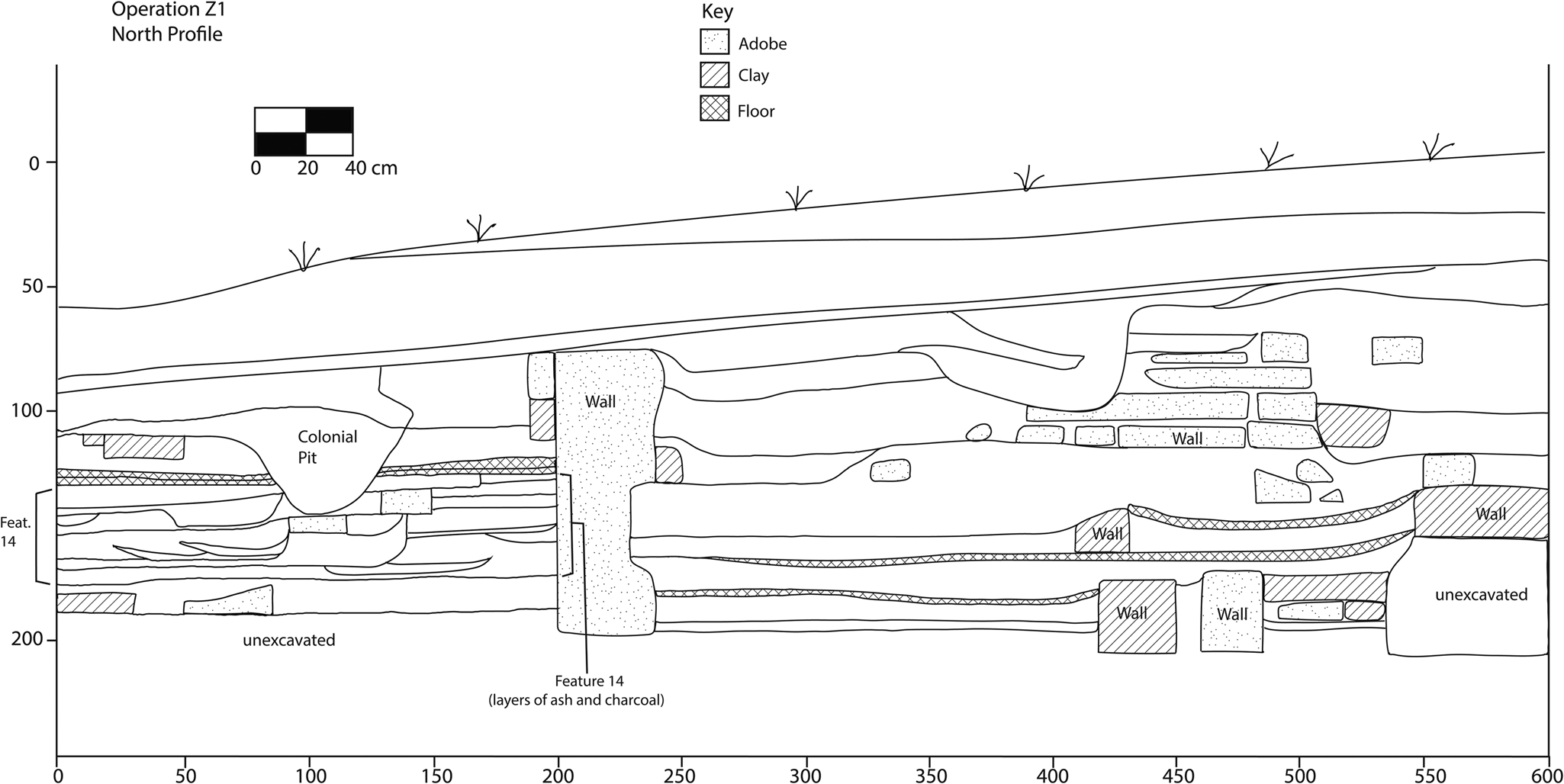
Excavations of Structure 1 uncovered a large outdoor firing area identified as Feature 14 (Figures 2 and 8), approximately 1.5 × 2.0 m in size and 37 cm deep, that we argue is evidence for firing pottery. The firing area extended beyond the limits of the excavation unit, therefore, it is likely even larger than noted here. The firing area had heavily matted and charred plant materials and scorched earth reflecting the addition of fuel and in-situ burning. The profile of Feature 14 (Figure 8), which has alternating lenses of charcoal and ash, reveals that these deposits were created by multiple firing events rather than a single deposit. Moreover, it can be observed in the profile that pits were repeatedly dug in this area over time, as they intrude into one another, possibly a result of pit kilns. Pottery produced in Xaltocan typically has a gray to black core, which suggests it was fired at low temperatures in an open fire or pit kiln for a short duration (Minc Reference Minc, Nichols and Rodríguez-Alegría2017:364). Daub debris recovered from the firing area, may be the remnants of a mud plaster covering used in firing such as that described by Balkansky et al. (Reference Balkansky, Feinman and Nicholas1997). Daub debris was not recovered from other contexts and therefore is unlikely to be the result of roof or wall fall. Similar lumps of daub or clay have also been found in Teotihuacan ceramic production contexts (Sullivan Reference Sullivan2006). The firing area in Structure 1 was partially protected by the southern and western adobe walls of the house, which would have helped to reduce wind, making this a good location for firing pottery. This pattern correlates with Stark's (Reference Stark and Nelson1985:165) description of open firing areas, which are often located adjacent to houses and produce large hearth-like areas. In contrast, cooking hearths associated with Structure 1 were much smaller, did not have daub debris, and were single pits inside rooms.
Profile of Feature 14, firing area facing north (on the left, 0–200 cm east to west) and adjacent interior rooms on the right. Illustration by De Lucia.

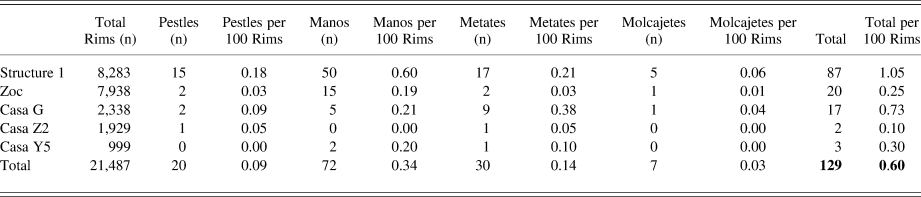
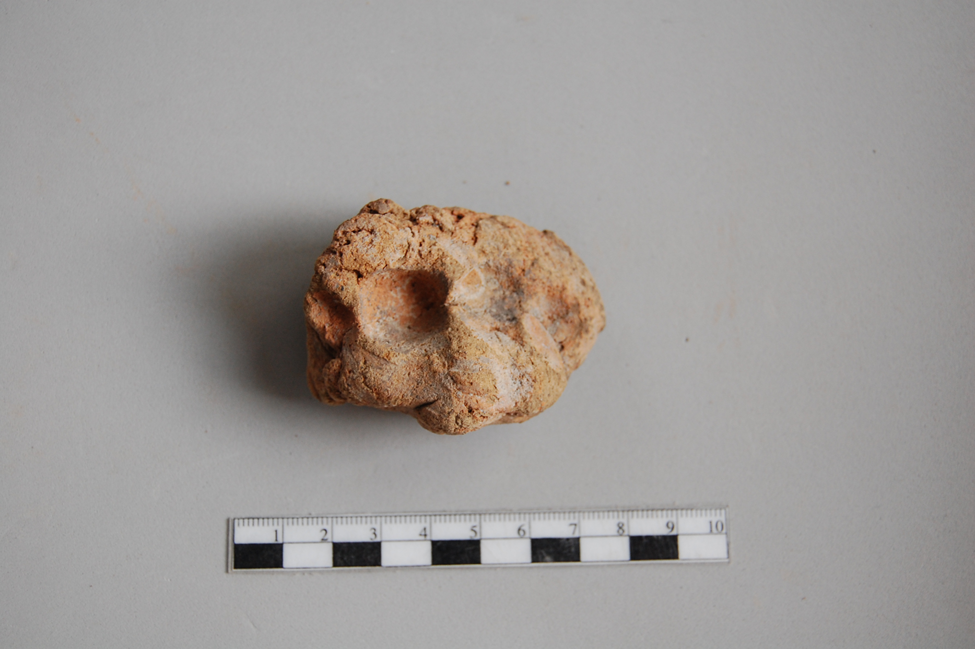
A high density of pottery and concentrations of large fragments of utilitarian (jar and griddle) pottery that may have been used as props in firing were also observed during the excavation of Feature 14, which is often an indicator of production (Santley et al. Reference Santley, Arnold and Pool1989; Stark and Garraty Reference Stark and Garraty2004). The ceramics from the firing area were analyzed by Brumfiel, who unfortunately has since passed away, and we have not been able to access her data to quantify them. Nonetheless, Structure 1 had a higher than average concentration of grinding tools compared to other contemporaneous houses (Table 4). Because the excavations were of variable sizes, the number of grinding tools was standardized according to number of rim sherds. Structure 1 had almost twice as many pestles and manos (0.18 and 0.60 per 100 rims respectively) compared to other Early Postclassic houses excavated at Xaltocan (average of 0.09 and 0.34, respectively), indicating that they probably were not needed in large numbers for regular household food preparation. Pestles and manos are particularly useful for grinding clays and tempers. Casa G had the highest concentration of metates (0.38 per 100 rims), however, Brumfiel (Reference Brumfiel2009) interpreted this as a location of metate production. Grinding tools could have been used for a variety of activities, especially given that Structure 1 engaged in multicrafting (De Lucia Reference De Lucia2013). If this were a potting household, however, we would expect that it should have a higher than average concentration of grinding tools given that, as noted earlier, potting households tend to have more grinding tools (Deal Reference Deal1998; Williams Reference Williams2018); thus, Structure 1 meets this expectation. Further, Structure 1 also had artifacts which would be unexpected in nonpotting households, including three fired lumps of clay (Figure 9) and two small polishing stones mixed with domestic refuse. Additionally, four larger, hard round stones and two oval-shaped stones were recovered that may have been used as pottery shaping or polishing tools. Orange pigment was also found spilled on an earthen floor of an interior room.
Groundstone tools from Early Postclassic household excavations in Xaltocan.

Evidence of ceramic production not typically found in nonpotting households includes a clump of unworked clay with finger impressions. Photograph by De Lucia.

Brumfiel (Reference Brumfiel2009) interpreted the firing area in Structure 1 as a location of pottery production but did not identify any wasters. Wasters, however, may be difficult to identify and small-scale ceramic firing locations may produce few wasters (P. Arnold Reference Arnold, Neff and Bishop1991:89; Balkansky et al. Reference Balkansky, Feinman and Nicholas1997; Deal Reference Deal, Pool and Bey III2007; Stark Reference Stark1984). At Otumba, for example, Otis Charlton et al (Reference Otis Charlton, Charlton, Nichols, Santley and Hirth1993:162) found molds for the production of censers but no manufacturing errors, and figurine and spindle whorl production areas produced very few wasters (Otis Charlton et al. Reference Otis Charlton, Charlton, Nichols, Santley and Hirth1993). Failures for skilled potters can be rare (Shott Reference Shott2018:37). In addition, broken pots are frequently discarded away from houses or on the outskirts of town to avoid overflow (Williams Reference Williams2017:77, Reference Williams2018). Because Xaltocan was an island, it is likely that production waste and other trash was simply dumped into the water at the edge of the mound or even used to expand the island. Previous excavations have demonstrated that the island mounds were constructed using trash, including ceramics and organic refuse (Brumfiel Reference Brumfiel2005d). In summary, the combined evidence of a large open firing area with in situ burning of organic waste, concentrations of large ceramic sherds, and daub fragments in addition to production waste such as lumps of clay and pigments, ceramic manufacturing tools, and a high frequency of grinding tools together signal that ceramics were produced in Structure 1.
DISCUSSION: HOUSEHOLD PRODUCTION
The NAA data demonstrating local production and consistency in paste recipe, in conjunction with the archaeological evidence for a firing area found in this study, suggest that the inhabitants of Structure 1 were manufacturing pottery. If Structure 1 obtained pottery from the marketplace, we would expect to find plainware from locations outside of Xaltocan, as seen by Peters (Reference Peters2002). Even if Structure 1's household members were obtaining plainwares exclusively from local potters, we would expect to find ceramics with more diverse compositional profiles. Foster's (Reference Foster1960:607) ethnographic analysis of Mexican household pottery assemblages found that a nonpotting household had pots made by at least 10 different potters, while a potting household made all of their own vessels with the exception of a couple of gifts. Deal (Reference Deal, Pool and Bey III2007:52) also notes that Maya potters also “tended to have more local pottery in their own inventories.” Even when multiple potters in a community draw from the same local clay source, temper is often obtained from a wide variety of sources and paste recipes vary (Arnold Reference Arnold2000:341; Fowler et al. Reference Fowler, Middleton and Fayek2019; Neff et al. Reference Neff, Bishop and Arnold1988). While it is technically possible that the occupants of Structure 1 obtained their ceramics from a single source, this scenario seems unlikely given the wide variety of goods that were available in local marketplaces and that several generations of occupation are represented. While homogeneity in paste does not alone reflect domestic production, the incorporation of multiple lines of evidence, including a large firing area, ceramic production tools, manufacturing waste, and a comparison to sitewide trends support this interpretation.
The NAA results further demonstrate that some Xaltocan-produced decorated wares, especially Black-on-Orange and Brown Incised wares, cluster tightly with the plainwares suggesting that household potters in Xaltocan produced both utilitarian and decorated pottery. Further, differences in vessel form or rim shape of plainwares did not correlate with different locations of production (as they all sourced locally), suggesting that households produced a variety of vessel forms. Significant outliers to the Xaltocan-1b compositional group were mica-tempered ollas, which are easily distinguishable. These results support conclusions by Santley et al. (Reference Santley, Arnold and Pool1989:121) that households produce a wider range of wares and vessels (but at a lower volume) than specialized workshops and that small-scale producers do not necessarily specialize in one type of good but rather may produce a variety of goods in a competitive economic setting. Ethnohistorical documents also suggest that Aztec potters produced a wide variety of utilitarian and decorated wares. For example, Sahagún (Reference Sahagún, Anderson and Dibble1950–1982 [1575–1577]:bk 10, p. 83) describes the “clay worker” as producing a range of objects including plain cooking ollas, water jars, pitchers, braziers, and candle holders, as well as decorated wares including “reddish ones, offering bowls, merchants’ bowls, white ones, black bowls; ladles; combs; sauce bowls—incised, polished.” He specifically states that the potter sells both well-fired vessels and poorly fired, “inferior” vessels. Many technological changes were introduced during the colonial period including finer tempers and clays, glazes, and new firing techniques (Jiménez-Pérez et al. Reference Jiménez-Pérez, Jiménez-Pérez, Brancamontes Cruz, Cruz-Orea, Mendoza-Alvarez, Gordillo-Sol and Hernani Yee-Madeira2007; Minc Reference Minc, Nichols and Rodríguez-Alegría2017:361), which may have influenced ceramic production, but, Sahagún's descriptions indicate that potters certainly had the ability to produce a variety of vessel types.
Organization of Production
The data from Structure 1 help to offer a new understanding of the organization of household production in Early Postclassic central Mexico, while data from past survey, test pitting, and household excavations at Xaltocan provide a broader context. The establishment of a distinct area for firing ceramics, as well as the continued use of the same space for production over time, in Structure 1 would reflect a production intensity beyond that which would be expected to simply meet domestic needs. When pottery manufacture serves only to meet household need, potting households would resemble nonpotting households and evidence for ceramic manufacture would likely be scarce or absent since pottery manufacture would be infrequent (Santley et al. Reference Santley, Arnold and Pool1989:108; also see Arnold Reference Arnold1991:92). In contrast, the firing area described above was well-defined and used repeatedly as indicated by both the depth of the deposits and the repeated digging of pits in this area. Given that a pit could have been cleaned out and reused, it is possible that each pit represents more than a single firing event. Further, the firing area extends beyond that which can be observed in the profile, therefore, there would have been more firing events than are observable here. Nonetheless, ceramic manufacture in Structure 1 was likely small in scale given that small-scale production does not produce large amounts of production waste and manufacturing implements tend to be mixed with other household refuse (Santley et al. Reference Santley, Arnold and Pool1989:109), which is the pattern seen here. Further, we did not recover artifacts to suggest mass production such as molds or excessive amounts of wasters as found in some other sites such as Ejutla (Feinman Reference Feinman, Skibo and Feinman1999), suggesting a lower intensity of production. Thus, it is possible that the inhabitants of Structure 1 produced ceramics for domestic use and small-scale local or regional exchange. Ceramics from Xaltocan were exchanged in small quantities to other sites including Cuauhtitlan and Chiconautla as part of exchange networks (Stoner et al. Reference Stoner, Millhauser, Rodríguez-Alegría, Overholtzer and Glascock2014). Pottery may have also been produced to supply cooking and serving vessels for large feasting or ceremonial events within the domestic or community setting. For example, Nash (Reference Nash1970:48) observed that the production of ceremonial cooking pots in Chiapas was considered “unpaid work.” Food and cooking are important components of domestic ritual and large numbers of vessels are necessary for ritual and feasting ceremonies (Arnold Reference Arnold2018:206; Gokee and Logan Reference Gokee and Logan2014; Morán Reference Morán2016). The similarity in paste recipe between different types of vessels recovered from different contexts within Structure 1 might reflect a kin-based group or community of practice involved in pottery production. The consistency in paste recipe through time would indicate that pottery traditions were passed down through generations.
The inhabitants of Structure 1 were involved in agricultural activities as evidenced by botanical remains and the recovery of agricultural implements (see De Lucia [Reference De Lucia2013] and De Lucia and Morehart [Reference De Lucia, Morehart, Morehart and De Lucia2015] for further information). Thus, pottery production would have taken place intermittently, and perhaps seasonally, since household labor is typically directed towards the fields in the agricultural season resulting in a decline in ceramic production (Deal Reference Deal1998:42; Williams Reference Williams2017:36, Reference Williams2018:14). In Xaltocan, pottery firing and drying would have been difficult during the rainy season, when summer rains come almost daily and humidity would extend drying time (also see Williams Reference Williams2017:36). These findings support arguments made by other scholars (Brumfiel Reference Brumfiel, Earle, Brumfiel and Earle1987; Minc Reference Minc, Nichols and Rodríguez-Alegría2017; Nichols Reference Nichols, Hirth and Pillsbury2013) that in rural areas of central Mexico, most craft producers were still reliant on subsistence agriculture.
Unlike many ethnographic case studies, the inhabitants of Structure 1 were not exclusively dedicated to manufacturing ceramics. De Lucia (Reference De Lucia2011, Reference De Lucia2013) has demonstrated elsewhere that the household also engaged in a variety of production activities including fish processing and matmaking. Other activities, likely for domestic consumption, included spinning and weaving, as suggested by the presence of spindle whorls and bone weaving tools (De Lucia Reference De Lucia2013). Further, the recovery of net-making tools, obsidian cores, and debris from the manufacture of bone tools (De Lucia Reference De Lucia2013) indicate that the household often made the tools they needed for other activities, engaging in contingent crafting (Hirth Reference Hirth2009a:23). Multicrafting would have been a useful risk-minimization strategy in an extended family unit since tasks can be divided among many different individuals, making production activities more efficient and diversified (Hirth Reference Hirth2009a). Structure 1 had multiple rooms and in Xaltocan houses were tightly clustered, suggesting that people lived in extended family units and production activities could have incorporated extended family members (De Lucia and Overholtzer Reference De Lucia and Overholtzer2014). In sum, ceramic manufacture in Xaltocan likely took place intermittently on a small-scale alongside other subsistence and craft activities, as is seen throughout much of Mesoamerica.
The findings from Xaltocan contrast with archaeological evidence from Late Postclassic Otumba, where production waste was much more abundant, craft production was concentrated in particular neighborhoods or barrios, and household-based craft production was of greater intensity (Charlton et al. Reference Charlton, Nichols, Charlton, Stantley and Hirth1993, Reference Charlton, Charlton, Nichols, Neff, Pool and Bey2007; Nichols Reference Nichols, Hodge and Smith1994, Reference Nichols, Hirth and Pillsbury2013). Crafting neighborhoods have also been documented at other sites such as Classic-period Teotihuacan (Sullivan Reference Sullivan2006). Despite the excavation of at least three other houses near Structure 1, evidence for ceramic production has not been identified in nearby houses (Brumfiel Reference Brumfiel2005d; Brumfiel and Rodríguez-Alegía Reference Brumfiel and Rodríguez-Alegría2010), thus, there is no evidence to suggest that potters were clustered into neighborhoods at Xaltocan. Further, we did not recover molds or stamps to suggest that Structure 1 was producing other types of clay objects such as figurines, spindle whorls, or musical instruments as in Otumba (Charlton et al. Reference Charlton, Nichols, Charlton, Stantley and Hirth1993, Reference Charlton, Charlton, Nichols, Neff, Pool and Bey2007; Nichols Reference Nichols, Hodge and Smith1994). The greater output and organization of ceramic production seen in Late Postclassic sites such as Otumba could have been a consequence of the increased centralization of ceramic exchange systems and political integration during the Late Postclassic (Charlton et al. Reference Charlton, Charlton, Nichols, Neff, Pool and Bey2007; Hodge and Minc Reference Hodge and Minc1990; Nichols Reference Nichols, Hirth and Pillsbury2013), and possibly increasing management by elites (Otis Charlton and Charlton Reference Otis Charlton, Charlton, Manzanilla and Hirth2011:235), although Nichols (Reference Nichols, Hirth and Pillsbury2013; see also Hirth Reference Hirth2009a) argues that many crafts, including most ceramics, were independently produced in household workshops. During the Early Postclassic, however, production systems were noncentralized and small-scale, and intermittent production based in houses makes it unlikely that elites were involved in organizing or managing production (Charlton et al. Reference Charlton, Charlton, Nichols, Neff, Pool and Bey2007; Feinman and Nicholas Reference Feinman, Nicholas, Manzanilla and Hirth2011).
Structure 1 was a typical commoner house and was not of lower economic status than other contemporary houses excavated at Xaltocan, as indicated by the fact that it had a high proportion of imported serving wares, particularly elaborate Polychromes from Cholula (Brumfiel Reference Brumfiel2009; see De Lucia and Overholtzer [Reference De Lucia and Overholtzer2014] for further description). Further, when Structure 1 was occupied, Xaltocan's chinampa system was at its maximum extent and households should have had sufficient agricultural land to meet subsistence needs (Morehart Reference Morehart2014, Reference Morehart2016; Morehart and Frederick Reference Morehart and Frederick2014). Household excavations at Otumba have similarly found that potters lived in typical commoner houses (Nichols Reference Nichols, Hirth and Pillsbury2013:63). These data support Hirth's (Reference Hirth2009a:15) argument that craft production does not correspond with resource stress in Mesoamerican archaeological contexts. It is important to keep in mind that poverty associated with many modern potters (Arnold Reference Arnold1985:226; Deal Reference Deal1998:25; Jordan and Prufer Reference Jordan and Prufer2017; Stark Reference Stark1991) may be a consequence of modern world systems, the legacies of colonialism, and modern government policies (Nash Reference Nash and Nash1993:130). Nash (Reference Nash and Nash1993:130), for example, has observed that in modern times the “intensification of production done in the home has occurred in rural areas throughout Mexico as a result of the shrinking land base for indigenous communities and a rising population.”
CONCLUSIONS
In this article, we argue that the production of plain and decorated pottery took place at the household level in Early Postclassic Xaltocan. The NAA results demonstrating unusual tight clustering within the Xaltocan-1b subgroup, along with the absence of imported utilitarian pottery, the reduced diversity of utilitarian pottery compared to sitewide trends, and archaeological indications for pottery production, together suggest that pottery production took place in Structure 1. This is not to say that all pottery that falls within the Xaltocan-1b subgroup was produced in Structure 1, but rather that Structure 1 was part of a community of practice that manufactured various types of vessels. Further, manufacturing traditions persisted through multiple generations given that Feature 14 and the sherds sampled in this study likely span several decades of occupation. As noted in the section Household Multicrafting and Communities of Practice, technological attributes and sequences are transmitted through learning and are conservative, contributing to the formation and endurance of such communities of practice.
In Structure 1, pottery production took place alongside several other production activities and subsistence agriculture. Thus, pottery production would have been an intermittent activity within domestic contexts that was part of a multicrafting strategy. Similarity in paste recipes between plain and decorated pottery indicates that the same group of potters made both plain and decorated wares, as well as vessels with different forms and rim shapes. Given that multiple production activities have been identified in Structure 1, it is likely that all household members participated and possibly collaborated in production activities. Ceramic production may have served to augment household income in order to obtain objects through market exchange, while at the same time supplying vessels for social, political, or ritual events. Households, such as Structure 1, regularly participated in market exchange as evidenced by imported goods including ceramics and obsidian recovered from commoner households. Households, thus, played an important role in the production and consumption of goods in Early Postclassic Xaltocan.
Finally, this study demonstrates that surface indicators of pottery production alone are not adequate to identify small-scale household production, especially where deposits are well below the surface such as at Xaltocan. We may be underestimating the extent of small-scale household production and, thereby, the importance of domestic economies to broader networks of exchange, by not considering less-visible, intermittent production in households. This study thus provides an additional model for identifying small-scale household ceramic production where it might otherwise be invisible. In sum, by considering the organization of household labor, we can learn about the various ways in which households participated in market systems and how their participation has changed through time.
RESUMEN
Analizamos la producción de cerámica doméstica en el sitio de Xaltocan, México, para comprender la organización de la producción doméstico. Examinamos cerámicas del posclásico temprano (ca. 900–1200 d.C.) usando análisis de activación de neutrones. También examinamos la evidencia arqueológica de la fabricación de cerámica para comprender mejor la intensidad y la organización de la producción doméstico. Este artículo describe uno de los raros descubrimientos arqueológicos de un horno pre-azteca. Este estudio analiza la cerámica de una estructura doméstica en comparación con los patrones de todo el sitio.
Llegamos a la conclusión de que la producción casera era a tiempo parcial y complementa otros tipos de actividades productivas. La similitud en la receta de pasta sugiere que los hogares producen cerámicas simples y también decorados. Además, encontramos que la cerámica de la Estructura 1 es más químicamente homogéneo que el grupo químico más grande en Xaltocan. En contraste con los contextos etnográficos donde la producción doméstica está asociada con hogares empobrecidos, concluimos que este no fue el caso en Xaltocan del posclásico temprano. Cuando observamos la cerámica en sus contextos de uso y producción, podemos entender las prácticas y decisiones tomadas por unidades sociales individuales, lo cual es crucial para interpretar los sistemas económicos pre-aztecas.
SUPPLEMENTARY MATERIAL
The supplementary material for this article can be found at https://doi.org/10.1017/S0956536120000036
ACKNOWLEDGMENTS
This research was conducted with the permission of Mexico's Instituto Nacional de Antropología e Historia, the people of Xaltocan, and the Arenas Ramírez family. The Archaeometry Lab at MURR is supported by the National Science Foundation. This project was subsidized by the laboratory's mini-grant program under NSF grant #1621158. De Lucia's research was supported by a Dissertation Fieldwork Grant (#7706) from the Wenner-Gren Foundation, a National Science Foundation Doctoral Dissertation Improvement Grant (#0742249), a Postdoctoral Research Fellowship grant (#1103522) awarded in 2011, an Association for Feminist Anthropology Dissertation Award, Graduate Research Grants from the University Research Grants Committee at Northwestern University, and research grants from the LeCron Foster and Friends of Anthropology at Northwestern. We would like to offer a special thanks to Wesley Stoner for offering comments on this manuscript and assistance updating the data. We also greatly appreciate the help of Whitney Goodwin and the comments offered by several anonymous reviewers whose suggestions have greatly improved this manuscript. Any errors are our own.