INTRODUCTION
For most persons with a relatively mild traumatic brain injury (TBI), the symptoms resolve within a few weeks. On occasion, however, recovery is prolonged and patients are left with a constellation of persisting somatic, cognitive, or psychological symptoms often referred to as postconcussion syndrome (PCS). The symptoms include physical problems such as increased sensitivity to light and noise, headache, fatigue, deficits in attention, information processing, and memory, and ongoing emotional disturbance. Although PCS is typically a consequence of mild TBI, it can occur after more severe injuries, although this finding is unusual because these cases typically result in disabling and pervasive neuropsychological and physical deficits that overshadow the more subtle symptoms of PCS.
A reduction in the speed and efficiency of information processing is a common cognitive deficit in persons with TBI (e.g., van Zomeren & Deelman, 1976) and in persons who have sustained a recent concussion (Killam et al., 2005; McClincy et al., 2006). Word fluency tests have been shown to be sensitive to changes in information processing resulting from neurological damage, including TBI (Henry & Crawford, 2004; Levin et al., 2000; Raskin & Rearick, 1996). There are at least two possible reasons why persons with neurological damage may be less efficient at generating words in a fluency paradigm. Rohrer et al. (1995) and Rohrer et al. (1999) have classified these explanations as retrieval slowing and structure loss. According to the retrieval-slowing hypothesis, persons with neurological impairments take longer to retrieve words from memory and this finding is the underlying cause of poor performance on fluency tasks. The structure-loss hypothesis proposes that there is a degradation of information in semantic memory and thus fewer words are available for retrieval. Rohrer et al. (1999) developed a model of rate of retrieval that can be used to distinguish between these hypotheses. The model has two parameters: N, an estimate of the number of words that would be retrieved if a person is given enough time to recall all the exemplars of a category they have available, and tau, which is an estimate of the mean latency to retrieve each word. In this model, a faster mean latency (tau) is suggestive of structure loss, because if there are fewer items in semantic memory, it should take less time to generate those that remain. Conversely, an increased mean latency combined with comparable values of N is indicative of retrieval slowing as it takes longer for the patients to search and retrieve each word from memory.
The aim of the present study was to investigate word fluency in persons with PCS, a group whose performance in this domain of functioning has not previously been examined. Our first aim was to analyze response times to determine whether generalized cognitive slowing was characteristic of the verbal fluency performance of persons with PCS. Accordingly, the latency to make a first response and the interresponse times (IRTs) were measured from audiotaped recordings of the participants' responses. Our second aim was to study the dynamics of retrieval in word fluency tasks using the curve-fitting analysis of Rohrer et al. (1995).
METHOD
Participants
PCS group
A total of 20 persons (10 men and 10 women) referred to the clinic at Wakari Hospital in Dunedin who met the criteria for PCS were recruited for the study. The criteria for the diagnosis of PCS were formulated by the Accident Rehabilitation and Compensation Insurance Corporation (2001) and are consistent with the criteria in the Diagnostic and Statistical Manual–Fourth Edition (DSM-IV; American Psychiatric Association, 2000): (1) Medical evidence of TBI; (2) Symptoms for 6 weeks or more after injury; (3) At least three of the following symptoms: fatigue, sleep problems, low mood or anxiety, sensitivity to noise or light, dizziness, headaches, irritability, blunted affect, evidence of personality change, and attention, concentration and/or memory impairments; (4) Neuropsychological test evidence of memory and/or attention deficits; (5) Alteration in work or social performance; and (6) Symptoms are not attributable to a psychological illness. Persons with a TBI resulting in symptoms consistent with DSM-IV diagnosis of Dementia due to Head Trauma and persons with clinical signs of depression were excluded. All diagnoses of PCS were made as a result of consensual decision by a neurologist and clinical neuropsychologist following clinical interview, psychological testing, and a neurological examination.
Fifteen patients had some period of loss of consciousness (LOC; M = 5.22 min; SD = 9.73), and the average period of posttraumatic amnesia (PTA) for the group was 88.25 hr (SD = 191.10). Of the 20 patients, 13 had a first recorded Glasgow Coma Scale score greater than 13, PTA less than 24 hr, and LOC less than 30 min and were classified as having sustained a mild TBI; the other 7 patients had more severe injuries. The causes of the injuries were as follows: Motor vehicle accidents (n = 7), work-related accident (n = 4), fall (n = 3), sports injury (n =2), and other (e.g., assault, n = 4). All participants were tested between 6 and 12 weeks after the injury.
Control group
There were 20 healthy controls, each matching a patient for age (within 4 years), gender (10 males, 10 females), and current occupation, who were recruited from the community. Matching was achieved by contacting a work place that employed people of the same occupation as one of the patients, and identifying a person of a specific gender and age who might be approached to take part in the study. After the persons had agreed to being approached, the study was explained to them and they were invited to take part. Exclusion criteria included a history of neurological or psychiatric disorder, or treatment with a medication that was likely to cause cognitive deficits. There was no significant difference between the average age of the patient sample (M = 33.1; SD = 10.64) and that of the controls (M = 33.9; SD = 11.22). The data included in this manuscript were obtained in compliance with the regulations of the Otago Ethics Committee.
Measures
All participants were first administered the Repeatable Battery for the Assessment of Neuropsychological Status (RBANS; Randolph, 1998) and then the FAS version of the Controlled Oral Word Association Test (COWAT; Benton & Hamsher, 1976). For the purposes of the study, the testing session was audiotaped and the data recorded from the semantic fluency test of the RBANS, which requires participants to generate fruit and vegetable names in 60 s, and from the COWAT, were analyzed.
Data Analyses
The PowerLab Chart sound system (ADInstruments) was used to transform the audiotaped recordings into continuous sound waves visible on a computer screen. A timeline was imposed on the sound wave, making it possible to determine the number of words produced within a specified period of time, and to measure the interval between each consecutive pair of words.
In the initial analysis, a cumulative exponential equation (Roediger et al., 1977) was used to fit curves to the data of each individual.

In this equation, t denotes time and R(t) is the cumulative number of words generated at time (t). N is an estimate of the total number of words that would be generated if the participant was given unlimited time. Tau is the average of the difference in time between the first word generated and each subsequent word. The between-group comparisons of the estimates of N and tau were based on the values derived from curves for each individual.
The first response latency (FRL) and IRTs were then measured from the soundwaves. The FRL was defined as the time that elapsed between the experimenter ending the instruction that announced the category (e.g., “I want you to give me all the words you can that start with letter F”) and the first vocalization of a relevant response. The IRT was the time between the end of the vocalization of one word and the start of the next; the time taken to articulate the word was excluded. All group comparisons were conducted using t tests (alpha < .05). Where the standard deviations of a variable differed significantly between groups, separate variance estimates were used.
RESULTS
Semantic Fluency
Overall, PCS patients produced significantly fewer responses than controls and were slower at producing their first word (Table 1). Errors, defined as any word generated that was neither a fruit nor a vegetable, were calculated for individual patients and controls. There were few errors for both patients (M = .20; SD = .52) and controls (M = .45; SD = .76), and few perseverations for both patients (M = .50; SD = .83) and controls (M = .85; SD = .99).
Means, standard deviations, t statistics, and effect sizes (d) for the total scores, measures of response latency, and curve parameter estimates (N and tau) for the PCS and control groups on the semantic fluency task

There was no significant difference in subsequent mean latency (tau) between PCS patients and controls (Table 1). The controls' asymptotic recall (N), however, was significantly larger than that of the patients', suggesting they had fewer words that they could retrieve. To investigate possible cognitive slowing, a median IRT was calculated for each individual. All IRTs that were lengthened by the presence of either a perseveration or an error were excluded from this calculation. The median IRT (Table 1) was significantly longer for the PCS patients: t (23.49) = 2.91; p < .01; d = .93.
Verbal Fluency
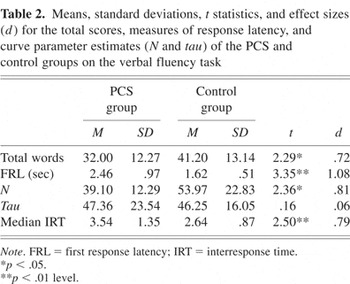
Analysis of responses on the COWAT followed the procedures used for the semantic fluency task except that data were averaged across the three trials. The data from one patient and her matched control were excluded from the analysis of the FRL data as she misunderstood task instructions. The PCS group generated significantly fewer words and took longer to generate their first word than the controls (Table 2). There was no difference between the number of errors or perseverations generated by the patients and controls. The median IRT (Table 2) was significantly longer for the patients than the controls. The cumulative exponential was again fitted to individual participant data to derive parameter estimates for each individual. Data from three patients and their matched controls were excluded because there was insufficient deceleration in the curve to allow a reasonable estimate of N. There was no significant difference between groups on tau; however, the controls' asymptotic recall (N) was significantly larger than the patients (Table 2), suggesting that, if given unlimited time, the controls would have generated significantly more words than the patients.
Means, standard deviations, t statistics, and effect sizes (d) for the total scores, measures of response latency, and curve parameter estimates (N and tau) of the PCS and control groups on the verbal fluency task

A 2 (Group) × 2 (Fluency Task: Semantic and COWAT) analysis of variance (ANOVA) was calculated to see whether the patients were specifically impaired on one fluency task. A main effect of Group (F(1,38) = 10.70, MSE = 31.92, p < .01) and a main effect of Fluency Task (F(1,38) = 144.58, MSE = 11.33, p < .01) was found. Overall, patients generated fewer words (M = 14.66) than controls (M = 18.79) and more words were generated on the semantic fluency task (M = 21.25) than the average score across the three trials of the COWAT (M = 12.20). The Group × Fluency Task interaction was not significant (F(1,38) = 2.01, MSE = 11.33), indicating that the patients were not specifically impaired on one fluency task.
DISCUSSION
Consistent with previous findings with persons with TBI (Raskin & Rearick, 1996), the persons with PCS retrieved fewer words on both fluency tasks than the controls. Examination of the audiotaped recordings showed that the PCS group took longer to generate their first word and had longer median IRTs (with the speech component and time taken to produce errors removed) on both fluency tasks, providing consistent evidence of slowing of cognitive processing in PCS. Median IRT values are not, however, an accurate estimate of mean response latency over the response curve unless participants have completed retrieving words within the specified time, which was not the case in this study; the distinction between retrieval-slowing and storage-loss depends on the shape of the curve describing the decline in producing words, not the IRT values.
The results from the curve-fitting exercise are difficult to interpret. On both tasks, the PCS group had a significantly reduced N, but there was no between-group difference in subsequent response latency, tau. The two groups approached different asymptotes (defined by N) at the same rate. For this to happen, the PCS group must be approaching the lower asymptote in smaller steps (words per unit time), that is, with longer latencies between words (slower IRTs), than the control group. This conclusion is consistent with the slower mean IRTs of the PCS group. Although it might appear that the difference in N (estimated words available) was evidence for storage loss, this is not unequivocally the case. Significant semantic store loss (as seen in Alzheimer's disease) should result in both a reduced estimate of N and a faster rate of retrieval (tau); in fact the tau values were the same for the two groups.
If N had been comparable between the two groups and tau much slower for the PCS group, this would have provided evidence for retrieval-slowing as the basis of the semantic memory deficits in the PCS group. There was no evidence for this. In sum therefore, the results of curve analysis do not provide support for either the retrieval or structure hypotheses. This overall conclusion must be qualified by acknowledging that because both patients and controls groups had not finished generating words by the end of 60 s, N may not be accurate estimate of the number of words participants had available. The total number of words produced in 60 s was not dissimilar to the asymptotic values, suggesting that extra time might not have influenced the estimates of N.
The absence of evidence of any acceleration in the PCS patients curve suggests that the shape of the curve was determined by a generalized slowing in responding that was consistent across the time frame of the task. Specific deficits in speed of retrieval or degradation in semantic memory stores, if present, may simply not be of sufficient magnitude to be detectable. An explanation for these findings is that TBI results in a global reduction in processing capacity as a consequence of diffuse axonal damage affecting cortical and subcortical fiber tracts (Bigler, 2004).
This study is the first to investigate speed of word retrieval in persons with relatively subtle cognitive deficits resulting from brain trauma by directly measuring latencies to generate words. The findings validate the self-report of persons with PCS that they experience a general slowing in the ability to think as quickly as they could before the injury. Although these deficits may be minor, they can have an impact on the ability to interact with others in casual conversation and in the work place. Although it is likely that speed of word retrieval will be a transient difficulty in persons with PCS, it may be useful for patients to understand that the changes have occurred and for clinicians to consider using sensitive measures of response times to monitor restitution of functioning.
ACKNOWLEDGMENTS
The authors acknowledge with gratitude the assistance of the staff of the ISIS Rehabilitation Clinic, especially Nick Titov, Lea Galvin, and Sara-Jane Ivory. We are also grateful for the advice of John Wixted and Douglas Rohrer on the analysis of the response curve data.