Introduction
The Aegean Sea has long attracted the attention of biogeographers (Turrill, Reference Turrill1929; Strid, Reference Strid1996), since it is characterised by high environmental and topographical heterogeneity (Blondel et al., Reference Blondel, Aronson, Bodiou and Boeuf2010), diversity and endemism (Strid, Reference Strid1996). The Aegean archipelago consists of more than 7000 islands and islets (Triantis & Mylonas, Reference Triantis, Mylonas, Gillespie and Glague2009), most of which are located in the phytogeographical region of the Kiklades. Intensive field work has taken place in this region, which is characterised as one of the most floristically explored phytogeographical regions of Greece (Dimopoulos et al., Reference Dimopoulos, Raus, Bergmeier, Constantinidis, Iatrou, Kokkini, Strid and Tzanoudakis2013; Bergmeier & Strid, Reference Bergmeier and Strid2014). However, certain islands have been the main focal areas of floristic research, leaving our knowledge of the Kiklades’ flora still incomplete.
Twenty-two large islands and numerous islets comprise the phytogeographical region of the Kiklades, which has long been considered floristically impoverished, compared to the other phytogeographical regions of Greece (Phitos et al., Reference Phitos, Strid, Snogerup and Greuter1995). The Kiklades host 1768 taxa (Dimopoulos et al., Reference Dimopoulos, Raus, Bergmeier, Constantinidis, Iatrou, Kokkini, Strid and Tzanoudakis2013), 161 of which are Greek endemics (9.10%), and demonstrate lower than normal endemism, as expected by their size (Georghiou & Delipetrou, Reference Georghiou and Delipetrou2010). However, their degree of endemism is above average for Mediterranean islands (c.8%, Médail & Quézel, Reference Médail and Quézel1997) and in a recent analysis (Kougioumoutzis & Tiniakou, Reference Kougioumoutzis and Tiniakou2014), some members of the Kiklades emerged as plant diversity hotspots. The Kiklades seem predestined to biogeographical and floristic studies, due to their variability in size, palaeogeographical history and geological composition, as well as in topographical and climatic characteristics. Less than half the large islands comprising the phytogeographical region of the Kiklades are floristically well known (Hansen, Reference Hansen1971; Tzanoudakis, Reference Tzanoudakis1981; Raus, Reference Raus1986, Reference Raus1988, Reference Raus2012; Böhling, Reference Böhling1994; Browicz, Reference Browicz1997; Livaniou-Tiniakou et al., Reference Livaniou-Tiniakou, Christodoulakis, Georgiou and Artelari2003; Snogerup et al., Reference Snogerup, Snogerup, Stamatiadou, von Bothmer and Gustafsson2006; Kougioumoutzis et al., Reference Kougioumoutzis, Tiniakou, Georgiou and Georgiadis2012, Reference Kougioumoutzis, Tiniakou, Georgiou and Georgiadis2014a). Thus, we decided to investigate the flora of Folegandros Island thoroughly.
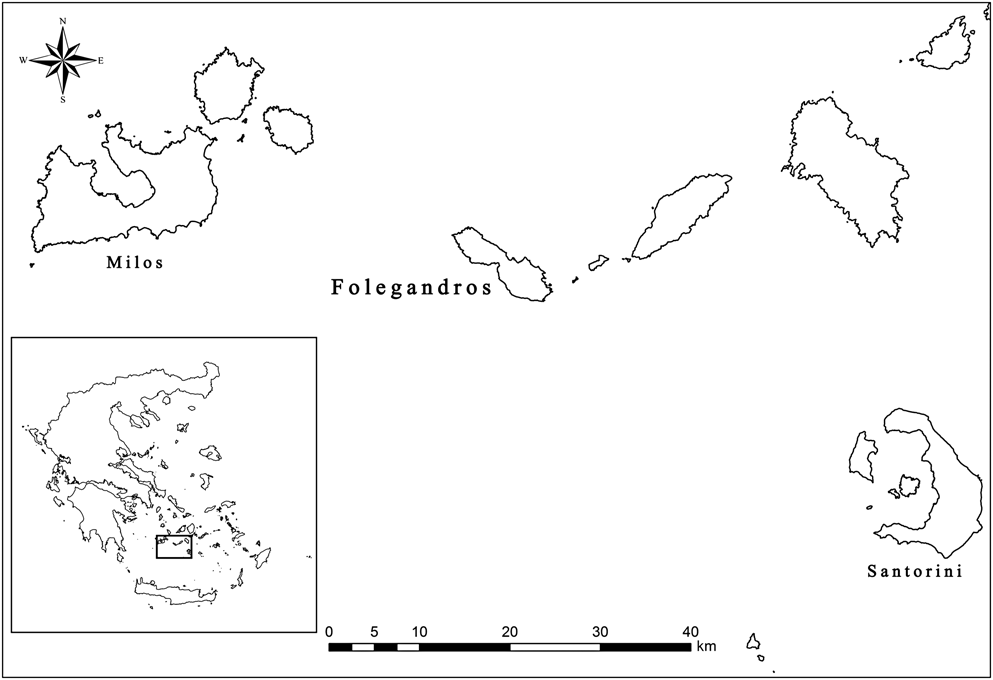
Τhe island of Folegandros (Fig. 1) has a special geographical, biogeographical and ecological position in the Aegean area. It is located in the southern part of the phytogeographical area of the Kiklades, between the volcanic archipelagos of Milos and Santorini, and, despite its small size (c.32 km2), it is characterised by a variety of substrates and is built up of five major tectono-stratigraphic units (Photiades & Keay, Reference Photiades and Keay2003), viz. schists with serpentinite bodies, gneiss, marbles, Quaternary and Neogene deposits. Folegandros forms a part of the median tectono-metamorphic Attic-Cycladic Complex, which is composed of an Alpine and pre-Alpine tectonic pile (Papanikolaou, Reference Papanikolaou, Dixon and Robertson1984, Reference Papanikolaou and Helgeson1987).
Folegandros Island.

The study area is mainly hilly with an intense relief, the highest peak being Aghios Eleftherios hill (415 m). Several gravelly and sandy beaches can be found by the coast. The hydrographical network is rather limited, with no obvious runoff.
The nearest meteorological station to Folegandros lies in Antiparos island; according to Gouvas & Sakellariou (Reference Gouvas and Sakellariou2011), this station and therefore the study area belongs to the arid bioclimatic zone with a mild winter and also to the Thermo-mediterranean zone, with a long dry period.
Rechinger (1944) was the first botanist to report on plants from Folegandros. Most records, however, were reported within the framework of the Natura 2000 research programme. Snogerup (Reference Snogerup, Kamari, Felber and Garbari1994), Runemark (Reference Runemark, Kamari, Felber and Garbari1996, Reference Runemark, Kamari, Felber and Garbari2000, Reference Runemark, Kamari, Felber and Garbari2006), Strid & Tan (Reference Strid and Tan1997, Reference Strid and Tan2002), Thanopoulos (Reference Thanopoulos2007) and Biel & Tan (Reference Biel, Tan, Vladimirov, Dane and Kit2008) have also reported on plants from Folegandros. Information on some endemic taxa occurring in the area is given by Tan & Iatrou (Reference Tan and Iatrou2001). From a phytogeographical point of view, however, the interesting flora of the island of Folegandros has not yet received the attention it deserves.
The present study therefore aimed to thoroughly investigate the flora of Folegandros, by examining the floristic affinities of the study area to the other, floristically better explored islands of the phytogeographical region of the Kiklades, namely Anafi (Kougioumoutzis et al., Reference Kougioumoutzis, Tiniakou, Georgiou and Georgiadis2012), Andros (Snogerup et al., Reference Snogerup, Snogerup, Stamatiadou, von Bothmer and Gustafsson2006), Antiparos and Paros (Raus, Reference Raus1986), Giaros (Tzanoudakis, Reference Tzanoudakis1981), Kimolos (Kougioumoutzis et al., Reference Kougioumoutzis, Tiniakou, Georgiou and Georgiadis2014a), Milos (Browicz, Reference Browicz1997; Raus, Reference Raus2012), Naxos (Böhling, Reference Böhling1994), Santorini (Hansen, Reference Hansen1971; Raus, Reference Raus1988; Tan & Iatrou, Reference Tan and Iatrou2001) and Serifos (Livaniou-Tiniakou et al., Reference Livaniou-Tiniakou, Christodoulakis, Georgiou and Artelari2003).
Materials and Methods
Several collection and field observation trips to the study area were carried out in the spring and autumn of 2013 in order to acquire an integrated knowledge of the flora and vegetation of Folegandros. Herbarium specimens are deposited at the Botanical Museum of the University of Patras (UPA). Species identification and nomenclature are according to Tutin et al. (1964–1980, 1993), Davis (1965–1985), Pignatti (Reference Pignatti1982), Tan & Iatrou (Reference Tan and Iatrou2001), Greuter et al. (1984–1989), Strid & Tan (Reference Strid and Tan1997, Reference Strid and Tan2002), Greuter & Raab-Straube (Reference Greuter and Raab-Straube2008) and Dimopoulos et al. (Reference Dimopoulos, Raus, Bergmeier, Constantinidis, Iatrou, Kokkini, Strid and Tzanoudakis2013). Species identification and nomenclature of the genera Anthemis L., Astragalus L., Anchusa L., Crepis L., Dittrichia Greuter, Reichardia Roth, Tordylium L. and Trifolium L. are according to Georgiou (Reference Georgiou1990), Podlech (Reference Podlech2008), Selvi & Bigazzi (Reference Selvi and Bigazzi2003), Kamari (Reference Kamari1976), Brullo & de Marco (Reference Brullo and de Marco2000), Gallego et al. (Reference Gallego, Talavera and Silvestre1980), Al-Eisawi & Jury (Reference Al-Eisawi and Jury1988) and Zohary & Heller (Reference Zohary and Heller1984) respectively. For family delimitation we follow APG III (2009). The nomenclature and status of the endemic taxa recorded from Folegandros are based on Tan & Iatrou (Reference Tan and Iatrou2001), Georghiou & Delipetrou (Reference Georghiou and Delipetrou2010) and Dimopoulos et al. (Reference Dimopoulos, Raus, Bergmeier, Constantinidis, Iatrou, Kokkini, Strid and Tzanoudakis2013). The status of the alien taxa occurring in the study area is according to Arianoutsou et al. (Reference Arianoutsou, Bazos, Delipetrou and Kokkoris2010) and Dimopoulos et al. (Reference Dimopoulos, Raus, Bergmeier, Constantinidis, Iatrou, Kokkini, Strid and Tzanoudakis2013). The life-form and chorological categories follow Dimopoulos et al. (2013 – see Appendix for abbreviations used). Sørensen’s index (Sørensen, Reference Sørensen1948) as well as the statistical software SPSS 20 are used for the cross-correlation between the islands. We used the same databases as in Kougioumoutzis & Tiniakou (Reference Kougioumoutzis and Tiniakou2014) and Kougioumoutzis et al. (Reference Kougioumoutzis, Simaiakis and Tiniakou2014b) regarding the endemism levels in the phytogeographical region of the Kiklades.
Results
Flora
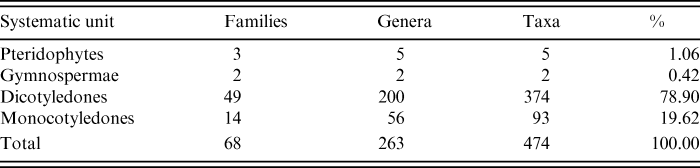
The vascular flora of Folegandros comprises 474 taxa, belonging to 263 genera and 68 families (Table 1). Six alien taxa are included in the plant list, but have not been considered in the floristic analysis.
Number of vascular plant taxa in the flora of Folegandros Island
The literature survey revealed 329 bibliographical reports for the study area (Rechinger, 1944; Snogerup, Reference Snogerup, Kamari, Felber and Garbari1994; Runemark, Reference Runemark, Kamari, Felber and Garbari1996, Reference Runemark, Kamari, Felber and Garbari2000, Reference Runemark, Kamari, Felber and Garbari2006; Strid & Tan, Reference Strid and Tan1997, Reference Strid and Tan2002; Tan & Iatrou, Reference Tan and Iatrou2001; Thanopoulos, Reference Thanopoulos2007; Biel & Tan, Reference Biel, Tan, Vladimirov, Dane and Kit2008). We report 145 taxa as new to Folegandros (see Appendix). Forty taxa are Greek endemics, seven of which are new records for the study area. Fourteen of the new records and 47 taxa overall are under statutory protection.
The most species-rich families in the flora of Folegandros are the Asteraceae (64 taxa), followed by the Fabaceae (63 taxa) and Poaceae (48 taxa). These three families account for more than one third of the total flora (37.31%). Apiaceae (24 taxa), Caryophyllaceae (24 taxa), Brassicaceae (22 taxa) and Lamiaceae (14 taxa) are also well represented.
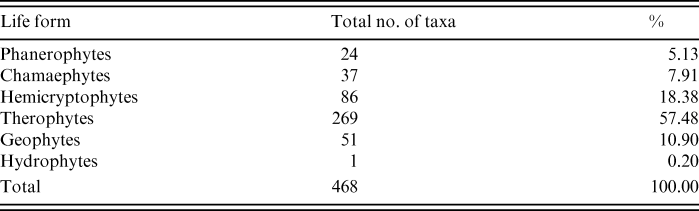
In life forms (Table 2) therophytes dominate, followed by hemicryptophytes, geophytes, chamaephytes and phanerophytes.
Life forms in the flora of Folegandros Island
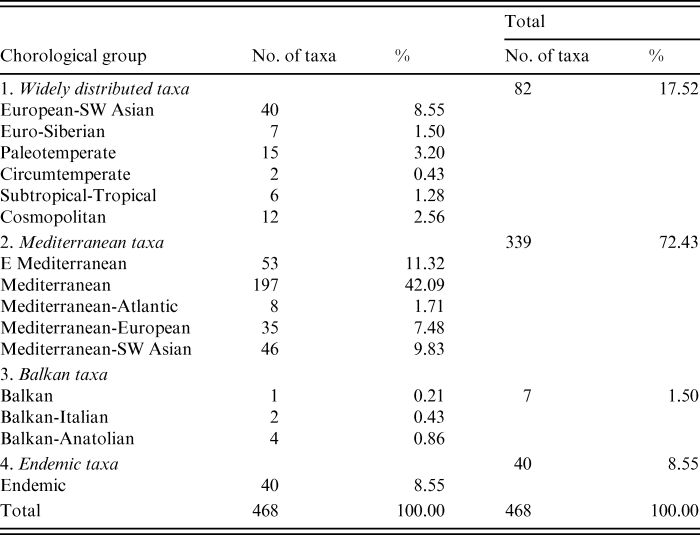
According to their general distribution, the local vascular flora can be classified into 15 main chorological groups (Table 3). The endemic group represents 8.55% of the total flora with 40 taxa. Phytogeographically, the endemic element is the most important group and is discussed separately. The Mediterranean chorological group predominates, highlighting the geographical position and climatic characteristics of the study area. The other chorological elements are represented in lower percentages, with a relatively high proportion of Asian elements, and also of invasive elements, indicating intense human impact in the study area.
Chorological groups in the flora of Folegandros Island
The alien flora of Folegandros comprises six taxa (1.27%), belonging to six genera and six families. The neophytes amount to 60.00% of Folegandros alien flora and the most prominent among the invasive species is Aeonium arboreum (L.) Webb & Berthel., which occupies large areas, especially in the endemic species-rich calcareous cliffs of Folegandros.
Endemism
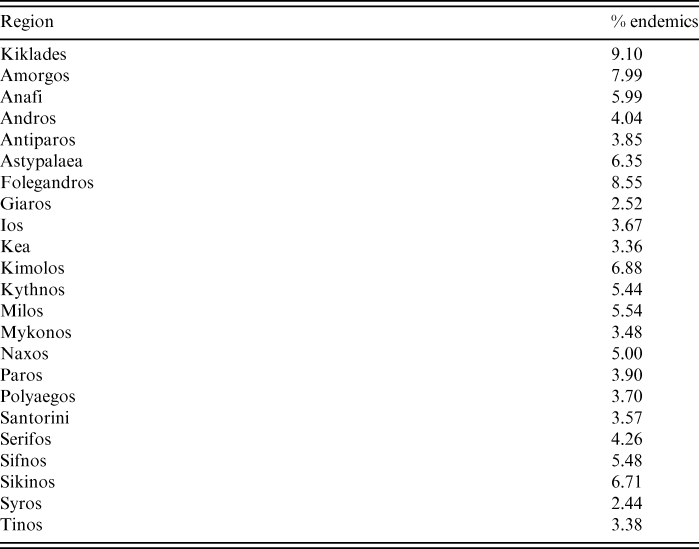
According to Dimopoulos et al. (Reference Dimopoulos, Raus, Bergmeier, Constantinidis, Iatrou, Kokkini, Strid and Tzanoudakis2013), 1768 taxa are found in the phytogeographical region of the Kiklades, 161 of which are considered endemics (9.10%). In Folegandros, 40 endemic taxa were found, making up 8.55% of its flora (Table 4). The level of endemism in Folegandros is rather low compared to that in the whole of Greece (22.2%, Dimopoulos et al., Reference Dimopoulos, Raus, Bergmeier, Constantinidis, Iatrou, Kokkini, Strid and Tzanoudakis2013) but, taking into consideration the small size of the study area (c.32 km2), its geographic position not close to known areas of high endemism, the unfavourable arid climate, as well as the intense human pressure present on the island (i.e. high intensity grazing, highly cultivated areas – abandoned or not), this percentage is rather significant. Furthermore, compared to endemism levels in other parts of the phytogeographical region of the Kiklades, yet with larger size than that of the study area (Table 4), that of Folegandros is rather high, even appearing to be the highest in the phytogeographical region of the Kiklades.
Endemism in Folegandros and the phytogeographical region of the Kiklades, as well as in the other large Kikladic islands
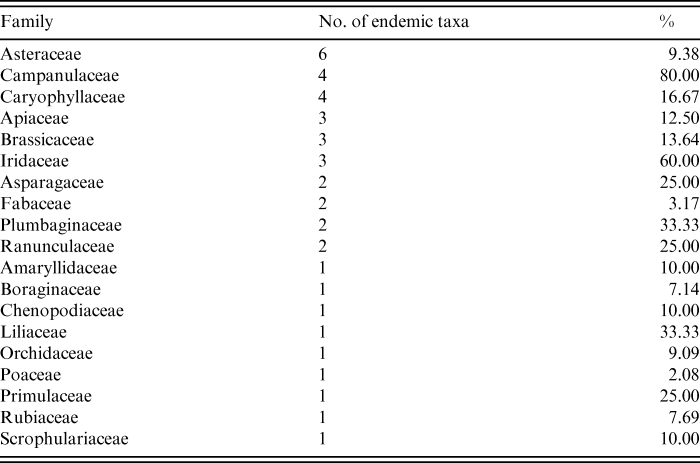
The endemic species belong to 19 families and 31 genera. Families rich in endemic species in absolute numbers are Asteraceae, Campanulaceae and Caryophyllaceae (Table 5), their degree of endemism (9.38%, 80.00% and 16.67%, respectively) being higher than that of the general flora (8.55%). These results agree with the trend observed in the whole Greek endemic flora (Georghiou & Delipetrou, Reference Georghiou and Delipetrou2010).
Families with endemic taxa and their degree of endemism
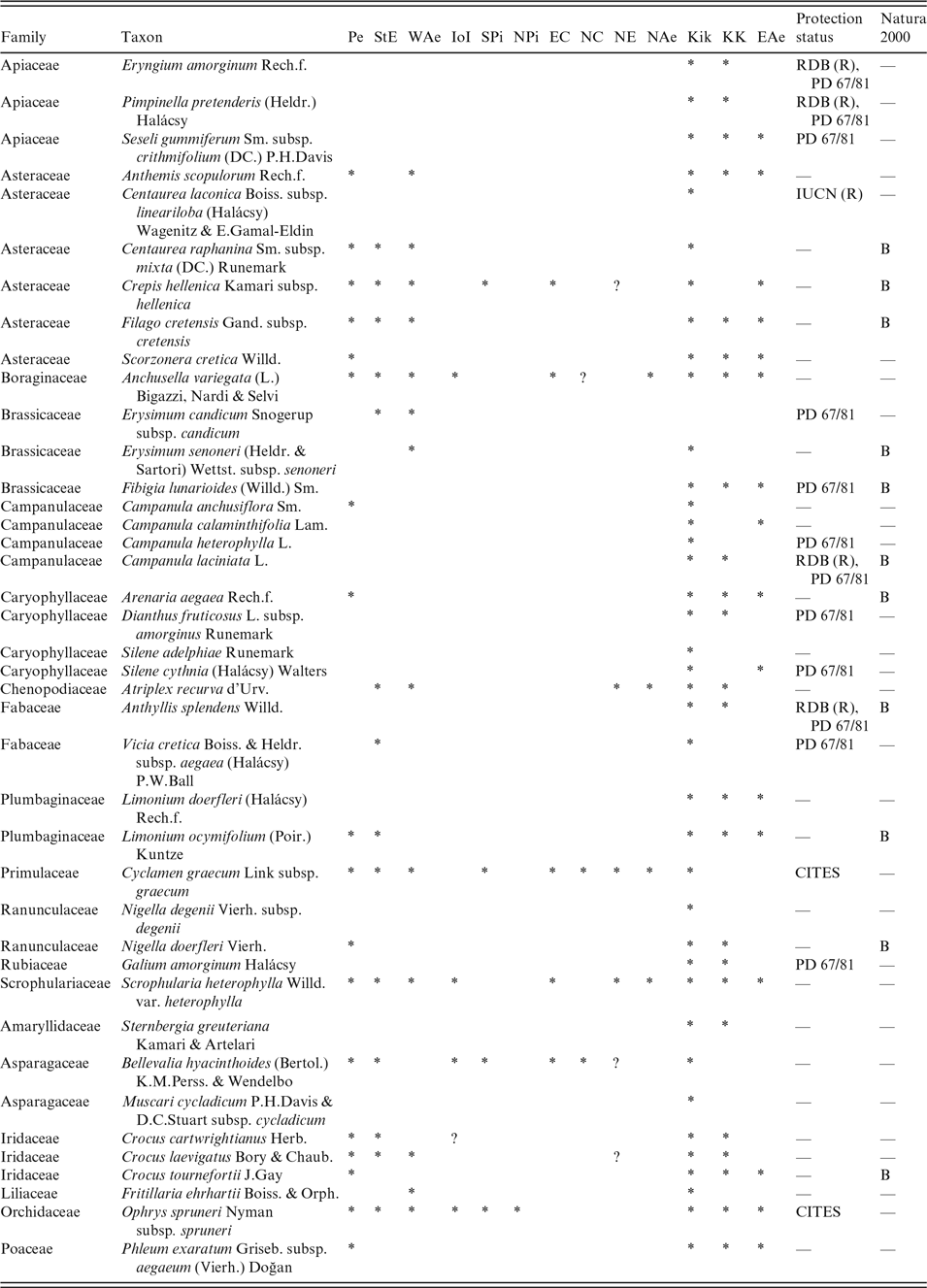
Nearly half (19) of the endemic taxa found on Folegandros correspond to one or two phytogeographical areas (Table 6), thus providing valuable information regarding the phytogeographical position of the study area, as the existence of biregional endemics is a good indication of phytogeographical connections between regions (Georghiou & Delipetrou, Reference Georghiou and Delipetrou2010). It would be expected that Folegandros shows higher affinities with the phytogeographical area of the East Aegean Islands (EAe) since, according to Georghiou & Delipetrou (Reference Georghiou and Delipetrou2010), the phytogeographical area of the Kiklades (Kik) is chorologically more closely connected to EAe than to that of Kriti and Karpathos (KK). While this may be true for the majority of the Kikladic islands, our results demonstrate that Folegandros is phytogeographically closer to KK, as we recorded eight endemic taxa (Anthyllis splendens Willd., Campanula laciniata L., Dianthus fruticosus L. subsp. amorginus Runemark, Eryngium amorginum Rech.f., Erysimum candicum Snogerup subsp. candicum, Galium amorginum Halácsy, Pimpinella pretenderis (Heldr.) Orph. ex Halácsy and Sternbergia greuteriana Kamari & Artelari) occurring exclusively in Kik and KK and only two taxa (Silene cythnia (Halácsy) Walters and Campanula calaminthifolia Lam.) that occur exclusively in Kik and EAe. Therefore we argue that Folegandros seems to be more closely connected to KK, concurring with previous studies in the southern part of the phytogeographical area of the Kiklades (Kougioumoutzis et al., Reference Kougioumoutzis, Tiniakou, Georgiou and Georgiadis2012, Reference Kougioumoutzis, Tiniakou, Georgiou and Georgiadis2014a). It could be argued that the southern Kiklades as a whole have higher phytogeographical affinities with Kriti and this could possibly be attributed to the close palaeogeographical distance between southern Kiklades and Kriti during the Messinian salinity crisis (Hsü, Reference Hsü1972). Our results concur with Kougioumoutzis et al. (Reference Kougioumoutzis, Simaiakis and Tiniakou2014b), according to whom most of the biregional endemics present in the phytogeographical region of the Kiklades originate from the phytogeographical region of Kriti and Karpathos.
Greek endemic taxa in Folegandros, their geographical distribution and their protection and evaluation status according to European and national legislation and lists
Abbreviations:
Pe, Peloponnisos; StE, Sterea Hellas; WAe, West Aegean Islands; IoI, Ionian Islands; SPi, South Pindhos; NPi, North Pindhos; EC, East Central; NC, North Central; NE, North East; NAe, North Aegean Islands; Kik, Kiklades; KK, Kriti and Karpathos; EAe, East Aegean Islands.
CITES: Convention on International Trade in Endangered Species of Wild Fauna and Flora.
IUCN: Red List of Threatened Plants (IUCN, 2010), with the following classification system: R: the species population is rare.
Natura 2000 (Dafis et al., Reference Dafis, Papastergiadou, Georghiou, Babalonas, Georgiadis, Papageorgiou, Lazaridou and Tsiaoussi1996): The database created after the Directive 43/1992, where the plants are evaluated as: B: Greek endemics.
PD: Greek Presidential Decree 67/1981 (1981), on the protection of the native flora and wild fauna of Greece.
RDB: Red Data Book of Rare and Threatened Plants of Greece.
The conservation status of the Greek endemic taxa of Folegandros, as well as their evaluation status within the Natura 2000 Network, is shown in Table 6. Twenty-four out of 40 endemic taxa are under statutory protection.
Phytogeographical relationships within the Kiklades
The phytogeographical region of the Kiklades consists of 22 large islands; detailed and available floristic data exist, however, only for the following islands: Anafi, Andros, Antiparos and Paros, Giaros, Kimolos, Milos, Naxos, Santorini and Serifos. Therefore, we focus on these 10 islands in order to examine the floristic affinities of Folegandros Island within the phytogeographical region of the Kiklades.
All the islands in the comparison are in the same bioclimatic zone and phytogeographical region (Kik) as the study area, except for Naxos, which has a more humid climate, although being part of the same phytogeographical region (Kik).
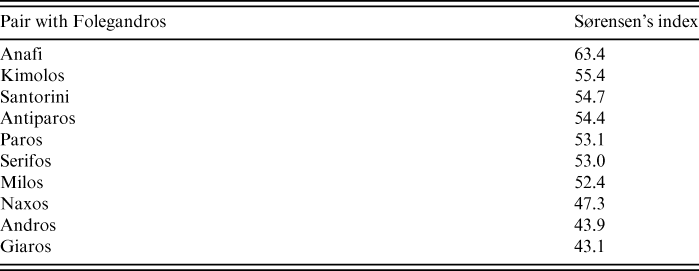
In Table 7 Sørensen’s index values for each island pair show that Folegandros has the strongest phytogeographical affinity with Anafi.
Sørensen’s index values for each large island of the phytogeographical region of the Kiklades compared to Folegandros Island
Discussion
The high percentages of therophytes (57.48%) and of leguminous taxa (13.43%) indicate disturbance in Mediterranean ecosystems (Naveh, Reference Naveh, Kozlowski and Ahlgren1974; Arianoutsou & Margaris, Reference Arianoutsou, Margaris, Margaris and Mooney1981; Barbero et al., Reference Barbero, Bonin, Loisel and Quézel1990; Panitsa et al., Reference Panitsa, Dimopoulos, Iatrou and Tzanoudakis1994, Reference Panitsa, Snogerup, Snogerup and Tzanoudakis2003; Panitsa & Tzanoudakis, Reference Panitsa and Tzanoudakis1998). Intense stock farming and other agricultural activities have not yet ceased in Folegandros and have clearly altered the island’s floristic character, as the relatively high local amount of Asian elements (8.55%) suggests.
According to Arianoutsou et al. (Reference Arianoutsou, Bazos, Delipetrou and Kokkoris2010), the total number of alien taxa accounts for c.5% of the native flora of Greece, which is significantly higher than that of Folegandros (1.27%). Nevertheless, in Folegandros where abandoned grazing grounds and farm lands occupy large areas, Aeonium arboreum has heavily contaminated and altered these habitats which would otherwise be colonised by native pioneer herbs and shrubs. This phenomenon is also observed in other Aegean islands (Arianoutsou et al., Reference Arianoutsou, Bazos, Delipetrou and Kokkoris2010; Kougioumoutzis et al., Reference Kougioumoutzis, Tiniakou, Georgiou and Georgiadis2012, Reference Kougioumoutzis, Tiniakou, Georgiou and Georgiadis2014a).
The high percentages of chamaephytes and hemicryptophytes depend on the frequency of limestone cliffs which very often harbour endemic taxa (Kypriotakis, Reference Kypriotakis1998; Kypriotakis & Tzanoudakis, Reference Kypriotakis and Tzanoudakis2001; Tzanoudakis et al., Reference Tzanoudakis, Panitsa, Trigas and Iatrou2006). In Folegandros, nearly half (45%) of the endemic flora are chamaephytes or hemicryptophytes, which are scattered in the numerous steep calcareous cliffs present on the island.
The number of species per surface unit is an important parameter of Aegean vascular plant diversity, in relation to the conservation of the diversity of the Aegean area (Panitsa & Tzanoudakis, Reference Panitsa and Tzanoudakis2010). In this context Folegandros seems to be a biodiversity hotspot at least for the phytogeographical region of the Kiklades, in spite of the intense human presence and the relatively low number of plant taxa present on the island, as it hosts more than five times (14.7 species/km2) the taxa per surface unit than Andros or Naxos (2.7 and 2.4 species/km2, respectively), 37 times the taxa compared to the whole East Aegean area (0.4 species/km2, Panitsa & Tzanoudakis, Reference Panitsa and Tzanoudakis2010) and 27 times the taxa compared to the Kiklades (c.0.54 species/km2, Phitos et al., Reference Phitos, Strid, Snogerup and Greuter1995). Moreover, Folegandros hosts 10 times (1.25 endemic species/km2) the endemic taxa per surface unit compared to Andros and Naxos (0.11 and 0.12 endemic species/km2, respectively) and 21 times the endemic taxa compared to the Kiklades (0.06 endemic species/km2). Our results concur with Kougioumoutzis & Tiniakou (Reference Kougioumoutzis and Tiniakou2014), who characterised Folegandros as an endemic plant diversity hotspot in the phytogeographical region of the Kiklades.
The existence of biregional endemics is a good indication of phytogeographical connections between regions (Georghiou & Delipetrou, Reference Georghiou and Delipetrou2010). Eight endemic taxa found in the study area – Anthyllis splendens, Campanula laciniata, Dianthus fruticosus subsp. amorginus, Eryngium amorginum, Erysimum candicum subsp. candicum, Galium amorginum, Pimpinella pretenderis and Sternbergia greuteriana – provide useful information regarding the biogeographical position of Folegandros, as they are found exclusively in the phytogeographical regions of Kiklades and Kriti-Karpathos. Folegandros seems to have very close phytogeographical affinities with Amorgos, Anafi and Astypalaea. More specifically, Erysimum candicum subsp. candicum and Sternbergia greuteriana can only be found outside the phytogeographical region of Kriti-Karpathos, in Anafi and Folegandros. The rest of the aforementioned taxa have a wider southern Kikladic distribution; most of them, however, are also found in (or were described from) Amorgos. In particular, Anthyllis splendens is found outside Kriti only in Amorgos, Anafi, Folegandros and Kythnos, Campanula laciniata is reported from Kriti, Karpathos, Amorgos, Anafi, Astypalaea, Folegandros, Kythnos, Sikinos and Sifnos, Dianthus fruticosus subsp. amorginus is distributed in Kriti and Amorgos, Astypalaea, Folegandros, Kimolos, Milos and Sikinos, Eryngium amorginum is found in Kriti, Amorgos, Astypalaea and Folegandros, Galium amorginum in Kriti, Amorgos, Folegandros and Naxos, while Pimpinella pretenderis is distributed in Kriti, Astypalaea, Folegandros, Ios, Santorini and Sikinos. The evidence presented here suggests a close phytogeographical relationship between Folegandros and Kriti, as well as between southern Kiklades and Kriti since, according to Strid & Tan (Reference Strid and Tan1997), the phytogeographical region of Kriti and Karpathos has strong connections to that of the Kiklades, especially as far as the dry southeastern islands are concerned.
The flora of Folegandros is more similar to that of Anafi, and then to Kimolos and Santorini (Kik), than to that of Andros and Giaros. The stronger floristic affinities between Folegandros and Anafi can be attributed to the fact that in both these islands there are numerous calcareous cliffs hosting several rare and endemic taxa, as well as to their quite similar climatic conditions. On the other hand, the rather low floristic similarity between Folegandros and Andros can be attributed to the more humid climate of the latter; after all, the phytogeographical region of the Kiklades is climatically compartmentalised (Theocharatos, Reference Theocharatos1978). Our results are in accordance with the phytogeographical compartmentalisation of the Kiklades (Kougioumoutzis et al., Reference Kougioumoutzis, Simaiakis and Tiniakou2014b), as well as with the fact that Folegandros acts as an endemic species pool in the phytogeographical region of the Kiklades (Kougioumoutzis et al., Reference Kougioumoutzis, Simaiakis and Tiniakou2014b).
Acknowledgements
The authors are much indebted to Dr Paraskevas Vasilakopoulos for his invaluable assistance in the field. Cordial thanks are also due to Dr Ioannis Kokkoris for his help in constructing the geographical map of Folegandros Island and to Dr Leonardos Tiniakos for his help and comments regarding the geology of Folegandros Island. The authors would like to thank Dr Thomas Raus and an anonymous reviewer for their valuable comments and suggestions on the manuscript.
Appendix
Notes
• Only taxa new to the investigated area appear in the catalogue below.
• Names of taxa not native to the area are in square brackets.
Abbreviations used
KK: K. Kougioumoutzis observations and/or vouchers
Obs.: Field observation
Phot.: Photograph
Collection dates

Collection sites
Life forms
Chamaephyte (Ch) Geophyte (G)
Hemicryptophyte (H) Phanerophyte (P)
Hydrophyte (A) Therophyte (T)
Chorological groups
Widely distributed taxa
European-SW Asian (EA)
Euro-Siberian (ES)
Paleotemperate (Pt)
Circumtemperate (Ct)
Subtropical-Tropical (ST)
Cosmopolitan (Co)
Mediterranean taxa
Eastern Mediterranean (EM)
Mediterranean (Me)
Mediterranean-Atlantic (MA)
Mediterranean-European (ME)
Mediterranean-SW Asian (MS)
Balkan taxa
Balkan (Bk)
Balkan-Italian (BI)
Balkan-Anatolian (BA)
Endemic taxa (Endemic)
Adventive taxa (Adv.)
Catalogue of plants
FERNS
Pteridaceae
Adiantum capillus-veneris L. – G, ST; L; 17, b, KK 3204
ANGIOSPERMAE
Acanthaceae
Acanthus spinosus L. – H, Me; ΚΚ Phot.
Amaryllidaceae
Allium neapolitanum Cirillo – G, Me; 9, a, KK 2899
Sternbergia greuteriana Kamari & Artelari – G, Endemic; 25, d, KK 3209
Apiaceae
Daucus guttatus Sm. subsp. guttatus – T, Me; 13, b, KK 3282; 16, b, KK 3298
Foeniculum vulgare Mill. – H, Me; L; KK Obs.
Prangos ferulacea (L.) Lindl. – H, EA; L; KK Obs.
Scandix pecten-veneris L. – T, EA; L; 1, a, KK 2980; 10, a, KK 3222
Asparagaceae
Muscari commutatum Guss. – G, BI; 4, a, KK 3210
Muscari cycladicum P.H.Davis & D.C.Stuart subsp. cycladicum – G, Endemic; 1, a, KK 2896; 5, a, KK 3115
Ornithogalum narbonense L. – G, Me; L; 13, b, KK 3254
Asteraceae
Anthemis rigida (Sm.) Heldr. – T, EM; 7, a, KK 3368
Calendula arvensis (Vaill.) L. – T, ME; L; 2, a, KK 3058; 4, a, KK 2862
Carduus pycnocephalus L. subsp. pycnocephalus – T, Me; 1, a, KK 3001
Crepis foetida L. subsp. rhoeadifolia (M.Bieb.) Čelak. – T, EA; L; 1, a, KK 2951
Crepis sancta (L.) Bornm. – T, EA; 1, a, KK 2969
Hedypnois rhagadioloides (L.) F.W.Schmidt subsp. tubaeformis (Ten.) Hayek – T, Me; L; 1, a, KK 2946; 13, b, KK 3253; 15, b, KK 3330
Hyoseris scabra L. – T, Me; 9, a, KK 2885; 11, a, KK 2850
Hypochaeris cretensis (L.) Bory & Chaub. – T, Me; 13, b, KK 3287; 16, b, KK 3294
Lactuca acanthifolia (Willd.) Boiss. – H, EM; F; KK Obs.
Notobasis syriaca (L.) Cass. – T, Me; 16, b, KK 3299
Ptilostemon chamaepeuce (L.) Less. – H, EM; L; KK Obs.
Rhagadiolus stellatus (L.) Gaertn. – T, Me; 1, a, KK 2978; 13, b, KK 3250
Scorzonera mollis M.Bieb. – H, EA; L; 1, a, KK 2934; 2, a, KK 3063; 11, a, KK 2828; 12, b, KK 3341; 13, b, KK 3255
Sonchus tenerrimus L. – T, Me; L; 3, a, KK 3078; 7, a, KK 2825; 9, a, KK 2912
Tragopogon dubius Scop. – H, EA; 10, a, KK 3219
Tragopogon porrifolius L. – H, Me; 1, a, KK 2922; 11, a, KK 2844; 12, b, KK 3342
Boraginaceae
Anchusa aegyptiaca (L.) DC. – H, EM; L; 1, a, KK 2924
Anchusa italica Retz. – H, Me; KK Obs.
Buglossoides arvensis (L.) I.M.Johnst. – T, Me; 4, a, KK 2871
Cynoglossum columnae Ten. – T, Me; 1, a, KK 2944
Echium diffusum Sm. – T, Me; L; 4, a, KK 2870
Echium parviflorum Moench – T, Me; L; 16, b, KK 3293
Echium plantagineum L. – T, ME; 12, a, KK 2858
Neatostema apulum (L.) I.M.Johnst. – T, Me; L; 13, b, KK 3277
Onosma graecum Boiss. – T, EM; 1, a, KK 2971
Brassicaceae
Erysimum candicum Snogerup subsp. candicum – Ch, Endemic; F; 5, a, KK 3103; 6, a, KK 3112; 7, a, KK 2827; 9, a, KK 2883
Matthiola incana (L.) R.Br. – Ch, ME; 17, b, KK 3338
Campanulaceae
Campanula erinus L. – T, ME; L; 13, b, KK 3263
Caryophyllaceae
Spergularia diandra (Guss.) Boiss. – T, EA; L; 7, a, KK 2853; 9, a, KK 2873
Spergularia media (L.) C.Presl – Ch, Me; 15, b, KK 3321
Chenopodiaceae
Salsola tragus L. – T, Pt/[Co]; KK Obs.
Convolvulaceae
Cuscuta palaestina L. – T, Me; L; 14, b, KK 3317
Crassulaceae
[Aeonium arboreum (L.) Webb & Berthel.] – H/C, [NW-Afr.]; KK Obs.
Cucurbitaceae
Bryonia cretica L. – G, EM; L; 9, a, KK 2909
Euphorbiaceae
Euphorbia exigua L. – T, ME; L; 2, a, KK 3048
Euphorbia helioscopia L. – T, Co; 1, a, KK 2964
Euphorbia peplus L. – T, Co; 1, a, KK 3009
Fabaceae
Astragalus echinatus Murray – T, Me; L; 15, b, KK 3307
Astragalus hamosus L. – T, MS; L; 6, a, KK 3116
Astragalus spruneri Boiss. – T, Bk; L; 6, a, KK 3193
Coronilla scorpioides (L.) W.D.J.Koch – T, ME; L; 2, a, KK 3036
Hedysarum spinosissimum L. – G, Me; 1, a, KK 3000; 13, b, KK 3258; 15, b, KK 3319
Hippocrepis unisiliquosa L. – T, Me; 11, a, KK 2838
Lathyrus aphaca L. – T, MS; L; 6, a, KK 3199
Lathyrus cicera L. – T, MS; L; 11, a, KK 2837; 13, b, KK 3333
Lathyrus clymenum L. – T, Me; L; 2, a, KK 3064
Lathyrus setifolius L. – T, Me; L; 12, b, KK 3367
Lotus ornithopodioides L. – T, Me; L; 1, a, KK 3011; 2, a, KK 3060; 6, a, KK 3117; 9, a, KK 2906; 12, b, KK 3370
Medicago disciformis DC. – T, Me; 10, a, KK 3224
Medicago polymorpha L. – T, Pt; 1, a, KK 2953; 6, a, KK 3112
Medicago truncatula Gaertn. – T, MS; L; 2, a, KK 3044; 9, a, KK 2874
Onobrychis aequidentata (Sm.) d’Urv. – T, Me; L; 1, a, KK 2963; 10, a, KK 3218; 15, a, KK 3328
Onobrychis caput-galli Lam. – T, Me; 12, b, KK 3353; 14, b, KK 3301
Ononis ornithopodioides L. – T, Me; 13, b, KK 3267
Ononis viscosa L. subsp. sieberi (DC.) Širj. – T, Me; 12, b, KK 3385; 15, b, KK 3308
Trifolium nigrescens Viv. – T, Me; L; 1, a, KK 2935; 9, a, KK 2881
Trifolium spumosum L. – T, Me; L; 7, a, KK 2803
Trifolium tomentosum L. var. tomentosum – T, Me; L; 6, a, KK 3105; 7, a, KK 2814; 11, a, KK 2834
Vicia cretica subsp. aegaea (Halácsy) P.W.Ball – T, Endemic; 10, a, KK 3225
Vicia hybrida L. – T, Eurymed.; 7, a, KK 2807
Vicia sativa subsp. cordata (Hoppe) Batt. – T, ME; 11, a, KK 2863
[Vicia sativa L. subsp. sativa] – T, Pt; 1, a, KK 2956; 6, a, KK 3123; 11, a, KK 2842; 12, b, KK 3388
Gentianaceae
Centaurium tenuiflorum (Hoffmanns. & Link) Fritsch subsp. tenuiflorum – T, ME; 2, a, KK 3205; 12, b, KK 3346; 15, b, KK 3309
Geraniaceae
Erodium gruinum (L.) L’Hér. – T, EM; L; 2, a, KK 3046; 9, a, KK 2908
Geranium molle L. – T, Pt; L; 1, a, KK 2937; 4, a, KK 2864; 16, b, KK 3296
Geranium purpureum Vill. – T, Me; L; KK Obs.
Hypericaceae
Hypericum triquetrifolium Turra – H, EM; L; 1, a, KK 3017
Iridaceae
Crocus cartwrightianus Herb. – G, Endemic; 21, d, KK Phot.; 22, d, KK Phot.
Crocus laevigatus Bory & Chaub. – G, Endemic; 21, d, KK Phot.; 22, d, KK Phot.; 24, d, KK Phot.
Lamiaceae
Lamium moschatum Mill. – T, EM; L; 5, a, KK 3097
Salvia verbenaca L. – H, MA; L; 1, a, KK 2923
Salvia viridis L. – T, Me; L; 1, a, KK 3002; 10, a, KK 3212
Sideritis romana L. subsp. curvidens (Stapf) Holmboe – T, EM; L; 11, a, KK 2833
Liliaceae
Gagea graeca (L.) Irmsch. – G, BA; 4, a, KK 2984
Gagea peduncularis (J.Presl & C.Presl) Pascher – G, Me; 4, a, KK 2859
Linaceae
Linum bienne Mill. – H, Me; 2, a, KK 3030
Linum strictum L. subsp. strictum – T, Me; 1, a, KK 2995; 12, b, KK 3381; 13, b, KK 3276; 15, b, KK 3315
Malvaceae
Malva parviflora L. – T, MS; L; 7, a, KK 2818
Malva pusilla Sm. – T, ES; 1, a, KK 3013
Myrtaceae
[Eucalyptus camaldulensis Dehnh.] – P, [Austr.]; KK Obs.
Oleaceae
Olea europaea L. – P, Me; L; KK Obs.
Orchidaceae
Anacamptis collina (Russell) R.M.Bateman, Pridgeon & M.W.Chase – G, MS; KK Phot.
Anacamptis papilionacea (L.) R.M.Bateman, Pridgeon & M.W.Chase – G, MS; KK Phot.
Ophrys ferrum-equinum Desf. – G, BA; KK Phot.
Ophrys fusca Link subsp. fusca – G, Me; KK Phot.
Ophrys fusca Link subsp. iricolor (Desf.) K.Richt. – G, Me; KK Phot.
Ophrys lutea subsp. galilaea (H.Fleischm. & Bornm.) Soó – G, Me; KK Phot.
Ophrys lutea Cav. subsp. lutea – G, Me; KK Phot.
Ophrys omegaifera H.Fleischm. – G, Me; KK Phot.
Ophrys spruneri Nyman subsp. spruneri – G, Endemic; KK Phot.
Ophrys tenthredinifera Willd. – G, Me; KK Phot.
Serapias orientalis (Greuter) H.Baumann & Künkele subsp. orientalis – G, Me; KK Phot.
Orobanchaceae
Orobanche minor Sm. – T, EA; L; KK Phot.
Orobanche pubescens d’Urv. – T, Me; L; KK Phot.
Phelipanche nana (Reut.) Soják – T, Pt; L; KK Phot.
Papaveraceae
Fumaria capreolata L. – T, Me; 19, c, KK 3237
Glaucium corniculatum (L.) Rudolph – T, Me; 14, b, KK 3304
Glaucium flavum – H, ME; KK Phot.
Papaver rhoeas L. var. rhoeas – T, EM; 1, a, KK 2919; 2, a, KK 3032; 9, a, KK 2890; 11, a, KK 2845; 12, b, KK 3259; 19, c, KK 3234
Papaver rhoeas L. var. strigosum Boenn. – T, Pt; 2, a, KK 3019; 13, b, KK 3251
Plantaginaceae
Plantago afra L. – T, Me; 2, a, KK 3026; 9, a, KK 2904
Poaceae
Anisantha diandra (Roth) Tutin – T, Me; 12, b, KK 3368
Anisantha fasciculata (C.Presl) Nevski – T, Me; 1, a, KK 2993; 13, b, KK 3262
Anisantha sterilis (L.) Nevski – T, MS; L; 13, b, KK 3249
Avena sterilis L. – T, MS; L; 9, a, KK 2877
Briza maxima L. – T, ST; 1, a, KK 2985; 12, b, KK 3248
Hainardia cylindrica (Willd.) Greuter – T, Me; 12, b, KK 3365
Hordeum murinum L. subsp. leporinum (Link) Arcang. – T, Me; 2, a, KK 3054; 6, a, KK 3108; 9, a, KK 2914; 12, b, KK 3367; 15, b, KK 3312
Melica minuta L. – H, Me; L; 12, b, KK 3247
Phleum arenarium L. – T, MS; 7, a, KK 2820; 15, b, KK 3326
Phragmites australis (Cav.) Steud. – G, Co; KK Obs.
Piptatherum miliaceum (L) Coss. – H, MS; 7, a, KK 2810
Poa timoleontis Boiss. – H, EM; 1, a, KK 2926
Polypogon maritimus Willd. subsp. maritimus – T, Me; 1, a, KK 2984
Polypogon monspeliensis (L.) Desf. – T, ST; 2, a, KK 3027; 15, b, KK 3313
Stipa capensis Thunb. – T, Me; L; 14, b, KK 3302
Stipa pennata L. – H, ES; 2, a, KK 3047; 13, b, KK 3284
Posidoniaceae
Posidonia oceanica (L.) Delile – A, Me; KK Obs.
Primulaceae
Samolus valerandi L. – H, Co; 17, b, KK 3200
Rubiaceae
Galium murale (L.) All. – T, Me; L; 12, b, KK 3378; 13, b, KK 3260
Galium setaceum Lam. – T, MS; L; 16, b, KK 3290
Galium spurium L. – T, Ct; 1, a, KK 2918; 2, a, KK 3056; 5, a, KK 3095; 7, a, KK 2806; 15, b, KK 3318
Galium verrucosum Huds. – T, Me; 9, a, KK 2895
Sherardia arvensis L. – T, EA; 7, a, KK 2804
Scrophulariaceae
Linaria triphylla (L.) Mill. – T, Me; L; 2, a, KK 3022; 9, a, KK 2891
Scrophularia lucida L. – H (Ch), Me; L; 5, a, KK 3096
Veronica agrestis L. – T, EA; 4, a, KK 2861
Veronica cymbalaria Bodard – T, Me; 9, a, KK 2884
Veronica polita Fr. – T, EA; L; 1, a, KK 2927
Tamaricaceae
Tamarix hampeana Boiss. & Heldr. – NP, EM; 2, a, KK 3023; 7, a, KK 2824
Urticaceae
Parietaria judaica L. – H, EA; 17, b, KK 3336
Valerianaceae
Centranthus calcitrapae (L.) Dufr. – T, Me; L; 2, a, KK 3039; 10, a, KK 3216; 13, b, KK 3283
Valerianella discoidea Loisel. – T, Me; L; 1, a, KK 2929; 2, a, KK 3041
Valerianella vesicaria (L.) Moench – T, MS; 12, b, KK 3390; 13, b, KK 3274