Proper hand hygiene (HH) is the single most important factor in preventing healthcare-associated infections (HAIs), but HH compliance rates remain alarmingly low among healthcare workers (HCWs).Reference Erasmus, Daha and Brug 1 , 2 Social dynamics may influence HH practices, but evidence supporting an effect of role models and leadership regarding HH is limited by small samples and loose definitions of role model.Reference Lankford, Zembower, Trick, Hacek, Noskin and Peterson 3 , Reference Snow, White, Alder and Stanford 4 For example, a University of Utah study of 66 nursing students found that HH compliance was positively influenced by the HH practices of their mentors.Reference Snow, White, Alder and Stanford 4 However, a Northwestern University study of 721 HCWs found a negative effect. If a senior health professional did not wash his or her hands, HCWs were less likely to wash their hands. However, no change in behavior was observed if a senior health professional did wash their hands.Reference Lankford, Zembower, Trick, Hacek, Noskin and Peterson 3 In our study, we analyzed ~3,000 HH observations to describe the impact of being in a group (≥2 people) with a leader modeling HH compliance to determine whether the HH practices of HCWs in groups are influenced by the HH practices of group role models.
METHODS
Study Population
A total of 4 adult inpatient care units at a single tertiary care hospital were selected for study: a rehabilitation unit, an intensive care unit, and 2 observation units. HH stations, defined as either a sink or an alcohol-based hand rub (ABHR), were located both inside and outside of patient rooms. Only the intensive care unit had glass windows to allow viewing of HH stations inside a patient’s room; in-room HH stations in other units were not observed (to maintain patient privacy). Units were observed between February 14 and 28, 2014, by 21 graduate students (8 hours/student). Observers were trained in the use of a standardized observation tool employed for data collection. The tool was an HH observation tool used at UMHS with modifications.
Definitions
Data were collected at 4 HH opportunities: room entry, room exit, before gloves were put on, and after glove removal. Glove use followed hospital policy for standard precautions or contact precautions as appropriate. Successful HH was defined as the use of soap and water or ABHR when presented with an HH opportunity. Observations were classified as “group” or “individual,” where “group” was defined as 2 or more HCWs presented with the same HH opportunity at the same time. “Individual” was defined as any nongroup observation. A “group leader” was defined as the HCW with the highest apparent seniority in the group who was considered the HH role model for that group. If no leader was apparent, the group was regarded as leaderless. Observations were further stratified by unit and HCW type based on attire, including long white coats (eg, worn by attending physicians, residents, physician assistants, nurse practitioners), short white coats (eg, worn by students), scrubs (eg, worn by nurses), and other attire (eg, worn by environmental services, dietary, transport, etc.).
Analysis
We calculated HH compliance, defined as the proportion of successful HH events, separately for groups and individuals. HH compliance of group members was calculated (excluding the group leader) in three ways: (1) when the group leader successfully performed HH; (2) when the group leader failed to perform HH; and (3) for leaderless groups. Differences between groups and individuals were assessed using Pearson’s χ2 test. All analyses were performed using SAS version 9.3 (SAS Institute, Cary NC).
RESULTS
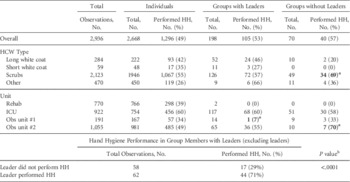
A total of 2,936 HH observations were collected over 168 hours of observation. Among these, 268 (9%) were observations of groups and 2,668 (91%) were observations of individuals. HH compliance was highest among HCWs in scrubs (61% in groups, 55% among individuals) and in the intensive care unit (58% in groups, 60% among individuals) (Table 1).
Comparison of Hand Hygiene (HH) Compliance in Two Scenarios: (1) When a HCW Performs HH Alone versus when a HCW Performs HH in a Group and (2) When a Group Leader Performs HH versus when a Group Leader Does Not Perform HH

NOTE. UMHS Healthcare Workers observed February 14–28, 2014 (N=2,936 observations). Overall, 268 observations (9.1%) were in groups consisting of at ≥2 persons. There were 120 non-leader group members (4% of all observations and 45% of group observations). Observations were collected over a span of 168 hours between 12:00 a.m. and 11:00 p.m. with most observations collected between 9:00 a.m. and 5:00 p.m.
HH, hand hygiene; HCW, healthcare worker; Individuals, HCWs with a HH opportunity when alone; Groups, HCWs with a HH opportunity when in groups of 2 or more; EVS, environmental services; Rehab, rehabilitation unit; ICU, intensive care unit; Obs Unit, observation unit; leader, HCW with the highest apparent seniority in the group; group members with leaders, HCWs who were not the leader of their group (in groups with a leader only).
a P values obtained using Pearson’s χ2 test comparing % HH compliance of individuals vs groups with leaders or groups without leaders. Bold values indicate P<.05.
b P value obtained using Pearson’s χ2 test comparing % HH compliance of leader did not perform HH vs leader performed HH.
Overall, HH compliance was marginally better among groups with leaders and groups without leaders versus individuals (53% and 57% vs 49%, respectively); however, no major differences were observed between groups and individuals by HCW type or unit. Interestingly, significantly greater HH compliance was observed among group members when the group leader practiced HH than when the group leader did not practice HH (71% and 29%, respectively, P<.0001) (Table 1).
DISCUSSION
In our analysis of almost 3,000 HH observations in a tertiary care facility, we found that the HH of HCWs in groups differed from HCWs not in groups and that the behavior of group leaders strongly affected HH compliance when they were in groups. Our findings are consistent with a study among physicians and nurses showing a significant drop in HH compliance when the HH role model retired (a physician) or was transferred (a nurse).Reference Lieber, Mantengoli and Saint 5 Together, these findings indicate the important role leaders can play in promoting and sustaining HH compliance among HCWs.
This effect is not limited to HH: Strong leadership improves gowning and gloving practices, accelerates the adoption of new therapies and guidelines, and reduces barriers to infection control policy implementation.Reference De Bono, Heling and Borg 6 – Reference Soumerai, McLaughlin and Gurwitz 8 These effects may be stronger when the leader is actively present as a role model, such as when in a group. Medical students imitate the HH practices of their superiors, which often leads to low HH compliance when superiors fail to perform HH.Reference Erasmus, Brouwer and van Beeck 9 Further, HCWs (and others) change behavior when they are being observed.Reference Pittet, Simon, Hugonnet, Pessoa-Silva, Sauvan and Perneger 10 Therefore, role models who are actively present may have a strong influence on HCW behaviors, including HH.
Although group leader was defined by observation and the HCWs were aware they were under observation, our findings indicate a strong influence of role models on HH compliance. Therefore, as patient care continues to become increasingly team based, the interaction of role models and groups will likely become an important determinant affecting HH compliance rates.
Acknowledgments
The authors thank Patrick Albertus, Matthew Lau, and Omar Yasin for their assistance in designing the study and collecting observations, and Utibe Effiong for the creation and coordination of HH observations into a database and for collecting observations. We also thank the EPID 655 section 1, class of 2014 for their assistance in collecting observations.
We appreciate the cooperation of the following unit heads during the observation process: Richard Burney, MD; Edmund Chadd, MD; Milo Engoren, MD; Michelle Fernamberg, MHA, BSN, CRRN, RN; Jason Ham, MD; Ann Kohler-Kaiser, RN, Nurse Manager; and Joan McNeice, MS, RN, Nurse Manager.
Financial support. None reported.
Potential conflicts of interest. All authors report no conflicts of interest relevant to this article.