Introduction
Triglycerides and total cholesterol are risk factors for future cardiovascular disease. Even among children and young adults, these risk factors have been associated with the development of atherosclerosis in both cross sectionalReference Berenson, Srinivasan and Bao 1 , Reference Owen, Rudnicka and Nightingale 2 and longitudinalReference Li, Chen and Srinivasan 3 , Reference Raitakari, Juonala and Kahonen 4 studies. Improved understanding of determinants of elevated serum triglycerides and cholesterol could provide additional opportunities to prevent cardiovascular disease.
Selenium and copper are essential trace elements. Selenium, as part of selenoproteins, plays a role in protection against oxidative stress, thyroid function and immune function.Reference Barceloux 5 Copper, incorporated into cuproenzymes, plays a role in heme and iron metabolism, immune function, and glucose and cholesterol metabolism.Reference Barceloux 6 , Reference Stern, Solioz and Krewski 7 Although required for good health, either very low or very high concentrations may result in poor health outcomes, including cardiovascular disease.Reference Flores-Mateo, Navas-Acien, Pastor-Barriuso and Guallar 8 – Reference Stranges, Marshall and Trevisan 13 Elevated selenium concentrations have been linked with elevated cholesterol and triglyceride concentrations.Reference Bleys, Navas-Acien and Stranges 14 – Reference Stranges, Laclaustra and Ji 17 A few studies have found positive associations between copper and serum lipids;Reference Ghayour-Mobarhan, Taylor and Kazemi-Bajestani 18 , Reference Obeid, Elfakhani and Hlais 19 including a cross-sectional correlation of copper with triglyceride among hyperlipidemic Iraqi men.Reference Al-Sabaawy 20 Other studies, however, have found inverse relationships.Reference Bo, Durazzo and Gambino 21 , Reference Pavao, Figueiredo and Santos 22 Evidence in newborns is very limited: a study of selenium supplementation during pregnancy found higher cord blood triglyceride concentrations among those taking supplements,Reference Boskabadi, Maamouri and Rezagholizade Omran 23 and a cross-sectional study found umbilical cord serum copper concentrations were positively associated with triglycerides, but not with total or low-density lipoprotein (LDL) cholesterol.Reference Bastida, Vaquero, Veldhuizen and Sanchez-Muniz 24
In prior work, we showed a strong correlation between umbilical cord copper and selenium;Reference Wells, Jarrett and Lin 25 however, previous studies have only evaluated these elements in isolation instead of simultaneously. The goal of this study was to determine the joint association between umbilical cord serum selenium and copper concentrations with umbilical cord serum triglycerides and total cholesterol in a population of newborns from Baltimore, Maryland.
Methods
Study design
We obtained umbilical cord blood samples and medical record data from 300 singleton births between November 2004 and March 2005 at the Johns Hopkins Hospital in Baltimore, Maryland as part of the Baltimore Tracking Health Related to Environmental Exposures Study. This study was approved by the Johns Hopkins Medicine Institutional Review Board and was determined to be exempt from the Health Insurance Portability and Accountability Act. More details about the study were described previously.Reference Wells, Jarrett and Lin 25 , Reference Herbstman, Sjodin and Apelberg 26
There were 591 singleton births during the data collection period. Study staff collected 341 umbilical cord blood samples, of which only 300 had sufficient sample for laboratory analyses. Twenty-five births were excluded due to missing data for triglycerides and cholesterol (n=4), missing data for selenium and copper (n=12), missing data for n-3 fatty acids (n=9). A subject with outlier values for total cholesterol, triglycerides and copper was also omitted, leaving a total of 274 births.
Data collection
Procedures for this study have been described previously.Reference Wells, Jarrett and Lin 25 , Reference Herbstman, Sjodin and Apelberg 26 Briefly, trained hospital staff collected umbilical cord blood from the umbilical cord vein immediately following delivery. Cord blood was stored for <3 h at 4°C, then study staff separated samples into whole blood (for methyl mercury) and serum (for other analytes) and transferred samples to 2 mm polypropylene tubes prescreened for metals. Samples were stored at −80°C and were shipped on dry ice. Laboratory analysis of umbilical cord blood was conducted at the United States Centers for Disease Control and Prevention (selenium, copper, methyl mercury, triglycerides, total cholesterol and cotinine) and the United States National Institute on Alcohol Abuse and Alcoholism (n-3 fatty acids).
Selenium and copper were measured in umbilical cord serum with inductively coupled plasma dynamic reaction cell mass spectrometry (ICP-DRC-MS). Methyl mercury was measured in whole blood using high performance liquid chromatography coupled with ICP-DRC-MS. Limits of detection (LOD) were 5 µg/l (selenium), 4 µg/dl (copper) and 0.48 µg/l (methyl mercury). A total of 48 methyl mercury measurements below the LOD were replaced with LOD/√2 for analyses.Reference Hornung and Reed 27
Triglycerides and total cholesterol were measured in umbilical cord serum using the same protocol as the CDC’s National Health and Nutrition Examination Survey: an automated timed-endpoint method that marks breakdown products of the lipid and measures their quantity via wavelength absorbance of the marked product.
Cotinine was measured using liquid chromatography in conjunction with atmospheric pressure ionization mass spectrometry (LOD=0.015 ng/ml); 26% of samples were below the LOD. Cord serum cotinine and information from the medical record were used to determine smoking status, as described below. Fatty acids in umbilical cord serum were measured using fast gas chromatography in an automated system featuring a robotic apparatus.Reference Lin, Salem and Wells 28 , Reference Masood and Salem 29 The ratio of n-3 highly unsaturated fatty acids (HUFAs)/total HUFAs was used in statistical analyses.
Gestational age, birth weight, maternal age, prepregnancy body mass index (BMI) and self-reported smoking were obtained from infant and maternal medical records; a random 10% sample was checked in duplicate for accuracy. Prepregnancy BMI was calculated from the most recent maternal height and weight before pregnancy from the maternal medical record. For mothers with missing height (n=3), prepregnancy weight (n=7), or both (n=1), we imputed these data using multivariable regression models that controlled for placental weight, weight gain during pregnancy, race, education, height and prepregnancy weight.Reference Wells, Navas-Acien and Herbstman 30 We defined smoking as a report of smoking during pregnancy in the medical record or umbilical cord serum cotinine >10 ng/ml.
Data analyses
Statistical analyses were completed using Stata 11.2 (College Station, TX). Triglycerides, total cholesterol, mercury, and copper all had log-normal distributions. Therefore, these were described using geometric means and natural-log transformed for analyses, where appropriate. Linear regression, Student’s t-tests, one-way ANOVAs and nonparametric smoothing (lowess) curves were used for bivariate analyses. Quartiles were used for exposure variables in regression analyses. Linear regression models on log-transformed triglyceride or total cholesterol concentrations were used to estimate the percent difference of lipid concentrations comparing quartiles 2–4 v. the lowest quartile of selenium or copper.
Relevant confounders were identified based on previous work,Reference Bleys, Navas-Acien and Stranges 14 , Reference Ghayour-Mobarhan, Taylor and Kazemi-Bajestani 18 , Reference Bo, Durazzo and Gambino 21 , Reference Wells, Jarrett and Lin 25 as well as exploratory data analysis within this data set. Methyl mercury and n-3 fatty acids were included as potential confounders for effects of selenium as they share an exposure source (fish or seafood consumption), there are some indications that they affect cardiovascular health, and they may also affect each other.Reference Park and Mozaffarian 31 , Reference Shearer, Savinova and Harris 32
Quadratic terms were used for gestational age and maternal prepregnancy BMI based on nonparametric smoothing curves of these variables with the outcomes. Triglyceride concentrations can be dependent on fasting. While fasting duration before delivery was not available, women are not allowed to eat during delivery and our results remained unchanged after further adjustment for duration of labor.
We modeled metal exposures in relation to blood lipids using the following sets of potential confounding variables: (1) gestational age; (2) further adjusted for maternal age, maternal race, parity, maternal smoking during pregnancy, prepregnancy BMI, n-3 HUFAs/total HUFAs and methyl mercury; and (3) further adjusted for either selenium or copper.
Results
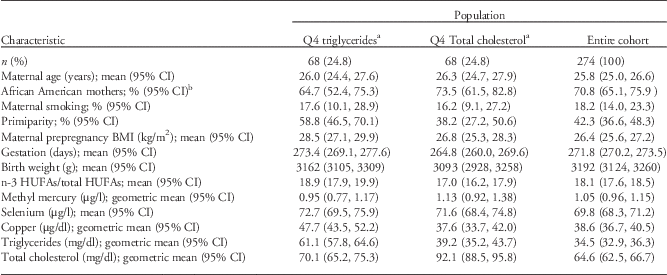
The study population is described in Table 1. Mothers were, on average, 25.8 (95% confidence interval (CI): 25.0, 26.6) years old and 20.4% were under 20. There were 70.8% African Americans, 25.1% Caucasians and 7.7% Asian Americans. Before pregnancy, 24.1% of mothers were overweight and 24.1% were obese.
Participant characteristics, THREE study, 2004–2005

THREE, Tracking Health Related to Environmental Exposures; CI, confidence interval; BMI, body mass index; HUFA, highly unsaturated fatty acid; Q4, fourth quartile.
a Umbilical cord serum triglycerides ⩾46.0 mg/dl; umbilical cord serum total cholesterol ⩾77.7 mg/dl.
b Percent of Caucasians was Q4 triglycerides: 27.9 (95% CI: 18.4, 40.0); Q4 total cholesterol: 25.0 (95% CI: 16.0, 36.9); entire cohort: 21.5 (95% CI: 17.0, 26.8). Percent of Asians was Q4 triglycerides: 7.4 (95% CI: 3.0, 16.8); Q4 total cholesterol: 1.5 (95% CI: 0.2, 10.2); entire cohort: 7.7 (95% CI: 5.0, 11.5).
Geometric mean umbilical cord serum triglyceride was 34.5 mg/dl (95% CI: 32.9, 36.3) with a range of 13.3–110.4 mg/dl. Geometric mean total cholesterol was 64.6 mg/dl (95% CI: 62.5–66.7) with a range of 30.1–145.6. In bivariate analyses, higher cord blood serum triglyceride concentrations were associated with higher gestational age, prepregnancy BMI, n-3 HUFA/total HUFAs, primiparity, selenium, and copper. Higher total cholesterol concentrations were associated with lower gestational age, birth weight and n-3 HUFA/total HUFA ratio. Results were similar for the relationship between n-3 HUFA/total HUFA and selenium or cholesterol when the fatty acid ratio was included in multivariable models (data not shown).
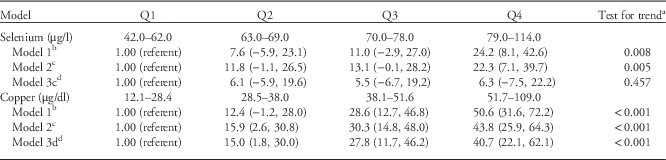
After adjustment for gestational age, birth weight, maternal age and race, primiparity, prepregnancy BMI, smoking, n-3 HUFAs/total HUFAs and methyl mercury, umbilical cord triglyceride concentrations increased with increasing cord blood selenium or copper quartiles (Table 2, model 2). However, in models which also included both selenium and copper, only copper was associated with significantly higher triglycerides (Table 2, model 3).
Percent difference (95% confidence interval) in cord serum triglyceride by increasing quartile of selenium or copper, THREE study 2004–2005, n=274

THREE, Tracking Health Related to Environmental Exposures; Q1, first quartile; Q2, second quartile; Q3, third quartile; Q4, fourth quartile; HUFA, highly unsaturated fatty acid.
a Based on regression model using selenium or ln(copper) instead of quartiles.
b Adjusted for gestational age (quadratic).
c Adjusted for gestational age (quadratic), maternal age, maternal race, maternal smoking, primiparity, low birth weight, prepregnancy body mass index (quadratic), n-3 HUFAs/total HUFAs, and ln(methyl mercury).
d Adjusted for variables in Model 2 as well as (3c) ln(copper) or (3d) selenium.
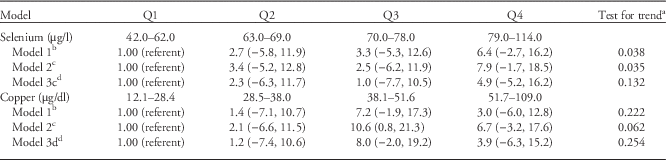
There was a significant trend in adjusted models for selenium and total cholesterol (Table 3, model 2); however none of the associations for selenium and total cholesterol by quartile of selenium were significant and the trend was not significant after adjustment for copper. There was also a borderline significant test for trend for the association of copper with total cholesterol in an adjusted model (Table 3, model 2), but not after adjustment for selenium (Table 3, model 3).
Percent difference (95% confidence interval) in cord serum total cholesterol by increasing quartile of selenium or copper, THREE study 2004–2005, n=274

THREE, Tracking Health Related to Environmental Exposures; Q1, first quartile; Q2, second quartile; Q3, third quartile; Q4, fourth quartile; HUFA, highly unsaturated fatty acid.
a Based on regression model using selenium or ln(copper) instead of quartiles.
b Adjusted for gestational age (quadratic).
c Adjusted for gestational age (quadratic), maternal age, maternal race, maternal smoking, primiparity, low birth weight, prepregnancy body mass index (quadratic), n-3 HUFAs/total HUFAs and ln(methyl mercury).
d Adjusted for variables in model 2 as well as either (3c) ln (copper) or (3d) selenium.
Discussion
This study shows a positive association of selenium and copper with triglycerides in umbilical cord serum. However, in models including both selenium and copper, only the association between copper and triglycerides remained statistically significant. For total cholesterol, we see a significant or borderline significant (P<0.10) test for trend in adjusted models for selenium and copper, respectively; but not after models are adjusted for both selenium and copper. These results add valuable information regarding these compounds at an early stage of development, and suggest that simultaneous examination of multiple micronutrients may be beneficial in fully understanding the relationships between micronutrients and cardiovascular risk factors.
Selenium and copper are both essential nutrients and for optimal health their concentrations need to remain within a certain range. While the beneficial ranges for selenium and copper in adults are fairly well understood, relatively little information on optimal concentrations of these micronutrients in umbilical cord blood is available. Selenium concentrations are known to vary geographically, in large part due to differences in selenium content in soil and subsequently in the diet.Reference Navarro-Alarcon and Cabrera-Vique 33 In the United States, the majority of the population is selenium-replete;Reference Bleys, Navas-Acien and Stranges 14 therefore, slight increases of selenium may be sufficient to exceed the range of selenium’s beneficial effect. To date, however, scientific evidence for this has been mixed.Reference Stranges, Laclaustra and Ji 17 , Reference Stranges, Tabak and Guallar 34
We observed a positive relationship between selenium and triglycerides or total cholesterol, but this relationship did not persist after controlling for copper. Several cross-sectional studies conducted in adult populations from the United States or Western Europe report positive relationships between selenium and triglycerides,Reference Bleys, Navas-Acien and Stranges 14 , Reference Laclaustra, Stranges, Navas-Acien, Ordovas and Guallar 16 , Reference Obeid, Elfakhani and Hlais 19 , Reference Yang, Lee and Lee 35 including one among newborns,Reference Boskabadi, Maamouri and Rezagholizade Omran 23 or selenium and cholesterol.Reference Bleys, Navas-Acien and Stranges 14 – Reference Stranges, Laclaustra and Ji 17 , Reference Obeid, Elfakhani and Hlais 19 , Reference Yang, Lee and Lee 35 However, other studies did not see a relationship of selenium with triglyceridesReference Suadicani, Hein and Gyntelberg 36 or found an inverse relationship of selenium with triglycerides and cholesterol.Reference Karita, Yamanouchi and Takano 37 It has also been suggested by a few researchers that the relationship between selenium and cardiovascular risk factors may depend on whether the selenium was derived from fish sources v. non-fish sources such as nuts.Reference Cominetti, de Bortoli, Garrido and Cozzolino 38 – Reference Strunz, Oliveira and Vinagre 40 These studies suggested that non-fish sources were not related to increases in cardiovascular risk factors.
Longitudinal studies of selenium and lipids have recently been published. A short-term selenium supplementation trial among United Kingdom adults found selenium related to a reduction in total and non-high-density lipoprotein (HDL) cholesterol; however, this seemed to be attenuated at higher levels of supplementation.Reference Rayman, Stranges, Griffin, Pastor-Barriuso and Guallar 41 Additionally, a Cochrane review of selenium supplementation trials, most of which did not include lipids as a primary outcome, did not find evidence of a relationship between selenium and cholesterol or triglycerides.Reference Suadicani, Hein and Gyntelberg 36 , Reference Rees, Hartley and Day 42 Interestingly, two recent cohort studies among Finnish youthReference Stranges, Tabak and Guallar 34 and adult Italian malesReference Stranges, Galletti and Farinaro 43 both found positive associations of selenium with cholesterol on a cross-sectional, but not longitudinal basis.
We report a significant positive relationship between copper and triglycerides, but did not observe a relationship between copper and total cholesterol among newborns. This is consistent with a study conducted among Spanish newbornsReference Bastida, Vaquero, Veldhuizen and Sanchez-Muniz 24 and a cross-sectional study among hyperlipidemic Iraqi men,Reference Al-Sabaawy 20 although there was no correlation between copper and triglycerides among controls in the Iraqi study. Several other studies in children or adults have found positive relationships between copper and several forms of cholesterol,Reference Obeid, Elfakhani and Hlais 19 HDL cholesterol,Reference Ghayour-Mobarhan, Taylor, New, Lamb and Ferns 15 or an unfavorable lipid profile (LDL/HDL>2.2).Reference Elcarte Lopez, Villa Elizaga and Gost Garde 44 However, other studies among adults report inverse associations between copper and cholesterolReference Bo, Durazzo and Gambino 21 or no relationship between copper and triglyceridesReference Ghayour-Mobarhan, Taylor, New, Lamb and Ferns 15 , Reference Obeid, Elfakhani and Hlais 19 , Reference Elcarte Lopez, Villa Elizaga and Gost Garde 44 , Reference Kim and Choi 45 or cholesterol.Reference Kim and Choi 45 , Reference DiSilvestro, Joseph, Zhang, Raimo and Kim 46
A few studies in adult populations have evaluated both selenium and copper with respect to lipid concentrations.Reference Ghayour-Mobarhan, Taylor, New, Lamb and Ferns 15 , Reference Obeid, Elfakhani and Hlais 19 , Reference Pavao, Figueiredo and Santos 22 In Lebanese adults, both selenium and copper were correlated with total cholesterol but only selenium was correlated with triglycerides.Reference Obeid, Elfakhani and Hlais 19 Portuguese men with hyperlipidemia had higher selenium concentrations but lower copper concentrations compared to controls, with no differences among women.Reference Pavao, Figueiredo and Santos 22 In adults from the United Kingdom, HDL cholesterol was positively related to copper and total cholesterol positively related to selenium concentrations in multivariable analyses.Reference Ghayour-Mobarhan, Taylor, New, Lamb and Ferns 15 The comparison with our findings, however, is uncertain because those studies did not adjust for the other metal, two of them did not adjust for other key variablesReference Obeid, Elfakhani and Hlais 19 , Reference Pavao, Figueiredo and Santos 22 and they were conducted in adult instead of newborn populations. Average concentrations of selenium and copper differ substantially between adults and children and the relationship of these micronutrients with lipids could be lifestage dependent.
Some results from our regression models (Tables 2–3) have a statistically significant test for overall trend of triglycerides or cholesterol levels across quartiles of selenium and/or copper, while comparisons of the second, third and/or fourth quartile v. the lowest quartile levels were not statistically significant, as confidence intervals included zero. This suggests that the overall magnitude of changes we observed were perhaps too small and too variable to be observed for the numbers of individuals in each quartile (68), but large enough to be detected by a trend test that incorporates the entire range of exposures and therefore has more statistical power.
One limitation of this study is that we did not have access to some variables which may have been useful in analyses. Specifically, maternal blood samples were not collected; and laboratory analysis of zinc, chromium, HDL cholesterol or LDL cholesterol were not available. In particular, several studies have reported different results for HDL cholesterol in comparison with total cholesterol or LDL cholesterol for both seleniumReference Stranges, Laclaustra and Ji 17 , Reference Obeid, Elfakhani and Hlais 19 , Reference Suadicani, Hein and Gyntelberg 36 , Reference Miyazaki, Koyama, Nojiri and Suzuki 39 and copperReference Ghayour-Mobarhan, Taylor, New, Lamb and Ferns 15 as we do not have HDL and LDL measurements we are unable to directly compare our results to this work.
Promotion of healthy serum lipid concentrations, a major risk factor for cardiovascular disease, is an important public health goal. Our findings indicate that at birth, higher triglyceride concentrations in umbilical cord blood are associated with elevated copper concentrations and maybe also with elevated selenium. Our work adds important early life evidence to a growing body of evidence on the relationship between trace metals and lipid concentrations.
Acknowledgments
The authors thank Jochen Heidler for help with data collection; Ruth Quinn for study management; as well as Norman Salem, Jr. and John Bernert for their assistance with laboratory analyses. The U.S. EPA has not officially endorsed this work and the views presented herein are those of the author and may not reflect those of the agency. Likewise, the findings and conclusions in this report are those of the authors and do not necessarily represent official positions of the Centers for Disease Control and Prevention, the Food and Drug Administration or the National Institutes of Health.
Financial Support
This study received funding from the Maryland Cigarette Restitution Program Research Grant, the United States National Institute for Environmental Health Sciences (R.U.H., grant #:1R01ES015445), and the United States STAR Fellowship Program (E.M.W.).
Conflicts of Interest
None.
Ethical Standards
The authors assert that all procedures contributing to this work comply with the ethical standards of the United States Department of Health and Human Services (HHS 45CFR 46) and with the Helsinki Declaration of 1975, as revised in 2008, and has been approved by the institutional committees at the Johns Hopkins Hospital, in Baltimore, Maryland, United States.