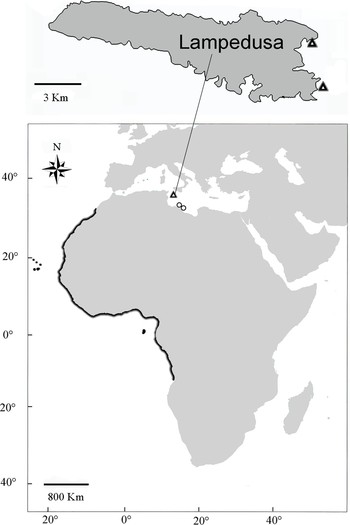
The African hind Cephalopholis taeniops (Valenciennes, 1828) (Serranidae: Epinephelinae) was classically reported from the eastern Atlantic coasts of Africa, from Angola to Morocco (south to the Gibraltar Strait), including the Islands of Cape Verde, Principe and Sao Tomé (Heemstra & Randall, Reference Heemstra and Randall1993; Figure 1). This grouper is reported to be associated with a variety of benthic habitats, from sandy to rocky bottoms, within a wide bathymetric range (i.e. 20–200 m; Ben Abdallah et al., Reference Ben Abdallah, Ben Soussi, Méjri, Canapé and Golani2007 and references therein).
Map of the original distribution of Cephalopholis taeniops (from Heemstra & Randall, Reference Heemstra and Randall1993) with the recent Mediterranean records. Triangles indicate the new sites of observation at Lampedusa; circles indicate the sites of occurrence reported by Ben Abdallah et al. (Reference Ben Abdallah, Ben Soussi, Méjri, Canapé and Golani2007).

Even though this fish is reported to achieve a maximum size of 70 cm total length (TL), it seldom exceeds 40 cm TL (Séret, Reference Séret1981; Heemstra & Randall, Reference Heemstra and Randall1993). The most frequent livery is represented by a reddish-orange head, body, and median fins with small blue spots. Fins are blackish in the distal portions, and soft dorsal, caudal, and anal fins have narrow bluish margins. Horizontal blue lines depart just below the eye (Heemstra & Randall, Reference Heemstra and Randall1993). A less common livery is also reported, with a black background with blue spots on the entire body and head (Séret, Reference Séret1981).
Little is known about the biological traits of this fish. It is listed as a diandric protogynous hermaphrodite, with some males that may not pass through a functional female stage but male gonads develop directly from immature females (Rocha et al., Reference Rocha, Ferreira, Choat, Craig, Sadovy and Bertoncini2008 and references therein).
From a commercial point of view, the African hind is mostly fished and used for human consumption locally in the distribution area (Ben Abdallah et al., Reference Ben Abdallah, Ben Soussi, Méjri, Canapé and Golani2007) although from Senegal this fish is exported to France (Heemstra & Randall, Reference Heemstra and Randall1993).
Due to the paucity of data available, in terms of population biology, reproductive strategies and actual impact of fishing, the IUCN classified this fish into the category ‘data deficient’ (www.iucnredlist.org). The IUCN Red List, in spite of the fact that no protected areas are established within the original range of distribution of this fish, does not recommend any particular conservation measure. However, according to a precautionary approach, considering the usually high catchability and economic value of groupers for many fisheries, and the typical biological traits of many large serranids that may make it difficult for population recovery after impact (e.g. high longevity, slow growth, site attached behaviour and formation of spawning aggregations; Di Franco et al., Reference Di Franco, Bussotti, Navone, Panzalis and Guidetti2009; Sadovy De Mitcheson et al., Reference Sadovy de Mitcheson, Cornish, Domeier, Colin, Russel and Lindeman2009), this grouper would deserve attention in the future in order to collect basic biological/ecological data and avoid any negative impact on local populations.
In 2002 and 2004, two individuals of C. taeniops (less than 30 cm TL) were caught by local fishermen off the Libyan coasts (southern Mediterranean Sea; Figure 1) on rocky bottoms at about 45–50 m depth (Ben Abdallah et al., Reference Ben Abdallah, Ben Soussi, Méjri, Canapé and Golani2007). This represents the first record of the African hind in the Mediterranean. Before this record, in fact, the African hind was not included in the list of serranids reported from the Mediterranean basin (Tortonese, Reference Tortonese, Whitehead, Bauchot, Hureau, Nielsen and Tortonese1986; Quignard & Tomasini, Reference Quignard and Tomasini2000; Golani et al., Reference Golani, Orsi-Relini, Massuti, Quignard and Briand2002; Bradai et al., Reference Bradai, Quignard, Bouain, Jarboui, Ouannes-Ghorbel, Ben Abdallah, Zouali and Ben Salem2004).
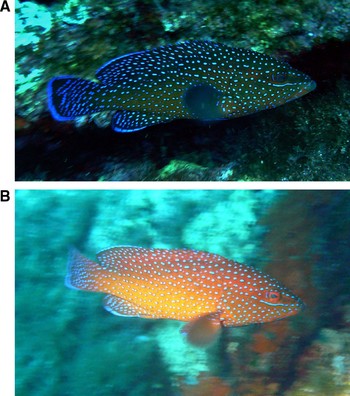
On 13 July and 16 July 2009 one individual African hind was observed at Lampedusa Island. The fish was recorded at the southern side of Cape Grecale, located on the eastern side of the Island and included in the buffer zone of the local Marine Protected Area (Figure 1). The individual was observed to swim with a stop-and-go behaviour typical of serranid fish at about 10 m depth on a rocky bottom mostly covered by macroalgae, and rich in boulders, shelters and large crevices (thus providing refuge for fish). The African hind observed in Lampedusa was found associated with other local fish species in sublittoral rocky reefs (see Mazzoldi & De Girolamo, Reference Mazzoldi and De Girolamo1997), including the dusky grouper Epinephelus marginatus. The individual observed was about 30 cm TL, and mostly displayed a confident behaviour towards the diver. Under natural light, the colour of the entire body appeared to be dark with blue spots, blue fin margins and blue lines below the eye (Figure 2A). However, when photographed with flash light the same dark individual resulted to be reddish with blue spots, margins and lines below the eye (Figure 2B).
(A) Individual observed under natural light condition; (B) the same individual photographed with flash (photographs by F. Giardina).

A preliminary survey conducted by interviewing SCUBA-divers in June and July 2009 allowed to know the other individuals, that sometimes congregate in groups, were found and photographed in other sites of the Island (e.g. Punta Parrino, at about 30 m depth; Figure 1), which suggests that the individual we sought at Lampedusa was not an isolated individual. From the same point of view, the records of the two individuals in the Libyan waters cannot be considered as sporadic events.
The photographs taken in different light conditions (natural versus flash) are useful to assess the actual livery of the individuals observed. Flash or torch should be used to check these observations, otherwise individuals with the common orange-reddish livery could be reported as having the rare dark-bluish livery (Séret, Reference Séret1981; Heemstra & Randall, Reference Heemstra and Randall1993) simply because of scarce natural lighting due to depth and/or the presence of the fish under boulders or into crevices.
This record of the African hind from Lampedusa is not that far geographically from the first record in the Mediterranean Sea (off the coasts of Libya; Ben Abdallah et al., Reference Ben Abdallah, Ben Soussi, Méjri, Canapé and Golani2007). It comes anyway from an Island located about 250–300 km north with respect to the previous records, which confirms the belief that the geographical area of the Sicily channel is an important crossroad for many exotic species invading and settling in the Mediterranean Sea (Andaloro & Azzurro, Reference Andaloro and Azzurro2004). Before this record of the African hind, only 6 species of groupers (Serranidae: Epinephelinae) were known from the region of the Sicily channel, i.e. Epinephelus haifensis Ben-Tuvia, 1953; Epinephelus caninus (Valenciennes, 1843); Epinephelus marginatus (Lowe, 1834); Epinephelus aeneus (Geoffroy Saint-Hilaire, 1817); Epinephelus costae (Steindachner, 1878); and Mycteroperca rubra (Bloch, 1793) (Azzurro et al., Reference Azzurro, Andaloro and Marino2000 and references therein). The occurrence of C. taeniops at Lampedusa thus pushes this number up to 7.
Cephalopholis taeniops represents the first exotic grouper of Atlantic origin that entered the Mediterranean, the other two exotic groupers being Epinephelus coioides (Hamilton, 1822) and Epinephelus malabaricus (Bloch & Schneider, 1804), of Indo-Pacific origin (Ben-Tuvia & Lourie, Reference Ben-Tuvia and Lourie1969; Heemstra & Golani, Reference Heemstra and Golani1993). The present finding also represents the northernmost record of this species and provides further evidence of the ongoing trend of northward expansion of thermophilic organisms in the Mediterranean Sea (Bianchi & Morri, Reference Bianchi and Morri1994; Astraldi et al., Reference Astraldi, Bianchi, Gasparini and Morri1995; Guidetti et al., Reference Guidetti, Bianchi, La Mesa, Modena, Morri, Sara and Vacchi2002), where more than 50 fish species, of both exotic and native origin, were recently recorded northwards with respect to their previous distribution (Azzurro, Reference Azzurro and Briand2008). This phenomenon of geographical expansion encompasses a variety of thermophilic organisms, including macroalgae, plankton, invertebrates and fish (Bianchi, Reference Bianchi2007) and it is widely considered as one of the most detectable harbingers of climate change in the northern hemisphere (Perry et al., Reference Perry, Low, Ellis and Reynolds2005 and references therein).
Changes in the distribution areas of marine organisms are generally thought to be more noticeable in correspondence to transitional areas and biogeographical boundaries (Bianchi, Reference Bianchi2007). Within the Mediterranean, the Sicily channel separates the western from the eastern sectors of the basin and it has long been thought to act as a filter to the eastwards intrusion of Atlantic species and the western migration of lessepsian species (Quignard & Tomasini, Reference Quignard and Tomasini2000). However, in the last two decades, the number of exotic fish recorded in this area has dramatically increased. Today, as far as the exotic fish are concerned, we can list 10 Erythrean (Upeneus moluccensis, Fistularia commersonii, Stephanolepis diaspros, Leiognathus klunzingeri, Etrumeus teres, Siganus luridus, Siganus rivulatus, Pempheris vanicolensis, Parexocoetus mento and Priacanthus hamrur) and 13 Atlantic invaders (Beryx splendens, Gephyroberyx darwinii, Pisodonophis semicinctus, Microchirus boscanion, Solea senegalensis, Chaunax suttkusi, Psenes pellucidus, Trachyscorpia cristulata echinata, Seriola rivoliana, Seriola fasciata, Seriola carpenteri, Sphoeroides pachygaster and Selene dorsalis) (Azzurro, Reference Azzurro and Briand2008 and references therein; Vella & Deidun, Reference Vella and Deidun2009). These species have two well separated biogeographical origins (i.e. the Atlantic and Indo-Pacific regions) and cross their routes of longitudinal expansion in the Mediterranean Sea through the Sicily channel.
This study, in conclusion, provides evidence about the importance of the Sicily channel from a biogeographical point of view, which appears to be more a crossroad than a barrier against the expansion of exotic fish species through the Mediterranean Sea. This suggests that this area would deserve to be continuously monitored to detect recent colonization events by exotic fish entering the Mediterranean from either the Gibraltar Strait or the Suez Canal. From this perspective, the existence of a Marine Protected Area encompassing three Islands in the region (MPA of Pelagie Islands) and the related staff made it possible not only to detect the ‘new’ species, but also to collect the observations of divers that detected other individuals. This also suggests how important can be community-based actions (Azzurro, Reference Azzurro and Briand2008; Azzurro, in press) to increase the chance to early detect the new arrival of exotic species. This approach, based on the engagement of a dispersed network of volunteers (e.g. people who could notice ‘unusual fish’ in the course of their usual activities, like fishermen and divers) may thus assist collection of information useful for research and monitoring programmes.
ACKNOWLEDGEMENTS
Many thanks are expressed to P.C. Heemstra, who confirmed the identification and provided valuable information about the species object of this study. This paper benefited from information obtained within the ‘Alien fish alert’ campaign, (http://www.monitamal.net/campagnapescimaivisti.htm), partially founded by the project ‘MonItamal’ (Interreg IIIA Italy–Malta).