Introduction
In recent years, geosynthetic clay liners (GCLs) have received much attention as barrier systems in municipal solid-waste landfill applications because of their good physical and chemical properties, ability to self-repair, easy processing, and environmental endurance. Extensive experimental studies have investigated the hydraulic conductivity of GCLs (Abuel-Naga et al., Reference Abuel-Naga, Bouazza and Gates2013; Bouazza, Reference Bouazza2002; Bouazza et al., Reference Bouazza, Gates and Abuel-Naga2006; Giroud et al., Reference Giroud, Badu-Tweneboah and Soderman1997; Liu et al., Reference Liu, Gates, Bouazza and Rowe2014; Rouf et al., Reference Rouf, Bouazza, Singh, Gates and Rowe2016; Rowe, Reference Rowe1998; Xue et al., Reference Xue, Zhang and Liu2012). Numerous investigators have focused on the factors influencing GCL hydraulic conductivity through compatibility tests (Jo et al., Reference Jo, Katsumi and Benson2001; Vasko et al., Reference Vasko, Jo, Benson and Edil2001; Jo et al., Reference Jo, Benson, Shackelford, Lee and Edil2005; Fox and Ross, Reference Fox and Ross2011; Benson, Reference Benson2013; Shen et al., Reference Shen, Wang, Wu, Xu, Ye and Yin2015). Considering actual field conditions, the coupling effect of the overlying load pressure and the leachate on the hydraulic conductivity of GCLs has been addressed recently (Shackelford et al., Reference Shackelford, Sevick and Eykholt2010; Kang & Shackelford, Reference Kang and Shackelford2011; Zhu et al., Reference Zhu, Ye, Chen, Chen and Cui2015; Malusis et al., Reference Malusis, Shackelford and Kang2015; Chen et al., Reference Chen, Zhu, Ye, Cui and Chen2016; Scalia et al., Reference Scalia, Bohnhof, Shackelford, Benson, Sample-Lord, Malusis and Likos2018, Wang et al., Reference Wang, Xu, Chen, Dong and Dou2019a, Reference Wang, Chen, Dou and Dongb). Naka et al. (Reference Naka, Flores, Katsumi and Sakanakura2016) presented a state-of-the-art review of the factors impacting the hydraulic conductivity of GCLs, concluding that bentonite type, prehydration, confining pressure, pH, metal concentration, and metal ion type are the strongest influences. Numerical simulations and theoretical models, which have made possible the measurement of hydraulic conductivity of GCLs from information about the porous media structure, are powerful alternatives in predicting this physical parameter (Dexter & Richard, Reference Dexter and Richard2009; Guan et al., Reference Guan, Xie, Wang, Chen, Jiang and Tang2014; Nakano & Miyazaki, Reference Nakano and Miyazaki2005; Quinton et al., Reference Quinton, Elliot, Price, Rezanezhad and Heck2009; Schaap & Leij, Reference Schaap and Leij1998; Xie et al., Reference Xie, Zhang, Feng and Wang2018).
Compared to the extensive experimental studies, however, numerical simulations have been relatively few (Bolt, Reference Bolt1956; Bouazza et al., Reference Bouazza, Zornberg, McCartney and Singh2013, Reference Bouazza, Singh and Rowe2014; Saidi et al., Reference Saidi, Touze-Foltz and Goblet2006; Siemens et al., Reference Siemens, Take, Rowe and Brachman2012; Stępniewski et al., Reference Stępniewski, Horn and Dikinya2011). Theories based on case studies remain quite rare (Benson et al., Reference Benson, Chen, Edil and Likos2018; Kolstad et al., Reference Kolstad, Benson and Edil2004, Reference Kolstad, Benson and Edil2006; Siddiqua et al., Reference Siddiqua, Blatz and Siemens2011; Yan et al., Reference Yan, Wu and Thomas2020). Chai and Shen (Reference Chai and Shen2018) used diffuse double layer (DDL) theory to analyze the swelling behavior of a Na+ bentonite used in GCLs with lower dry unit weights and found linear relationships between the calculated double layer thickness and the measured corresponding free swelling index and liquid limit. Dominijanni et al. (Reference Dominijanni, Manassero and Puma2012, Reference Dominijanni, Guarena and Manassero2018) proposed a physical approach to interpreting the phenomenological parameters obtained from laboratory tests. Michels et al. (Reference Michels, Méheust, Mario, Santos, dos Hemmen, Droppa, Fossum and Silva2019) inferred mesoporous humidity from a space-resolved measurement with a fractal diffusion equation and showed that water transport through a system of clay minerals could be hysteretic. However, they suggested that sample preparation history in Na bentonite has little effect on the water vapor transport through the mesopores. Using the study of Chung and Daniel (Reference Chung and Daniel2008), Liu et al. (Reference Liu and Wang2018) calculated the hydraulic conductivity of GCLs using DDL theory. However, Sposito (Reference Sposito1984) stated that the DDL theory cannot predict the dissolved divalent cations accurately, especially in the initial stages of swelling, as was verified by Schanz and Tripathy (Reference Schanz and Tripathy2009). Meanwhile, the fractal model is characterized mainly by the fractal dimension, which is affected by the physical properties of porous media. Some studies showed that the fractal theory can be used to determine the swelling properties of bentonite (Boadu, Reference Boadu2000; Thevanayagam & Nesarajah, Reference Thevanayagam and Nesarajah1998), especially in the initial swelling stage. Peng et al. (Reference Peng, Chen and Pan2020) employed small-angle X-ray scattering (SAXS) and liquid nitrogen adsorption (Frenkel-Halsey-Hill (FHH) and Neimark thermodynamic method) to determine the fractal dimension of four Chinese bentonites. The swelling strain and the clay particle thickness changed non-linearly as a function of water content and cation type (Altoé et al., Reference Altoé, Michels, Santos and Roosevelt2016; Michels et al., Reference Michels, Fonseca, Méheust, Altoé, Grassi, Droppa, Knudsen, Cavalcanti and Cavalcanti2020). Further studies have extended fractal theory in studying bentonite (Li & Xu, Reference Li and Xu2019; Xiang et al., Reference Xiang, Xu, Yu, Fang and Wang2019; Xu et al., Reference Xu, Matsuoka and Sun2003, Reference Xu, Sun and Yao2004).
The overall objective of the current study was to present a theoretical mathematical equation for calculating the hydraulic conductivity of GCLs, particularly regarding the coupled effect of mechanical and chemical processes. The DDL theory and a new fractal model of montmorillonite were combined. Also investigated was the influence on the hydraulic conductivity of GCLs of confining pressure, the concentration of permeate salt solutions, exchangeable cations, bentonite ionic radius, the surface fractal dimension of montmorillonite, and the distance, density, and coefficient of viscosity of interlayer water between two montmorillonite layers. The flow chart showing how the theoretical model is developed is shown in Fig. 1.
The flow chart of the theoretical model

As shown in the flow chart (Fig. 1), from a macro view, the hydraulic conductivity of GCLs can be calculated using Poiseuille’s Law and Darcy's Law. From the micro view, the hydraulic conductivity of GCLs can be calculated using the capillary rise concept of clay swelling and fractal dimensions. Combining the micro and macro views, a theoretical model for predicting the hydraulic conductivity of GCL is developed. The effect of confining pressure, the concentration of the permeating solution, the exchangeable cations, the ionic radii of cations, the montmorillonite surface fractal dimension, and the distance between two montmorillonite layers (m) after swelling are considered in this theoretical model.
A Theoretical Model of GCL Hydraulic Conductivity
GCLs consist generally of bentonite sandwiched between two geotextile layers that are needled or sewn together to provide shear strength. Bentonite materials, the most important components of the GCLs, are characterized by potentials for high water retention and swelling (Rowe, Reference Rowe2014). For the bentonite material, Komine (Reference Komine2005) assumed that water goes mainly through two montmorillonite layers swollen by adsorbed water, based on their experimental work (Komine & Ogata, Reference Komine and Ogata1996, Reference Komine and Ogata2003, Reference Komine and Ogata2004; Komine, Reference Komine2004a, Reference Komineb). Therefore, according to the plane Poiseuille flow equation, the maximum velocity,
 , can be expressed as:

where s i is the half distance between two montmorillonite layers (m) after swelling at the exchangeable cation i (i denotes the primary exchangeable cations, such as Na+, Ca2+, K+, and Mg2+ in bentonite) (Komine & Ogata, Reference Komine and Ogata2003),
 is the coefficient of viscosity of interlayer water between two montmorillonite parallel layers (Pa⋅s), p is hydraulic pressure, x is the coordinate along the flow,
 is differentiation of p with x, ρ is solution density, g is gravitational acceleration,
 is the hydraulic gradient, and
 is the density of interlayer fluid between two montmorillonite parallel-plate layers (Pa/m).
The average velocity v then can be expressed as (Komine & Ogata, Reference Komine and Ogata2003):

Using Darcy’s law for flow through a porous medium, the average velocity can be expressed as follows:

where
 is the hydraulic conductivity of GCLs (m/s).
By simultaneous solution of Eqs. 2 and 3, the hydraulic conductivity (m/s) of two montmorillonite parallel layers at the exchangeable-cation i, k i can be expressed as:

Moreover, for a given bentonite,
 and
 are constant. Therefore, k i depends only on s i.
Komine & Ogata (Reference Komine and Ogata2003, Reference Komine and Ogata2004) proposed the parameter “swelling volumetric strain of montmorillonite εsv.” The εsv is the percentage volume increase of swelling deformation of montmorillonite. This parameter is defined by:

where V m is the volume of montmorillonite in the buffer material, V v is the volume of voids in the buffer material, and V sw is the maximum swelling deformation of the buffer material at constant vertical pressure (V sw ≥ 0).
Meanwhile, from the viewpoint of the behavior of montmorillonite, εsv can also be expressed as (Komine & Ogata, Reference Komine and Ogata2003, Reference Komine and Ogata2004):

where t is the thickness of the montmorillonite layer (m) and R ion is the ionic radius.
In addition, an equation that accommodates the influences of the exchangeable-cation composition of bentonite by parameters giving the numbers of Na+, K+, Ca2+, Mg2+, and the radius of exchangeable cations after montmorillonite swelling can be obtained as:

where (R ion) i is the ionic radius of the exchangeable-cation i.
Evidence of self-similar microstructures were found in bentonite (Mandelbrot, Reference Mandelbrot1982; Pusch & Yong, Reference Pusch and Yong2003; Pusch, Reference Pusch1999). Xu et al. (Reference Xu, Xiang, Jiang, Chen and Chu2014a, Reference Xu, Xiang, Jiang, Chen and Chub) analyzed the deformation and fractal behavior of bentonite by relating the elastic and fracture behaviors as proposed in the following model:

where V w is the water volume adsorbed by montmorillonite and V m is the volume of montmorillonite (Xu et al., Reference Xu, Sun and Yao2004). K is the montmorillonite expansion coefficient,
 is swelling stress, and D s is the surface fractal dimension of montmorillonite in bentonite.
The montmorillonite fraction in bentonite can be measured using XRD. Meanwhile, in the GCL permeation tests, the bentonite is completely saturated at a constant confining pressure (ASTM D6766). This indicates that a relationship exists between the structure of a montmorillonite mineral after swelling (d, t, and R ion, etc.) and a confining pressure (σc). Therefore, from the combined Eqs. 4, 7, and 8, the hydraulic conductivity of GCLs can be expressed by the structure of a montmorillonite mineral after swelling and the confining pressure as follows:

Among these, K can be estimated as follows (Xu et al., Reference Xu, Matsuoka and Sun2003):

where C is the Hausdorff measurement of the fractal surface (Pfeifer & Schmidt, Reference Pfeifer and Schmidt1988),
 is the free energy of the chemical solution,
 is the surface tension, and
 is the contact angle of the adsorbed liquid with the material.
Some researchers have introduced 0.1 mol/L as the threshold to distinguish the stronger from the weaker solutions (Vasko et al., Reference Vasko, Jo, Benson and Edil2001; Jo et al., Reference Jo, Benson, Shackelford, Lee and Edil2005). Xu et al. (Reference Xu, Xiang, Jiang, Chen and Chu2014a, Reference Xu, Xiang, Jiang, Chen and Chub) found that K varies with the concentration of the permeating solution due to the limitations of the bilayer model. The present theoretical models, therefore, will be represented by dividing the chemical salt solution concentration into two zones:

where k pre (m/s) is the hydraulic conductivity of GCL in the theoretical models; k a (m/s) is the hydraulic conductivity of GCL when the solution concentration is 0–0.1 mol/L; k b (m/s) is the hydraulic conductivity of GCL when the solution concentration is > 0.1 mol/L.
Based on the theory of Frenkel-Halsey-Hill (FHH), D s can be given by (Avnir & Jaroniec, Reference Avnir and Jaroniec1989; Neimark, Reference Neimark1990; Yin, Reference Yin1991):

where
 is the gas volume adsorbed at equilibrium pressure (cm2/g), B is an FHH constant, P 0 is the saturation pressure of the adsorbate, and
 is the nitrogen partial pressure.
Rao and Thyajaraj (Reference Rao and Thyagaraj2007) investigated the effect of the inflow of sodium chloride solutions on the swell compression behavior of compacted expansive clays under a range of external loads. The ratio of total vertical stress to swell stress determined the nature of strains experienced by the compacted clay specimens subjected to direct inundation with salt solutions. Therefore,

where
 is the total net vertical stress (Rao & Thyajaraj, Reference Rao and Thyagaraj2007),
 is vertical confining stress, and
 is osmotic stress.
Using partition theory, Xu et al. (Reference Xu, Xiang, Jiang, Chen and Chu2014a, Reference Xu, Xiang, Jiang, Chen and Chub) proposed that
 can be written as

where
 is osmotic suction and can be calculated through the Van’t Hoff equation as (Colin et al., Reference Colin, Clarke and Clew1985; Lang, Reference Lang1967)

where A is the Van’t Hoff coefficient, c the concentration of salt solutions,
 the cation valence, R the universal gas constant, and T the absolute temperature.
Substituting Eqs. 13 and 14 into 9 yields:

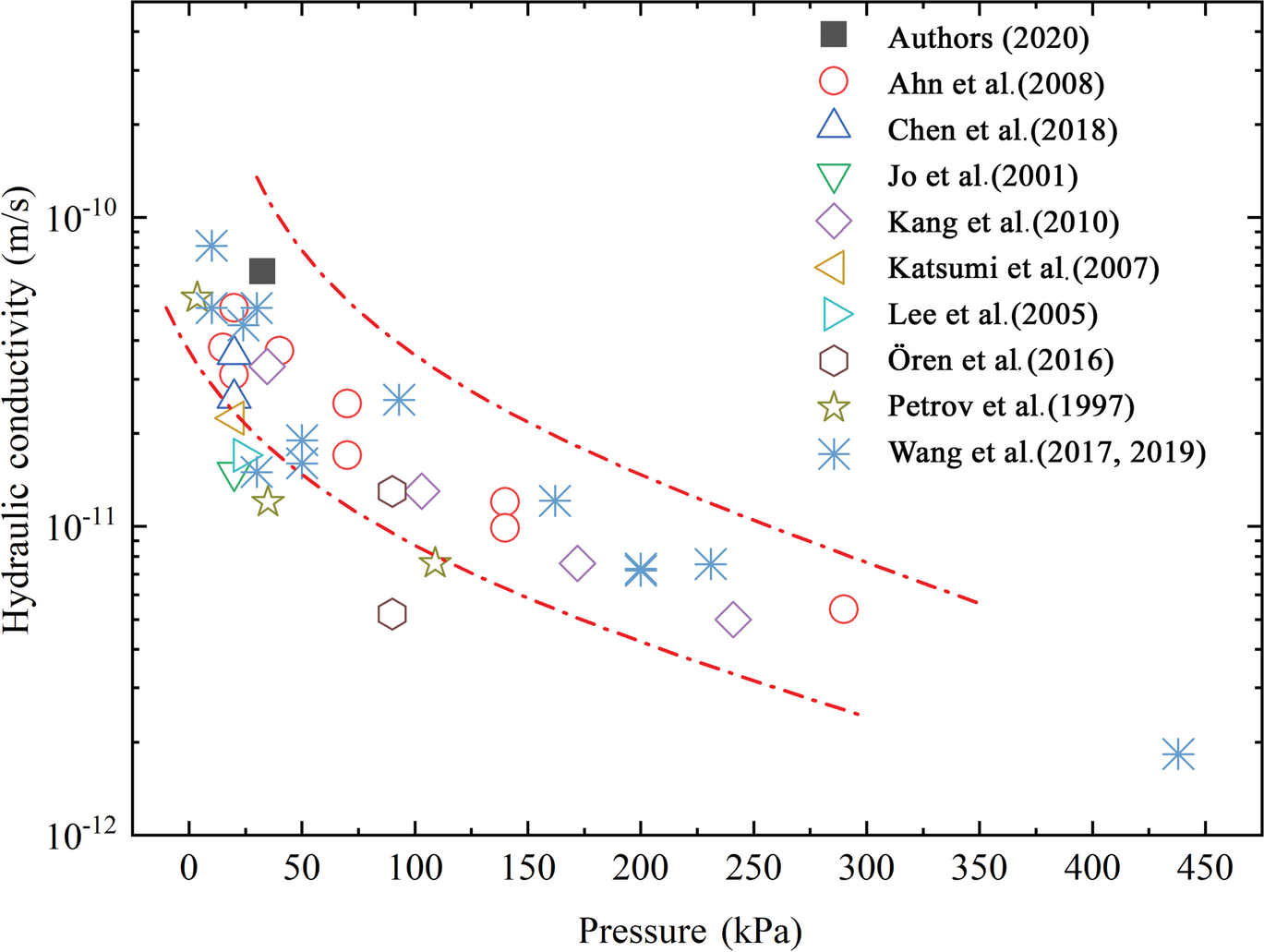
From Eq. 9, when the confining pressure (p) increases, the hydraulic conductivity decreases. This is consistent with many experimental studies (Benson et al., Reference Benson, Chen, Edil and Likos2018; Kang & Shackelford, Reference Kang and Shackelford2011; Malusis et al., Reference Malusis, Shackelford and Kang2015; Shackelford et al., Reference Shackelford, Sevick and Eykholt2010; Zhu et al., Reference Zhu, Ye, Chen, Chen and Cui2015) as shown in Fig. 2. Shackelford et al. (Reference Shackelford, Sevick and Eykholt2010) explained that the average confining pressure leads to a reduction in the void ratio, which results in a reduction of the hydraulic conductivity. In addition, from Eqs. 15 and 16, the increase in solution concentration will lead to an increase in
 and then, accordingly, an increase in the hydraulic conductivity. This is consistent with the experimental study of Jadda and Bag (Reference Jadda and Bag2020), who found, using SEM, that the solution leads to the limitation of the bentonite swelling and results in the large pore size (comparing Fig. 3a through c in the red boxes), which increases the hydraulic conductivity.
The experimental hydraulic conductivity of GCLs under different pressures

Scanning Electron Microscope images of the bentonites: (a) Divalent bentonite powder sample, (b) Divalent bentonite in DI water, (c) Divalent bentonite in 1.0 mol/L NaCl (Jadda and Bag, 2011)

Considering the main exchangeable cations (Na+, Ca2+, K+, and Mg2+) in bentonite, the hydraulic conductivity of bentonite, k pb, can be approximated by

where CEC is the bentonite cation exchange capacity (meq/g) and EXC i is the CEC (meq/g) with respect to the i th ion
Introducing the montmorillonite fraction in bentonite, C m, the hydraulic conductivity of GCLs, k pre, can be written as:

Considerable research has shown that the hydraulic conductivity of GCLs increased in the stronger solutions (Petrov & Rowe, Reference Petrov and Rowe1997; Jo et al., Reference Jo, Katsumi and Benson2001; Lee et al., Reference Lee, Shackelford and Benson2005; Scalia & Benson, Reference Scalia and Benson2011; Xu et al., Reference Xu, Xiang, Jiang, Chen and Chu2014a, Reference Xu, Xiang, Jiang, Chen and Chub). Other studies (Mesri & Olson, Reference Mesri and Olson1970; Yong & Mohamed, Reference Yong and Mohamed1992; Egloffstein, Reference Egloffstein2001) reported a positive ratio between the hydraulic conductivity of GCLs and the square root of cationic concentration. Therefore, the hydraulic conductivity at 0.1 mol/L is being used to represent the hydraulic conductivity at concentrations > 0.1 mol/L. The following equation for predicting the hydraulic conductivity of GCL in the stronger solutions (> 0.1 mol/L, Bouazza et al., Reference Bouazza, Gates and Abuel-Naga2006) can be derived:

Verification of the Analytical Model
To validate this theoretical model of GCL permeability coefficients, the theoretical values obtained from Eqs. 18 and 19 were verified by the experimental results of Petrov and Rowe (Reference Petrov and Rowe1997), Jo et al. (Reference Jo, Benson, Shackelford, Lee and Edil2005), Lee et al. (Reference Lee, Shackelford and Benson2005), and Wang et al. (Reference Wang, Xu, Chen, Dong and Dou2019a, Reference Wang, Chen, Dou and Dongb, Reference Wang, Dong, Chen and Douc). All the parameters used in the formula are the same as those in the experiments. An example calculation is presented in Appendix I. The comparisons for different cases are summarized in Figs. 4, 5 and 6. In Fig. 4, the experimental data are represented by the x-axis and the predict data are represented by the y-axis. This 'One to one' graph is common to illustrate the deviation of the hydraulic conductivities of GCL (Benson et al., Reference Benson, Chen, Edil and Likos2018; Chen et al., Reference Chen, Benson and Edil2019; Li et al., Reference Li, Chen and Benson2020). The dashed line indicates the specific deviation of hydraulic conductivities of GCL (e.g. 1:1, 2:1, 1:2). The closer to the 1:1 dash line, the smaller is the deviation of the hydraulic conductivity of GCLs. The deviation of the hydraulic conductivity of GCLs in the logarithmic coordinate system is generally between 1:10 and 10:1 (Shackelford et al., Reference Shackelford, Sevick and Eykholt2010; Wang et al., Reference Wang, Xu, Chen, Dong and Dou2019a, Reference Wang, Chen, Dou and Dongb, Reference Wang, Dong, Chen and Douc). It is one order of magnitude deviation, which is a conventional deviation in illustrating the hydraulic conductivity of GCL.
Hydraulic conductivities of GCL: predicted model (k pre) versus experimental data (k exp)

Hydraulic conductivities in weak and medium solutions

Hydraulic conductivities at different pressures (NaCl)

An Empirical Model of GCL Hydraulic Conductivity
Kolstad et al. (Reference Kolstad, Benson and Edil2004, Reference Kolstad, Benson and Edil2006) proposed a relatively simple empirical model that can be used to estimate the hydraulic conductivity of GCLs based on experimental data. It is a function of ionic strength and relative abundance of monovalent and divalent cations (RMD). An adjustment model relating these parameters was developed through stepwise regression analysis (Draper & Smith, Reference Draper and Smith1981) using a significance level of 0.05:

where K exp is the hydraulic conductivity to the inorganic chemical (m/s); K DI is the hydraulic conductivity of deionized water (m/s); and I is the ionic strength. The influence of confining pressure cannot be considered in this model. To address the coupling of mechanical and chemical processes, the model accounted for the influence of the confining pressure by using regression techniques on extensive experimental data (Bradshaw et al., Reference Bradshaw, Benson and Rauen2016; Chen et al., Reference Chen, Benson and Edil2019; Jo et al., Reference Jo, Benson, Shackelford, Lee and Edil2005; Lee & Shackelford, Reference Lee and Shackelford2005; Petrov & Rowe, Reference Petrov and Rowe1997); a good relationship between hydraulic conductivity of deionized water and the total net confining stress can be introduced conveniently as:

Substituting Eq. 21 into 20 yields an empirical hydraulic conductivity which combines mechanical and chemical processes:

Using the experimental data from Jo et al. (Reference Jo, Benson, Shackelford, Lee and Edil2005), details from example calculations of k pre and k emp are shown in Appendices I and II, respectively.
The deviation of the two models can be compared by the standard deviation of the sample

where N is the number of samples,
 is the i
th sample, and
 is the sample average.
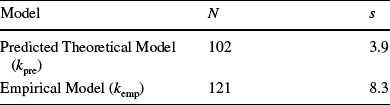
Comparison of the deterministic and the empirical models is summarized in Fig. 7 and in Table 1, using the standard deviations of the two models. All other data used in Fig. 7. were calculated using the method shown in Appendices I and II, and summarized in Appendix III. From Fig. 7 and Table 1, the predicted model is more accurate while the empirical model is simpler.
Hydraulic conductivities of GCL: predicted model (k pre) versus empirical model (k exp)

The sample standard deviation in two models

Conclusions
A simplified mathematical expression was developed to predict the hydraulic conductivity of GCLs. Two external factors were identified: confining pressure and concentration of permeating salt solutions. Six internal factors were identified: exchangeable cations; ionic radius in bentonite; surface fractal dimension of montmorillonite; the distance between two montmorillonite layers (m), exchanged with cation i (i denotes the primary exchangeable cations, such as Na+, Ca2+, K+, and Mg2+ in bentonite), after swelling; and the density and coefficient of viscosity of the interlayer fluid, which is often controlled or measured during construction of GCLs liners.
The proposed prediction model (k pre) has a maximum deviation of ~1 :10–10:1 compared to experimental results (k exp), and the empirical model (k emp) has a mean deviation of ~1:15–15:1 compared to experimental results (k exp). The theoretical model is more accurate than the empirical model, especially in the case of high effective stress. The writers caution, however, that the practical regression empirical model should not be used as a substitute for hydraulic conductivity assessment in the field and laboratory.
This study presents a theoretical model that predicts the hydraulic conductivity of GCL. Although the predictions have been shown to agree well with experimental data, one must remember, however, that with theoretical models, taking into account all of the actual conditions in the calculation process is complex. The theoretical model was developed based on the DDL and fractal theory, and the assumptions inherent in those theories will affect the analytical model accordingly. Therefore, more details and suitable hypotheses should be considered when this theoretical model is used in the field and in practice.
Note also that this study was developed assuming room temperature conditions only. However, some studies have shown that the temperature will affect the expansion of clay minerals (Altoé et al., Reference Altoé, Michels, Santos and Roosevelt2016; Gates et al., Reference Gates, Aldridge and Carnero-Guzman2017; Michels et al., Reference Michels, Fonseca, Méheust, Altoé, Grassi, Droppa, Knudsen, Cavalcanti and Cavalcanti2020), which is the term s i in Eq. 4, and the predicted hydraulic conductivity accordingly. Therefore, the effect of temperature on the permeability coefficient should be addressed in future work.
Supplementary Information
The online version contains supplementary material available at https://doi.org/10.1007/s42860-021-00167-0.
Funding
This study was supported by the National Natural Science Foundation of China (NSFC) (Nos. 51778353, 51978390); Open Research Fund of State Key Laboratory of Geomechanics and Geotechnical Engineering, Institute of Rock and Soil Mechanics, Chinese Academy of Sciences (No. Z018007); China Scholarship Council (CSC 201906895014); and the Youth Innovation Promotion Association CAS (2017376). The authors express their gratitude for this financial assistance. The authors also express their sincere gratitude to Prof. Benson, the former Dean and Hamilton Chair in Engineering, School of Engineering, University of Virginia, who offered valuable suggestions for this study.
Declarations
Conflict of Interest
The authors declare that they have no conflict of interest.