Introduction
The growth rate of milk production in India – 4.7% annually between 1971 and 1994 (World Bank, 1998) – during the ‘white revolution’ has been made possible, in particular, through the use of crossbred cows between local breeds of the Zebu type (Bos indicus) and highly specialised exotic breeds (Bos taurus) such as Holstein or Jersey breeds. Crossbred animals maintain the advantages of local breeds, such as adaptation to harsh environments, resistance to diseases or to extreme heat, and also have a production superior to local breeds. In order to monitor and improve the production level of cows, milk recording is necessary: in a way, the persistence of satisfactory milk production in low- to medium-input environments is a sign of acceptable sustainability. Breeding value estimation should allow the ranking of cows and bulls based on the trait analysed between farms and crossbred populations, and also between different crossbred subpopulations, to develop the genetic evaluation scheme (Mason and Buvanendran, 1982).
The non-governmental organisation (NGO) Bharatiya Agro Industries Foundation (BAIF; Pune, Maharashtra, India) produces about 3 million semen doses yearly from crossbred, local or exotic breeds. Most of these doses are used for breeding in very small herds with an average of less than 2.0 cows. In the 1980s, a milk-recording scheme based on BAIF specialised technicians was set up. The vast majority of the milk-recorded herds was very small (average ∼2.4 recorded lactations per herd per year). Moreover, a selection scheme was implemented as part of the Indian Council for Agricultural Research project with the aim of progeny testing of batches of 10 local crossbred bulls or exotic pure breed sires every 18 months. Bulls were evaluated using a contemporary comparison method based on their daughters’ production over a lactation.
A general challenge faced by breeding organisations in most dairy cattle populations in tropical areas is the cost and sustainability of milk recording, with strong dependence on subsidies. This is particularly the case of India, and especially for NGOs such as BAIF, where there is complete reliance on governmental or non-governmental subsidies. Furthermore, the relative inefficiency of performance recording in extremely small herds precludes its expansion, which itself has a strong impact on the size and efficiency of breeding schemes. As already initiated in some countries, new directions for more sustainable milk recording have to be looked for.
The objective of this study was to compare the technical efficiency of two alternative simplified milk-recording protocols (MRP) in situations where herds are of very small size. This comparison was done using BAIF data, i.e. in a South Asian tropical area and in a population of crossbred dairy cows, but could be extended to other locations and even to other species. The simplified MRP were simulated by sampling subsets of the test-day (TD) records from a data set collected under the current MRP. The potential impact of each alternative MRP proposed was measured as the loss in accuracy of the 305-day cow production and as the resulting reliability of sire evaluation for a given population structure.
Material and methods
Current milk-recording system
Milk recording at BAIF is performed by technicians operating in 16 centres of Maharashtra, which are a subset of the nearly 1400 BAIF centres spread over 12 Indian states. A centre includes a number of villages, usually 10–15. Farms enrolled in milk recording must have at least four breeding females. Technicians visit each farm every 14 days, alternately either in the morning or evening, to measure the quantity of milk produced by each cow. This 14-day interval was initially chosen in order to better follow the production during the early part of the lactation and to better estimate milk yield for cows with short lactations. This type of MRP is officially called AT2 by the International Committee for Animal Recording (ICAR, 2004). The ‘A’ indicating milk recording is done by a technician and not by the farmer; ‘T’ stands for ‘alternate’ because it is done only once in a day, alternating morning and evening milkings at each visit, and ‘2’ the interval in weeks between 2 consecutive TDs. As an attempt to better predict the production in 24 h, the true AT2 protocol has been slightly modified at BAIF: the technician also includes any extra information given by the farmer, indicating whether the cow produced less or more milk at the previous milking, and writes it down. However, in practice, the production measured at one milking is simply multiplied by 2 to get daily production in most of the cases, as for a usual AT protocol. Hence, this MRP will still be considered as approximately AT2.
The initial data set extracted from BAIF database included almost 30 000 lactations from almost 23 000 cows recorded between January 1992 and May 2004. The daily milk production of a maximum of 22 TDs was available for each lactation, whether complete or short lactation (almost 300 000 TDs in total). Some of the cows also had records on fat percentage but these were not considered in this study. The results presented here only refer to milk yield.
More than 90% of the lactations were from Holstein crossbred cows and only these were considered. More than three-fourth of the cows’ sires were unknown and about 50% of known sires were crossbred animals of 75% Holstein breed origin. Incomplete, truncated or obviously incorrect observations (for instance, with calving date preceding birth date) were deleted. The selection criteria were the following: a lactation length between 210 and 500 days, a minimum of 14 TDs per lactation (almost 7 months of lactation length) with the first TD not later than 45 days after calving and a maximum interval of 50 days between 2 following TDs. After editing, 11 827 lactations from 9558 cows were used in the following analyses.
First, a 305-day milk production (M) was computed for each lactation using the test interval method referenced by ICAR (2004). The test interval method proved to be the most accurate method to calculate lactation yields in a previous study based on data collected from crossbred Holstein cows of the same NGO by Mangurkar and Gokhale (Reference Mangurkar and Gokhale1995). This 305-day production was considered as the reference and the results from simulated simplified MRP were compared with this production value.
Based on 11 827 lactations, the average 305-day milk production was 2932 ± 826 kg. The average milk yield production was of the same magnitude as of previous studies on Indian Zebu × Holstein crossbred cows (e.g. Mangurkar, Reference Mangurkar1997), but the standard deviation was extremely large (coefficient of variation of 28%, as against 11% for Mangurkar, Reference Mangurkar1997). This can be explained by the extreme genotypic diversity of cows considered (from 50% HF up to 87.5%, with unspecified B. indicus origin), and by the huge variability in environmental conditions across herds.
Simplified milk-recording systems
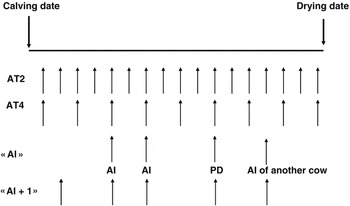
Simplified MRP (Figure 1) were simulated in two different ways: as a first step, the interval between 2 TDs was increased from 2 up to 4, 6 or 8 weeks, respectively, simply by sampling only 1 out of 2, 3 or 4 consecutive TDs. This would correspond to maintaining the current milk-recording organisation with the possibility of extending the area covered by each technician by decreasing the number of visits to each farm. For the second class of simplified MRP, it is assumed that the existing staff (artificial insemination (AI) technicians) already visiting farms for their AI activity would collect production data supplied by the farmer. Of course, it is realistic to get such an answer only when the herd size is small or when the farmer correctly and regularly records this information himself. To mimic such milk recording done by the farmer and transmitted through the AI technician, TD records were sampled from each lactation of a cow as follows: a first TD record was extracted about 3 months after calving, when the visit of the AI technician for the first insemination of the cow would probably happen; another one was extracted 1 month later with a probability of 0.5 (when the cow needs a second service, assuming a female fertility of 50%) and another one was selected 2 months after the last insemination, corresponding to the time of pregnancy diagnosis, which is systematically performed at BAIF. Apart from these TDs directly linked to a particular cow, it is necessary to take into account other production information collected for this cow when the AI technician visits the herd to inseminate another cow. Considering an average herd size of two cows (the real value in our data set was 2.4), another TD record was chosen randomly, mimicking the time when the second cow in the herd is inseminated and, as explained before, a second TD was extracted after about 1 month with a probability of 0.5. Therefore, 3 (e.g. when the insemination date of a second cow corresponds to an already selected TD) to 5 unequally spaced TDs were sampled throughout each lactation. Hereafter, this protocol will be referred to as ‘AI’. Because it is a priori known that the production at the beginning of a lactation (until the first AI record) will not be properly estimated in most cases, a similar protocol with one extra systematic recording visit by the AI technician 1 month after calving was also considered (protocol ‘AI + 1’).
Illustration of the sampling procedure to simulate the simplified milk-recording protocols envisioned (PD = pregnancy diagnosis).

Comparison criteria
To compare the different protocols, the current AT2 MRP was chosen as the reference. First, at the cow level, for each simplified protocol (Si) and each lactation, the 305-day milk production M(Si) was estimated using the test interval method (ICAR, 2004) based on the TD sampled. Average productions ( (Si)) and their standard deviations were compared with the reference values (
 ). Average biases (
 ) and the standard deviations of these biases were also computed. Finally, the accuracy of each protocol relative to the reference protocol was assessed as the R 2 of the regression of M(Si) on M. The decrease in R 2 is a measure of the loss of accuracy coming from the simplification of the MRP. To also check whether some parts of the lactation stages were more under- or overestimated than other stages of lactation, these criteria were computed at 100, 200 and 305 days, using the test interval method in all cases.
In practice, the 305-day milk production of cows is used to compute estimated breeding values (EBV) of their sires. Obviously, the reliability of EBV would be affected by the loss of accuracy of 305-day production from simplified MRP. According to the index selection theory and assuming that records from its n progeny contribute to the EBV of a given sire, the EBV reliability (R) of such a sire under the reference protocol is as follows:

where h 2 is the heritability of milk yield under the reference protocol. Under a simplified recording protocol, this reliability becomes (see the Appendix):

where  represents the sum of the squared systematic bias and the increase in residual variance due to the simplification of the protocol, and
 is the phenotypic variance after correction for fixed effects.
Two values of heritability were considered: h 2 = 0.10 and 0.20. The first value was estimated in a preliminary study on the same data set (results not shown). This value is considered more representative of the MRP in areas with very small herd sizes in tropical conditions. It takes into account the huge variability in management systems. Another explanation for this low heritability is that contemporary groups cannot be defined as herd × year combination because of lack of sufficient records, and therefore it is necessary to combine together herds from a same centre. This results in a less-precise correction for local environmental effects. The poor knowledge of breed composition of the crossbred animals is another important reason of low heritability.
From these formulae, the loss in EBV reliability resulting from different MRP can be evaluated and compared. Conversely, one can determine the number of daughters to be recorded with each MRP to get the same reliability R as with the reference scheme with n daughters.
Results
305-day milk production accuracy
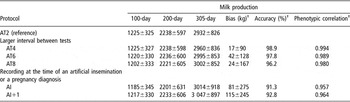
The 305-day production calculated using the various alternative MRP tended to systematically overestimate the reference production (Table 1) probably because the drop in production at the end of lactation was not properly accounted for, since the TDs at the end of lactation are not always sampled. When the interval between 2 TDs increased, the accuracy of the estimation of 305-day production decreased and the standard deviation of the bias increased when compared with the reference protocol (Table 1). The relative accuracies for the AT4, AT6 and AT8 MRP were 98.9%, 97.8% and 96.2%, respectively, of that obtained with the reference protocol. The 100-day and 200-day productions showed a slight underestimation of production in early and mid-lactation, but showed a large overestimation at the end of lactation.
Average 100-day, 200-day and 305-day estimated milk production, 305-day milk bias (kg) and accuracy depending on the milk-recording protocol

†Compared with the reference milk-recording protocol AT2.
For protocols involving AI technicians, the loss of accuracy was larger than with the other protocols, with an accuracy of 91.3% for the AI protocol, with substantial average bias and standard deviation (81 ± 275 kg), and it was 92.8% for the AI + 1 protocol. When a TD was added systematically after 1 month of lactation (AI + 1), the relative accuracy was slightly improved (92.8%) but the bias stayed important. In this case, the accuracy for 200-day production was satisfactory (95.8%) because the beginning of the lactation was better known. Indeed, with a beginning of lactation less underestimated, the bias on the 305-day production was larger with the AI + 1 protocol.
Phenotypic correlations between 305-day productions calculated using different MRP (Table 1) decreased when the interval between TDs increased and it clearly dropped when switching to milk recording based on the use of AI technicians.
Reliability of bull estimated breeding values
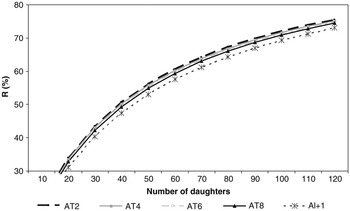
The expected impact of the loss of accuracy and potential bias of 305-day production on the reliability (R) of the bull EBV is illustrated in Figure 2, when a heritability of 0.10 is assumed.
Reliability of the bull’s estimated breeding values as a function of its number of daughters and of the milk-recording protocol (h 2 = 0.10).

The value of R decreased when the protocol was simplified. For example, for 50 daughters, R decreased from 56.2% with the AT2 reference protocol to 52.7% for the AI protocol. However, for the same number of daughters, this loss was limited (0.3% to 0.5%) when the interval between 2 TDs increased. Furthermore, the number of additional daughters necessary to maintain the same reliability was relatively low, i.e. equal to one or two daughters for each 2-week increase of the TD interval, for a reliability of 70%.
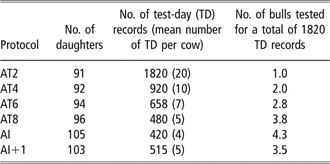
The drop in reliability was important (2.2% to 3.5%) when switching from the reference protocol to the MRP (AI) one, more than when simply increasing the interval between TDs. Six extra daughters were necessary to maintain a reliability of 50% (obtained with 39 daughters with the AT2 protocol) and 14 extra daughters for a reliability of 70% (Table 2). Adding a record at approximately 1 month of calving only slightly improved the situation when compared with the AI protocol.
Number of daughters and test day records necessary to progeny test a bull depending on the milk-recording protocol to obtain a reliability of 0.70 with a heritability of 0.10

Instead of considering progeny group size as the main variable, R can be expressed as a function of the total number of TDs, over all daughters (Table 2). The AT2 reference protocol required four to five times more TDs per lactation than the AT8 and AI protocols, respectively. When the loss of reliability for these simplified protocols was compensated for by an increase in progeny group size, it was possible to test about four times more bulls with the same total number of TDs.
When a heritability of 0.20 was considered, the results (not shown) were similar, with a smaller decrease in reliability with simplified MRP compared with the reference situation.
Discussion
Genetic improvement in many countries from tropical areas and particularly in India is strongly impaired by small average herd sizes. Smallholders are difficult to reach and often cannot afford the cost of buying improved stock from private companies. For poor farmers, access to superior genetic animals that could improve their economic situation heavily relies on subsidies, either from government or from NGOs. The lack of a large and stable market makes the development of local genetic programmes difficult.
Implementing dairy cattle breeding schemes in low-input tropical regions is a challenging task that has been rarely found sustainable in the past (Madalena et al., Reference Madalena, Agyemang, Cardellino and Jain2002). In these regions, the cost of maintaining a milk-recording programme is a major component of the total cost of a progeny test scheme. Consequently, it influences the testing capacity of the programme and the number of progeny-tested bulls available, and can be considered as one of the major limiting factors for genetic improvement in developing countries, especially – again – when the average herd size is very small.
Milk recording started in the early 1990s at BAIF (India) and has been relatively successful ever since. In particular, it is one of the very few recording schemes in the world that provide accurate information based on field data from very small herds. This type of information is of critical value, because it reflects the production potential in this specific tropical environment. The high dependence of BAIF’s milk recording on subsidies has prevented its spread to a large population size. Employing technicians to measure performances in such herds is less cost-effective than in larger herds, and finding simpler MRP, which need less man power, is a prerequisite for expanding milk recording in small herds and consequently for more efficient breeding schemes.
Although it was not the goal of this study to perform an economic analysis, it suggests that it is possible to simplify the current BAIF MRP, leading to a more efficient use of the existing staff. A first possibility is to decrease the frequency of recordings, whatever the size of the herd. The loss of accuracy and the bias switching from the actual protocol to an AT4 type are relatively limited at the cow level. They both increase only moderately even for less-frequent recordings (AT6 or AT8). These results are consistent with other published research in other populations. Hammami et al. (Reference Hammami, Bedhiaf Romdhani and Djemali2004) reported correlations of 0.988, 0.982 and 0.974, respectively, between the real 305-day production obtained with daily measures and protocols AT4, AT6 and AT8, for Holstein cows in Tunisia. These values are very similar to ours despite a much stricter reference protocol.
The second strategy studied here was a protocol where AI technicians collect production information from dairymen during their regular visit for AI or pregnancy diagnosis activities. The reduced number of tests combined with non-standardised spacings between tests induces an important loss of accuracy and an increased bias on 305-day production, even when an extra record is collected 1 month after calving in order to better determine the shape of the beginning of the lactation curve. This approach is therefore not suggested, although it would reduce milk-recording costs, if the aim is a correct assessment of the productivity of an individual cow over a complete lactation.
However, the primary motivation for milk recording is the genetic evaluation of bulls based on their daughters’ production. Relatively inaccurate 305-day yields are not necessarily a major problem as long as they are not strongly biased. We chose to illustrate this by calculating the number of daughters required to obtain reliabilities of bulls’ genetic evaluation similar to the ones under the reference AT2 MRP. With less-frequent recordings (AT4, AT6 or AT8), only few more daughters need to be tested to reach the same reliability, i.e. one to five daughters for a reliability of 70%, respectively, in the example presented in Table 2. Other authors also considered that recordings could be performed less than once a month (Pander et al., Reference Pander, Thompson and Hill1992) because the reduction in cost largely compensates for the loss in reliability. MacDaniel (Reference MacDaniel1969) concluded that milk recording could be done every 8 weeks if the aim is genetic evaluation of bulls and classification of cows in the same farm.
In the tropical situation considered, with the AI MRP, at least 15% more daughters per sire should be milk recorded to get a 70% reliability of the bull EBV. Our assumptions in calculating the efficiency of milk recording through AI technicians assumed that milk production information collected by AI technicians is per se as accurate as what the milk-recording technician measures. However, the use of measures collected by the farmer himself has been proposed by the Food and Agriculture Organization (Mason and Buvanendran, 1982). It is possible with some trained, conscientious and literate farmers, if they have only two or three cows. This underlines the need to maintain the current milk recording – possibly with longer intervals between tests – to accommodate medium- to large-sized farms.
In this study, it was assumed that the use of milk production data for genetic evaluation relies on two steps: first, periodic measures of daily production are combined into a standardised lactation record (e.g. a 305-day record), and second, genetic evaluation is based on the modelling of such 305-day records. Concerning the calculation of a 305-day milk yield with the test interval method, the results are overestimated when the protocol is simplified. This is particularly true for the MRP with the AI technicians.
It must be noted that the simplified protocols considered here are noticeably better suited for genetic evaluation based on TD information (e.g. Schaeffer and Dekkers, Reference Schaeffer and Dekkers1994). TD models use daily information directly and therefore do not need extrapolation of records in progress or combination into a potentially biased or inaccurate lactation record. They naturally accept data coming from heterogeneous MRP, with large or unequal spacings. Finally, they allow a better modelling of environmental effects, for example, seasonal effects for small areas. Hence, at least part of the loss in accuracy due to indirect collection of the information through AI technicians can be recovered through most sophisticated genetic evaluation models.
Without being overoptimistic – e.g. a heritability of 10% for milk production was assumed – it has been shown that three to four times more bulls could be progeny tested maintaining the same accuracy as under the current system at BAIF. This can be done simply by further spacing the distribution of tests over time and cows (Table 2), which corresponds to dividing the number of tests per cow by 4, compensated for by an increase of 10 to 15 of the number of daughters per bull. As a consequence, new opportunities for more efficient selection schemes can be envisioned.
Another limitation of this study is that it only considered milk yield. Other production traits, in particular fat percentage, are often economically important, depending on the production context considered. They were not taken into account here, and are difficult to record without specialised technicians. However, they are generally more heritable than milk yield and could be recorded on part of the daughters of progeny-tested bulls without compromising much the reliability of the genetic evaluations. Other traits, such as functional or fitness traits (longevity, fertility, mastitis resistance), are receiving increasing attention because of their impact on cost reduction, and because of their antagonism with high milk production. These traits are usually characterised by a low heritability, but at least some of them (e.g. fertility) could heavily benefit from a systematic recording, for genetic evaluations. Once again, this recording would rely on AI technicians.
Conclusion
In situations of a tropical area where herd size is very small, simplifying the MRP traditionally used in temperate areas appears to be possible. Considering the accuracy of predicted 305-day milk yield and the expected reliability of progeny-tested bulls’ EBV, the proposed protocols for BAIF situation rely on increasing the interval between 2 TDs or on collecting individual milk yields through AI technicians. This study did not consider economic aspects but, at least in tropical areas sharing the same herd size constraints, these simplified protocols should clearly have an economic impact since less TDs would be necessary to test one bull. Then, for the same cost, it could be possible to test more bulls without affecting the reliability of bulls’ genetic evaluation and thus increase the efficiency of the selection scheme.
Acknowledgements
The financial support of the Indian Council for Animal Research, New Delhi for the generation of part of the data through its Field Progeny Testing project is gratefully acknowledged. Comments from the two anonymous referees to improve the quality of the paper were highly appreciated.
Appendix Change in EBV reliability R of bulls when milk production of their daughters is less precisely estimated
Let yj be the 305-day production of a daughter j of sire i under the reference protocol. This production is usually analysed with a mixed model of the form

where β represents a set of relevant fixed effects, X is an incidence matrix, ai is the random effect of the additive genetic value of the sire i and ej is a residual term.
Under a simplified recording protocol, the estimated production becomes yj* where  with
 , δ is the average bias under the simplified protocol and εj is the difference between productions under the reference and simplified protocols after correction for systematic biases. If we assume that δ, ε and e are independent, we can write

The model equation to analyse the data under the simplified protocol is

The model residual becomes Δj + ej.
Using index selection theory, the sire’s additive genetic effect based on its n daughters is estimated as  where
 is the average production after correction for fixed effects.
Under a reference protocol, with Var( :

If one replaces the average production  , we still have
 but now,
 and
 , which leads to the expressions: