





Management Implications
Freshwater ecosystems function through a balance of interconnected biological relationships. Invasive aquatic plant introductions can disrupt ecosystem stability by influencing water quality, shifting habitat availability, and altering food web dynamics. These consequences translate to direct impacts to society through interference with infrastructure, reduction of recreational opportunities, and changes to property values. Hydrilla verticillata (hydrilla), a U.S. federal noxious weed, serves as a primary example of a species that can produce these potential consequences in U.S. waterways. Recently, a genetically distinct biotype of H. verticillata (“clade C”) has been identified in the United States, and effective management options are not yet well understood. This work aims to initiate the investigation of chemical control methods to consider for the management of clade C H. verticillata and compares responses to those of monoecious and dioecious H. verticillata biotypes. Through direct comparison, results can determine whether variation in treatment response exists between biotypes. Generally, results indicate that clade C H. verticillata responds similarly to herbicide treatment when evaluated with monoecious and dioecious H. verticillata, supporting the application of traditional H. verticillata management strategies for this novel biotype.
Introduction
A genetically distinct population of hydrilla [Hydrilla verticillata (L. f.) Royle], an invasive aquatic plant in the United States, was recently discovered in New England (Foley et al. Reference Foley, Stebbins, Doherty, Tippery and Bugbee2024; Tippery Reference Tippery2023; Tippery et al. Reference Tippery, Bugbee and Stebbins2020). Since the 1950s, H. verticillata has remained a major aquatic weed in the United States, and today, millions of stakeholder dollars are spent annually for management-related activities (Weber et al. Reference Weber, Wainger, Harms and Nesslage2021). In the state of Florida alone, US$174 million was allocated to H. verticillata management by the Florida Department of Environmental Protection between the years 1980 and 2005, in addition to supplementary funds expended by other state, federal, and private entities (Schmitz Reference Schmitz2007). Hydrilla verticillata is challenging to manage due to biological traits that include prolific reproduction through fragmentation and vegetative propagules, fast growth rates, low light attrition, and limited natural predation to suppress populations through top-down pressure (Glomski and Netherland Reference Glomski and Netherland2012; Haug et al. Reference Haug, Harris and Richardson2019; Langeland Reference Langeland1996; True-Meadows et al. Reference True-Meadows, Haug and Richardson2016).
Historically, two biotypes of H. verticillata have been actively managed in the United States, herein referred to as “monoecious” and “dioecious” (True-Meadows et al. Reference True-Meadows, Haug and Richardson2016). Despite morphological similarities, monoecious and dioecious H. verticillata biotypes are genetically distinct with unique geographic origins (Harms et al. Reference Harms, Williams and Grodowitz2014). In general, monoecious and dioecious H. verticillata have demonstrated similar phytotoxic response to herbicides in controlled mesocosm studies (Ortiz et al. Reference Ortiz, Nissen and Dayan2022; Van et al. Reference Van, Steward and Conant1987; Wood and Netherland Reference Wood and Netherland2019). However, the two biotypes have exhibited differences in several phenological, life-history, and physiological traits (Beets et al. Reference Beets, Foley, Sperry, Howell and Richardson2025; Steward and Van Reference Steward and Van1987; True-Meadows et al. Reference True-Meadows, Haug and Richardson2016; Van Reference Van1989). Because of this, some variation in treatment regime, such as aligning management with varied phenological stage, may improve management success (Owens and Madsen Reference Owens and Madsen1998; True-Meadows et al. Reference True-Meadows, Haug and Richardson2016).
Initial investigations of the most recent H. verticillata introduction, herein referred to as “clade C,” indicate unique growth traits such as prolific axillary turion production in early-season growth (Beets et al. Reference Beets, Foley, Sperry, Howell and Richardson2025). Clade C H. verticillata also exhibits inherent genetic differences, in which sequencing in internal transcribed spacer (ITS), PDS, and trnL-F gene regions have revealed a distinct phylogenetic separation between this novel biotype and monoecious and dioecious H. verticillata lineages, as the latter are both present in clade B (Tippery et al. Reference Tippery, Bugbee and Stebbins2020).
Chemical control methods with registered aquatic herbicides are critical tools for H. verticillata management in the United States. Aquatic herbicides can provide comparatively fast relief for invaded systems and can also serve as a cost-effective alternative to other strategies such as mechanical and biological methods (Mudge et al. Reference Mudge, Sartain, Getsinger and Netherland2021a; Netherland et al. Reference Netherland, Getsinger and Stubbs2005). Unlike applications in terrestrial settings, chemical treatment by herbicides in submersed aquatic systems are applied in a three-dimensional space, where the water column depth and surface acreage of treatment sites need to be factored into application prescriptions. Additionally, this space is dynamic, with water flow rate being a major factor in the delivery of herbicide to target vegetation. Because of this, the relationship between contact duration and herbicide dose (concentration-exposure time [CET]) is a necessary factor to measure when determining efficacy for aquatic plant management (Getsinger and Netherland Reference Getsinger and Netherland2018). Independent CET relationships for monoecious and dioecious H. verticillata have been determined for many herbicide active ingredients (Getsinger et al. Reference Getsinger, Poovey, Glomski, Slade and Richardson2011; Glomski et al. Reference Glomski, Skogerboe and Getsinger2005; Mudge et al. Reference Mudge, Sartain, Sperry and Getsinger2021b; Netherland Reference Netherland1991; Vassios et al. Reference Vassios, Nissen, Koschnick and Hielman2017), but direct comparisons of biotype response are limited.
Utilizing herbicides for H. verticillata management can address disadvantages of alternative control methods by reducing stem fragmentation, decreasing overall site disturbance, and allowing for long-term control through the directed reduction of stem and root biomass (Sperry et al. Reference Sperry, Haller and Ferrell2021). Additionally, depending on aquatic plant community characteristics, non-target damage can be decreased through the strategic use of selective herbicide applications and sublethal CETs (Sprecher et al. Reference Sprecher, Getsinger and Stewart1998). These factors are especially important to consider in dynamic sites, such as flowing systems, where additional issues with site access and shifting environmental conditions arise. There are currently 16 registered herbicides labeled for aquatic settings in the United States (Schardt and Netherland Reference Schardt, Netherland, Gettys, Haller and Petty2020). However, not all available herbicides are conducive to or effective for H. verticillata control due to chemical characteristics or developed herbicide resistance (Dayan and Netherland Reference Dayan and Netherland2005). It is imperative that the current herbicide tool set be preserved to ensure effectiveness and future utility.
Small-scale herbicide efficacy trials provide an opportunity to evaluate several chemistries concurrently under controlled conditions to examine concentration and exposure time components on test plants. For aquatic plant species, there are several general experimental designs that can be utilized (i.e., jar test, growth chamber, greenhouse, outdoor tank), and each provides specific research needs (Richardson and Haug Reference Richardson and Haug2018). Herbicide efficacy trials are important to directly assess and compare treatment options and act as an intermediary step for larger-scale studies, including in situ field assessments and operational applications. When biological variation exists within a species, results of small-scale herbicide efficacy trials assist practitioners in determining whether management strategies can remain consistent across populations, as demonstrated by studies such as Cheshier et al. (Reference Cheshier, Madsen, Wersal, Gerard and Welch2012) and Bultemeier et al. (Reference Bultemeier, Netherland, Ferrell and Haller2009).
The objectives of this work were to: (1) evaluate the response to select aquatic herbicides on the novel clade C H. verticillata biotype and (2) compare treatment response the of clade C H. verticillata biotype to monoecious and dioecious H. verticillata biotypes under a small-scale greenhouse mesocosm trial.
Materials and Methods
Research was conducted in Raleigh, North Carolina at the North Carolina State University Weed Control Labs (35.810278°N, 78.721714°W) in September 2023 (Trial 1) and repeated in April 2024 (Trial 2). To prepare, apical stem tips (10 cm) of three H. verticillata biotypes (monoecious [Farm Pond in Granville County, NC], dioecious [Philpott Lake, VA], and clade C [Keeney Cove, Connecticut River, CT]) were collected from stock populations and planted in 90-ml cups filled with topsoil amended with slow-release fertilizer (Osmocote™ Smart Release 15-9-12, Scotts, Marysville OH) and capped with sand. Potted stems were allowed to establish in 20 to 75-L aquaria for 2 wk before herbicide treatment. Mesocosms were covered by 50% shade cloth throughout the duration of the study to reduce light intensity, limit algal growth, and aid in temperature regulation.
Following establishment, all plants were transferred to individual 947-ml mesocosms filled with 700 ml of untreated water from a municipal source (mean pH = 8.4) amended with water conditioner (API™ Tap Water Conditioner). On treatment day, water temperature and pH within 8 to 10 randomly selected mesocosms were measured (temperature: 25.2C (Run 1), 24.7C (Run 2); pH: 8.11 (Run 1), 8.04 (Run 2)]. For treatments that included flumioxazin, water pH was artificially lowered using a buffer solution (mean = 6.9) to reduce chemical degradation due to hydrolysis (Kwon et al. Reference Kwon, Armbrust and Grey2004).
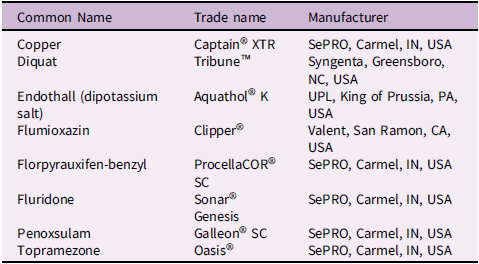
Mesocosms were treated with aquatic herbicides as in-water injections applied via syringe from a stock solution mixed to achieve intended concentrations. Tested treatments included copper (500 and 1,000 µg ai L−1), diquat (180 and 370 µg ai L−1), endothall (2,500 and 5,000 µg ai L−1), flumioxazin (200 and 400 µg ai L−1), and florpyrauxifen-benzyl (25 and 50 µg ai L−1) for 24- or 72-h exposure times (“fast-acting”); and fluridone (5- and 10-µg ai L−1), penoxsulam (15 and 30 µg ai L−1), and topramezone (25 and 50 µg ai L−1) at a 1,080 h (45 d) exposure time (“slow-acting”) (Table 1). A nontreated reference for each biotype and exposure period was also incorporated into the treatment randomization. All treatments (28) were replicated 4 times per biotype (3) for a total of 336 experimental units. At the designated time intervals, exposure time to herbicide was concluded by transferring potted plants from mesocosms filled with treated water to mesocosms filled with water from the same source as pretreatment conditions (nontreated municipal water amended with water conditioner).
Tested active ingredients and their sources.

Table 1. Long description
A table with three columns and nine rows, detailing the common names, trade names, and manufacturers of various herbicides. The columns are labeled 'Common Name', 'Trade name', and 'Manufacturer'. The rows list the following data: Row 1: Common Name: Copper, Trade name: Captain XTR, Manufacturer: SePRO, Carmel, IN, USA. Row 2: Common Name: Diquat, Trade name: Tribune TM, Manufacturer: Syngenta, Greensboro, NC, USA. Row 3: Common Name: Endothall (dipotassium salt), Trade name: Aquathol K, Manufacturer: UPL, King of Prussia, PA, USA. Row 4: Common Name: Flumioxazin, Trade name: Clipper, Manufacturer: Valent, San Ramon, CA, USA. Row 5: Common Name: Florpyrauxifen-benzyl, Trade name: ProcellaCOR SC, Manufacturer: SePRO, Carmel, IN, USA. Row 6: Common Name: Fluridone, Trade name: Sonar, Manufacturer: SePRO, Carmel, IN, USA. Row 7: Common Name: Fluridone, Trade name: Genesis, Manufacturer: SePRO, Carmel, IN, USA. Row 8: Common Name: Penoxsulam, Trade name: Galleon SC, Manufacturer: SePRO, Carmel, IN, USA. Row 9: Common Name: Topramezone, Trade name: Oasis, Manufacturer: SePRO, Carmel, IN, USA.
Posttreatment visual plant injury was ranked on a continuous 0% to 100%, scale where 0% indicated no visual impact and 100% indicated complete plant senescence and was recorded weekly for 6 wk post–final treatment exposure period (WAT). At trial termination (6 WAT), the aboveground biomass of all plants was destructively harvested, dried at 65 C for at least 72 h, then weighed. Percent biomass reduction was calculated by comparing dried biomass of representative nontreated reference plants of each biotype and exposure period to the dried biomass of treated plants: biomass reduction (%) = [(W c – W s)/W c]*100, where W c = mean nontreated reference biomass, and W s = sample biomass.
Biomass reduction and 6 WAT estimated visual injury response variables were rescaled to meet model assumptions and subjected to a generalized linear mixed-model (GLMM) with beta distribution in JMP Pro (v. 18.2.0; SAS Institute, Cary, NC,USA) with treatment (herbicide with assigned concentration and exposure time) and biotype included as fixed effects and run included as a random effect to account for variation between plant populations and the environment during the two trial periods. Before analysis, outliers were removed by standard screening using the interquartile range method. Back-transformed means are presented to assist data interpretation. Where significant, treatment means were separated by further post hoc analysis (α = 0.05).
Results and Discussion
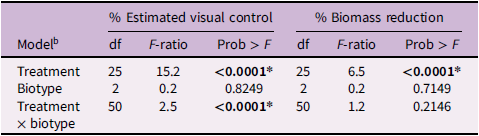
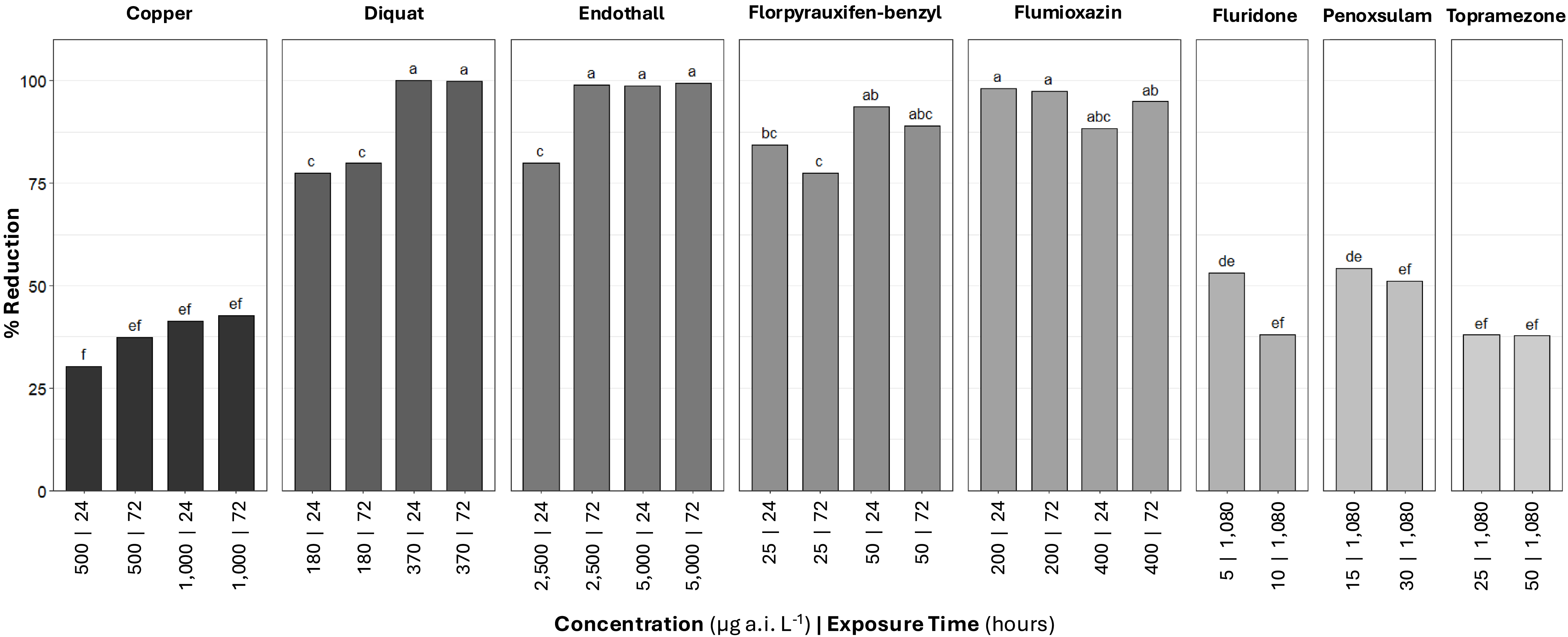
The biomass reduction of H. verticillata significantly differed by treatment (P < 0.0001) but did not differ among biotypes tested (P = 0.7149) or the interaction of treatment by biotype (P = 0.2146; Table 2). When pooled by biotype, variation of treatment response occurred most significantly between active ingredients and less so by concentration or exposure time (Figure 1). Generally, treatment with fast-acting herbicides resulted in greater H. verticillata biomass reduction than treatment with slow-acting herbicides. The only exception would be copper, a fast-acting herbicide that resulted in consistently low biomass reductions (approx. 30% to 45%).
Mixed-model analysis results of the effect of treatment (herbicide with assigned rate and exposure time), biotype, and their interaction on rescaled biomass reduction (%) and estimated visual control (%) response variables. a

Table 2. Long description
A table with two main sections: Estimated visual control and Biomass reduction. Each section has three rows labeled Treatment, Biotype, and Treatment x biotype, and four columns labeled df, F-ratio, and Prob > F. Row 1: Treatment, df, 25; F-ratio, 15.2; Prob > F, <0.0001*. Row 2: Biotype, df, 2; F-ratio, 0.2; Prob > F, 0.8249. Row 3: Treatment x biotype, df, 50; F-ratio, 2.5; Prob > F, <0.0001*. Row 1: Treatment, df, 25; F-ratio, 6.5; Prob > F, <0.0001*. Row 2: Biotype, df, 2; F-ratio, 0.2; Prob > F, 0.7149. Row 3: Treatment x biotype, df, 50; F-ratio, 1.2; Prob > F, 0.2146.
a Significant results shown in bold (α = 0.05).
b GLMM with beta distribution, with run as random effect.
Back-transformed means of biomass reduction (%) of Hydrilla verticillata separated by treatment type (P < 0.0001) and pooled by biotype (P = 0.2146). Means separated by Tukey’s honest significant difference (HSD) (α = 0.05) in which bars that share the same letter across all treatments (herbicide | concentration | exposure time) do not statistically differ.

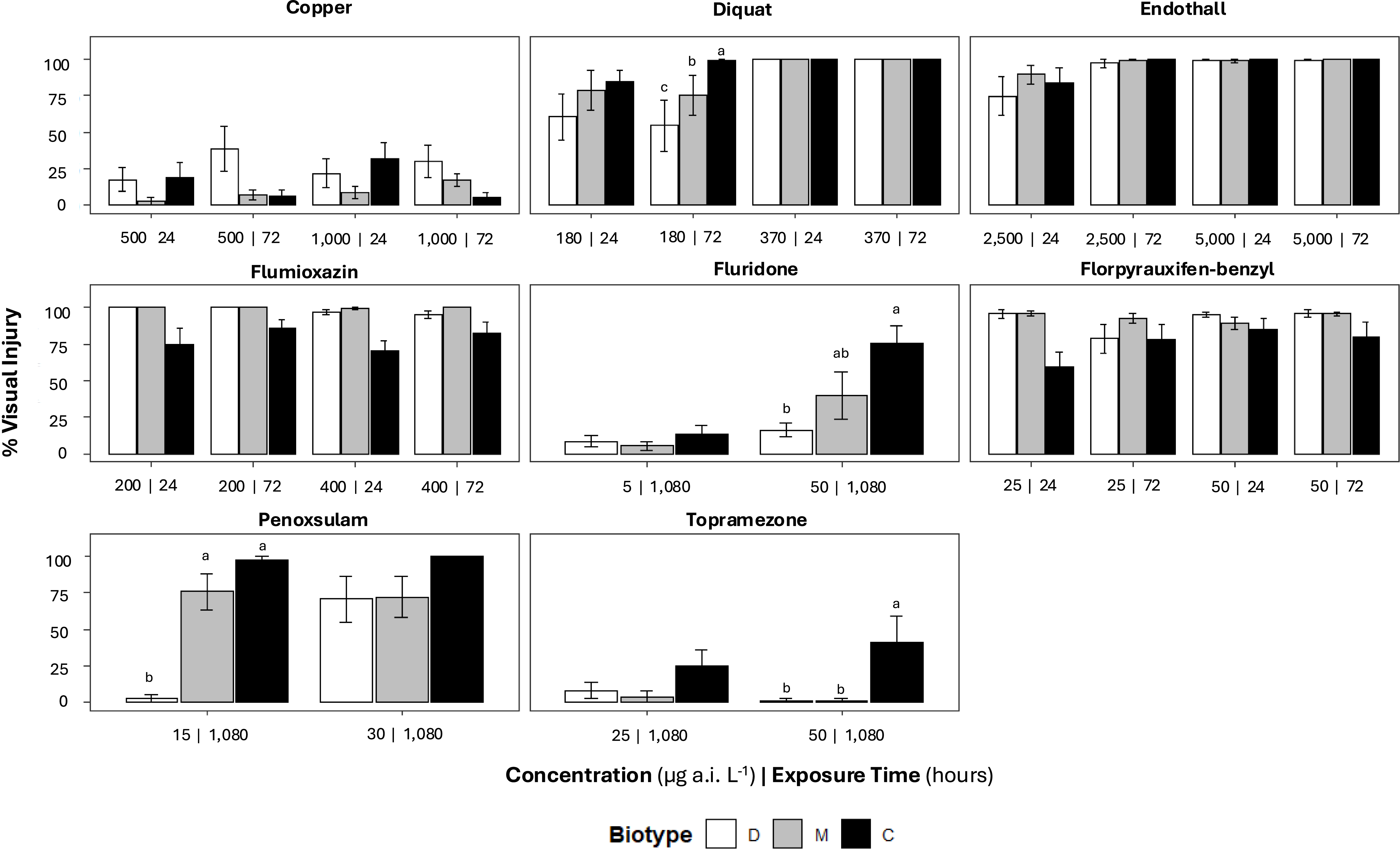
Estimated visual injury of H. verticillata significantly differed by treatment (P < 0.0001) and the interaction between treatment and biotype (P < 0.0001) but did not differ by biotype alone (P = 0.8249) (Table 2). This result demonstrates that the visual effect of treatment depended on H. verticillata biotype. These differences by biotype only occurred for a subset of tested herbicides and included diquat (180 µg L−1 [72 h]), fluridone (10 µg L−1 [1,080 h]), penoxsulam (15 µg L−1 [1,080 h]), and topramezone (50 µg L−1[1,080 h]) (Figure 2). In all instances, clade C H. verticillata was more sensitive than dioecious H. verticillata, but it was only more sensitive than monoecious H. verticillata in the diquat and topramezone treatments. While this variation by biotype was not observed through biomass reduction, the estimated visual injury response variable captures treatment-related symptomology that cannot be reflected in biomass data, such as overall tissue viability, bleaching, and visual plant health, which are important factors to consider when ranking herbicide sensitivity. Differences by biotype may also be explained by treatment timing and the phenological stage of tested plants, as factors such as photoperiod may differentially influence overall plant growth (Van Reference Van1989).
Back-transformed means of visual injury (%) of Hydrilla verticillata separated by treatment type and biotype (P < 0.0001: treatment × biotype). Bar fill color represents biotype (dioecious = white; monoecious = gray; clade C = black). Bars represent ±SE. Means separated by Fisher’s LSD (α = 0.05), in which bars within each treatment (herbicide | concentration | exposure time) by biotype grouping that share different letters differ significantly. Bars without letters denote lack of statistical difference by biotype.

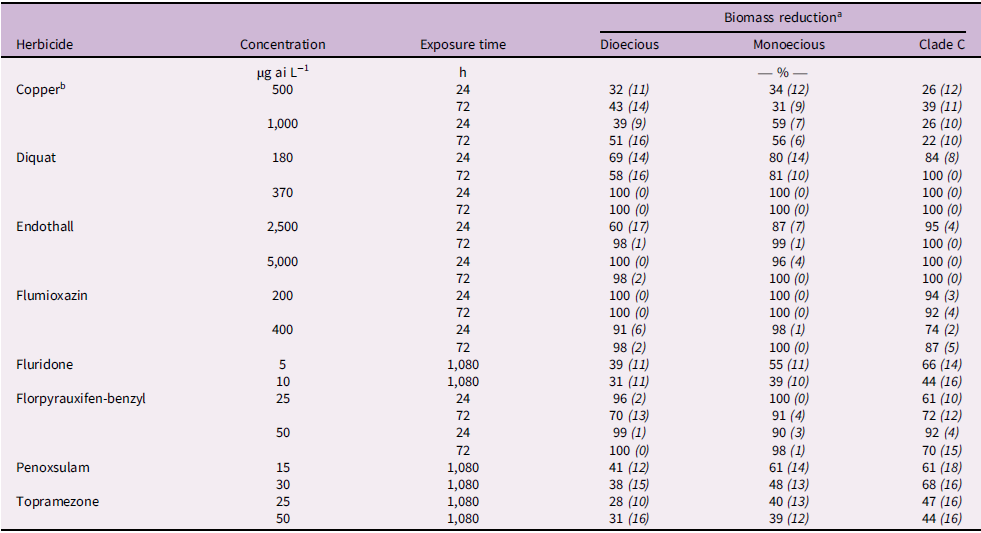
Complete control of clade C H. verticillata occurred as a result of only a few tested treatments (Table 3). These included treatment with diquat (180 µg L−1 [72 h]; 370 µg L−1 [24 and 72 h]), as well as endothall (2,500 µg L−1 [72 h]; 5,000 µg L−1 [24 and 72 h]), as recorded by 100% biomass reduction. Additionally, clade C H. verticillata was greatly reduced (70% biomass reduction or greater) following treatment with florpyrauxifen-benzyl (25 µg ai L−1 [72 h]; 50 µg L−1 [24 and 72 h]) and flumioxazin (all tested concentration/exposure times). Copper was not effective at controlling clade C H. verticillata at any tested treatment, as evidenced by less than 40% biomass reduction for all treatment combinations.
Observed raw data summaries (mean with standard error in parentheses) for aboveground biomass reduction (%) of Hydrilla verticillata biotypes (dioecious, monoecious, clade C) measured 6 wk after treatment.

Table 3. Long description
A table comparing biomass reduction percentages of Hydrilla verticillata biotypes (dioecious, monoecious, clade C) after treatment with various herbicides. The table has 8 columns and 8 rows, including headers. Columns are labeled Herbicide, Concentration, Exposure time, and Biomass reduction for Dioecious, Monoecious, and Clade C. Row 1: Copper, 500 µg ai L⁻¹, 24 h, 32, (11), 34, (12), 26, (12). Row 2: Copper, 1,000 µg ai L⁻¹, 24 h, 39, (9), 59, (7), 39, (11). Row 3: Copper, 1,000 µg ai L⁻¹, 72 h, 51, (16), 56, (6), 22, (10). Row 4: Diquat, 180 µg ai L⁻¹, 24 h, 69, (14), 80, (14), 84, (8). Row 5: Diquat, 180 µg ai L⁻¹, 72 h, 100, (0), 100, (0), 100, (0). Row 6: Diquat, 370 µg ai L⁻¹, 24 h, 100, (0), 100, (0), 100, (0). Row 7: Diquat, 370 µg ai L⁻¹, 72 h, 100, (0), 100, (0), 100, (0). Row 8: Endothall, 2,500 µg ai L⁻¹, 24 h, 60, (17), 87, (7), 95, (4).
a Mean weight of representative plants at treatment (g DW) = 0.04 (Dioecious (D)), 0.02 (Monoecious (M)), 0.05 (Clade C (C)). Mean weight of nontreated control plants at harvest (g DW) = fast-acting: 0.09 (D), 0.10 (M), 0.11 (C); slow-acting: 0.18 (D), 0.20 (M), 0.15 (C).
b Rate measured by % metallic copper equivalent.
Treatments with 370 µg L−1 diquat for 24- and 72-h exposure times were the only treatments to provide complete control of all three H. verticillata biotypes (Table 3). Endothall at a concentration of 5,000 µg L−1 and 72 h exposure reduced monoecious and clade C H. verticillata biomass by 100% at 6 WAT, and dioecious H. verticillata biomass by 98% at 6 WAT. Flumioxazin treatment of 200 µg L−1 with 72 h exposure was also generally effective for biomass reduction of all biotypes, ranging from 100% reduction for monoecious and dioecious H. verticillata to 92% reduction for clade C H. verticillata.
Monoecious and dioecious H. verticillata response in this study generally corresponds to previous mesocosm experiments. Van et al. (Reference Van, Steward and Conant1987) tested monoecious and dioecious H. verticillata response to diquat and found that young plants were moderately sensitive to 250 µg ai L−1 diquat (24 h) with 67% and 77% visual injury, respectively. This could be comparable to our result of 79% (monoecious) and 61% (dioecious) visual injury, respectively with treatment of 180 µg L−1 diquat (24 h) (Figure 2). Additionally, we determined biomass reduction across biotypes to average 84% (24 h) and 77% (72 h) when treated by 25 µg L−1 florpyrauxifen-benzyl (Figure 1). Comparatively, Beets and Netherland (Reference Beets and Netherland2018) tested dioecious H. verticillata response to florpyrauxifen-benzyl at 24 µg ai L−1 with 24 and 72 h exposure times and determined that biomass was reduced by 68% and 80%, respectively.
These results can provide a baseline understanding of the comparative influence of herbicides for control of H. verticillata biotypes. An important finding is the lack of major differences by treatment in biomass reduction between H. verticillata biotypes (Table 3). With this, results indicate that the collective dataset related to chemical controls for monoecious and dioecious H. verticillata in the United States can serve as reliable guidance for clade C H. verticillata management. Similarities in growth patterns between the three H. verticillata biotypes have also been documented (Beets et al. Reference Beets, Foley, Sperry, Howell and Richardson2025), supporting the presence of consistency within the species.
Mesocosm trials are designed to remove the variation that comes along with environmental conditions that may occur under operational-level scenarios, and due to this, it is possible that H. verticillata response in the present study may be overestimated in comparison to probable operational-level response. Herbicide fate can be strongly influenced by environmental factors in aquatic environments that include light intensity, water chemistry, turbidity, and water exchange rates. As such, site conditions need to be carefully studied before the application of herbicides, particularly those that can experience rapid environmental dissipation rates such as diquat and flumioxazin (Clayton and Matheson Reference Clayton and Matheson2010; Kwon et al. Reference Kwon, Armbrust and Grey2004).
Of the additional limitations that come along with mesocosm experiments, the constraint of container size is highly influential. Trials set in smaller scales (<2 L) such as the present study likely do not adequately represent realistic management conditions or allow for testing of plants with robusticity that is representative of field conditions; however, they allow for more testable replicates and treatments when compared with trials set in larger scales (100 to 250 L). An additional study limitation to consider is treatment timing, as trials were conducted in September and April, both falling outside of the typical window for H. verticillata management in the northeastern United States. Despite work in controlled environmental conditions, it is possible for plants to experience some influence from natural phenological growth patterns.
While this research outlines preliminary investigation into the response of clade C H. verticillata to various chemical management options, future efforts should consider increased scale to capture environmental factors that may influence treatment efficacy. These may include consideration of additional concentration and exposure times, plant maturity, and flowing systems.
For the clade C H. verticillata biotype specifically, it is necessary to investigate targeted management strategies for unique water flow scenarios. The lower Connecticut River, the initial point of establishment of clade C H. verticillata in the United States, is a highly dynamic flowing system with strong tidal influence. Because of this, an understanding of clade C H. verticillata response to various CET scenarios, including those of intermittent herbicide applications, will be valuable for water resource managers (Beets et al. Reference Beets, Haug, Sperry, Leon-Gonzalez, Cope, Everman and Richardson2026; Howell et al. Reference Howell, Sperry, Beets, Durham, Glueckert and Riner2026). Recent studies have determined that sites in which clade C H. verticillata is established vary in water exchange rates that would allow for herbicide contact times that range from less than 1 h to just over 72 h (Howell et al. Reference Howell, Sperry, Beets, Durham, Glueckert and Riner2026). To effectively manage clade C H. verticillata in sites with fast water exchange rates, our findings support use of fast-acting herbicide applications (e.g., endothall or diquat) for greatest control. Where water exchange rates allow, florpyrauxifen-benzyl or fluridone may also serve as efficacious options for clade C H. verticillata management.
Recent reports have documented diverse aquatic plant communities within the Connecticut River, and it will be important to consider these in H. verticillata management plans (Hickler et al. Reference Hickler, Bertin, Motzkin and Searcy2018).Clade C H. verticillata management should remain a high priority, as the establishment of this species can have adverse impacts on such native plant communities (Haller and Sutton Reference Haller and Sutton1975; Langeland Reference Langeland1996; Silveira et al. Reference Silveira, Michelan and Harthman2025). Further, herbicide prescriptions should be site specific and should consider the unique selectivity profiles of formulated products. Continued prioritization of clade C H. verticillata management will contribute to managing the spread of this novel H. verticillata biotype outside current known localities and mitigate potential impacts to water resources in the U.S. Northeast and beyond (Foley et al. Reference Foley, Stebbins, Doherty, Tippery and Bugbee2024).
Acknowledgments
The authors would like to acknowledge Dr. Erika Haug for assistance with trial conceptualization and Delaney Davenport, Logan Wilson, Michael Punt, Jessica Baumann, Jack Elvin, and Jake Marinelli for their assistance with trial set up, treatment, and harvest.
Funding statement
Funding was provided by the U.S. Army Corps of Engineers Environmental Research and Development Center Aquatic Plant Control Research Program.
Competing interests
The authors declare no conflicts of interest.
NDA statement
The USDA is an equal opportunity provider and employer. Mention of trade names or commercial products is solely to provide specific information and does not imply recommendation or endorsement by the federal government.

 Open access

