Introduction
Humankind achieved to domesticate different farm animals such as cattle, goats, sheep, donkeys, pigs, chickens, pigeons, and horses for diverse purposes throughout the history (Zeder, Reference Zeder2012). Thanks to domestication, farm animals were utilized not only to obtain animal-derived products (meat, milk, and eggs) but also to craft different products (cloths, blankets, bows, etc.) to face environmental challenges (Frantz et al., Reference Frantz, Bradley, Larson and Orlando2020). Moreover, certain farm animals were utilized for specific purposes, such as to travel long distances and pigeons to build communication among societies throughout the history. Today, however, farm animals are raised mainly to obtain animal-derived products including milk, meat, and eggs to meet consumer demands across the world. Products obtained from farm animals are a part of a healthy and balanced diet for society. Indeed, the consumption rate of meat and milk is thought as an indicator of well-being status across societies (Demir and Güneş, Reference Demir and Güneş2017; Bereżnicka and Pawlonka, Reference Bereżnicka and Pawlonka2018). On the other hand, efforts to increase the yields of animal-derived products to meet the protein requirements of humankind may lead to decreased survival (Dillon et al., Reference Dillon, Berry, Evans, Buckley and Horan2006) and adaptation ability (Oltenacu and Broom, Reference Oltenacu and Broom2010) towards variable environmental conditions in farm animals. Interestingly, human prosperity increases day by day, while farm animal welfare (FAW) decreases due to the increasing world population and demand for animal products. It is clearly seen that farm animals play a key role in human life by increasing prosperity in the developing world, while animal welfare (AW) remains debated (Mulder and Zomer, Reference Mulder and Zomer2017).
Today, many factors (increasing human population, destruction of land suitable for raising livestock species, and climate change negatively affecting the agricultural sectors) have forced farmers to select and rear high-yielding farm animals under intensive production systems (Lopes et al., Reference Lopes, de los Reyes Borjas, da Silva, Facó, Lôbo, Fiorvanti and McManus2012). This kind of rearing, which is necessary to guarantee long-term food supplements for human beings, could negatively affect FAW in which animals are unable to perform their natural behaviors. Naturally, these limitations on farm animals have arisen concern among consumers who are willing to pay more money for products obtained from alternative production systems in which AW is concerned (Clark et al., Reference Clark, Stewart, Panzone, Kyriazakis and Frewer2017). Still, it is believed that AW-friendly production systems are not able to meet the requirement of animal-derived products of the whole world. Moreover, in developing countries, AW may not be a priority objective due to malnutrition, economic, and socio-cultural challenges (Molomo and Mumba, Reference Molomo and Mumba2014). Regardless, balanced breeding and management practice should be adopted by farmers to meet the demands of the society for animal-derived products and to maintain and/or increase FAW.
Being a dynamic characteristic of an animal, welfare is affected not only by genetic structure (e.g. born with a genetic disease) (Rooney and Sargan, Reference Rooney and Sargan2010), but also by a considerable number of environmental factors including fear, noise, diseases (genetic, metabolic, and infectious), veterinarian applications (artificial insemination, vaccination, and surgical operations), climatic parameters (heat, humidity, and rainfall), management (beak trimming, castration, and horn blunting), and feeding practices (Duncan, Reference Duncan2004; Castelhano-Carlos and Baumans, Reference Castelhano-Carlos and Baumans2009; von Borell et al., Reference von Borell, Baumgartner, Giersing, Jäggin, Prunier, Tuyttens and Edwards2009; Lacetera, Reference Lacetera2019; Hu et al., Reference Hu, Do, Gray and Miar2020). Negative effects of these parameters decrease FAW by occurring stress symptoms in animals. Farmers indeed are able to increase AW by adopting suitable management practices aimed to remove the negative effects of these parameters. For example, designing the open parts of barns for clean air circulation, sheep shearing during warm months to facilitate heat balance, and releasing animals to pastures in which adequate grass is available are costless practices for farmers to increase FAW (Koknaroglu and Akunal, Reference Koknaroglu and Akunal2013; Herzog et al., Reference Herzog, Winckler and Zollitsch2018; Horback, Reference Horback2019). If AW is considered as a quantitative trait which requires improvement of the genetic structure of animals to achieve optimum welfare in livestock, the gene or gene regions determining these traits should be investigated and the frequency of the desired alleles in the population should be increased.
In this regard, developing molecular genetics can enable farmers to detect animals with desired genotype combinations. Hence, the aims of this review were (1) to summarize the direct and indirect contributions of molecular genetics to FAW and (2) to evaluate the current and possible applications of molecular genetics to increase AW.
Definition and assessment of welfare of farm animals
Naturally, a many animals survive in the wild, while pets, laboratory animals, and livestock are housed by humans for ornamental, scientific, and economic purposes. Additionally, attitudes toward animals may vary between individuals, societies, and religions. A universal definition of welfare is difficult, as the definition should cover any animal species and should be acceptable by different societies and religions. There are five main freedoms accepted globally to define AW. These freedoms are (1) freedom from hunger and thirst, (2) freedom from discomfort, (3) freedom from pain, (4) freedom to express natural behavior, and (5) freedom from fear and distress (Farm Animal Welfare Council, 1992).
As highlighted in the definition of welfare, the assessment of FAW should be as objective as possible, cover any animal species and should be accepted by different societies and scientists. As highlighted by Fernandes et al. (Reference Fernandes, Hemsworth, Coleman and Tilbrook2021), the status of AW changes from negative to positive, which is subjective and may change according to different conditions. In this regard, Botreau et al. (Reference Botreau, Veissier, Butterworth, Bracke and Keeling2007) articulated that 12 items grouped into four main criteria (feeding, housing, health, and behavior) are enough to assess welfare status in farm animals. Among these criteria, behavioral responses to negative conditions and stressors is believed to be the most distinctive and observable parameter to assess AW. For example, fleeing behavior is observed in animals fearing the environment (human or wild animals). While some animals flee immediately from negative environmental stressors, less fleeing behavior may be detected in others, which often indicates the presence of other stressors such as disease. Another example is the normal shadow-seeking behavior among farm animals under the negative effects of heat stress.
Advances in molecular genetics and its implications in FAW
Qualitative characteristics such as feather color, horn/polled phenotype, and comb shape (in chickens) are determined only by genetic structure in farm animals. On the other hand, the economically important yields of livestock (milk, meat, eggs, cashmere, etc.), resistance to diseases, and adaptation capabilities are complex traits controlled by a large number of genes, together with various environmental factors, from climatic parameters to nutrition (Holmbeg and Andersson-Eklund, Reference Holmbeg and Andersson-Eklund2004; Demir et al., Reference Demir, Karsli, Fidan, Karsli, Aslan, Aktan, Kamanlı, Karabağ, Şahin Semerci and Balcıoğlu2020). Both roles of genes and environmental factors determine the phenotype of the animals in terms of certain quantitative traits (Hayes and Goddard, Reference Hayes and Goddard2001). While most environmental factors can be observed and manipulated by farmers, detection of genes and their effects requires genetic analysis. Molecular genetics enables scientists to analyze farm animals individually, at a molecular level such as DNA and RNA. Initially, analyzing nucleic acids was based on restriction fragment length polymorphism (RFLP) methods in which restriction enzymes were utilized to distinguish the animals based on limited genes or gene regions (Yadav et al., Reference Yadav, Tomar, Jha and Singh2017). Subsequently, thanks to the invention of polymerase chain reaction (PCR) technology by Kary Mullis in 1984, numerous molecular markers such as allele-specific PCR (AS-PCR), nested PCR, touchdown PCR, reverse transcription PCR (RT-PCR), quantitative PCR, random amplified length polymorphic DNA, amplified fragment length polymorphism, and microsatellites together with SNPs were discovered to analyze specific quantitative and qualitative traits in livestock species (Singh et al., Reference Singh, Birbian, Sinha and Goswami2014; Yadav et al., Reference Yadav, Tomar, Jha and Singh2017). Today, the whole genome of farm animals can be sequenced via next generation sequencing (NGS) platforms (Guo et al., Reference Guo, Tao, Li, Li, Zhong, Wang, Ma, Chen, Song and Zhang2018; Zhi et al., Reference Zhi, Da, Liu, Cheng, Zhang, Wang, Li, Tian, Yang, He, Long, Wei and Cao2018; Weldenegodguad et al., Reference Weldenegodguad, Popov, Pokharel, Ammosov, Ming, Ivanova and Kantanen2019). It is obvious that thanks to PCR techniques and advances in sequencing technologies, analyzing nucleic acids has gained speed. Indeed, although the Human Genome Project (HGP) was finished in 13 years, today, whole genome sequencing of an individual takes one day (Dunisławska et al., Reference Dunisławska, Łachmańska, Sławińska and Siwek2017).
The aforementioned methods are utilized for many purposes in farm animals, including revealing genetic origins (Upadhyay et al., Reference Upadhyay, Chen, Lenstra, Goderie, MacHugh, Park, Magee, Matassino, Ciani, Megens, van Arendonk and Groenen2017), selection signatures (Guo et al., Reference Guo, Tao, Li, Li, Zhong, Wang, Ma, Chen, Song and Zhang2018), genetic diversity (Demir and Balcioğlu, Reference Demir and Balcioğlu2019), population structure (Karsli et al., Reference Karsli, Demir, Fidan, Aslan, Karsli, Arik, Semerci, Karabag and Balcioglu2020), population difference (Ceccobelli et al., Reference Ceccobelli, Lasagna, Demir, Rovelli, Albertini, Veronesi, Francesca and Rosellini2020), detecting genes related to economically important traits (Wang et al., Reference Wang, Liu, Qi, Hui, Yan, Qu, Lan and Pan2021), identifying genes related to resistance/susceptibility to specific infectious diseases (Bermingham et al., Reference Bermingham, Bishop, Woolliams, Pong-Wong, Allen, McBride, Ryder, Wright, Skuce, McDowell and Glass2014), carrier animals of genetic diseases (Gebreselassie et al., Reference Gebreselassie, De, Mukherjee and Gohain2019), analyzing phylogenetic relationships (Özşensoy et al., Reference Özşensoy, Kurar, Dogan, Bulut, Nizamoglu, Isık, Camlıdag and Altunok2019), and conducting parentage testing (Keskin et al., Reference Keskin, Yilmaz, Gündüz, Ata, Gül, Cemal, Karaca and Önel2019).
In addition, traditional breeding studies mainly focus on the yield records of the animal itself or progeny testing. Obtaining these records is time-consuming and each year results in less than expected genetic gain per year. Today, however, traditional breeding studies can be supported by marker-assisted selection (MAS) in which molecular markers are commonly used to detect genes or gene regions related to economically important yields (Wakchaure et al., Reference Wakchaure, Ganguly, Praveen, Kumar, Sharma and Mahajan2015). Indeed, many genes or gene regions were revealed to be associated with meat (Sevane et al., Reference Sevane, Armstrong, Cortés, Wiener, Wong, Dunner and Gemqual Consortium2013), milk (Kiyici et al., Reference Kiyici, Arslan, Akyuz, Kaliber, Aksel and Çinar2019), egg (Bhattacharya et al., Reference Bhattacharya, Chatterjee, Dange and Bhanja2019), and cashmere (Jin et al., Reference Jin, Lu, Fei, Lu, Quan, Liu, Chu, Di, Wang and Wei2020) yields in different farm animals. Because desired gene regions or genotype combinations related to economically important yields can be detected at birth or embryo stage, genetic gain has increased in traditional breeding studies supplemented with MAS (Singh et al., Reference Singh, Mal, Gautam and Mukesh2019).
It is important to emphasize that advanced molecular genetics are not utilized solely to increase yield traits, but also for positive influence on FAW from different perspectives. The most important factors that negatively affect the welfare of livestock are diseases and decreased adaptation ability to various environmental conditions. Molecular markers are effective to detect animals resistant to disease and with high capacity for adaptation. These animals can be used in MAS studies to increase AW for future generations.
The contributions of molecular genetics to the welfare of livestock can be examined in two ways, as ‘direct’ and ‘indirect’ contributions, which are explained in detail in the following sections. It is noteworthy that while some molecular genetics-based applications are used to increase well-being in farm animals, others have potential for future use.
Direct contributions of molecular genetics to FAW
Effects of DNA extraction protocol on FAW
Molecular genetic studies are carried out with nucleic acids extracted from different cell types. Extraction of high-quality DNA is the first and most important step of genomic studies in farm animals. Possessing the same sequence in all nucleated somatic cells, DNA can be extracted from body fluids (blood, milk, and sperm) (Nasiri et al., Reference Nasiri, Forouzandeh, Rasaee and Rahbarizadeh2005; Anvar et al., Reference Anvar, Namavar-Jahromi, Ebrahimi and Gharesi-Fard2015; Pokorska et al., Reference Pokorska, Kułaj, Dusza, Żychlińska-Buczek and Makulska2016), body tissues (liver, kidney, muscle, and feathers) (Taggart et al., Reference Taggart, Hynes, Prodöuhl and Ferguson1992; Biase et al., Reference Biase, Franco, Goulart and Antunes2002; Wang et al., Reference Wang, Tong, Hu, Yang, Zhong, Yu, Wu, Liu, Li, Hua, Zhao and Zhang2011a, Reference Wang, Wang, Zhang and Dongb), and digestive products such as feces (Zhang et al., Reference Zhang, Li, Ma and Wei2006). AW can be negatively affected according to the cell type which is used for DNA extraction. For example, while DNA can be extracted at high concentration from blood cells, the collection of blood samples requires physical contact between veterinarians and animals. Such physical contact, together with injections, may cause physical stress to the animal, leading to decreased milk, meat, or egg yields. Indeed, Breuer et al. (Reference Breuer, Hemsworth, Barnett, Matthews and Coleman2000) highlighted that milk yield decreased in dairy cattle through fear of human contact. On the other hand, collecting liver, muscle, and kidney for DNA extraction requires surgical operations which may result in death of the animal. It is clear that in molecular genetic studies, the cell types used for DNA extraction directly affects FAW, which has caused ethical concerns. In scientific reports, permission is required from local or global ethical councils/committees before collection of samples for molecular genetic studies conducted on different farm animals such as cattle, goats, sheep, and donkeys (Guang-Xin et al., Reference Guang-Xin, Hong, Zhao, Ma, Chu, Zhu and Huang2019; Öner et al., Reference Öner, Yılmaz, Eriş, Ata, Ünal and Koncagül2019; Yatkın et al., Reference Yatkın, Özdil, Ünal, Genç, Kaplan, Gürcan, Arat and Soysal2020; Yaman et al., Reference Yaman, Aymaz, Keleş, Bay, Hatipoğlu, Kaptan, Başkurt, Yilmaz and Heaton2021).
Obtaining some cell types for molecular genetic studies not only decreases FAW, but also negatively affects the farmer incomes due to decreases in economically important yields. Thanks to advances in molecular genetics and technology, DNA can be extracted from molted feathers (Bello et al., Reference Bello, Francino and Sánchez2001; De Volo et al., Reference De Volo, Reynolds, Douglas and Antolin2008) and feces (Zhang et al., Reference Zhang, Li, Ma and Wei2006). In birds, feathers are shed naturally before migration for long distances or during physical activities such as flapping, while fecal samples can be always collected from the animals as a consequence of defecation. Although molted feather samples can be obtained from poultry species such as chickens, ducks, and geese, fecal samples can be obtained from all farm animals. Using molted feathers and feces as sources of DNA extraction for molecular genetic studies has reduced the need for physical contact between veterinarians and animals. Thus, such applications may eradicate negative stress effects on animals, resulting in increased welfare.
Genome editing in farm animals
Genome editing tools including zinc-finger nucleases, transcription activator-like effector nucleases (TALENs), and clustered regularly interspaced short palindromic repeats-associated 9 (CRISPR/Cas9) are providing opportunities to obtain genetically engineered farm animals (Petersen, Reference Petersen2017). Double-stranded DNA breaks are created at a specific genomic regions and repaired via non-homologous end joining (NHEJ) or homology directed repair pathways (Petersen, Reference Petersen2017). By using CRISPR-Cas9 technology, specific genome regions can be removed (Li et al., Reference Li, Sheng, Wang, Yang, Liang, Huang, Liu, Li, Yang, Yang, Jia, Xie, Wang, Hao, Du, Xu, Zhou, Li, Sun, Tong, Li, Qiu and Song2017), altered (Ding et al., Reference Ding, Strong, Patel, Ng, Gosis, Regan, Cowan, Rader and Musunuru2014), or novel sequences can be inserted (Li et al., Reference Li, Zhang, Zhang, Yu, Pan and Rollins2018). While these tools are commonly used to edit genes related to economically important traits (Wang et al., Reference Wang, Ouyang, Xie, Yao, Guo, Li, Jiao and Pang2015; Zhang et al., Reference Zhang, Lu, Song, Lu, Zhou, He, Yuan, Yan and Cheng2019), they are also promising for genes related to AW. For example, horn phenotype is not desired in cattle breeding and horn removal is routinely conducted with calves, resulting in pain and stress (Menchaca et al., Reference Menchaca, Dos Santos-Neto, Mulet and Crispo2020). Today, it is possible to produce polled animals by editing the gene, POLLED (Carlson et al., Reference Carlson, Lancto, Zang, Kim, Walton, Oldeschulte, Sonstegard and Fahrenkrug2016). With respect to resistance to infectious disease, tuberculosis-resistant calves have been produced by editing SP110 gene with TALEN (Wu et al., Reference Wu, Wang, Zhang, Yang, Lv, Liu and Zhang2015) and the NRAMP1 gene with CRISPR/Cas9 (Gao et al., Reference Gao, Wu, Wang, Liu, Chen, Li, Cui, Liu, Zhang and Zhang2017). Because many genome editing tools are meant to increase the welfare of livestock, it is striking that there are social concerns about these new tools.
As highlighted by Lee et al. (Reference Lee, Uh and Farrell2020), the error-prone nature of NHEJ pathway may lead to unexpected phenotypes and off-target effects may be observed in some cases. Additionally, quantitative traits are controlled by several genes, while today genome editing tools are mainly used for single genes. Surely, advances in molecular genetics and biotechnology will support the application of these tools for several genes in the future. Having both advantageous and disadvantageous, it is also believed that applications of genome editing tools will facilitate to produce animals with desired welfare traits in the future.
Indirect contributions of molecular genetics to FAW
Molecular genetics in diseases
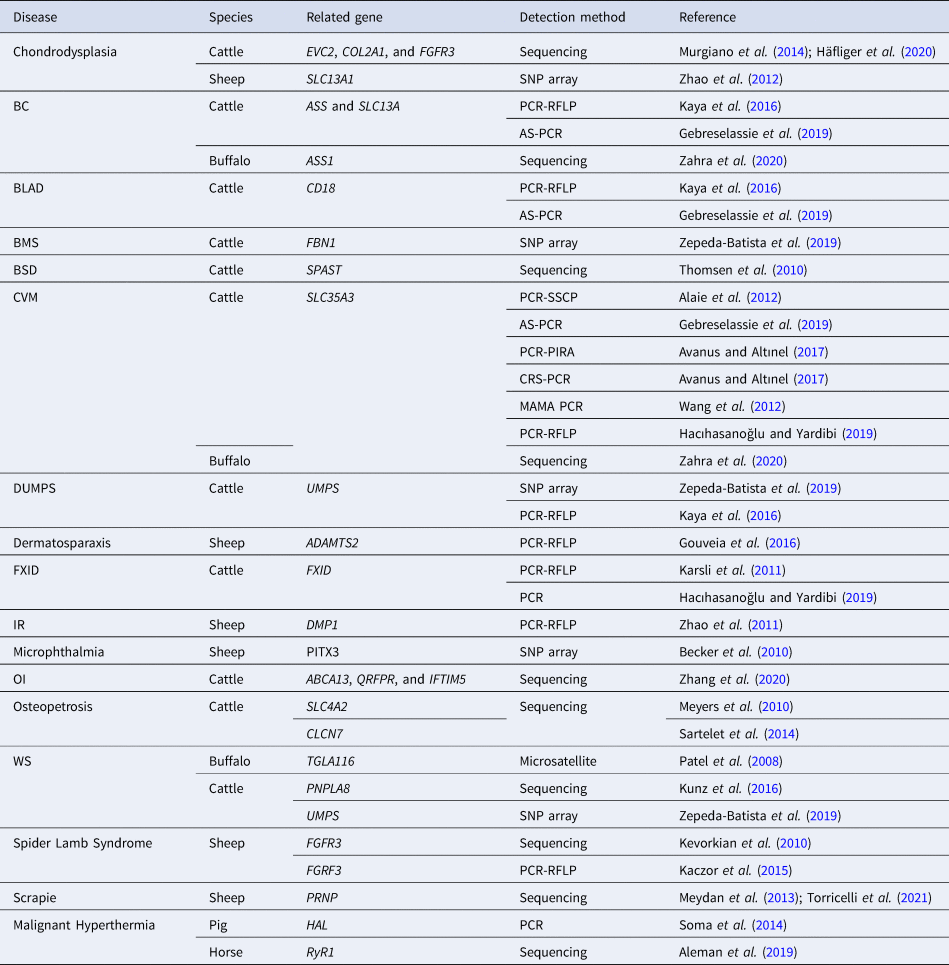
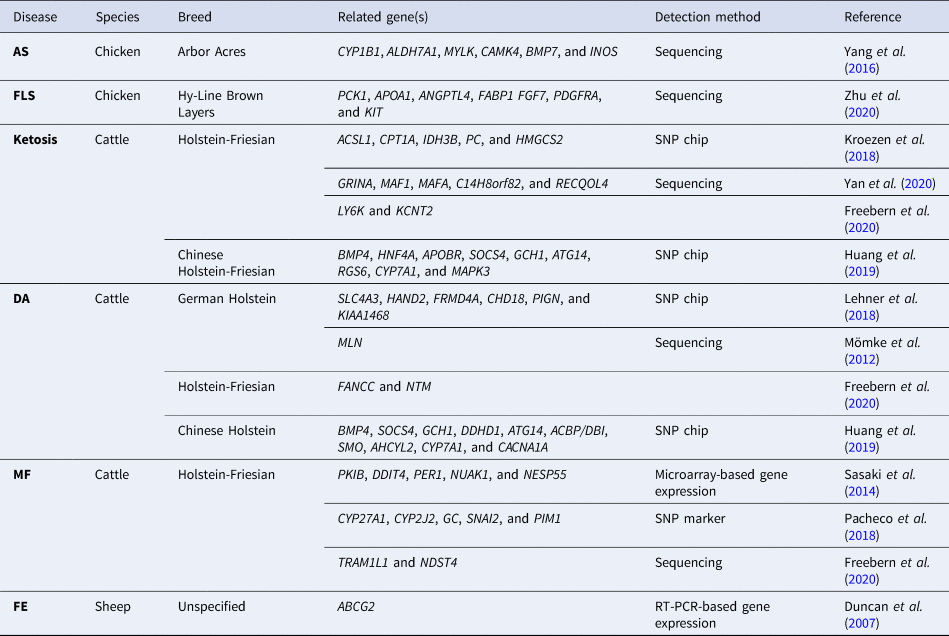
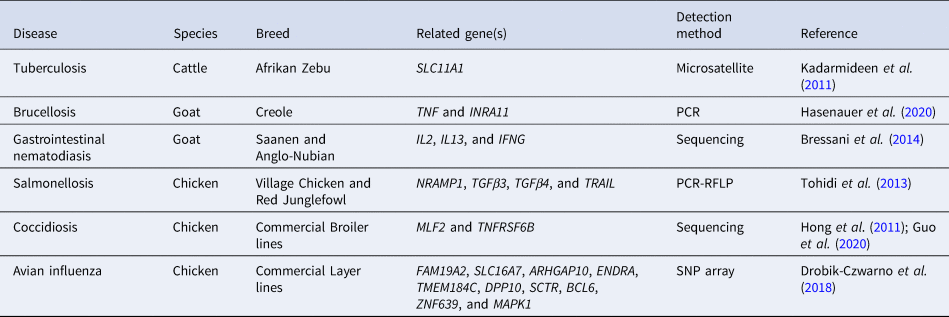
Genetic, metabolic, and infectious diseases are some of the main factors in decreasing FAW. Diseases may restrict farm animals in terms of all five main freedoms, as unnatural behaviors such as less drink and eating, discomfort, and pain are observed in animals suffering from disease. Additionally, life quality decreases among farm animals suffering from disease. Today, numerous genetic (Table 1), metabolic (Table 2), and infectious (Table 3) diseases have been detected in farm animals via different molecular techniques.
An overview of common genetic diseases detected among farm animals by molecular techniques

BC, bovine citrullinaemia; BLAD, bovine leukocyte adhesion deficiency; BMS, bovine Marfan syndrome; BSD, bovine spinal dysmyelination; CVM, complex vertebral malformation; DUMPS, deficiency of uridine monophosphate synthase; FXID, factor XI deficiency; IR, inherited rickets; OI, osteogenesis imperfecta; WS, weaver syndrome.
An overview of genes associated with resistance/susceptibilty to common metabolic diseases and detected in farm animals by molecular techniques

AS, ascites syndrome; FLS, fatty liver syndrome; DA, displaced abomasum; MF, milk fever; FE, facial eczema.
An overview of genes associated with resistance/susceptibility to common infectious diseases and detected in farm animals by molecular techniques

Genetic diseases generally show autosomal recessive inheritance in which affected animals can be detected at birth via phenotype, while molecular markers should be utilized to detect the carrier animals (Kaya et al., Reference Kaya, Meydan, Kiyma, Alan and Yildiz2016; Gebreselassie et al., Reference Gebreselassie, De, Mukherjee and Gohain2019; Zahra et al., Reference Zahra, Imran, Zahoor, Ashraf, Jaffry, Nadeem, Rashid, Younas, Akhtar and Shehzad2020). Being noninfectious, genetic diseases do not affect healthy animals via mating and other physical contacts, while the alleles leading to the disease may be transferred to the next generation via carrier animals. Rarely occurring genetic diseases may affect AW differently, depending on the type of disease. For example, complex vertebral malformation causes premature births, aborted fetuses, and stillborn calves in cattle (Wang et al., Reference Wang, Tong, Hu, Yang, Zhong, Yu, Wu, Liu, Li, Hua, Zhao and Zhang2011a, Reference Wang, Wang, Zhang and Dongb), while dermatosparaxis leads to skin fragility and delayed wound healing in sheep (Gouveia et al., Reference Gouveia, Cunha, De Almeida, Nogueira, Souza Filho, Menezes and Gouveia2016).
Metabolic diseases occur under unsuitable feeding applications such as imbalance of nutrition and insufficient food supply for maintenance, growth, production, and reproduction in farm animals (Martinez et al., Reference Martinez, Sinedino, Bisinotto, Ribeiro, Gomes, Lima, Greco, Risco, Galvão, Taylor-Rodriguez, Driver, Thatcher and Santos2014). Intensive indoor production conditions, in which animals are fed intensively to obtain optimum economically important yields, may cause the development of metabolic diseases by altering animal physiology. Additionally, pain and discomfort behaviors that decrease AW are observed in sick animals. During the disease, the amount of economically important traits decreases which also negatively affects the incomes of farmers. Compared to genetic diseases, metabolic diseases decrease AW during a shorter period of time, because these diseases are generally temporary. Negative effects of these diseases could be removed by applying suitable feeding methods, such as individually or breed-specific feeding rather than group feeding.
Although genetic and metabolic diseases decrease FAW at the individual level, infectious diseases may affect the whole herd. These diseases may spread out from ill animals to healthy ones in different ways, such as direct contact, respiration, eating the same feed, and drinking the same water. Moreover, the disease agent may spread out to animals in nearby regions via carrier organisms such as birds. Development of infectious diseases leads to symptoms of stress that decrease the welfare of farm animals. Advanced stages of infectious diseases may result in the death of animals. Although the development of infectious diseases may be prevented by suitable management practices (such as hygiene, isolation, and vaccination), drug treatments are available for several infectious diseases. Vaccinations requiring physical contact between the veterinarian and animals may cause stress to animals, while drug treatment leads to ethical concerns among consumers due to drug residues in animal-derived products. As vaccination and drug treatments are not transferred on to future generations, these applications must be repeated over time. Therefore, the financial burden of vaccination and drug treatment may not be practicable for smallholder farmers.
Thus, genetic, metabolic, and infectious diseases negatively affect farm animals to perform their natural behaviors and lead to decreased quantity of economically important traits which are essential to guarantee human nutrition as well as maintaining production by farmers. Today, numerous molecular techniques such as sequencing, SNP array, SNP chip, and PCR-based applications (PCR-RFLP, RT-PCR, AS-PCR, PCR-SSCP, PCR-PIRA, CRS-PCR, and microsatellites) are available to analyze factors associated with genetic, metabolic, and infectious diseases in farm animals at the DNA level (Tables 1–3). By using these molecular techniques, carrier animals of genetic diseases, together with animals resistant to metabolic and infectious diseases, can be detected with high accuracy in a short time. Moreover, both susceptible and carrier individuals can be detected at the embryo stage, based on candidate genes and/or related mutations. Elimination of undesired alleles for genetic diseases, and conservation of desired alleles associated with lower incidence of metabolic and infectious diseases, will lead to future generations that are not carriers of genetic diseases and are resistant to metabolic and infectious diseases. AW may be kept at an optimum level in farm animals which are free of disease. It is seen that molecular genetics played a key role to increase AW in terms of both detecting and eliminating several diseases in farm animals.
Genomic selection versus traditional selection
Traditional selection methods have been mainly based on estimated breeding value (EBV) for economically important traits. Animals with higher EBV values for a specific yield such as milk (Lee et al., Reference Lee, Do, Choy, Dang, Mahboob and Cho2019), meat (Gardner et al., Reference Gardner, Pethick, Hopkins, Hegarty, Cake, Boyce and Allingham2006), egg (Wolc et al., Reference Wolc, Arango, Settar, O'sullivan, Olori, White, Hill and Dekkers2012), wool (Hamadani et al., Reference Hamadani, Ganai, Khan, Shanaz and Ahmad2019), or cashmere (Zhang et al., Reference Zhang, Wang, Lei, Wang, Su, Zhang, Zhou, Wei, Meng, Wang and Li2014) are used in selection studies to obtain future generations with higher yields. Of course, some characteristics such as carcass traits and milk yield capacity of male animals cannot be directly recorded at the individual level. To detect EBV in male animals in terms of milk yield, a progeny test should be conducted in which sperm samples are collected from male animals and transferred to female animals by artificial insemination (González-Recio et al., Reference González-Recio, Ugarte and Alenda2005). As previously mentioned, these applications require physical contact between veterinarians and animals, which trigger stress symptoms in animals. Similarly, EBV values for carcass traits cannot be detected directly from animals, which require progeny test as well (Seo et al., Reference Seo, Shen, Salces, Yoon, Lee and Kim2006). To detect EBV values for carcass traits of an animal, several dozen of its offspring must be slaughtered. Indeed, vast numbers of quail (n = 1093, Narinc et al., Reference Narinc, Aksoy, Karaman, Aygun, Firat and Uslu2013), chicken (n = 1465, Venturini et al., Reference Venturini, da CRUZ, Rosa, Baldi, El Faro, Ledur, Peixoto and Munari2014), cattle (n = 96, Warren et al., Reference Warren, Scollan, Enser, Hughes, Richardson and Wood2008), and sheep (n = 5870, Greeff et al., Reference Greeff, Safari, Fogarty, Hopkins, Brien, Atkins, Mortimer and Van Der Werf2008) were slaughtered to estimate genetic parameters for carcass traits.
It is seen that traditional selection practices to detect EBV for several traits decrease FAW. Today, however, genomic selection is commonly used to detect superior animals in terms of economically important traits via genomic estimated breeding value (GEBV). FAW has increased in different species by estimating GEBV, which does not require slaughtering practices rather than EBV (Zhang et al., Reference Zhang, Xu, Luo, Zhang, Gao, He, Ji, Zhang, Li and Zhang2017; Lopez et al., Reference Lopez, Lee, Park, Shin, Oh, De Las Heras-Saldana, van der Werf, Chai, Park and Lim2019).
Economically important traits generally show quantitative inheritance, indicating they are shaped and controlled by additive effects of a large number of loci. Thanks to advances in sequencing technologies, the whole genome of farm animals can be sequenced, and candidate genes can be detected by comparative analysis with reference genomes. Genome wide association analyses are not only utilized for the detection of candidate genes associated with economically important traits (Falker-Gieske et al., Reference Falker-Gieske, Blaj, Preuß, Bennewitz, Thaller and Tetens2019), but also for analyzing the genes directly related to AW and behavior of farm animals (Grindflek et al., Reference Grindflek, Hansen, Lien and van Son2018). Moreover, animals can be genotyped at birth by high-density SNP data obtained by NGS platforms (Kaushik et al., Reference Kaushik, Kandavel, Nalpathamkalam and Pasman2021). Genomic selection studies have increased AW, because they reduce slaughter and physical contact between the veterinarians and animals.
Molecular genetics in the adaptation to climate change
Being one of the most destructive environmental factors, climate change can decrease FAW both directly and indirectly (Mader et al., Reference Mader, Frank, Harrington, Hahn and Nienaber2009). Changes in climatic parameters such as temperature, humidity, cloudiness, and precipitation may decrease FAW indirectly, as they affect the quality and quantity of crops that are essential for farm animal nutrition. On the other hand, body temperature is maintained in balance in farm animals, while increasing environmental temperature may cause heat stress (Rashamol et al., Reference Rashamol, Sejian, Bagath, Krishnan, Archana and Bhatta2020) that affects animal behaviors (Indu and Pareek, Reference Indu and Pareek2015). Indeed, as highlighted by Perini et al. (Reference Perini, Cendron, Rovelli, Castellini, Cassandro and Lasagna2021), animals facing heat stress intend to eat less, drink more, and seek shadows to lie down in order to balance body heat. These abnormal behaviors are signs of decreased welfare in farm animals. Thus, more thermotolerant animals may be preferred by farmers, to mitigate the negative effects of climate change.
Thanks to advances in molecular genetics, several genes associated with thermotolerance (HSP70, HSP90AB1, HSP90β, HSPB7, etc.) have been detected in farm animals (Chen et al., Reference Chen, Gan, Xiao, Jiang, Zhang and Luo2013; Sailo et al., Reference Sailo, Gupta, Verma, Singh, Vishwas, Chaudhari, Das, Upadhyay and Goswami2015; Hassan et al., Reference Hassan, Nawaz, Rehman, Ali, Dilshad and Yang2019; Zeng et al., Reference Zeng, Cao, Wu, Huang, Zhang, Lei and Zhao2019). These genes are used in MAS to increase the productivity of farm animals raised in hot climates. Thus, development in molecular genetics increases AW, because thermotolerant animals show more natural behaviors under increasing temperature.
Independently of molecular genetics, epigenetic mechanisms are promising to produce animals resistant to adverse environmental factors, decreasing AW. Epigenetics mechanisms could change phenotypic expression of a certain gene without changes in DNA sequence, via different means such as DNA-RNA methylation, non-coding RNA regulation, and histone modification (Yakovlev, Reference Yakovlev2018). Relationships between epigenetic mechanisms and AW have been comprehensively reviewed by Sinclair et al. (Reference Sinclair, Rutherford, Wallace, Brameld, Stöger, Alberio, Sweetman, Gardner, Perry, Adam, Ashworth, Robinson and Dwyer2016).
Conclusions and future perspectives
In this study, the direct and indirect contributions of developing molecular genetics to FAW were reviewed to raise awareness among both scientists and farmers. Molecular techniques widely used to identify animals resistant to metabolic and infectious diseases or genetic disease carriers that contribute to the welfare of livestock are less practicable in developing countries and by smallholder farmers due to their economic burden. However, as these molecular techniques become more affordable, they will routinely be used to analyze whole genomes of animals at birth, or even at embryonic stages, to detect and eliminate genetic diseases and to identify animals that are more susceptible or resistant to metabolic and infectious diseases as well as and environmental factors that impact FAW. In addition, advances in biotechnology and genome-editing tools will facilitate direct modification of genomic regions associated with welfare traits in livestock species. Animals with desired genotypes can then be used for traditional breeding supported with genome studies to maintain AW at the most optimum levels possible.
Acknowledgments
The authors would like to thank the two anonymous reviewers for their valuable comments and scientific contributions to the manuscript.