Introduction
Bilingual and monolingual infants attain their first words at the same time (Genesee, Reference Genesee2003). However, bilingual toddlers, when learning words in two languages, acquire the vocabulary of each language more slowly, although their overall vocabulary across the two languages is on par with that of their monolingual peers (Core, Hoff, Rumiche & Señor, Reference Core, Hoff, Rumiche and Señor2013). Infants in both groups are equally exposed to referents for objects and actions. However, bilingual infants’ exposure to a given word that goes with a referent is divided across two languages, which slows the word learning process in each language learned. In contrast, owing to greater exposure to words in only one language, monolingual infants appear to tune into and learn the vocabulary of that language faster than bilingual infants.
The biobehavioral process of perceptual narrowing or tuning into the ambient environment is ubiquitous to many domains (Maurer & Werker, Reference Maurer and Werker2014; Pascalis, de Haan & Nelson, Reference Pascalis, de Haan and Nelson2002). In the language domain, at first, infants distinguish between phonemes present and phonemes not present in their native language. By about 6 months, however, monolingual infants begin to distinguish between native language-specific vowel contrasts but not the non-native vowel contrast (Kuhl, Williams, Lacerda, Stevens & Lindblom, Reference Kuhl, Williams, Lacerda, Stevens and Lindblom1992). By about 10 months, monolingual infants distinguish between native language-specific consonants but not non-native language consonant contrasts (Werker & Tees, Reference Werker and Tees1984, see review, Fava, Hull & Bortfeld, Reference Fava, Hull and Bortfeld2011). Similarly, in the visual modality, 4-month-old ASL learners discriminate between different ASL and different non-ASL signs, but by 14 months, they only discriminate the different ASL signs but not different non-ASL signs (Palmer, Fais, Golinkoff & Werker, Reference Palmer, Fais, Golinkoff and Werker2012). Even monolingual newborns show a preference for their native language acoustics over non-native language acoustics (Mehler, Jusczyk, Lambertz, Halsted, Bertoncini & Amiel-Tison, Reference Mehler, Jusczyk, Lambertz, Halsted, Bertoncini and Amiel-Tison1988; Moon, Panneton-Cooper & Fifer, Reference Moon, Panneton-Cooper and Fifer1993; Nazzi, Bertoncini & Mehler, Reference Nazzi, Bertoncini and Mehler1998; Ramus, Hauser, Miller, Morris & Mehler, Reference Ramus, Hauser, Miller, Morris and Mehler2000) as a result of in utero exposure to the language. In contrast, newborns exposed to two languages in utero show no preference for these languages (Byers-Heinlein, Burns & Werker, Reference Byers-Heinlein, Burns and Werker2010). These findings suggest that the phenomenon of experience-driven constraining or perceptual narrowing or its absence is ubiquitous to many forms of communication and multiple sensory modalities (also Lewkowicz & Ghazanfar, Reference Lewkowicz and Ghazanfar2009).
Perceptual narrowing to language-specific properties in infants corresponds with language specific functional reorganization in the brain during development. The absence of perceptual narrowing corresponds with the absence of language-specific functional reorganization (and retention of neural plasticity; Minagawa-Kawai, Mori, Naoi & Kojima, Reference Minagawa-Kawai, Mori, Naoi and Kojima2007). In a cross-sectional neurophysiological examination using NIRS (near infrared spectroscopy), monolingual 3- to 28-month-old infants were exposed to four pseudowords, two containing native-language phonemic features and two containing nonnative features. Infants of 12 months and beyond showed significant left hemisphere lateralization (i.e., greater hemodynamic activity in the left relative to the right hemisphere) to the native-language but not the non-native-language features of the pseudowords. The left-hemisphere lateralization reflects developing tuning to the native-language. In contrast, the younger infants showed equally bilateral activation to native and non-native features, suggesting more generalized mechanisms at play. Earlier bilateral representation of words and later left-hemisphere lateralization is also reported in bilingual English and Welsh learning infants (11 months) relative to monolingual English or Welsh learning infants (10 months, Vihman, Thierry, Lum, Keren-Portnoy & Martin, Reference Vihman, Thierry, Lum, Keren-Portnoy and Martin2007). Similarly, left hemisphere lateralization and tuning in response to dominant-language words occurs later around 19–22 months, and is highly correlated with the total number of words learned in the dominant language in bilingual English and Spanish learners (Conboy & Mills, Reference Conboy and Mills2006). It occurs much earlier at 11 months in monolingual English learners (Ramırez, Ramırez, Clarke, Taulu & Kuhl, Reference Ramırez, Ramırez, Clarke, Taulu and Kuhl2017). These studies provide strong evidence for: (a) perceptual narrowing or fine-tuning to the language environment, and (b) slower language-specific functional reorganization of the brain when learning two languages (e.g., English and Spanish, 19–22 months) versus one (10–12 months). It is possible that the degree of overlap (e.g., phonetic, lexical, or grammatical) in languages might also yield variations in neural and behavioral language tuning trajectories for bilingual relative to monolingual infants (see review, Fava et al., Reference Fava, Hull and Bortfeld2011), although overall language outcomes are comparable across groups (Core et al., Reference Core, Hoff, Rumiche and Señor2013; Genessee, Reference Genesee2003). In other words, the timing of perceptual narrowing versus perceptual protraction to accommodate the bilingual environment might also depend on the specific properties of the dual language environment.
Bilingual infants and toddlers also experience a protracted period during which time they accept word forms that contain non-native phonemic contrasts unlike their monolingual counterparts. For example, when 10-month-old bilingual and monolingual infants were exposed to native-language and non-native language syllabic contrasts, NIRS (near infrared spectroscopy) evidence suggests that the bilinguals showed activation in the left inferior cortex to both contrasts, whereas the monolinguals showed the same activation only in response to the native-language contrasts (Petitto, Berens, Kovelmen, Dubins, Jasinska & Shalinsky, Reference Petitto, Berens, Kovelman, Dubins, Jasinska and Shalinsky2012). This is because the phonological system narrows more slowly for infants and toddlers tuning into two languages than it does for infants learning a single language, allowing the phonological window to remain open longer for bilinguals than for monolinguals. This open window results in more flexibility during word learning for bilinguals compared to monolinguals. For example, when the native language does not use pitch contours to differentiate between names for objects, whereas monolinguals tune out these contrasts between 17–19 months (Hay, Graf Estes, Wang & Saffran, Reference Hay, Graf Estes, Wang and Saffran2015), bilinguals continue to perceive the contrast much longer until 22 months (Graf Estes & Hay, Reference Graf Estes and Hay2015). Similarly, when the names for objects differ in their vowel sounds (e.g., /min/ and /mun/) bilingual (Mandarin and English learning) 18-month-old infants learn to pair these words with a referent object, but not their monolingual counterparts (Singh, Fu, Tay & Golinkoff, Reference Singh, Fu, Tay and Golinkoff2017). Exposure to and learning of words in two languages and the latent flexibility of toddlers’ phonological system promotes learning of words for objects in a third language (Singh, Reference Singh2017).
Some behavioral and ERP studies have also reported that the ability to discriminate between native-language phonemic contrasts emerges later in bilingual infants than in monolingual infants and the window of perceptual sensitivity also remains open for a more protracted period of time (e.g., vowel contrasts, Bosch & Sebastián-Gallés, Reference Bosch and Sebastián Gallés2003; consonant contrasts, Burns, Yoshida, Hill & Werker, 2007; Garcia-Sierra, Rivera-Gaxiola, Percaccio, Conboy, Romo, Klarman, Ortiz & Kuhl, Reference Garcia-Sierra, Rivera-Gaxiola, Percaccio, Conboy, Romo, Klarman, Ortiz and Kuhl2011). As an example of later learning of native-language phonemic contrasts, bilingual infants learn minimal pairs, such as /bIh/ and /dIh/, as names for objects at about 20 months (Fennell, Byers-Heinlein & Werker, Reference Fennell, Byers-Heinlein and Werker2007), whereas monolinguals learn them earlier around 17 months (Werker, Fennell, Corcoran & Stager, Reference Werker, Fennell, Corcoran and Stager2002).
Still other research suggests that bilingual infants exhibit a non-linear pattern of differences in their phonetic contrast perception at different time points relative to their monolingual counterparts. For example, during phonetic development, while monolingual and bilingual infants of 5–6 months show a lack of perceptual sensitivity to the native Dutch vowel contrasts /I/-/i/, bilingual 8–9 month-old infants begin to show a heightened acoustic sensitivity to this native language contrast relative to monolinguals. Eleven- to 12-month-old bilinguals show perceptual sensitivity once again on par with the monolinguals, but 14- to 15-month-old bilinguals show attenuated sensitivity to the vowel contrast relative to their monolingual counterparts (Liu & Kager, Reference Liu and Kager2016; also see 12-month-olds bilinguals’ vowel-discrimination delay relative to monolinguals, Bosch & Sebastián-Gallés, Reference Bosch and Sebastián Gallés2003). These findings illustrate that experience with an additional language boosts bilingual infants’ phonological perception in the second half of the first year relative to monolingual infants (also see Kovacs & Mehler, Reference Kovacs and Mehler2009a; Reference Kovacs and Mehler2009b; see review, Werker, Reference Werker2012). It is possible that around 8–9 months, prior to lexical development, exposure to two languages heightens phonetic perception to accommodate two lexical systems rather than one. It is also possible that, after word production, the perceptual window either begins to close (e.g., Liu & Kager, Reference Liu and Kager2016), or remains open and protracted to further accommodate or retain sensitivity to two different languages and perceptual narrowing is slower in bilingual infants (e.g., Graf Estes & Hay, Reference Graf Estes and Hay2015). The findings taken together suggest: (a) that bilingual infants exhibit a perceptual protraction (lead) and a perceptual attenuation relative to monolinguals at two different time points during language development, and (b) that perceptual development is a non-linear rather than a linear incremental process.
Although these experimental studies provide insights into bilingual versus monolingual infants’ phonetic perception, lexical mapping and noun learning after first word onset, none compare bilinguals’ versus monolinguals’ emerging verb-action mapping prior to and after the transition to first words (see review, DeAnda, Poulin-Dubois, Zesiger & Friend, Reference DeAnda, Poulin-Dubois, Zesiger and Friend2016). During lexical mapping development, a precursor to lexical comprehension, recent evidence suggests that monolingual postverbal infants (referring in that study to post verb comprehension onset) of 12- to 14 months tune into language-specific lexical properties, such as the greater frequency of nouns relative to verbs in their noun-friendly language (noun bias, e.g., English; Gogate & Maganti, Reference Gogate and Maganti2017). As these infants naturally learned more words, in particular, nouns in the noun-friendly language (e.g., English) as per maternal report on the MacArthur-Bates Communicative Development Inventories (MCDI, Fenson, Dale, Reznick, Bates, Thal & Pethick, Reference Fenson, Dale, Reznick, Bates, Thal and Pethick1994), their verb-action mapping in the laboratory was attenuated relative to infants who had not learned as many nouns. Thus, tuning into a noun bias and learning more novel noun-object relations results in a temporary perceptual-lexical narrowing to nouns which, in turn, temporarily attenuates word-action mapping in postverbal relative to preverbal infants: the perceptual-lexical narrowing hypothesis (Gogate & Hollich, Reference Gogate and Maganti2016; Gogate & Maganti, Reference Gogate and Maganti2017). Substantiating this hypothesis, the postverbal 12- to 14-month-old infants failed to learn two novel word-action mappings when exposed to the pairings during habituation, whereas the preverbal 8- to 9-month-old infants succeeded in learning these mappings (Gogate & Maganti, Reference Gogate and Maganti2017). Early heightened perception of word-action relations likely emerges from young infants’ perception of their own and others’ actions (e.g., 2 months; Bahrick & Watson, Reference Bahrick and Watson1985) that far surpasses their object and face perception when pitted against one another (e.g., 5.5 months; Bahrick, Gogate & Ruiz, Reference Bahrick, Gogate and Ruiz2002).
In the present paper, bilingual infants’ perceptual-lexical narrowing to nouns in two languages and monolingual English-learning infants’ perceptual-lexical narrowing to nouns in one language raise specific hypotheses about the developmental trajectory of verb learning in infants learning two noun-friendly languages versus one. If learning one noun-friendly language and tuning into the greater frequency of nouns after word production onset attenuates word-action mapping in monolingual postverbal infants (12–14 months) relative to preverbal infants (Gogate & Maganti, Reference Gogate and Maganti2017), learning two noun-friendly languages (e.g., English and Spanish, Dhillon, Reference Dhillon2010) should further attenuate word-action mapping in bilingual postverbal infants after word production onset, when infants attend more to and learn more nouns than verbsFootnote 1 (a full-blown noun bias; Hypothesis 1A). In contrast, prior to developing a full-blown noun bias, when infants are yet to attend more to nouns relative to other words, but are experiencing a crossmodal perceptual protraction (lead) to accommodate learning two lexicons, bilingual preverbal infants should show heightened mapping of novel words onto actions in the second half of the first year (Hypothesis 1B). Two factors are pitted against one another: (a) the perceptual system's accommodating to two lexicons, requiring it to remain protracted (i.e., show heightened sensitivity to both languages), and (b) the system's tuning into the noun bias of the ambient languages, or attending more to the frequent nouns relative to other words, that gets stronger after word production but not prior to it. For bilingual infants to develop a full blown noun bias and show attenuated word-action mapping, the second factor must override the first. Exposure to two noun-friendly languages should further accelerate or speed up the developing noun bias after word production (when it consists mainly of nouns), but not prior to it. Furthermore, although monolingual postverbal infants show attenuated word-action mapping whereas their preverbal counterparts do not (Gogate & Maganti, Reference Gogate and Maganti2017), their difference may not be as significant because they are not exposed to two noun-dominant languages that speed up the noun bias post word production (Hypothesis 2).
To test these hypotheses, in the present study, we examined word-action mapping in preverbal and postverbal, bilingual infants learning two noun-friendly languages and monolingual English learning infants. Infants were habituated to two synchronous word-action pairings in an infant-controlled habituation procedure and tested using a version of the switch method (Gogate & Maganti, Reference Gogate and Maganti2017; Gogate, Reference Gogate2010), where the word-action pairings were interchanged.
Method
Participants
Eighty-five infants were recruited from pediatricians’ offices via brochures, mass mailings, newspaper, web and other advertisements distributed in Fort Myers, Florida, USA. In accord with the university's Institutional Review Board requirements, all mothers provided informed consent prior to infants’ participation. Infants were selected for this study based on their language status, bilingual or monolingual, and verbal level, preverbal or postverbal. The preverbal monolingual and bilingual groups comprised infants of average age 10.5 months based on prior studies which document the age of word production onset in infants. Specifically, norming studies (Fenson et al., Reference Fenson, Dale, Reznick, Bates, Thal and Pethick1994; Tardif, Fletcher, Liang, Zhang, Kaciroti & Marchman, Reference Tardif, Fletcher, Liang, Zhang, Kaciroti and Marchman2008) chart the earliest onset of word production at about 11 months in infants from noun-friendly language environments. Maternal responses to a background questionnaire were also used to establish whether the infants produced any words in one or two languages (inclusion criterion for preverbal groups, word-production = 0). In addition, for 11 of the 32 preverbal (5 bilingual, 6 monolingual) infants and 23 of the 32 postverbal (9 bilingual, 14 monolingual) infants, maternal report of their vocabulary on the MCDI was obtained at the time of testing. These infants were cohorts in another large-scale study. Bilingual preverbal and postverbal infants were randomly selected from this cohort. Each monolingual preverbal or postverbal infant was age-matched (within 1 day) with a bilingual preverbal or postverbal infant. The MCDI productive score for these infants and the maternal questionnaire for the remaining infants were used to include them in the preverbal groups if they did not produce words or in the postverbal groups if they produced words at the time of testing. These grouping methods allowed a cross-sectional examination of bilingual and monolingual infants’ word-action mapping prior to and after word productionFootnote 2.
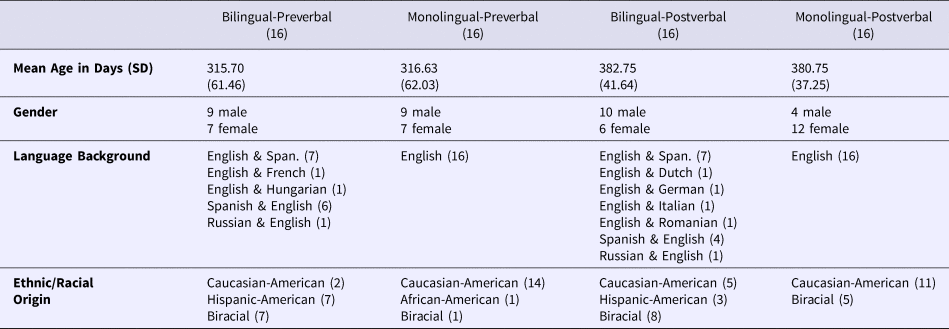
The final sample consisted of 64 infants (GA > 37 weeks, BW > 5 lbs., 32 male and 32 female), sixteen bilingual preverbal infants (Mean age, 10.5 months), and sixteen bilingual postverbal infants (Mean age, 12.5 months), sixteen monolingual preverbal infants (Mean age, 10.5 months), and sixteen monolingual postverbal infants (Mean age, 12.5 months). Table 1 provides the mean age in days, gender, language background(s), and ethnic distribution of the four groups. Twenty-one of the 85 infants (10 postverbal and 11 preverbal) were excluded from the final sample due to fussiness (6), or failure to reach habituation criterion after 20 trials (5), experimenter error (6), or equipment failure (2), or being outliers (2, visual recovery either less than or greater than 3 standard deviations from the group mean, explained under Procedure).
Mean age in days, gender, language background, and ethnic/racial origin of infants by group.

Mothers reported on a background questionnaire that their dominant language, the language they spoke at home to their infant, was a noun-friendly language: English (52 mothers, 25 of the preverbal and 27 of the postverbal infants), or Spanish (7 mothers, 6 of the preverbal and 4 of the postverbal infants) or Russian, (2 mothers, 1 each of the bilingual preverbal and postverbal infants, also see Table 1). In Table 1, the first of the two languages listed is the dominant language for the bilingual infants. Also based on the background questionnaire, infants’ ethnic group membership was determined (see Table 1 for ethnic distribution across groups). Mothers reported no infant health complications at birth or after requiring hospitalization.
Stimuli
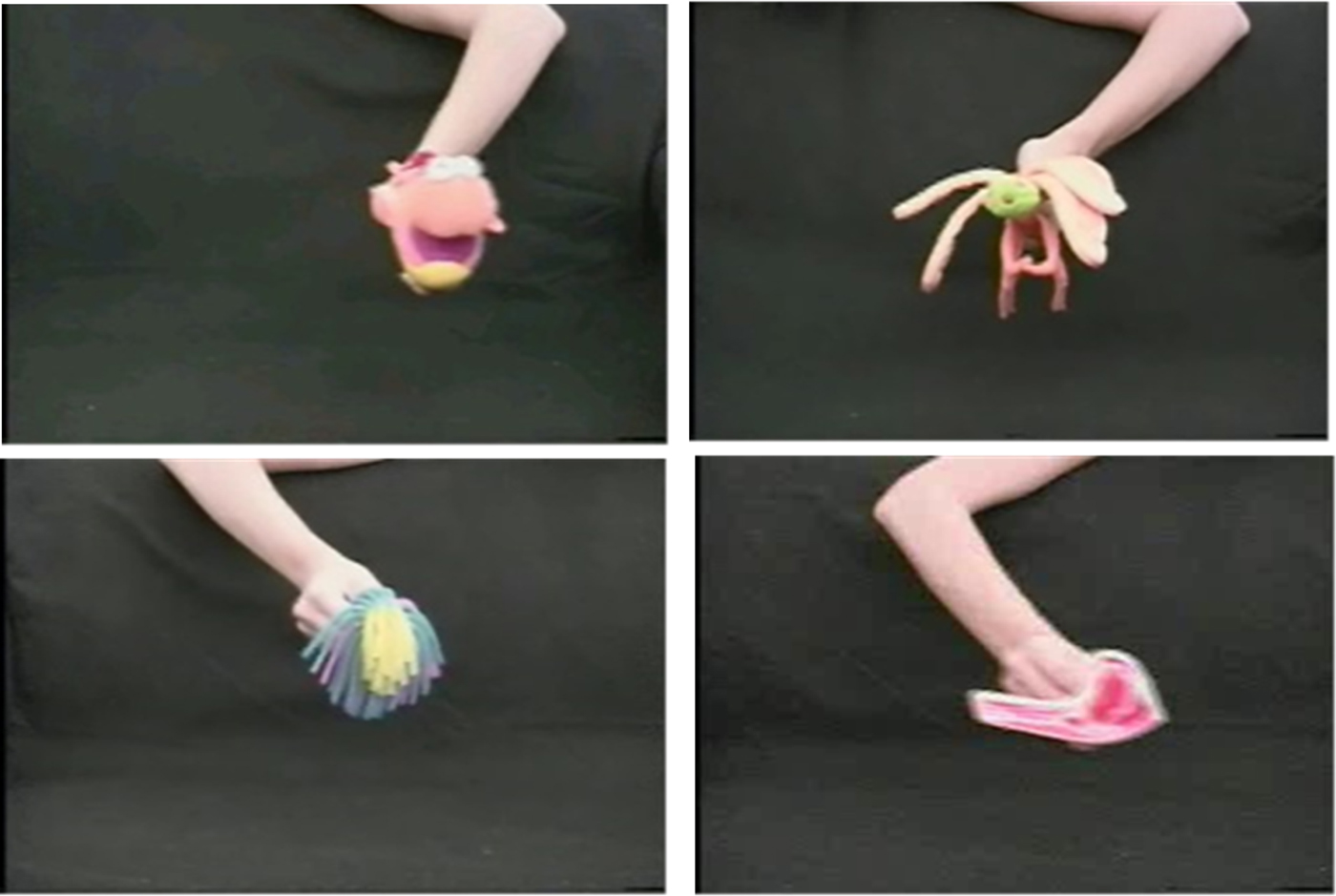
Eight dynamic video-displays of four hand-held objects, a fish, a dragonfly, a squiggly or a lamb-chop looming or shaking in synchrony with a spoken word, /wem/ or /bæf/, were usedFootnote 3 to present to the infants in the experiment (see Figure 1, and sample video stimuli in Figures S1 and S2 in supplementary materials). Looming and shaking motions were selected because they attract infants' attention significantly more than sideways and upwards motions (Matatyaho, Mason & Gogate, Reference Matatyaho, Mason, Gogate, Berthouze, Prince, Littman, Kozima and Balkenius2007; Matatyaho-Bullaro, Gogate, Mason, Cadavid & Abdel-Mottaleb, Reference Matatyaho-Bullaro, Gogate, Mason, Cadavid and Abdel-Mottaleb2014). On each display, a native speaker of Standard American English spoke one of the words every 3 seconds while her visible hand (and forearm) held and moved one object each time she spoke the word. The words were elongated and exaggerated as in infant-directed speech, and inflectionless akin to infants’ earliest spoken verbs (e.g., hug rather than hugs or hugging; see Tardif et al., Reference Tardif, Fletcher, Liang, Zhang, Kaciroti and Marchman2008).
(color online). The objects used in the word- action video displays: a fish, a dragonfly, a squiggly, and a lamb chop.

On the looming displays, every 3 seconds, an object moved from the center or 2 cm above it to the bottom of the 50.8 cm monitor in a forward-downward and linear path. The scale change of objects across displays, computed over 50 randomly selected occurrences of looming motions ranged from 12.7–13.7 cm at the start to 14.6–15.6 cm at the end. On the shaking displays, every 3 seconds, an object moved short distances, repetitively and quickly, on a lateral path from right to left or vice versa.
Procedure
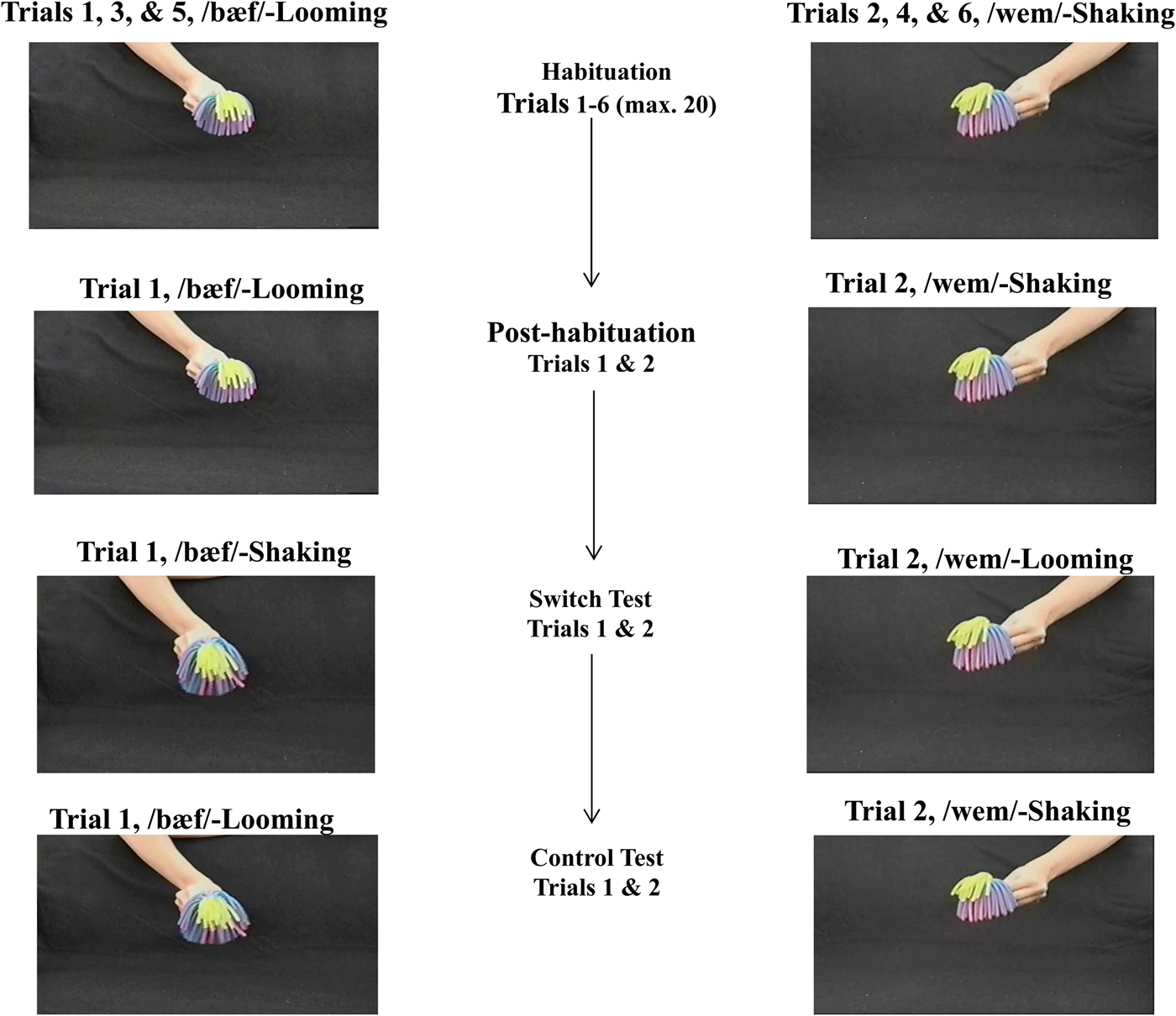
During infant-controlled habituation, seated in an infant seat facing a single 20” LCD monitor 55-cm away, infants observed two alternating video displays of two word-action pairings containing the same object (e.g., the squiggly), one word-action pair at a time. For example, the squiggly was loomed in synchrony with the word /bæf/ on one display, and on the second display, the same squiggly was shaken in synchrony with the spoken word /wem/ (see sample sequence, Figure 2). Each infant saw the same single object throughout habituation and test. The objects were counterbalanced so that eight monolinguals and eight bilinguals received one of the four objects. The words were presented at 65–70 dB (sound pressure at infants’ ear) via the speaker, placed under a table on which the infant seat was placed, to eliminate spatial co-location between the source of sound and visual displays from guiding infant fixation. The table on which the infant seat was placed, the monitor, and the speaker were all enclosed within a three-sided experimental booth. The mothers either stood behind the right panel and viewed their infant and the displays through a peek-hole, or sat on a separate chair placed right behind the infant seat. They were instructed not to talk, point to the monitor or gesture to their infant, and to maintain a neutral expression during the procedure.
(color online). Habituation, post-habituation and test sequence played on a single monitor: An example.

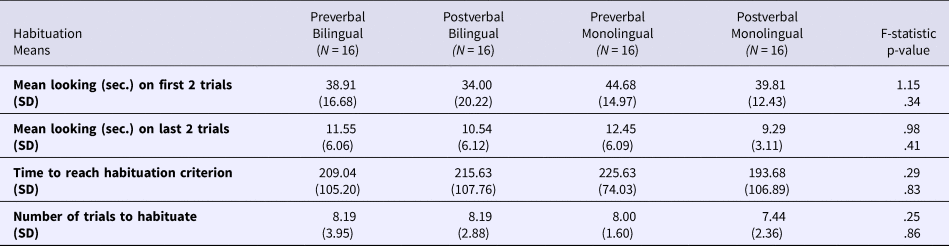
The length of each trial was infant-controlled (similar to Baillergeon, Spelke & Wasserman, Reference Baillergeon, Spelke and Wasserman1985; Bahrick, Reference Bahrick1994; Gogate & Bahrick, Reference Gogate and Bahrick1998; Gogate, Reference Gogate2010; Gogate & Maganti, Reference Gogate and Maganti2017; Matatyaho-Bullaro et al., Reference Matatyaho-Bullaro, Gogate, Mason, Cadavid and Abdel-Mottaleb2014). Each trial began when an infant fixated on a display, and ended when the infant looked away for 1.5 s or until 60 s of cumulative looking (inter-stimulus interval, 6s). Habituation continued until an infant reached a preset criterion: looking on two consecutive trials < 50% of the mean of the first two habituation trials (baseline) within a maximum of 20 trials (Table 2 provides the number and SD of trials infants took to habituate). Infants who did not reach this preset criterion in 20 trials were excluded from further analyses (see Participants section, second paragraph). Infants were required to complete at least 6 trials with at least three exposures to each word-action pairing to reach habituation criterion (Figure 2). One or two (when available) trained observers, hiding behind the central panel of the experimental booth, recorded infants’ visual fixations (in seconds) online from one of two peek holes on either side of and one above the monitor; they pressed a button on a button-box when infants looked at the monitor and released the button when they looked away, which were printed online. The observers wore shielded headphones and listened to music to mask the words being played, and recorded infants’ looking independently during the procedure. A third experimenter set up and played the videos, ensuring that the observers were blind to the stimuli and test-trial order. Cronbach's α of two observers’ visual fixation recordings for 25 out of 64 (39%) infants = .96.
Habituation means and standard deviations (SD) by verbal level and language status.

Following habituation, infants received two post-habituation trials (to control for regression to the mean, Bertenthal, Haith & Campos, Reference Bertenthal, Haith and Campos1983) identical to the prior habituation trials. Following the post-habituation trials, infants observed two consecutive switch (change) and two control (no change) test trial-displays, again one at a time (Figure 2), with their order counter-balanced (see Gogate, Reference Gogate2010; Gogate & Bahrick, Reference Gogate and Bahrick1998; also Fennel, Byers-Heinlein & Werker, Reference Fennell, Byers-Heinlein and Werker2007). On the two switch test trials, the word-action pairings were interchanged, whereas on the control test trials, the word-action pairing remained the same as during the habituation and post-habituation trials. For example, if an infant was habituated to the word-action pairings, /wem/-shaking and /bæf/-looming with the squiggly, the infant received the two consecutive switch test trials, /bæf/-shaking and /wem/-looming with the same squiggly, but the two no-change control test trials, /wem/-shaking and /bæf/-looming again with the squiggly. If infants learned the word-action pairings (e.g., /wem/-shaking and /bæf/-looming with the squiggly) during habituation, interchanging the pairings on the switch trials (e.g., /bæf/-shaking and /wem/-looming with the same squiggly), by simply changing the action while keeping the word, object, and hand constant, to isolate the action, should elicit longer looking although the actions and words are familiar relative to the no-change control trials (e.g., /wem/-shaking and /bæf/-looming with the squiggly). If, in contrast, infants failed to learn the word-action pairings during habituation, interchanging the pairings on the switch trials should not elicit longer looking relative to the no-change control trials. It is well established that, in experiments, after infants have habituated to stimuli, they typically look longer at changed stimuli if they encounter and notice a change (e.g., Baillergeon et al., Reference Baillergeon, Spelke and Wasserman1985). Infants’ perception of the change is measured as a difference between raw looking to the original stimuli and the changed stimuli, called visual recovery. To obtain visual recovery in the present study, infants’ mean looking to the control trials was subtracted from their mean looking to the switch trials (Gogate, Reference Gogate2010; Gogate & Bahrick, Reference Gogate and Bahrick1998; Matatyaho-Bullaro et al., Reference Matatyaho-Bullaro, Gogate, Mason, Cadavid and Abdel-Mottaleb2014).
Analyses plan
Four variables from the habituation phase, the mean looking on the first two habituation trials (baseline), the mean looking on the last two habituation trials, the time taken to reach habituation criterion (seconds), and the number of trials taken for infants to habituate, were analyzed using analyses of variance (henceforth ANOVAs) by Group (bilingual preverbal, bilingual postverbal, monolingual preverbal, and monolingual postverbal), to assess infants’ looking time behavior (attention) during the learning process. A secondary ANOVA assessed infants’ total looking (attention) during habituation by Object presented (fish, dragonfly, squiggly, or lamb chop), verbal level (preverbal or postverbal) and language status (monolingual or bilingual). The total looking during habituation included looking on the baseline and last two habituation trials, and is typically correlated with the number of trials to habituate.
To assess infants’ word-action mapping after habituation to the pairings, on the test, first separate within-group analyses (paired t-tests, two-tailed p critical = .05) compared infants’ mean looking to the control versus switch trials within each verbal level and language status. Further, individual differences in the visual recovery on the test (mean looking to the switch trials minus mean looking to the control trials) were analyzed (binomial z-tests, two-tailed p critical =.05) to examine how many infants within each group showed a positive (or negative) recovery to the novel word-action relations. Next, a between-group ANOVA of infants’ mean looking time after habituation examined main effects of Trial-type (post-habituation versus control versus switch), Verbal-level (preverbal versus postverbal), Language Status (bilingual versus monolingual), and Object (4), and interactions between these factors. Post hoc t-tests (Bonferroni multiple comparisonFootnote 4) were performed to examine between-group differences in mean looking by Trial-type, Verbal-level, Language Status and Object. A secondary ANOVA assessed whether the order of presentations of test-trials (control and switch) and the word-action pairing order during habituation influenced infants’ word-action mapping during the test. Finally, we assessed the relation between infants’ word-action mapping in the laboratory and their everyday vocabulary as per maternal report on the MCDI by language status (and verbal level).
Results
In this section, analyses and results of the habituation phase are reported prior to the analyses and results of the word-action mapping test phase, and correlations between infants’ word-action mapping and MCDI scores.
Habituation phase
To assess habituation performance across groups, four separate one-way ANOVAs compared the main effect of Group (4: preverbal bilingual vs. postverbal bilingual vs. preverbal monolingual vs. postverbal monolingual) on infants’ mean looking on the first two habituation (baseline) trials, mean looking on the last two habituation trials, the total time taken to reach habituation criterion, and the number of trials taken to habituate. These analyses revealed no significant main effect of Group for infants’ mean looking on the first two habituation trials, F (3, 60) = 1.15, p = .34, partial η p2= .05, power = .29, the mean looking on the last two habituation trials, F (3, 60) = 0.98, p = .41, partial η p2 = .05, power = .25, the total time taken to reach habituation criterion, F (3, 60) = 0.29, p = .83, partial η p2 = .01, power = .10, or the mean number of trials taken for infants to habituate, F (3, 60) = 0.25, p = .86, partial η p2 =.01, power = .10 (Table 2). These null findings suggested no significant differences between groups in infants’ looking behavior during habituation.
To evaluate whether the object used influenced habituation by verbal level and language status, a 4 (Object: fish vs. dragonfly vs. lamb chop vs. squiggly) x 2 (Verbal-level: preverbal vs. postverbal) x 2 (Language Status: bilingual vs. monolingual) ANOVA was performed on infants’ time taken to reach habituation criterion. This analysis yielded a significant main effect of Object, F (3, 48) = 3.05, p = .04, partial η p2 = .16, power = .68, suggesting that the object presented influenced infants’ attention during habituation to the word-action pairings. Post hoc t-tests (Bonferroni multiple comparison) showed that overall infants tended to prefer the fish the most and the lamb chop the least although this difference did not reach statistical significance (Mean difference = 85.60s, SE = 32.70, p = .07 (p critical = .013). The analyses also yielded a significant Object x Language Status interaction, F (3, 48) = 4.18, p = .01, partial η p2 = .21, power = .83. Post hoc analyses (Bonferroni, p critical =.05) comparing the bilingual versus monolingual groups’ habituation looking times revealed that the bilingual infants preferred the squiggly (M = 278.60s, SE = 28.51) the most and the lamb chop (M = 97.87s, SE = 38.06) the least, whereas the monolingual infants preferred the fish (M = 290.07s, SE = 33.22) the most and the squiggly (M = 176.68s, SE = 39.40) the least, regardless of verbal level. No other main effects or interactions were found (ps > .05). Owing to these significant main effects and interactions, Object was included as a factor in the main ANOVA of test measures below.
Test Phase: Word-action mapping – within-group analyses
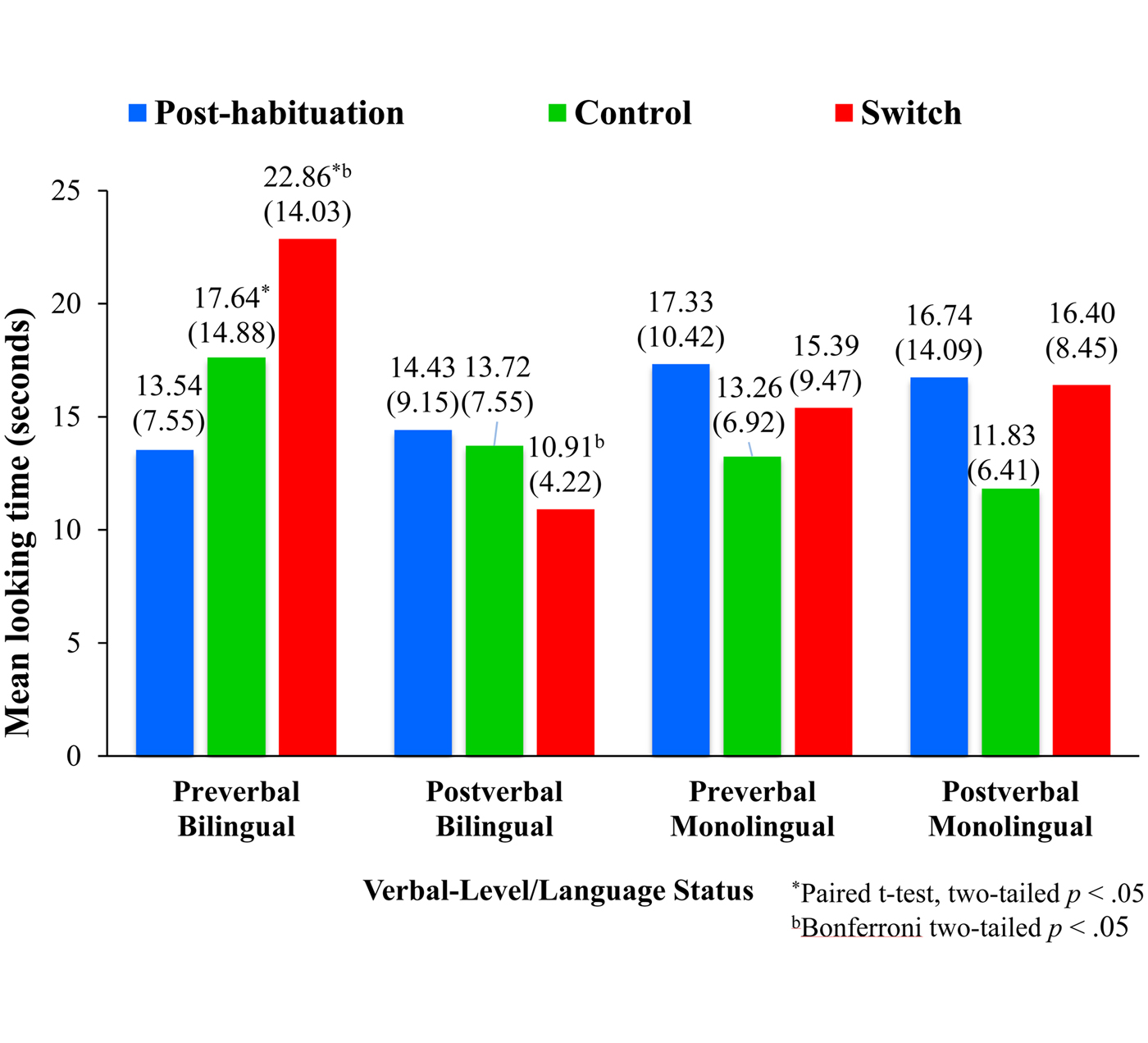
To evaluate infants’ test performance in each verbal-level and language status, switch versus control trial means were compared within each group. Consistent with hypotheses 1A and 1B, the preverbal bilingual infants looked significantly longer to the switch trials relative to the control trials (mean difference = 5.22 s (SD = 7.63), paired-t (15) = 2.74, p = .02, Figure 3), showing learning of the word-action mappings, but not the postverbal bilingual infants (mean difference = −2.81 s (SD = 7.19), paired-t (15) = −1.56, p = .14). Furthermore, consistent with hypothesis 2, neither the preverbal (mean difference = 2.13 s, SD = 5.96, paired-t (15) = 1.43, p = .17) nor the postverbal (mean difference = 4.57 s, SD = 12.57, paired-t (15) = 1.45, p = .17) monolingual infants looked significantly longer to the switch trials relative to the control trials.
(color online). Infants’ mean looking (and SD) by Trial-type, Verbal-level, and Language Status.

To evaluate individual differences within-group, we assessed the binomial distribution of infants’ individual visual recovery – i.e., mean looking on the switch minus mean looking on the control trials, either positive (< 0) or negative (> 0). Binomial z-tests versus .5 (chance) showed that 12 of the 16 preverbal bilingual infants (.75, exact two-tailed p = .08), but only 6 of the 16 postverbal bilingual infants (.38, exact two-tailed p = .45), 10 of the 16 preverbal monolingual infants (.63, exact two-tailed p = .45), and 9 of the 16 postverbal monolingual infants (.56, exact two-tailed p = .80) showed a positive visual recovery. These findings suggest marginally greater than chance probability of word-action mapping in preverbal bilingual infants.
Infant word-action mapping by language status, verbal level, and object – between-group analyses
To assess whether preverbal bilingual infants differed in their word-action learning on the test relative to the remaining groups, a mixed 2 (Language Status: bilingual vs. monolingual) x 2 (Verbal-level: preverbal vs. postverbal) x 4 (Object: fish vs. dragonfly vs. squiggly vs. lamb chop) x 3 (Trial-type: post-habituation vs. control vs. switch trials, the within-subjects factor) ANOVA was performed on infants’ mean looking (secs.). Consistent with hypotheses 1A, 1B and 2, this analysis yielded a significant interaction between Trial-type, Verbal-level, and Language status, F (2, 48) = 3.16, p = .047, partial η p2 = .06, power = .59 (Figure 3). Consistent with hypotheses 1A and 1B, post-hoc analysis revealed that the preverbal bilingual infants showed heightened word-action mapping by looking longer on the switch trials relative to the control and post-habituation trials, and they looked longer on the switch trials relative to the postverbal bilingual infants but not the other groups (Bonferroni multiple comparison p critical = .0125; see Figure 3). The significant and greater magnitude of difference between the bilingual groups in switch but not control or post-habituation looking across verbal levels was not evident in the monolingual groups. Further supporting hypotheses 1A, 1B, and 2, the effect-size of the mean switch minus mean control trial looking (visual recovery) was robust for postverbal versus preverbal bilingual groups, Cohen's d (-2.81 - 5.22/7.41) = 1.08, but not for postverbal versus preverbal monolingual groups, Cohen's d (4.57- 2.13/9.84) = .25. The robust difference in switch trial means and robust visual recovery effect-size comparing bilingual groups, but little difference in switch trial means and weak effect-size comparing monolingual groups, suggest that learning two noun-friendly languages rather than one intensifies word-action mapping prior to first word production, but attenuates word-action mapping after first word production, owing to a greater perceptual narrowing to nouns (also see below Infant word-action mapping, MCDI scores and language status). The analysis also revealed a significant interaction between Trial-type and Object, F (6, 48) = 2.57, p = .02, partial η p2 = .14, power = .83. However, post hoc t-tests revealed no significant difference in infants’ mean looking across Trial-type as a function of object (ps > .008 after Bonferroni correction). No other main effects or interactions were significant (ps > .05).
Secondary analysis
A 4(first word-action pair during habituation: /wem/-shaking vs. /bæf/-looming vs. /bæf/-shaking vs. /wem/-looming) x 2(test-trial order: control vs. mismatch first) ANOVA of infants’ visual recovery assessed whether word-action pair order during habituation and order of presentation of test-trials influenced infants’ word-action mapping during the test. No main effect of first word-action pair, F (3, 56) = .67, p = .56, or test-trial order F (1, 56) = .03, p = .87, or interaction was found (p > .1).
Infant word-action mapping, MCDI scores and language status
To examine the relation between infants’ word-action mapping in the laboratory and their everyday word learning outside the laboratory, the missing data for infants from whom MCDI receptive and productive scores were not obtained were imputed using the multiple imputation method (SPSS; Howell, Reference Howell2015). This allowed statistical attribution of missing values after running multiple simulations (100 simulations per imputation) based on the existing observations. Correlational analyses of the MCDI expressive scores, of postverbal and preverbal infants considered together, pooled across five imputations yielded a statistically significant inverse correlation between visual recovery scores and MCDI word production for the bilingual [Pearson r(32) = -.39, p = .03], but not monolingual [Pearson r(32) = -.18, p = .33] infants. More importantly, visual recovery scores were significantly correlated with MCDI noun production for bilingual [Pearson r(32) = -.49, p = .005], but not monolingual [Pearson r(32) = -.13, p = .48] infants. The bilingual infants who produced more nouns (i.e., postverbal infants’ expressive nouns, pooled M = 6.93, SD = 5.16; expressive overall words, pooled M = 8.95, SD = 6.75) were less likely to learn the word-action pairings (hypothesis 1A), whereas those who produced a few or no nouns were more likely to learn the pairings (hypothesis 1B). This trend was not observed in the monolingual infants (postverbal infants’ expressive nouns, pooled M = 4.90, SD = 7.08, expressive overall words, pooled M = 6.81, SD = 9.05). Learning one noun-dominant language does not speed up perceptual narrowing to nouns as much as learning two, consistent in part with hypothesis 2.
Discussion
These findings are the first evidence illustrating word-action mapping differences across preverbal and postverbal bilingual infants, and show that bilingual infants’ word-action mapping is inversely correlated with noun learning. They provide novel insights into the origins of verb learning during the transition to first word production. Preverbal bilingual infants (prior to producing words), who were learning two noun-friendly languages, learned the two novel words paired with an adult's looming and shaking actions upon an object during habituation, and looked significantly longer to the switched relative to control word-action pairings on a subsequent test, illustrating learning of the pairings. Consistent with hypothesis 1B, prior to developing a full-blown noun bias, when infants are yet to attend more to nouns relative to other words, but are experiencing a crossmodal perceptual protraction (lead) to accommodate two lexicons, bilingual preverbal infants of 10.5 months showed heightened mapping of novel words onto actions. In contrast, the postverbal bilingual infants (after word production) showed markedly attenuated learning of the word-action pairings. They did not look longer to the switched versus control trials, and looked significantly less on the same switch but not post-habituation or control trials relative to their preverbal counterparts (Figure 3). Consistent with hypothesis 1A and the perceptual-lexical narrowing hypothesis, learning two noun-friendly languages attenuates word-action mapping in bilingual infants of 12.5 months post word production onset, when these infants attend more to and learn more nouns than verbs (a full-blown noun bias; Gogate & Maganti, Reference Gogate and Maganti2017). Both preverbal and postverbal monolingual infants, who were learning a single noun-friendly language (English), demonstrated attenuated learning of the word-action pairings, with little difference in their looking on control (or post-habituation) versus switched word-action pairings within or across verbal levels (hypothesis 2). Further supporting hypotheses 1A, 1B and 2, the correlational analyses showed that bilingual but not monolingual infants who produced a greater number of nouns (indexed on the MCDI) showed attenuated word-action pair learning in the laboratory.
The present findings illustrate that the domain-general biobehavioral process of perceptual narrowing, ubiquitous to multiple domains and sensory modalities (Hadley, Rost, Fava & Scott, Reference Hadley, Rost, Fava and Scott2014; Lewkowicz & Ghazanfar, Reference Lewkowicz and Ghazanfar2009; Maurer & Werker, Reference Maurer and Werker2014), also occurs in the domain of lexical mapping across auditory-visual sensory modalities. However, the timing and extent of perceptual narrowing to nouns varies in bilingual versus monolingual infants. Perceptual-lexical narrowing to nouns, at the expense of verb learning, starts around 10.5 months in monolingual infants learning a noun-dominant language, but not on average until 12.5 months in bilingual infants learning two noun-dominant languages. Thus, the preverbal bilingual infants learned the word-action relations, whereas their monolingual counterparts showed attenuated learning of the same relations. We conclude therefore that the monolingual English learning preverbal infants (of average age 10.5 months) tuned into the noun-dominance of their ambient language environment prior to word production, resulting in attenuated learning of word-action relations, but not the bilingual preverbal infants (also of average age 10.5 months). Consistent with this conclusion, the monolingual English learning postverbal infants also showed attenuated learning of word-action relations during habituation, as they too had tuned into noun-friendly English, albeit not as strongly as their postverbal bilingual counterparts. The monolingual postverbal infants plateaued or asymptoted in their perceptual narrowing; the monolingual preverbal and postverbal groups showed no significant word-action mapping differences in their switch trial looking.
Further lending credence to the conclusion that perceptual narrowing to nouns attenuates verb-action learning, in an earlier study (Gogate & Maganti, Reference Gogate and Maganti2017) as well, the decline in word-action relation learning was more pronounced in a slightly older group of postverbal 12- to 14-month-olds (92% monolingual, 8% bilingual) with a stronger noun bias (indexed by more nouns than verbs on the MCDI), who had also started to produce verbs (not just nouns). In contrast, 8- to 9-month-old preverbal infants (88% monolingual, 12% bilingual) with a less pronounced noun bias, who were also yet to produce verbs, learned the same word-action relations. These earlier findings taken together with those of the present study also suggest that the timing and extent of perceptual narrowing to nouns varies in bilingual versus monolingual infants. Whereas bilingual postverbal infants’ word-action mapping is already strongly attenuated at 12.5 months, for monolinguals, attenuation continues (present Figure 3) and gets stronger as infants learn more nouns (and verbs) between 12- to 14-months (Gogate & Maganti, Reference Gogate and Maganti2017).
The present study also suggests a perceptually protracted period of word-action mapping in bilingual preverbal infants in the domain of lexical mapping. Several prior findings have shown that the perceptual sensitivity window, in response to the ambient language environment containing two languages, is protracted for bilinguals relative to that of monolinguals (e.g., Graf Estes et al., Reference Graf Estes and Hay2015; Singh et al., Reference Singh, Fu, Tay and Golinkoff2017). Consistent with these prior findings, in the present study, the bilingual preverbal infants displayed a protracted perceptual sensitivity window for word-action mappings prior to perceptual narrowing to nouns (prior to word production). The cognitive demands for learning two languages likely slow the process of perceptual narrowing to nouns in bilingual preverbal infants, prior to producing nouns. This, in turn, enables the learning of words that are not nouns (e.g., verbs) for a protracted period of time. Thus, whereas the preverbal bilingual infants learned the word-action mappings at 10.5 months, similar to 8- to 9-month-old (88%) monolingual infants in Gogate and Maganti (Reference Gogate and Maganti2017), the preverbal monolinguals at 10.5 months in the present study failed to learn the same word-action mappings, showing perceptual narrowing.
Others have suggested that, in the first year, bilingual infants show a perceptual-cognitive advantage over their monolingual counterparts (Liu & Kager, Reference Liu and Kager2016; Kovacs & Mehler, Reference Kovacs and Mehler2009a; Reference Kovacs and Mehler2009b; see review, Werker, Reference Werker2012). At first glance, the present findings from bilingual preverbal infants appear to reflect a perceptual-cognitive advantage over their monolingual preverbal counterparts, because they learned the arbitrary, novel word-action pairings during the habituation phase, and looked longer when the pairings were switched during the test phase. However, further examination, in relation to the pattern seen in monolingual infants, shows that for bilinguals prior to first word production, the pattern is consistent with protracted development. For example, based on the available evidence, Byers-Heinlein and Fennell (Reference Byers-Heinlein and Fennell2014) suggested that “…bilingual individuals might retain more sensitivity… reaching a less narrow end state than monolinguals. Nevertheless, bilingual infants do become perceptually-specialized native listeners to both of their languages, despite increased variation and differing patterns of perceptual development in comparison to monolinguals.” The present findings, although consistent with this view, differ in one aspect. They suggest that if the two languages being learned are similar (i.e., both are noun-friendly), creating more consistency in what is being learned, then bilingual preverbal infants prior to word production temporarily reach a broader, more protracted, state. In comparison, bilingual postverbal infants, after word production, temporarily reach a more narrow state, showing weaker word-action learning (associated with greater noun learning). Overall, these findings suggest that infants’ lexical development does not involve a linear, unidirectional, and incremental process of perceptual narrowing or protraction. Rather, it entails a process that undergoes protraction at times and narrowing at other times, dovetailing the affordances of the environment, in this case the nouns infants attend to and learn.
Two aspects that could potentially limit the scope and generalizability of the present findings deserve mention. First, although normative studies discussed earlier (Fenson et al., Reference Fenson, Dale, Reznick, Bates, Thal and Pethick1994; Tardif et al., Reference Tardif, Fletcher, Liang, Zhang, Kaciroti and Marchman2008) have observed that infants do not typically produce words prior to 11 months, it is possible that some of the preverbal infants in the present study produced a word or two on the MCDI checklist which mothers may have overlooked when responding to the maternal questionnaire. It would have been desirable to obtain MCDI data for all infants, although missing data were statistically imputed prior to analyses. In addition, although the bilingual posteverbal infants had learned slightly more words than their monolingual counterparts, it would have been desirable to obtain MCDI scores from both languages to accurately account for their total vocabulary (Core et al., Reference Core, Hoff, Rumiche and Señor2013).
In conclusion, consistent with several research studies in auditory and visual perception (Hadley et al., Reference Hadley, Rost, Fava and Scott2014; Flom, Reference Flom2014; Pascalis, Loevenbruck, Quinn, Kandel, Tanaka & Lee, Reference Pascalis, Loevenbruck, Quinn, Kandel, Tanaka and Lee2014; Maurer & Werker, Reference Maurer and Werker2014), the present findings are the first to suggest that (a temporary) perceptual narrowing to a noun-friendly environment inversely affects infants’ word-action mapping during and immediately after the transition to first word production (Gogate & Hollich, Reference Gogate and Hollich2016). Bilingual infants who learn two noun-friendly languages showed attenuated word-action mapping during their post word production period, whereas their preverbal counterparts mapped the same words onto the actions successfully during an infant-controlled habituation procedure. No such trend was seen in infants learning a single noun-friendly language, in the age-ranges (10.5–12.5 months) tested here. These findings underscore the role of language experience in shaping the timing and flexibility of perceptual narrowing to one noun-friendly language versus two. In addition, they underscore that infants utilize general-purpose (Gogate, Reference Gogate and Hollich2016; Gogate & Maganti, Reference Gogate and Maganti2016), perceptual narrowing or protraction, and auditory-visual synchrony perception mechanisms to learn word-action relations.
Author ORCID
Lakshmi Gogate, 0000-0002-8040-9548
Supplementary Material
For supplementary material accompanying this paper, visit https://doi.org/10.1017/S1366728919000051
Figure S1: A sample video of the lamb chop being shaken in synchrony with the utterance /wem/.
Figure S2: Sample videos of the spoken words /wem/ and /bæf/ presented synchronously with the squiggly being shaken or loomed during habituation and test trials. For example, if the word-action pairs /wem/-shaking and /bæf/-looming were presented during the habituation phase, then /bæf/-shaking and /wem/-looming were presented during the switch test trials (see Figure 2 for a complete sequence).
Acknowledgements
This research was supported in part by grants from the National Science Foundation (BCS 1123890) to LG, and the Department of Science and Technology (SR/WOS/-A/ET-143/2011), Govt. of India to MLM. The research was conducted at Florida Gulf Coast University, Fort Myers, FL, USA. A portion of these data was presented at the Biennial Meeting of the Society for Research in Child Development, March 2015, Philadelphia, PA, USA. We are very grateful to the infants and mothers who participated and to Dr. Dalit Matatyaho-Bullaro for the stimuli. Our special thanks to Jamie Goldman, Tamara Santos, Kerry Laing, Kendall Jeffries, Kabreea Dunn, Rachel Boyko, Victoria Pereira, Carlos Herrera, Paul Milford and Steven Oberheim for their assistance with testing, and Claudia Lastre, Elisa Salomoni, and Jacquiline Thorsen for data entry and preliminary analyses.