INTRODUCTION
The prevailing view regarding European party systems is that the imprint of the structure of historic social cleavages has diminished during the post-war period. In studies of party systems, there has been a shift from the Rokkan-like cleavages to an emphasis on the substantive content of political issues (Lijphart Reference Lijphart1982; Franklin Reference Franklin, Franklin, Mackie and Valen1992; Hazan Reference Hazan1997).
The shift from cleavages to issues is a conversion from focusing on the domain of identification of the traditional voters to the space of competition of the “non-identified partisans or floating voters” (Sani and Sartori Reference Sani, Sartori, Daalder and Mair1983, 330). In the domain of identification, many dimensions (ideological, religious, ethnic, linguistic, and so on) can play a role in the alignment with parties. To explain the behavior of the floating voter on the other hand, the one-dimensional left-right scale is sufficient, because parties compete among themselves along one primary left-right dimension: “the space of competition may well be single space, regardless of how many cleavages and/or identification dimensions exist” (Sani and Sartori Reference Sani, Sartori, Daalder and Mair1983, 330).
Most electoral studies have followed the idea that a multiplicity of dimensions can be squeezed into one and the same dimension. However, Sartori also asserted that the religious dimension could not be absorbed into the left-right dimension and this means that the space of competition has two dimensions, the religious dimension and the left-right dimension as some sort of supper issue.
At the same time, Sartori offers a solution to restore the one-dimensionality by compressing the religious dimension on the y-axis until the space of competition is “almost entirely flattened along the x axis” (Sartori Reference Sartori2005, 302). The average position of Dutch parties on the left-right scale seems to confirm the Sartori thesis that the party competition can be squeezed or flattened along one dimension. The Appendix shows that since 1918, the positions of the Dutch parties are very stable and they present a pattern that is very similar to other Western European party systems. Despite the appearance of consensus over the ranking of parties on the political spectrum, this agreement disappears as soon as one analyzes the left-right placement of parties on the meso-level. Religious people define the left-right placement of parties differently from secular people.
The last three Dutch Parliamentary elections (May 2002, January 2003, and November 2006) are included in the study, but in 2002, Pim Fortuyn introduced a new dimension that could not be squeezed into the “frozen” dimensions of the party system (Pellikaan, de Lange and van der Meer Reference Pellikaan, de Lange and van der Meer2007). The impact of Fortuyn's new politics on the Dutch party system is part of the globalization of Western Europe that gives rise to new cleavages (Kriesi et al. Reference Kriesi, Grande, Lachat, Dolezal, Bornschier and Frey2008). This makes the analysis of the recent Dutch elections more complex, but the basic characteristic remains the same, i.e., religious voters define the left-right placement of parties differently from secular voters.
This study demonstrates that instead of having one left-right dimension as some sort of “super issue,” there are at least two left-right scales, one for voters for secular parties and one for voters for religious parties.
IDENTIFICATION OF DIMENSIONS AND IDEOLOGIES
The identification of dimensions and ideologies in party systems is a classic theme in comparative studies (Lipset and Rokkan Reference Lipset, Rokkan, Lipset and Rokkan1967; Sartori Reference Sartori2005; Lijphart Reference Lijphart1982; Klingemann Reference Klingemann, Klingemann and Fuchs1995; Budge et al. Reference Budge, Klingemann, Volkens, Bara and Tanenbaum2001; Laver Reference Laver2001; Benoit and Laver Reference Benoit and Laver2006; Klingemann et al. Reference Klingemann, Volkens, Bara, Budge and Mcdonald2006). Historically oriented researchers emphasize that ideologies and dimensions are the outcome of a historical process: “only careful historical, sociological, and political analysis can do full justice to the distinct qualities of any given political system” (Daalder Reference Daalder, LaPalombara and Weiner1966, 50). Sociologically, skilled scholars look at the function of parties, whereby parties serve as agencies of mobilization and integration of local communities (Lipset and Rokkan Reference Lipset, Rokkan, Lipset and Rokkan1967).
The historical analysis and the focus on the general functioning of political parties have a common ground, namely the structure of cleavages. Rokkan-type cleavages (center-periphery, state-church, land-industry, and worker-capital owner) are the outcome of centuries-old processes of economic modernization and nation state formation, and they still have an impact on modern-day political conflict, since political parties are “seen as actors defining the relevant political cleavages for the voters” (Oskarson Reference Oskarson and Thomassen2005, 85).
In most European countries, the mobilization and articulation of local demands by political parties match these cleavages quite well and parties' respective ideological profiles can also be traced back to the main dimensions, i.e., class (socio-economic), and religion (secular versus religious).
Since the late 19th century, three ideologies have dominated Dutch politics: socialism, liberalism, and confessionalism. These ideologies and their respective institutions, such as schools, media, labor unions, and hospitals, and so on, formed the pillars of the pillarization (verzuiling). Each of these pillars represented only a minority of the population and they were founded on the socio-economic and the religious cleavages in the Netherlands (Lijphart Reference Lijphart1968; De Beus, Lehring and van Doorn Reference De Beus, Lehning and van Doorn1989; Andeweg and Irwin Reference Andeweg and Irwin2005). In a pillarized political system, knowledge of background characteristics of voters, such as religious denomination and class position, is sufficient to predict the voting behavior of people. During this pillarized period, five political parties have ruled the Dutch political system: “Three religious parties — one Catholic (KVP), and two Orthodox-Protestant, Antirevolutionaries (ARP), and Christian-Historicals (CHU) — have contested or shared power with two nonconfessional parties — the Liberals (VVD) and the Socialists, organized in the Labour Party (PvdA)” (Daalder and Rusk Reference Daalder, Rusk, Patterson and Wahlke1972, 147).
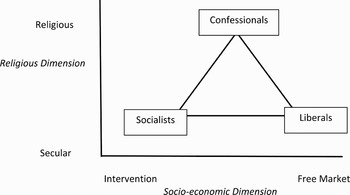
The political parties in the pillarized party system are located in a two-dimensional policy space in Figure 1 (Rose and McAllister Reference Rose, McAllister, Denver and Hands1991; Lijphart Reference Lijphart1982; Hazan Reference Hazan1997; Benoit and Laver Reference Benoit and Laver2006). Figure 1 shows the policy space with the socio-economic dimension as the horizontal axis and the religious dimension as the vertical axis. The class dimension in Lijphart's policy space shows the antagonistic relationship between the socialists on the left and the liberals on the right, which has its roots in the Marxist concept of the class struggle. The modern version of the class dimension is no longer defined by the class struggle but by the different views about the desirability of state intervention in socio-economic issues. Socialists are more in favor of intervention aimed at helping the underprivileged, and the liberals are supportive of the workings of the free market.
Two dimensional policy space (Lijphart Reference Lijphart1982).

The religious dimension illustrates the classic antithesis between the confessionals at the top and the secular parties at the bottom of the model. The so-called antithesis is the distinction between people who live their lives according to Christian Revelation and people who live their lives according to the rationale of the Enlightenment (Lipschits Reference Lipschits1977). The religious dimension was modernized too, and it now stands for the different views on the desirability of state intervention in moral and ethical issues. For example, secular, socialist, and liberal parties are pro-choice with regard to the issue of abortion and euthanasia, whereas the confessional parties are pro-life.
In the depillarized Dutch society, the period after 1963, the electoral support of parties could no longer be predicted properly with the knowledge of class position and religious denomination (Lijphart Reference Lijphart1968; Andeweg and Irwin Reference Andeweg and Irwin2005). Electoral studies replaced the domain of identification with the pillarized model of Figure 1 for the space of competition of Figure 2 to explain the floating voters. This space of competition is “a new, openly competitive depillarized model which is characterized by a one-dimensional socio-economic left-right scale” (Hazan Reference Hazan1997, 108–109).
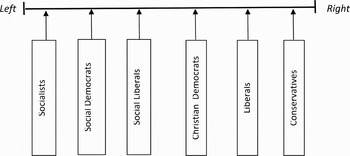
Average left-right position of party families.

The location of political parties on Downs' left-right dimension is solely defined by the ideological preference of a party for the degree of state intervention in the economic sphere. The scale reduces “all political questions to their bearing upon one crucial issue: how much government intervention in the economy should there be?” (Downs Reference Downs1957, 116). The result is a one-dimensional scale with the left end that “represents full government control, and the right end means a completely free market” (Downs Reference Downs1957, 116). In the amended version, the left-right scale functions as a “super issue” that covers all political beliefs and values.Footnote 1Figure 2 shows the amended left-right scale with the position of party families from left to right: the socialists, the greens, the social democrats, the social liberals, the Christian democrats, the liberals, the conservatives, and the populist radical right.
The average rating of the placement of Dutch parties in the Appendix corresponds very well with the left-right scale in Figure 2. Comparative analysis across European countries shows a similar representation of party families. One of the main reasons for the success of the left-right scale is that it presents a pattern of policy positions that is established for all major political parties across Western Europe (Klingemann Reference Klingemann, Klingemann and Fuchs1995; Laver and Hunt Reference Laver and Hunt1992).
The switch from the pillarized model to the left-right scale is consistent with the historical analysis of the process of state formation and nationalization. Caramani describes the development of nation building in Western Europe, “as a general move from territorial-cultural cleavages toward a functional Left-Right alignment. First, the Left-Right opposition includes the liberal and conservative party families that emerged from the centre-periphery and state-church cleavages during the first phases of competitive elections with restricted electorates. (…) Second, the Left-Right functional opposition includes the social democratic party family that emerged from the class cleavage after the Industrial Revolution in opposition to both liberal and conservative parties” (Caramani Reference Caramani2004, 198).
THE MEAN RATING OF PARTIES ON THE LEFT-RIGHT SCALE
The most appropriate measure to determine the impact of class and religion on the political beliefs of people and the placement of parties on the left-right scale are the records of the Dutch Parliamentary Election Study (DPES).Footnote 2 During the election of the Dutch Parliament, people are asked the following question:
“It is often said of political beliefs that they are LEFT OR RIGHT. When you think of your own political beliefs, where would you place yourself on this scale (see the show-card)? Please tell me the number that applies to you.”
Show card presented, listing response alternatives

The same show-card is used for the placement of parties on the left-right scale: “It is also said of political parties that they are LEFT AND RIGHT. Could you please indicate the degree to which you think that a party is left or right?”
In the questionnaire, the meaning of the terms “left” and “right” is undefined, which mean that these terms are defined by the political beliefs of the respondent. The scales in the Appendix show a very stable Dutch party system until 1998. During the period 1963–1998, before the cultural dimension changed the Dutch party system, the ranking of parties on the left-right scale was very stable. The relative position of the party families in relation to each other remained stable. What changed during this period was the merger of the three largest confessional parties, the KVP and the Protestant parties ARP and CHU into one Christian Democratic Party (CDA). The Christian Democratic Party (CDA) is located on the center right of the scale. In addition, a number of small left parties, the Communist Party (CPN), the pacifist-Socialist Party (PSP), the Radical Left Party (PPR), and the Evangelical Left (EVP) came together in one party: the Green Left (GL). The Green Left had the position at the far left on the scale until the socialists party (SP) gained enough electoral support on the national level and entered the parliament in 1994.
The creation of the CDA and the GL and the entering of D66 and the SP are in themselves important events in the history of Dutch politics, but they do not disturb the picture of the location of party families on the scale. The reason that these new parties did not change the party system is because these parties were founded on the already existent lines of conflict (Schattschneider Reference Schattschneider1960; Mair Reference Mair1997).
In the Appendix, one can see that in 1998, the small conservative religious parties lost their right-wing position to an extreme right party, the Centrum Democraten (CD), the former Centrum party (CP). The introduction of the extreme right party CP in 1982 created only a small disturbance in the Dutch party system and the party leader Hans Janmaat was not able to mobilize large electoral support. Most traditional parties interpreted the lack of success of the CP and the CD as confirmation that the Dutch people had no affinity with the populist view of the extreme right, in contrast, for example, to the Flemish voters who support the extreme right party, the Vlaams Belang (formerly known as Vlaams Blok).
Aarts and Thomassen (Reference Aarts and Thomasen2008, 217) studied the answers of the Dutch electorate to the question what they considered to be the most important problem in the Netherlands, and these answers revealed that since the early 1990s minorities and asylum seekers have been the highest ranked problem for most voters. This means that the “multicultural-mono-cultural dimension” was latent for more than a decade at the level of the electorate, but somehow Janmaat was not able to mobilize this cultural dimension. It was not until the entrance of Fortuyn to Dutch politics in 2002 that the cultural dimension was activated as a new line of conflict in the Dutch space of competition (Pellikaan et al. Reference Pellikaan, van der Meer and de Lange2003; Reference Pellikaan, de Lange and van der Meer2007). The main result in terms of the left-right model is a shift of the VVD in 2002 to the right of the conservative religious parties and next to the populist radical right parties. The relocation of the VVD to the right of the religious conservative parties is explained in terms of combining the socio-economic issues with the cultural issue regarding asylum seekers and migrants from Islamic countries.
The election of May 2002 disturbed the “natural” positions of parties, especially that of the VVD. Fortuyn introduced a new line of conflict, the multicultural society versus the mono-cultural society that restructured the party competition in the Netherlands. He was the architect of political change (Schofield Reference Schofield2006). The secular right wing parties, the liberal-conservative VVD and the populist radical right LPF and PVV are since 2002 at the far end of the left-right scale.
PROBLEMS WITH THE LEFT-RIGHT SCALE
The left-right spatial model, according to Downs himself, is unrealistic because “actually each party is leftish on some issues and rightish on others” (Downs Reference Downs1957, 116). The new adapted version of the Downsian political orientation scale as some sort of “super issue” is, on the one hand, more realistic because it encompasses more issues than government intervention in the economy, but on the other hand, the underlying idea of the super issue — that for every political item there is a “leftish” and a “rightish” answer — is very problematic.
Acceptance of the realistic notion that parties have “leftish” and “rightish” answers for different issues raises the possibility that parties must be located in multi-dimensional space. The one-dimensionality of the left-right scale is only guaranteed by assuming that all parties are always leftish (or rightish) on all issue dimensions. However, in the Dutch politics there is no self-evident link between religion and economics for confessional and liberal parties as there exists in, for example, the United States. If a liberal party moves to the right by adopting the most neo-liberal economic policy proposal, then this move does not imply that the liberal party also embraces a more religious position.
Benoit and Laver (Reference Benoit and Laver2006, 113) present a similar argument when they portray the dimensional structure of the Dutch party system. They plot the party positions on economic policy and social liberalism, i.e., ethical issues. The replacement of class and religion by economic and moral issues as the two dimensions generates a scatter plot of Dutch parties that is very similar to Figure 1.
The view that the religious dimension can be compressed is rejected by recent comparative studies. Oskarson shows that “two of the countries, Germany and the Netherlands, are clearly two-dimensional with both the class cleavage and the religious cleavage forming party systems, whilst the four others, Britain, Denmark, Norway, and Sweden are more or less one-dimensional along the class cleavage” (Oskarson Reference Oskarson and Thomassen2005, 87). Moreover, even in countries like Britain with a clear class cleavage, empirical analysis demonstrates that “religion continues to influence the electoral behaviour of British citizens, across its multiple dimensions and in conjunction with social class” (Kotler-Berkowitz Reference Kotler-Berkowitz2001, 552).
Oskarson's comparative study that looks at trends in six countries since the 1960s shows that “in the Netherlands religious voting is on a higher level than class voting all through the period” (Oskarson Reference Oskarson and Thomassen2005, 93). The importance of religion in Dutch politics has decreased during the last century, but the divide between secular and religious voters and parties is still important, not only in relative but also in absolute terms. The percentage of people who attend religious services decreased from 56% every week in 1971 to 38.7% once a month or more in 2006.Footnote 3 This means that almost 40% percent of the people in 2006 are religious and analysis shows that it is four times as likely that religious people vote for a confessional party as for a secular party.Footnote 4
THE LEFT-RIGHT ON THE MESO-LEVEL
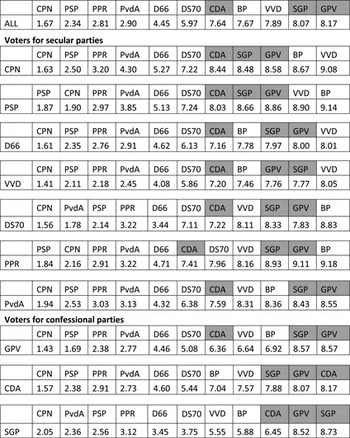
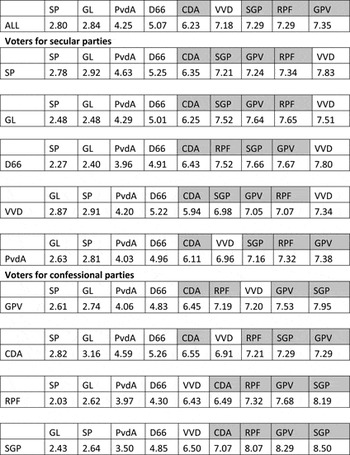
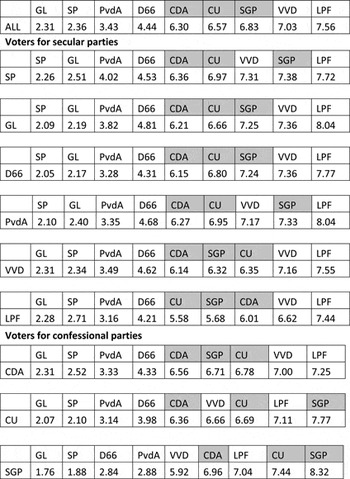
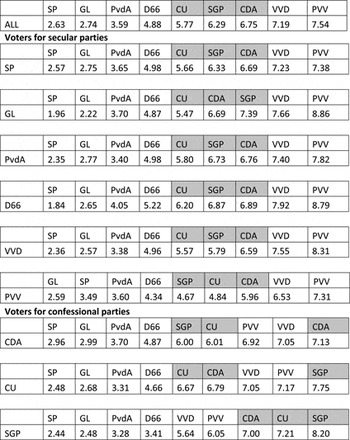
The ordering of party families from left to right in the Dutch party system has been stable during the 20th-century. The match between Figure 2 and the ordering of parties in the Appendix is in itself remarkable enough, but it only holds on the aggregate or macro-level. The disagreement on the ordering of parties by voters on the meso-level is revealed in Tables 1 to 4, which display the ranking of parties separated between voters for secular parties and voters for religious parties for the elections of 1981, 1998, 2002, and 2006.
Average left-right position of parties in 1981 (* source DPES 1981)

Average left-right position of parties in 1998 (* source DPES 1998)

Average left-right position of parties in 2002 (* source DPES 2002)

Average left-right position of parties in 2006 (* Source DPES 2006)

The rankings of 1981 show that most secular voters who are motivated by the class dimension define the location of parties on socio-economic grounds, i.e., with the socialists on the left, the liberals on the right, and the confessional parties in the middle. Voters of the religious parties have a different ranking of parties: the socialists on the left, the liberals in the middle, and the confessional parties on the right.
Not all voters do satisfy this scheme. For example, the voters of the PPR, a radical split from KVP, and the voters of DS70, a liberal split from the “New Left” Labor party, place the rightist party, the Boerenpartij (the Farmers' Party) on the right end of the scale. The voters for the Labor party and the voters for the Christian Democrats place the CDA to the left of the VVD and the conservative Christian parties to the right of the VVD. The PvdA and CDA have become catchall parties (Kirchheimer Reference Kirchheimer, LaPalombara and Weiner1966) and class and religion motivate the voters of these two parties.
The second example in this study is the ranking of parties by voters in the latest election before the “new politics” of Fortuyn. In 1998, most secular voters placed the parties in the same positions, the Socialists, Greens, Labor, and Social Liberals on the left, and all the confessional parties on the right side of the middle and the liberal party, the VVD, on the right. The voters of the two largest parties, the PvdA and the CDA, again have a similar pattern of placing parties on the scale, with the orthodox religious parties on the right of the VVD. This view is shared with the orthodox voters, who go one-step further by placing the CDA to the right of the VVD. In 1998, the voters for the religious parties demonstrate again that they have a different motive for the ranking of party families. Based on the antithesis between secular and religion they place the socialists on the left, the liberals in the middle, and the confessional parties on the right.
To illustrate the impact of Fortuyns' new politics on the Dutch party system, the ranking of parties by the group of voters for the election of 2002 is presented in Table 3. Since 2002, the beliefs on which people place the parties on the left-right scale are more complicated than before. Besides the traditional socio-economic issues, the class and religious cleavages as well as the cultural issue of the migrants from Islamic countries have become very salient in the electoral competition between the political parties. The LPF as a populist radical right-wing party has the harshest position against the arrival of new migrants and against the religious manifestation of Muslims. All secular voters place the LPF on the right end of the scale. In addition, most secular voters put the VVD, which expresses a somewhat moderate version of Fortuyn's new politics, at some distance to the left of the LPF. In addition, the religious voters put the LPF more to the right than the CDA. Only the orthodox voters of the SGP place the CU and the SGP on the right end of the scale.
Table 4 shows that even the voters for religious parties are influenced by the cultural dimension on migrants and Islamic issues as well. The placement of the CDA on the far right by the voters of the Christian democrats cannot be explained as an antithesis, i.e., the CDA did not become more religious in the sense that they prescribed that people must live their life according to the Christian Revelation. Nor did the CDA openly change their policy as regards the issue of abortion and euthanasia. The placing of the CDA on the right must be a combination of the acceptance of the neo-liberal economic program by the CDA and the advocating a Fortuyn-like unified mono-cultural view of the Dutch society. In this respect, the voters of the SGP are the only “true” orthodox Calvinists, who place their party on the right end of the scale, followed by the CU and the CDA. The secular conservative party VVD and the populist radical right party, the PVV, are, in the eyes of the Calvinists, just secular parties on the right side of the center. From the ranking of parties, one can deduce that the voters of the SGP are immune to the modern apprehension of a multicultural society and are still motivated by Christian Revelation.
DOWN'S FORGOTTEN CONDITIONS OF ONE-DIMENSIONALITY
The electoral studies make use of the modern Downsian scale by assuming that all parties can be located on the scale and furthermore that each individual voter can place himself somewhere on this scale. However, the increasing use of the left-right scale has neglected the formal restrictions on which the one-dimensional political orientation is founded.
The first condition of having a one-dimensional space is Downs' restriction of individual transitivity, i.e., “that every voter's preferences are single-peaked and slope downwards monotonically on either side of the peak (unless his peak lies at one extreme on the scale)” (Downs Reference Downs1957, 115–116). This requirement is always fulfilled given the structure of the questionnaire. If one person gives a numerical value to each of the parties, than these parties can be placed on single line.Footnote 5
The second condition of having a one-dimensional space is Downs' restriction of collective transitivity or that political parties “can be ordered from left to right in a manner agreed upon by all voters” (Downs Reference Downs1957, 115). Even though all individual orderings satisfy the condition of individual transitivity due to the form of the questionnaire, it is very unlikely that the aggregate of all individuals also satisfies the condition of collective transitivity. This outcome in itself is not very interesting; it only becomes interesting if specific groups of people, each with the same characteristics, have opposite ranking of parties, as in the Dutch case.
By using the average score of all people, the results show that the parties are ordered from left to right, but not necessarily in a manner agreed upon by all voters. The orderings in the Appendix show that, on the macro-level, voters have a very consistent view about the locations of parties on the left-right scale. However, by looking at the meso-level in Tables 1 to 4, it becomes clear that different group of voters have different orderings of parties. The ranking of parties in Tables 1 to 4 by different groups of voters is a clear violation of Downs' second requirement and this means that we cannot place the parties on a left-right scale in a manner previously agreed upon.
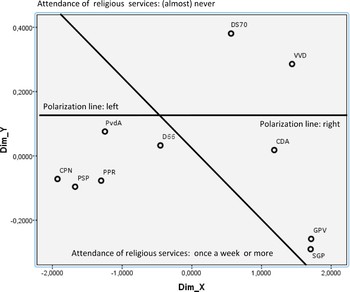
The robustness of the macro-positions of parties on the left-right scale in the period before and after 1963 raises the question whether the two-dimensional policy space in Figure 1 can be reconciled with the one-dimensional left-right ranking of political parties by different groups of people? The puzzle can be solved by placing the parties in a two-dimensional Euclidean space and then squeezing and compressing the two dimensions until one-dimensional left-right axis remains. Figure 3Footnote 6 illustrates the political space of the data of Table 1. The two-dimensional space illustrates all 10 political parties and the location of these parties is based on the calculation of the Euclidean distance between the parties. To facilitate the interpretation of the political space two dimensions are added in the figure: the polarization left-right dimension and the religious dimension. The attendance of the religious services from (1) once a week or more to (5) (almost) never, is a good operationalization of the religious dimension. The left-right dimension is the super issue that contains all issues other than religious issues. The left-right dimension and the religious dimension divide the figure in four parts. In the south-west corner are located the leftist parties, who are in favor of issues like more income distribution, with the CPN on the extreme of this dimension. These clusters of parties are positioned at the secular side of the religious dimension, which means that they support the pro-choice option for women. In the northeast corner are the DS70 and the VVD who are in favor of the working of the market, which increase income differences. Of all the secular voters, the voters for the VVD are the closest to the confessional parties on the abortion dimension. The confessional parties are located in the southeast corner somewhat in the middle of the socio-economic dimension and they are at the religious side that supports the pro-life position.
The political space of 1981.Footnote 6

This configuration of parties in Figure 3 shows a clear two-dimensional political space that is based on the different rating of parties on the left-right scale. At the same time, one can also deduce from this figure a single left-right ranking of parties by squeezing the two dimensions into one dominant conflict dimension by compressing the y-axis until the space of competition is entirely flattened along the x-axis. The position of the parties on the horizontal axis is very similar to the position of parties on the macro level in Table 1, from left to right: CPN-PSP-PPR-PvdA-D66-DS70-CDA-VVD-SGP-GPV.
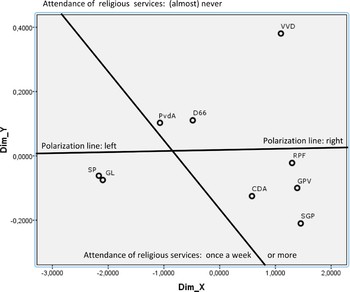
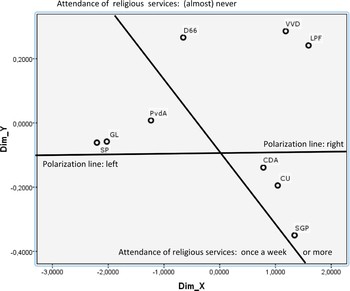
Figure 4Footnote 7 presents the Euclidean distances between the parties, which are based on the left-right placements of parties by different group of voters in Table 2. Again, the polarization left-right dimension and the religious dimension divide the figure into four parts. The political space of 1998 shows the cluster of the coalition parties of the Purple cabinet, in the northeast corner with the (red) socialist PvdA and the (blue) liberal D66 and VVD. The political difference between the coalition partners is demonstrated by the distance between the VVD on the one hand and the PvdA and D66 on the other. The leftist opposition with the SP and GL is located in the southwest corner, and the confessional parties are placed in the southeast corner. The position of the parties on the x-axis is similar to the position on the macro-level in Table 2, from left to right: SP-GL-PvdA-D66-CDA-VVD-RPF-GPV-SGP. The location of parties on the x-axis did not change much since 1981 and the secular-rightist party VVD is still to the left of the orthodox religious parties. Figure 5Footnote 8 presents the political space of 2002 with the polarization dimension and the religious dimension. The polarization dimension now includes issues such as the asylum seekers and the multi-cultural society. Those who are against admitting asylum seekers and are in favor of a mono-cultural society can be found on the right side of the polarization dimension, while the people who accept the asylum seekers and support a multi-cultural society are on the left side. The impact of the asylum and the migrant issues on the polarization dimension in 2002 is illustrated by the LPF, which has the most extreme position on mono-cultural issues yet has a moderate position on economics (Pellikaan, van der Meer and de Lange Reference Pellikaan, van der Meer and de Lange2003). The leftist parties are in favor of a multi-cultural society and they oppose the neo-liberal economic reform of the purple coalition.
The political space of 1998.Footnote 7

The political space of 2002.Footnote 8

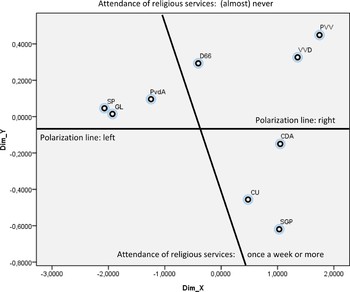
Figure 5 shows again three clusters of parties, the socialists in the northwest corner, the liberals and the populist right party in the northeast corner, and the confessional parties in the southeast corner. The position of parties on the x-axis, after compressing the y-axis, is from left to right: SP-GL-PvdA-D66-CDA-CU-VVD-SGP-LPF. The political space of 2006 in Figure 6Footnote 9 has the same two dimensions that divide the area in four domains, as does Figure 5. The GL and the populist radical right Party of Wilders are the antagonistic parties on the polarization dimension. Moreover, on the other dimension, the religious dimension, the orthodox party SGP is the opposing party of the libertine party D66. Figure 6 illustrates that due to the electoral competition on the asylum issue the VVD has moved to the right end of the political spectrum following the Populist Party, the PVV. The VVD and the Populist Party PVV are located to the right of the orthodox religious parties on the x-axis: SP-GL-PvdA-D66-CDA-CU-SGP-VVD-PVV.
The political space of 2006.Footnote 9

Each of the four maps (Figs. 3 to 6) presents a two-dimensional political space that reveals the multi-dimensionality of the identification of the different groups of voters on the meso-level. Comparing the four figures from 1981 to 2006 it becomes clear that the angle between the religious dimension and the left-right dimension increases in time.Footnote 10 The change of the religious line in the direction of a vertical position means that religious issues have become more independent from other issues on which the parties compete with each other.
RELIGION STILL MATTERS
Voters for secular parties and voters for religious parties have different motives and beliefs on which they base their orderings of parties on the left-right scale. Each group of voters defines its own left-right scale. These different left-right scales are individually single-peaked but there is no overall single-peak, which means that there is no collective transitivity of the orderings of parties. The intransitivity is a clear violation of Downs' condition for placing all parties on a single line in a manner agreed upon by all voters. One can create a Downsian political orientation by squeezing and compressing the space of competition until it is entirely flattened along the x-axis, but this compressing of the political space is in contradiction with Downs' conditions for one-dimensionality.Footnote 11
The stability of the mean ratings of parties on the left-right scale during the period of pillarization (since 1918) and the period of depolarization (since 1963) leads to the conclusion that class and religion were the entities of identification during the whole 20th-century and not only in the first part of it. The process of depolarization did have a strong effect on the institutional organization of the Dutch society, but the political space of electoral competition remains largely the same. In terms of Schattschneider's theory, this means that the change from cleavages to issue dimensions did not change the principal lines of conflicts between the three main clusters of parties — the socialists, the liberals, and the confessionals. Behind the class and religious cleavages, on the one hand, and the socio-economic and ethical issue dimensions, on the other hand, one recognizes the same principal ideological differences. It is because of this similarity between the cleavages and the issue dimensions that the macro ordering of parties on the left-right scale are very consistent during the whole of the twentieth century. Pim Fortuyn, as the architect of political change (Schofield Reference Schofield2006), introduced the cultural dimension as the new line of conflict that changed the Dutch party system (Pellikaan, de Lange and van der Meer Reference Pellikaan, de Lange and van der Meer2007).
A plausible reason why the importance of religion in Dutch politics has been overlooked is the practice of consociational democracy. In the Netherlands, “religious conflicts were eventually taken off the political agenda of majority decision-making by a democratic — but not liberal or secular — consociational agreement that allocated funds, spaces, and mutual vetoes to religious communities with competing comprehensive doctrines” (Stepan Reference Stepan, Diamond, Plattner and Costopoulos2005, 11). In other words, the political practice of consociational democracies “to take religion off the political agenda” (Stepan Reference Stepan, Diamond, Plattner and Costopoulos2005, 11) has led to the idea that religious issues only play a marginal role in the ideological framework. The analysis in this study demonstrates that religion still matters. The relevance of religion is broader than the impact on the left-right placement of parties in the political space. The notion of Christianity has political importance in the discussion about the boundary of the European Union and the acceptance of Turkey as a new member state. Other studies establish the role of religion in the politicization of European identity and in the enlargement of the European Union in other countries (Byrnes and Katzenstein Reference Byrnes and Katzenstein2006; Checkel and Katzenstein Reference Checkel and Katzenstein2009).
Appendix Political parties and placement on the Left-Right scale