INTRODUCTION
The archaeological site of Saruq al-Hadid is located on the southern fringes of the Emirate of Dubai, in the United Arab Emirates. Excavations at the site have uncovered an incredibly rich assemblage of material remains, including thousands of artifacts in ceramic, stone, bone, shell, wood, and various alloys of copper, iron and gold that have, in key areas, transformed our understanding of the concurrent development of southeastern Arabian society (Nashef Reference Nashef and Avanzini2010; Weeks et al. Reference Weeks, Cable, Franke, Karacic, Newton, Roberts, Stepanov, McRae, Moore, David-Cuny, Al Aali, Boraik and Zein2018, Reference Weeks, Cable, Franke, Newton, Karacic, Roberts, Stepanov, David-Cuny, Price, Bukhash, Radwan and Zein2017). Archaeological deposits at Saruq al-Hadid cover an area of more than 1 square kilometer within the mobile dunes of the northeastern extension of the Rub’ al-Khali desert and—based on artifact typologies—attest to long-term, persistent, temporary use by human groups from the Neolithic period through to the relatively recent past. This use clearly changed through time: early activities focused on the exploitation of local wild animal resources and the presence of seasonal grazing for domestic herds (Roberts et al. Reference Roberts, Weeks, Cable, Fillios, Al Ali, Boraik and Zein2018); later occupations are characterized by increased craft activity—likely incorporating the production of metal, bone, shell and wood artifacts—in contexts of apparent ritual activity and deposition and involving the interaction of members of multiple communities (Karacic et al. Reference Karacic, Boraik, Qandil and David-Cuny2017; Weeks et al. Reference Weeks, Cable, Franke, Karacic, Newton, Roberts, Stepanov, McRae, Moore, David-Cuny, Al Aali, Boraik and Zein2018). The latest periods of use of the site include the “scavenging” and recycling of earlier ferrous metal remains (Stepanov et al. Reference Stepanov, Weeks, Franke, Salvemini, Cable, Al Ali, Boraik, Zein and Grave2019), as well as copper smelting on a significant scale (Weeks et al. Reference Weeks, Cable, Franke, Newton, Karacic, Roberts, Stepanov, David-Cuny, Price, Bukhash, Radwan and Zein2017) and later, historically and archaeologically documented seasonal occupation by modern mobile groups (e.g., Wilkinson Reference Wilkinson1977; Contreras Rodrigo et al. Reference Contreras, Vila, Albarracín, Bukhash, Al Abbar, Radwan and Zein2017: Fig. 4).
Understanding the history of human activities at Saruq al-Hadid is made more difficult by its very complex formation processes. The site’s location in a highly active dune field means that dune formation processes controlled by wind, water, and gravity have shaped and reshaped the archaeological deposits repeatedly since their formation (e.g., Lancaster Reference Lancaster1986; Leigh Reference Leigh, Goldberg, Holliday and Ferring2001; Mayer Reference Mayer2002), in addition to the likely effects of repeated anthropogenic disturbance of pre-existing archaeological deposits (e.g. Gifford-Gonzalez et al. Reference Gifford-Gonzalez, Damrosch, Damrosch, Pryor and Thunen1985). Moreover, while Saruq al-Hadid has produced stratigraphic sequences of intercalated anthropogenic and natural deposits up to ca. 7 m deep, the site is almost totally lacking in substantial or standing architectural remains.
To date, no integrated overview of the site’s chronological (and spatial) development has been developed that fully addresses its complex taphonomy and the difficulties introduced by its ephemeral occupation and large scale. In this paper, we review the existing dating evidence from Saruq al-Hadid, both typological and especially radiometric, and present new radiocarbon (14C), TL, material and stratigraphic data on site chronology and periods of use. This integrated methodology provides for the first comprehensive overview of the site’s development and allows evidence from the site to be properly situated within current debates about the chronology and development of southeastern Arabian societies through the second and first millennia BC and later (e.g., Magee and Carter Reference Magee and Carter1999; Velde Reference Velde2009; Degli Esposti and Benoist Reference Degli and Benoist2015; Righetti Reference Righetti2015; de Vreeze Reference de Vreeze2016; Magee et al. Reference Magee, Händel, Karacic, Uerpmann and Uerpmann2017; Degli Esposti et al. Reference Degli-Esposti, Coldoluci, Phillips, Tagliamnote, Sasso, Avanzini and Degli2018).
Previous Programs of Excavation and Dating at Saruq al-Hadid
Saruq al-Hadid was first discovered, accidentally, in 2002, and since then has witnessed more than a decade of intensive archaeological field research and large-scale excavation by multiple field missions including a Jordanian team (Al-Khraysheh and An-Nashef Reference Al-Khraysheh and An-Nashef2007; Nashef Reference Nashef and Avanzini2010), the University of Arkansas Dubai Desert Survey (DDS; Casana et al. Reference Casana, Herrmann and Qandil2009; Herrmann et al. Reference Herrmann, Casana and Qandil2012), alongside continuous work by local archaeological teams (e.g. Qandil Reference Qandil, Hellyer and Ziolkowski2005). Since 2014, excavation at the site has been undertaken by a series of teams working in parallel under the direction of the Architectural Heritage and Archaeology Department, Dubai Municipality, including a Spanish mission (Contreras Rodrigo et al. Reference Contreras, Vila, Albarracín, Bukhash, Al Abbar, Radwan and Zein2017), a German mission (Ihde Reference Ihde2017), and the Saruq al-Hadid Archaeological Research Project (SHARP) coordinated through the University of New England, Australia (Weeks et al. Reference Weeks, Cable, Franke, Newton, Karacic, Roberts, Stepanov, David-Cuny, Price, Bukhash, Radwan and Zein2017, Reference Weeks, Cable, Franke, Karacic, Newton, Roberts, Stepanov, McRae, Moore, David-Cuny, Al Aali, Boraik and Zein2018: Fig. 3).
Periods of occupation at Saruq al-Hadid were initially broadly dated based on typological comparisons for material excavated during the early fieldwork of the Jordanian and Dubai teams (Qandil Reference Qandil, Hellyer and Ziolkowski2005; Al-Khraysheh and An-Nashef Reference Al-Khraysheh and An-Nashef2007; Nashef Reference Nashef and Avanzini2010). While these studies recognized that the site was situated within a wider landscape showing occupation across many periods including the Neolithic and Bronze Ages, studies of material from Saruq al-Hadid itself focused on the abundant and material-rich deposits of the early Iron Age and the site was suggested to be “a one-phase occupation dated to the Iron Age II period” (Nashef Reference Nashef and Avanzini2010). Subsequently, 14C and optically stimulated luminescence (OSL) dating was undertaken at the site by the DDS project, based on samples collected during comparatively small-scale excavations (e.g. Herrmann et al. Reference Herrmann, Casana and Qandil2012: Tables 1, 2). These dates suggested a much longer but highly discontinuous sequence of occupation at the site, with Bronze Age occupation at certain points in the third and early second millennia BC, and considerable early Iron Age occupation in the early first millennium BC (Herrmann et al. Reference Herrmann, Casana and Qandil2012: Fig. 13). Significantly, the OSL dates were used alongside material parallels to suggest that metallurgical activities at the site—including both copper and iron working—took place only after the end of the Iron Age, i.e. “after 300 BC and possibly as late as the first century AD” (Herrmann et al. Reference Herrmann, Casana and Qandil2012: 65).
In the period since 2014, Saruq al-Hadid has been the focus of several more intensive programs of absolute dating focusing on 14C and TL determinations (Contreras Rodrigo et al. Reference Contreras, Vila, Albarracín, Bukhash, Al Abbar, Radwan and Zein2017: Fig. 4; Weeks et al. Reference Weeks, Cable, Franke, Newton, Karacic, Roberts, Stepanov, David-Cuny, Price, Bukhash, Radwan and Zein2017: Tabs. 2, 3, Fig. 6). The results of these studies, supplemented by new determinations and a close seriation of the site’s ceramic assemblage, form the basis of the analysis and interpretation presented in the present paper. Together, the amalgamated chronological data from Saruq al-Hadid support a more nuanced reconstruction of long-term, intermittent, but persistent human activities at the site from the late prehistoric period to recent centuries.
Saruq al-Hadid: Stratigraphy and Site Formation
The archaeological deposits of Saruq al-Hadid are underlain by the Mio-Pliocene Barzaman Formation, a thick succession of fluvial sediments characterized by poorly sorted conglomerates with clasts of ophiolitic material, chert and limestone set within a dolomitic cement (Macklin et al. Reference Macklin, Ellison, Manning, Farrant and Lorenti2012; United Arab Emirates Ministry of Energy 2012). Secondary gypsum occurs in weathered outcrops of this formation, and a thick deposit of such gypsum sits immediately below the cultural deposits at the site. Based on a single OSL determination of 5821 ± 282 BP on overlying sediments, the gypsum formed before the fourth millennium BC (Herrmann et al. Reference Herrmann, Casana and Qandil2012: 52).
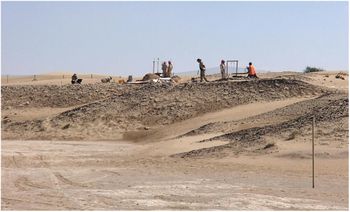
The major periods of occupation of Saruq al-Hadid fall into the mid- to late-Holocene, after the early Holocene climatic optimum (e.g. Preston et al. Reference Preston, Thomas and Goudie2015, Reference Preston, Parker and Walkington2012), in a period when drier conditions led to the reactivation and sometimes rapid expansion of dune systems in southeastern Arabia (Farrant et al. Reference Farrant, Duller, Parker, Roberts, Parton, Knox and Bide2015; Bray and Stokes Reference Bray and Stokes2003, Reference Bray and Stokes2004). As a result, the stratigraphic sequence at Saruq al-Hadid commonly consists of fine, interdigitated, sloping, and minimally differentiable anthropogenic deposits and natural aeolian dune deposits, creating difficulties in identifying the spatial boundaries of individual cultural contexts at the time of excavation (Figure 1). Thus, alongside single-context recording of delineable archaeological deposits, excavations also proceeded by the use of artificial contexts ca. 10 cm deep as fundamental recording units. This approach allowed the post-excavation assessment of changes in assemblage densities and composition to contribute to the identification and characterisation of archaeological phases (Cable Reference Cable and Weeks2015, Reference Cable and Weeks2016, Reference Cable and Weeks2017).
A view of the central sector of Saruq al-Hadid, during excavation. The flat area in the foreground is the gypsum pavement, exposed by previous excavations. Upon the gypsum sit aeolian dunes containing stratified archaeological deposits, capped by a dark deflation deposit of copper smelting slag and other archaeological materials.

The large size of Saruq al-Hadid represents a fundamental confounding factor in efforts to characterize its chronology, and it must be recognized that the phasing and dating developed for one part of the site are not necessarily representative of occupation across its entire area. Specifically, occupational horizons identified in the deep deposits of the central sector are not present across all parts of Saruq al-Hadid, and the site (particularly its unexcavated areas) may host deposits from occupational horizons that are not represented in the central sector. Accepting these limitations, the description presented here focuses on deposits from the SHARP excavations in the central sector of the site and immediately neighboring areas, although the broader horizontal patterns of occupation observed at the site are also addressed. Overall, five broad vertical “horizons,” together comprising between three and seven meters in total depth, characterize stratigraphic changes in the central sector of Saruq al-Hadid (Weeks et al. Reference Weeks, Cable, Franke, Newton, Karacic, Roberts, Stepanov, David-Cuny, Price, Bukhash, Radwan and Zein2017, Reference Weeks, Cable, Franke, Karacic, Newton, Roberts, Stepanov, McRae, Moore, David-Cuny, Al Aali, Boraik and Zein2018).
Horizon V
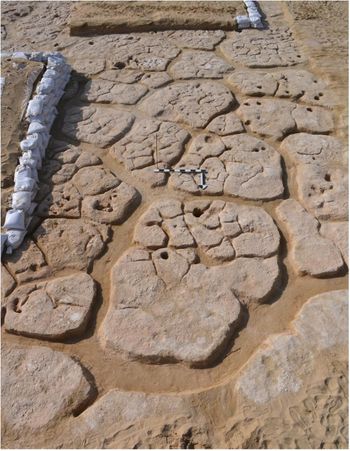
The earliest of the Horizon V deposits include burning events, postholes and other features dug into the gypsum and covered by a natural gravel layer (Weeks et al. Reference Weeks, Cable, Franke, Karacic, Newton, Roberts, Stepanov, McRae, Moore, David-Cuny, Al Aali, Boraik and Zein2018: Fig. 4). These features were densest in the north, west, and northeast edges of the excavated area (Figure 2), where little of the later Horizon V deposits remained. In those areas the gravels were relatively thick (ca. 2–4 cm) and included notable amounts of shell and bone fragments; gravels to the south, which were buried by additional Horizon V sand deposits, were thinner (sometimes even absent). Above this in the southern half of the central sector were more postholes, pits, and hearths dug through the gravel layer; a thin (ca. 2–4-cm thick) layer consisting of discrete or semi-discrete deposits of faunal bone; and an intermittent series of hearths and ash pits within a low-density or sterile banded sand matrix that varied from coarse pink to fine brown bands (Weeks et al. Reference Weeks, Cable, Franke, Karacic, Newton, Roberts, Stepanov, McRae, Moore, David-Cuny, Al Aali, Boraik and Zein2018: Fig. 5). This deposit of sand, hearths, and faunal bone created a low mound less than 1 m high and ca. 25–30 m wide in the southern half of the central sector, based on the excavated limits of this deposit to the north, east, and west; its southern extent was not found. Indicative of the “active” nature of the site’s dune setting, hearths located on the slope of Horizon V deposits appear to have been truncated by later erosion. Plant castings were common in the sand deposits comprising upper Horizon V, indicating the presence of vegetation cover at the time of their formation. The material assemblage includes animal remains, lithics and manuports, ceramics, and shell.
Post-holes of Horizon V structures in the gypsum pavement, at the base of the archaeological sequence in the central sector of the site. Looking south. Scale bar = 1 m.

Horizon IV
Horizon IV is a mounded deposit sitting on top of the low Horizon V rise in the southern half of the Central Sector. At its greatest extent, Horizon IV is ca. 30 m east-west and 1 m thick; its southern extent was not found but the deposits stretch at least 25 m north-south. This horizon is most notable for its bone-rich matrix and midden-like nature (Weeks et al. Reference Weeks, Cable, Franke, Karacic, Newton, Roberts, Stepanov, McRae, Moore, David-Cuny, Al Aali, Boraik and Zein2018: Fig. 6), including numerous hearths and considerable numbers of stone tools and ceramic sherds. Horizon IV displays significant variation in overall topography and in the density of different feature and material types. Its base is defined by an increase in the density of hearths, ash pits and lenses, and sandstone, and by a dramatic increase in the amount of animal remains found throughout. Subsequent Horizon IV deposits are also bone-rich and include chipped and groundstone artifacts, shell (primarily marine), and rare copper-base artifacts and metallurgical residues. Soil discolorations, typically lacking any bone in an otherwise bone-rich deposit, indicate the presence of as-yet-unclassified features. The upper part of Horizon IV is also bone-rich. It includes groundstone tools but few lithics; a relatively high density of ceramic vessels (including pedestalled bowls); and some copper-base artifacts including predominantly arrowheads, alongside a very small assemblage of secondary copper production residues. The upper limit of Horizon IV varies considerably. To the north, west, and east the top of the deposit slopes down, nearly meeting the gypsum. The uppermost 10 cm of these sloping deposits exhibit very high densities of archaeological materials, with 13–20 kg of bone per 1000 L. Artifact studies and absolute dating results (see below) indicate that the surfaces of these dense, sloping upper deposits include some intrusive material associated with later deposits, reflecting the effects of gravity and wind on the site’s ephemeral material remains. The sand matrix is mid- to light-brown and semi-fine. The highest part of Horizon IV is a ca. 7-m-long low ridge that runs NNE-SSW from F-T1 to G-S1. Six meters to the west (in G-R1) a single, small mortared stone structure, measuring ca. 0.5x0.7x0.3 m, was found (Weeks et al. Reference Weeks, Cable, Franke, Newton, Karacic, Roberts, Stepanov, David-Cuny, Price, Bukhash, Radwan and Zein2017: Fig. 5; Weeks et al. Reference Weeks, Cable, Franke, Karacic, Newton, Roberts, Stepanov, McRae, Moore, David-Cuny, Al Aali, Boraik and Zein2018: Fig. 7). This feature is covered by mixed Horizon III-IV deposits, but its pronounced lean and the deformation of the deposits below and around it suggest that it had sunk somewhat and probably belonged to a later sub-phase of Horizon IV. To date, it is the only standing structure recorded from the site.
Horizon III
During the period that followed, the central sector of the site experienced a series of aeolian deposition and deflation events that affected Horizon IV and V deposits as well as the deposition of Horizon III. The result is areas of relatively sterile deposits alongside contemporary deposits that are thin but comparatively artifact rich. Horizon III is thus defined based on a combination of stratigraphic evidence and marked changes in the material assemblage. It consists of a possibly discontinuous deposit characterized by a tan medium-fine sand matrix of variable thickness (2–40+ cm). The associated material assemblage consists of fragmented and complete vessels of soft-stone, copper, and ceramic; unworked and worked sandstone that in places may have functioned as working surfaces on the shifting sand; a strong decrease in the amount of faunal remains with an increase in horn core deposits; and an increase in the variety of metal (primarily copper-base) artifacts, including ingots, vessels, arrowheads, spearheads and blades, and metallurgical residues. Ceramic pedestalled bowls, sometimes including snake appliqué, are found in their greatest numbers in Horizon III (Weeks et al. Reference Weeks, Cable, Franke, Newton, Karacic, Roberts, Stepanov, David-Cuny, Price, Bukhash, Radwan and Zein2017: Fig. 4; Weeks et al. Reference Weeks, Cable, Franke, Karacic, Newton, Roberts, Stepanov, McRae, Moore, David-Cuny, Al Aali, Boraik and Zein2018: Fig. 8). Some chipped and ground stone tools were also associated with these deposits, as were complete softstone vessels (McRae Reference McRae and Weeks2017). Beginning at the base of Horizon III, unworked sandstone is used to construct ephemeral features, such as short stone walls, tent weights, or working surfaces.
Horizon II
Horizon II consists of a deep series of deposits related to intermittent human activities, both discrete and dispersed, within a tan medium-fine sand matrix banded with layers of coarser pink sand. The entire deposit is between 1.3 m and 3 m thick, and together with the banded layers of sand suggest aeolian sand deflation and accretion. Discrete deposits appear to have been emplaced either between or on near-sterile dunes, while a low frequency of dispersed finds typically appears as “background” material throughout the sand matrix. Ephemeral sandstone features continue to mark what were probably temporary occupation surfaces (Weeks et al. Reference Weeks, Cable, Franke, Newton, Karacic, Roberts, Stepanov, David-Cuny, Price, Bukhash, Radwan and Zein2017: Fig. 3), sometimes associated with changes in artifact densities. Of note are deposits associated with hide processing (Roberts et al. Reference Roberts, Weeks, Cable, Fillios, Al Ali, Boraik and Zein2018: 10), which include large numbers of personal adornments (particularly beads) and copper alloy snake figurines.
Interspersed within the matrix was the broadest variety of materials and artifacts of all the periods represented: a large amount of copper slag as well as secondary copper production debris (although rarely found together in the same contexts), off-cuts, and artifacts, including miniature and full-sized weapons and tools; iron artifacts and fragments; ceramic sherds including large vessels bearing snake appliqué decoration; gypsum clumps of unknown origin; worked wood; worked and unworked marine shell; gold, antimony, and silver small finds and production residues; soft-stone vessel fragments and ornaments; and faunal remains consisting of worked, unworked, and green-stained bone as well as horn core (Weeks et al. Reference Weeks, Cable, Franke, Newton, Karacic, Roberts, Stepanov, David-Cuny, Price, Bukhash, Radwan and Zein2017: Figs. 10–24). Faunal remains and stone tools were found at much lower frequencies in Horizon II in comparison to earlier deposits at the site. Overall, the Horizon II assemblage indicates a focus on (1) tools and weaponry; (2) primary and secondary metallurgical production; and (3) heretofore unknown hide processing activities, the archaeological contexts of which suggest that these activities were undertaken and their residues meaningfully deposited within ritually charged social settings.
Horizon I
Horizon I consists of a modern “desert pavement” surface formed by wind deflation (Weeks et al. Reference Weeks, Cable, Franke, Karacic, Newton, Roberts, Stepanov, McRae, Moore, David-Cuny, Al Aali, Boraik and Zein2018: Fig. 11), resulting in a dense deposit ca. 10–40 cm thick, consisting primarily of copper slag (averaging more than 35 kg per 1000 L of sand), along with the highest frequency of iron fragments found in the stratigraphic sequence. In addition, Horizon I incorporates significant amounts of ceramics, green-stained and/or worked bone, copper-base artifacts and secondary production debris, sandstone, beads of various materials, marine shell, wood, and gold and silver artifacts. In general, there is no clear stratigraphic differentiation of deposits within the Horizon I deflation pavement. Dug into Horizon II are a series of pits—possibly robber pits—that appear to have been later filled by eroded sediment from Horizons I and II. To varying degrees, these pits are stratigraphically capped by deflated deposits, suggesting that they are not recent (i.e., modern). In places the slag pavement has been buried by recently formed dunes, which has made it difficult to identify Horizon I’s horizontal boundaries in some areas; Herrmann’s (Reference Herrmann2013) model of the uppermost deposits suggests it extends at least 120 m north-south.
Horizon I therefore represents many of the same activities as found in Horizon II, alongside a range of new activities that took place in subsequent periods but which are now stratigraphically indistinguishable due to deflation. The abundance of copper slag highlights the importance of primary copper production as a component of both earlier Horizon II and later Horizon I activities. However, the presence of pits also suggests the possible reuse of material such as bone and iron deposited during the earlier periods of use at the site. This hypothesis is supported by analyses of the poorly preserved and heavily fragmented iron remains from Horizon I, which testify to the scavenging and reprocessing of this material after its initial deposition in the early Iron Age (Stepanov et al. Reference Stepanov, Weeks, Franke, Salvemini, Cable, Al Ali, Boraik, Zein and Grave2019), although the chronological timeframe for these later activities is difficult to determine.
Occupation Outside the Central Sector
Saruq al-Hadid also evidences horizontal stratigraphy, with activities spread over a broad spatial area at different times during the occupation of the site. This is seen most clearly during the early Iron Age, when occupation can be documented intermittently over more than a square kilometer in the western (Al-Khraysheh and An-Nashef Reference Al-Khraysheh and An-Nashef2007), northeastern (area 2F; Contreras Rodrigo et al. Reference Contreras, Vila, Albarracín, Bukhash, Al Abbar, Radwan and Zein2017) and eastern sectors of the site (Casana et al. Reference Casana, Herrmann and Qandil2009: 41, Fig. 9; Weeks et al. Reference Weeks, Cable, Franke, Karacic, Newton, Roberts, Stepanov, McRae, Moore, David-Cuny, Al Aali, Boraik and Zein2018: Fig. 13). However, activities also occurred outside the central sector of the site during the Bronze Age, as documented by excavations to the west and northwest of the Horizon IV “bone layer” (Ihde Reference Ihde2017; Herrmann et al. Reference Herrmann, Casana and Qandil2012: 59, Figs. 2, 13, Tab. 1). Currently, it is not possible to stratigraphically relate these Bronze and Iron Age occupational sequences to that described above for the central sector, but material indices and absolute dates allow some comparisons to be made, as discussed below.
METHODS
The difficulties associated with dating archaeological material stratified in natural dune deposits are significant, and require a multi-stranded approach (cf. Mayer Reference Mayer2002). The absolute dating strategy developed for Saruq al-Hadid integrates archaeometric, stratigraphic, and material-based approaches to address the challenges presented by the site’s complex taphonomy and stratigraphy. Absolute dating focused principally on 14C determinations for the comparatively well-preserved lower deposits at the site (Horizons V to II), and on thermoluminescence dating of technical ceramics for the heavily deflated upper deposits comprising Horizon I, which produced limited datable organic material from its latest phases of use. In addition to the use of TL, efforts were made to directly 14C date copper smelting slag from Horizons II and I when surviving inclusions of charcoal—residues of the fuel used for the smelting process—were observed.
Samples were selected for absolute dating based upon their stratigraphic context in relation to the observed horizons and other archaeological features of the site. The absolute dates are interpreted in relation to these stratigraphic markers and their related material remains, with particular attention paid to assemblages of ceramics, metal artifacts and production residues, and animal bones. This approach facilitates the development of a robust chronology for the central sector of Saruq al-Hadid—with a focus on the area excavated by the SHARP team (Weeks et al. Reference Weeks, Cable, Franke, Karacic, Newton, Roberts, Stepanov, McRae, Moore, David-Cuny, Al Aali, Boraik and Zein2018: Fig. 3)—which can be integrated with a discussion of the broader chronology and spatial distribution of human activities across this large, persistent temporary place.
Radiocarbon Dating
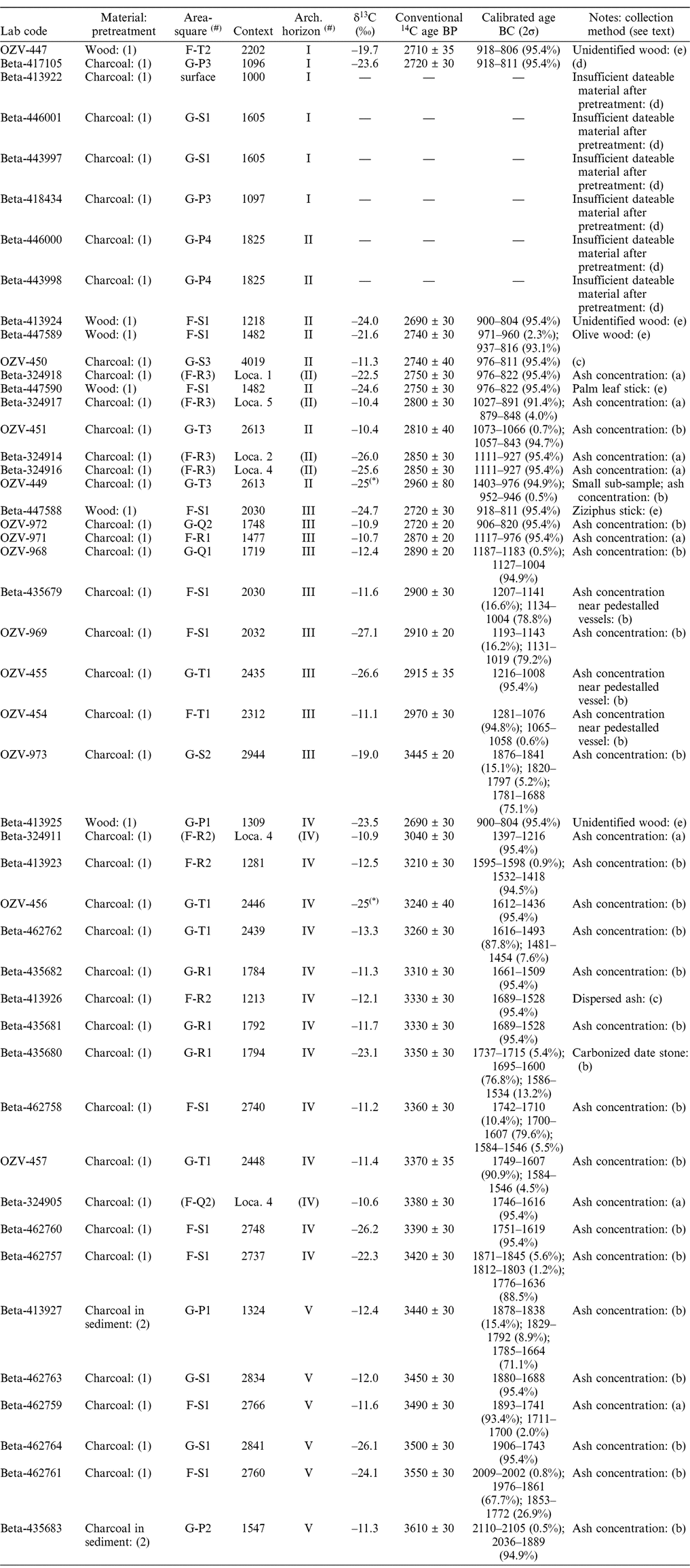
The 47 specimens for 14C dating consist of charcoal (including one carbonized date stone) or wood. Dense concentrations of charcoal and ash from contexts such as hearths, fire pits and ashy lenses were preferentially selected for dating over more dispersed charcoal samples. Samples were collected in one of five ways (see Table 1):
a. for some concentrated burnt deposits, hand collection of charcoal was undertaken at the point of excavation;
b. for most concentrated burnt deposits, sediment samples were collected in the field and subsequently hand sieved to separate out individual pieces of charcoal;
c. for deposits with a lower charcoal density, particularly those in the upper horizons of the site, dispersed charcoal samples were amalgamated by hand sieving of sediment samples aggregated from across a single context;
d. metallurgical slags from the site occasionally preserved small amounts of heavily burnt organic material from the smelting process, which was hand collected using metal laboratory implements, and;
e. wood specimens, which occurred with some frequency in the upper deposits at the site, were typically chosen for dating from those obtained by hand sieving of sediment samples aggregated from across a single context.
Regardless of collection method, all samples were stored in sealed polyethylene bags prior to export to the University of New England where they were sub-sampled (if necessary) and sent for analysis. The specimens were analyzed by accelerator mass spectrometry (AMS) following standard pretreatment and analytical protocols at two laboratories: Beta Analytic, Miami, USA (laboratory code Beta), and ANSTO, Sydney, Australia (laboratory code OZV; Fink et al. Reference Fink, Hotchkis, Hua, Jacobsen, Smith, Zoppi, Child, Mifsud, van der Gaast, Williams and Williams2004).
Radiocarbon dates from the central sector of Saruq al-Hadid, ordered by Horizon (I-V) and conventional 14C age BP (youngest to oldest).

Notes: Calibrated using OxCal v4.3.2 (Bronk Ramsey Reference Bronk2009); IntCal13 atmospheric curve (Reimer et al. Reference Reimer, Bard, Bayliss, Beck, Blackwell, Ramsey, Buck, Cheng, Edwards, Friedrich, Grootes, Guilderson, Haflidason, Hajdas, Hatte, Heaton, Hoffmann, Hogg, Hughen, Kaiser, Kromer, Manning, Niu, Reimer, Richards, Scott, Southon, Staff, Turney and van der Plicht2013). Notes: (1) acid/alkali/acid; (2) acid washes only; (*) δ13C assumed (not measured); (#) area-squares and archaeological horizons indicated in parentheses are for material from non-SHARP excavations in the central sector of the site.
Thermoluminescence (TL) Dating
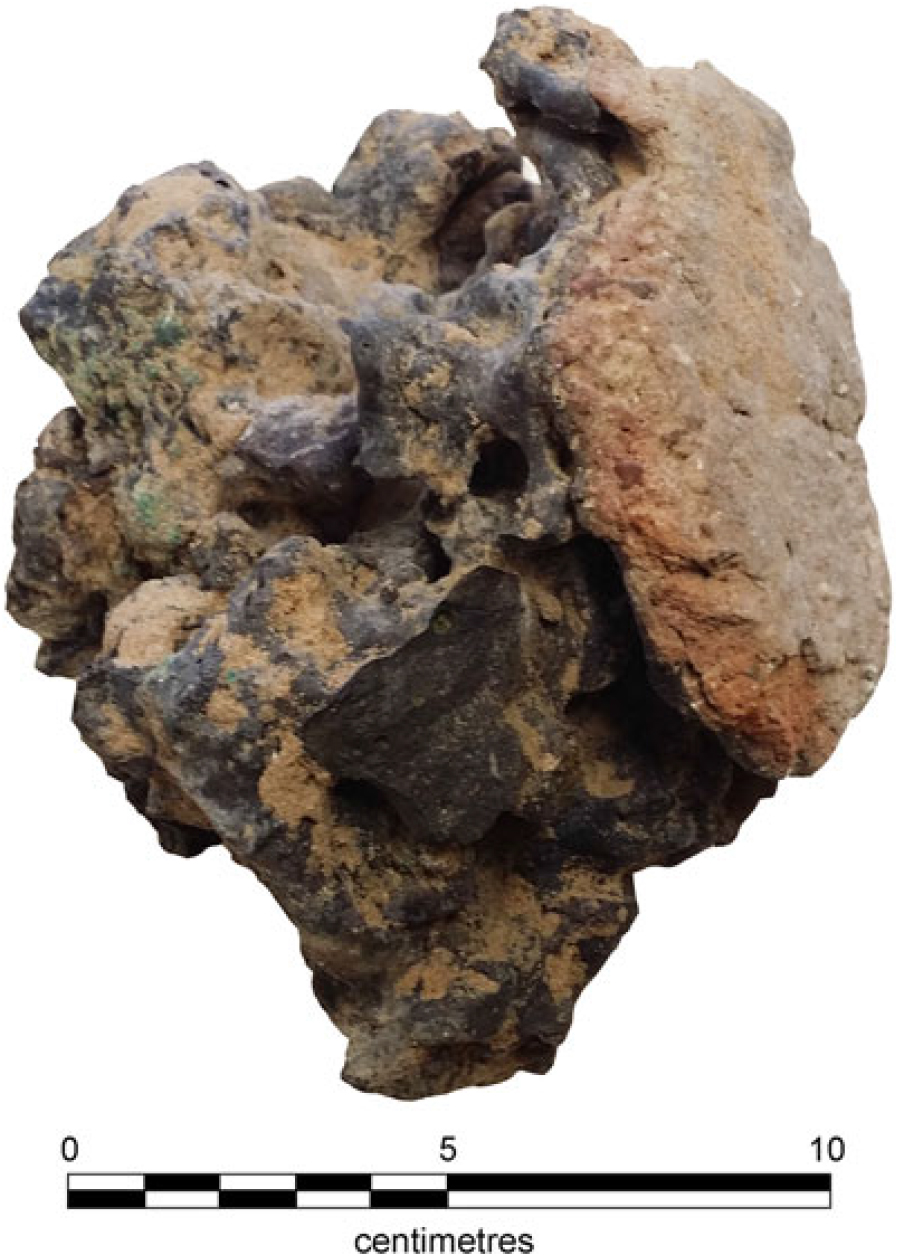
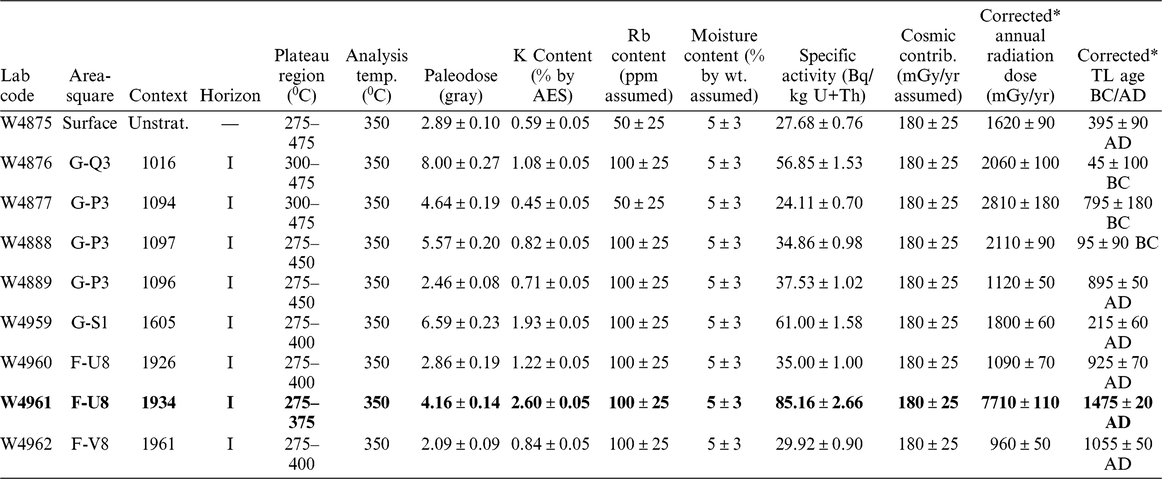
Thermoluminescence (TL) analyses were performed on 10 fragments of technical ceramic, i.e. furnace linings with adhering furnace slag from copper smelting operations (Figure 3). Samples were hand-collected during excavation or surface reconnaissance, and subsequently stored in polyethylene bags before export to the University of New England where they were reprocessed and sent for analysis. The specimens were analyzed at the TL Dating Laboratory in the School of Earth and Environmental Science, University of Wollongong, Australia, following the analytical protocol outlined in Sabtu et al. (Reference Sabtu, Mahat, Amin, Price, Bradley and Maah2015). The calculation of annual radiation dose for the samples was complicated by site taphonomy: their presence at or near the site surface in heavily deflated contexts meant that the current context of the samples did not necessarily reflect their context during deposition. An adequate assessment of the characteristics of the original burial matrix was therefore difficult to achieve. In order to correct for this, analyses of multiple samples of sediment (sand) from the site were undertaken to determine an average contribution to each of the measured annual radiation dose levels.
TL sample W4875 showing the reddish furnace lining or “technical ceramic” (upper right) adhering to the black copper smelting slag with greenish corrosion patches and adhering sand (left). (Please see electronic version for color figures.)

Ceramic Seriation
The ceramic seriation focused on diagnostic pottery from primary contexts. Diagnostic sherds, here defined as preserving information concerning the shape of the vessel or its surface decoration, were entered into a database, with particular attention given to the macroscopically defined fabrics of each diagnostic sherd. Context records were examined to identify those contexts located securely within a stratigraphic horizon. In addition, ceramic joins were considered such that if a sherd from a stratigraphically secure context could be conjoined with a sherd from another context and the latter context was in a different horizon, both contexts were removed from the analysis. In total, SHARP excavated 625 contexts with pottery, of which 306 contexts were classified as primary based on this methodology.
The seriation study focused on five macroscopically defined fabrics that have been identified as secure chronological markers at sites within the region. Geochemical analyses have determined that that these fabrics were all likely to have been produced within the Oman peninsula, and, therefore, fluctuations in their production and consumption reflect local socio-economic practices (Karacic et al. Reference Karacic, Weeks, Cable, Méry, al-Ali, Boraik, Zein, Glascock and MacDonald2018). Fabric A lacks visible inclusions, was produced on a wheel or tournette, and highly fired. This fabric compares favourably with the sandy red ware known from the Umm an-Nar period (ca. 2700–2000 BC) (Cleuziou Reference Cleuziou1989: 57–59; Méry Reference Méry2000: 125–126; McSweeney et al. Reference McSweeney, Méry and Macchiarelli2008: 6–8). Characteristics of Fabric B include small inclusions mostly of calcareous grit, an even firing, and traces of production on a wheel or tournette. All examples of Fabric B come from small open bowls that are often decorated on the exterior with painted wavy lines. Both this fabric and the vessel shapes in which it occurs are diagnostic of the Wadi Suq period, which dates from ca. 2000–1600 BC (Carter Reference Carter1997; Méry Reference Méry2000, 253-257; Righetti and Cleuziou Reference Righetti and Cleuziou2010; de Vreeze Reference de Vreeze2016). The third chronological maker, Fabric C, has a buff to orange exterior with grey core. Inclusions vary in size and frequency but generally include mineral temper and calcareous grit, and vessels may either be handmade or wheelmade. Fabric C is identical to fabric 1 from Tell Abraq, which is associated with the Late Bronze Age (ca. 1600–1300 BCE) (Velde Reference Velde, Potts, Naboodah and Hellyer2003; Magee et al. Reference Magee, Händel, Karacic, Uerpmann and Uerpmann2017: 225–229). Fabric D is distinctive in that it is exclusively handmade with large angular mineral and grog inclusions, and corresponds with the coarse ware that is regarded as diagnostic of the Iron Age I period (ca. 1300–1100 BC) in the northern part of the peninsula (Magee Reference Magee1996; Magee and Carter Reference Magee and Carter1999). However, it must be noted that recent excavations at Tell Abraq have found this same pottery, there identified as Tell Abraq fabric 2, in deposits that date to the mid-second millennium (Magee et al. Reference Magee, Händel, Karacic, Uerpmann and Uerpmann2017: 228). Fabric E has a sandy paste that fires to an orange to buff colour with inclusions of red to black grit that vary in size from less than 1 mm to greater than 5 mm. The finer examples of Fabric E correspond with Benoist’s (1999: 61–63) sandy buff ware. This fabric is found in the range of vessel shapes considered diagnostic of the Iron Age II period. In terms of absolute dates, the Iron Age II in the northern part of the Oman peninsula is generally regarded as dating from ca. 1100–600 BC (Magee Reference Magee1996), although recent work suggests that the typical Iron Age II ceramic repertoire appeared likely two centuries earlier further to the south in central Oman (Phillips Reference Phillips and Avanzini2010; Degli Esposti et al. Reference Degli-Esposti, Coldoluci, Phillips, Tagliamnote, Sasso, Avanzini and Degli2018).
RESULTS
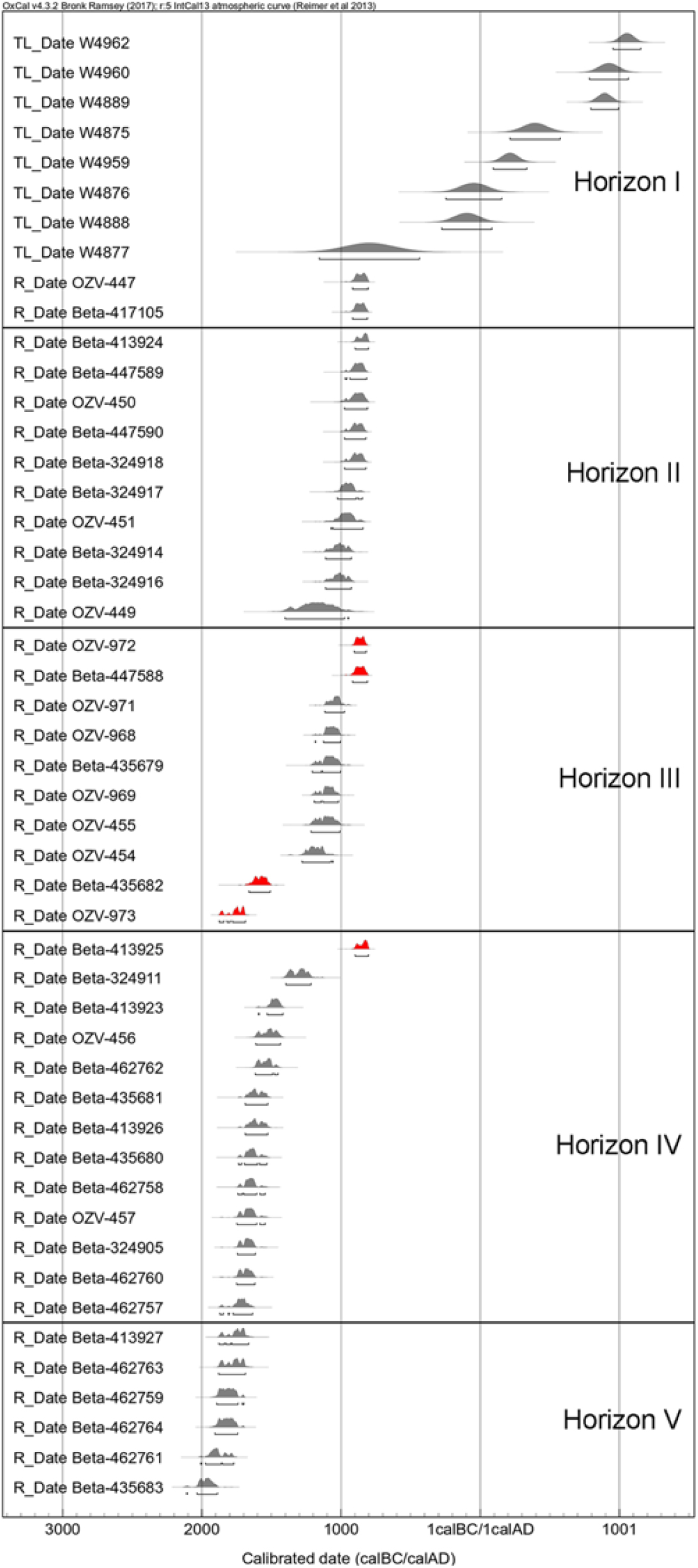
The calibrated 14C and thermoluminescence dates are presented in Tables 1 and 2, respectively, and illustrated together in Figure 4 (by archaeological horizon). 14C dates were calibrated using OxCal v4.3.2 (Bronk Ramsey Reference Bronk2009) and the IntCal13 atmospheric curve (Reimer et al. Reference Reimer, Bard, Bayliss, Beck, Blackwell, Ramsey, Buck, Cheng, Edwards, Friedrich, Grootes, Guilderson, Haflidason, Hajdas, Hatte, Heaton, Hoffmann, Hogg, Hughen, Kaiser, Kromer, Manning, Niu, Reimer, Richards, Scott, Southon, Staff, Turney and van der Plicht2013). Only one of the seven ash/charcoal samples extracted from within copper smelting slags provided enough material, after pretreatment, for AMS dating. Overall, 41 specimens produced enough material for 14C dating and eight samples produced reliable TL ages; together, they exhibit a largely coherent chrono-stratigraphic sequence beginning with the lowest Bronze Age deposits (Horizon V) of the late third/early second millennium BC and ending with the heavily deflated deposits of Horizon I at the top of the stratigraphic sequence, which conflate material remains spanning approximately two millennia from the early first millennium BC to the early second millennium AD.
Thermoluminescence dates from Saruq al-Hadid, ordered by lab code.

Notes: *D gamma recalculated using an average value of 389 microGrays/yr from measurements of three sand samples. Sample W4961 (indicated in bold) showed an anomalous annual radiation dose and the date is likely to be unreliable; it has been excluded from further analysis and discussion.
Calibrated radiocarbon dates and thermoluminescence dates from the central sector of Saruq al-Hadid, organized by Horizon. Determinations regarded as representing residual or intrusive dates in Horizons III and IV are indicated in red.

As indicated by the results of the δ13C analyses (Table 1), the Saruq al-Hadid charcoal samples fall into two clearly distinct groups representing either C3 (δ13C from –19.0 to –27.1; n=9) or C4 (δ13C from –10.4 to –13.3; n=20) plants. Although most archaeological contexts from the site showed evidence for the use of mixed (C3+C4) fuel, there is no indication any analyzed 14C samples are of mixed C3/C4 species. These data correlate with the results of archaeobotanical research at the site indicating the burning of a limited range of locally collected taxa, particularly Calligonum sp. (C4) and Acacia spp. (C3), for cooking, heating and other activities, alongside the consumption of fruits that were probably at least partly brought to the site from elsewhere (Newton Reference Newton and Weeks2017; Weeks et al. Reference Weeks, Cable, Franke, Newton, Karacic, Roberts, Stepanov, David-Cuny, Price, Bukhash, Radwan and Zein2017: 37–40, Tabs. 5-6). Neither Calligonum nor Acacia currently grow on site or in its vicinity.
Calligonum sp., either C. comosum L’Hér. or C. crinitum Boiss. subsp. arabicum Sosk., usually have a shrubby growth form in Arabian contexts (Jongbloed Reference Jongbloed2003). Although these are slow-growing species and studies on other desert shrubs indicate life expectancies of several hundred years due to vegetative multiplication (e.g., Bowers Reference Bowers2005), each stem or root (i.e. the part of the plant collected for direct burning or charcoaling) is relatively short-lived. Another C4 plant represented in the anthracological assemblages from the site is the desert shrub Amaranthaceae (including probably Aerva javanica and other species not precisely identifiable).
Acacia spp. is the main C3 taxon identified in the charcoal, with Ziziphus sp. being very marginal in quantity. Both are long-lived shrubs and trees. Several anatomical types of Acacia are distinguished, which may belong to A. ehrenbergiana Hayne and to A. tortilis (Forssk.) Hayne. The latter is usually a tree (with a single stem), while the former is lower and usually branches from the base, giving it the form of a shrub (Jongbloed Reference Jongbloed2003). Most genera of the Zygophyllaceae family (the taxon identified is Fagonia/Zygophyllum) use the C3 pathway, with the exception of one species of Zygophyllum (Sage and Monson Reference Sage and Monson1999: 561). Because anatomical observation does not allow identifying the taxon with that level of precision, Fagonia/Zygophyllum is likely to be a C3 plant.
Unlike the limited spectrum of local desert taxa observed in the charcoal remains, the preserved wood samples from Saruq al-Hadid show a great deal of species and geographical diversity (Weeks et al. Reference Weeks, Cable, Franke, Newton, Karacic, Roberts, Stepanov, David-Cuny, Price, Bukhash, Radwan and Zein2017: Tab. 5). This includes a preponderance of olive (Olea europaea) and sidder (Ziziphus/cf.Ziziphus) wood alongside a range of other woods from oasis, piedmont, mountain and coastal zones in southeastern Arabia, as well as exotic species such as pine that must have been obtained through long-distance exchange.
Although these plant species display variable life expectancies, there is no evidence in the 14C dates from Saruq al-Hadid for a noticeable “old wood” effect, or for any consistent chronological differentiation between C3 and C4 charcoal samples from related contexts. Additionally, the wood samples analyzed typically comprised small sticks that cannot have been of substantial age at harvesting, meaning that their interpretation is not complicated by consideration of potential old wood effects. These wood specimens are particularly consistent in their dating, exhibiting a spread of only ca. 60 14C yr and calibrated age ranges in the 10th–9th centuries BC, regardless of which horizon they were recovered from.
The complex site formation processes at Saruq al-Hadid are most clearly evidenced in the dates obtained for Horizon III and Horizon I. Horizon III deposits appear to include both residual material (OZV-973, Beta-435682) from Horizon IV below and intrusive material (Beta-413925, 447588, OZV-972) from Horizon II above; these out-of-context samples are indicated in red on Figure 4, alongside a single intrusive sample in Horizon IV. The presence of residual material is unsurprising in Horizon III, which as noted above comprises a comparatively thin, ephemeral and potentially discontinuous series of deposits whose material components rest directly on (and in some cases appear to have been compacted into) the dense, deflated surface of Horizon IV. Moreover, the analysis of zooarchaeological remains from the stratigraphic sequence indicates a heavy concentration of small animal bones—rodents, reptiles and fish—in Horizon III (Roberts et al. Reference Roberts, Weeks, Cable, Fillios, Al Ali, Boraik and Zein2018: Tabs. 3, 4). While some of these remains are burnt and may be in primary context, a component is likely to represent the effects of both bioturbation by animal burrowing (observed in the present and likely to have taken place in the archaeological past) and the downwards percolation of small artifacts in the loose sandy matrix. The zooarchaeological data thus provide a clear indication that intrusive material—particularly small samples—is likely to have been incorporated into Horizon III, as borne out by the 14C analyses. The presence of wood specimens in Horizon III and Horizon IV is a further indication of the downwards percolation of small remains; as noted above, all wood specimens from the site appear to date to a very short time period within the Horizon II activities at the site. In context 2030 (square F-S1, Horizon III), a wood specimen dated to the ninth century cal BC, whereas a C4 charcoal specimen from the same context dates to the twelfth-eleventh centuries cal BC. The very heavy deflation of Horizon I deposits is indicated by the broad spread of absolute dates over a period of ca. two millennia. This includes a pair of 14C and TL dates from the same context (1096, square G-P3, Horizon I) that date to the ninth century cal BC and the ninth-tenth century AD, respectively.
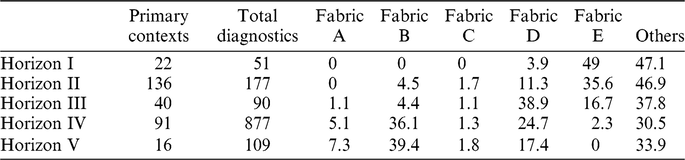
Frequencies of the fabrics are presented in Table 3 and Figure 5 as percentages of the total assemblage for each horizon. Horizon I is underrepresented, with only 22 primary contexts and a total of 51 diagnostic sherds. This is, in large part, owing to the deflation of this upper level that led to difficulties with drawing clear boundaries between the contexts of Horizon I and the uppermost deposits of Horizon II. Similarly, the at times ambiguous interfaces between Horizons III and IV and between Horizons IV and V resulted in comparatively few primary contexts for Horizons III and V. In the case of Horizon V, the limited number of contexts was exacerbated by the fact that not all trenches excavated by SHARP reached this depth. Supporting the observations from the 14C analyses, residual and intrusive pottery is an inevitability in the Saruq al-Hadid sequence. For this reason, interpretations of the data depend on overall observed ceramic trends as opposed to the single latest sherd identified within a context.
Diagnostic sherd counts and fabrics as percentages for each horizon in the central sector at Saruq al-Hadid.

Ceramic fabric frequencies from the central sector of Saruq al-Hadid, by horizon. The width of each graph corresponds with the percentage of that fabric within each horizon.

The overall results of the dating program are considered, horizon by horizon, in the following section. The discussion draws upon statistical modeling of the absolute 14C and TL dates and consideration of material remains associated with each horizon.
DISCUSSION
In order to refine the site’s absolute chronology, Bayesian modeling of the 14C and TL dates was undertaken using OxCal 4.3.2 (Bronk Ramsey Reference Bronk2009). Previously published 14C analyses from the central sector of the site (Herrmann et al. Reference Herrmann, Casana and Qandil2012: Tab. 1) have been included in their inferred stratigraphic position, based on published context descriptions. As noted above, sub-phases of Horizon I could not be differentiated stratigraphically. Nevertheless, based purely on the results of radiometric dating, Horizon I has been divided into three phases: Horizons Ic (oldest) to Ia (youngest). Overall, Horizons V-Ic were modeled as contiguous phases and Horizons Ic-Ia as sequential phases. The first model incorporated an outlier analysis for the Horizon III dates that allocated a significantly higher prior likelihood (p=0.50) of outlier status for the Horizon III and IV wood specimens. The resulting model identified both the “residual” samples (OZV-973, Beta-435682) and the “intrusive” samples (Beta-413925, 447588, OZV-972) as certain or highly likely (>69% chance) outliers. These five samples were removed from the subsequent OxCal modeling run, the results of which are presented below.
Saruq al-Hadid in the Bronze Age: Horizons V and IV
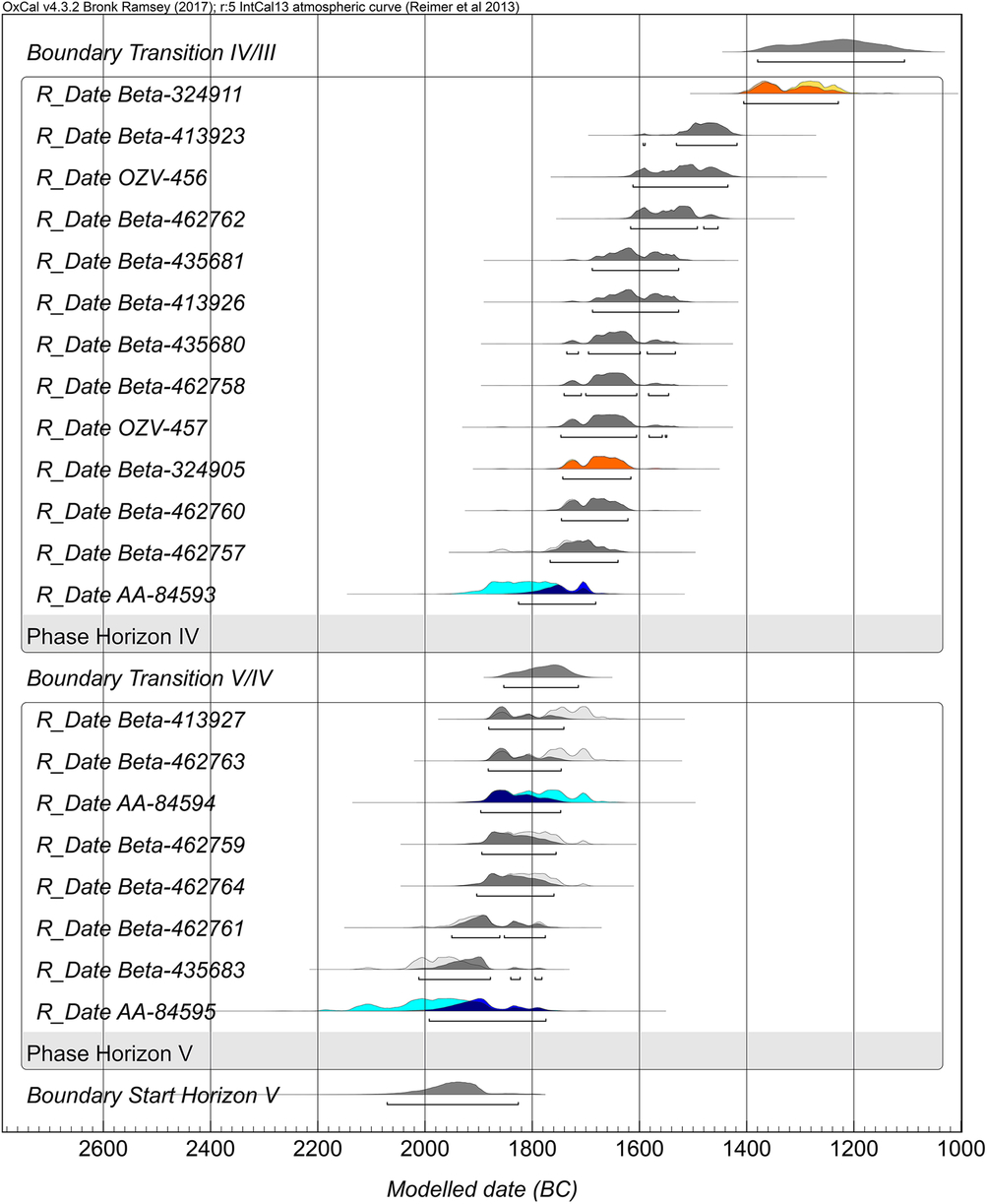
The earliest deposits in the central sector of the site, comprising Horizon V, are represented by eight 14C dates. These display consistent modeled age ranges in the early centuries of the second millennium BC (Figure 6), contemporary with the Wadi Suq period (ca. 2000–1600 BC) in southeastern Arabia. The modeled start date for this phase in the centre of the site is 2071–1827 cal BC, with a span of 23–247 yr (95.4% confidence limits).
Modeled dates for Horizons V and IV in the central sector of Saruq al-Hadid. Dates on samples from non-SHARP excavations are indicated in orange. Previously published determinations (Herrmann et al. Reference Herrmann, Casana and Qandil2012: Tab. 1; recalibrated after rounding of 14C BP age and error to nearest decade) are indicated in blue.

The ceramics from Horizon V, though relatively low in quantity, include both Fabrics A and B, with the latter forming nearly 40% of the diagnostic ceramics in the assemblage. This corpus of material is highly fragmentary, making the confident identification of vessel shapes difficult. In fact, there are no diagnostic sherds from Fabric A sufficiently preserved to be able to identify a vessel shape. Nevertheless, the presence of Fabric A, which corresponds with the Umm an-Nar period sandy red ware, raises the possibility of late third millennium activity in this part of the site or the continuation of certain production techniques from the third millennium into the early second millennium, as has been argued at Qarn al-Harf (de Vreeze Reference de Vreeze2016). It was possible to classify 17 rim sherds of Fabric B as coming from beakers and globular bowls, for which well-dated Wadi Suq period comparanda are known from Tell Abraq (Potts Reference Potts1991, Fig. 49), Nud Ziba (Kennet and Velde Reference Kennet and Velde1995, Fig. 10), and Hili 8 (Righetti and Cleuziou Reference Righetti and Cleuziou2010: 283–285). Fabric D, accounts for over 17% of the assemblage, and all examples of Fabric D belong to large, open bowls. While this particular shape of vessel is considered typical of the Iron Age I (cf. Magee Reference Magee1996, Fig. 1; Barker Reference Barker2002, Fig. 18.1-4), recent excavations at Tell Abraq have determined that such vessels appear at least by the middle of the second millennium BC (Magee et al. Reference Magee, Händel, Karacic, Uerpmann and Uerpmann2017: 228–229). The frequency with which the Fabric D bowls appear in Horizon V is too great to be explained by taphonomic processes, and the evidence from Saruq al-Hadid clearly indicates that the handmade coarse ware was in use by the early second millennium. Only two sherds of Fabric C were recovered in primary contexts from Horizon V, neither of which preserved a sufficient profile to reconstruct the shape of the vessel.
Material remains and previously published 14C dates indicate that Saruq al-Hadid was occupied well before the earliest absolute dates obtained for Horizon V in the central sector of the site. The consistent low frequency occurrence of Neolithic stone artifacts on the surface of the site is a testament to the use of the area at that time (ca. 6th–4th millennia BC), coinciding with the evidence for very large Neolithic stone tool aggregations at nearby sites such as Al-Ashoosh 2 (Casana et al. Reference Casana, Herrmann and Qandil2009). Moreover, 14C dating of hearth pits dug into the gypsum pavement at Saruq al-Hadid in areas to the west and north of the central sector has produced calibrated ages in the early and mid-third millennium BC (Herrmann et al. Reference Herrmann, Casana and Qandil2012: Tab. 1). These absolute dates are supported by the identification of diagnostic Umm an-Nar period pottery at Saruq al-Hadid (Fabric A, see above), and more broadly by the occurrence of contemporary third millennium BC occupation at the nearby desert site of Al-Ashoosh (Contreras et al. Reference Contreras, Carcacer, Thomas, Koljic, Murray, Bukhash, Al Abbar, Boraik and Zein2016).
According to the 14C determinations and modeling, Horizon IV follows immediately upon Horizon V, with a V-IV transition date of 1854–1715 cal BC (95.4% confidence limit). The 13 reliable 14C dates from Horizon IV (Figure 6) span the mid-second millennium BC, encompassing the Wadi Suq period to Late Bronze Age transition in southeastern Arabia. This substantial horizon has a modeled span of 317–542 yr (95.4% confidence limit).
The ceramic material from Horizon IV is dominated by beakers and bowls in Fabric B and large, open bowls in Fabric D. As previously remarked, Fabric B material can be dated to the Wadi Suq period, while the Fabric D vessels, commonly associated with the Iron Age I period, appear already in the early to middle second millennium. Fabric C is again relatively scarce, forming only 1.3% of the assemblage. One shwerd of note from Horizon IV that does not fall within the above documented fabrics but is from a primary context is the string-cut base of a footed goblet, a key chronological indicator for the Late Bronze Age in the northern Oman Peninsula (Velde Reference Velde, Potts, Naboodah and Hellyer2003: 151; Magee et al. Reference Magee, Händel, Karacic, Uerpmann and Uerpmann2017, Fig. 31). Fabric E forms only 2.3% of the pottery from primary deposits in Horizon IV, but belongs to vessel shapes uncommon in the Iron Age II corpus. This relatively low concentration of Fabric E may, therefore, be indicative of early experimentation with raw materials and firing techniques that would subsequently be more frequently employed in the early first millennium BC.
Other than ceramics, chronologically diagnostic material remains from Horizon IV are limited. Nevertheless, deposits from this horizon have produced a substantial collection of chipped stone tools and debitage (Moore and Grant Reference Moore, Grant and Weeks2017), including a microlithic component. This assemblage is unparalleled at contemporary sites in the region, but its occurrence at Saruq al-Hadid is stratigraphically well controlled.
Occupation at Saruq al-Hadid during the Wadi Suq period and Late Bronze Age has also been documented immediately to the west of the central sector of the site. Excavations by the German Mission to Saruq al-Hadid (Ihde Reference Ihde2017: 15–24) have recoded a series of occupation deposits consisting of fireplaces and storage pits which, based on associated ceramics, can be broadly dated to the mid-second millennium BC. More significantly, a series of wells recorded in the same area have been clearly dated to this period on stratigraphic and material grounds (Ihde Reference Ihde2017: 24–31).
Saruq al-Hadid in the Early Iron Age: Horizons III, II and I
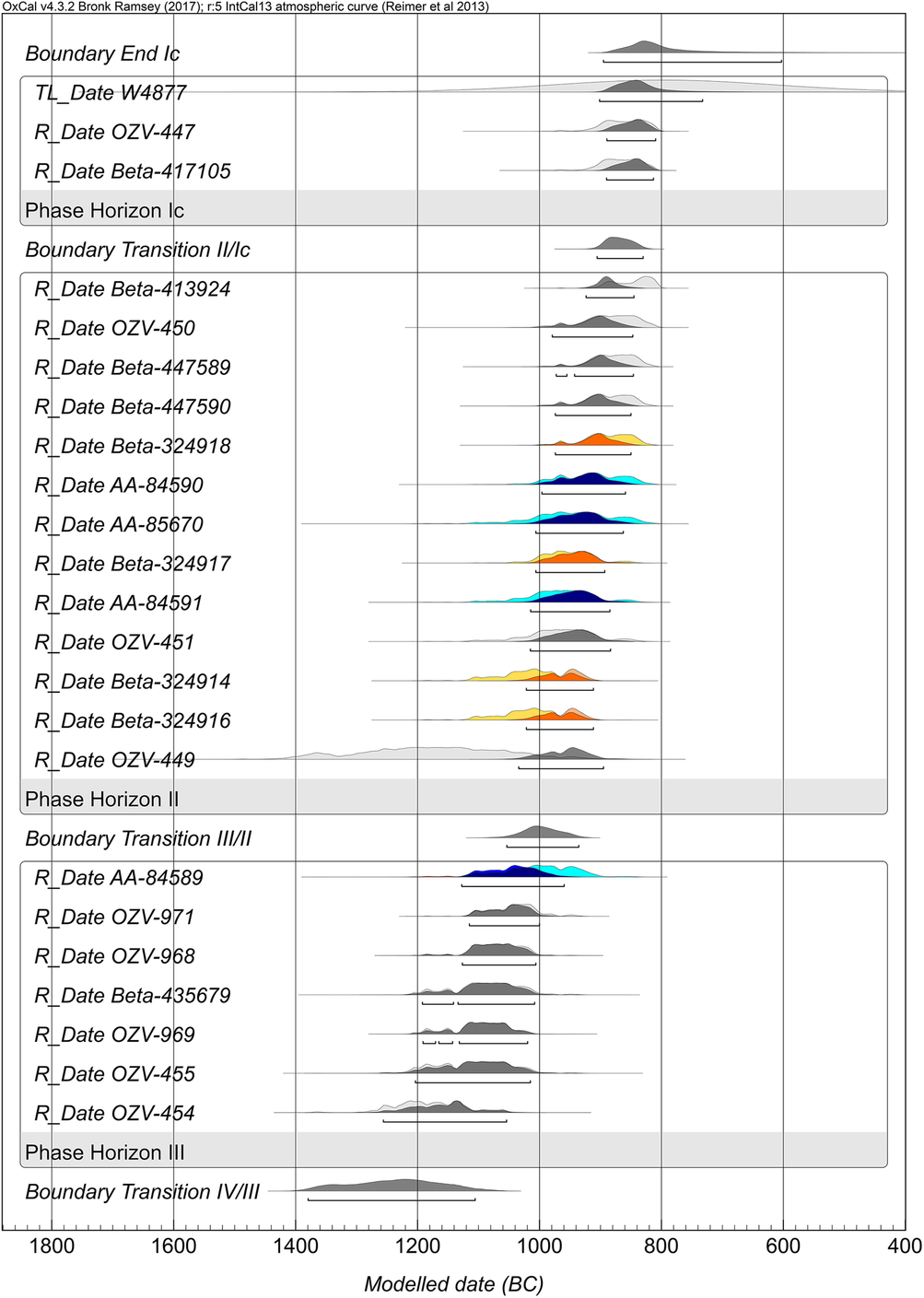
The 14C determinations and modeling indicate a transition date from Horizon IV to III of 1380–1106 cal BC (95.4% confidence limit). The six reliable 14C dates from Horizon III (Figure 7) span the late second to early first millennium BC, equivalent to the Iron Age I period as categorized by Magee (Reference Magee1996). This horizon—archaeologically ephemeral and stratigraphically difficult to delineate—has a modeled span of 53–270 yr (95.4% confidence limit).
Modeled dates for Horizons III, II and Ic in the central sector of Saruq al-Hadid. Dates on samples from non-SHARP excavations are indicated in orange. Previously published 14C dates (Herrmann et al. Reference Herrmann, Casana and Qandil2012: Tab. 1; recalibrated after rounding of radiocarbon BP age and error to nearest decade) are indicated in blue.

Both Fabrics A and B decrease significantly in Horizon III, where they likely represent residual materials. Fabric D is the most common fabric, accounting for nearly 40% of all ceramics from primary contexts. This sudden increase in Fabric D parallels observations for the Iron Age I period at Tell Abraq and Kalba (Magee Reference Magee1996; Magee and Carter Reference Magee and Carter1999). Fabric E forms 16.7% of the ceramic assemblage of Horizon III, typically occurring as pedestalled bowls, some of which preserve snake appliqué. While this shape is found in Iron Age II contexts (cf. Benoist Reference Benoist and Avanzini2010), at Saruq al-Hadid other typical Iron Age II ceramic shapes are absent in Horizon III. Early examples of snake appliqué pottery are known from Husn Salut and date to the final century of the second millennium (Condoluci et al. Reference Condoluci, Degli Esposti, Phillips, Avanzini and Degli Esposti2018: 104–105), but these examples do not come from pedestalled bowls.
A small but chronologically significant assemblage of complete softstone vessels was recovered from Horizon III contexts at Saruq al-Hadid (Figure 8; McRae Reference McRae and Weeks2017). This assemblage contains almost all the complete vessels recorded during SHARP excavations and includes several small vessels (GR14400, 14402, 14403, 14424, 14439) of possible Iron I type (cf. During et al. Reference During, Olijdam and Botan2017: Fig. 8). One of these vessels (GR14402) comes from context 1719 14C dated to the late second millennium BC, and two (GR14403, 14439) are from contexts without radiometric dates. However, two other vessels (GR14400, 14424) come from context 1748, which produced a calibrated 14C date in the ninth century BC. Nevertheless, the characteristics of these vessels as a group—including their shapes, light engraving, and comparatively thin walls—support their attribution to Iron I period and further support the dating of Horizon III to this time. To these examples can be added the softstone vessel GR14147, an Iron I (or possibly Late Bronze Age) transitional type found out of context in a mixed Horizon I-II deposit, with clear evidence that it had been broken for reworking or recycling.
The assemblage of soft stone vessels from Horizon III, and the LBA-Iron I type vessel from Horizon I-II (GR14147). Original images © H. David-Cuny.

Horizon II follows immediately after Horizon III, with a modeled III-II transition date of 1054–936 cal BC (95.4% confidence limit). The 13 modeled 14C dates from Horizon II (Figure 7) span the first two centuries of the first millennium BC, encompassing roughly the first half of the Iron II period (following Magee Reference Magee1996). This horizon comprises a rich collection of archaeological deposits and witnesses a dramatic expansion of activities across the site; it has a modeled span of 36–181 yr (95.4% confidence limit) in the central sector.
Fabric E supersedes all other fabrics in Horizon II. In addition to the continuation of pedestalled bowls, Fabric E is used to produce the complete range of typical Iron Age II ceramic vessels, including bridge-spouted vessels, bowls, and jars (Magee Reference Magee1996; Benoist Reference Benoist1999: 80–116). Continuing alongside Fabric E, is Fabric D which now represents 11.3% of the assemblage. This continuation is not unexpected, as Magee (Reference Magee and Conard2011) notes that the handmade coarse ware of the Iron Age I continues into the Iron Age II at Tell Abraq, but in decreasing frequency. Fabrics B and C continue in Horizon II but in low concentrations and may be residual. There is no evidence for Fabric A in Horizon II.
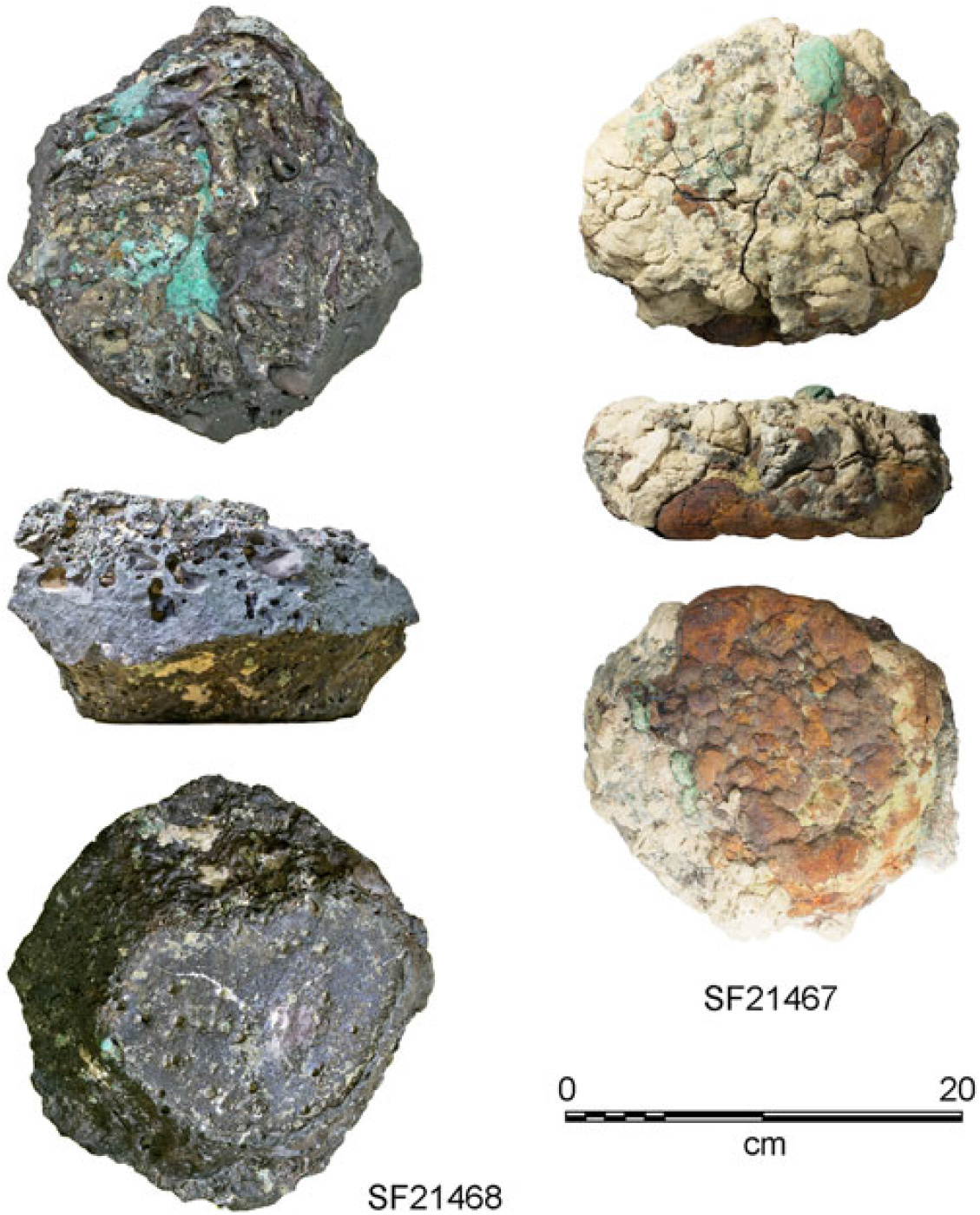
In addition to ceramic material, Horizon II has produced abundant material remains with parallels to southeastern Arabian sites occupied in the early Iron Age. This is particularly clear in the case of the multitude of copper-base artifacts from the site, which include characteristic early Iron Age types such as bangles/anklets, socketed axes and hoes, crescent-pommelled daggers, vessels and a variety of arrowheads (Al-Khraysheh and An-Nashef Reference Al-Khraysheh and An-Nashef2007; Contreras Rodrigo et al. Reference Contreras, Vila, Albarracín, Bukhash, Al Abbar, Radwan and Zein2017: Fig. 6; Boraik Reference Boraik2017: 29; Weeks et al. Reference Weeks, Cable, Franke, Newton, Karacic, Roberts, Stepanov, David-Cuny, Price, Bukhash, Radwan and Zein2017: Figs. 3, 19, 20; Weeks et al. Reference Weeks, Cable, Franke, Karacic, Newton, Roberts, Stepanov, McRae, Moore, David-Cuny, Al Aali, Boraik and Zein2018: Fig. 9); that can be well paralleled at sites including Al-Qusais, Bithnah, Masafi, Rumeilah, ‘Uqdat al-Bakrah, Ibri/Selme, and Salut (Boucharlat and Lombard Reference Boucharlat and Lombard1985; Yule and Weisgerber Reference Yule and Weisgerber2001; Taha Reference Taha2009; Benoist et al. Reference Benoist, Le Carlier, Goy, Degli, Armbruster, Attaelmanan, Robin, Schiettecatte and Charloux2015; Avanzini and Degli Esposti Reference Avanzini and Degli2018; Yule and Gernez Reference Yule and Gernez2018). Also diagnostic of this transitional phase from the Bronze to the Iron Age are bimetallic artifacts of copper alloy and iron, known in numerous examples from Saruq al-Hadid (Al-Khraysheh and An-Nashef Reference Al-Khraysheh and An-Nashef2007: 175; Nashef Reference Nashef and Avanzini2010: Fig. 6; Weeks et al. Reference Weeks, Cable, Franke, Newton, Karacic, Roberts, Stepanov, David-Cuny, Price, Bukhash, Radwan and Zein2017: Fig. 21) and with strong early Iron Age parallels in neighboring regions such as Iran. Copper production residues and semi-products from Horizon II contexts at Saruq al-Hadid (Weeks et al. Reference Weeks, Cable, Franke, Newton, Karacic, Roberts, Stepanov, David-Cuny, Price, Bukhash, Radwan and Zein2017: Fig. 20; Boraik Reference Boraik2017: 25) also display clear typological parallels with materials recovered from early Iron Age contexts at Masafi-1, including large disc-shaped to plano-convex ingots and “furnace bottoms” (Figure 9; Weeks et al. Reference Weeks, Cable, Franke, Newton, Karacic, Roberts, Stepanov, David-Cuny, Price, Bukhash, Radwan and Zein2017: Fig. 20; cf. Benoist et al. Reference Benoist, Le Carlier, Goy, Degli, Armbruster, Attaelmanan, Robin, Schiettecatte and Charloux2015: 28–30, Fig. 7). Typological parallels to early Iron Age sites are also common amongst the assemblages of beads (e.g. Weeks et al. Reference Weeks, Cable, Franke, Newton, Karacic, Roberts, Stepanov, David-Cuny, Price, Bukhash, Radwan and Zein2017: Fig. 23), soft-stone vessels (e.g. Contreras Rodrigo et al. Reference Contreras, Vila, Albarracín, Bukhash, Al Abbar, Radwan and Zein2017: Fig. 6), and pyramidal stamp seals (Boraik Reference Boraik2017) from Horizon II and contemporary deposits at Saruq al-Hadid.
Examples of a copper smelting furnace slag (SF21468, left) and a heavily corroded raw copper ingot (SF21467, right) found together in Horizon II (context 1187) at Saruq al-Hadid. The furnace slag has a flat lower surface (lower left), indicating the interface between the slag and the metal ingot and/or matte that formed below it in the furnace. Original images © H. David-Cuny.

It is clear that the heavily deflated deposits of Horizon I also incorporate material of early Iron Age date. As indicated in Figure 7, two 14C dates and one TL date from Horizon I contexts fall broadly into the first half of the first millennium BC, with modeled ages in the ninth century BC, an end date of 896–604 cal BC, and a span for Horizon Ic of 0–123 yr (95.4% confidence limit). One of the 14C dates is for a piece of charcoal embedded in a copper slag, providing secure evidence that metalworking activities had commenced at the site by this period. This conclusion is supported by the contemporary (but less precise) TL date W4877, for a piece of technical ceramic attached to copper slag.
Although total diagnostic sherds from primary contexts are few in Horizon I, they also demonstrate the presence of early Iron Age material. Fabrics A, B, and C are totally absent, while Fabric D represents less than 5% of the assemblage and may be residual material. Only Fabric E is found in any significant quantities and many of the sherds from Fabric E appear in common Iron Age II vessel shapes, which is consistent with the 14C and TL dates for Horizon Ic.
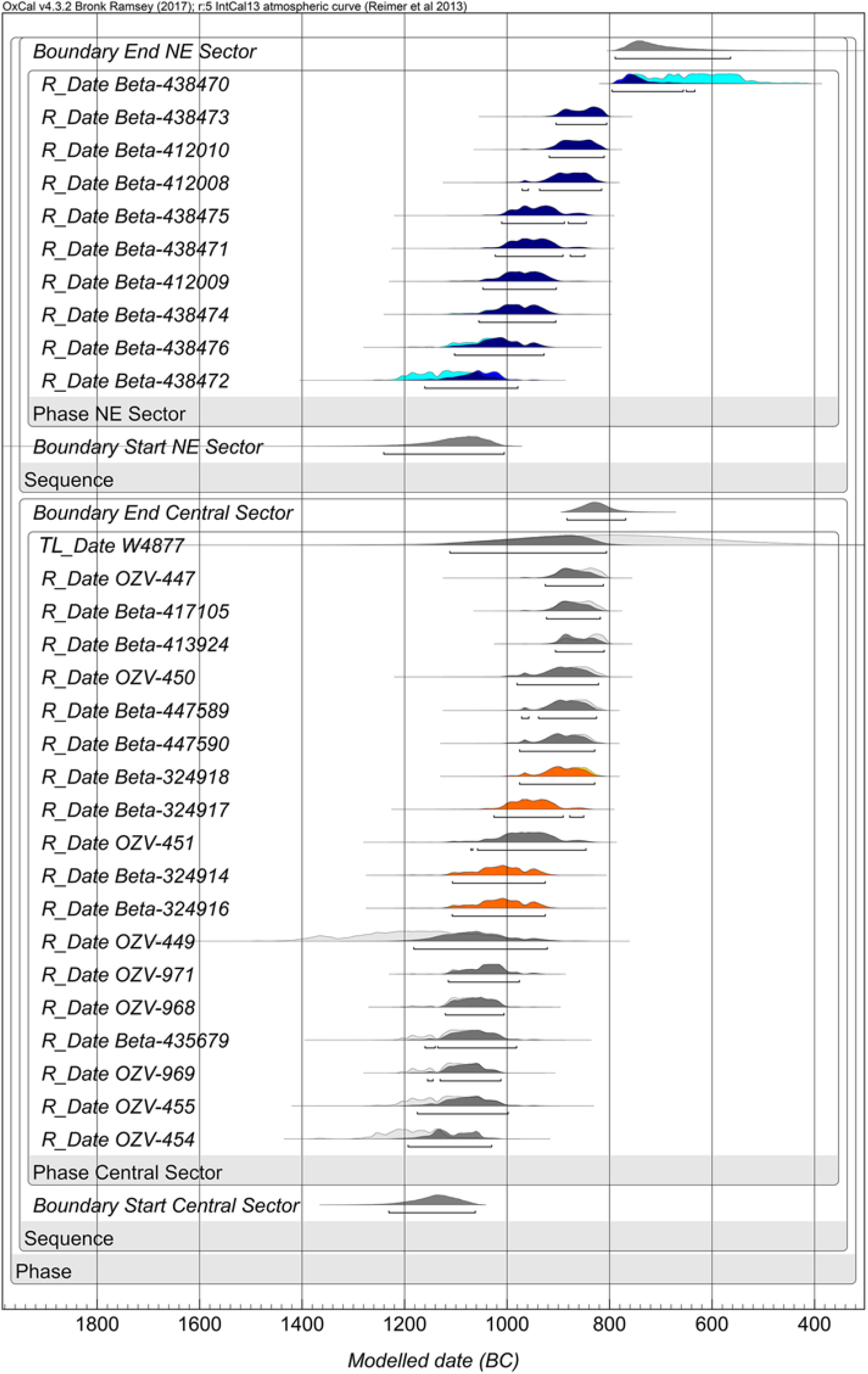
As noted above, the early Iron Age appears to witness the most expansive and intense human occupation of Saruq al-Hadid in the late prehistoric period, with abundant material remains recorded (unevenly) across an area in excess of one square kilometer (Qandil Reference Qandil, Hellyer and Ziolkowski2005; Al-Khraysheh and An-Nashef Reference Al-Khraysheh and An-Nashef2007; Al-Casana et al. Reference Casana, Herrmann and Qandil2009; Nashef Reference Nashef and Avanzini2010; Herrmann et al. Reference Herrmann, Casana and Qandil2012; Contreras Rodrigo et al. Reference Contreras, Vila, Albarracín, Bukhash, Al Abbar, Radwan and Zein2017; Ihde Reference Ihde2017). Previously published 14C determinations provide ample additional evidence for early Iron Age occupation outside of the central sector of the site, as illustrated in Figure 10. These dates, from a series of high-temperature installations (hearths or furnaces) in the northeastern sector of the site (Contreras Rodrigo et al. Reference Contreras, Vila, Albarracín, Bukhash, Al Abbar, Radwan and Zein2017: Figs. 2, 4), predominantly span the early centuries of the first millennium BC, contemporary with Horizon II in the central sector. However, occupation in the later second millennium BC is also recorded for Hearths 8 and 12, contemporary with Horizon III in the central sector, and one 14C determination (Beta-438470) from Hearth 4 produced a younger date suggesting occupation in the eighth century BC or later.
Modeled absolute dates for Horizons III, II and Ic in the central sector of Saruq al-Hadid and previously published radiocarbon determinations for the northeastern sector of the site (Contreras Rodrigo et al. Reference Contreras, Vila, Albarracín, Bukhash, Al Abbar, Radwan and Zein2017: Tab. 1). Dates from non-SHARP excavations are indicated in orange, and previously published dates are indicated in blue.

Saruq al-Hadid after the Early Iron Age: Horizon I
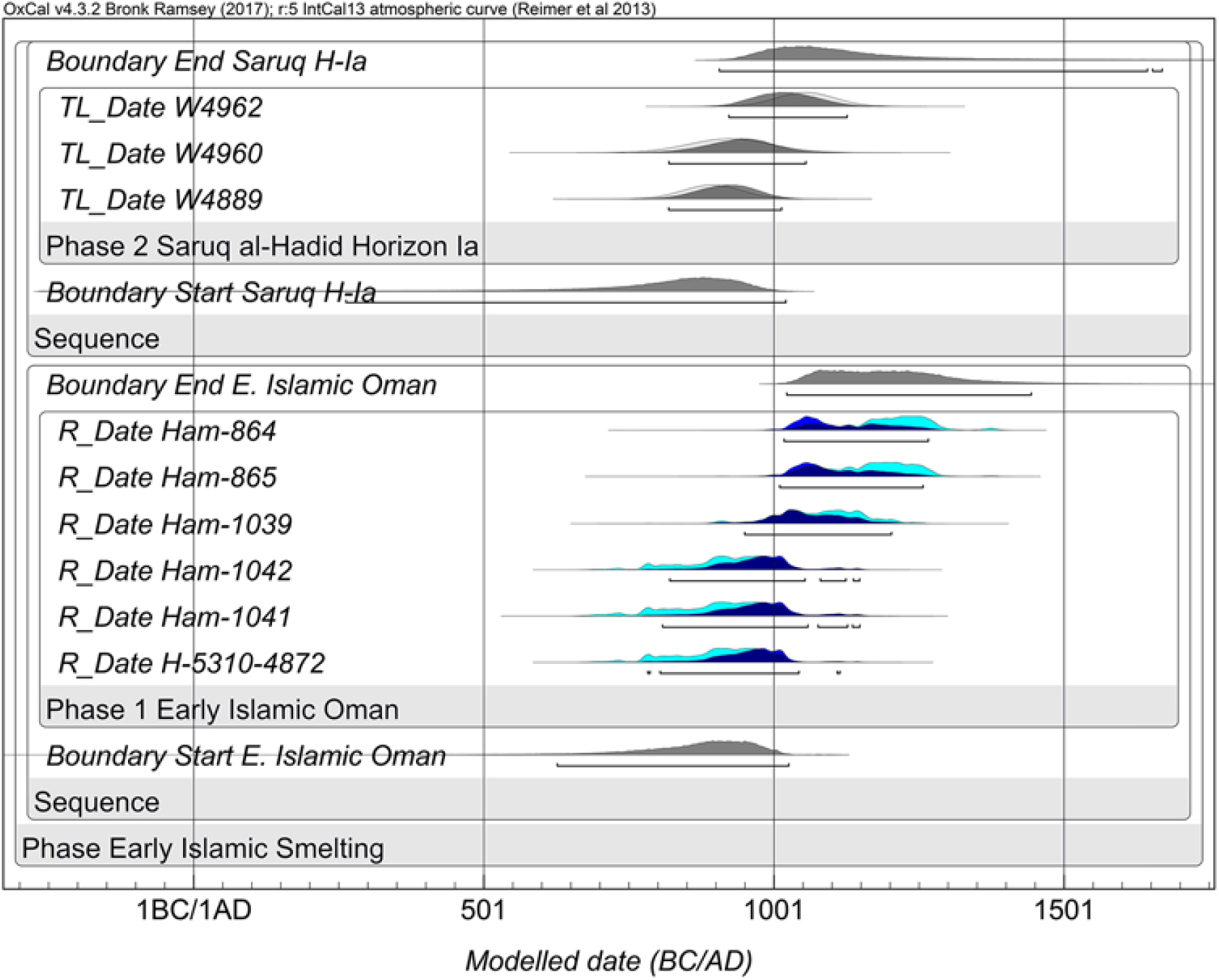
The absolute dates for Horizon I are illustrated in Figure 11, and comprise two 14C determinations and eight TL dates on technical ceramics associated with metallurgical production. Based purely on the results of radiometric dating—there is no clear stratigraphic differentiation of deposits within Horizon I—human use of Saruq al-Hadid represented by the deflation pavement has been modeled as three sequential phases: Horizons Ic (oldest) to Ia (youngest). As discussed above, Horizon Ic has modeled early Iron Age dates falling in the ninth century BC, and includes directly dated metallurgical production residues. Four TL dates comprising Horizon Ib fall broadly into the period from the third century BC to the sixth century AD, i.e. contemporary with the Late Pre-Islamic Period (ca. 300 BC—AD 600). Although the range is very broad, the modeling suggests an interval between Horizons Ic and Ib of 73–847 yr (95.4% confidence). Three TL dates comprising Horizon Ia fall into the period from the ninth to the eleventh centuries AD, i.e. the early Islamic period. Modeling suggests an interval between Horizons Ib and Ia of 0–604 yr (95.4% confidence). Thus, in contrast to the Bronze Age and Iron Age occupation of the site, which appears to be (and has been modeled as) persistent, human use of Saruq al-Hadid after the Iron Age appears to have been more episodic, even if the pyrotechnological activities documented were sometimes undertaken at a substantial scale. The TL dates indicating early Islamic smelting operations at Saruq al-Hadid accord with 14C dates on Islamic smelting operations in Oman (Figure 12; Weisgerber Reference Weisgerber1980: 75, Tab. 1).
Modeled dates for Horizon I at Saruq al-Hadid. The modeled sub-phases Ic to Ia are not based on stratigraphic considerations, but on the absolute date determinations.

Modeled TL dates for technical ceramics from Horizon Ia at Saruq al-Hadid (top) and previously published radiocarbon dates (bottom) for early Islamic smelting operations in the Sultanate of Oman (Weisgerber Reference Weisgerber1980: Tab. 1; in blue).

Other than the abundant remains of slag and technical ceramics, material evidence for human activities at Saruq al-Hadid after the early Iron Age is very sparse. Some fragmentary iron artifacts display typological features suggestive of a Late- or Post-Iron Age date (Weeks et al. Reference Weeks, Cable, Franke, Karacic, Newton, Roberts, Stepanov, McRae, Moore, David-Cuny, Al Aali, Boraik and Zein2018: Fig. 12), and many iron pieces show traces of fragmentation and other processing indicative of their reworking or recycling after their original deposition in the early Iron Age (Stepanov et al. Reference Stepanov, Weeks, Franke, Salvemini, Cable, Al Ali, Boraik, Zein and Grave2019). Herrmann et al. (Reference Herrmann, Casana and Qandil2012: 65) noted (but did not illustrate) the occurrence of green glazed pottery at the site, which they suggest may belong to the Late Pre-Islamic period. The presence of artifacts made of brass at the site (Qandil Reference Qandil, Hellyer and Ziolkowski2005: 134) may also indicate occupation in this broad period, as brass use is traditionally thought to have been a post-Iron Age innovation in the region (Weeks Reference Weeks2004). Ceramics of the Islamic period have been recorded in small amounts in the northeastern sector of the site (Contreras Rodrigo et al. Reference Contreras, Vila, Albarracín, Bukhash, Al Abbar, Radwan and Zein2017: 59), and a Persian blue speckled plate, a type which does not appear before the thirteenth century AD (Kennet Reference Kennet2004: 53–54), was found on the surface of Horizon I. To these material indicators can be added two 14C dates from upper deposits in the northeastern sector of the site (Contreras Rodrigo et al. Reference Contreras, Vila, Albarracín, Bukhash, Al Abbar, Radwan and Zein2017: Fig. 4, Beta-438468, 438469) that date to the fifteenth century AD and later.
However, previous TL dating of technical ceramics from metallurgical production sites in Oman dated from the Early Bronze Age to the Islamic Period (Wagner and Yule Reference Wagner, Yule and Yule2015: Tab. 5) has shown highly variable results, with calculated ages often significantly younger than expected where associated material remains or 14C dates are available. As the typological evidence for Late Pre-Islamic and early Islamic activities at Saruq al-Hadid is comparatively limited, and there are currently no 14C dates indicating occupation at the site during this period, the TL dating evidence presented here is best regarded as preliminary. Further fieldwork and post-excavation analyses will be required to confirm the chronological framework for post-Iron Age occupation at Saruq al-Hadid.
CONCLUSIONS
Saruq al-Hadid is a large and complex late prehistoric site with an extended and persistent history of short-term occupation. Although not a stratified tell such as the contemporary sites of Kalba K4 (Carter Reference Carter1997; Eddisford and Phillips Reference Eddisford and Phillips2009) or Tell Abraq (Potts Reference Potts1990, Reference Potts1991; Magee et al. Reference Magee, Händel, Karacic, Uerpmann and Uerpmann2017), Saruq al-Hadid is nevertheless characterized by a clear stratigraphic succession of material remains that can now be dated with some degree of absolute chronological precision, and whose associated archaeological remains include material of significance for understanding the later prehistoric societies of southeastern Arabia. The development of this broad and robust phasing for the use of the site nevertheless recognizes the confounding effects of site formation processes on the disposition of individual artifacts—which must be closely assessed on a case-by-case basis in respect to residuality and intrusivity—and individual deposits, which must be seen as palimpsests of cultural and natural formation processes over varying durations. Moreover, the large size of the site means that the chronological phasing and dating developed here for the central sector is not necessarily representative of occupation across its entirety.
Occupation in the central sector of the site begins in the very late third or early second millennium BC, with Horizon V deposits consisting of numerous hearths and ephemeral post-hole structures associated with small scale habitation and subsistence residues. The exploitation of the desert interior in this period was by no means a new phenomenon, as it built upon significantly earlier third millennium BC occupation that is documented both in the broader vicinity of Saruq al-Hadid, and at the site itself in areas outside the central sector (Herrmann et al. Reference Herrmann, Casana and Qandil2012: Tab. 1). Subsequently, deposits of Horizon IV in the central sector of the site document intensive subsistence activities focused on wild animal hunting (Roberts et al. Reference Roberts, Weeks, Cable, Fillios, Al Ali, Boraik and Zein2018), which can now be clearly dated to a period of several centuries in the mid-second millennium BC, ca. 1750–1300 BC. The site provides a new perspective on human occupation of southeastern Arabia at this time, a period otherwise known for a dramatic reduction in recorded settlement and which has been systematically explored only on its northern fringe in coastal U.A.E. and Oman. A variety of material indices, particularly ceramics (Karacic et al. Reference Karacic, Weeks, Cable, Méry, al-Ali, Boraik, Zein, Glascock and MacDonald2018), plant remains (Newton Reference Newton and Weeks2017) and animal bones (Roberts et al. Reference Roberts, Weeks, Cable, Fillios, Al Ali, Boraik and Zein2018), serve to link Saruq al-Hadid with contemporary settlements in the coastal and piedmont zones (e.g. Magee et al. Reference Magee, Händel, Karacic, Uerpmann and Uerpmann2017), providing a clearer picture of the integration of short- and long-term occupation sites in the settlement system of the second millennium BC.
The site is also significant in providing evidence of the transition from the Bronze Age to the Iron Age, concurrent with the dramatic expansion of settlement in southeastern Arabia that has been documented for the early first millennium BC (e.g. Magee Reference Magee2014). In particular, the central sector of Saruq al-Hadid has facilitated the recognition of key aspects of material assemblages of the late second millennium BC. These Horizon III deposits, dated to ca. 1300–1000 BC, are strongly associated with emergent “ritual” practices and traditions recorded across southeastern Arabia in the early first millennium BC (e.g., Benoist Reference Benoist and Avanzini2010; Mouton et al. Reference Mouton, Benoist and Cordoba2011; Benoist et al. Reference Benoist, Le Carlier, Goy, Degli, Armbruster, Attaelmanan, Robin, Schiettecatte and Charloux2015), which at Saruq al-Hadid are characterized in particular by an unusual ceramic assemblage dominated by pedestalled vessels commonly displaying painted or appliqué snake decoration (Karacic et al. Reference Karacic, Boraik, Qandil and David-Cuny2017).
The intensification and expansion of occupation at Saruq al-Hadid—indicated particularly by the abundance and wide spatial distribution of gold, copper alloy, iron, soft-stone, ceramic and other material remains at the site—can be clearly dated to the early centuries of the first millennium BC, ca. 1000–800 BC. The evidence includes new 14C and TL dates from the stratigraphic sequence in the central sector of the site, alongside recently published 14C determinations from the northeastern sector. Secondary metalworking activities such as refining and casting were a significant component of human activities at Saruq al-Hadid in the early Iron Age (Franke Reference Franke and Weeks2016; Contreras Rodrigo et al. Reference Contreras, Vila, Albarracín, Bukhash, Al Abbar, Radwan and Zein2017), and the direct dating of metallurgical residues from the central sector presented here indicates that primary copper smelting was also being undertaken at the site at this time. This is an important conclusion given that initial absolute dating studies (Herrmann et al. Reference Herrmann, Casana and Qandil2012: 65, Tab. 2) suggested that metallurgical activities at the site may only have commenced after the Iron Age. The evidence from Saruq al-Hadid can now be considered as contemporaneous with that from other metalworking and deposition sites in the mountains and desert fringes of southeastern Arabia, including Masafi-1 in the U.A.E. (Goy et al. Reference Goy, Le Carlier de Veslud, Degli and Attaelmanan2013; Benoist et al. Reference Benoist, Le Carlier, Goy, Degli, Armbruster, Attaelmanan, Robin, Schiettecatte and Charloux2015) and ‘Uqdat al-Bakrah (Yule and Gernez Reference Yule and Gernez2018) and Jebel Mudhmar (Gernez et al. Reference Gernez, Jean and Benoist2017a, Reference Gernez, Jean, Benoist, Gernez and Giraud2017b) in Oman. Together, these sites represent a relatively recently discovered and unexpected component of early Iron Age technological and socio-political development in southeastern Arabia, whose nature and significance remains to be fully explored.
The absolute dating program has also been able to preliminarily demonstrate intensive but perhaps more intermittent periods of post-Iron Age activities at Saruq al-Hadid, which appear to have been more narrowly focused on metallurgical production. These date particularly to the Late Pre-Islamic period, when copper smelting and the scavenging and reprocessing of Iron Age ferrous artifacts were the main activities undertaken, and to the early Islamic period in the eighth through tenth centuries AD. Primary metal extraction is poorly documented at other sites in southeastern Arabia in the Late Pre-Islamic period, especially in the Sasanian period (Weisgerber 1987; Weeks Reference Weeks2003: 33–43), although the secondary refining and working of copper, silver, lead and iron is well attested at sites such as Mleiha and Ed Dur (e.g. Ploquin et al. Reference Ploquin, Orzechowsky, Briand and Mouton1999; Delrue Reference Delrue2008) in the late centuries BC and the early centuries AD. In contrast, the early Islamic period witnessed a massive expansion of copper production in southeastern Arabia, to levels unmatched before modern times. This industry has been well documented at large-scale production sites close to ore sources in the al-Hajjar Mountains (e.g. Weisgerber Reference Weisgerber1980: Tab. 1; Reference Weisgerber1981, Reference Weisgerber2007; Hauptmann Reference Hauptmann1985), but it now also appears to have incorporated (rare?) desert production sites such as Saruq al-Hadid. The reasons for this choice of production locale remain obscure, given the great distance from ore sources; the possible local availability of fuel is a factor that must be considered for the post-Iron Age metallurgical activities at Saruq al-Hadid.
No doubt, future programs of absolute dating will serve to better define and refine our understanding of this multi-period site: the chronological sub-division of our current broad archaeological “horizons”; the spread of occupation or activity areas across the site’s large spatial area; and the chronological parameters for the appearance of certain materials and technologies at the site, such as copper smelting and the use of iron artifacts. Nevertheless, the effective integration of a range of relative and absolute dating strategies and techniques in the present study has allowed for the development of the first absolute chronology for Saruq al-Hadid that approaches completeness, despite the challenges presented by ephemeral archaeological deposits in a highly mobile and active dune field. The dates allow for Saruq al-Hadid and its material remains to be properly situated within the archaeological record of wider southeastern Arabia, and in particular for research at the site to contribute to the burgeoning recent discussion of changes in southeastern Arabian society and settlement patterns across the second millennium BC; a dramatic but still poorly understood period of cultural change.
Acknowledgments
The SHARP program at Saruq al-Hadid, including 14C and TL dating, received financial and logistical support from Dubai Municipality (Contract 639/1/1413904) and funding from ANSTO Research Grant N10773 (round 2017-1) for AMS 14C determinations. We recognize and acknowledge the hard work of the SHARP excavation team at Saruq al-Hadid, whose skilful excavation underpinned the development of the chronological framework presented here. Many thanks to Christopher Ramsey (Oxford University) for advice and guidance with OxCal modeling, and to Gary Marriner (UNE) for providing the initial orientation for the use of OxCal. Any errors remain the responsibility of the authors.