Introduction
The use of agricultural by-products, especially cereal straws, in livestock feeding is a long practice in many countries of the world. Maize stover in particular is an important component of ruminants’ feed (Kossila, Reference Kossila1988). It has been widely used as forage for ruminants in the form of fresh-cut straw after harvesting, hay or silage, and its estimated production has exceeded the amounts of grass silage in many countries (Wilkinson and Toivonen, Reference Wilkinson and Toivonen2003). Because of the improvement in agronomic performance of crops and an understanding of the digestion and nutrient requirement of ruminants, many new maize hybrids, including waxy and high-oil maize hybrids, have recently become the subject of renewed interest (Dado, Reference Dado1999). High-oil, sweet and waxy maize hybrid varieties have been evaluated for their nutritional value in ruminants’ diet due to the elevated level of oil, crude protein (CP) or amylopectin content in the seed or stover (Atwell et al., Reference Atwell, Jaster, Moore and Fernando1988; Mustafa et al., Reference Mustafa, Hassanat and Berthiaume2004). However, there is paucity of information on variability in the quality and quantity of maize stover as influenced by genetic factors, especially for high-oil, sweet, waxy and fodder maize stovers. Harika and Sharma (Reference Harika and Sharma1994) and Tolera et al. (Reference Tolera, Berg and Sundstøl1999) reported varietal variation in grain, stover, total biomass yield and nylon bag dry matter (DM) degradability of the stover based on their study of three to eight varieties of maize, respectively. A wide genetic variability in the ratio of leaf to stem was observed for maize stover in the previous study (Harika and Sharma, Reference Harika and Sharma1994).
In addition to the genetic factors, the proportion and quality of the morphological fractions may result in variation in the nutritional quality of crop residues. Schulthess et al. (Reference Schulthess, Tedla, Mohammed-Saleem and Said1995) noted major differences in the nutritive value of wheat straw fractions. The lowest fiber content was observed in the leaf blade of wheat straw, which was lower than leaf sheath and stem (Schulthess et al., Reference Schulthess, Tedla, Mohammed-Saleem and Said1995; Tan et al., Reference Tan, Chen, He, Fang and Xing1995). The digestibility of organic matter (OM) and fiber for leaf blade were higher than for stem as reported for most cereal straws (Capper et al., Reference Capper, Thomson, Rihawi, Termanini and Macrae1986; Shand et al., Reference Shand, Ørskov and Morrice1988; Tolera and Sundstøl, Reference Tolera and Sundstøl1999). Leaf blade had a higher in vitro gas production and CP content but lower acid detergent fiber (ADF) content than stem for maize stover (Tang et al., Reference Tang, Tan, Zhou, Jiang, Jiang and Sheng2006). On the other hand, previous studies showed that stem fraction contributed over 0.50 to whole-plant wheat straw (Ohlde et al., Reference Ohlde, Becker, Akin, Rigsby and Lyon1992; Tan et al., Reference Tan, Chen, He, Fang and Xing1995). Furthermore, stem fraction comprised about 0.45 to 0.70 of sorghum stover, with the contribution of leaf blade to whole stover being only 0.18 to 0.30 (Miron et al., Reference Miron, Solomon, Adin, Nir, Nikbachat, Yosef, Carmi, Weinberg, Kipnis, Zucherman and Ben-Ghedalia2006). The previous results indicated that the nutritive value of cereal straws is dependent on the proportion of stem in whole plant. Although the nutritive value of different morphological fractions of most fine-stemmed cereal straw has been evaluated and documented (Kernan et al., Reference Kernan, Coxworth, Crowle and Spurr1984; Ohlde et al., Reference Ohlde, Becker, Akin, Rigsby and Lyon1992; Schulthess et al., Reference Schulthess, Tedla, Mohammed-Saleem and Said1995), relatively little has been done in this respect on coarse-stemmed new maize hybrids such as high-oil, waxy, sweet and fodder maize stover. Therefore, this study was designed to investigate the effect of genotype variability on the proportion, chemical composition and in vitro gas production characteristics of different morphological fractions of maize stover.
Material and methods
Maize genotypes
Five maize genotypes, namely Kexiangyu 11 (conventional maize), Gaoyou 115 (high-oil maize), Kexiangluoyu 1 (waxy maize), Huqing 1 (fodder maize) and Kexiangtianyu 1 (sweet maize) were used in this experiment. Kexiangluoyu 1 and Kexiangtianyu 1 are short and early-maturing varieties released by the Institute of Subtropical Agriculture (ISA), the Chinese Academy of Sciences, Changsha, China. Kexiangyu 11 is a conventional variety, developed in ISA through intensive selection for increasing glutinousness. Gaoyou 115 is a variety with high oil content in grain, and developed in the China Agricultural University in 1996. Huqing 1 is a hybrid variety used for silage.
Planting, harvesting and sample preparation
The five maize genotypes were planted under similar agronomic conditions on the same field in the experimental farm of ISA, and with three replicated plots of 5 m × 5 m for each genotype. They were sown on 9 August 2005. The planting distance was 0.65 m inter rows and 0.25 m intra rows, making 20 maize stands within rows and eight rows per replicated plot. A mixed inorganic fertilizer was applied at sowing time (kg/ha: calcium superphosphate, 750; potassium chloride, 360; ammonium bicarbonate, 1500) and 100 kg urea/ha was applied when the plants reached knee height.
Harvesting of the plants was done at day 45 after tasseling. The tasseling dates were on 3, 5, 6, 8 and 11 October 2005 for waxy, conventional, high-oil, fodder and sweet maize, respectively. Samples of 10 whole plants were randomly selected and collected in triplicate from the three replicated plots for each genotype. They were carefully separated into five different morphological fractions, i.e. leaf blade, leaf sheath, stem, husk and cob. All samples were dried at 65°C and milled through a 1-mm sieve prior to chemical analysis and in vitro gas production measurements.
In vitro gas production
All samples were incubated in vitro with rumen fluid in calibrated glass syringes as described by Tang et al. (Reference Tang, Tan, Zhou, Jiang, Jiang and Sheng2006). Three rumen-fistulated goats (Liuyang black wether goat, a local breed, 20 ± 1.0 kg) were fed a total of 814 g DM maize stover and 801 g DM concentrate mix meal (contained per kg DM: 452 g maize grain, 360 g wheat bran, 126 g soybean meal, 16 g urea, 10 g salt and 36 g trace element and vitamin premix) at the experimental farm of ISA, offered in equal portions twice a day. Animals could access water freely. Rumen fluid was collected before feeding in the morning, and strained through four layers of gauze into a pre-warmed, insulated bottle. All laboratory handling of rumen fluid was carried out under a continuous flow of CO2.
Approximately 200 ± 10 mg dry weight of each sample was weighed in triplicates into three syringes of 100 ml, respectively. All syringes were pre-warmed at 40°C before the injection of 30 ± 1 ml rumen fluid–buffer mixtures into each syringe. The syringes containing sample and rumen fluid–buffer were placed in a shaking water bath (DSHZ-300, Taicang, Jiangsu, China) with 50 movements per minute at 39°C. Three syringes containing only incubation media were placed in the water bath and used as blanks to correct for the gas production due to the activity of the rumen fluid. Gas volume readings were taken after 2, 4, 6, 12, 24, 36, 48, 60 and 72 h of incubation. The data were fitted to the exponential equation of the form GP = a + b(1−e−ct) (Ørskov and McDonald, Reference Ørskov and McDonald1979; Blümmel and Ørskov, Reference Blümmel and Ørskov1993), where GP was defined as gas production at time t; a, b and c being constants of the exponential equation, where a is the intercept of the gas production curve, b the proportion of gas production during time (t) and c the rate of gas production of the ‘b’ fraction. Volatile fatty acid (VFA) content of the supernatant was determined after 72 h of incubation by gas chromatograph. In vitro fermentation was terminated at 72 h; the residual solution was filtered into the preweighed Gooch filter crucibles, dried at 105°C for 24 h and then ashed at 550°C for in vitro organic matter disappearance (IVOMD) measurement.
Chemical analysis
DM was measured by oven drying the sample at 105°C overnight, whereas ash was determined by igniting the samples in a muffle furnace at 550°C for 6 h. The CP content was calculated as 6.25 × N, which was obtained by the micro-Kjeldahl method. Neutral detergent fiber (NDF) and ADF were determined according to Van Soest and Robertson (Reference Van Soest and Robertson1985). A gas chromatograph (HP5890, Agilent 5890; Agilent Technologies Co. Ltd, USA) was used for VFA analysis, and an HP-INNOWax column (30 m in length with a 0.25 mm i.d.) was used for the separation. The attenuation was set at a nitrogen diffluent ratio of 1 : 60, hydrogen flow 50 ml/min, airflow 500 ml/min, injector temperature 200°C, column temperature 150°C and detector temperature 200°C. The relative response factor, representing the peak of each VFA, was calculated using the standard VFA mixture, which was chromatographed with each group of 10 samples. Total molar concentration was calculated by taking the sum of individual VFAs as 100%. NH3-N was determined as described by Weatherburn (Reference Weatherburn1967).
Statistical analysis
The statistical analysis of data was done by analysis of variance (ANOVA) with the software package of Statistical Analysis System (Release 8.2, SAS Institute Inc., Cary, NC, USA; 2001) using the GLM procedure. Two-way ANOVA procedure was used to test the main and interactive effect of genotype and morphological fraction on chemical composition, in vitro gas production parameters and IVOMD. The following model was used for the analysis of data:

where Yijk = dependent variable, μ = overall mean, Ri = effect of replicate (i = 1, 2 or 3); Gj = effect of genotype (j = 1, 2, 3, 4 or 5); Fk = effect of morphological fraction (k = 1, 2, 3, 4 or 5); Gj × Fk = interaction effect between genotype (j = 1, 2, 3, 4 or 5) and morphological fraction (k = 1, 2, 3, 4 or 5), and e = the random residual error. Statistical significances were considered to exist if P <0.05. The Pearson correlation coefficients between in vitro gas production parameters and IVOMD or CP concentration were determined using the Proc Corr procedure of Statistical Analysis System (Release 8.2, SAS Institute Inc.; 2001). P values < 0.05 were used to determine whether relationships were significant.
Results and discussion
Proportion of morphological fractions
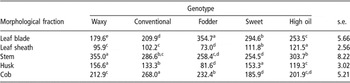
Table 1 shows the proportion of different morphological fractions of stovers from five maize genotypes. Waxy maize had higher proportions of stem and husk and a lower proportion of leaf blade (P < 0.05) than those of other four genotypes (except for husk of sweet maize). Fodder maize had the highest proportion of leaf blade and the lowest proportions of leaf sheath and husk (P < 0.05) among the five genotypes. The highest proportions of cob and leaf sheath (P < 0.05) were observed in conventional and high-oil maize varieties, respectively.
Proportion (g/kg DM) of morphological fractions of stover from five maize genotypes

a,b,c,d,eMeans with different superscripts in the same row are significantly different (P < 0.05); DM = dry matter.
The stem fraction comprised the highest proportion (between 254.5 and 355.0 g/kg DM) of whole-plant maize stover, followed by cob and leaf blade in genotypes of waxy, conventional and high oil. However, leaf blade comprised the highest proportion of total stover, followed by stem and cob in fodder and sweet genotype. With the exception of leaf sheath, husk tended to comprise a lower proportion of total stover. It was reported that stem constituted about 0.45 to 0.53 proportion of the total maize stover (Tolera and Sundstøl, Reference Tolera and Sundstøl1999). The differences between the present and previous studies may have resulted from the genetic variation in the genotypes and planting conditions. On the other hand, the stage of maturity and length of stubble have been documented as factors that could affect the morphological composition of cereal straws (Theander and Åman, Reference Theander and Åman1984). Russell (Reference Russell1986) reported that the stem proportion increased and the proportion of leaves decreased with the increasing maturity stage of maize.
Chemical composition
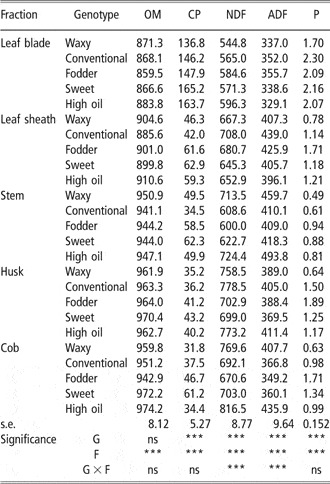
A number of main and interactive effects of genotype and morphological fraction on chemical composition of maize stover fractions were identified (Table 2). Maize genotype had a significant effect on the chemical composition of stover parts (P < 0.001). The stover fractions from sweet maize genotype were higher in CP content than the corresponding parts from other four maize genotypes. The highest and lowest P contents of stover fractions were observed from fodder and waxy maize genotypes, respectively. The genotype effect on OM, NDF and ADF contents of stover fractions varied with different morphological fractions. For example, the fractions of leaf blade and leaf sheath from high-oil maize genotype had lower ADF contents, while its fractions of stem, husk and cob had higher ADF contents. The variation in chemical composition among the five genotypes confirmed that varietal differences influence the biosynthesis of CP and fiber in maize. The differences in the P content of maize stover among the genotypes, despite similar soil and agronomic conditions and same P application levels, suggested differences in genetic potential between genotypes in P enrichment. The weighted mean of P content (1.28 g/kg DM) of stover fractions from the five genotypes was lower not only than that from corn silage (2.0 g/kg DM, Lacount et al., Reference Lacount, Drackley, Cicela and Clark1995) but also than that from whole rice plant silage (2.8 g/kg DM, Islam et al., Reference Islam, Nishida, Ando, Ishida, Yoshida and Arakawa2001). The possible reason may be the differences in the varieties and agronomic conditions applied in the different studies. Also, maturity stage may affect the P content of maize forage (Islam et al., Reference Islam, Nishida, Ando, Ishida, Yoshida and Arakawa2001).
Chemical composition (g/kg DM) of morphologic fractions for five maize genotype stovers

OM = organic matter; CP = crude protein; NDF = neutral detergent fiber; ADF = acid detergent fiber; P = phosphorous; G = genotype effect; F = morphological fraction effect; DM = dry matter; ns: not significant.
**P < 0.01, ***P < 0.001.
Chemical composition of stover parts was affected (P < 0.001) by morphological fractions. When averaged across the five maize genotypes, leaf blade had the highest CP (152 g/kg DM) and P (2.06 g/kg DM) content, and the lowest NDF (572 g/kg DM) and ADF (342 g/kg DM) contents compared with other morphological fractions; the highest NDF (742 g/kg DM) and the lowest CP (39 g/kg DM) contents were observed in husk; stem had the highest ADF (438 g/kg DM) and the lowest P (0.74 g/kg DM) contents; the highest OM (964.5 g/kg DM) content was observed in the husk of maize stover. This is consistent with the previous studies on other cereal straws (Bhargava et al., Reference Bhargava, Ørskov and Walli1988; Goto et al., Reference Goto, Takabe, Morita and Abe1992; Schulthess et al., Reference Schulthess, Tedla, Mohammed-Saleem and Said1995). Higher CP content, and lower NDF and ADF contents in the leaf blade of wheat straw were also observed in the previous study (Tan et al., Reference Tan, Chen, He, Fang and Xing1995). Leaf blade fraction of maize stover had the highest CP and lowest fiber (NDF and ADF) contents compared with other morphological fractions. This is similar to the findings observed in previous studies (Tolera and Sundstøl, Reference Tolera and Sundstøl1999; Tang et al., Reference Tang, Tan, Zhou, Jiang, Jiang and Sheng2006). It was reported that husk had a higher NDF content than leaves and stem, while stem had a higher ADF content than leaves and husk, respectively (Verbič et al., Reference Verbič, Stekar and Resnik-Čepon1995). There were significant interaction effects between genotype and morphological fraction on the OM, NDF and ADF contents of stover parts. The present results were in agreement with the findings of Wang et al. (Reference Wang, Wu, Liu and Qian2006), in which variety and the morphological fraction of rice straw had significant interaction effects on OM, NDF and ADF contents.
On the average, over 0.40 and 0.50 of P and CP contents of maize stover were contributed by leaf blade. Husk and leaf sheath, however, contributed little to the P and CP contents of stover (0.07 and 0.13, 0.08 and 0.09), while stem and cob contributed about 0.33 and 0.36 of CP and P contents of whole stover, respectively. The stem contributed the highest proportion of NDF (0.29) and ADF (0.32), both leaf sheath and husk contributed 0.25 NDF and 0.23 ADF to whole stover.
Leaf blade, stem and cob contributed over 0.75 of OM, CP, P and fiber contents of whole stover; this implied that the nutritive value of stover mainly depended upon the digestibility of these morphological fractions. Thus, the nutritive value could be improved by increasing the proportion of these fractions, especially leaf blade, which contributed over 0.50 CP of whole stover. However, the number of leaves per plant or the proportion of leaf blade in whole stover decreased with the delay in harvesting from the physiological maturity to the dead ripe stage (Harika and Sharma, Reference Harika and Sharma1994; Tolera et al., Reference Tolera, Berg and Sundstøl1999), and more leaf material than stem was lost in the process of harvesting and handling the stover. It is therefore important to choose the appropriate harvesting date in order to maximize the use of maize stover. Further study is therefore recommended to investigate the effects of maturity stage on the chemical composition and proportion of morphological fractions.
In vitro fermentation of stover parts
Morphological fractions of maize stovers differed in their volume of gas production in a decreasing order as follows: husk > cob > leaf sheath > stem > leaf blade (Figure 1). The observed decreasing order in gas production of morphological fractions in this study is not in agreement with the result of Tolera and Sundstøl (Reference Tolera and Sundstøl1999), in which the volume of in vitro gas production for stem was higher than that of leaf sheath. The rapid gas production in the early stage of fermentation recorded for husk and cob indicated higher contents of rapidly fermentable soluble components in these fractions. Similarly, gas production due to the fermentation of insoluble but fermentable feed components was highest in husk and was more rapid between 6 and 12 h of incubation (Tolera and Sundstøl, Reference Tolera and Sundstøl1999).
In vitro gas production of different morphological fractions. The mean value of five maize genotypes.

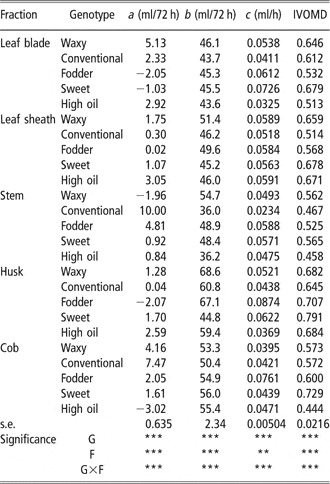
Significant effects of genotype and morphological fraction on in vitro gas production parameters and IVOMD of maize stovers were observed (Table 3). The genotype effect was not consistent in different morphological fractions. When averaged across all tested morphological fractions for each genotype, the potential gas production (a + b) (56.9 ml/72 h) of stover parts for waxy genotype was higher than for conventional and fodder genotype, which in turn were higher than for high-oil and sweet genotype (i.e. waxy > conventional > fodder > high oil > sweet). The rate of gas production (c) of stover fractions decreased in the following order: fodder > sweet > waxy > high oil > conventional. In vitro OM disappearance of stover parts from sweet genotype (0.688) was the highest, and the lowest value of IVOMD was observed in high-oil maize stover (0.554).
In vitro gas production parameters and OM disappearance of morphological part from five maize genotype stovers

a = the intercept of gas production curve; b = the proportion of gas production during time (t); c = the rate of gas production of the ‘b’ fraction; IVOMD = in vitro organic matter disappearance; G = genotype effect; F = morphological fraction effect; OM = organic matter.
**P < 0.01, ***P < 0.001.
The mean a values (2.9 ml/72 h and 2.5 ml/72 h, respectively) of stem and cob were higher, whereas the c values (0.047 and 0.050 ml/h, respectively) were lower than those of leaf sheath and husk (1.2 ml/72 h and 0.057 ml/h, 0.7 ml/72 h and 0.056 ml/h, respectively). The c value of leaf blade was numerically higher than those of stem and cob but numerically lower than those of leaf sheath and husk. The higher and lower a values in stem and husk were in agreement with the findings of Tolera and Sundstøl (Reference Tolera and Sundstøl1999) though all intercept values in their study were negative. Positive intercept values (a) in the current study could be due to the higher easily degradable components of feed. The higher c value of leaf blade could also be another indication of rapidly degradable nutrients in this portion of maize stover. Both b and (a + b) values decreased in the following order: husk > cob > leaf sheath > stem > leaf blade. Husk had the highest (P < 0.05) gas production rate compared with the other fractions and this is consistent with the results of Tolera and Sundstøl (Reference Tolera and Sundstøl1999) and Tang et al. (Reference Tang, Tan, Zhou, Jiang, Jiang and Sheng2006). However, the rate of gas production decreased in the following order: husk > cob > leaf sheath > steam > leaf blade, which was not consistent with the above-mentioned reports. This inconsistence may be attributed to the differences in variety and maturity stage of maize forage used in this study. Wang et al. (Reference Wang, Wu, Liu and Qian2006) reported that the stage and variety had significant effects on the rate of gas production of rice straw. Higher c value of husk indicates that it needs more time for the microbial population to multiply and colonize the insoluble substrate than that of the other fractions (Van Milgen et al., Reference Van Milgen, Berger and Murphy1993; Groot et al., Reference Groot, Cone, Williams, Debersaques and Lantinga1996). Husk was higher in IVOMD (0.702) than those of other morphological fractions. The IVOMD of morphological fractions decreased as follows: husk > leaf sheath > leaf blade > cob > stem. The significant (P < 0.001) interaction effects between a, b, (a + b), c and IVOMD were observed in the current study.
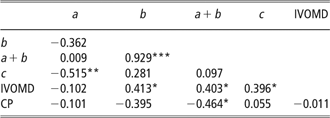
A significant positive correlation (P < 0.05) was observed between IVOMD and the values of b, a + b and c (Table 4). The value of c was negatively correlated (P < 0.01) with the a value, a significant negative relationship (P < 0.05) was also found between the CP content and the potential gas production (a + b). The potential gas production and IVOMD represented the degradable feed component; therefore, higher values of potential gas production and IVOMD for husk implied that it was more digestible than the other fractions (Hovell et al., Reference Hovell, Ngambi, Barber and Kyle1986). Similarly, waxy maize stover had higher values of a + b and IVOMD than conventional, fodder and high-oil genotypes, indicating that it had higher digestibility than the other maize stovers mentioned above. Simultaneously, a negative relationship between CP content and gas production was also noted in the previous studies (Cone and van Gelder, Reference Cone and van Gelder1999; Tolera and Sundstøl, Reference Tolera and Sundstøl1999). The high CP concentration of leaf blades probably contributed to the rather low potential gas production of these fractions.
The Pearson correlation coefficient between in vitro fermentation parameters and crude protein contents (n = 25)
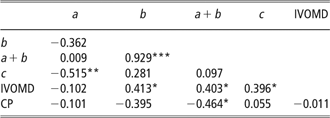
CP = crude protein; IVOMD = in vitro organic matter disappearance; a = the intercept of gas production curve; b = the proportion of gas production during time (t); c = the rate of gas production of the ‘b’ fraction.
*P < 0.05, **P < 0.01, ***P < 0.001.
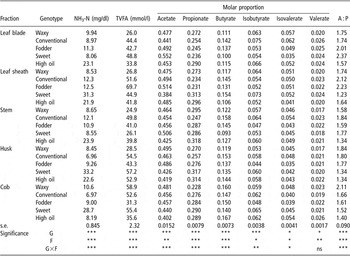
The effects of genotype and morphological fraction on NH3-N and total volatile fatty acid (TVFA) concentration, and the molar proportion of VFA in the supernatant after 72 h of incubation, are shown in Table 5. The genotype of maize stover had significant effects (P < 0.05) on NH3-N concentration. On the average, leaf sheath had the highest concentration of NH3-N (17.3 mg/dl). Higher NH3-N concentration in stover parts of the sweet and high-oil genotypes and in the fractions of leaf sheath indicated that protein in these feeds was highly degradable in the process of in vitro fermentation. Acetic acid molar proportions of morphological fractions and genotypes were lower while propionic acid and butyric acid molar proportions were higher than the results from previous studies (Tolera et al., Reference Tolera, Sundstøl and Said1998; Tolera and Sundstøl, Reference Tolera and Sundstøl1999), which were in the range of 0.437 to 0.483, 0.254 to 0.301 and 0.121 to 0.153, respectively. The propionic acid proportions of new maize genotypes and the husk fraction were higher than those of the conventional variety and other fractions. This may imply that the new maize varieties and husk supply more efficient energy than the conventional variety or the other fractions for ruminants. Husk had the highest TVFA concentration of the supernatant after 72 h incubation, which was consistent with the study of Tolera and Sundstøl (Reference Tolera and Sundstøl1999). The highest molar proportions of propionic acid in the supernatant were from stem and husk, and the lowest from leaf blade. This is in agreement with the findings of Tolera and Sundstøl (Reference Tolera and Sundstøl1999). With the exception of valeric acid, the molar proportion of other VFAs showed significant interaction effects between genotype and morphological fraction.
NH3-N concentration, volatile fatty acid content and molar proportion of the supernatant after incubation of 30 ml rumen liquor/buffer and 200 mg dry matter of different morphological fractions from five maize genotype forages for 72 h in vitro gas production

TVFA = total volatile fatty acid; A : P = the ratio of acetic acid and propionic acid; G = genotype effect; F = morphological fraction effect; ns = not significant.
*P < 0.05, **P < 0.01, ***P < 0.001.
Conclusions
The proportion of the morphological fractions was influenced by the genotype of maize. Leaf blade had the strongest ability in enriching P compared with the other morphological fractions and contributed over 0.40 and 0.50 of P and CP in the whole-plant maize stover. Husk had higher in vitro OM digestibility among five fractions, and the new maize genotypes (waxy, fodder, sweet and high oil) probably had higher digestibility based on the potential gas production and the rate of gas production, IVOMD and TVFA concentration compared with the conventional genotype.
Acknowledgments
The authors would like to express their most sincere gratitude and appreciation to the Chinese Academy of Sciences (No. kscx2-YW-N-022), the Ministry of Science and Technology of China (2006BAD04A15) and the Natural Science Foundation of Hunan Province (No. 05JJ10004) for jointly providing the financial support for this study. Grace Tayo gratefully acknowledges the support of a postdoctoral fellowship grant from the Chinese Academy of Sciences (CAS) and the Academy of Sciences of the Developing World (TWAS).