INTRODUCTION
Indonesia is an archipelago consisting of 17 504 islands. The five largest islands are Sumatra, Java, Kalimantan, Sulawesi and Papua. Administratively, the country is divided into 33 provinces (under the new constitution of Indonesia in 2012 is divided into 34 provinces) with a total population of 237 641 326. The majority of the population of Indonesia is Muslim (87·18%), whereas the remaining 12·82% consists of Christians, Buddhists, Hindus and others. Christian populations are the majority in certain districts in several provinces of Indonesia such as East Nusa Tenggara, North Sulawesi, Papua and North Sumatra. By contrast, in Bali Provinces, the majority of the 3 890 757 inhabitants are Hindus (83·5%) (Statistics Indonesia, 2011). Different religious and socio-cultural backgrounds in these provinces may affect the number of cases or prevalence of the major human cestode parasites in Indonesia. Usually, taeniases due to the ingestion of uncooked meat are in general rare in Indonesia, since Muslims usually do not eat uncooked meat.
Historically, Taenia saginata taeniasis in Indonesia was first reported in the 19th century, where Luchtmans found this disease among the Dutch in East Java in 1867 (Oemijati, Reference Oemijati1977). By contrast, taeniasis due to Taenia solium was identified from a Chinese living in East Kalimantan in 1940 (Bonne, Reference Bonne2006).
Through joint projects starting in 1996, we have confirmed the occurrence of taeniases due to T. saginata from Bali, T. solium from Papua and Bali, and T. asiatica from Samosir Island in Lake Toba, North Sumatra. T. saginata taeniasis is rather common in Bali where local people consume uncooked beef dish (beef lawar) as a traditional local food (Simanjuntak et al. Reference Simanjuntak, Margono, Okamoto and Ito1997; Wandra et al. Reference Wandra, Margono, Gafar, Saragih, Sutisna, Sudewi, Depary, Yulfi, Darlan, Okamoto, Sato, Sako, Nakao, Nakaya, Craig and Ito2007).
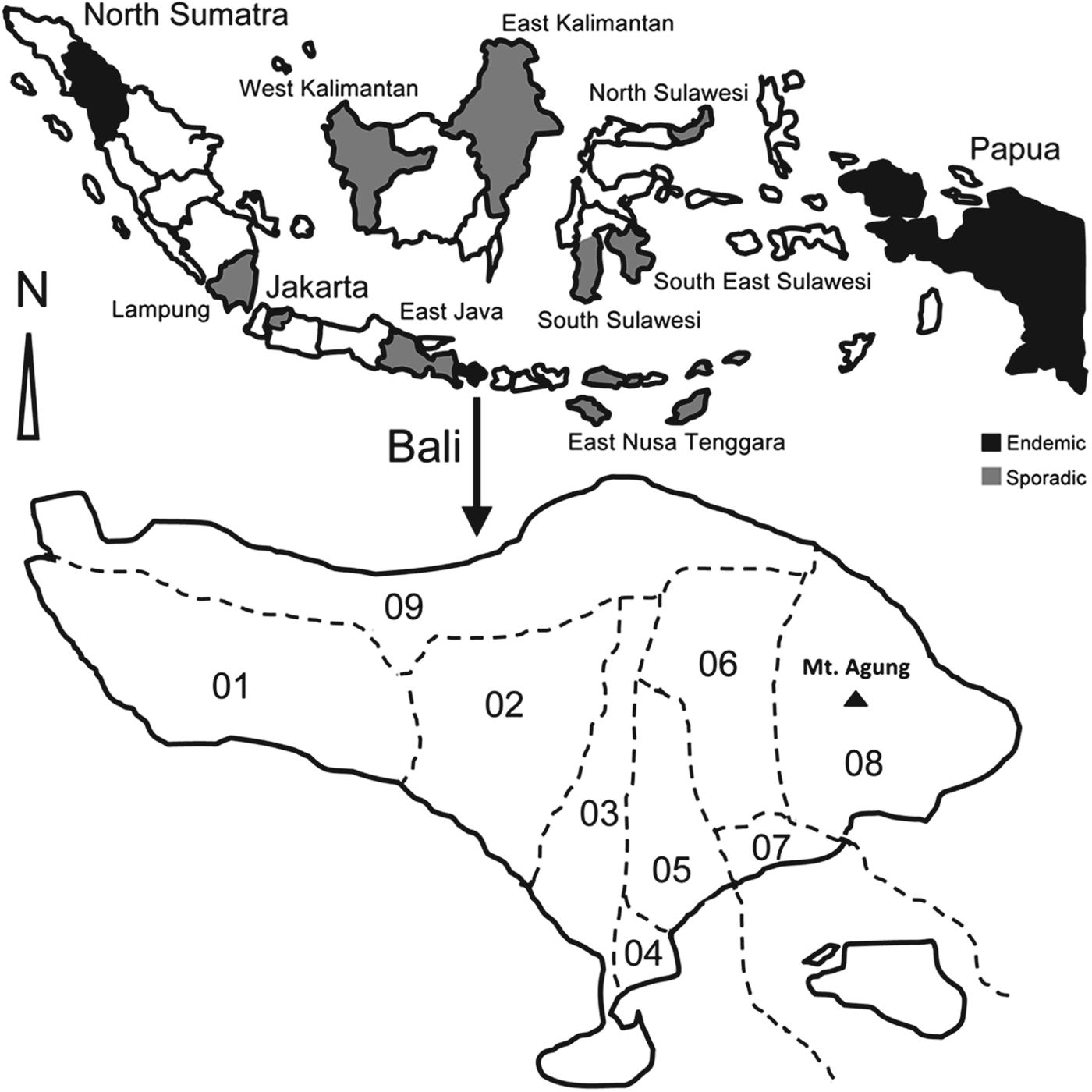
Taeniases due to T. saginata and/or T. asiatica and T. solium and cysticercosis due to T. solium have also been sporadically reported from other provinces: Lampung, Jakarta, West Kalimantan, North Sulawesi, South Sulawesi, South-East Sulawesi and East Nusa Tenggara (Fig. 1) (Simanjuntak et al. Reference Simanjuntak, Margono, Okamoto and Ito1997; Margono et al. Reference Margono, Ito and Suroso2001a, Reference Margono, Himawan, Purnama, Subahar, Hamid and Ito2002; Ito et al. Reference Ito, Wandra, Yamasaki, Nakao, Sako, Nakaya, Margono, Suroso, Gauci and Lightowlers2004; Suroso et al. Reference Suroso, Margono, Wandra and Ito2006; Wandra et al. Reference Wandra, Margono, Gafar, Saragih, Sutisna, Sudewi, Depary, Yulfi, Darlan, Okamoto, Sato, Sako, Nakao, Nakaya, Craig and Ito2007).
Geographic maps of Indonesia (upper) and Bali (lower). 01–09: nine districts in Bali: Jembrana (01), Tabanan (02), Badung (03), Denpasar (04), Gianyar (05), Bangli (06), Klungkung (07), Karangasem (08), and Buleleng (09). Denpasar is the capital city of Bali.

DISTRIBUTION OF TAENIASIS AND CYSTICERCOSIS
T. solium cysticercosis in Papua (formerly Irian Jaya)
In Papua, taeniasis/cysticercosis (T/C) cases due to T. solium were first reported from Paniai district in early 1970s (Tumada and Margono, Reference Tumada and Margono1973a, Reference Tumada and Margonob; Desowitz et al. Reference Desowitz, Margono and Simanjuntak1977). In this district, increased number of cases of seizures and burns were reported from people sleeping around fire-places in local houses (Tumada and Margono, Reference Tumada and Margono1973b). During 1973–1976, the number of cases of burns increased up to 257, resulting from accidents due to epileptic seizures (Subianto et al. Reference Subianto, Tumada and Margono1978). In Enarotali hospital, Paniai, a total of 15/170 hospitalized patients were positive for Taenia eggs (9%). Within 6 months (1972–1973), 13 cysticercosis cases were reported, and a total of 77·3% of suspected cysticercosis patients were serologically positive (Desowitz et al. Reference Desowitz, Margono and Simanjuntak1977).
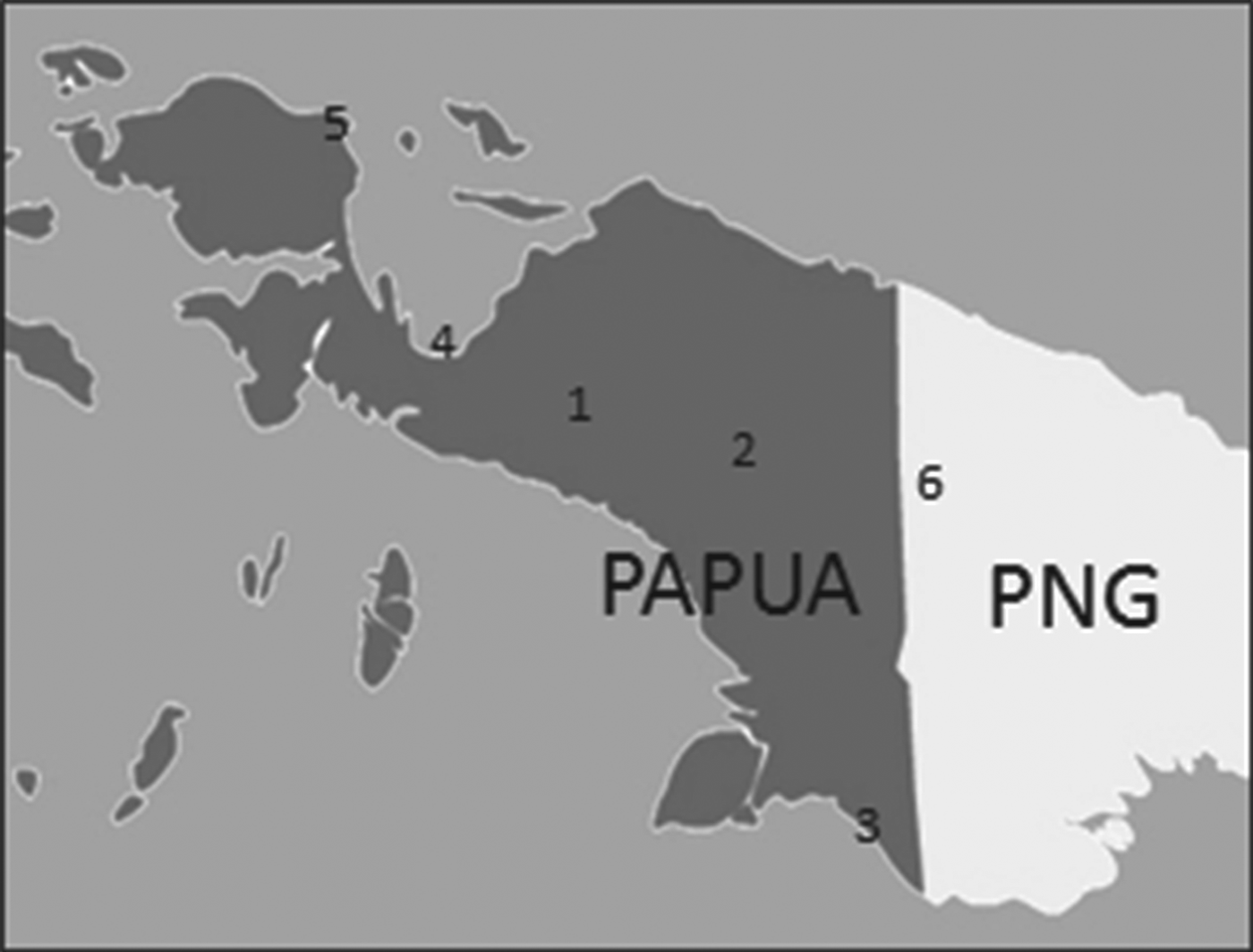
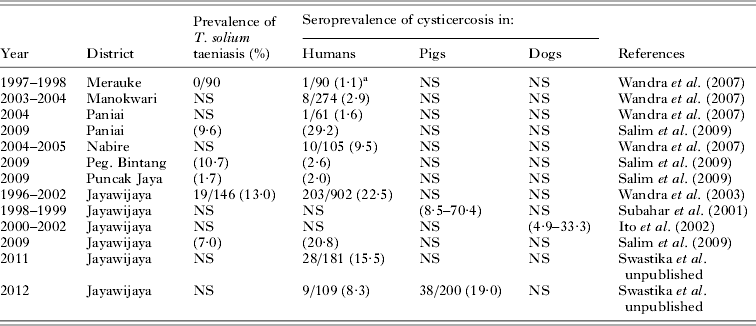
Movement of people from the endemic district (Paniai) to other districts, sometimes with pigs as the traditional and socio-cultural life style, appears to have spread the parasite to other 5 districts in Papua (Jayawijaya, Manokwari, Nabire, Pegunungan Bintang and Puncak Jaya) (Table 1, Fig. 2) (Simanjuntak et al. Reference Simanjuntak, Margono, Okamoto and Ito1997; Wandra et al. Reference Wandra, Margono, Gafar, Saragih, Sutisna, Sudewi, Depary, Yulfi, Darlan, Okamoto, Sato, Sako, Nakao, Nakaya, Craig and Ito2007; Salim et al. Reference Salim, Ang, Handali and Tsang2009) and even into Papua New Guinea (PNG) (Fritzsche et al. Reference Fritzsche, Gottstein, Wigglesworth and Eckert1990: Flew, Reference Flew1998; Ito et al. Reference Ito, Wandra, Yamasaki, Nakao, Sako, Nakaya, Margono, Suroso, Gauci and Lightowlers2004; Owen, Reference Owen2006).
Map of Papua (former Irian Jaya) and Papua New Guinea (PNG). Numbers 1–6 are District names in Papua and PNG. 1: Paniai where the first outbreak of NCC was reported in 1970’ (Tumada and Margono, Reference Tumada and Margono1973a, Reference Tumada and Margonob; Desowitz et al. Reference Desowitz, Margono and Simanjuntak1977), 2: Jayawijaya where it was reported in 1990’, 3: Merauke where only one imported case was found; 4 and 5: Nabire and Manokwari, respectively, where it was reported in 2000’, 5: Manokwari where only imported case was found, 6: OK Teddy Mine where NCC cases were confirmed in 1997 (Flew, Reference Flew1998; Ito et al. Reference Ito, Wandra, Yamasaki, Nakao, Sako, Nakaya, Margono, Suroso, Gauci and Lightowlers2004; Owen, Reference Owen2006).
Summarized data of prevalence of taeniases and seroprevalence of cysticercosis due to T. solium in Papua by District, 1996–2012 (Subahar et al. Reference Subahar, Hamid, Purba, Wandra, Karma, Sako, Margono, Craig and Ito2001; Ito et al. Reference Ito, Putra, Subahar, Sato, Okamoto, Sako, Nakao, Yamasaki, Nakaya, Craig and Margono2002; Wandra et al. Reference Wandra, Ito, Yamasaki, Suroso and Margono2003, Reference Wandra, Margono, Gafar, Saragih, Sutisna, Sudewi, Depary, Yulfi, Darlan, Okamoto, Sato, Sako, Nakao, Nakaya, Craig and Ito2007; Salim et al. Reference Salim, Ang, Handali and Tsang2009)
NS: no sample.
a Imported case.
In Jayawijaya district, neurocysticercosis (NCC) appears to remain highly endemic, since people suffering from epileptic seizures and subsequently drowned in rivers were reported from District Health Office Services (Handali et al. Reference Handali, Liying, Lusikoy, Senis and Sihombing1997; Simanjuntak et al. Reference Simanjuntak, Margono, Okamoto and Ito1997). During 1991–1995, the number of cases of epileptic seizures increased each year at a local health centre with a total 293 new cases of epileptic seizures and 1120 cases of burns. Serology, using highly specific native or recombinant antigens (Ito et al. Reference Ito, Plancarte, Ma, Kong, Flisser, Cho, Liu, Kamhawi, Lightowlers and Schantz1998, Reference Ito, Plancarte, Nakao, Nakaya, Ikejima, Piao, Kanazawa and Margono1999, Reference Ito, Wandra, Yamasaki, Nakao, Sako, Nakaya, Margono, Suroso, Gauci and Lightowlers2004; Sako et al. Reference Sako, Nakao, Ikejima, Piao, Nakaya and Ito2000, 2013; Sato et al. Reference Sato, Yamasaki, Sako, Nakao, Nakaya, Plancarte, Kassuku, Dorny, Geerts, Benitez-Ortiz, Hashiguchi and Ito2003 – see this Special Issue of Parasitology, volume 140) and mitochondrial DNA (mtDNA) analysis (Yamasaki et al. Reference Yamasaki, Allan, Sato, Nakao, Sako, Nakaya, Qiu, Mamuti, Craig and Ito2004), revealed that the majority of cases of epileptic seizures and burns were due to the presence of cysticerci of T. solium, and approximately 25–30% of healthy people were asymptomatic but positive for cysticercosis as well (Wandra et al. Reference Wandra, Subahar, Simanjuntak, Margono, Suroso, Okamoto, Nakao, Nakaya, Schantz and Ito2000, Reference Wandra, Ito, Yamasaki, Suroso and Margono2003; Ito et al. Reference Ito, Wandra, Yamasaki, Nakao, Sako, Nakaya, Margono, Suroso, Gauci and Lightowlers2004; Yamasaki et al. Reference Yamasaki, Allan, Sato, Nakao, Sako, Nakaya, Qiu, Mamuti, Craig and Ito2004).
An epidemiological study on T/C was carried out in 5 districts of Papua in 1996–2005. A total of 1474 persons were surveyed using both questionnaires and physical examinations, detection of taeniasis by copro-ELISA and mtDNA analyses. Serology of people, pigs and dogs was conducted for the detection of antibodies against cysticerci of T. solium. A total prevalence of 13·0% for T. solium taeniasis was confirmed in Jayawijaya district. No T. saginata or T. asiatica has been found from Papua. A total seroprevalence of 15·7% cysticercosis was detected in all of five districts (Jayawijaya, Manokwari, Nabire, Paniai and Merauke) (Fig. 2). The seroprevalence of cysticercosis in humans in each district was highly variable from 1·1% in Merauke (1997–1998) to 22·5% in Jayawijaya (1996–2002). There is no evidence that T. solium transmission occurs in Merauke. One woman showing a high antibody titre in 2007 was a transmigrant from South Sulawesi. Seroprevalence of cysticercosis in pigs in Jayawijaya ranged from 8·5–70·4% during 1998–1999 and in dogs from 4·9–33·3% in 2000–2002 (Subahar et al. Reference Subahar, Hamid, Purba, Wandra, Karma, Sako, Margono, Craig and Ito2001; Ito et al. Reference Ito, Putra, Subahar, Sato, Okamoto, Sako, Nakao, Yamasaki, Nakaya, Craig and Margono2002, Reference Ito, Wandra, Yamasaki, Nakao, Sako, Nakaya, Margono, Suroso, Gauci and Lightowlers2004; Margono et al. Reference Margono, Ito, Sato, Okamoto, Subahar, Yamasaki, Hamid, Wandra, Purba, Nakaya, Ito, Craig and Suroso2003; Wandra et al. Reference Wandra, Margono, Gafar, Saragih, Sutisna, Sudewi, Depary, Yulfi, Darlan, Okamoto, Sato, Sako, Nakao, Nakaya, Craig and Ito2007) (Table 1). As dog meat is available in Papua, dogs as well as pigs may play a role in the completion of the T. solium life cycle (Ito et al. Reference Ito, Putra, Subahar, Sato, Okamoto, Sako, Nakao, Yamasaki, Nakaya, Craig and Margono2002, Reference Ito, Wandra, Yamasaki, Nakao, Sako, Nakaya, Margono, Suroso, Gauci and Lightowlers2004).
Salim et al. (Reference Salim, Ang, Handali and Tsang2009) reported seroprevalence of cysticercosis and taeniasis in four districts: They are 20·8 and 7·0%, respectively in Jayawijaya, 29·2 and 9·6% in Paniai, 2·6 and 10·7% in Pegunungan Bintang and 2·0 and 1·7% in Puncak Jaya. As we have no previous data on T/C in the latter two districts, it is impossible to evaluate these data, especially the uniqueness showing high prevalence of taeniasis but very low cysticercosis in Pegunungan Bintang without direct evidence other than indirect serological data.
The recent field survey of cysticercosis in Jayawijaya revealed that 15·5% (2011) and 8·3% (2012) of humans and 19% of pigs (2012) were seropositive for cysticercosis (Swastika et al. unpublished). The serological tools applied in Papua were ELISA, immunoblot for both people and pigs, and for people the commercially available immunochromatographic rapid kit (ADAMU-CC, ICST Co. Ltd., Saitama, Japan) using recombinant antigens and native but highly purified antigens (Sako et al. 2013). Subcutaneous cysticerci of T. solium were confirmed from several sero-positive volunteers. Compared to serological data in Jayawijaya (1996–2009), seroprevalence of cysticercosis in humans and pigs appears to be relatively lower in 2011–2012 but further follow-up studies on a larger scale are necessary to discuss the future perspectives. The data from the two groups, sero-positive and sero-negative for cysticercosis in Jayawijaya (1996–2002), showed that the most important factors associated with cysticercosis were age (18 years or older), low level of education and the habit of not washing hands before eating. Furthermore, among 506 families in Jayawijaya, surveyed during 1996–2005, it was reported that only 17% were defaecated in a latrine (Wandra et al. Reference Wandra, Margono, Gafar, Saragih, Sutisna, Sudewi, Depary, Yulfi, Darlan, Okamoto, Sato, Sako, Nakao, Nakaya, Craig and Ito2007).
Taeniasis/cysticercosis in Papua New Guinea
There is a possibility of introduction of T/C due to T. solium to the neighbouring country, PNG (Fritzsche et al. Reference Fritzsche, Gottstein, Wigglesworth and Eckert1990; McManus, Reference McManus1995; Flew, Reference Flew1998; Ito et al. Reference Ito, Wandra, Yamasaki, Nakao, Sako, Nakaya, Margono, Suroso, Gauci and Lightowlers2004; Dwyer, Reference Dwyer2006; Owen, Reference Owen2006). A serological survey of OK Teddy Mine in PNG (Fig. 2) was carried out in 1997 using approximately 600 human serum samples. Based on both ELISA and immunoblot examinations, approximately 3% were confirmed serologically-positive for cysticercosis (Flew, Reference Flew1998; Ito et al. Reference Ito, Wandra, Yamasaki, Nakao, Sako, Nakaya, Margono, Suroso, Gauci and Lightowlers2004). It is, therefore, urgent to conduct field surveys of T/C in PNG.
Taeniases/cysticercosis in Bali
Historically, the first report of cysticercotic pigs in Bali was published in 1928 (Le Coultre, Reference Le Coultre1928). Human subcutaneous cysticercosis (SCC) cases were reported in 1960 (Soebroto et al. Reference Soebroto, Tjing and Nmoeljono1960). There are several reports on T. solium, epileptic seizures, SCC, NCC, and seroprevalence of cysticercosis in Bali (Ngoerah, Reference Ngoerah1975; Simanjuntak et al. Reference Simanjuntak, Margono, Schalan, Harjono, Rasidi and Sutopo1977; Theis et al. Reference Theis, Goldsmith, Flisser, Koss, Chioino, Plancarte, Sugura, Widjana and Sutisna1994; Rodriguez-Canul et al. Reference Rodriguez-Canul, Allan, Fletes, Sutisna, Kapti and Craig1997; Sutisna et al. Reference Sutisna, Flaser, Kapti, Rodriguez-Canul, Puta Widjana, Craig and Allan1999; Margono et al. Reference Margono, Subahar, Hamid, Wandra, Raka Sudewi, Sutisna and Ito2001b, Reference Margono, Himawan, Purnama, Subahar, Hamid and Ito2002; Wandra et al. Reference Wandra, Depary, Sutisna, Margono, Suroso, Okamoto, Craig and Ito2006a, Reference Wandra, Sutisna, Dharmawan, Margono, Sudewi, Suroso, Craig and Itob, Reference Wandra, Sudewi, Swastika, Sutisna, Dharmawan, Yulfi, Darlan, Kapti, Samaan, Sato, Okamoto and Ito2011; Sudewi et al. Reference Sudewi, Wandra, Artha, Nkouawa and Ito2008).
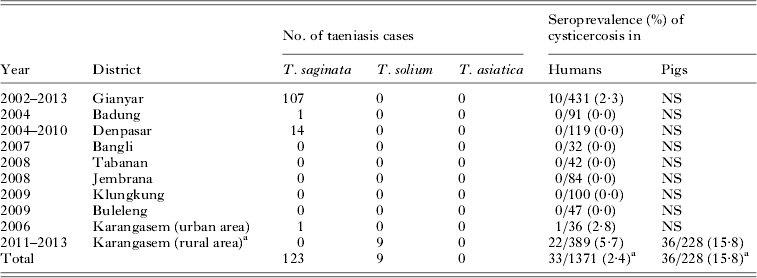
Taeniasis cases have been observed in all nine districts of Bali Province (Gianyar, Badung, Denpasar, Bangli, Tabanan, Jembrana, Klungkung, Buleleng and Karangasem) during 2002–2013 (Fig. 1). A total of 1492 persons were surveyed using both questionnaires and physical examinations. Taenia eggs were detected by microscopic examination of faecal samples (Kato-Katz method). Identification of Taenia species using the expelled proglottids was carried out by mitochondrial DNA analysis (Yamasaki et al. Reference Yamasaki, Allan, Sato, Nakao, Sako, Nakaya, Qiu, Mamuti, Craig and Ito2004; Myadagsuren et al. Reference Myadagsuren, Davaajav, Wandra, Sandar, Ichinkhorloo, Yamasaki, Sako, Nakao, Sato, Nakaya and Ito2007; Wandra et al. Reference Wandra, Margono, Gafar, Saragih, Sutisna, Sudewi, Depary, Yulfi, Darlan, Okamoto, Sato, Sako, Nakao, Nakaya, Craig and Ito2007). Serology of people (1369) and pigs (228) was carried out for the detection of T. solium cysticercosis.
Among 1492 people, a total of 123 T. saginata taeniasis cases were found which were distributed in four districts (Gianyar, Badung, Denpasar and an urban area in Karangasem) (107, 1, 14 and 1 cases, respectively), and 9 cases of T. solium taeniasis in Karangasem (rural area). T. solium was first observed in rural area of Karangasem in 2011 (3 cases) after one decade of surveys in Bali from 2002 onwards (Fig. 1) (Wandra et al. Reference Wandra, Sudewi, Swastika, Sutisna, Dharmawan, Yulfi, Darlan, Kapti, Samaan, Sato, Okamoto and Ito2011; Swastika et al. unpublished).
So far, there is no real evidence of T. asiatica in Bali (Table 2). We have concluded from interviews that this is because the majority of local people prefer uncooked pork lawar but dislike uncooked viscera of pigs. It is crucial difference from local people in Samosir Island in Lake Toba, North Sumatra (see below). However, several persons interviewed in Karangasem in 2013 told us that they consumed undercooked liver of pigs as well as pork. Therefore, the possibility of an epidemic of T. asiatica taeniasis remains at least in this area, especially when carriers of T. asiatica taeniasis visit this area and pigs are contaminated with eggs of this parasite, and meat and viscera of pigs are served as a local dish without meat inspection.
Summarized data of taeniasis cases and seroprevalence of cysticercosis by District in Bali, 2002–2013 (Wandra et al. Reference Wandra, Depary, Sutisna, Margono, Suroso, Okamoto, Craig and Ito2006a, Reference Wandra, Sutisna, Dharmawan, Margono, Sudewi, Suroso, Craig and Itob, Reference Wandra, Margono, Gafar, Saragih, Sutisna, Sudewi, Depary, Yulfi, Darlan, Okamoto, Sato, Sako, Nakao, Nakaya, Craig and Ito2007, Reference Wandra, Sudewi, Swastika, Sutisna, Dharmawan, Yulfi, Darlan, Kapti, Samaan, Sato, Okamoto and Ito2011; Sudewi et al. Reference Sudewi, Wandra, Artha, Nkouawa and Ito2008)
NS: no sample.
a Swastika et al. unpublished.
A total of seroprevalence of 2·4% T. solium cysticercosis was confirmed using both glycoproteins purified from T. solium cyst fluid (Ito et al. Reference Ito, Plancarte, Ma, Kong, Flisser, Cho, Liu, Kamhawi, Lightowlers and Schantz1998) and chimeric recombinant antigen (Sako et al. Reference Sako, Nakao, Ikejima, Piao, Nakaya and Ito2000; Sato et al. Reference Sato, Yamasaki, Sako, Nakao, Nakaya, Plancarte, Kassuku, Dorny, Geerts, Benitez-Ortiz, Hashiguchi and Ito2003). Among 1369 human serum samples examined after mass screening in the nine districts, serum samples from only 2 districts (Gianyar and Karangasem) were sero-positive for cysticercosis (2·3 and 2·8%, respectively). A total of sero-prevalence of 15·8% (36/228) [5 of 64 (7·8%) in 2011 (based on ELISA and immunoblot) and 18·9% (31/164) in 2013 (based on ELISA)] was detected in pigs in Karangasem (Table 2) (Swastika et al. unpublished). So, there can be no doubt that Karangasem is exceptionally highly endemic with T/C in Bali.
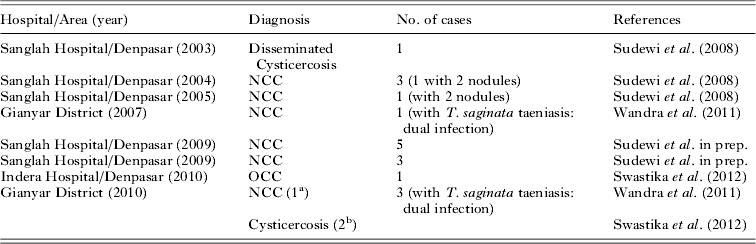
During 2003–2010, a total of 13 cases of T. solium cysticercosis from Sanglah Hospital, University of Udayana and 1 case from Indera Hospital, Denpasar, were reported sporadically. These cases were mostly from people living in Gianyar and Karangasem and the remaining cases lived in other districts. A total of 4 cases were detected in the field during epidemiological an survey in Gianyar (Table 3) (Sudewi et al. Reference Sudewi, Wandra, Artha, Nkouawa and Ito2008; Wandra et al. Reference Wandra, Sudewi, Swastika, Sutisna, Dharmawan, Yulfi, Darlan, Kapti, Samaan, Sato, Okamoto and Ito2011). It is assumed that the source of infection of T. solium in Bali, especially in Gianyar, is due to T. solium carriers from Karangasem who periodically migrated to other districts of Bali for looking for jobs during the dry season from April to October.
Summarized data of cysticercosis in Bali, 2003–2010 (NCC: neurocysticercosis, OCC: ocular cysticercosis)
a Serology and CT Scan (+).
b Serology (+) but CT Scan (−).
There is a crucial difference in the socio-economic data of local people between Gianyar (2002–2004) and other districts (2004–2010) including Karangasem (2011). Almost all families in Gianyar have good sanitary facilities and do not defaecate in the backyard, and all pigs are kept indoors (Wandra et al. Reference Wandra, Depary, Sutisna, Margono, Suroso, Okamoto, Craig and Ito2006a, Reference Wandra, Sutisna, Dharmawan, Margono, Sudewi, Suroso, Craig and Itob). People in Gianyar like to eat uncooked beef ‘lawar’, whereas most people in other districts eat cooked beef (Wandra et al. Reference Wandra, Sudewi, Swastika, Sutisna, Dharmawan, Yulfi, Darlan, Kapti, Samaan, Sato, Okamoto and Ito2011). Lawar is a traditional local dish of raw pork or raw beef and it suggests a reason why we can detect taeniasis due to T. saginata every year in Gianyar. By contrast, in rural Karangasem, 29% (18/62) of families have no sanitary facilities and people defaecate in the garden, 83·9% (40/46), 10·9% (5/46) of pig owners keep their pigs in a fenced field, and 2·2% (1/46) in open common pasture and roaming free. Interviews of 62 respondents of 62 families in Karangasem in 2011 showed that all were Hindus, of whom 83·9% (52/62) consumed pork lawar and 9·7% (6/62) consumed beef lawar (Swastika et al. unpublished). Such crucial differences may be in part due to the crucial difference in geographic situation between the two districts. Gianyar is located between Karangasem and the capital city, Denpasar and is basically a flat region whereas the rural area in Karangasem is the slope of Mount. Agung (3142 m) (Fig. 1). Also, local beef contaminated with cysticerci of T. saginata may be widely consumed in Bali, but only people who eat uncooked beef become infected with T. saginata, as shown in Gianyar. It cannot explain the reason why T. saginata infections are not rare in people living in Badung, Denpasar and the urban area of Karangasem. Uncooked beef lawar is prepared and sold exclusively in Gianyar. So, people in other districts may acquire infection by consumption of beef lawar prepared in Gianyar by (1) attending religious ceremonies in Gianyar, or (2) people from Gianyar bringing beef lawar as a gift mainly for the religious ceremonies for their relatives or friends living in other districts.
However, the source of infection for T. saginata taeniasis is still not clear, since cattle in Bali are also slaughtered in unlicensed slaughterhouses. Quality control of beef, even in the markets, is rather difficult because of the limited number of meat inspectors (Wandra et al. Reference Wandra, Depary, Sutisna, Margono, Suroso, Okamoto, Craig and Ito2006a, Reference Wandra, Margono, Gafar, Saragih, Sutisna, Sudewi, Depary, Yulfi, Darlan, Okamoto, Sato, Sako, Nakao, Nakaya, Craig and Ito2007). During 2002–2004, three of 56 T. saginata carriers in Gianyar were beef lawar sellers and several other taeniasis carriers bought lawar from these sellers (Wandra et al. Reference Wandra, Sutisna, Dharmawan, Margono, Sudewi, Suroso, Craig and Ito2006b). In addition, screening of 15 lawar sellers in 2004 revealed that 40% (6/15) of them were T. saginata carriers (Wandra et al. Reference Wandra, Sudewi, Swastika, Sutisna, Dharmawan, Yulfi, Darlan, Kapti, Samaan, Sato, Okamoto and Ito2011).
Taeniasis/cysticercosis in Samosir Island, Lake Toba, North Sumatra
Although T. asiatica was described as an independent species by Eom and Rim (Reference Eom and Rim1993), this parasite has been recognized for long time as common in Asia and known as ‘Asian Taenia’ which is common in people who eat meat and viscera of pigs but not cattle in Taiwan, the Philippines and Indonesia (Yokogawa, Reference Yokogawa1935; Huang et al. Reference Huang, Lin and Khaw1966; Kosin et al. Reference Kosin, Depary and Djohansjah1972; Chao and Fan, Reference Chao and Fan1986; Fan et al. Reference Fan, Chung, Chan, Wong, Wu, Hsu, Huang and Chen1987, Reference Fan, Soh and Kosin1990a, b; Fan, Reference Fan1988; Kosman et al. Reference Kosman, Depary, Napitupulu, Kosin and Fan1988; Simanjuntak et al. Reference Simanjuntak, Margono, Okamoto and Ito1997; Ito et al. Reference Ito, Nakao and Wandra2003, Reference Ito, Wen and Yamasaki2005; de Leon, Reference de Leon, Ito, Wen and Yamasaki2005). One example of this unique ‘Asian Taenia’ was reported as common tapeworms from Samosir Island (Kosin et al. Reference Kosin, Depary and Djohansjah1972). Epidemiological surveys in 1986 and 1987 revealed that 21% (97/465) of 76 families in Samosir Island were infected with ‘Asian Taenia’ (Kosman et al. Reference Kosman, Depary, Napitupulu, Kosin and Fan1988). The Indonesian parasitologists joined with Fan in Taiwan and confirmed the unique life cycle of this ‘Asian Taenia’ (Fan et al. Reference Fan, Soh and Kosin1990a, Reference Fan, Kosman, Kosin, Depary and Napitupulub). It is interesting to note that eggs of ‘Asian Taenia’ develop into mature metacestodes in the liver of pigs and cattle but not in muscle. Nonetheless, it has been stressed that T. asiatica inhabits the liver of pigs and differs from T. saginata in its organotropism for liver rather than muscle.
These Taiwan, Indonesian and Korean researchers regarded ‘Asian Taenia’ as an independent species (Chao and Fan, Reference Chao and Fan1986; Fan et al. Reference Fan, Chung, Chan, Wong, Wu, Hsu, Huang and Chen1987, Reference Fan, Soh and Kosin1990a). However, several researchers working on molecular differences between ‘Asian Taenia’ and T. saginata recommended that it should not be described as an independent species (Zarlenga et al. Reference Zarlenga, McManus, Fan and Cross1991; Bowles and McManus, Reference Bowles and McManus1994; Simanjuntak et al. Reference Simanjuntak, Margono, Okamoto and Ito1997). The most recent molecular studies on T. asiatica and T. saginata carried out in several areas where both species are occur sympatrically have revealed hybrids of these two species (Okamoto et al. Reference Okamoto, Nakao, Blair, Anantaphruti, Waikagul and Ito2010; Yamane et al. Reference Yamane, Suzuki, Tachi, Li, Chen, Nakao, Nkouawa, Yanagida, Sako, Ito, Sato and Okamoto2012, also see this Special Issue of Parasitology, volume 140, 2013). So, the species status is still under debate.
Recent epidemiological surveys of T/C and soil-transmitted helminthiases carried out in 2003, 2005 and 2006 revealed that six of 371 people (1·6%) from 285 families [2 of 58 (3·4%) in 2003 and 4 of 182 (2·2%) in 2005] were confirmed as infected with T. asiatica by multiplex PCR (Yamasaki et al. Reference Yamasaki, Allan, Sato, Nakao, Sako, Nakaya, Qiu, Mamuti, Craig and Ito2004; Wandra et al. Reference Wandra, Margono, Gafar, Saragih, Sutisna, Sudewi, Depary, Yulfi, Darlan, Okamoto, Sato, Sako, Nakao, Nakaya, Craig and Ito2007). We could not detect any case of T. asiatica in 2006 and there was no evidence of the occurrence of T. solium or T. saginata in this island, since all tapeworms were identified to be T. asiatica by multiplex PCR (Wandra et al. Reference Wandra, Margono, Gafar, Saragih, Sutisna, Sudewi, Depary, Yulfi, Darlan, Okamoto, Sato, Sako, Nakao, Nakaya, Craig and Ito2007). The residents of Samosir Island eat a traditional dish made with minced pork (Kosman et al. Reference Kosman, Depary, Napitupulu, Kosin and Fan1988; Fan et al. Reference Fan, Chung, Soh and Kosman1992). When they cut pork into small pieces, they eat uncooked viscera (liver) which contains the cysticerci of T. asiatica, which is a clear risk factor for taeniasis. It is more common for the butcher to taste the small pieces of viscera of pigs through preparation of these foods in North Sumatra (Wandra et al. Reference Wandra, Sutisna, Dharmawan, Margono, Sudewi, Suroso, Craig and Ito2006b, Reference Wandra, Margono, Gafar, Saragih, Sutisna, Sudewi, Depary, Yulfi, Darlan, Okamoto, Sato, Sako, Nakao, Nakaya, Craig and Ito2007).
Throughout our field surveys in Samosir Island in 2003, 2005 and 2006, microscopic stool examination of a total of 371 samples revealed that 45 (12·1%), 44 (11·9%) and 28 (7·5%) were positive for Ascaris lumbricoides, Trichuris trichiura and hookworm eggs, respectively. However, 30 (8·1%), 11 (3·0%) and 19 (5·1%) were mixed infections of both A. lumbricoides and T. trichiura, both A. lumbricoides and hookworms and both T. trichiura and hookworms. Furthermore, 15 (4·1%) were mixed infections of all three nematode species (Wandra et al. unpublished). By contrast, we could not detect any Taenia eggs. It indicates that taeniasis is a neglected NTD. We could confirm T. asiatica in Samosir Island based on the questionnaire and whether individuals had any experience of expulsion of proglottids. This approch was much more sensitive than the microscopic detection of eggs in faeces. All of the 285 respondents were Christians, 173 (60·7%) had no formal primary or secondary school education, 242 (84·9%) were farmers or merchants, and 146 (51·2%) of families had no sanitary facilities. Available data from 96 respondents from 96 families on behaviour and personal hygiene showed that the most of families (82·3%) obtained water from springs, 6·3% consumed water without boiling, 57·3% did not wash their hands before eating, 56·3% did not wash their hands after defaecating, and 39·6% ate raw vegetables and fruits. The drastic decrease in the number of taeniasis cases due to T. asiatica in Samosir Island is considered to be due to the change in eating boiled but not uncooked pork through sustainable education (Wandra et al. Reference Wandra, Margono, Gafar, Saragih, Sutisna, Sudewi, Depary, Yulfi, Darlan, Okamoto, Sato, Sako, Nakao, Nakaya, Craig and Ito2007, Reference Wandra, Sudewi, Swastika, Sutisna, Dharmawan, Yulfi, Darlan, Kapti, Samaan, Sato, Okamoto and Ito2011).
CONTROL STRATEGIES
Considering the differences in cultures, religions, levels of education, socio-economics, control strategies should be adapted to the local epidemiological situations. The following criteria are expected to take the priority (Suroso et al. Reference Suroso, Margono, Wandra and Ito2006; Wandra et al. Reference Wandra, Sutisna, Dharmawan, Margono, Sudewi, Suroso, Craig and Ito2006b): (1) Active case finding and treatment of tapeworm carriers; (2) Periodic hygiene checks of the traditional dishes concerned in transmission of infection; (3) Periodic check of the health of lawar sellers (in Bali) and including their family members; (4) Establishment of an inspection system to check the quality of beef/pork/viscera and determine the distribution of infected animals; (5) Investigation of the family members and the neighbourhoods of cysticercosis patients who were diagnosed at the hospital; (6) Sustainable public health education in personal hygiene, environmental sanitation, including improved practices related to pig and cattle raising, to all communities, and (7) Encouragement of political commitment and inter-sectoral collaboration at local, national and international levels. Improvement of simple diagnostic laboratory tools, strengthening surveillance system and establishment of reference laboratories are also essential.
FUTURE PERSPECTIVES
Recent advances in molecular and immuno-diagnostic tools, especially for the real-time detection of infections in people and pigs and even dogs have revealed that cysticercosis due to T. solium is a re-emerging disease in Bali and still an emerging disease in Papua. In Bali, most of the people live in the cities and towns and keep pigs indoors through sustainable education. Through our joint international projects over the last one decade, it has recently been revealed that from 2011 onwards there are still some villages where people keep pigs outdoors, and taeniasis and cysticercosis in local people and cysticercosis in pigs due to T. solium infection have been confirmed using the real-time detection tools (Ito, 2013 – see this Special Issue of Parasitology, volume 140). In 2011, we found three taeniasis carriers in the villages but in 2013 we found more carriers in people in the neighbouring village and the beach-side urban area of the same District. It is urgent task to prevent re-emergence of cysticercosis in Bali, Indonesia. Thus it is very important that we commence the eradication of T. solium from this area in Bali. Bali is a small island and basically rich with a good education system, and we would expect to eradicate this disease from Bali. Cysticercosis was rather common in Bali 2–3 decades ago (Sutisna et al. Reference Sutisna, Flaser, Kapti, Rodriguez-Canul, Puta Widjana, Craig and Allan1999) but we were unable to detect any T. solium tapeworm carriers in surveys conducted between 1996–2011 (Wandra et al. Reference Wandra, Sudewi, Swastika, Sutisna, Dharmawan, Yulfi, Darlan, Kapti, Samaan, Sato, Okamoto and Ito2011), which we assume to be due to the sustainable education here. However, we are now facing re-emergence of this disease in several villages in Karangasem. If this disease is distributed exclusively in this area, we have a great chance to eradicate it. Therefore, we have just started international joint project for transmission ecological studies of T/C in Karangasem with the third tool, GPS in order to obtain more concrete evidence (Giraudoux et al. Reference Giraudoux, Raoul, Pleydell, Li, Han, Qiu, Xie, Wang, Ito and Craig2013). In North Sumatra, people have changed their eating habitats from uncooked to cooked meat and viscera, even though they do not wash hands. Due to such drastic change in the life style, it is now very difficult to detect T. asiatica cases. It has taken approximately 30 years. If we can cut off the life cycle of T. asiatica or T. solium between pigs and humans, the pig is the ideal and economic animal which can scavenge human faeces without any Taenia after eradication. However, STHs are still common in North Sumatra. So, sustainable education regarding hand washing before eating and general improvements for the better standards of living are important. At this time, we have no clear ideas for control of taeniasis/cysticercosis in Papua. It will take much longer for control of this disease in Papua than in Bali. The local Government in Papua and the central Government in Jakarta are budgeting for the training public health personnel for control of this disease in Papua, but not yet in Bali. Also, such strategies are affected by the improvement in economy. Another difficulty in general is that we have the weakness to be tempted to eat uncooked foods.
In this review, we have discussed taeniases and cysticercosis in the three islands where we have worked over many years. Indonesia consists of more than 17 500 islands and the peoples of each island will have their own traditional life styles. Taeniasis due to T. saginata, T. asiatica or T. solium has not yet been identified by molecular tools in other islands.
ACKNOWLEDGEMENTS
We acknowledge many colleagues who have joined us in Samosir Island, Bali and Papua.
FINANCIAL SUPPORT
The studies were supported by Grant-in-Aid for scientific research (1994–2015) and Asia-Africa Scientific Platform Funds (2006–2008, 2009–2011) from the Japan Society for the Promotion of Science, and the Special Coordination Fund for Promoting Science and Technology (2003–2005, 2010–2012) from the Ministry of Education, Culture, Sports and Science & Technology in Japan (MEXT). The content is solely the authors’ responsibility and does not necessarily represent the official views of the funders.