Introduction
Although helminth infections are prevalent in tropical countries (World Health Organization, 2005), the worm burden and related morbidity vary from place to place due to host and environmental factors (Quinnell, Reference Quinnell2003). One of the host factors implicated in the variation in helminth infection across settings is the ABO blood group (Khattab et al., Reference Khattab, El-Gengehy and Sharaf1968; Camus et al., Reference Camus, Bina, Carlier and Santoro1977; Pareira et al., Reference Pareira, Bostolini, Carneiro, da Silva and Neves1979; T> et al., Reference T> , Goluska, O'Leary and Douglas1979; Ndamba et al., Reference Ndamba, Gomo, Nyazema, Makaza and Kaondera1997). However, the nature of this association remains uncertain (Gabr & Mandour, Reference Gabr and Mandour1991; Cooper et al., Reference Cooper, Guevara and Guderian1993; Ndamba et al., Reference Ndamba, Gomo, Nyazema, Makaza and Kaondera1997). Studies have documented a high prevalence of Schistosoma mansoni infection and high morbidity in individuals with blood type A (Khattab et al., Reference Khattab, El-Gengehy and Sharaf1968; Camus et al., Reference Camus, Bina, Carlier and Santoro1977; Pareira et al., Reference Pareira, Bostolini, Carneiro, da Silva and Neves1979; Ndamba et al., Reference Ndamba, Gomo, Nyazema, Makaza and Kaondera1997) and blood type B (T> et al., Reference T> , Goluska, O'Leary and Douglas1979). This could be due to N-acetyl-d-galactose polysaccharides in S. mansoni which have a structural resemblance to substances in the A and B blood groups (Dean, Reference Dean1974; Haseeb et al., Reference Haseeb, Thors, Linder and Eveland2008). The S. mansoni polysaccharides may serve as receptors to adsorb A and B antigens, leading to concealment of target antigens on the parasite's surface. By this mechanism it is hypothesized that S. mansoni may escape the host immune system (Haseeb et al., Reference Haseeb, Thors, Linder and Eveland2008) and cause greater morbidity in patients with blood types A and B.
On the other hand, some studies have reported a non-significant difference in the prevalence of S. mansoni infection or hepatosplenic forms of S. mansoni in individuals with different blood groups (Katz et al., Reference Katz, Tavares and Abrantes1976; El Masri & Sharfi, 1982; Gabr & Mandour, Reference Gabr and Mandour1991). Infections with Ascaris lumbricoides, Trichuris trichiura, hookworm, Hymenolepis nana and Enterobius vermicularis have not been associated with ABO blood group (Gabr & Mandour, Reference Gabr and Mandour1991; Cooper et al., Reference Cooper, Guevara and Guderian1993). These inconsistencies in previous findings necessitate further investigation.
Infections with A. lumbricoides, T. trichiura, hookworm and S. mansoni are known to be associated with a high risk of undernutrition and anaemia (Thein-Hlaing et al., Reference Thein-Hlaing, Thane-Toe, Than-Saw, Myat-Lay-Kyin and Myint-Lwin1991; Stoltzfus et al., Reference Stoltzfus, Chwaya, Tielsch, Schulze, Albonico and Savioli1997; Brooker et al., Reference Brooker, Peshu, Warn, Mosobo, Guyatt, Marsh and Snow1999; Curtale et al., Reference Curtale, Abdel-Fattah, el-Shazly, Shamy and el-Sahn2000; Stephenson et al., Reference Stephenson, Latham and Ottesen2000; Assis et al., Reference Assis, Prado, Barreto, Reis, Conceicao Pinheiro, Rraga and Blanton2004; Ulukanligil & Seyrek, Reference Ulukanligil and Seyrek2004, Koukounari et al., Reference Koukounari, Fenwick, Whawell, Kabatereine, Kazibwe, Tukahebwa, Stothard, Donnelly and Webster2006; Jardim-Botelho et al., Reference Jardim-Botelho, Brooker, Geiger, Fleming, Lopes, Diemert, Correa-Oliveira and Bothony2008). As the mechanisms by which these different worm types affect haemoglobin level and nutritional status vary (Brooker et al., Reference Brooker, Peshu, Warn, Mosobo, Guyatt, Marsh and Snow1999; Stephenson et al., Reference Stephenson, Latham and Ottesen2000; Friedman et al., Reference Friedman, Kanzaria and McGarvey2005; Pullan & Brooker, Reference Pullan and Brooker2008), the impact is thought to be additive when they co-exist in a host (Pullan & Brooker, Reference Pullan and Brooker2008). In addition, a greater intensity of infection has been reported among individuals co-infected with multiple intestinal helminth species (Faulkner et al., Reference Faulkner, Turner, Behnke, Kamgno, Rowlinson, Bradley and Boussinesq2005) which might exacerbate associated morbidity (Ezeamama et al., Reference Ezeamama, Friedman, Olveda, Acosta, Kurtis, Mor and McGarvey2005, 2007; Brito et al., Reference Brito, Barreto, Silva Rde, Assis, Reis, Parraga and Blanton2006; Brooker et al., Reference Brooker, Akhwale, Pullan, Estambale, Clarke, Snow and Hotez2007). However, reports regarding the effect of multiple helminth infections on haemoglobin and nutritional status are contradictory (Ezeamama et al., Reference Ezeamama, Friedman, Olveda, Acosta, Kurtis, Mor and McGarvey2005, Reference Ezeamama, McGarvey, Acosta, Zierler, Manalo, Wu, Kurtis, Mor, Olveda and Friedman2008; Brito et al., Reference Brito, Barreto, Silva Rde, Assis, Reis, Parraga and Blanton2006; Marini et al., Reference Marini, Maldonado-Contreras, Cabras, Hidalgo, Buffa, Marin and Floris2007; Mupfasoni et al., Reference Mupfasoni, Karibushi, Koukounari, Ruberanziza, Kaberuka, Kramer, Mukabayire, Kabera, Nizeyimana, Deville, Ruxin, Webster and Fenwick2009). Moreover, previous studies have mainly focused on school-age children (Ezeamama et al., Reference Ezeamama, Friedman, Olveda, Acosta, Kurtis, Mor and McGarvey2005, Reference Ezeamama, McGarvey, Acosta, Zierler, Manalo, Wu, Kurtis, Mor, Olveda and Friedman2008; Brito et al., Reference Brito, Barreto, Silva Rde, Assis, Reis, Parraga and Blanton2006; Mupfasoni et al., Reference Mupfasoni, Karibushi, Koukounari, Ruberanziza, Kaberuka, Kramer, Mukabayire, Kabera, Nizeyimana, Deville, Ruxin, Webster and Fenwick2009) and, hence, they might not fully depict the problem in adults and preschool children. Although the prevalence of intestinal helminth infections in adults is low, the increased likelihood of chronic infection may have public health implications. Therefore, this study assessed the associations between helminth infections and ABO blood group, anaemia and undernutrition in febrile outpatients of all age groups who visited Dore Bafeno Health Centre, southern Ethiopia.
Methods and materials
Study area and population
A cross-sectional study was conducted at Dore Bafeno Health Centre, Dore Bafeno District, approximately 283 km south of Addis Ababa, Ethiopia. The area is located at 1708 m above sea level with a latitude of 7°5′N and longitude of 38°29E. The mean annual temperature is 23.2°C (21.5–25°C) and the mean annual rainfall is 80.4 mm (15–130 mm). Over the previous 5 years, helminth infections were diagnosed only second to malaria amongst patients attending the health centre. Almost all of the participants belonged to the Sidama ethnic group, residing in a rural area with similarities of life style, depending upon agriculture for their living. The study participants were febrile outpatients with suspected malaria who were attending Dore Bafeno Health Centre. Previous studies have shown that Plasmodium infection is associated with helminth infection, ABO blood group, anaemia and nutritional status (Degarege et al., Reference Degarege, Animut, Legesse and Erko2009, Reference Degarege, Animut, Legesse and Erko2010, Reference Degarege, Girmay, Animut, Legesse and Erko2012; Zerihun et al., Reference Zerihun, Degarege and Erko2011). Hence, individuals diagnosed with Plasmodium infection were excluded from this study. Plasmodium infection was confirmed using both blood film microscopy and CareStart™ Malaria Pf/Pv Combo test (Access Bio, Inc, Atlanta, Georgia, USA). Individuals found to be positive for the Plasmodium parasite on either of the two tests were excluded.
Socio-demographic and nutritional status
Socio-demographic data of each study participant were collected using a structured questionnaire. Nutritional status was assessed using participants' weight measured to the nearest 0.1 kg and height measured to the nearest 0.1 cm. Standardized z-scores were calculated using Anthro software (World Health Organization, 2010) for children aged up to 5 years and using Anthro Plus software (World Health Organization, 2009) for children in the age range of 6–19 years. The generated z-scores were used to classify whether the children were well nourished or undernourished (i.e. underweight if weight-for-age or body mass index-for-age z-scores were less than − 2, stunted if height-for-age z-score was less than − 2 and wasted if weight-for-height z-score was less than − 2) (World Health Organization, 2006). The nutritional status of adults older than 19 years was determined using the standard categories of body mass index (BMI) (i.e. BMI < 18.5 kg/m2 classified as underweight) (World Health Organization, 1995). Children aged up to 19 years were considered as severely undernourished when z-scores were less than − 3 (World Health Organization, 2006), and adults older than 19 years were considered to be severely undernourished when the BMI was under 16.9 kg/m2 (World Health Organization, 1995).
Blood group, haemoglobin level and stool specimen
A fresh blood sample was collected from a finger prick and mixed with commercial antisera A, antisera B and antisera D (Tulip Diagnostics (p) Ltd, Verna, India) to determine ABO blood group. Similarly, a fresh blood sample was taken to determine haemoglobin level using HemoCue (HemoCue HB 201, Anghelom, Sweden). To classify the study participants as anaemic based on their haemoglobin level, the following cut-off values were used: < 110 g/l for children in the age range of 6–59 months; < 115 g/l for children in the age range of 5–11 years; < 120 g/l for children in the age range of 12–14 years; < 120 g/l for non-pregnant women above 15 years of age and < 130 g/l for men above 15 years of age (World Health Organization, 2001).
A fresh stool sample of approximately 5 g was collected from each participant and two slides were prepared using the Kato–Katz method (World Health Organization, 1991). After immediate qualitative examination of the slides for various helminth species and quantification for hookworm, the slides were placed in slide boxes and transported to Aklilu Lemma Institute of Pathobiology (ALIPB), Addis Ababa University, for quantitative examination for S. mansoni, A. lumbricoides and T. trichiura infection. Transportation from the study site to ALIPB took about 4 h.
Ethical considerations
The Institutional Review Board (IRB) of ALIPB, Addis Ababa University, approved the conduct of the study and endorsed oral consent as the majority of the study populations were illiterate. The Hawassa Zuria District Health Office granted permission for the study to be conducted at the target health centre. Only consenting individuals were asked to provide the specimens. For children younger than 18 years, consent was obtained from parents or guardians. Individuals positive for soil-transmitted helminths were treated with 400 mg of albendazole and those positive for S. mansoni, Taenia saginata, and H. nana were treated with praziquantel.
Data analysis
Data were computerized using EpiData version 3.1 (The EpiData Association, Odense, Denmark) and analysed using STATA version 11 (Stata Corporation, College Station, Texas, USA). Proportions were compared using Pearson's chi-square. Multivariable logistic regression analysis was used to quantify the degree of association of: (1) intestinal helminth infection with ABO blood group; (2) helminth infection with nutritional status; and (3) helminth infection with anaemia, after adjusting for pre-specified confounding variables. In the subgroup of study participants who were identified as having at least one parasitic infection, multiple linear regression was used to quantify the effect of ABO blood group on the mean egg counts of helminth infection. Before including helminth egg intensity in the linear regression model, logarithmic transformation was carried out in order to normalize the distribution. Multiple linear regression analysis was also used to evaluate the association between intestinal helminth infection and mean haemoglobin level. Nutritional data were included in regression models as binary independent variables. Results were considered statistically significant whenever the P value was less than 5.0%.
Results
Socio-demographic characteristics
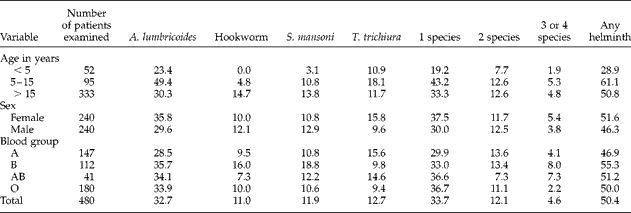
Among 702 febrile patients who visited Dore Bafeno Health Centre during the study period, 31.6% were infected with Plasmodium and hence excluded from the analysis. The remaining 480 individuals (240 females and 240 males; mean age (SD) 23.1 (14.2) years, and age range from 1 to 80 years) were included in the current study. Of participants, 50.4% were found to be infected with at least one intestinal helminth species. The most prevalent parasite was A. lumbricoides (32.7%) (table 1) and the least prevalent was E. vermicularis (0.6%).
The prevalence (%) of helminth infections, relative to host age, sex and blood group in 480 patients attending Dore Bafeno Health Centre, southern Ethiopia, December 2010.
The prevalence of single, double, triple and quadruple helminth infections was 33.7, 12.1, 4.0 and 0.6%, respectively (table 1). The prevalence of double infections was highest for A. lumbricoides and T. trichiura (30/480, 6.3%), followed by the combination of hookworm and A. lumbricoides (25/480, 5.2%), then A. lumbricoides and S. mansoni (22/480, 4.6%), and T. trichiura and hookworm (11/480, 2.3%). Among 242 study participants who were positive for at least one helminth parasite, the likelihood of A. lumbricoides infection was significantly lower in patients infected with T. trichiura (odds ratio (OR) = 0.40, 95% confidence interval (CI) = 0.22, 0.74), hookworm (OR = 0.44, 95% CI = 0.23, 0.84) and S. mansoni (OR = 0.23, 95% CI = 0.12, 0.44) compared to individuals who were not infected with the respective helminth species. Similarly, the odds of T. trichiura infection was lower in individuals infected with S. mansoni (OR = 0.35, 95% CI = 0.15, 0.82) compared to individuals infected with other helminth species.
ABO blood group and haemoglobin level
Among the 480 study participants, 37.5, 30.6, 23.3 and 8.5% were O, A, B and AB blood groups, respectively (table 1). The prevalence of A. lumbricoides, hookworm, T. trichiura, S. mansoni or of any intestinal helminth infections was not significantly different across different blood groups (table 1). In a multiple logistic regression analysis, controlling for the effects of age, sex and nutritional status, the risk of being infected with only A. lumbricoides, hookworm, T. trichiura, S. mansoni and any intestinal helminth species also remained non-significant when compared among individuals with different blood groups (data not shown). Similarly, after adjusting for the effects of age, sex and nutritional status in multiple linear regression models, differences in mean eggs/g of A. lumbricoides, hookworm, S. mansoni and T. trichiura were not significant across various blood groups (data not shown).
In a multiple logistic regression model which was adjusted for the effects of sex, nutritional status and ABO blood group, the odds of intestinal helminth infection were higher among individuals older than 15 years (adjusted odds ratio (AOR) = 3.01; 95% CI = 1.01 to 8.92) and in the age range of 5–15 years (AOR = 3.27, 95% CI = 1.47 to 7.28) compared to those who were younger than 5 years. However, the likelihood of intestinal helminth infections was not significantly different between males and females (data not shown).
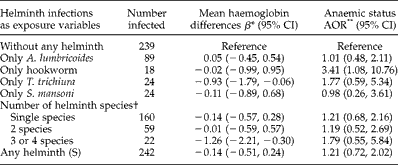
In a multivariable linear regression model, the mean haemoglobin level was significantly lower in individuals who were infected with three or more intestinal helminth species compared to individuals with double (regression coefficient (β) = − 1.19, 95% CI = − 2.34 to − 0.03), single (β = − 1.10, 95% CI = − 1.99 to − 0.196) or no infection (β = − 1.26, 95% CI = − 2.21 to − 0.30). Similarly, individuals who were infected with only T. trichiura had significantly lower mean haemoglobin level compared to individuals who were not infected with intestinal helminths (table 2). The odds of developing anaemia were 3.4 times higher (95% CI = 1.08, 10.76) in individuals who were infected with only hookworm compared to individuals not infected with intestinal helminth (table 2). An increase in intensity of A. lumbricoides infection was significantly associated with a decrease in haemoglobin level and with an increase in the prevalence of anaemia (adjusted OR = 1.51, P= 0.001). There was no significant association between intensity of S. mansoni infection or hookworm infection and haemoglobin level (data not shown).
The association between helminth infection and haemoglobin levels and anaemia in 480 patients who attended Dore Bafeno Health Centre, southern Ethiopia, December 2010.
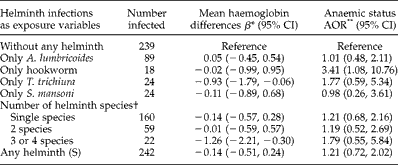
The result in each column is generated from six different logistic regression models and in each regression model the focus was on being positive for the indicated parasite. In each of the six logistic regression models individuals without intestinal helminth infections were used as the reference.
* β (regression coefficient from multiple linear regression models), adjusted for age, sex and nutrition.
** AOR (adjusted odds ratio from multivariate logistic regression models), adjusted for age, sex and nutrition.
† Number of helminth species, included in the regression model as a four categorical explanatory variable.
The mean haemoglobin level of males was significantly higher than that of females (β = 0.69, 95% CI = 0.32, 1.06). However, there was no significant association between age and mean haemoglobin level or between age and the likelihood of being anaemic. Similarly, there was no significant difference in mean haemoglobin level and in the likelihood of being anaemic between undernourished and well-nourished individuals (data not shown).
In a multivariable linear regression analysis, intestinal helminth infection was associated significantly with a lower haemoglobin level in individuals with blood type AB (β = − 1.02, 95% CI = − 2.02 to − 0.03) than in cases with blood type O. The mean haemoglobin level of intestinal helminth-infected individuals with blood group AB was marginally significantly lower compared to intestinal helminth-infected non-AB blood group individuals (β = − 0.91, 95% CI = − 1.85 to 0.02). Although it was not statistically significant, the odds of developing intestinal helminth-related anaemia were higher for individuals with blood type AB compared to individuals with blood group O. Helminth-infected individuals with blood type A and blood type B also had a slightly lower mean haemoglobin level and a higher prevalence of anaemia compared to helminth-infected individuals with blood type O (data not shown).
Nutritional status
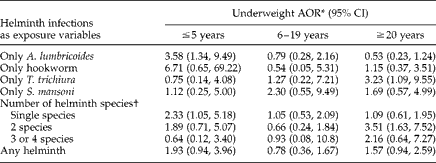
The odds of being underweight were significantly higher for A. lumbricoides and T. trichiura infected individuals of age ≤ 5 and ≥ 20 years, respectively, when compared to individuals of the corresponding age group without intestinal helminth infections (table 3). Among individuals of age at least 20 years, the odds of being underweight were significantly higher among cases infected with two different intestinal helminths than those individuals infected with a single intestinal helminth (AOR = 3.02, 95% CI = 1.36 to 6.73). The likelihood of being wasted for children aged ≤ 5 years and the likelihood of being stunted for children in the age range of 6–19 years were comparable between individuals infected with only A. lumbricoides, hookworm, S. mansoni or T. trichiura and those individuals without intestinal helminths (data not shown). In the multivariate linear regression model, helminth-infected individuals aged ≥ 20 years showed significantly lower mean BMI compared to cases without helminth infection of the same age range (β = − 0.89, 95% CI = − 1.49 to − 0.29).
Age-specific associations between helminth infections and being underweight in 480 febrile patients who attended Dore Bafeno Health Centre, southern Ethiopia, December 2010.
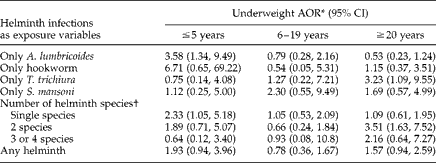
The result in each column is generated from six different logistic regression models and in each regression model the focus was on being positive for the indicated parasite. In each of the six logistic regression models individuals without intestinal helminth infections were used as the reference.
* AOR (adjusted odds ratio from multivariate logistic regression models), adjusted for age and sex.
† Number of helminth species, included in the regression model as a four categorical explanatory variable.
Discussion
Multiple intestinal helminth infections were common in all age groups (ranging from 1 to 80 years old) attending the outpatient department of Dore Bafeno Health Centre for their acute febrile illness. Individuals belonging to the four blood groups had a similar prevalence and intensity of infection with A. lumbricoides, hookworm, T. trichiura and S. mansoni. Patients infected with three or more helminth species had a significantly lower mean haemoglobin level compared to patients infected with a single helminth, with any two helminths or who were negative for any intestinal helminth. The association between low mean haemoglobin level and intestinal helminth infection was greater in individuals with blood type AB compared to those with blood type O. Ascaris lumbricoides and T. trichiura infections were significantly associated with being underweight in patients younger than 6 years and in patients older than 19 years, respectively. Being underweight was more common in adults infected with two different intestinal helminths compared to adults infected with a single helminth or with no helminth infection.
One of the strengths of the current study is that it was possible to adjust for many potential confounding variables, including age, sex and nutritional status, which could affect intestinal helminth infection and related morbidity. The study participants were homogeneous in terms of their life style, education, income level, rural residence and ethnicity. Furthermore, none of the study participants were infected with the Plasmodium parasite. However, the study is limited in that other genetic markers (such as the human leucocyte antigen system and the glyoxalase I system), which can render individuals susceptible or resistant to helminth infection, were not assessed (Quinnell, Reference Quinnell2003). Also, signs such as hepatosplenomegaly and liver fibrosis, which can be associated with intensity of intestinal helminth infection (Khattab et al., Reference Khattab, El-Gengehy and Sharaf1968; Camus et al., Reference Camus, Bina, Carlier and Santoro1977; Pareira et al., Reference Pareira, Bostolini, Carneiro, da Silva and Neves1979; Ndamba et al., Reference Ndamba, Gomo, Nyazema, Makaza and Kaondera1997), were not investigated. The diagnostic method used was not very sensitive for E. vermicularis and also not 100% sensitive for other helminths, especially in the case of light infection (Knopp et al., Reference Knopp, Mgeni, Khamis, Steinmann, Stothard and Rollinson2008). This might have resulted in misclassification of some study participants, which could explain some of the non-significant findings.
The prevalence and intensity of A. lumbricoides, hookworm, T. trichiura and S. mansoni infections were similar among individuals with different blood groups, consistent with previous reports (Katz et al., Reference Katz, Tavares and Abrantes1976; El Masri and Sharfi, Reference El Masri and Sharfi1982; Gabr & Mandour, Reference Gabr and Mandour1991; Cooper et al., Reference Cooper, Guevara and Guderian1993). However, other studies have reported a higher prevalence and intensity of S. mansoni infection in individuals of blood group A (Ndamba et al., Reference Ndamba, Gomo, Nyazema, Makaza and Kaondera1997) and higher frequency of blood group B individuals among S. mansoni infected cases (T> et al., Reference T> , Goluska, O'Leary and Douglas1979). These differences could be attributed to variation in the nutritional status, co-infection, host genetic status and age of the study participants (children versus adults) or the strain virulence of S. mansoni, in addition to intensity of infection (May & Anderson, Reference May and Anderson1979). Indeed, among the current study participants, very few individuals had a heavy intensity of S. mansoni infection. All hookworm infected, and the majority of A. lumbricoides and T. trichiura infected, individuals had a light intensity of infection.
Intestinal helminth-infected individuals with blood group AB had a significantly lower mean haemoglobin level compared to helminth-infected individuals with blood type O. Although statistically not significant, intestinal helminth-infected individuals with blood group A and B showed a trend towards a lower mean haemoglobin level compared to intestinal helminth infected individuals with blood type O. This corroborates the view that morbidity related to helminth infection varies with blood type of the host (Khattab et al., Reference Khattab, El-Gengehy and Sharaf1968; Camus et al., Reference Camus, Bina, Carlier and Santoro1977; Pareira et al., Reference Pareira, Bostolini, Carneiro, da Silva and Neves1979; Ndamba et al., Reference Ndamba, Gomo, Nyazema, Makaza and Kaondera1997).
Polysaccharides that resemble substances in the blood of groups A and B have been identified in A. lumbricoides, hookworm (Oliver-gonzalez & Gonzalez, Reference Oliver-gonzalez and Gonzalez1949) and S. mansoni (Dean, Reference Dean1974; Haseeb et al., Reference Haseeb, Thors, Linder and Eveland2008) which can adsorb A and B blood group substances to mask target antigens on the parasite surface. In addition, A. lumbricoides extracts from individuals with blood type A and B prohibit agglutination of anti-A antibodies and anti-B antibodies, respectively (Deleon et al., Reference Deleon, Foresto, Zdero and Valverdeh2000; Deleon & Valverdeh, Reference Deleon and Valverdeh2003). This suggests that A. lumbricoides mimics A and B antigens of infected hosts. Thus, immune responses of individuals with blood type A, B and AB against the parasites may not be as effective (Haseeb et al., Reference Haseeb, Thors, Linder and Eveland2008), leading to exacerbation of morbidity related to helminth infection, such as anaemia.
Ascaris lumbricoides and T. trichiura infections were associated with a higher chance of underweight in children ≤ 5 years of age and adults, respectively. Infection by these worms is known to affect the physiology of the small intestine, resulting in abnormal digestion and malabsorption, leading to nutritional deficiency (Stephenson et al., Reference Stephenson, Latham and Ottesen2000). In addition, associated with gastrointestinal wall damage due to these parasitic infections, symptoms such as anorexia, vomiting and diarrhoea may occur, which can also lead to decreased nutrient uptake or loss of available nutrients (Stephenson et al., Reference Stephenson, Latham and Ottesen2000). The increase in the odds of being underweight and the decrease in mean BMI was greater in adults infected with two different helminth species than in similar age groups of individuals without intestinal helminth infection. This seems to support the view that the impact of two different helminth infections on nutritional status could be additive when they co-exist (Pullan & Brooker, Reference Pullan and Brooker2008).
The odds of being anaemic were significantly higher for individuals who were infected with only hookworm compared to individuals not infected with intestinal helminths. Hookworm causes intestinal blood loss, thereby predisposing infected individuals to anaemia (Roche & Layrisse, Reference Roche and Layrisse1966). The reduction in mean haemoglobin level was significantly higher in patients infected with three or more different intestinal helminths compared to patients infected with one or two intestinal helminth species, or with individuals not infected with intestinal helminths. This agrees with previous reports (Ezeamama et al., Reference Ezeamama, Friedman, Olveda, Acosta, Kurtis, Mor and McGarvey2005, Reference Ezeamama, McGarvey, Acosta, Zierler, Manalo, Wu, Kurtis, Mor, Olveda and Friedman2008; Brito et al., Reference Brito, Barreto, Silva Rde, Assis, Reis, Parraga and Blanton2006) that suggest the additive impact of different intestinal helminth species on haemoglobin level when they co-exist in a host. Variation in the mechanisms by which different intestinal helminth species affect nutritional status and haemoglobin level (Pullan & Brooker, Reference Pullan and Brooker2008) and increase in intensity of helminths when different species co-exist together (Faulkner et al., Reference Faulkner, Turner, Behnke, Kamgno, Rowlinson, Bradley and Boussinesq2005) might have resulted in this larger reduction of haemoglobin level and the increased prevalence of being underweight in individuals with multiple helminth infections. Indeed, in the current study, the intensity of helminth infection was higher in individuals co-infected with two or more different helminth species compared to those infected with only a single helminth species.
In conclusion, although individuals of all blood groups are equally susceptible to intestinal helminth infection, individuals with the AB blood group appeared to become more anaemic than those with other blood types during infection with intestinal helminths. Multiple intestinal helminth infections are associated with a significantly lowered haemoglobin level and higher prevalence of underweight compared to single intestinal helminth infection in adults. Undernutrition was more severe in A. lumbricoides-infected children of age ≤ 5 years and T. trichiura-infected adults of age ≥ 20 years. Future studies should focus on mechanisms by which blood group AB exacerbates the helminth-related reduction in mean haemoglobin level. There is also a need for further studies to investigate the additive impact of multiple intestinal helminth infections on nutritional status in children.
Acknowledgements
This study received financial support from the Aklilu Lemma Institute of Pathobiology, Addis Ababa University (grant number 6223). We thank also the staff of Dore Bafeno Health Centre for their assistance during data collection. We are grateful to the inhabitants of Dore Bafeno District, without whom the study would not have been possible. We would like to thank laboratory technicians of Akililu Lemma Institute of Pathobiology for their help during fieldwork and specimen examination in laboratory. We acknowledge Dr Charlotte Hanlon of the Psychiatry Department, Addis Ababa University for editing the language of the manuscript.