I. INTRODUCTION
Injectable and settable synthetic bone grafts that possess initial mechanical strength exceeding that of host bone and maintain strength comparable to bone while remodeling could improve the clinical management of a number of orthopedic conditions, such as repair of open tibial plateau fractures, Reference Russell and Leighton1,Reference Simpson and Keating2 screw augmentation, Reference Amendola, Gasbarrini, Fosco, Simoes, Terzi, Delure and Boriani3–Reference Larsson and Procter5 and vertebroplasty. Reference Verlaan, Oner and Dhert6 Since their discovery in 1982, Reference Legeros, Chohayeb and Schulman7 calcium phosphate cements (CPCs) were successfully introduced into clinical applications due to their osteoconductivity and fast setting times. Reference Chim and Gosain8 While the initial compressive strength of CPCs is comparable to that of trabecular bone, they undergo brittle fracture at strains less than the yield strain of trabecular bone, resulting in failure under physiologically relevant loads with a substantial shear component. Reference Hall, Beuerlein and McKee9–Reference Bohner11 Thus, the brittleness of CPCs precludes their use in many weight-bearing applications. Combining ceramics with polymers has been investigated as an approach to design materials with tougher mechanical properties. However, a recent review of the ceramic/polymer composite literature reported that the compressive strength of most composites is substantially weaker than both trabecular bone and CPCs. Reference Wagoner Johnson and Herschler10
Low-porosity (<10%), settable composites incorporating a degradable lysine-derived prepolymer, a polyester triol, a tertiary amine catalyst, and allograft bone particles exhibited initial compressive strength exceeding that of trabecular bone and remodeled by creeping substitution of the allograft particles. Reference Dumas, Prieto, Guda, Zienkiewicz, Garza, Bible, Holt and Guelcher12 However, the torsional strength of the composites was less than that of trabecular bone. Furthermore, allograft bone has low bioactivity, is limited in supply, and can present risks of disease transmission. Thus, there is a compelling need for high-viscosity, settable ceramic/polymer composites with initial mechanical properties exceeding those of host bone, particularly under loadings with a significant shear component. Reference Jones13
45S5 Bioactive glass (BG) has been widely used for bone regeneration due to its bioactivity, Reference Jones13–Reference Hench and Wilson15 as assessed by the formation of a hydroxycarbonate apatite (HCA) layer on its surface in physiological solution. Reference Saravanapavan, Jones, Pryce and Hench16 Dissolution of ions from BG alters the local environment and promotes cellular responses critical for both new bone formation as well as the formation of an apatite layer on the surface. Reference Hench17,Reference Hoppe, Gueldal and Boccaccini18 BG/polymer composites have been investigated for bone regeneration. Reference Jones13,Reference Tanner19–Reference Ryszkowska, Auguscik, Sheikh and Boccaccini22 In a previous study, BG/dextran composites remodeled to form new bone when injected into rabbit femoral condyle plug defects. Reference Chan, Thompson, Robinson, Wilson and Hench23 However, BG/dextran composites are not settable and thus the initial strength is substantially less than that of trabecular bone. While settable polymers offer the advantages of increased strength, interfacial bonding between the polymer and BG phases is required to prevent nucleation of cracks and premature failure. Reference Jones13,Reference Neuendorf, Saiz, Tomsia and Ritchie24 Using monomer transfer molding, glass fiber/poly(ε-caprolactone) (PCL) composites have been fabricated in which polymerization was initiated from an amine-terminated silane grafted to the fiber surface, resulting in chemical bonding between the glass and the PCL phases and enhanced mechanical properties. Reference Jiang, Evans, Jones, Rudd, Scotchford and Walker25,Reference Jiang, Walker, Jones and Rudd26 However, thermoplastic polymers such as PCL must be processed by melt- or solvent-casting and are not suitable for injectable and settable systems.
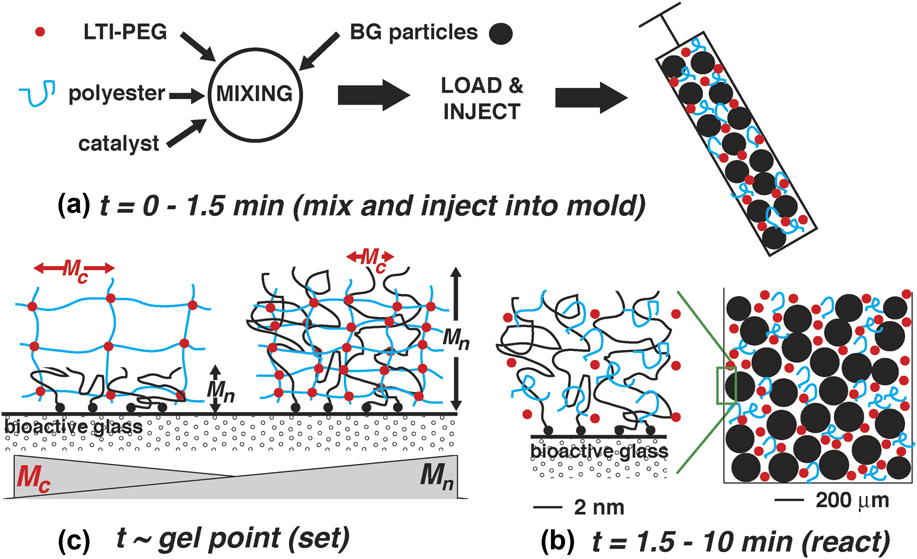
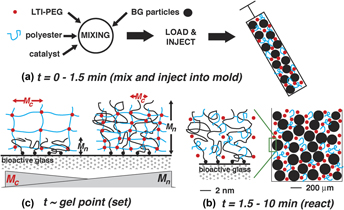
In this study, we investigated an alternative approach in which mechanical properties are enhanced by chain entanglements between surface-initiated PCL chains on the BG particles and an in situ-formed polyurethane (PUR) polymer network [Fig. 1(c)]. To prepare the composites, a lysine triisocyanate (LTI)-poly(ethylene glycol) (PEG) prepolymer was mixed with a polyester triol, a tertiary amine catalyst, and BG particles [Fig. 1(a)]. The LTI-PEG prepolymer and the polyester triol react to form a polymer network with a gel time of ∼10 min and molecular weight between crosslinks M c [Figs. 1(b) and 1(c)]. Prior to mixing with the reactive polymer, BG particles were functionalized with the silane-coupling agent 3-aminopropyl-triethoxysilane (APTES) followed by surface polymerization of ε-caprolactone via surface-initiated ring-opening polymerization (ROP). Reference Verne, Vitale-Brovarone, Bui, Bianchi and Boccaccini27,Reference Kunze, Freier, Helwig, Sandner, Reif, Wutzler and Radusch28 The molecular weight of the surface-initiated PCL [M n, Fig. 1(c)] was varied by adjusting the polymerization time. We hypothesized that under conditions where M* = M n/M c >> 1, surface-initiated PCL chains are physically entangled in the polymer network as the reaction progresses toward the gel point [Fig. 1(c)], which enhances interfacial bonding and mechanical properties. To test this hypothesis, the effects of M* on the compressive properties of the composites were investigated by varying the molecular weight of both the surface-initiated PCL (M n) and the polyester triol component of the polymer network (M c). Additionally, the torsional strength was measured to evaluate the feasibility of the composites as weight-bearing bone grafts under more physiologically relevant loads incorporating a shear component. Finally, the ability of the strongest composite to remodel in vivo was evaluated in a rat femoral condyle plug defect model.
Schematic illustrating the synthesis of settable BG/polymer composites by reactive liquid molding. (a) The reactive mixture comprises LTI-PEG prepolymer (red circles), polyester triol chains (blue lines), and BG particles (black circles), which are mixed, loaded into a syringe, and injected into a mold. (b) The interfacial region near the surface of the BG particles (2 nm scale bar) initially comprises PCL chains (black lines) anchored to the surface by an APTES linker (small black circle), LTI-PEG prepolymer, and polyester triol. During the first 10 min, the LTI-PEG reacts with the polyester triol to form a poly(ester urethane) network. The surface-initiated PCL chains are becoming entangled within the in situ forming polymer network. (c) After the gel point (>10 min), the prepolymer and polyester triol have reacted to form an interconnected polymer network with molecular weight between crosslinks M c. For low molecular weight grafted PCL and high molecular weight polyester triol, M n < M c, resulting in a low degree of entanglements between grafted PCL chains and the PUR network. For high molecular weight PCL and low molecular weight polyol, M n > M c, resulting in a high degree of entanglements.

II. EXPERIMENTAL
A. Materials
Melt-derived 45S5 BG particles (150–212 μm diameter) were purchased from Mo-Sci Corporation (Rolla, MO). APTES, ε-caprolactone, dipropylene glycol, PCL triol (M n ∼300 g mol−1, referred to as PCL300), deuterated dimethyl sulfoxide (DMSO), glycerol, and iron (III) acetylacetonate (FeAA) catalyst were purchased from Sigma-Aldrich (St. Louis, MO). Magnesium sulfate, stannous octoate (Sn(Oct)2), and phosphate-buffered saline (PBS) were acquired from Thermo Fisher Scientific (Waltham, MA). Technovit 4000 (Heraeus Kulzer) was purchased from Electron Microscopy Sciences (Hatfield, PA). Triethylenediamine (TEDA) was purchased from Evonik (Parsippany, NJ). A lysine triisocyanate (LTI)-polyethylene glycol (PEG) prepolymer (21% NCO) was supplied by Medtronic (Memphis, TN). d,l-lactide and glycolide were supplied by Polysciences (Warrington, PA).
B. Surface modification and characterization of BG particles
1. In vitro study design
BG/polymer composites with adjustable M* = M n/M c were prepared by independently varying the values of M n and M c. To vary M c, polymer networks were synthesized from a 300 g mol−1 (7C300) or 3000 g mol−1 (7C3000) poly(ε-caprolactone (70%)-co-glycolide (20%)-co-d,l-lactide (10%)) triol and either a FeAA or TEDA catalyst. These copolyester triols were amorphous, viscous liquids at room temperature. The value of M n was varied by three BG surface treatments (Table I): (i) cleaned and unmodified (U-BG), (ii) silanized with APTES (Sil-) and polymerized with ε-caprolactone for 5 h (5 h PCL-BG), and (iii) Sil-BG polymerized with ε-caprolactone for 24 h (24 h PCL-BG). BG polyurethane composites are denoted by the following notation: BG surface treatment-BG/polyol-catalyst (e.g., a composite made with 24 h PCL-BG, 7C300 polyester triol, and FeAA catalyst is denoted 24 h PCL-BG/7C300-F).
Characterization of the surface-initiated ROP of ε-caprolactone, by M n and PDI (determined by GPC), and wt% PCL (determined by TGA).

2. Cleaning
Melt-derived 45S5 BG particles were sonicated for 5 min in a solution of acetone in deionized (DI) water (95 vol%) at room temperature followed by rinsing in DI water under sonication for 5 min, based on previous optimization. Reference Verne, Vitale-Brovarone, Bui, Bianchi and Boccaccini27 A total of three rinsing cycles were performed.
3. Surface-initiated polymerization of ε-caprolactone
After cleaning, particles were contacted with a 2 μM solution of APTES in 9:1 (v/v) ethanol:DI water for 5 h at room temperature, Reference Jiang, Walker, Jones and Rudd26 rinsed with ethanol, and annealed at 100 °C for 1 h. For surface-initiated ROP, ε-caprolactone was dried in the presence of magnesium sulfate. A mixture comprising a 1:1000 molar ratio of Sn(Oct)2:ε-caprolactone Reference Jiang, Evans, Jones, Rudd, Scotchford and Walker25 and a 0.83:1 weight ratio of Sil-BG:ε-caprolactone was reacted with Sil-BG particles while stirring at 110 °C. The polymerization time (5 or 24 h) was controlled to vary the number-average molecular weight M n (Table I) of the surface-polymerized PCL. Treatment groups were denoted by the polymerization time as noted above. PCL-modified BG particles were extracted with chloroform to remove nongrafted PCL and dried at 40 °C for 24 h.
4. Gel permeation chromatography (GPC)
A Waters Breeze GPC (Milford, MA) was used to measure the number-average molecular weight (M n) of the extracted nongrafted PCL, which has been reported to approximate the M n of the grafted polymer. Reference Barsbay, Gueven, Stenzel, Davis, Barner-Kowollik and Barner29 Two MesoPore 300 × 7.5 mm columns (Polymer Laboratories) were used in series with stabilized tetrahydrofuran as the mobile phase at a flow rate of 1 mL min−1 at 35 °C.
5. Thermogravimetric analysis (TGA)
TGA analyses were performed to quantify the amount of PCL on the BG surface, with a heating rate of 10 °C min−1 over the temperature range of 25–600 °C under a nitrogen flow of 40 mL min−1. A TA Instruments Q500 instrument (New Castle, DE) with the corresponding TA Instruments Universal Analysis 2000 (Version 4.5A) software was used. The sample masses were 20 mg.
C. Synthesis and characterization of BG/polymer composites with varying molecular weight between PUR crosslinks and surface layer molecular weight
1. Synthesis
BG/polymer composites were prepared by mixing the LTI-PEG prepolymer, polyester triol, surface-modified BG particles, and catalyst [Fig. 1(a)]. The polyester triol and catalyst were varied to modify the molecular weight between crosslinks of the polymer network (M c), while the composition of the BG particles was modified to vary the surface-initiated PCL molecular weight (M n). Polyester triols with number-average molecular weights of 300 or 3000 g mol−1 and a backbone comprising 70% ε-caprolactone, 20% glycolide, and 10% d,l-lactide (7C300 and 7C3000) were synthesized by ROP in the presence of stannous octoate catalyst as described previously. Reference Guelcher, Patel, Gallagher, Connolly, Didier, Doctor and Hollinger30 The appropriate polyester triol (7C300 or 7C3000) and the amount of catalyst (7C300: 0.015–0.098 wt% and 7C3000: 0.023–0.150 wt% for FeAA and TEDA, to yield the same gel times) added as a dipropylene glycol solution were weighed in one side of a small plastic cup and mixed until homogenous. The LTI-PEG prepolymer was added to the clean half of the cup and the appropriate amount of BG particles spread over the entire surface of the cup. The relative amounts of LTI-PEG prepolymer and polyester were calculated assuming an isocyanate index of 140 (i.e., 40% excess isocyanate). Reference Guelcher, Patel, Gallagher, Connolly, Didier, Doctor and Hollinger30 The amount of BG was based on a density of 2.7 g cm−3 and a targeted volume percent (56.7%) in the final composite. All components were hand-mixed, loaded into a 5 mL syringe, and injected into a mold at room temperature and 40–50% relative humidity. The mixture was cured under a load of 0.96 kg for 5 min to simulate compacting the material in a confined defect space, followed by curing at unloaded conditions at 37 °C for 24 h to simulate curing in the human body.
2. Rheology
Rheological properties of the noncatalyzed composites were measured using a TA Instruments AR2000ex rheometer (New Castle, DE) to determine the initial viscosity. After mixing the components, the sample was loaded between 40-mm diameter steel cross-hatch plates and compressed to a gap of 2.6 mm. Viscosity measurements were completed at a constant strain of 1% as a function of shear rate.
3. Polymer swelling and composite porosity
The polymer network molecular weight between crosslinks M c was calculated using the Flory–Rehner equation from swelling experiments. Reference Ruppender, Merkel, Martin, Mundy, Sterling and Guelcher31 The dimensionless surface molecular weight M* was defined as the surface layer number-average molecular weight M n (measured by GPC) divided by M c:
 $$M^* = {{M_{\rm{n}} } \over {M_{\rm{c}} }}\quad .$$
M n was adjusted by varying the surface PCL polymerization time and M c was adjusted by varying the polyol molecular weight or catalyst during composite fabrication. Thus, a family of composites with 0 ≤ M* ≤ 28 was fabricated from the four polymer network compositions and three BG surface treatments (U-BG, 5 h PCL-BG, 24 h PCL-BG) to investigate the effect of M* on mechanical properties. The porosity of the composites was computed from scanning electron microscope (SEM) cross-sectional images at 60x magnification and 5 kV using a Hitachi S-4200 SEM (Finchampstead, UK). The pore area in each image was quantified using MetaMorph Offline (Version 7.7.0.0) software. The porosity was calculated as the pore area fraction.
4. Quasistatic compressive mechanical testing of BG/polymer composites
Cylindrical specimens (6 × 12 mm) were prepared and compressive mechanical testing was conducted using an MTS 858 Bionix Servohydraulic Test System (Eden Prairie, MN). Composites were conditioned in PBS at room temperature for 24 h immediately before testing and preloaded to approximately 12 N followed by continuous compression until failure at a rate of 25 mm min−1. The load and position were recorded every 0.01 s. The compressive stress was calculated by dividing the load by the cross-sectional area of the samples post-hydration. Compressive modulus (E) was calculated as the slope of the initial linear section of the stress–strain curve, compressive strength (σ) as the maximum stress achieved, and compressive ultimate yield strain (UYS) as the strain at the compressive strength.
D. Synthesis and torsion testing of BG/polymer composites with bone-like torsional strength
To evaluate the feasibility of BG/polymer composites for bone regeneration in weight-bearing defects, specimens fabricated from the three BG surface treatment groups (U-, 5 h PCL-, and 24 h PCL-BG) and the 7C300-F polymer network (FeAA catalyst and 7C300 polyester triol) were tested under torsion. Quasistatic torsion testing was performed using an Instron Dynamite 8841 fatigue tester (Norwood, MA) equipped with a 1.7 Nm torque cell. Approximately 4 mm of each end of the cylindrical specimens (6 × 20 mm) was potted in larger cylindrical molds made from Technovit 4000. The gage length (i.e., the gap between the potted ends) was approximately 12 mm. Specimens were conditioned in PBS at room temperature for 24 h and secured to the Instron with one end attached to a stationary torque transducer that measured the torque (T). The crosshead speed was 0.035 rad s−1 to minimize viscoelastic effects. Reference Garnier, Dumas, Rumelhart and Arlot32,Reference Ford and Keaveny33 The shear stress (τ) was determined from the torque/angle unit length (θ = α/L) curve using the equation:
 $$\tau = {1 \over {2\pi r^3 }}\left( {\theta {{{\rm{d}}T} \over {{\rm{d}}\theta }} + 3T} \right)\quad ,$$
where r is the radius of the cylindrical specimen, dT/dθ was determined by fitting a fifth order polynomial to the experimental torque curve (from zero up to the maximum T and corresponding θ values), and T is the interpolated torque. Reference Garnier, Dumas, Rumelhart and Arlot32 The shear modulus (G) was defined as the slope of the linear portion of the stress/angular deformation curve (G = τ/γ), the torsion strength as the maximum shear stress achieved, and the torsion UYS as the strain at the torsion strength.
One-way ANOVA and Tukey HSD test were performed using JMP 9.0 to determine whether statistical differences existed between the means of groups of interest. For all experiments, P < 0.05 was considered statistically significant.
E. Rat femoral condyle defect in vivo model
1. Animal study
Three rats were used in the femoral condyle defect in vivo model. All surgical and care procedures were carried out under aseptic conditions based on IACUC approval. After rats were placed under anesthesia, bilateral defects approximately 3 mm diameter × 5 mm deep were drilled in the distal aspect of each lateral femoral condyle. Composite precursors were gamma-irradiated using a dose of approximately 25 kGY. The lead-candidate composite (24 h PCL-BG/PCL 300-F) was mixed, injected into the cylindrical defect, and followed by closure of the wound 5 min after implantation. A slower degrading polyol (PCL300 instead of 7C300) Reference Hafeman, Zienkiewicz, Zachman, Sung, Nanney, Davidson and Guelcher34 was utilized in the in vivo study to maintain polymer in the defect site for an extended period of time and investigate the effect of the presence of BG on bone remodeling. Implanted femurs were harvested 8 wk after composite implantation.
2. Histological analysis
Rat femora were maintained in a solution of 10% neutral buffered formalin for less than two weeks followed by a series of ethanol dehydrations. Specimens were embedded in poly(methyl methacrylate) and longitudinal cross-sections were cut, ground, and polished (<100 μm) in the middle of the defect from the resultant blocks using an Exakt system. The sections were stained with Sanderson's rapid bone stain and Van Gieson counterstain. BG particles stained light brown, residual polymer stained turquoise, and new bone stained red. The sections were imaged at 2x and 10x magnification with an Olympus camera (DP71) and SZX16 microscope.
III. RESULTS
A. Characterization of surface-modified BG and BG/polymer composites
The properties of the surface-modified particles, including polymerization time, M n, PDI, and wt% PCL, are listed in Table I. As anticipated, the mean molecular weight of PCL increased from 5026 to 19,225 g mol−1 when reaction time was increased from 5 to 24 h. The wt% PCL paralleled the increase in M n as 5 and 24 h polymerization times added 0.058 and 0.158 wt% on to the unmodified BG particle surfaces.
As shown in Fig. 2, composites made with 7C300 noncatalyzed polymer and the three BG surface treatment groups of interest (one representative from each group displayed) showed shear-thinning properties, as evidenced by the decrease in viscosity with shear rate. All groups exhibited a viscosity approaching 15 Pa s at a high shear rate (above 400 s−1). The rheological properties of noncatalyzed BG/polymer composites did not appear to be dependent on the surface properties of the BG at high shear rates.
Viscosity of noncatalyzed BG/polymer composites fabricated with 7C300 polyol and U-BG, 5 h PCL-BG and 24 h PCL-BG particles, as a function of shear rate.

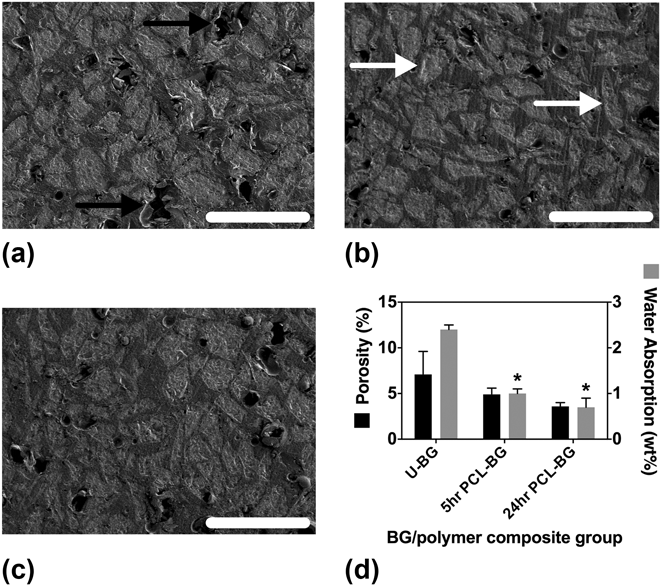
BG particles can be identified in the images of the cross-sections of U-, 5 h PCL-, and 24 h PCL-BG/7C300-F composites shown in Figs. 3(a)–3(c), respectively, with white arrows pointing to representative particles in Fig. 3(b). Surface modification did not appear to alter the shape and size of the BG particles. BG/polymer composites made with all the three BG groups exhibited few dispersed irregularly shaped voids. Voids can be seen in Figs. 3(a)–3(c), with black arrows pointing to a representative void in Fig. 3(a). The porosity and change in mass of the composites after conditioning in PBS (water absorption) are shown in Fig. 3(d). Composites made with U-BG exhibited significantly higher water absorption compared with those made with 5 h and 24 h PCL-BG. While the porosity of U-BG/7C300-F composites was also higher compared with the other two groups, the differences were not significant. Similar observations were made for U-, 5 h PCL-, and 24 h PCL-BG/7C300-T composites (data not shown).
SEM images of cross-section of BG/polymer composites fabricated with 7C300 polyol, FeAA catalyst, and (a) U-BG, (b) 5 h PCL-BG, and (c) 24 h PCL-BG particles (scale bar = 500 μm, white and black arrows point to representative BG particles and voids, respectively) and their subsequent (d) overall porosity (volume fraction pores) and water absorption (wt%) after 24 h incubation in PBS. * indicates P < 0.05 compared to composites made with U-BG, with respect to water absorption.

B. Compressive properties
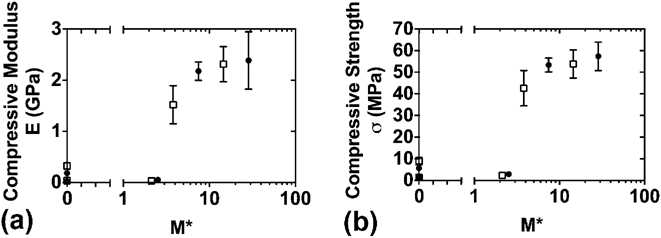
To investigate the structure–property relationships governing compressive modulus and strength, BG/polymer composites were prepared from polyester triols with varying molecular weight (300 and 3000 g mol−1) and different catalysts (FeAA and TEDA) to yield polymer networks with tunable molecular weight between crosslinks (M c) (673–9041 g mol−1). The molecular weight of surface-initiated PCL on the BG particles (M n) was varied over the range 0–19,225 g mol−1 by varying the polymerization time (0, 5, or 24 h, Table I). The compressive modulus (E) and strength (σ) of the composites are plotted against the dimensionless surface layer molecular weight M* = M n/M c in Figs. 4(a) and 4(b), respectively. Interestingly, data for E and σ for both TEDA and FeAA catalysts lie approximately on the same curve. For both catalysts, E attains 50% of its maximum value (E m) at M* = 3.8–7.5 and 90% of E m at M* = 7.5–10.0. Similarly, σ reaches 50% of its maximum value (σm) at M* = 2.5–3.8 and 90% of σ*m at M* = 7.5–10.0. Above M* ≅ 20, the compressive properties asymptotically approach the maximum value. Taken together, these data suggest that the effects of interfacial bonding on mechanical properties saturate at M* ≥ 20. The composite with the highest compressive mechanical properties, 24 h PCL-BG/7C300-F, had mean compressive modulus and strength values of 2.39 GPa and 57.4 MPa, respectively.
Effects of surface-initiated PCL number-average molecular weight (M n) and PUR network molecular weight between crosslinks (M c) on quasistatic compressive mechanical properties of BG/polymer composites. M n values are provided in Table I. In swelling experiments, M c values were measured for PUR networks catalyzed by FeAA or TEDA with 7C300 and 7C3000. Compressive (a) modulus and (b) strength plotted versus dimensionless surface layer molecular weight M* = M n/M c. Values reported as mean ± standard deviation of triplicate samples. An M* = 0 x-axis value was manually added to the semi-log plot to allow for values corresponding to M* = 0 (composites made with U-BG) to be plotted.

C. Torsional properties
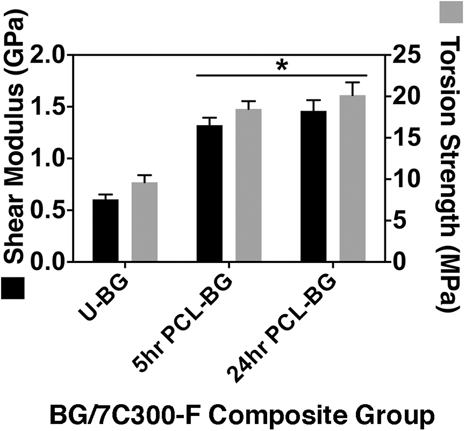
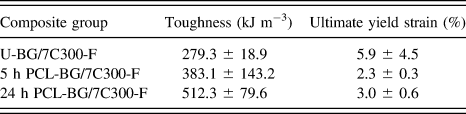
To investigate the feasibility of BG/polymer composites as weight-bearing bone grafts, the torsional properties of the lead-candidate composite (24 h PCL-BG/7C300-F) were measured under quasistatic loading (Fig. 5). Both U-BG/7C300-F and 5 h PCL-BG/7C300-F composites were also tested to investigate the effects of layer thickness on torsional strength. U-BG/7C300-F showed the weakest mechanical properties, with a shear modulus and torsional strength of 0.61 GPa and 9.6 MPa, respectively. PCL surface-polymerization significantly increased the torsional properties of the composite compared to U-BG/300-F. 24 h PCL-BG/7C300-F exhibited a shear modulus and torsional strength of 1.46 GPa and 20.2 MPa, respectively. Differences between 24 and 5 h PCL-BG/7C300-F were not significant. The torsional toughness and UYS of the three composites tested are listed in Table II. Despite a decrease in the UYS between BG/polymer composites made with PCL-grafted BG compared to those with U-BG, the overall toughness of these composites significantly increased. The lead-candidate composite (24 h PCL-BG/7C300-F) had the highest mean torsional toughness, 512.3 kJ m−3.
Surface-polymerization of PCL on BG particles significantly increases the quasistatic torsional properties of BG/polymer composites fabricated with 7C300 polyol and FeAA catalyst. Values reported as mean ± standard deviation of triplicate samples. Statistical analysis performed by one-way ANOVA and Tukey HSD. * indicates P < 0.05 compared to composites made with U-BG.

Torsion mechanical properties of 24 h PCL-BG/T7C2G1L300-F composites.

D. In vivo remodeling
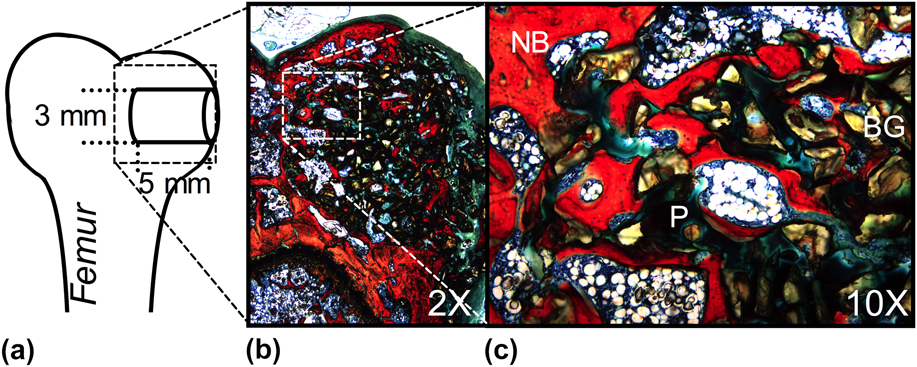
The ability of the lead-candidate BG/polymer composite (24 h PCL-BG/PCL300-F) to remodel and form new bone in vivo was evaluated in a proof-of-concept study. 24 h PCL-BG/PCL300-F was injected into rat femoral condyle plug defects and remodeling was assessed at 8 weeks post-implantation. To provide orientation with respect to histological analysis, an illustration of the defect is shown in Fig. 6(a). The low magnification (2x) image of an embedded histological section [Fig. 6(b)] shows new mineralized bone growth (red), dispersed between remaining BG particles and residual PUR polymer (turquoise), throughout the entire defect site. The high magnification (10x) image of the same histological section [Fig. 6(c)] highlights appositional mineralized bone growth (NB) on the surfaces of residual BG particles and residual polymer (P). Osteocytes can be seen dispersed throughout the new mineralized bone. No negative signs of a sustained inflammatory response were noted in any of the analyzed defects.
Histological sections of lead-candidate BG/polymer composite (24 h PCL-BG/7C300-F) implanted into rat femoral condyle defect in vivo model. (a) Illustration of shape and size (3 mm diameter × 5 mm length) of cylindrical plug defect. (b) Low- (2x) and (c) high- (10x) magnification images of histological section at 16 weeks. NB: new mineralized bone, BG: 45S5 BG, P: polymer.

IV. DISCUSSION
Injectable composites incorporating 45S5 BG particles and a flowable polymer remodeled to form new bone when implanted in metaphyseal bone defects in rabbits. Reference Chan, Thompson, Robinson, Wilson and Hench23,Reference Wang, Lu, Chen and Chang35 Appositional bone growth was observed near the surface of the BG particles, followed by remodeling of the BG to form new bone at later time points. While dextran, glycerin, and polyethylene glycol improve the flowability of the composite, these polymers are nonsettable, and consequently their weak mechanical properties preclude their use as weight-bearing bone grafts. In addition to settability, interfacial bonding between the polymer and particle phases is another important factor regulating mechanical properties. Reference Jones13 Amine-terminated silanes have been effectively used to promote bonding between mineral and polymer phases, Reference Jiang, Evans, Jones, Rudd, Scotchford and Walker25,Reference Khan, Parsons, Jones, Walker and Rudd36 but their high reactivity with isocyanate-terminated prepolymers (∼1000 times faster than hydroxyl groups Reference Oertel37 ) limits their utility for injectable applications. In the present study, we investigated a novel approach for enhancing interfacial bonding by physical entanglements of surface-initiated PCL chains on the BG surface within a polymer network formed in situ through the reaction of the LTI-PEG prepolymer with the polyester triol. The presence of surface-initiated PCL chains significantly increased the strength of the composites when the dimensionless surface layer molecular weight M* > 3.
Physical chain entanglements between polymer phases are known to enhance interfacial bonding. As shown in Fig. 4, σ and E increase sigmoidally with M*, asymptotically approaching their maximum values when M* ≥ 20. This dependence is conjectured to result from entanglements between the surface-initiated PCL chains and the PUR network formed in situ. Interestingly, these observations contrast with a previous study reporting that composites comprising α-tricalcium phosphate (α-TCP) particles dispersed in poly(l,dl-lactide) did not show a significant improvement in mechanical properties when l-lactide was grafted to the protonated surface of the α-TCP particles. Reference Kunze, Freier, Helwig, Sandner, Reif, Wutzler and Radusch28 For linear polymers, physical crosslinks due to chain entanglements result as the molecular weight of the polymer approaches the entanglement molecular weight (M e), Reference Brown and Russell38 which for PCL is 15,000 g mol−1. Reference Gurarslan, Shen and Tonelli39 Thus, our finding that mechanical properties are enhanced when M* > 3 suggests that the molecular weight of the surface-initiated PCL must exceed 45,000 g mol−1 to produce substantial entanglements within the bulk PCL phase. Considering that the molecular weight of the surface-polymerized l-lactide was only 390–1050 g mol−1, entanglements and the consequent increase in mechanical properties would not be expected.
To modify the 45S5 BG particles, a surface-initiated ε-caprolactone polymerization technique was modified from a monomer transfer molding process in which polymerization of ε-caprolactone is initiated on the surface of a BG fiber preform. Reference Jiang, Evans, Jones, Rudd, Scotchford and Walker25,Reference Jiang, Walker, Jones and Rudd26 In this process, a continuous polymer phase comprising high (>125,000 g mol−1) molecular weight PCL was covalently bound to the BG fibers, resulting in a significant enhancement in mechanical properties. However, due to the high temperature (110 °C) required for ε-caprolactone polymerization, the monomer transfer molding process is not suitable to fabricate the bulk polymer for injectable composites. The monomer transfer molding approach contrasts with the reactive liquid molding process reported in the present study, in which lower (<20,000 g mol−1) molecular weight surface-initiated PCL chains interpenetrate with the polymer network formed in situ [Fig. 1(c)]. Furthermore, the reactive liquid molding process was carried out at physiological temperature (37 °C) in the presence of BG particles modified by surface-initiated polymerization of ε-caprolactone, thereby rendering the composites suitable for injectable applications.
While the compressive strength of CPCs (∼50 MPa) and many ceramic/polymer composites exceed that of trabecular bone (4–12 MPa), Reference Allen, Hogan, Hobbs, Koivuniemi, Koivuniemi and Burr40 there is a paucity of data on the strength of CPCs under more physiologically relevant loading conditions, such as torsion or shear. Reference Bohner11 Due to the brittleness of CPCs, their tensile strength is at least an order of magnitude lower than the compressive strength. Reference Bohner11 The brittleness and weak shear properties of CPCs have been suggested to contribute to their poor performance in applications where only modest weight-bearing properties are required, such as kyphoplasty. Reference Bohner11,Reference Libicher, Hillmeier, Liegibel, Sommer, Pyerin, Vetter, Meinzer, Grafe, Meeder, Noldge, Nawroth and Kasperk41,Reference Maestretti, Cremer, Otten and Jakob42 While the shear modulus (0.61 GPa) and torsional strength (9.6 MPa) of the U-BG/7C300-F composite only slightly exceed the corresponding values for trabecular bone (0.29 GPa and 6.1 MPa, respectively Reference Garnier, Dumas, Rumelhart and Arlot32 ), the torsional properties of 5 h PCL- and 24 h PCL-BG/7C300-F composites exceed the values reported for trabecular bone and CPCs by a factor of >3. Reference Dumas, Prieto, Zienkiewicz, Guda, Wenke, Bible, Holt and Guelcher43 Mechanical testing was performed on materials made in 40–50% relative humidity, cured for 24 h at 37 °C, and soaked in PBS for 24 h prior to testing. While the humidity in bone defects is anticipated to be higher than 40–50% due to the presence of body fluids, in a previous study we reported that environmental water has minimal impact on the cure profile of allograft bone/polymer composites. Reference Page, Prieto, Dumas, Zienkiewicz, Wenke, Brown-Baer and Guelcher44 However, further studies are necessary to assess the effects of body fluids on the mechanical properties of BG/polymer composites cured in vivo.
We have previously reported that injectable, settable allograft/polymer composites catalyzed by TEDA did not release cytotoxic components during cure and promoted new bone formation in a rabbit femoral condyle plug defect model. Reference Dumas, Prieto, Guda, Zienkiewicz, Garza, Bible, Holt and Guelcher12,Reference Page, Prieto, Dumas, Zienkiewicz, Wenke, Brown-Baer and Guelcher44 In another study, polyurethane scaffolds synthesized using the FeAA catalyst were shown to be noncytotoxic and support mineralization in vitro and new bone formation in vivo. Reference Gorna and Gogolewski45,Reference Gogolewski and Gorna46 While TEDA and FeAA catalysts have been reported to be noncytotoxic in vivo, the cytotoxicity of residual stannous octoate catalyst from the surface-initiated polymerization in vivo is unknown. The presence of Sn in the x-ray photoelectron spectroscopy (XPS) spectra suggests that the Sn(Oct)2 catalyst was bound within the grafted PCL, which is consistent with a previous study. Reference Jiang, Evans, Jones, Rudd, Scotchford and Walker25,Reference Jiang, Walker, Jones and Rudd26 Rat femoral condyle defects filled with the lead-candidate BG/polymer composite did not show evidence of toxicity (Fig. 6). However, longer term studies are needed to evaluate the biocompatibility and safety of the settable bone grafts. To reduce the risk of toxicity, the tin catalyst could be eliminated by surface-initiated polymerization of PCL on phosphoric acid-treated BG without the intermediate step of silanization. Reference Dumas, Prieto, Zienkiewicz, Guda, Wenke, Bible, Holt and Guelcher43
BG/polymer composites showed ingrowth of new bone, residual BG, and residual polymer at 8 weeks when injected into femoral condyle plug defects in rats (Fig. 6). These observations are in agreement with a previous study reporting remodeling of BG/dextran composites injected into femoral condyle plug defects in rabbits. Reference Chan, Thompson, Robinson, Wilson and Hench23 However, dextran is a water-soluble polymer functioning as a temporary carrier that diffuses away from the defect site after injection. In contrast, the reactive polymer investigated in the present study must degrade in order for cells to infiltrate the composites. Previous studies have reported that the lysine-derived poly(ester urethane) networks investigated in the present study break down by hydrolytic and oxidative degradation. Reference Hafeman, Zienkiewicz, Zachman, Sung, Nanney, Davidson and Guelcher34,Reference Page, Prieto, Dumas, Zienkiewicz, Wenke, Brown-Baer and Guelcher44 Similarly, BG breaks down by dissolution and/or osteoclast-mediated degradation. Reference Lehtonen, Tuominen and Hiekkanen47,Reference Midha, van den Bergh, Kim, Lee, Jones and Mitchell48 While additional studies at later time points and in larger animal models are required to elucidate the mechanism, it is anticipated that cells infiltrate and remodel the composite by degradation of the polymer and BG phases. Reference Dumas, Prieto, Zienkiewicz, Guda, Wenke, Bible, Holt and Guelcher43
The results from the present study elucidate the interfacial structure–property relationships governing the mechanical properties of surface-modified ceramic/polymer composites. The molecular weight of the surface-initiated polymer layer on the ceramic particle must exceed the molecular weight between crosslinks of the bulk polymer phase by at least a factor of 3 to achieve effective interfacial bonding and enhanced mechanical properties. Further in vivo studies are necessary to assess the ability of settable BG/polymer composites to maintain torsional strength exceeding that of trabecular bone during remodeling of the grafts.
V. CONCLUSIONS
In this study, the effects of the surface-initiated polymerization of ε-caprolactone on the mechanical properties of BG/polymer composites were investigated. Surface-initiated PCL chains increased the compressive strength of BG/polymer composites 6- to 10-fold compared to unmodified BG particles. Furthermore, compressive strength was dependent on the ratio of the molecular weight of the surface-initiated PCL layer to the mesh size of the polymer network formed in situ. The torsional strength of the lead-candidate composite exceeded that of human trabecular bone and CPCs by a factor of 3. When injected into femoral condyle plug defects in rats, the lead-candidate BG/polymer composite supported cellular infiltration and remodeling. The initial bone-like strength of BG/polymer composites, as well as their ability to support bone remodeling in vivo, points to their potential for future development as injectable, settable grafts for repair of weight-bearing bone defects.
ACKNOWLEDGMENTS
This material is based upon work supported by the National Science Foundation under (Grant No. 0847711) (CAREER award to S.A. Guelcher) and the National Institutes of Health through the National Institute of Arthritis and Musculoskeletal and Skin Diseases under Award Number AR064304 (S.A. Guelcher and J. C. Wenke). The content is solely the responsibility of the authors and does not necessarily represent the official views of the National Institutes of Health. A.J. Harmata acknowledges financial support from an Oak Ridge Institute for Science and Education Fellowship funded by the U.S. Army Medical Research and Materiel Command.
Disclosure
S.A. Guelcher is a consultant for Medtronic, Inc. Medtronic supplied some of the raw materials used to fabricate the composites and has supported research in Guelcher's laboratory at Vanderbilt University.