By early 1863, Harriet Jacobs had long mastered reading people. Even before she could extend a hand to the stone-faced Julia Wilbur, she caught a flash of resentment in Wilbur's eyes. Jacobs decided against a handshake. “Miss Wilbur, I am Harriet Jacobs. Do you remember me?” she asked. Wilbur did remember Jacobs. In fact, Wilbur had not taken her eyes off of the immaculately but modestly dressed African American woman from the moment Jacobs stepped into the converted barracks that now served as a school for freedwomen and girls. Wilbur first met Jacobs in 1849 in Rochester, New York, when Wilbur was a teacher and the secretary of the Rochester Ladies’ Anti-Slavery Society. Then, Jacobs was a self-emancipated, former slave operating an antislavery reading room in the city. Yet, on this unseasonably warm evening of January 14, 1863, in a converted barracks in the District of Columbia, the wheels of fortune had indeed turned. Wilbur made no effort to hide her anger as Jacobs explained that the New York Friends had decided to make Jacobs head matron of the freedwomen's school—the school Wilbur had opened and run almost single-handedly for three months. Footnote 1
. . . At least that is how I imagine the early 1863 encounter between the two women. It could have been that Wilbur made the first move and greeted Jacobs warmly, excited to see the now-famous author of Incidents in the Life of a Slave Girl. The resentment? I know that it was real. The New York Friends had not even informed Wilbur that Jacobs was coming to the District of Columbia, let alone informed her of its decision to make Jacobs head of the school. In letters to friends and in her diary, Wilbur expressed her anger towards the New York Friends’ decision—and her resentment toward Jacobs. Wilbur was part of a growing number of Northern white women who headed industrial sewing schools: special schools set up exclusively for freedwomen and girls by Northern aid societies working in conjunction with military and Freedmen's Bureau officials.Footnote 2
Using industrial sewing schools as a case study, I explore key questions about labor processes, racialization, carceral institutions, and philanthro-capital in disciplining labor and extracting profit from marginalized workers—in this case, formerly enslaved women and girls. This essay is an opening foray into the ways racial capitalism shaped the experiences of the African American women and girls who worked, learned, and sought refuge in the industrial sewing schools that first opened during the Civil War. Northern freedmen's aid societies working with Union military officials and later with the Freedmen's Bureau created industrial sewing schools exclusively for Black women and girls to teach them basic literacy and sewing skills. Freedwomen and girls produced tons of clothing every month that aid societies, the U.S. Army, and the Freedmen's Bureau shipped around the country. Most of the clothes were sold at below-market rates in place of free clothing rations at freedmen's stores and by Army Quartermasters where no stores existed.Footnote 3
The earliest industrial sewing schools opened in 1862 and grew out of sewing circles established for freedwomen in the contraband camps. By 1868, industrial sewing schools reached a peak of nearly fifty schools that taught/employed eighteen hundred Black women and girls. Colleges and other schools opened for freedpeople absorbed some of the industrial sewing schools after the Freedmen's Bureau shut down operations in 1872. Led almost exclusively by white women, industrial sewing schools sought to train and control Black women: indeed, to mold them, in the estimation of white reformers, into both good workers and good women.Footnote 4
More factory than classroom, the schools also functioned as carceral spaces that placed freedwomen and girls under the surveillance of not only the white matrons but also other agents put in place by the aid societies, reformers, the U.S. Army, and later the Freedmen's Bureau. People operating and working in the schools could be punitive. School officials expected freedwomen to work long hours. In some instances, they withheld rations if the women did not work in the school and forbade them from bringing male family members other than small children with them. Officials sometimes did not allow the women to bring sick or elderly family members either who depended on the women's care but could not sew or do work at the school. Scrutinized in ways similar to criminals, negative assumptions about Black women's private lives, especially their capabilities as mothers, and about their work ethic excused, even necessitated in the minds of school officials and supporters a heavy hand in imposing work discipline on the women. Anxieties about the presence of Black women in public spaces and Union lines led matrons to ship women to other parts of the country to fulfill work contracts negotiated by the matrons. Some school officials separated or used the threat of separating children from mothers to discourage complaints and as punishment. Existing at the intersections of racial capitalism, education, and reform, the industrial sewing schools acted as carceral spaces that sought to surveil, commodify, and exploit freedwomen and girls under the guise of humanitarian reform and economic opportunity.
Racial capitalism highlights how race and gender are constitutive rather than incidental to how capitalism operates and orders a host of relationships that extend beyond mere economics. In Black Marxism, historian Cedric Robinson reveals capitalism as inherently racial: It operates through the hierarchies of difference that it alternately creates and exploits. Racial capitalism considers not only the economic but also the cultural and social benefit extracted from workers’ racial—or, more accurately, racialized—identities. It relies, too, on varying levels of coercion, violence, and surveillance.Footnote 5
The industrial sewing schools did not create the racial and class hierarchies between freedwomen and the schools’ supporters, but the schools certainly capitalized on them. Aid-society and later military officials justified the schools as institutions of reform and charity even as those same officials downplayed the institution's power as a form of gendered racial capitalist exploitation. Antebellum orphanages and industrial schools had also emphasized reform and charity as their mission while putting their young charges to work. In the context of the Civil War, emancipation, and early Reconstruction, however, industrial sewing schools represented a novel free-labor experiment.
The antinomies of free labor created a highly exploited class of Black women student-workers. Black women made and repaired clothes, kept uo the schools, and even performed domestic chores for the white teachers and matrons. The schools did more than just extort Black women's physical labor. They also extracted Black women's social-reproductive labor. I extend social-reproductive labor to include not just the physical and emotional labor involved in unpaid care-giving but also the elevated status that accrues to the recipients of such caregiving labor. For the aid societies (and later for the Freedman's Bureau), Black women's productivity legitimated not only the wisdom of officials’ decisions to put the women to work in the first place but also the underlying cultural logics that necessitated the need for both the officials’ leadership and jurisdiction over the women.Footnote 6
Specifically, white women working in the schools and those who donated materials constantly invoked Black women's desperation and dependence as the incentive for their leadership and control, further legitimating their roles as “white mothers.” White women leveraged, as Thavolia Glymph argues, the “symbolically powerful and materially significant” trope of white mothering, revealing white women's deep investment in and skillful deployment of “the vocabulary of racism and racially gendered and sexualized domestic hierarchies.”Footnote 7 In the context of the industrial sewing school, white matrons capitalized on Black women's labor in both material and symbolic ways. They conscripted Black women to perform domestic work in their homes. They used profits from the sales of the clothes the women produced to subsidize their meager aid-society salaries. They drew commissions from contracting Black women and girls to work in homes, farms, plantations, and factories in the South, Mid-Atlantic, and Northeast. The matrons tapped into a vibrant interregional and national market for Black women's labor, but they were indifferent to the vulnerabilities Black women faced. These white women's insistence on labor contracts for these low-paying, low-skilled jobs often locked Black women into extremely inflexible and restrictive work arrangements. The transport of women and girls coupled with the exploitative labor arrangements forced freedwomen into a labor cycle reminiscent of the antebellum domestic slave trade and similar to postbellum apprenticeship, which smacked of quasi-slavery. The military and federal government's roles in funding and supervising such transport augurs early- to mid-twentieth century domestic parole, a penal practice in which the state forced Black women to complete their prison sentences performing domestic service in private homes.Footnote 8
More important, white women leveraged their role as exemplars to degraded Black womanhood. While they suggested an underlying sisterhood with Black women based on their shared identities as women, white women legitimated their authority and enforced their status by elaborating the ways they fundamentally differed from Black women. Matrons drew attention away from how they enriched themselves materially by calling attention to the value they added to their interactions with Black women and, by extension, to the uplift of society in general.
The matrons, along with aid-society and military officials, claimed that the discipline, structure, and work in the industrial sewing school would prepare Black women for domestic roles as free women. Their expectations and motives proved altogether different. They believed that Black women should work. The best possible redemption for Black families was never Black women's retreat into the home but in their labor outside of it. The schools fitted Black women to work for whites but never to achieve parity with them, especially with white women. As working women, Black women could never truly be ladies. The schools’ low to non-existent wages also ensured Black women would never do well enough financially to challenge men as the legitimate providers for families. The labor itself, then, reinforced Black women's economic dependence while further elevating white women as the antithesis of Black womanhood.
The gendering, or I might suggest the domestication, of racial capitalism within and through the industrial sewing schools rendered freedwomen and girls’ labor both conspicuous and invisible. Conspicuous because the lady matrons, many of them from elite and middle-class Northern families, made frequent reference to the women under their charge in their letters and reports to aid-society and Freedmen's Bureau officials. Indeed, they controlled the schools’ official narrative. Their missives stressed both the hard work and the good work they were doing to transform the lives of destitute freedwomen. Insulating themselves from accusations of self-interest, the schools helped elite white women support themselves while evading the stigma attributed to poor white and Black women laborers in the period. The freedwomen and girls’ labor was also invisible. As the white women emphasized the patriotic, charitable, and rehabilitative aspects of their labor, they erased not only the profits on which they depended but also the exploitative aspects of the hard work Black women did to produce that wealth. Elite white women preserved their class privilege while discounting their continued dependence—similar to enslavers—on Black women for provision.Footnote 9
Scholars continue to tease out gender as a critical aspect of racial capitalism. They have highlighted Black women's reproductive labor as central to the development of capitalism. As racial chattel slavery crystallized, enslaved women's wombs and work served as the engine of modern capitalism because they reproduced the enslaved workforce. Indeed, people were the capital that fueled that engine. Slavery's capitalism, to borrow phrasing from historians Sven Beckert and Seth Rockman, existentially separated the enslaved person from his or her labor. But the enslaved were something even more than the capital represented in their bodies and the labor those bodies performed: Some personally benefitted from capitalism.Footnote 10
Enslaved women were among the most active architects of and participants in the slaves’ economy. Yes, they enriched their enslavers, but they also enriched themselves. Enterprising Black women built personal wealth from the sale of foodstuffs and handicrafts, overwork, and self-hire. For example, market women cultivated local and interregional networks with free Black and enslaved people to ensure that a steady supply of fresh food and other goods made it to town markets. The derogatory characterizations of market women as “loose, idle and disorderly” reaffirmed in the minds of enslavers the lowliness of Black women even as they deluded themselves about their utter dependence on them.Footnote 11
The myriad codes and statutes municipalities and states passed to circumscribe the slaves’ economy implicitly recognized enslaved people's market exchanges as a source of empowerment. Indeed, historian John Campbell describes enslaved people's market activities as a “terrain of freedom.”Footnote 12 As historian Justene Hill Edwards reminds us, however, while capitalism offered a measure of freedom, it did not equal freedom: “enslaved peoples’ investments in their own economic lives only entrenched them even more deeply within the institution of slavery.”Footnote 13 Finally, the afterlives of slavery, so intimately bound up with gendered racial capitalism, continued to shape Black women's relationship to the state and dogged their efforts to provide for themselves and their families long after freedom came.Footnote 14
Like the slave economy, the industrial sewing schools offered Black women a possible path to economic autonomy, but it was one sullied by a similarly deceptive freedom. The schools resembled in some ways antebellum orphanages and schools for poor and immigrant children, which, in addition to offering charity, served as institutionalized instruments of authority, surveillance, coercion, and violence. Black women were also vulnerable to varying levels of violence inside and outside of the schools.Footnote 15
Soldiers, Union and Confederate, and local white citizens set fire to the schools; evicted women from the schools; and harassed, beat, and even raped women at the schools. The schools coerced Black women in other ways, too. Poor working conditions, lack of mechanization (e.g., hand-sewing) as well as mechanization (e.g., sewing machines), and routinization also enacted various levels of coercion on Black women worker-students.Footnote 16
Recall that antebellum orphanages and industrial schools, which served in some ways as models for the industrial sewing schools, had hoped to transform not just individual children but society itself. During the Civil War, the reformers who cast their gaze on the rebellious South had equally ambitious goals: to rebuild Southern industry and inculcate free-labor values in the formerly enslaved. They imagined industrial sewing schools playing an important role in those transformations. The schools would teach Black women and girls a marketable skill along with the habits of work and thrift.
Thus, industrial sewing schools exemplified the key tenets of racial capitalism: hierarchies of difference rooted in intersections of race and gender; expropriation and dispossession; and coercion and violence. The Civil War and emancipation served as the crucible that both forged mid-nineteenth-century capitalist transformations, sparked through an alchemy of gender and race, and birthed the industrial sewing school. “Domesticating Racial Capitalism” explores the context that influenced how reformers melded the home and factory in experimenting with Black women's labor within the industrial sewing school. The profitability of the schools exceeded reformers’ expectations though many continued to accept negative assumptions about Black women's willingness to work. White women wrested local control of the schools from male officials by leveraging domestic metaphors. Changes in attitudes about the administration of aid, however, made the schools even more appealing to reformers as a path to self-sufficiency.
The white matrons of the schools, working closely with their sponsoring aid societies, partnered with the Freedmen's Bureau to maximize productivity at the schools. To ensure a steady flow of donations and financial support for the schools, or philanthro-capital, white women spun a narrative that deflected from the capitalist and carceral relations that made the school more factory, more correctional than scholastic. The labor that Black women performed and the challenges they faced in the schools were alternately hypervisible and obscured. It is important to stress, however, the ways Black women pressed their needs and asserted their rights. They go largely unnamed in the sources, their voices and experiences mediated by others, but they do offer glimpses of their responses. As I explore these instances of resistance and agency, I try to heed historian Marisa J. Fuentes's challenge to contextualize the nature of both given the constraints freedwomen and girls faced.Footnote 17
 “Blackwater. Get to Blackwater.” Like the river itself, its name eddied and swelled along the slave grapevine, carrying with it the possibility of freedom. The Blackwater River marked the dividing line between Confederate and Union ground in Virginia. Mary Pope remembered the name after she saw something in her mistress's face, just around the eyes and mouth. Mary had not seen that something in a long while, but she recognized it from a few years before. Right before the white woman had sold her husband Joe. Mary feared now that the financially desperate white woman would sell one or maybe all of her four children. One thought now consumed Mary: if she could just get to Blackwater. . . . Footnote 18
Late one night in the fall of 1864, Mary, her husband Joe, who had managed to get back to the Southampton County plantation to visit his family, and their four children along with a half-dozen other enslaved people hastily packed some provisions and stole out toward the Blackwater River. They walked for days. A boatman helped them across the Nottoway River. They made it across the Blackwater on their own, but freedom was not there waiting for them on the other side. They walked another thirty miles until a Confederate soldier captured the ragged group. At gunpoint, he marched them to a nearby town and had them locked up until their enslavers could be contacted to retrieve them. Mary's gamble had, so far, extracted a devastating toll. Her family faced re-enslavement and one of her children, perhaps the youngest, little five-year-old Amos, died in the Confederate jail. But there was no going back. She and those left managed to escape. They eventually made their way to Union lines in Suffolk. And to freedom.
The family soon resettled in the contraband camp near Norfolk. As Black people's actions pushed President Abraham Lincoln and Congress to reconsider the Civil War as a war for emancipation, the numbers of free and self-emancipated Black people swelling Union lines and Southern cities presented both a labor and resources challenge. Already convinced that Black people should work, U.S. military officers’ and Northern reformers’ first priority was getting African Americans back to work producing the wealth that they had generated as enslaved people, but to do so now for wages.Footnote 19
Mary Pope wanted to work, to earn money for herself and her family. If she could avoid the fields, all the better. In addition to agriculture, the South needed industry. Northern industrialists and reformers figured that freedpeople needed industrial skills to participate effectively in their vision of a New South, that Black people should be trained for industrial work. Some of these Northerners may not have been aware of how much Southern industry had already made widespread use of enslaved labor in public works, railroads, iron and steel foundries, coal mines, tobacco factories, flour mills, timber, chemical works, and other industries.
Those interested in reconstructing Southern industry and using Black labor, especially the Black women living behind Union lines, faced many challenges. For one, the war had disrupted much of the South's industries. Before the Civil War, enslaved women had worked in industry as well: stemming tobacco leaves in tobacco factories, felling wood for railroads, digging trenches for levees, and more. Black women, however, had only been a fraction of the industrial workforce. Reformers had to be creative if they were to put Black women to work and teach them industrial skills that paid wages and turned a profit for investors.Footnote 20
Reformers turned not to burned-out Southern factories and mills but the home as a solution. The exigencies of war had reemphasized the private home as a site of production. The thousands of women on the home front who raised money, sewed uniforms, donated food and medicine, and suffered deprivations made the domestic economy central to the war effort. The war made the prospect of scaling up essential domestic activities and extracting profit from them a risk that entrepreneurial-minded Northerners and Southerners, strapped military officers, and ardent aid society officials would be willing to take.Footnote 21
They took a cue from Confederate and Union Army manufacturers and later some local Freedmen's Bureau offices that had contracted white women to produce sewn goods in the women's homes. The manufactories solved two interrelated problems: keeping prices low and helping destitute women. While there were plenty of freedwomen and girls to put to work, few freedwomen had suitable homes in which to do piecework. Many lived in abandoned military barracks and in cabins and tents near army lines. In the countryside, they lived in former slave dwellings on abandoned and confiscated plantations. They did attend school in great numbers, however. The idea of putting Black women to work while teaching them industrial skills closely aligned with military officials' and reformers’ primary goals: It offered a chance to inculcate the values of free labor and thrift, and it was a way to confine Black women and children, whom military officials often judged as threats to discipline and decorum among the troops.Footnote 22
Sitting in the intersections of commerce, the home, and the workhouse, industrial sewing schools represented a key site for experimenting with—and controlling—freedwomen's labor. The schools offered an easy prescription to address heightened anxieties about Black women's presence in both public and private spaces: “[T]he ‘best white folk’ felt that they could blend the political, social, and cultural ideals of the Old South with the impulses and aspirations of the Industrial Revolution.”Footnote 23 The earliest industrial sewing schools grew out of sewing circles and small sewing classes organized by free Black and white women.Footnote 24 In 1862, missionaries sent two sewing machines, but no material or clothes, to freedpeople's schools in Port Royal, South Carolina. Four teachers associated with the National Freedman's Relief Association (NFRA) taught “sewing and knitting” along with “domestic matters of the household” to freedwomen in hospitals and in freedwomen's homes in and around Port Royal.Footnote 25 Teachers in the freedmen's schools taught sewing when time allowed.
The four NFRA teachers sent the items that freedwomen produced back home to the North. Aid-society officials quickly saw a profitable use for the thousands of donated pieces of clothing and material they had been collecting to give away to freedpeople in the South. Why merely give the items away, which reinforced the indolence many believed charity fostered, when they could instruct these women in the habits of industry? They could teach Black women a marketable skill and pay them a salary, which would go a long way toward putting Black families on the path to self-sufficiency. They would then sell instead of give the clothes to freedpeople. The aid societies would, of course, donate some of the clothing to meet freedpeople's most desperate and immediate needs, but the bulk would be sold in place of free donations. Tens of thousands of pounds of clothes, material, sewing notions, and even a few sewing machines donated by individuals, local aidsociety branches, factories, and merchants poured into the industrial sewing schools so that freedwomen could repair and repurpose used clothes and make new clothes. By the end of the war in 1865, the NFRA operated six industrial sewing schools.Footnote 26
The earliest industrial schools emerged by 1862. By the last two years of the war, many of the major aid societies underwrote schools exclusively devoted to sewing. In 1865, some of the largest aid societies, including the NFRA, joined to become the American Freedmans [sic] Union Commission (AFUC). The creation of sewing schools continued apace under the AFUC and other aid societies. For example, the Baltimore AFUC branch opened an industrial sewing school in November 1865, and it operated four sewing schools with forty-two teachers and five hundred freedwomen and girls in less than a year. The AFUC established an all-white women's auxiliary to oversee and support the new schools. The number of industrial sewing schools grew after the war through the early 1870s. The Freedmen's Bureau ceased operations in 1872, and industrial-focused curricula began to take hold in Southern schools and colleges. Northern capital and philanthropy, which would eventually pour resources into supporting industrial education for African Americans, experimented first with these industrial sewing schools.Footnote 27
In the early to mid-1860s, schools teaching vocational skills represented only a fraction of the thousands of schools established by African American communities, the Freedmen's Bureau, aid societies, and church missionary societies. Industrial sewing schools were the earliest industrial schools created by and for freedpeople but were open exclusively to women and girls. Only later did these industrial schools become coeducational and turn to other vocational and agricultural training, such as printing, shoemaking, bricklaying, and scientific farming. Typically headed by elite and middle-class white women, industrial sewing schools “taught” freedwomen the domestic arts—whether Black women possessed such skills or not. Mary Pope and her daughters may have attended the industrial sewing school the New-England Freedmen's Aid Society opened in Norfolk the winter of 1864. Pope was not shy about describing her own skill with the needle and noted that her daughters, sixteen-year-old Rachel and twelve-year-old Betsy, were also capable spinners and knitters.Footnote 28
Indeed, the assumption that Black women were deficient homemakers, mothers, and women animated reformers’ strategies in their work with freedwomen. Some reformers did not expect much. The Rochester Ladies’ Anti-slavery and Freedmen's Aid Society, which Julia Wilbur had helped found in 1851, surmised, “We wrong the negro by claiming too much for him, and expecting too much from him all at once.”Footnote 29 Josephine Griffing, who ran at least two schools in the District of Columbia and became one of the Freedmen's Bureau's first women civilian employees, stressed, “We consider the Sewing Department, in our schools, one of the most important to the ignorant women and children of the South, who must be taught to live before they can really profit by other lessons.”Footnote 30
Union Army chaplain and Superintendent of Negro Affairs for North Carolina Horace James believed an emphasis on work—not home, not family—was absolutely essential for dealing effectively with Black women: “Household cares do not sit heavily upon people who live in almost primitive simplicity.”Footnote 31 Instructing Black women in industry represented a practical experiment in small domestic manufacturing. James believed that Black women taking in spinning and weaving work rather than laboring in fields would “substitute an occupation which requires skill, and taxes ingenuity, for one which is coarse and plodding, is to confer a lasting benefit.”Footnote 32
Home-based work, however, was not always a practical strategy for women living in camps and on confiscated plantations and farms. Classrooms, which sometimes doubled as residences, were particularly well-suited to industrial training and work for women and children. In the industrial sewing schools that sprouted throughout the South, freedwomen and girls learned and practiced sewing, straw-braiding (for hats, mattresses, and baskets), weaving, ironing, laundry, housekeeping, and cooking. Mostly girls under twelve and young male children stayed with freedwomen who were working in the schools in part because women were the primary caregivers and because children over twelve were typically sent out to find paid work to support the family.Footnote 33
To be sure, some of the tasks that Black girls performed differed from the work women performed in the schools due to differences in age and size, but the nature of girls’ labor also differed in other significant ways. In this opening foray, I am not able to consider in full the unique dimensions of girls’ experiences in the schools. How did girls arrive in these spaces? Were they with families or orphaned? Had they been considered delinquents? These questions and others help tease out the schools’ carceral aspects. Industrial sewing schools may have doubled as reformatories, perhaps even serving as models of late nineteenth- and early twentieth-century industrial home schools for colored girls with their shared interests in using work as reform and institutional settings as appropriate spaces to inculcate certain values. Courts paroled Black girls convicted of crimes to industrial home schools. Courts, police, and local officials also institutionalized the wayward girls they felt were in danger of falling into lives of crime, orphans, and the “feeble minded” into industrial home schools. Black clubwomen were particularly critical of how the state and institutions headed by whites dealt with Black children. Black women often took the lead in opening, operating, and sustaining industrial homes for delinquent Black children, especially girls.Footnote 34
Men and women headed the earliest industrial sewing schools, but women stressed how important it was that women oversee these schools. They advocated practical education and work for freedwomen—directed by elite white women like themselves—as the best use of resources and their unique talents. They stressed to male military officers and aid-society leadership the critical need for women to work with women by invoking domestic metaphors to describe the schools. When the New-England Freedmen's Aid Society opened its first industrial sewing school in Norfolk in December 1864, one of the teachers assured the schools’ benefactors that it would teach Black women not only sewing “but will also teach these mothers and wives how to live good lives, and how to make a happy, social, virtuous home.”Footnote 35 Male officials, however, acquiesced to white women's demands for positions over industrial sewing schools and even within the Freedmen's Bureau after the women's consistent and, at times, aggressive protest and petitions.Footnote 36
The industrial sewing schools enhanced white women's leadership at a critical juncture in attitudes about charity and reform. While male leadership judged the charitable distribution of clothes and even food as “demoralizing and tending to increase rather than diminish pauperism,” they seemed to hold no such disdain for distributing donated clothes and material to the sewing schools.Footnote 37 While scholars have argued that aid societies’ and the Freedmen's Bureau's retreat from direct relief represented precursors to late nineteenth-century scientific charity, the shift can also be seen in market terms. The shift presaged industrialists’ streams of philanthro-capital into vocational education for Black children and young adults to create a large low-skilled and skilled workforce in the South that would remain subservient and pose little threat to white labor in other regions of the country. The increasing focus on practical education had roots in efforts to move poor and immigrant children off of welfare rolls and into factories, farms, and other places working either for room and board at social-service institutions or for wages in positions often arranged by the institutions’ largely female staff.Footnote 38
White women also insisted that only women should be allowed to attend the sewing schools. They certainly believed in their power to be effective leaders, managers of resources, and positive influences on freedwomen at the schools, and they likely believed they really were serving the best interest of freedwomen. Their arguments echoed those of antebellum reformers who had lobbied for female guards in women's prisons and matrons in homes for youthful offenders, asylums, orphanages, and other social-welfare institutions. Two main themes ran through early nineteenth-century reformers’ justifications: that women were a special category of prisoner and patient, and that women possessed a unique set of qualifications with which to administer care and correction. The industrial sewing schools lay somewhere between a correctional institution and a school. Abolitionist and aid-society women relied on similar arguments to stress how imperative it was that women oversee the schools. Their claims also relied on assumptions that Black women represented a potentially dangerous threat to social order but one that white women's civilizing influence could mitigate. Julia Wilbur, along with other white women aid-society workers, called attention to the “coarse familiarity” of male soldiers, officers, and aid-society workers who worked with freedwomen.Footnote 39 The insistence on women-only pupils also allowed the head matrons to sidestep criticism about working in close, unchaperoned proximity to white men and lessened the likelihood of working around Black men.Footnote 40
The schools, then, provided elite and middle-class white women a number of advantages. They did not have to expose themselves to the backbreaking work in the fields that poor white and Black women performed. A practical education in homemaking leveraged these white women's expertise in domestic life and as keepers of culture. Schools for middle-class white women focused less on preparing them for the world of work, as historian Tamika Nunley observes, “and more on enhancing [their] prospects for marriage.”Footnote 41 Because white reformers, missionaries, military officers, landowners, and agents insisted that Black women work outside of the home, an education in the domestic arts did double duty making freedwomen suitable for remunerative work, particularly as domestics in white homes or as low-paid factory laborers. White women argued that they elevated Black women's home life through lessons in domestic arts and economy, or, more accurately, work skills that freedwomen could also use in the labor market. White women's lessons also ensured that Black women would be confined to low-wage work outside of the home and would never be their equals.
White women were not alone in either their sentiments about the rehabilitative effect of work on freedwomen or the necessity of having capable women teach them. Harriet Jacobs noted about her early work with in contraband camps,
I could not but feel how much these young women and children needed female teachers who could do something more than teach them their A, B, C[s]. They need to be taught the right habits of living and the true principles of life.Footnote 42
Elite and middle-class Black women reformers and activists sometimes had an ambivalent relationship with enslaved women. In some ways, they appeared to echo white women's condemnation of Black women. Jacobs strongly advocated education because of her middle-class leanings as an educated and cultured Black woman. While interracial class tensions certainly existed, Black women's encounters with each other differed in significant ways from their encounters with white women.
Jacobs's experiences as an enslaved, a fugitive, and then self-emancipated woman shaped her notions of the “right habits of living.” For example, she insisted on sexsegregated institutions like hospitals and housing to better meet Black women's needs. Education helped Black women contribute to their families’ survival and well-being. It meant that they could better financially support families on their own as Jacobs had done. Jacobs was not dependent on the white aid societies for her livelihood or position. Nor were the societies her first encounter with the worlds of wage or relief work. Never content to rely solely on white philanthropists, Black churches and aid societies, especially women's groups and auxiliaries, supported local relief work and educational institutions. Jacobs also fought for Black autonomy and control over freedpeople's schools. As this essay is an opening foray, I cannot include a fuller discussion of a number of important topics here, including Black women who had been emancipated before the war and attended the schools alongside formerly enslaved women; African American aid societies; industrial sewing schools operated by Black women; or key figures, such as Sojourner Truth (who served as a Distributing Agent for the D.C. industrial sewing schools), Elizabeth Keckley, Harriet Jacobs, and other Black women who worked with freedwomen in the schools.
Some white head matrons took to their new positions over the industrial sewing schools with vigor. Harriet Carter from Cambridge, Massachusetts, was a common sight around camps in and around the District of Columbia “pick[ing] up women and children for a sewing-school.”Footnote 43 Carter stressed that she taught “the arts of economy and industry” at her school.Footnote 44 She implored her fellow society members and others to support her work: “Can you not arouse some interest in the Industrial School, which shall bring some orders for goods, so the women may be employed?”Footnote 45 Old Cambridge Freedmen's Aid Society in her hometown heeded her call with a large donation of clothing and other items. In Virginia, Lucy Chase redoubled her efforts “to furnish remunerative work” for the women on Craney Island during the winter of 1864. She seemed to boast in a letter to friends at home: “I can command as many sewing machines as I may desire.” She knew skilled women to put behind those machines, too, and hoped to “secure here, or elsewhere, permanent situations in manufacturing establishments” for them. She imagined this effort as part of her a larger plan: “That will be one spoke in my grand industrial wheel.”Footnote 46
The industrial sewing schools certainly greased the grand industrial wheel imagined by Chase. Almost immediately, the schools exceeded expectations. In speeches delivered around the country soon after the war ended, Freedmen's Bureau Commissioner General Otis O. Howard expressed high praise for industrial sewing schools. He remarked to an audience in Augusta, Maine, that “wherever these schools have been tried they have paid their way.”Footnote 47 To be sure, the industrial sewing schools, the Union Army, and the Freedmen's Bureau shared a symbiotic relationship. Some local Freedmen's Bureau offices donated space, paid rent, and provided fuel to nearby schools. Bureau offices also solicited donations of material and helped some schools purchase sewing machines. Josephine Griffing's National Freedmen's Relief Association Industrial School No. 1, as her school in Alexandria came to be called, was among the schools that purchased sewing machines. The Lincoln Industrial School in Richmond purchased “rebel cloth” at below-market rates from the federal government when Union soldiers raided and took control of textile mills in and around Richmond.Footnote 48 Freedwomen also sewed and repaired uniforms for soldiers at the schools.Footnote 49
The Bureau sold the items sewn by freedwomen at the industrial sewing schools to freedpeople around the country at below-market prices in place of free clothing rations in freedmen's stores or through the Army Quartermaster where no stores existed. The Freedman's Stores were not the first experiment in domesticating the market. During the war, municipal and county governments in parts of the South took an active role in the market to reduce inflation as a way to help impoverished white women. Municipalities addressed scarcity by lowering prices and bringing more goods to the market. Though the state intervened in local economies and subverted free-market mechanisms, it still preserved the legitimacy of market principles and class prerogatives. For example, elite women volunteered to sew as opposed to work for wages, and they supervised working-class white women's and enslaved women's sewing work.Footnote 50
Sales at the freedmen's stores offer a hint of the profitability of the industrial sewing schools. C. Thurston Chase, the NFRA General Superintendent of Freedmen's Schools in Virginia, judged the stores “a necessary accompaniment” to the industrial sewing school.Footnote 51 A few stores, operated by whites, opened in the North. A single store in Boston, owned by “a Boston gentleman,” claims to have furnished $90,000 in goods in 1864. Most Freedman's Stores, understandably, opened in the South where most freedpeople lived. Stores operated at large contraband camps in and near cities such as Pine Bluff and Little Rock, Arkansas; Vicksburg, Mississippi; Beaufort, South Carolina; Hampton, Virginia; Roanoke Island, North Carolina; and other locations, especially throughout the Mississippi River Valley. Superintendent of Contrabands John Eaton, for example, boasted that the Pine Bluff Freedman's Store did such a brisk business that it forced local merchants to lower their prices.
Black people managed some of the stores. Lieutenant Peter Vogelsang, a native of Brooklyn, New York, who served with the 54th Massachusetts, operated the Freedmen's Store on Roanoke Island for the NFRA. The store at Roanoke Island operated in the same building as a Freedman's School. The freedpeople in the all-Black community of Slabtown in Hampton, Virginia, operated a Freedman's Store, school, and industrial sewing school out of the same building. Enslaved father and son Benjamin and Isaiah Montgomery converted two stores at Davis Bend near Vicksburg, Mississippi, that they had operated for locals and the steamboat traffic into stores serving freedpeople. They furnished most of the freedpeople in the area, an estimated eighty percent, on credit.
White men associated with or appointed by the U.S. Army operated most of the freedmen's stores. Eaton and his brother opened a Freedman's Store to sell goods to freedpeople priced at, they claimed, only ten percent above cost. At Vicksburg, General Cadwallader Washburn issued Special Field Orders No. 27, which gave two white merchants exclusive rights to operate stores. The order formally capped the stores’ profits at no more than thirty-three percent above cost. Despite the order recognizing only the white merchants, the Montgomerys continued operating two freedmen's stores in the area. While they were certainly interested in turning a profit, they also wanted to help freedpeople. The Montgomerys reported that the other stores sold freedpeople cheap goods at high prices.Footnote 52
The freedmen's stores proved important in the lives of freedpeople. Some freedpeople left their enslavers’ farms and plantations with almost nothing. Aid-society workers and others often commented on the desperate need for clothing among the freedpeople. When Harriet Jacobs arrived in the Capitol in 1862, she described the desperate conditions she found there: “Each day brings its fresh additions of the hungry, naked and sick.”Footnote 53 Lucy Chase wrote in her report to the Roxbury Branch of the New-England Freedmen's Aid Society about the “women and tender little children [who] were heaped together, naked, helpless, often sick.”Footnote 54 Thousands of freedpeople attended local schools, but observers stressed that even more would attend if they had clothes. The freedmen's stores filled a desperate need, making the women's work at the industrial sewing schools even more critically important.Footnote 55
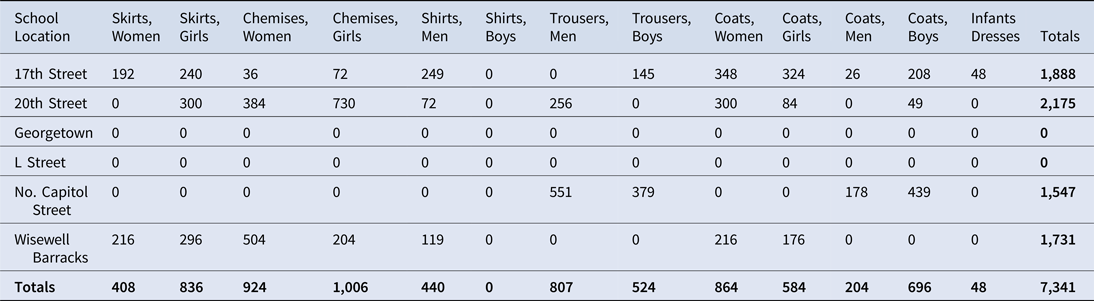
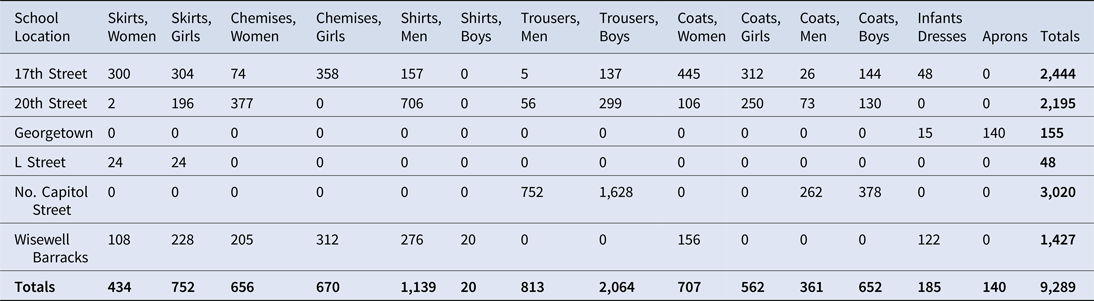
Ascertaining precise figures of production from the industrial sewing schools is difficult. Indeed, even the official records underreport freedwomen's production. An 1868 semi-annual report by the superintendent for freedmen's schools reported that in the first six months of that year 1,873 female student-workers in 46 industrial schools produced 3,105 garments. A set of extant ledgers for six industrial schools in the District of Columbia belie these modest figures and hint at the incredible amount of work the small workforces of freedwomen undertook. The women and girls at the six D.C. schools alone cut 7,341 pieces of fabric and produced 9,289 articles of clothing in the first three months of 1868—numbers that dwarf the superintendent's official figures.Footnote 56 Tables 1 and 2 offer some sense of the types and amounts of clothing the women produced.Footnote 57
Cut Pieces Produced at the Six Industrial Schools in the District of Columbia, February–March 1868

Manufactured [or Sewn] Clothes Produced at the Six Industrial Schools in the District of Columbia, February–March 1868

Sources: Ledgers for Mrs. L. M. E. Ricks Supt. of Industrial School, Mrs. J. S. Griffing Supt. of Industrial School, Mrs. Furmey Supt. of Industrial School, Miss Walker Supt. of Industrial School, and Miss Miller Georgetown Sewing School, all in Volume 98, BRFAL D.C. Field Office Records.
Susan Walker, who had initially taught in Port Royal, opened an industrial sewing school in the Campbell Barracks in Washington, D.C., in December 1865. The first ten freedwomen students there produced three hundred pairs of men's pants within a few months. Encouraged by their progress, Walker expanded enrollment. In September 1866, she moved to the Wisewell Barracks and increased the number of students—and their volume of work. Soon, about seventy women began working six hours during the day in the school, and then they cut garments at night. The white matrons did make a little time for lessons. Walker taught reading and math but did not provide a break for lessons: The freedwomen received one hour of daily instruction while they toiled at their needles. Lucy and Sarah Chase, who oversaw an industrial sewing school near Norfolk, reported, “We consider it feasible to unite study and sewing, so we hang our A.B.C. card upon the walls, and keep heads and fingers busy.”Footnote 58 They accentuated the positive of mixing a little schooling with work for the approximately ninety women at their school.
The use of donated materials certainly represented a boon to the schools’ bottom line. Each month, the D.C. schools received thousands of yards of raw material: jersey, denim, kersey (a coarse wool), and white cotton sheeting. The schools also received barrels and boxes stuffed with donated buttons, cotton and linen threads, and needles. Black women also produced their own notions and thread, which helped ensure that donated materials could be turned into coats, dresses, and pants at the lowest costs possible. The head matrons shipped the finished items to Bureau offices several times a month to meet demand. The volume of material shipped was significant enough that the NFRA hired a full-time “Disbursing Agent for Clothing” in 1866.Footnote 59
Competition between schools in D.C. and other places became fierce. The AFUC admitted that the distribution of donations had “induced an injurious rivalry between schools in some localities.”Footnote 60 Some sewing-school matrons and teachers charged that AFUC administrators showed favoritism in what they judged the unequal distribution of donated clothing and materials.Footnote 61
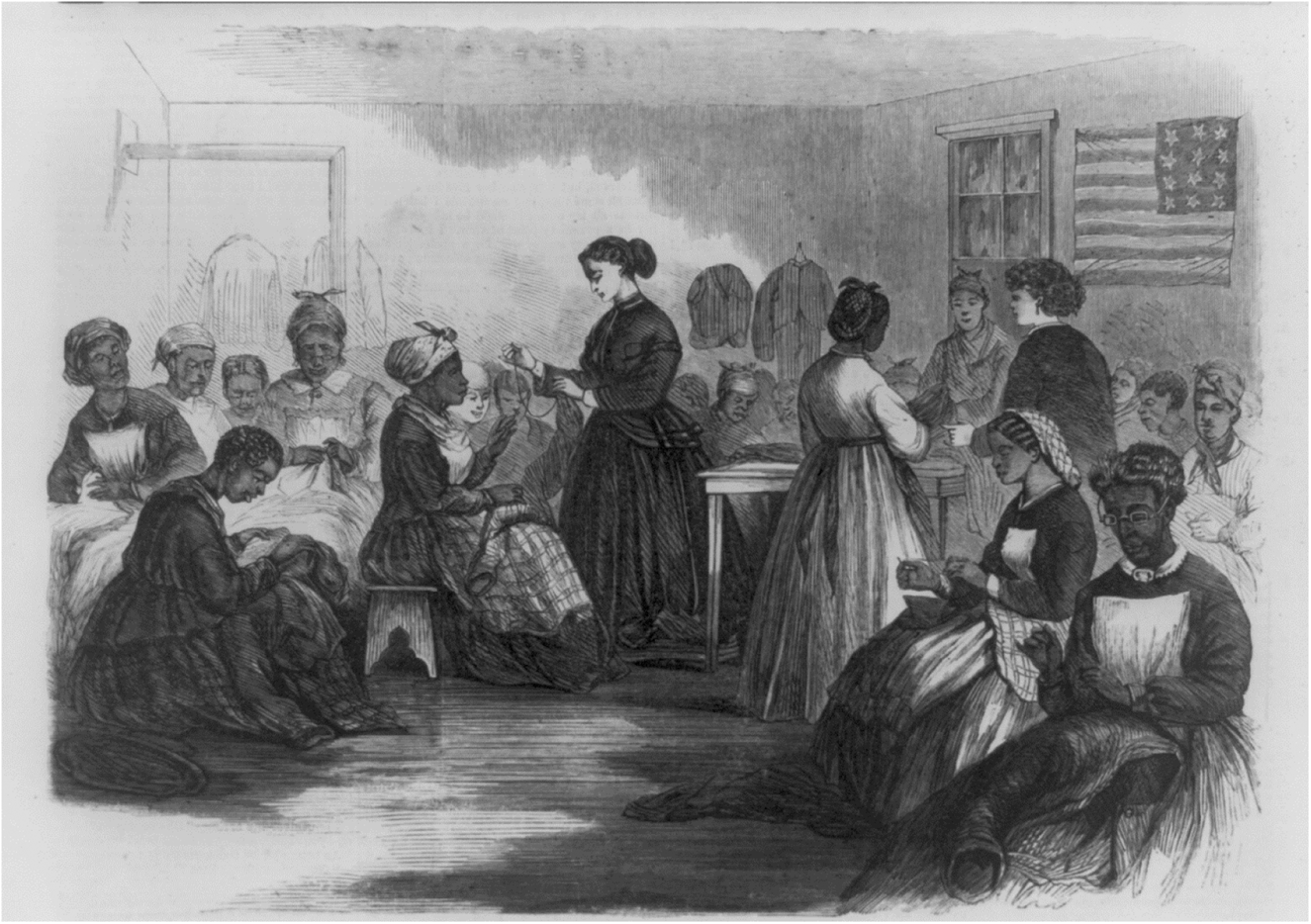
Though they were called schools, it is more accurate to think of the industrial sewing schools as part school, part workhouse. They were spaces for correction. The schools reflect their carceral sensibilities in the ways they sought to control freedwomen who embodied—or potentially embodied—multiple valences of social problem: “immoral, criminal, and vulnerable.”Footnote 62 Reports to aid societies do not mention corporeal punishment, but the schools still operated within a familiar carceral nexus: “deter the idle, punish the immoral, [and] reform the redeemable.”Footnote 63 They purported to keep hands and minds busy, to deter idleness, and to reform those women who were willing. A popular image of an industrial sewing school in Richmond, Virginia (see Image 1) reinforces the domestic imagery of the schools. The white woman highlighted at the center of the image holds a thread, assisting a seated Black woman. The image obfuscates the capitalist relations that made the school a factory and the women its workers. A contemporary commenting on the Richmond school, however, made the relation manifest: “It [the school] seeks the market, on which its life depends.”Footnote 64
An idyllic image from an 1866 newspaper of a sewing industrial school in Richmond hides the capitalist relations that made the school a factory and the women students its workers. Source: Detail from “Glimpses at the Freedmen - The Freedmen's Union Industrial School, Richmond, Va., from a sketch by Jas E. Taylor,” Frank Leslie's Illustrated Newspaper, September 22, 1866, 5, Library of Congress, LC-USZ62-37860.
Indeed, the aid-society leaders, Freedmen's Bureau officials, and even the white matrons used language reminiscent of factory work to describe activities at the school. The student-workers “manufactured” clothes. Officials praised the schools in terms of profits. A Bureau commissioner boasted that the twenty schools in his multi-state district, which included the District of Columbia and Maryland, made “considerable revenue.”Footnote 65 A number of advantages helped the schools realize such significant profits. For one, they used donated spaces and materials, which helped keep expenses low. Transporting the donated materials to the various schools did incur some small expense. The main reason, however, that the schools could be self-sustaining and still turn a profit is that they avoided one large expense: freedwomen's wages.
Most of the schools seldom paid promised wages to the freedwomen. The wages of sewing women who worked at Union and Confederate manufactories offer some sense of pay rates for creating civilian clothes. Sewing women employed by the manufactories earned more than women contracted to work for private companies. Still, contemporaries noted that these wages were not enough to live on. Sewing women agreed; they protested and even petitioned federal authorities for higher wages. In 1861, a sewing woman protesting her low pay noted that women in the Union manufactory where she worked earned 17½¢ for each shirt, 42½¢ for a pair infantry pants, and $1.12½ for a cavalry jacket in 1861, but only 15¢, 27¢, and $1, respectively, in 1864 for the same garments—even though demand was greater than ever. In some places, Black women may have been paid less than or rates similar to sewing women in the manufactories; in other instances, they made more. In 1868, a quartermaster in D.C. paid the freedwomen and girls at Wilbur's school 10¢ apiece for the 216 aprons and slips they had sewn. A Union manufactory paid sewing women 10¢ for each pair of men's underwear in 1864.Footnote 66
Officials promised to pay the freedwomen working in the industrial sewing schools a small wage, but the women were lucky if they received it. Esther Williams, the matron at an industrial sewing school on a former plantation in Sunnyside, North Carolina, was an exception: She consistently paid women at the school. More often, though, freedwomen received non-cash payments of clothes and food. They probably needed the items for themselves or others, but they needed their pay as well. Some head matrons gave up any pretense that they would pay freedwomen money. In 1867, head matrons at AFUC schools reported that the freedwomen would only be given clothing rather than wages “as rewards for [their] industry.”Footnote 67 Harriet Carter, who traveled the D.C. area picking up Black women for her school, paid those women with clothes rather than cash: “I devise every possible means to give work . . . [instead of] charity, in order that I may give clothing and food as pay for the work, rather than as mere gifts.”Footnote 68
An NFRA 1866 financial report hints at how much the societies and the bureau profited from the industrial sewing schools by saving on wage expenses. From April 1, 1865, to March 31, 1866, the one expense lower than the $173 spent on “Manufacturing clothing” was “Advertising” at $29. Salaries, board, transportation, and expenses for superintendents and teachers (calculated together in the report) came to $69,424 for the year, equal to about $1.3 million in modern-day dollars. The report had no line item for salaries paid to the freedwomen.Footnote 69
Some matrons and teachers of the school–factories kept a weather eye on the bottom line. In some instances, they met the women and girls where they were in terms of skill level and productive potential. For girls who could not sew very well, Julia Wilbur had them do patchwork and gave others some fabric with which to practice making simpler items such as aprons. The matrons may have wanted to be as efficient as possible, but their diligence also helped maximize profit. They understood that the clothes produced would be priced lower than market value, but they did try to turn a profit as much as they could. When a Freedmen's Bureau agent mistakenly priced some men's coats and pants as lower-priced boys’ garments, Louisa M. E. Ricks, matron of a school in D.C., hastily wrote the bureau agent asking him to increase the prices of the remaining clothes because “it makes some difference for the poor women who make them.”Footnote 70 What difference it made was questionable considering that the freedwomen often did not receive wages or directly benefit from any profits made by sales of the items they produced.
The most ingenious matrons and teachers found ways to make money from the worst of the donated items. Rather than throw damaged or well-worn donations away, Esther Williams had students at the industrial sewing school on the former North Carolina plantation wash and then rip the worst donated items into pieces that they made into patchwork clothes and rags. Others gave the worst of the donated clothing away to indigent freedpeople, such as the elderly, sick, and disabled. They preserved the student-workers’ labor for those materials that could turn a profit—and reinforced their sense of self as benefactors and educators rather than forewomen of small manufactories that also happened to teach reading and writing.Footnote 71
The matrons and aid-society officials deflected attention from the capitalist aspects of the industrial sewing schools by repeatedly intoning the true intent of the schools: to teach Black women to be women. White women not only proved to be the industrial sewing schools’ most enthusiastic apostles but also helped shape the narrative and ideological justifications for the schools. They found creative ways to emphasize their charitable motivations and feminine expertise. Given a recent previous generation of scholarship offering a flattering analysis of white women's work with freedpeople, it seems the matrons and teachers continued to shape the narrative and to obfuscate how they constructed and maintained gendered and racial hierarchies: “soldiers of light and love,” “angels of mercy,” “Yankee school marms.” I certainly concede that the elite and middle-class Northern women's motives were complex, and I have tried to adhere to historian Elsa Barkley Brown's stress on both/and orientations to historical actors rather than either/or. The white women aided freedpeople in their transition from slavery to freedom, but they undermined freedpeople in ways that helped the women preserve the status differences that gave whiteness and womanness meaning and power in the period and far beyond.Footnote 72
In their diaries, in letters and reports published in aid-society newsletters, and in public forums, white women circulated knowledge about freedwomen from the front lines. The writers sometimes painted them in sympathetic but infantilizing ways, and, at other times, in harsh terms. Griffing wrote about trying to provide for hundreds of Black women as a labor “not merely [of] the Christian duty of feeding the hungry and clothing the naked, but the broad field of encouragement to a higher life[:] instruction in the principles of Labor, Law, and Love.”Footnote 73 Susan Walker, who organized a number of industrial sewing schools in Washington, D.C., stressed that elevation was the true object of her school. In an 1865 letter, she wrote General Otis Howard,
The purpose of the school is to help the freedwomen to help themselves. It is not so much to furnish employment and do a large quantity of work, as to teach them how to do well whatever they undertake. The object is to become self-supporting and independent; to encourage in them habits of industry, economy, and cleanliness; to elevate them in character and condition; and to inspire an ambition for self-improvement.Footnote 74
Walker estimated that seven hundred freedpeople had passed through her school between 1865 and 1869. Although Walker insisted that her top priority had never been profit but “to help the freedwomen to help themselves,” profits were indeed essential to gaining support for the schools and for ensuring white women's ability to operate them. For the most part, white women controlled the official narrative about the schools in letters and reports to aid-society and Freedmen's Bureau officials. They stressed both the hard work and the good work they were doing to transform the lives of destitute freedwomen. The sewing schools for freedwomen became a way to align a number of interrelated self-interests. White women matrons pointed to their work with freedwomen to extend their moral influence into government and public service through their work with aid societies and with the Freedmen's Bureau, either as employees or liaisons.Footnote 75
No matter how the white women described it, the freedwomen and girls in the industrial sewing schools did work. Hard. They sorted through heavy piles of the donated clothing, which could be taxing work. They carried large, heavy bundles of clothing. Some of the clothing could be soiled and smelly or infested with lice, insects, and rats. The problem of shabby, dirty clothes was common enough that AFUC officials discouraged donations of cast-off clothing and appealed for “new material only [emphasis in original]”Footnote 76 The freedwomen and girls washed and ironed tons of clothing. They also disassembled clothing and cut new pieces out of raw material. At some schools, they manufactured thread, buttons, needles, and sewing notions. They spent their days sewing by hand and, in a few schools, on sewing machines.Footnote 77
The places where they labored sometimes were not ideal, especially in the early years of the war when federal policy was, for want of a better description, erratic and ad hoc. In late 1862, in and around the District of Columbia, Harriet Jacobs found self- and military-emancipated Black women, men, and children huddled in buildings damaged by shelling, with no windows and holes in the walls and roofs, exposing them to the elements. The people had very little or no food and were surrounded by the sick and dying. After days of seeing scenes of destruction, Jacobs still judged the Alexandria schoolhouse sheltering infants, children, and women, young and old, as “the most wretched of all the places.” The D.C. barracks where Julia Wilbur started her industrial sewing school in late 1862 was overcrowded. The barracks was supposed to house five hundred soldiers but three times that many freedpeople lived there.Footnote 78
The freedwomen and girls also faced varying levels of violence at the schools. Actual and threatened extralegal violence against freedpeople's schools was not uncommon. Emma V. Brown, one of the few Black teachers working for NEFAS, taught at a freedpeople's school in Georgetown. Embittered secessionists broke up her school in late 1864. She relocated to Washington city proper where, through the financial support of freedpeople, she was able to open another school. Bands of Confederate soldiers regularly raided areas in and near the Capitol, such as Hampton and Alexandria, and in places where the Union military presence was stretched thin.Footnote 79 Confederate sympathizers and soldiers were not the only threats to freedwomen in the schools. Union soldiers and citizens could prove dangerous as well. The army sometimes reclaimed spaces that it had donated. It evicted freedpeople living there and sometimes commandeer supplies. The army made it clear that its first priority was soldiers, not freedpeople. More to the point, “[t]he army's first concern was always control of, rather than assistance to, blacks.”Footnote 80
Unruly soldiers verbally and physical harassed the women and girls who called the barracks home, school, and workplace. Some also brutally beat women and children. At the Campbell Barracks, a group of soldiers forced some freedwomen to strip naked and shower in the cold while they watched. Harriet Jacobs tried to leverage her connections with influential abolitionists like L. Maria Child, Sarah Blake Shaw, William Nell, Charles and Amy Redmond, and William Lloyd Garrison. She apprised them of problems in the barracks and asked them to use their influence to help. In the meantime, however, Black women and girls had to endure hunger, cold, and racial-sexual violence as they waited on moral appeals to effect some change, if any.Footnote 81
But freedwomen did more than just wait. They took a variety of actions to retain control over their lives and to wrest some benefit from the industrial sewing schools. The white women matrons’ narratives and the aid societies’ and military's reports seldom talked about how Black women imagined the schools as a benefit to them beyond white people's estimations. Women and girls could gain at least basic literary and numeracy skills. Those with little experience sewing could learn and practice a skill that they could market for themselves or could barter as part of the informal economy. Improved sewing skills also meant that they could create higher-quality items for their families.
Letters and reports bear witness to the sporadic attendance of freedwomen and girls at the schools. The eighty students who sold the slips and aprons to a U.S. Army quartermaster represented two-thirds of the enrollment in Wilbur's school. About twenty women and girls regularly attended Esther Williams’ North Carolina plantation school though nearly fifty students filled her official roster. The NEFAS industrial sewing school in Alexandria documented more than one hundred women on its roster, but the school consistently averaged only eighty in regular attendance. These women may have been absent because they or a loved one was ill or for some other unfortunate circumstance, but they also absented themselves. Some freedwomen withdrew their labor from the school and other employers to take care of their homes and families. Historian Carol Faulkner observes that “while the women's rights movement allowed white middle-class women to look beyond the home for fulfillment, emancipation gave freedwomen their first opportunity to place their personal and family lives above the demands of a slaveholder or an employer.”Footnote 82 One Charlotte County, Virginia, Freedmen's Bureau agent scoffed that the freedmen there were “encouraging their wives to idleness,” but Black people consciously and deliberately drew boundaries between themselves, landlords, and employers who did not share their visions of freedom.Footnote 83 They prioritized taking care of themselves or family members, tried to escape abuse, and took advantage of other opportunities, especially work for wages.Footnote 84
When Black women could find higher paying—indeed, even paying—work, they took it. Harriet Jacobs noted the numbers of D.C. citizens coming to the barracks looking to hire freedpeople for short-term help. Jacobs wrote with a hint of bitter irony that the D.C. barracks “was thronged through the day by persons who came to hire these poor creatures, who they say will not work and take care of themselves.”Footnote 85 Anna Searing wrote her friend Emily Howland, “There is at present a greater call for women's labor than men's, so many [men] have been thrown out of government service: a skil[l]ful woman can make more here now than a man.”Footnote 86 Those seeking workers clearly preferred women without children. When demand was high, Black women could earn $1 a day. At other times, single women could earn $4 a month; a woman with one child found that pay reduced to $2.50 to $3 a month. Enrollment in the schools likely differed dramatically from official roll counts depending on whether students found more remunerative employment elsewhere. Even at their height during the early years after the war, when demand for clothes and other sewn goods was high, head matrons reluctantly reported that on any given day nearly half or more of the students on the official rolls were not in attendance.Footnote 87
The desire to escape mistreatment or simply the freedom to decide how to spend one's time were reasons not to attend school. Clearly, the schools were different from prisons or jails: Freedwomen could choose to attend or not. Black women, however, performed a risky calculus regarding whether to attend the schools or not. Black women were already widely assumed to be sexually immoral and criminal. Carceral logics at the vector of race and gender rendered suspect Black woman not working for a white employer. Those who chose to care for family, work for themselves, or choose their own employer raised suspicions of prostitution or some other crime in whites' minds. Historian Priya Kandaswamy cogently observes, “female vagrancy involved both a failure to be independent and a failure to embody proper forms of female dependency.”Footnote 88 Contemporaries noted a dramatic uptick in sex work around military barracks and camps in and near D.C. Even if a woman not on a job or in a school escaped suspicion of prostitution, local citizens or authorities could still accuse her of vagrancy, and she could be arrested. A judge or Freedmen's Bureau official could indenture her or apprentice her children. Thus, freedwomen were not formally confined in the school, but attendance helped shield them from charges of vagrancy and other criminal conduct.Footnote 89
White women were not ignorant of the challenges Black women faced. Some noted in their letters that the Black women attending their classes were often solely responsible for their families’ welfare and missed classes to find food or work. Their acknowledgment did not signal a recognition of sisterhood. In many ways, it further defined its limitations. While a number of Black women did struggle to support their families, not all did so alone. White women sometimes failed to appreciate the multiple shapes that Black people's families took and so missed the presence of men in freedwomen's lives. S. E. Foster, who shared part of Mary Pope's story with readers of NEFAS's Freedmen's Journal, failed to mention—even hint at the existence of—Pope's husband Joe. Matrons consistently described freedwomen and their family and home lives in ways that necessitated the white women's intervention.Footnote 90
Freedwomen were acutely aware that features of the schools officials touted as benefits represented serious limitations and impediments for them. Some complained that the schools set up for freedpeople did too little to help them achieve economic independence and political power. Mary Pope, who had escaped from Southampton County across the Blackwater River, wanted to learn. And she wanted to work. She and her daughters may have attended the New-England Freedmen's Aid Society's industrial sewing school in Norfolk that opened in December 1864 soon after she arrived in Norfolk. Unless she did not already possess reading or numeracy skills, Mary had little use for most of the lessons offered at the school. She was already an expert spinner and weaver. Mary had learned some weaving skills from her former enslaver, who had been “a mighty weaver herself” as Mary recalled.Footnote 91 Mary also taught her daughters Rachel and Betsy to knit and weave as well. Mary had proven that she would do anything to take care of and keep her family together.
The schools then provided some advantages for women like Mary and her daughters, benefits that were not important priorities to many of the school, aid-society, and military officials. Though donations of coal and other materials were sometimes inconsistent and even paltry, some of the industrial sewing schools did provide clean, warm places to spend the day away from the cramped and sometimes desperate conditions in the camps. The schools allowed Black women to keep their children and extended families together under their watchful eye in relatively safe spaces. Rather than leave elderly or infirm kin and children to fend for themselves or under the care of others, women could keep them close by at the schools.
Having endured so much to gain her freedom, freedwomen like Mary Pope would have appreciated the ability to keep loved ones near and offer them some modicum of protection. Having children and loved ones around lessened the chance that they would be apprenticed to locals or conscripted by military officials to work on fortifications or other job projects. Fears about separation were not unfounded. At the contraband camp at Roanoke Island, parents kept their children from attending schools after the army took a group of boys to New Bern to work without their parents’ permission. Women at the Roanoke Island camp, which operated a Freedmen's Store and an industrial sewing school on a former plantation, also expressed concern that their daughters would be taken from them to work on plantations. For Black women, concerns about sexual victimization played a factor in their desires to work closely with girl children and young women.Footnote 92
Time spent in the classes also allowed Black women to establish, reestablish, and nurture networks. In some cases, as with Mary Pope, freedpeople escaped together in groups or from the same areas and so likely ended up in the same camps. In other cases where freedpeople found themselves surrounded by new faces, freedwomen built new relationships and alliances to survive, provide for themselves and their families, and care for one another in the camps. Sitting and working together in the schools would have allowed the women opportunities to inquire about lost loved ones and rebuild families. They would have shared information about how to navigate bureaucracies to access donated food and clothing, about which white officials were sympathetic and helpful and which to avoid because they were insensitive, even cruel.
Susan Walker, head of an industrial sewing school in Washington, D.C., compiled a list of two hundred Black women and girls at her school. I recognize the value of this rare list, but it frustrates as well. It is extremely difficult to locate in formal records Black women dislocated by war and exploited by state and community institutions. But Walker's list offers hints about Black women's responses to restrictions officials tried to force on them. The list includes about a dozen male names. These may represent male children the women insisted keeping close or husbands and other male relatives who the women insisted the matrons give shelter to or work in the school.Footnote 93
Black women did not imbibe the lessons of servility that free-labor experiments like the industrial sewing schools were supposed to instill. They refused to allow their labor to fulfill only whites’ expectations. They refused to participate in their commodification, to be both product and producer. The women never stopped insisting that they should be paid the wages owed them rather than the clothes, rations, and scrip that head matrons felt fair compensation. Among the myriad cases demanding compensation that Black women brought to Freedmen's Bureau courts, most dealt with complaints about wages. The women also insisted that they did not just need rations and donated clothing: They deserved them. The items were their right. Like their sisters on leased plantations, women at the industrial sewing schools battled to ensure adequate rations. They also used the Freedmen's Bureau courts to compel matrons at the industrial sewing schools to pay promised wages.Footnote 94
D.C. matron Susan Walker's honied words cloyed when considered against her actions. Walker had insisted to Gen. Oliver O. Howard that her top priority had never been profit but “to help the freedwomen to help themselves,” but she quickly earned a reputation among freedwomen and Freedmen Bureau investigators as a cheat. She promised wages to student-workers for work they did in the school and for other duties that Walker contracted, but she paid them with clothes. When Black women refused to accept clothes as payment, which some complained were of poor quality, she still refused to pay them with money. She gave them Army rations of meat and flour.
Several freedwomen took their complaints against Walker's to the local Freedmen's Bureau courts. One investigator gave his candid assessment after investigating numerous charges brought against Walker: “justice to the poor colored women demands that Miss Walker be called to account for her knavery (I cannot use a milder term in this connection) as the treatment of her women employees has become outrageously notorious.”Footnote 95 Walker did sometimes fulfill her commitments and pay freedwomen in cash. She paid Virginia Johnson the ten dollars she promised, but then Walker took back five dollars. Johnson, along with other freedwomen who complained that Walker also took some or all of their pay, took Walker to the Freedmen's Bureau courts. Sophia Johnson sued Waity Harris, who oversaw an industrial sewing school in D.C. Johnson tried twice to get her promised pay from Harris, but Harris refused to pay. Johnson testified, “she was in a rage and halloed [sic] to me as if I was a dog.”Footnote 96 Freedwomen refused to toil within a context too reminiscent of slavery: they work, others benefit. More important, they asserted that their labor and fair recompense for it were vital to their survival and freedom.Footnote 97
Freedwomen at the school sometimes performed domestic work for the matrons and teachers. In rural areas, some teachers took up residence in abandoned plantation mansions and homes. Heating water, tending fires, cooking, and serving day and night in their previous sites of bondage proved too reminiscent of slavery for some freedwomen. Lucy and Sarah Chase had freedwomen and children working as servants in their residence on Craney Island, Virginia. It is not clear if the sisters paid the women. An exasperated Lucy Chase complained in letters that whenever she asked one of the four regular servants to do something, they passed the task on to someone else. The servants were so slow that she picked up the broom or needle herself rather than keep waiting on them. She complained,
they [the Negroes] are slow indeed! [emphasis in original] Southern women have often begged Northern abolitionists to sympathize with them, instead of with the slaves. . . . I am fast learning to sympathize with the depressed. To wait and wait, and still to wait is our lesson of everyday.Footnote 98
The freedwomen probably relished moments to frustrate their “new” mistresses by deploying resistance tactics they had used under enslavement, such as work slow-downs, temporarily absconding, and just saying no to the work.
The industrial sewing schools were important for reasons that transcended the material. Freedwomen worked hard to transform donated materials into sturdy and attractive clothing for other freedpeople. They worked under sometimes trying circumstances and often without pay not because they accepted the stingy lessons of free labor but because they understood the importance of their work for other Black people. Clothes were a scarce and precious commodity for freedpeople. A ledger of freedwomen in a Huntsville, Texas, jail notes that five of the fourteen women were serving two- to five-year sentences for stealing clothes. Mary Chamlin had been convicted of stealing a “shiny p[ai]r. of stockings and 7 ya[rd]s.” of fabric.Footnote 99 Every shirt and dress created ensured that a child or sister would not go naked. That they could keep warm in the winter. That they could attend church, school, or other public functions without feeling ashamed about their appearance. Indeed, freedwomen took pleasure in their appearance and in having nice clothes. A young woman working in Lucy and Sarah Chase's home could not hide her excitement upon seeing a pretty dress: “I should be ready to die, if I could get that dress!”Footnote 100
Freedwomen also understood that clothing was one marker of their free status. In her narrative, Harriet Jacobs recalled how much she hated the linsey-woolsey dress her enslaver would dole out every winter: “How I hated it!” she wrote. “It was one of the badges of slavery.”Footnote 101 During enslavement and in freedom, whites commented with ridicule, contempt, and scorn on African Americans' ill-fitting, outdated, and worn clothing, which both reinforced in their minds the primacy of whiteness as a marker of civilization and taste and offered reassurance that Black people could never be their equals. Jacobs was not alone in understanding how clothing visually and materially marked, defined, and restricted African Americans. In this opening foray, I cannot elaborate here on either the critical role of sewing and the fashion trades in the lives of enslaved women or on slave textiles. I cannot stress enough, however, that seamstresses in the schools, no matter their skill level, took seriously the work of fashioning their own visions of freedom. At the risk of overusing the metaphor, with each stitch Black women unraveled slavery and weaved themselves and the meanings of their labor into larger questions about citizenship, opportunity, and freedom.Footnote 102
It is important to consider Black women's “freedom dreams,” aptly described by the intellectual Robin D. G. Kelley as “visions fashioned mainly by those marginalized black activists who proposed a different way out of [their] contradictions”: or, more to the point, their “emancipatory vision.”Footnote 103 As this essay is an opening foray, I will have more to say about the political significance of early industrial education for Black women. Black women's labor in the industrial sewing schools made them legible to the head matrons, aid-society and military officials, and reformers. To them, Black women's bent backs signified their value. But the work women performed also made Black women legible to themselves. While white people devalued Black women's claims about what their time and effort meant, they could not completely set the terms and conditions of Black women's labor. The white head matrons and aid-society, military, and Freedmen's Bureau officials did not prioritize how the conditions of Black women's work in the school impacted the women's personal and family lives. They judged work that the women did in their own homes and for their own families as a burden on scarce resources, but similar work done within the industrial sewing school had value precisely because it fulfilled white reformers' free-labor visions of the role Black women would and should play in a post-emancipation society.
The uncompromising metal of free-labor ideology melded with the domestic economy to forge a new alloy—the industrial sewing school—in the crucible of capitalist transformations occurring in the mid-nineteenth-century United States. By 1872, the Freedmen's Bureau disbanded, and industrial sewing schools were soon subsumed into the industrial education curriculum of Black schools and colleges, and industrial homes for delinquent youth. With the industrial sewing schools, white teachers, reformers, and aid-society and Freedmen's Bureau officials found it impossible to reconcile Black women as both free-market actors and womanly dependents. Their experiment in domesticating racial capitalism relied on carceral logics that treated Black women as needing the discipline work conferred. Freedwomen were free, but the afterlives of slavery were ever present: exploitative labor contracts, apprenticeship, transport, convict leasing, and domestic parole. Whites' vision of domesticity indexed elite and middle-class white women's bodies to feminine virtue. At the same time, however, they expected Black women to give up the physical and ideological labor necessary that made the white domestic goddess possible.
Black women understood intimately the ways that their labor enhanced white women's power. They recognized how their own ideas about the meaning of their freedom and work lives clashed with the narrow frames of possibility envisioned by white people. In some instances, Black women folded the schools into their economic networks, attending when it suited them, and used them to shield themselves from charges of vagrancy and prostitution. Some probably appreciated not having to perform backbreaking field labor and welcomed considerations that they might be imagined as housewives and as gentlewomen. The work in the schools could be hard. To be sure, the needle however, could be as exacting a task master as an overseer. Emphasis on the need (and requirement) that Black women work made it clear that they were being trained to serve in capacities similar to work they had as slaves. White women heading and working in the schools promoted a public narrative about their own godliness, patience, and foresight to justify their leadership over the schools and to obscure the economic and carceral elements of the schools.
The work that the industrial sewing schools trained freedwomen for ensured that Black women would never do well enough to challenge the revered status of men (Black or white) as the true and legitimate providers for families. The work itself also ensured that Black women would never rise to the idealized status of white womanhood because they labored outside of the home. The schools reveal that reformers considered Black women's labor integral in rebuilding not just the South but the nation. Black women counted their labor in very different ways: as part of their care work and as essential to their autonomy. Thus, the schools reinforced Black women's economic dependence and their racial and social subordination in ways that foreclosed even the remote possibility that free labor could integrate them into the market or help them become self-sufficient. The production aspect of the earliest industrial schools, being all-women and profit-making enterprises, revealed the full panoply of exploitation: Black women's labor was sold for profit and called charity. The hierarchies of free-market relations, like those of the plantation household, quickly adapted themselves to the context of emancipation. The factory/classroom of the industrial sewing school represented an important front in the war over the meanings of Black women's labor.