AMADO'S TENT OF MIRACLES AS THEATRO-MUSEOLOGICAL PARADIGM FOR AFRO-BRAZIL
“You confound batuque and samba, horrible sounds, with music; abominable calungas, sculpted without the least respect for the laws of aesthetics, are raised up by you as examples of art; the rituals of savages possess, in your vision, the status of culture. This country will be outraged if we ever assimilate such barbarisms, if we don't fight back against this avalanche of horrors. Listen: all this, all the shit, supplied by Africa, which bespatters us, must be cleaned off the culture of the Fatherland, even if it becomes necessary to employ violence to accomplish this.”
“Violence has already been employed, Professor.”Footnote 1This dialogue is enacted between two characters in Jorge Amado's satiric novel Tenda das Milagres (Tent of Miracles). The last line, “Violence has already been employed, Professor,” is spoken by Pedro Archanjo (an exotically disguised fictionalization of the black Bahian anthropologist and historian Manuel Querino) who has just published his modest little book A Vida Popular da Bahia (The Popular Life of Bahia). The first speaker is a white racist patriarch academic, Nilo Argolo. The grand professor's horror-filled assault on the black civilizations of Bahia and the Brazilian Northeast is a fertile space to start uncovering the profound impact of African thought and ritual on the way Brazil is capable of remembering its slave history. The writing takes us back into Brazil's recent past to remind us of something which white Brazilians now do not like to dwell on. In the long first half of the twentieth century, white power structures ruthlessly sought intellectual justifications for the violent repression of the embarrassing “barbarism” of Afro-Brazilian culture.Footnote 2 Yet what is fascinating about the exchange in Tent of Miracles is the manner in which the professor's language is saturated in words of Yoruba origin, words which cover specific types of music and sculpture relating directly both to the slave-evolved heritage of Bahia and to the untranslatable glories of the cultural practice of the west coast of sub-Saharan Africa. Argolo's attack is not general but based in an intense and precise engagement with the terms of African ceremony and fetishism. When he refers with disgust to batuque and calungas he demonstrates the vivacity, tenacity and ubiquity of Afro-Brazilian influence. He uses powerful words that relate to ritual and African memory, words that carry multiple meanings, and which not only fascinate anthropologists but remain unsettled and unsettling in Brazil today. I will take each of these words in turn and consider it as the sign for a whole system of thought and artistic practice which looks back to Africa and then bounces between Brazil, Africa and Europe. If their full cultural weight is considered in the context of a specific ceremonial space, that of the Maracatu Nação, these words can open up an awful lot. Considered in the context of the elaborate ceremony of the crowning of the kings of Congo, batuque and calunga become hefty semantic keys, keys which can unlock much that is unique about Afro-Brazilian approaches to slavery, and to the way in which the Brazilian memory of Africa works through the memory of slavery. The following work may consequently be seen to have elements in common with recent theoretical approaches, notably those of Joseph Roach on Mardi Gras and the Notting Hill Carnival and the revelatory work on Jamaican cultural transformations and particularly the Jonkonnu ceremony, which appeared in 2007 around Yale's milestone exhibition and catalogue Art and Emancipation in Jamaica: Isaac Mendes Belisario and His Worlds. This work approaches the delicate task of tracing the cultural legacies of slavery in contemporary syncretic cultures of the Atlantic diaspora. My work, however, pushes out into new territory, first in terms of geographical location, by focussing on the relatively neglected intangible performance heritages of northeast Brazil, and second through its synaesthetic approach to dance and the use of ritual/sculptural objects within the context of Afro-Brazilian ritual performance.Footnote 3 I am moving up northeast Brazil a little way from Bahia, where Professor Argolo was speaking, to Recife, to think about how complicated the cultural manifestation of Africa can be within the Brazilian slave diaspora. I also want to think about how the Maracatu Nação might suggest that the extant approaches of Western museums to displaying and interpreting a phenomenon such as the calunga are wholly inadequate, and in many ways irrelevant to the processes of either recording or comprehending these living art forms.
The practice of the batuque and the display of the calunga come to life in the context of the African-evolved rituals of the Recife carnival. The ‘Night of the Silent Drums' takes place before the Igreja de Nossa Senhora do Terço in Recife, always on the first Monday night of Carnival, and is the single most concentrated ceremony show-casing the performance art known as Maracatu Nação. It is necessary to start by giving a brief outline of the form and to explain how it incorporates batuque and the calunga as essential elements.
COURTLY TROPICALISMO: THE KING OF CONGO, THE KING OF PORTUGAL AND THE SLAVE KING
The Maracatu Nação performed on the “Night of the Silent Drums” is a seven to eight-hour performance, beginning at about five in the evening with a children's enactment, by the Infantil Tambores Marins, and ending at midnight with a moment of terrible and terrific silence. The whole ceremony builds up to a sublime confrontation with the tragic effects and traumatic memory of slavery. The massed batuqueiros or percussion elements, each of which has previously performed its own ritual songs with its own varied rhythms, lock into a single rhythm. Then the drums go silent, and the lights are cut off across the city of Recife, and in the quietness thought is turned backwards in time to one special set of slaves. This final climax, enacted in that strange stillness and quietude of a multitude who had a few seconds before been so exuberant, is directed to the memory of the slaves who survived the Middle Passage, but who did not survive the processes of “seasoning” which prepared them for the plantations. In other words, there is a special tributary space opened up here for the memory of those who although on Brazilian soil did not complete the journey into slavery.
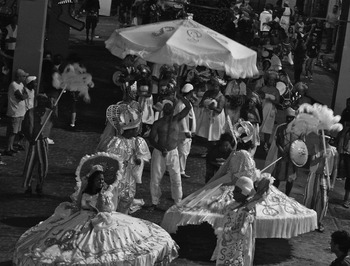
Formally the Night of the Silent Drums is made up of a continual procession, structurally formed around repetition with variation, in which each nação or Africa-related “nation” parades up the street leading to the church, where they in turn perform a ceremony, the “Rei do Congo,” the coronation of the King of Congo. Within each group the king's court are dressed in elaborate costumes which mimic the attire of the royal court of Lisbon during the baroque period, complete with period accessories including perukes. Although the costume and accessories are highly individualized there is no variation in the fundamental structure which each of these repeated performances takes, and each group is composed of the following elements (Figure 1). A percussion group, the batiqueiros (traditionally barefooted, beating out the batuque), who bring up the rear; a group of Bahianas, or Baianas, women dressed in the traditional costume of the street and house slaves of Bahia; and a group of lanceiros or symbolic warriors who act as a sort of outriders, who protect the royal court. The court itself heads the procession and consists of the following: rei/king, raínha/queen, porta estandarte/standard bearer (who carries the banner, very like the old trade union banners of Britain, embossed with the names, foundation dates and symbols of the Maracatu Nação he is leading), damas de paço/ladies of the palace (who attend the queen and who carry the calunga dolls), damas de buquê/ladies of the bouquet (ladies in waiting to the queen who bear flowers for her which are sometimes cast before her feet), pagens/pages (who bear the long trains of the royal couple), and finally the escravo/slave (who is male, usually naked to the waist, and holds a large coloured and fringed parasol over the royal couple).
“Rei do Congo” ceremony, Marcus Wood, digital photograph, 2008, Recife, Brazil.

The preparations for this event are very elaborate. Each nação has its own headquarters, devoted to its particular gods, which forms the focus for rehearsals and a space for the creation of costumes and sculptures during the year. Each of these terreiros is consequently a combination of social centre, church and museum. Some of these naçãos stretch back into slavery times: the Maracatu Nação Elefante was formed in the year 1800, and claims black roots going back to 1600, and although briefly disbanded after the death of a particularly venerated leader, was reformed, and is still active. The Maracatu Nação Leão Coroado was formed in 1863, a quarter of a century before Brazilian slavery was officially abolished, and has been in continual existence until today. It consequently claims a direct lineage with the coronation ceremonies performed by the mock courts of the slaves.
The whole event incorporates a tremendous range of art forms, which in their turn involve a variety of musical and theatrical elements, many of which look back to African-evolved traditions. These include elaborate themed songs with poetic lyrics, the creation of stylized and exotic brilliantly coloured costumes, the creation of symbolic embroidered banners, and a variety of portable sculptures, most notably the calunga.Footnote 4 As even this necessarily brief outline suggests, the Night of the Silent Drums constitutes a special brew of diasporic energies.
The basic setup is as follows: poor black people in Recife today, well over a hundred years after the abolition of slavery in Brazil, dress up in clothes which parody the attire of the colonial court of Lisbon, a court exiled to Brazil during the Napoleonic wars. Some performers even play the role of slaves, yet the king and queen by whom they are enslaved are themselves black, and are both Afro-Brazilian and African. Each “nation” performs their most sacred ritual on the threshold of a Catholic church, and yet they worship a fetish doll or calunga which, as we shall see, is considered to be several things at once. First the calunga is the embodiment of the living spiritual leader of each nação, yet it is also a vehicle allowing passage to the spirit world, an African sea goddess and the mother of Jesus Christ.
Thinking about how impossible it is to enter the psychology of enslaved individuals by considering the written evidence that comes down to us, M. I. Finley, the great historian of ancient slavery systems, asked a very useful question: “What for example may we legitimately imply about the psychology of the slaves who prayed and offered gifts to the Gods of the Greeks and Romans or who joined the innumerable cult associations under the Roman Empire, in particular those associated with ruler worship?”Footnote 5 With the Night of the Silent Drums we have a complex ceremony, a coronation, devoted at one level to the re-enactment of the central ritual of “ruler worship” within a European, and by extension an eighteenth-century colonial, society. This ritual is then extended and developed over a period of more than two hundred years, by a variety of slave, and then ex-slave, cult associations, so that it is overlaid by a series of elements relating to Central African, and specifically Congolese, and West African, and specifically Yoruban, beliefs and gods.
BATUQUE, DRUMMING ACROSS THREE CONTINENTS
Right at the heart of the Maracatu Nação is the repeated re-enactment of the ceremony of the coronation of the king of the Congo, and right at the heart of each of these re-enactments lie two elements, the percussion of the batuque, and the appearance of the goddess Iemanjá in the symbolic form of the calunga. Bearing in mind the outburst of Professor Argolo which prefaced this discussion I want to examine the semiotic and communicative limits of these two magical African words.
Batuque finds its origins mainly in Yoruba, although there are also Bantu elements, and it has now diffused beyond the Maracatu and candomblé into popular Brazilian speech. The different meanings it offers up to black and white open up perceptual gaps concerning what the memory of Africa meant, in the days of slavery, and what it means today. Small Portuguese–English dictionaries do not even include the word, but usually have short entries for related words, batucada meaning “dance percussion group” and batucar, “to drum.”Footnote 6 The dictionary which was the bible for English engineers working out in Brazil in the late nineteenth century, during the years in which slavery drew officially to its close, gives batuque as “a kind of African dance,” and batucar as “to beat often.”Footnote 7 James Taylor, whose Portuguese English Dictionary constituted the first in-depth introduction of Brazilian Portuguese to North American students and scholars before the appearance of the now authoritative Novo Michaelis, gives batucar as “to dance the BATUQUE, to hammer, make noise, beat time, to bang on the piano,” and batucador as “a poor piano player,” while batuque is given as “hammering, banging, a song-and-dance with stomping and hand-clapping, a hoe-down.”Footnote 8 This peculiar definition bears the hallmark of its white North American maker and gives no mention of African influences. The word here means primarily an almighty din of any sort. Taylor's definition also attempts to domesticate and familiarize batuque, turning it into the homely “hoedown” of popular American folklore. Michaelis provides definitions which superficially allude to the way the word is embedded in Afro-Brazilian culture: “1 ‘batuque’ s. m. (Braz) hammering, drumming, noisiness. 2. Generic designation of Afro-Brazilian dances. 3. Negro ball.”Footnote 9 What is important here is the manner in which the word means both a terrible racket and seemingly all Afro-Brazilian percussion, dance and socializing, including the rather inauthentic-sounding and oddly phrased “Negro ball.” There is the implication here that for a white audience all “Negro” drumming, clapping and dancing is generic, and boils down to an indiscriminate form of noise making. The attitude lying latent behind this definition is in fact, although expressed in less aggressive form, not that far removed from the sentiments expressed by Professor Argolo in my opening quotation.
If, however, batuque and its satellite words are taken seriously in terms of their African etymological roots, a very different picture emerges. John Schneider's revelatory mammoth and sadly all too neglected scholarly achievement the Dictionary of African Borrowings in Brazilian Portuguese (DABBP) for the first time laid bare the central impact of a range of African languages on key cultural concepts in Brazil. Schneider demonstrates how batuque refers both to a specific set of dances in the Northeast, to various cult religions, including Umbanda and nagô-mina in Bahia and Recife, and to the sacred nature of drumming as an activity both in West Africa and in Northeast Brazil. Schneider points out that the word refers to a sexually charged African-evolved dance, featuring the mutual “belly blow” as a sign for partners to change with each other, and the word also refers to a violent and simplified form of capoeira, the slave-evolved martial art/ballet of Bahia. In both cases it is the rhythmic, almost violent, reciprocity involved between partners practising the art form which is the defining element. In terms of African connections the most crucial definition is that for batucada given as “The rhythm or chant for the common African dance batuque. It is a very fast beat produced by percussion instruments.”
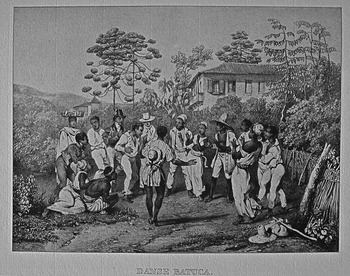
The most detailed and keenly observed historical representation of the batuque that has survived is the “Danse Batuca” plate (Figure 2) in João Maurizio Rugendas's vast travel book the Voyage Pittoresque dans le Brésil. This shows the dance being performed in the open air in a rural plantation. It appears to be a dance along the lines of the Jongo as it still survives in some of the more far-flung Rio favelas. A pair perform in the middle of a circular group, to a percussive rhythm performed to the circle, and responding to their movements. The percussion depicted in the “Danse Batuca” plate is as pure as it gets; indeed it is positively Steve Reich-ian for there are not even drums, only hand clapping. Yet the derivations of the word from Yoruban are deeply involved in African percussion and in the function of certain drums in particular. Batuque comes out of a Yoruban compound, bàtáà koto, fusing the idea of beating with a specific drum, for koto evolves out of reference to “the kósò drum used at the Gèlèdé, where the drummer awakens the Aláàáfin, a ruler of the Oyó.”Footnote 10 In Yoruba, bàtáà koto also relates to the effect of atavistic ceremonial music, the sacred “sound of drumming” itself. And yet the word is not tied down to West African meanings, because it also grows directly out of Bantu and refers to a Mozambican form of dance, the batchuk.Footnote 11 In summary, then, for blacks in the Northeast of Brazil the batuque constitutes a living embodiment of the transference of African drumming rhythms and religious ceremony into the performance of the Maracatu Nação.
“Danse Batuca.” João Maurizio Rugendas, black and white lithograph on stone, Plate XVIII, Jean Baptiste Debret, Voyage Pittoresque dans le Brésil, Paris, 1827–35.

Batuque also carries a specific set of meanings in relation to percussion which anchor it powerfully back in Africa and which relate directly to the survival of religious thought and ceremony through the Middle Passage. Batuque is consequently a powerful demonstration of the inability of the slave power to stamp out African modes of thought and art. Batuque maintains its connection to Africa with a directness which is different from the more creatively diluted relation of other popular musical forms, most significantly samba. Brazilian Portuguese does, of course, have a common verb for drumming, bater, and in the Rio Carnival the percussion section is called the bateria, but up in Bahia and Pernambuco in the carnival ceremonies they refer to drumming in terms of the African word batuque and the percussion sections are made up not of baterias but of batuqueiros. The original African connection between batuque and Oyó, which Schneider isolates in his discussion of the word's Yoruban roots, has been carried through to Afro-Brazilian culture. Oyó can describe both a candomblé nâgo (in other words a specifically Yoruban cult) popular in Bahia and Recife, and refer back to the ancient capital of Oyo in Nigeria, where Xangô was the king.Footnote 12 Xangô remains one of the most powerful candomblé deities, the god of thunder and lightning, who is interchangeable with the Catholic saints Paul, Jerome and Barbara. But in Pernambuco, xângo also refers to the terreiros or shrines where the cult ceremonies are held, and is also a general lay term used to describe all Yoruba cults, and all the naçãos which claim a lineage with Africa.
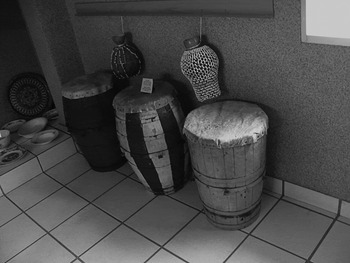
The irresistible sound which the batuqueiros make on the Night of the Silent Drums comes out of the big drums, the alfaia. It is these mighty instruments, coming in late at the third stage of the chants of the Maracatu Naçãos, which take everything to a new percussive and emotional pitch. It was these martial drums which the slave-owners periodically sought to ban; they are locked into a profound relation with African religious drumming; they talk to the ancestors directly. It was similar drums which hysterical whites in the aftermath of the first great revolt of the San Domingo slave revolution claimed they had heard beating through the night. Drumming from the alfaia was also singled out as central to the organization of the revolt of the Males in Bahia in 1835. In the aftermath the state government actually went so far as to prohibit any further importation of African war drums.Footnote 13 These big African-style drums, the heart of batuque, are a fine example of how it is unwise to come at objects with European categorical approaches. If you go to the terreiros you can see the oldest drums exhibited formally in the display sections, which are like a museum but not a museum.
The drums in Figure 3, for example, are kept in the Museo do Xambá in Olinda; they are part of a display, but are frequently taken out and used in ceremonies and in the carnival batuque performances of the Nação Xambá. The set up is very different from that of Western museums where objects are locked in cases and protected from use.Footnote 14 And so our key word batuque emerges as something much richer and less stable than the conventional lexicographers and Professor Argolo would have us believe. With batuque on the Night of the Silent Drums we have then a tremendous drum, a drumming style, and a profoundly complex parodic ceremony which both celebrates and mocks the power relations of colonial slavery, while alluding to social structures within the monarchies of ancient Yorubaland.
Alfaia drums in Museo do Xambá Olinda. Marcus Wood, digital photograph, 2008, Olinda, Brazil.

WHAT'S A CALUNGA WHEN IT'S UP AND RUNNING? MORPHING WHITE PORTUGUESE RAINHAS, AFRICAN LUNGAS AND AFRO-BRAZILIAN IEMANJÁS
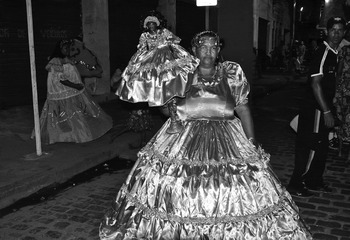
I want now to shift discussion from drumming to dancing, from batuque to the calunga. This is purely an academic move, for dancing, drumming and slavery operate in relation to each other within dark and organically linked memorial spaces, and are not elements which the Maracatu performers would seek to separate from each other.Footnote 15 At first glance the calunga as created, held and danced with on the Night of the Silent Drums looks straightforward. Take the calunga in Figure 4, for example, a little black doll, dressed up in what looks like an elaborate nylon gold ball gown, and held on a metal support a bit like a candlestick taken from a Catholic high altar. Yet what you see here is most certainly not what the Afro-Brazilian participants in the Night of the Silent Drums get. The limits of the calunga are not easily established; we well may ask what sculptural forms the calunga takes and what it signifies, but these logical Western academic questions are not stable or easy to answer, because the calunga is so much more than an object. I will try to explain something of what is at stake here, particularly in relation to the limits of what might be termed the Western museological gaze, by using one celebrated test case, the calungas of Dona Santa.
Calunga displayed by Dama de Paço, in the procession Noite do Tambores Silenciosos. Marcus Wood, digital photograph, 2008, Recife, Brazil.

Things start to get definitionally complicated for the calunga, and more significanty for us, when it is noted that the court of the king of Congo in the Maracatu is not manifested in any straightforward manner as an African royal establishment, but simultaneously as the European Portuguese court, and has reference in particular to the court as it was spectacularly transplanted from Lisbon, via Bahia, to Rio in the early 1800s. Leopoldina, for example, wife of Emperor Dom João, often becomes embodied in the calunga. This calunga together with the two other female calungas representing Princessa Leopoldina and Donna Emilia went into the collection of the Museum of the Northeast, in Recife, in the 1960s. This movement from live ritual, or fetish sculptural object, to entombed museological exhibit is itself crucially indicative of the fact that to Afro-Brazilian believers the calunga is a lot more than a toy or object. The incarceration of the calungas of the Nação do Elefante in a museum came as a result of the death of Dona Santa (Maria Júlia do Nascimento), who had been a remarkably powerful figure, and spiritual leader in this most ancient and revered of the Recife naçãos. She was Raínha do Maracatu Elefante, and Babalorixa of the Nação do Elefante. The three calungas referred to had been made to accompany her in her ceremonial duties, and had for many years been paraded in the Nação do Elefante during the Night of the Silent Drums, as well as operating as powerful fetish objects in other activities conducted by Dona Santa for the Nação do Elefante. But when Dona Santa died so did the connection between these calungas and the African water spirit from which her African heritage ultimately derives, and the living connection to the world of the ancestors.Footnote 16 Once the sacred breath went out of them with the death of Dona Santa these calungas became mere objects, and their spiritual death was certified by their donation to the dead environment of the formal museum. The revelatory scholar of Brazilian syncretism Raul Lody (a figure scandalously neglected by Western anthropology) has provided detailed anthropological descriptions of these three calungas, emphasizing how the connection with African gods is also fused with a fonte Católica, a “Catholic source.”Footnote 17 Lody further argues that the calunga of Dona Emilia has an intimate relation with a real Brazilian family, suggesting that details such as her wig are modelled upon the actual physical appearance of Dona Santa during the Maracatu coronation ceremony. He also goes on to point out that the particular type of wig which Dona Santa adopted, a coiffure with a knot of hair on the top, is typical of fashionable white women's hairstyles at the turn of the twentieth century. The calunga is, then, a fetish representation of the flesh and blood Babalorixa Dona Santa, and also of her adoption for whatever reasons of a white hair fashion.
What we can take from this is that certain syncretic ritual objects of which the calunga is sadly all too typical only get into traditional museums when they have quite literally ceased to live in the context of their proper, their original, cultural functions, and in the spiritual domestic home space of the terreiro. Once they have lost their spiritual essence these objects are meaningless, quite literally dead, to the people who made and used them. It is at this point that the museums finally take them in, or appropriate their physical shells, and then start casting about for definitions and coherent histories regarding what sculptural forms and styles the calungas are fashioned in, and what their aesthetic value to a Western gaze might be. Foolish questions, for the calungas anatomized by Lody are, as Lody is well aware, the products of ethnographic taxidermy; they are stuffed relics of a long-past ritual, the corpses of what were once truly visionary beings. But this is a problem for the Western academy; it means nothing to the Naçãos – the calunga is dead, long live the calunga! The museum may possess the shed skin of the imago or the snake, but every year in the months leading up to Carnival, legions of new living Calungas come into being. They are frequently made as ideal partners for the women who will interact with them. Many of the calungas use the frames of commercially produced plastic dolls bought in conventional toyshops and then set on a stick and sewn into customized costumes, which are identical in miniature to the costumes which will be worn by the women who will dance with the dolls, and who will thus bring them to life on the Night of the Silent Drums.Footnote 18 This mimetic symmetry or reproductive symbiosis is precisely evidenced in the woman and calunga in Figure 4 above. Yet there are no hard and fast rules governing the outward form of the calunga; she can be a rag doll, under duress a headscarf stuffed with straw, a stick with two eyes and a mouth scratched upon it, or simply an unchanged “Susie Olodum Doll,” a mass-produced black plastic children's toy from a cost-price store. If you are looking to create a museological taxonomy of her sculptural form you have sadly missed the point, and the procession will pass you by.
So how exactly are we supposed to understand the forms of these calungas now? Children's toys, fetish figures, African sculpture and candomblé all come together when one attempts to think about what dolls might mean for the memory of slavery in America and Brazil. The use of the calunga in the Maracatu of Recife is the central cultural phenomenon I have been circling around, trying to pin down, and finally if it can be explained then it must in part be seen for what it is, a doll. It is, however, very much a doll on the move. Given its centrality to the Afro-Brazilian ritual of Recife the calunga is a little-researched phenomenon. The most serious research on the calunga, conducted as long ago as the 1930s, was that of the great Brazilian folklorist Mário de Andrade; his findings were then developed in the 1970s in the work of Edison Carneiro, who was the first to suggest links between African belief systems and the little doll.Footnote 19 Andrade's findings were highly speculative and confusing. He stated that the word signified a figure of authority, but could also mean “ocean” and “god” in Bantu. But he saw the calunga as it functioned in the Maracatu as a Brazilian innovation growing out of the mispronunciation of the word calumba, meaning a doll or a little girl, or sugar cane syrup. In the religious procession the African fetish calunga became conflated with the nineteenth-century Portuguese senses of the word calumba.
But if you approach the word etymologically the calunga is not that easy to see as just a doll. Like batuque, calunga constitutes another multifaceted word remarkably complex in its possible significations, an etymological enigma which finally is so hybridized in contemporary Brazilian Portuguese that its meanings cannot be tied down, but flow into each other. Again there are wildly variant meanings attached to the word in the standard dictionaries. Taylor has the word signifying: “a runt; a small rat; a heathen divinity; a drayman or trucker's helper.”Footnote 20Michaelis gives “calunga 1 divinity of the Bantu cult; 2 fetish of the Bantu cult; 3 any small object; 5 a kind of dragonfly; 6 a) a little doll 6 b) toy or picture book for little boys 6 c) a small rat 6 d) little fellow, short man 6 f) a Negro.” The word now carries at least ten distinct meanings in the DABBP. Several of them are particularly interesting here, when considering what sort of fetish doll the furious professor Argolo may be referring to when he abhors all calungas. Calunga derives from a word with a common origin in Bantu, Umbudu and Kimbundu, kalunga, meaning “sea,” also “threshold.” The origins of the word in the complicated religious and social structures of Yoruban relations to the coast and to river tributaries were studied in detail by Alberto da Costa. It seems that the local powers of Angolan chiefs of lunga were intimately connected to their relation to the spirit of the great water, ultimately the sea, but also carried in the nearest local rivercourse.Footnote 21 Consequently the word came to be intimately associated with the queen of the water, or Iemoya, a Yoruban goddess predominantly associated, unlike the Brazilian Iemanjá, with freshwater and not saltwater.Footnote 22 When enslaved Africans evolved their syncretic cults in Northeast Brazil, Iemoya became the deity Iemanjá or Yemanjá, goddess of the sea and one of the two most powerful gods, in the Bahian and Recifian candomblés. Because of her power and mothering essence she is also a figure who is fused with the Virgin Mary. The relation of Iemanjá to the calunga was nicely summed up by Carneiro when he stated, “Iemanjá [Yoruba orixá of the waters] lives in the depths of the Calunga.”Footnote 23 The association between the African chief, and his necessary relation to the power of the great water, are consequently maintained in the Maracatu, in the presence of the calunga, who represents both Iemanjá and the power of the king's court.Footnote 24
So at a certain level, calunga or kalunga moves from describing an object to embodying a concept, it is “an inherited paradigm” common throughout Central and West Africa and it meant “the threshold between the lands of the living and the dead”; it was “a term used … to mean the sea, rivers, the world of the ancestors and God.” As Edison Carneiro was the first to suggest, in this sense the ritual doll stands as the embodiment of the border between life and death, the world of the living and the world of the ancestors, and that world can be crossed through water. For Kongolese people death was “just a passage through the Kalunga to the spirit world, an inverted world of white clay.”Footnote 25
Because the fetish dolls representing Iemanjá placed at her altar, and carried at ceremonies, were then called calunga, the word was extended to mean both the doll and then, by association, anything of a small size, including a child, a short person, or in lay talk a kind of small rat. Calunga is a fine example of how futile it is, in Brazilian Portuguese, to try and tie the multivalent associations of many African-derived terms down, once they have become absorbed into the metaphoric fluidities of the symbolic language of Brazilian syncretic religion. One gets a sense of the urgent power of these African words in Brazilian thought and life if one returns to their adoption in the outburst of Professor Argolo with which I started this essay. Argolo has already, despite his professed intellectual resistance to African-evolved cultures, been colonized by the language and objects he seeks to write off as so much aesthetic filth.
BLACK WOMEN DANCING TO THEMSELVES, FOR THEMSELVES, BUT ALL TOGETHER AND INTO THE INFINITE
The function of the calunga as used in the ceremonies of the Night of the Slient Drums can indeed be academically pursued using etymology, but the whole thing finally makes little sense unless it is remembered that we are not dealing only, or indeed primarily, with words here but with objects and movements. And when it comes to sacred dancing, black women in Brazil often dance according to a most un-Western perceptual mode in that they dance for, or into, themselves. Looking on the progress of the carnival groups of the Maracatu you see one group of women, the Damas de Paço, dancing in such a concentrated manner exclusively to themselves and for themselves. As they move to the beat of the alfaia and caixa de guerra they exist in a space of their own, and only secondarily for a human audience, who are in this sense mere onlookers.
The doll is not an appendage, or even an extension of the dancer's body, but a partner, and as has been argued above is also a very real threshold of communication with the spirit world of the ancestors, the slave ancestors in Africa. This single-sex dance with an effigy, or more widely a fetish object, in order to communicate with the dead is typical of a number of West African communal dance forms.Footnote 26 The Damas de Paço are dancing what, as has been established above, is formally described as a type of batuque, and yet the dance here is emphatically not, to quote Roger Bastide's wayward summation of the batuque as dance, “always the same erotic one, centred on the selection of a sexual partner.”Footnote 27 The stiff little doll, the magic fetish partner, may be many things, a queen, a goddess, the Virgin Mary, the very spirit of the African orixas, the memory of a dead slave, but one thing which the calunga is not is a sexual partner.
This lack of sexual content in a dancing partner may appear strange to an Anglo-American consciousness. We are used to a tradition where people do not dance with inanimate objects as partners, and where dance is primarily a chance to “get up close and personal” with a member of the opposite sex. When elaborate dance is performed with objects – Gene Kelly dancing with his umbrella in Singin’ in the Rain or the brilliant improvised sequences where Fred Astaire will use anything that comes to hand to simulate an absent Ginger Rogers – these objects function as props. Indeed Astaire seems perhaps more gentle and loving dancing with his hat stand in Royal Wedding than he ever does with poor Ginger.Footnote 28 If emotion is infused into the objects, it is at a minimal and emotionally predictable level. These objects do not have symbolic or spiritual energies, but simply serve as a continually inadequate substitute for the desired body of a flesh-and-blood female partner. To come at European dance and its relation to Afro-Brazilians from another direction, it was of course European dance forms which operated as mating rituals fixated on sexual partnership. The waltz, for example, and the polka, in the mid-nineteenth century, were so hugely popular among the planter elite that they were consequently carried out into the senzalas, and parodically adopted by the slaves.Footnote 29 African dance, however is not so constricted, or so timidly immersed, in one-on-one heterosexual pursuit. Ceremonial dances within many of the cultures of the sub-Saharan African “slave-coast” are not invariably about coupling, but might be designated spiritually utilitarian. Designed for a huge variety of quite practical purposes, dances are often carried out by specific age groups, and are also often restricted to one sex or the other.Footnote 30 In many of the performances the dancers, through the wearing of a mask, lose their individuality altogether and become manifestations of a certain spirit or animal. The Bantu and Yoruban dance forms adapted and adopted in the Brazilian slave diaspora consequently possess an utter confidence with the idea that dancers frequently dance with or to objects, not people.Footnote 31 The women's dance with the calunga must, then, be understood to exist in an entirely different world from anything European-based forms of social dance can easily imagine. Each of the Damas de Paço who has a calunga is intimately interacting with a complicated object, which takes in the symbolic function of monarch (Portuguese and African) and of a deity, the goddess Iemanjá. Yet it is equally important to notice that this dance is not, as with the devotional dances enacted within the terreiros, dedicated to the purpose of religious trance, or of spirit possession. As the women swirl around their dolls, move towards them and from them, they do not desire to become the spirit of Iemanjá; it is more a process of communing with her, or wanting to be acknowledged by her, and maybe of asking her for her help, as you would go and ask a friend, or an older sister, for help. If this kind of serious, self-involved dancing with, for and to a ritual object is not part of modern dance in the West, then where exactly do we look for its origins and how uniquely Afro-Brazilian is its survival?
THE ENIGMA OF THE OLD PLANTATION AND DANCING TO OBJECTS
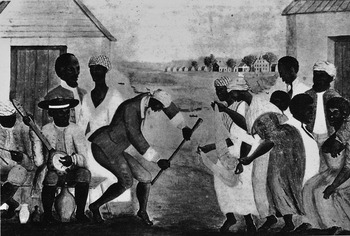
Little is known about, and very little work has been done on, the African element within North American slave dance. Lamentably few eye-witness descriptions have survived and even fewer authenticated paintings and drawings. Even when white observers did go into details of what they witnessed, the descriptions frequently reveal little about the social spectacle itself and a lot about the viewers' prejudices. For example, a description of slaves dancing in Pinkster in Albany in 1803 typically talks of the “lewd and indecent” gestures of the African American dance, climaxing in embraces “which must cover even a harlot with blushes to describe,” and talks of “twisting, wriggling hysterical slaves who, for the time, were thousands of miles away in the heart of superstitious Africa.”Footnote 32 I will, however, take one celebrated representation of American slave dancing, and think about what it can tell us of the calunga's function. Without a doubt both the most detailed, and yet the most enigmatic, image created within the slave systems of North America to describe slave dance is the compelling anonymous watercolour entitled The Old Plantation (Figure 5).Footnote 33
The Old Plantation, anon., c.1800, oil on board.

This mesmerizing painting, because of its remarkably detailed descriptions of instruments, costume and dance steps, and because of its aesthetic beauty, has generated a great number of conflicting commentaries and debates concerning exactly what sort of dance is being performed, and which part of Africa, if any, its inspiration comes from. The most exciting recent development in debates around this painting is the work of Babatunde Lawal, who has tried to work out the extent to which its major elements can be isolated as coming out of the Oyo kingdom of the Yoruba.Footnote 34 Lawal argues that the only element of the painting which emerges as incontrovertibly Yoruban is the manner in which the two women dance. They both hold strips of cloth, which they lean towards and dance “to.”Footnote 35
This is not just any piece of cloth that is being danced, but the “baby sash,” or oja, the long strip of cloth with which the mother attaches her baby to her lower back in order for the little creature to be carried. Symbolic of both motherhood and protection, the cloth has fetishistic power and is used apparently in a variety of dances where it is a gateway through which to appeal to the orixas for help, particularly in order to make a young woman fertile.Footnote 36 And it is relevant here that the oja under its Yoruban name remains an important element within candomblé ceremonies in Brazil, where it is used to initiate discussions with the orixas, and, in elaborate forms adorned with beads and shells, is frequently present on the peji or altar.Footnote 37 What Lawal establishes is that this tradition of African women dancing with inanimate objects as a way into communication with their gods successfully crossed into North America in the late eighteenth century, although this form of dancing appears to have died out relatively quickly thereafter.
The women's dances with their calungas in Brazil would seem to be the survival of a related dance form. These dolls are, of course, at one level powerful fertility symbols; Iemanjá, goddess of the oceans, is also the goddess of fertility, reproduction, plenitude. She is also as a universal mother the figure who looks after the spirits of the drowned, and consequently the deity who protects the slaves drowned on the Middle Passage and who will protect their memory and take them home to Africa. As we have seen, she is also an embodiment of the Congolese concept of kalunga as a threshold for passing between life and death, and in this role the doll is also a way of getting in touch with the spirits of these drowned ancestors.Footnote 38 The manifestation of Iemanjá through the calunga, and her communication with the people through her relationship with the dancers, speak to all aspects of this memory. It is an open and beautiful ritual for bringing the memory of the lost slaves together.
It should be evident by now that the Euro-American museologist or ethnologist sees not the same calunga that a wise Babalorixa sees. The calunga may look like a little black doll, dressed up in a tacky nylon ball gown, and held on a stick, but put her in the bigger syncretic picture and she emerges as a terrific spiritual conglomerate. The transformational, unstable calunga is something completely embedded in the African memory of slavery. She is a triumphant but shifting spiritual soul mate for real flesh-and-blood, ex-slave, Afro-Brazilian females, of any age. This little thing is too difficult, too deep, too much, too hot (and finally, on the Night of the Silent Drums, too sad) for white male anthropologists, and indeed for any male of any type or colour, to handle. Small wonder that Professor Argolo must drown his terror of her power in the violent camouflage of a rabid sexist and racist paranoia.