Systemic ventricular end-diastolic pressure is an important haemodynamic variable in all patients with single ventricle CHD who have undergone the Fontan operation. In these patients, single ventricle end-diastolic pressure influences the pulmonary artery pressure and elevated single ventricle end-diastolic pressure and pulmonary artery pressures have been associated with poor outcomes in adults with Fontan circulation. Reference Miranda, Hagler, Taggart, Borlaug, Connolly and Egbe1,Reference Miranda, Borlaug, Hagler, Connolly and Egbe2 Despite its physiologic importance in adults with a Fontan circulation, patient variables that are associated with an elevated single ventricle end-diastolic pressure have been poorly identified in this patient population. We retrospectively examined a cohort of adults with Fontan circulation who underwent cardiac catheterisation to try to identify patient factors that were associated with single ventricle end-diastolic pressure.
Materials and methods
The retrospective study was approved by the Institutional Review Board at Atrium Health Carolinas Medical Center. All patients older than 18 years of age with a Fontan circulation who had undergone cardiac catheterisation at our centre between January 2008 and March 2019 were identified. Patients were included regardless of the reason for the catheterisation. If a patient underwent multiple catheterisations during the time period, only the most recent catheterisation was evaluated. The patient charts were reviewed and relevant demographic, anatomic, surgical, and clinical variables were extracted. The records around the time of catheterisation were reviewed to determine if the patient endorsed any symptoms of heart failure including shortness of breath with activity, oedema, or orthopnea. Also, the most recent echocardiogram prior to the catheterisation was reviewed and variables were extracted from the study’s report, including ventricular systolic function (normal vs. abnormal), atrioventricular valve regurgitation (moderate/severe vs. none/mild), and semilunar valve regurgitation (moderate/severe vs. none/mild). The catheterisation report was also reviewed and relevant catheterisation-based variables were extracted, including single ventricle end-diastolic pressure.
QQ plots and the Shapiro–Wilk test were used to determine whether variables were normally distributed. Most of the continuous variables did not appear normally distributed and, thus, we reported median (interquartile range) for all continuous variables. General linear models with single ventricle end-diastolic pressure as the response variable and a single predictor variable were used to identify unadjusted associations between patient variables and single ventricle end-diastolic pressure. A multivariable general linear model was then performed with single ventricle end-diastolic pressure as the response variable and predictor variables selected from among those having a p-value < 0.05 on univariate analysis. The number of predictor variables included was limited to four, adhering to the rule of thumb requiring 10 observations per covariate estimated in a general linear model. Reference Harrell3 Collinearity in the multivariable model was assessed by variance inflation factors and an eigenvalue analysis of the model factors. Collinearity was suspected if variance inflation factor >10 and/or an eigenvalue was very small in the presence of a large condition index. Assumptions of the multivariable general linear model were assessed by inspecting residual plots, including plots of residuals and studentised residuals against predicted values, a normal probability plot of residuals, and plots of residuals against predictors. For any continuous predictors in the final model, a scatterplot between single ventricle end-diastolic pressure and the predictor was generated. A p-value < 0.05 was considered statistically significant. No adjustments were made for multiple testing. All analyses were conducted using SAS Enterprise Guide 7.1 (SAS Institute Inc., Cary, NC).
Results
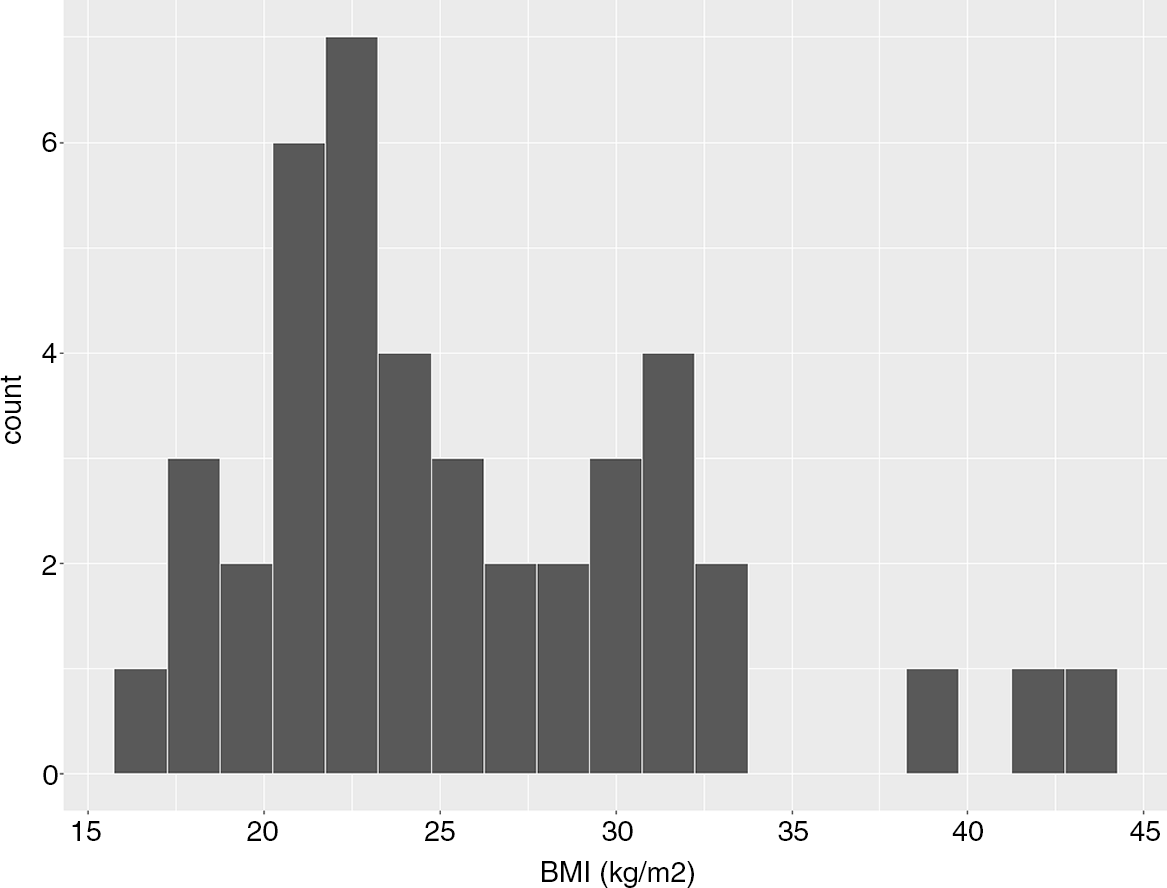
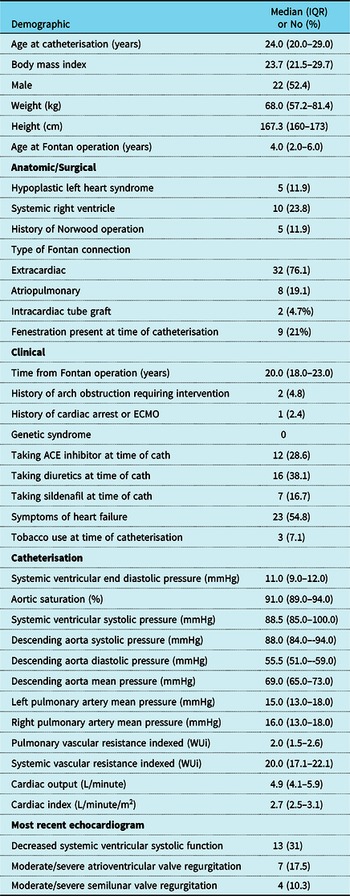
The baseline characteristics of our patients at the time of cardiac catheterisation are shown in Table 1. Forty-two patients were included, with a median weight of 68.0 kg (57.2–81.4), age of 24.0 years (20.0–29.0), and body mass index of 23.7 kg/m2 (21.5–29.7)at the time of catheterisation. The distribution of body mass index is graphically shown in Figure 1. Twenty-two (52.4%) were male, and 5 (11.9%) had a history of smoking. The most common form of CHD was double inlet left ventricle (18 pts, 43%), and 13 patients (31%) had tricuspid atresia/stenosis. Ten (23.8%) patients had a systemic right ventricle, and five (11.9%) had undergone a Norwood operation. The majority of patients (32 pts, 76%) had an extracardiac Fontan, and 9 (21%) had a patent fenestration at the time of catheterisation. The median of single ventricle end-diastolic pressure and of mean pulmonary artery pressure were 11.0 mmHg (9.0–12.0) and 16.0 mmHg (13.0–18.0), respectively.
Histogram showing the distribution of body mass index among the 42 included patients.

Baseline characteristics in 42 patients with Fontan circulation undergoing cardiac catheterisation

On review of the records, 23 (54.7%) patents endorsed symptoms of heart failure. Twenty-seven (64%) patients underwent catheterisation to evaluate new symptoms of any type, most commonly shortness of breath with exertion or oedema. Eight (9%) patients underwent catheterisation to evaluate decreased saturations in the absence of other symptoms, and 7 (16.6%) patients underwent catheterisation for routine surveillance. Nearly all of the patients were outpatients; 39 (93%) patients were outpatients at the time of catheterisation. The 3 (7%) inpatients were all in non-ICU settings, and none were on inotropes. Of these 3, 1 was admitted with neurologic symptoms, 1 admitted with atrial arrythmias, and another with oedema.
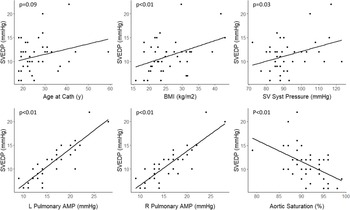
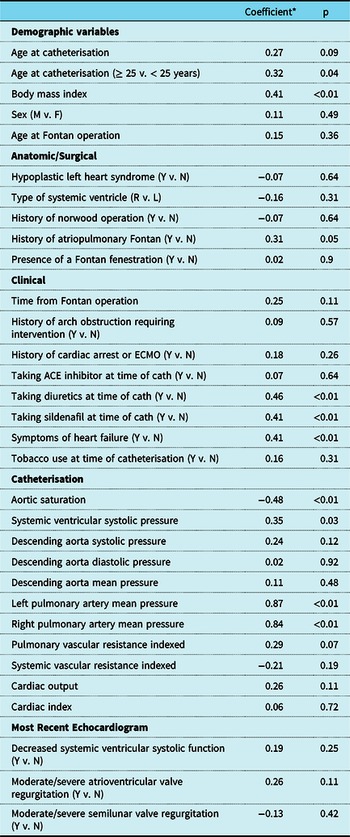
Table 2 summarises the results of univariate analysis. Age at catheterisation (p = 0.04), elevated body mass index (p < 0.01), symptoms of heart failure/circulatory failure (p < 0.01), taking diuretics at time of catheterisation (p < 0.01), taking sildenafil at time of catheterisation (p < 0.01), systemic ventricular systolic pressure (p = 0.03), and elevated pulmonary artery pressures (p < 0.01) were all positively associated with single ventricle end-diastolic pressure. Aortic saturation (p < 0.01) was negatively associated with single ventricle end-diastolic pressure. These associations are graphically illustrated in Figure 2. We did not find any statistically significant association between single ventricle end-diastolic pressure and type of systemic ventricle.
Scatterplots showing the association between systemic ventricular end-diastolic pressure and multiple variables on univariate analysis. (BMI = body mass index; L Pulmonary AMP = left pulmonary artery mean pressure; R Pulmonary AMP = right pulmonary artery mean pressure; SV = systemic ventricle; SVEDP = systemic ventricular end-diastolic pressure).

Results of univariate analysis of the association between patient variables and systemic ventricular end-diastolic pressure

* Standardised beta coefficients in simple generalised linear models with systemic ventricular end-diastolic pressure as dependent variable.
Results of the multivariable general linear model of single ventricle end-diastolic pressure are shown in Table 3. The predictor variables that were included in the final model were age ≥ 25 at catheterisation, body mass index, and presence of symptoms of heart failure/circulatory failure. Attempts were made to include a fourth variable, but the use of diuretics, the use of sildenafil, ventricular systolic pressure, and aortic saturation each showed evidence of multicollinearity based on eigenvalue analysis and, thus, were excluded. We chose the three included variables because the association between these three variables and single ventricle end-diastolic pressure was clinically and physiologically very plausible. We also felt that associations between these three variables and single ventricle end-diastolic pressure would have valuable prognostic (presence of symptoms of heart failure, age ≥ 25 years) and even therapeutic (body mass index) implications. For example, the use of diuretics was colinear with the presence of heart failure symptoms; however, we included the presence of heart failure symptoms and not diuretic use because we felt it most plausible that an elevated single ventricle end-diastolic pressure would lead to symptoms of heart failure that would then be treated with diuretic use. Single ventricle end-diastolic pressure was felt to contribute to mean pulmonary artery pressure and thus, mean right and left pulmonary artery pressure was not selected for the model. Multicollinearity was not detected in the final model by inspection of the variance inflation factors and analysis of eigenvalues. Residual plots for the final model did not show any clear violations of the assumptions of normality, equal variance, or independence. Inspection of plots also did not reveal any obvious deviation from linearity. The omnibus test for significance of the final model was statistically significant (p < 0.01), and R2 was 0.36. Single ventricle end-diastolic pressure was positively associated with age ≥ 25 at catheterisation (p < 0.01) and body mass index (p = 0.04). A positive association also existed with the presence of symptoms of heart failure/circulatory failure (p = 0.05), nearly reaching statistical significance.
Results of multivariate analysis of the association between patient variables and systemic ventricular end-diastolic pressure

Discussion
In a cohort of adult patients with a Fontan circulation who underwent cardiac catheterisation, we examined possible associations between single ventricle end-diastolic pressure and patient variables. In our cohort, single ventricle end-diastolic pressure was positively associated with age > 25 years, body mass index, and the presence of heart failure symptoms on multivariate analysis. In those with a Fontan circulation, single ventricle end-diastolic pressure is important because elevations in end-diastolic pressure are poorly tolerated. As ventricular diastolic pressure rises, the pulmonary venous atrial pressure rises and the passive, forward flow through the lungs diminishes and cardiac output suffers. Reference Budts, Ravekes, Danford and Kutty4
Our group was a typical cohort of adult patients with Fontan circulation, and the catheterisation-based data measured in our cohort were similar to previous reports. Reference Miranda, Hagler, Taggart, Borlaug, Connolly and Egbe1,Reference Mori, Hebson and Shioda5 Our cohort had a median (interquartile range) single ventricle end-diastolic pressure of 11.0 mmHg (9.0–12.0), mean PA pressure of 16.0 mmHg (13.0–18.0), mean indexed pulmonary vascular resistance of 2.0 indexed Woods Units (1.5–2.6), and cardiac index of 2.7 L/minute/m2 (2.5–3.1). In a description of haemodynamic data in 148 adult patients with Fontan circulation from the Mayo Clinic, the mean single ventricle end-diastolic pressure was 11.5 ± 4.7 mmHg, mean Fontan pressure was 16.1 ± 4.5 mmHg, mean indexed pulmonary vascular resistance 2.0 ± 1.1 indexed Woods Units, and mean cardiac index 2.8 ± 0.8 L/min/m2. Reference Miranda, Hagler, Taggart, Borlaug, Connolly and Egbe1
In our cohort, having an age > 25 years was positively associated with single ventricle end-diastolic pressure. When age was treated as a continuous variable, there was a positive relationship that nearly reached statistical significance (p = 0.09). In other words, older adults were more likely to have an elevated single ventricle end-diastolic pressure. In adults with a structurally normal heart, left ventricular diastolic function typically worsens with age. In healthy subjects, left ventricular tissue Doppler indices progressively change with increasing age, suggesting that left ventricular diastolic function worsens over time. Reference Innelli, Sanchez, Marra, Esposito and Galderisi6 In patients with single ventricle CHD, the systemic ventricle changes from a volume-loaded and dilated state to a chronically underfilled and preload-deprived state after the Fontan operation. The chronic lack of preload is associated with arterial vasoconstriction and increased afterload. The low preload/high afterload state can lead to maladaptive remodelling of the ventricle. Further, the elevated diastolic pressure can further deter passive pulmonary blood flow and further diminish ventricular preload. Reference Budts, Ravekes, Danford and Kutty4 Thus, there are factors unique to Fontan physiology that may contribute to worsening of the single ventricle end-diastolic pressure over time.
In our cohort, time from Fontan operation was positively associated with single ventricle end-diastolic pressure, but did not reach statistical significance (p = 0.11). It is possible that the size of our cohort limited the statistical power to detect a significant association between this variable and single ventricle end-diastolic pressure. But, because single ventricle end-diastolic pressure increases with age in those with a two-ventricle circulation as well, it is also possible that the association between single ventricle end-diastolic pressure and age is less dependent on Fontan physiology and more dependent on changes in diastolic function with age. Regardless, the increase in single ventricle end-diastolic pressure with age in adults with Fontan circulation is especially important because single ventricle end-diastolic pressure is a critical determinant of Fontan pathway and central venous pressure. Because the pulmonary venous atrial pressure is transmitted in series directly back to the pulmonary arteries and central veins, the central venous pressure will never be lower than the single ventricle end-diastolic pressure in a patient with Fontan physiology. If single ventricle end-diastolic pressure increases with age, then the central venous pressure will gradually increase over time in patients with Fontan physiology even if the transpulmonary gradient and pulmonary vascular resistance remain constant. Investigation into therapeutic approaches to lower single ventricle end-diastolic pressure in adults with Fontan physiology could be beneficial.
Among our patients, body mass index was also associated with single ventricle end-diastolic pressure. In those with a two-ventricle circulation, increased body mass index and obesity are associated with ventricular diastolic dysfunction. Reference Wang, Liang and Gopal7 It is not surprising that we have shown that this relationship also exists in those with Fontan circulation. In a study of teens and young adults with Fontan circulation, late complications after the Fontan operation were associated with a higher body fat percentage. Reference Powell, Wittekind and Alsaied8 The association between body mass index and single ventricle end-diastolic pressure is particularly important because body mass index is a modifiable variable and weight optimisation is an important therapeutic goal in those with Fontan circulation. Habitual activity has been associated with lower body mass index in children and adolescents with CHD, and there is evidence to suggest that establishing good exercise habits in paediatric patients with Fontan circulation may result in improved Fontan physiology as an adult. Reference OʼByrne, McBride, Paridon and Goldmuntz9,Reference Ohuchi, Negishi and Miike10 Unfortunately, data also exist showing that obesity significantly worsens during the first 5 years after Fontan operation. Reference Wellnitz, Harris, Sapru, Fineman and Radman11
However, it is critical to acknowledge that body mass index is an imperfect surrogate marker of obesity. The calculation of body mass index involves the variables of weight and height. A patient with significant heart failure may have an elevated weight and, thus, body mass index due to fluid retention rather than fat mass/obesity. We found an association between body mass index and single ventricle end-diastolic pressure, but this does not absolutely indicate that an association between fat mass/obesity and single ventricle end-diastolic pressure was present. Ideally, future studies would evaluate the association between single ventricle end-diastolic pressure and obesity using other modalities that are more accurate in measuring fat mass (ex. bioimpedance spectroscopy) instead of body mass index. Our study was retrospective, and, thus, we used body mass index as a surrogate for obesity. Also, body mass index has been used as a surrogate for obesity in other studies of patients with Fontan circulation. Reference Wellnitz, Harris, Sapru, Fineman and Radman11
We also found that those with an elevated single ventricle end-diastolic pressure were more likely to report symptoms of heart failure, an association that nearly reached statistical significance in the multivariate model (p = 0.05). Diastolic dysfunction is an important cause of heart failure in those with Fontan circulation. Reference Budts, Ravekes, Danford and Kutty4 As previously mentioned, elevated single ventricle end-diastolic pressure and atrial pressures leads to improved pulmonary blood flow and decreased cardiac output. Reference Budts, Ravekes, Danford and Kutty4,Reference Gewillig and Brown12
Single ventricle end-diastolic pressure was not associated with ventricular morphology. In prior work, we have shown that patients with systemic right ventricle have a higher single ventricle end-diastolic pressure before the bidirectional Glenn operation and before the Fontan operation compared to those with LV. Reference Schwartz, Karunanandaa and Anderson13,Reference Schwartz, Brock, Nykanen and DeCampli14 We hypothesise that chronic preload deprivation in the Fontan circulation drives diastolic dysfunction regardless of ventricular morphology.
Univariate analysis showed several other associations that could not be fully explored with multivariate analysis. Diuretic use and sildenafil use were positively associated with single ventricle end-diastolic pressure, but had evidence of collinearity with other variables and, thus, were not included in our multivariate analysis. Likewise, aortic saturation showed a negative association with single ventricle end-diastolic pressure, but also was collinear with other variables and could not be further explored with multivariate analysis. It is possible that adults with chronic cyanosis may develop ventricular injury that results in diastolic dysfunction and an elevated single ventricle end-diastolic pressure. As expected, pulmonary artery pressure was associated with single ventricle end-diastolic pressure, highlighting the important contribution of single ventricle end-diastolic pressure in determining pulmonary artery and central venous pressure in those with Fontan circulation.
Finally, identification of variables that are associated with single ventricle end-diastolic pressure in adults with Fontan circulation is important because ventricular filling pressures are associated with survival in this patient population. Reference Miranda, Hagler, Taggart, Borlaug, Connolly and Egbe1 In a prior evaluation of 148 adults with Fontan circulation, survival was worse in patients with an elevated single ventricle end-diastolic pressure and also worse in those with an elevated pulmonary capillary wedge pressure. On multivariate analysis, pulmonary capillary wedge pressure was associated with mortality, while single ventricle end-diastolic pressure was not. The wedge pressure is a surrogate for left atrial pressure and appears to better correlate with Fontan pressure compared to single ventricle end-diastolic pressure. Reference Miranda, Hagler, Taggart, Borlaug, Connolly and Egbe1 However, both wedge pressure and single ventricle end-diastolic pressure are measures of ventricular diastolic function, are intimately related, and are of critical importance in adults with Fontan circulation.
Limitations
We recognise several limitations to our study. First, our study was a retrospective review, and, thus, associations between variables and single ventricle end-diastolic pressure do not demonstrate causality. Also, the R2 for the final model was only 0.36, suggesting that additional variability in single ventricle end-diastolic pressure is explained by other factors. However, our sample size limited the number of variables included in the multivariable model and our database may not have captured all relevant variables. In addition, the catheterisations were performed by various interventional cardiologists and catheterisation techniques may be slightly different. Furthermore, while the pre-catheterisation and pre-anesthesia instructions have been consistent over the study time period, patient adherence to these recommendations may affect volume status at the time of catheterisation. Additionally, we found associations between patient variables and single ventricle end-diastolic pressure but did not investigate the prognostic significance of single ventricle end-diastolic pressure. Given these limitations, further research is needed.
Conclusions
In our cohort of adult patients with Fontan circulation undergoing cardiac catheterisation, single ventricle end-diastolic pressure was positively associated with age > 25 years, body mass index, and the presence of heart failure symptoms on multivariate analysis. Adults with Fontan physiology are at risk for diastolic dysfunction and maintaining a healthy body mass indexmay offer haemodynamic benefit and protect against symptoms of heart failure.
Acknowledgements
None.
Financial support
This research received no specific grant funding from any funding agency, commercial or not-for-profit sectors.
Conflicts of interest
None.